



Study Abroad Expert | Updated On - Sep 28, 2026
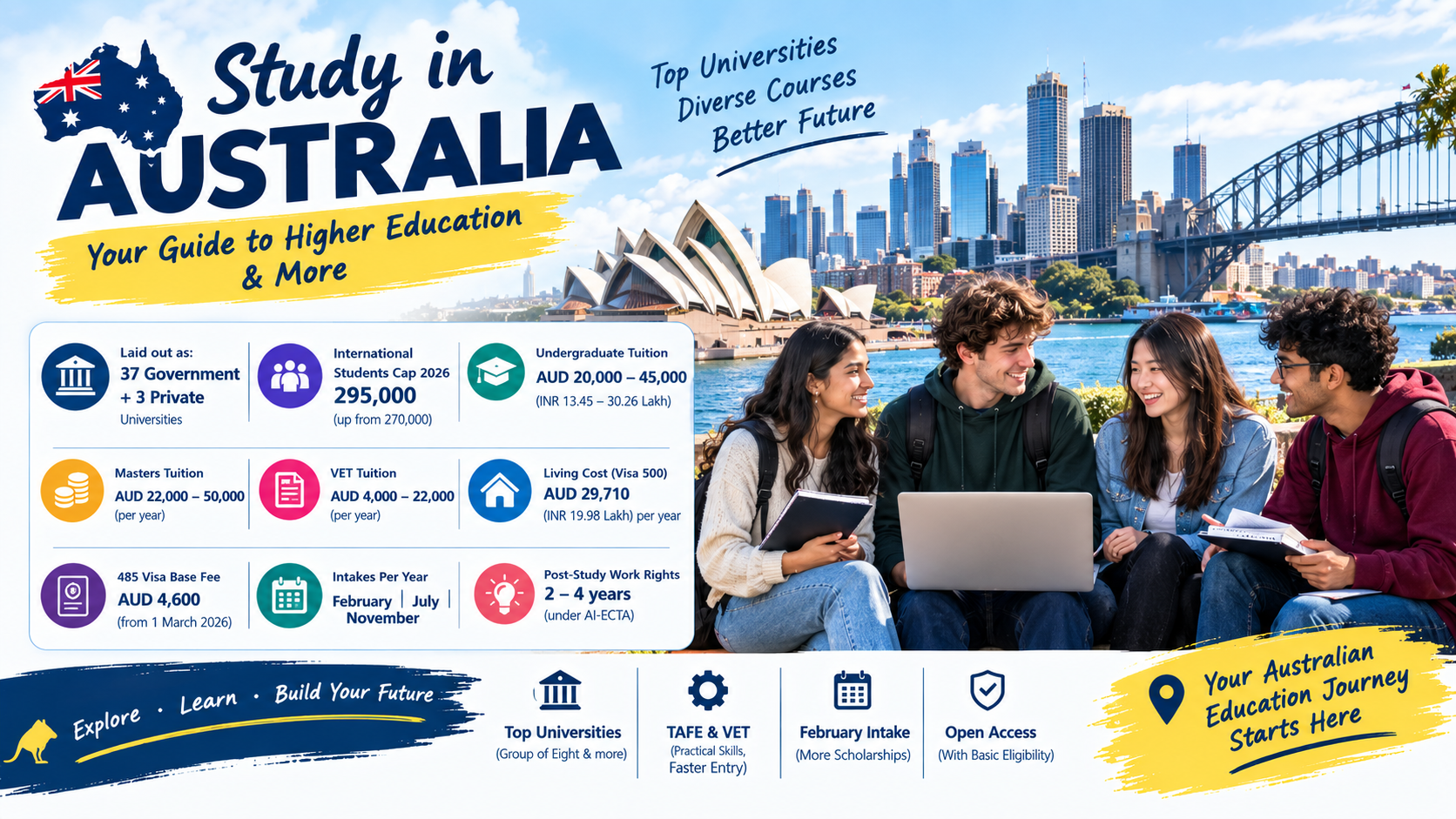
Higher education in Australia covers 37 government universities, 3 private universities and hundreds of TAFE and VET providers. Courses run from six-month certificates to four-year PhDs under the Australian Qualifications Framework (AQF). Indian students can also stay back for 2 to 4 years on the 485 work visa.
- Group of Eight universities carry global recognition but expect strong grades and higher fees.
- TAFE and VET routes suit students who want faster job entry over research prestige.
- February intake brings wider scholarships and course choice than July or November.
- Evidence Level 3 status means Indian applicants must plan finances at least six months ahead.
Check the full list of Group of Eight universities and their entry cutoffs
Indian enrolments in Australia crossed 126,000 in 2023, making India the second-largest source of international students. Melbourne alone hosted over 56,000 Indian students that year. Course choice, city and visa timing decide your fees, work rights and PR path in Australia.
Quick Facts on Higher Education in Australia
| Parameter | Detail |
|---|---|
| Number of universities | 37 government-funded and 3 private universities |
| International student cap 2026 | 295,000 places (raised from 270,000) |
| Undergraduate tuition per year | AUD 20,000 to AUD 45,000 (INR 13.45 lakh to INR 30.26 lakh) |
| Masters tuition per year | AUD 22,000 to AUD 50,000 |
| VET tuition per year | AUD 4,000 to AUD 22,000 |
| Visa 500 living-cost benchmark | AUD 29,710 (INR 19.98 lakh) per year |
| 485 visa base fee (from 1 March 2026) | AUD 4,600 |
| Post-study work rights for Indians | 2 to 4 years under AI-ECTA |
| English requirement | IELTS 6.0 to 6.5 for universities, 5.5 to 6.0 for VET |
| Intakes per year | February, July and November |
Conversions based on an AUD-INR rate of INR 67.25 as of September 28, 2026. Rates fluctuate; check the current rate before financial planning.
- Australian Higher Education System Explained
- Top Universities for Higher Education in Australia
- VET Courses and TAFE Pathways Explained
- Admission Requirements for Australian Universities
- Application Process and Intake Deadlines
- Fees for Higher Education in Australia
- Scholarships for Indian Students in Australia
- Student Visa and Post-Study Work Rights
Australian Higher Education System Explained
The Australian higher education system runs on 10 AQF levels, from Certificate I to Doctoral degrees. The Australian Qualifications Framework (AQF) is the national system that recognises every course you can take in Australia. It covers both university degrees and skills-based training. Levels 1 to 4 are certificates offered mainly through TAFE. Level 5 is a Diploma and Level 6 is an Advanced Diploma.
Levels 7 to 10 sit inside universities. Level 7 is a Bachelor degree. Level 8 covers Graduate Certificates, Graduate Diplomas and Bachelor Honours. Level 9 is a Masters. Level 10 is a Doctoral degree or PhD.
The Tertiary Education Quality and Standards Agency (TEQSA) regulates all higher education providers. Every course open to international students must sit on the CRICOS register (the official list of approved courses). Universities in Australia that are not CRICOS-listed cannot enrol you on a student visa.
- 37 government universities run public higher education across every state.
- 3 private universities add niche options for business and health courses.
- Six universities sit inside the QS World Rankings top 100 in 2026.
- Hundreds of TAFE and RTO providers deliver AQF Levels 1 to 6.
Read More: AQF levels, VET pathways and TAFE benefits for international students
Top Universities for Higher Education in Australia
The Group of Eight (Go8) covers Australia’s leading research universities, and all eight sit inside the QS World Rankings top 100 for 2026.
Indian students most often target the Go8 for a globally recognised degree and stronger visa credibility. Fees are higher and cutoffs are stricter, but the return on brand is real when you apply for jobs back home or in North America.
| University | City | QS World Rank 2026 |
|---|---|---|
| University of Melbourne | Melbourne | 19 |
| UNSW Sydney | Sydney | 20 |
| University of Sydney | Sydney | 25 |
| Australian National University (ANU) | Canberra | 32 |
| Monash University | Melbourne | 37 |
| University of Queensland | Brisbane | 40 |
| University of Adelaide | Adelaide | Top 100 |
| University of Western Australia | Perth | Top 100 |
Source: QS World University Rankings 2026. Outside the Go8, strong applied-course universities include RMIT, UTS, Macquarie, Deakin, La Trobe and Curtin. These often price 15 to 30% lower than Go8 fees.
MBA rankings inside Australia sit differently. Melbourne Business School, UNSW AGSM and the University of Sydney Business School lead the country on the FT Global MBA and QS MBA lists.
Key Insight: A Go8 degree does not always mean the best fit. Applied fields like IT, hospitality and design often deliver stronger placement outcomes at RMIT or UTS.
If your target is Sydney, the campus mix runs from research-heavy (Sydney, UNSW) to industry-linked (UTS, Macquarie). Fees at the University of Sydney sit at the higher end but come with the deepest scholarship pool for Indian PG applicants.
VET Courses and TAFE Pathways Explained
Vocational Education and Training (VET) is skills-focused study delivered mainly through TAFE institutes and CRICOS-approved private providers. Courses run from six months to two-and-a-half years.
VET makes sense if you want faster job entry, lower fees or a stepping stone into a Bachelor degree. Programs are industry-designed and heavy on workplace learning. Over 5 million students enrolled in nationally recognised VET courses in Australia in 2023.
Common high-demand fields include nursing, IT support, construction, hospitality, early childhood education, plumbing and diesel mechanics. Class sizes stay small and most courses include placements.
| Qualification | Duration | Annual Tuition |
|---|---|---|
| Certificate I to IV | 6 months to 1 year | AUD 4,000 to AUD 15,000 |
| Diploma | 1 to 2 years | AUD 10,000 to AUD 22,000 |
| Advanced Diploma | Up to 2.5 years | AUD 12,000 to AUD 22,000 |
Source: Study Australia and TAFE state websites. The average vocational-industry salary sits at around AUD 69,000 per year (roughly INR 46.4 lakh at today’s rate).
- Faster job entry: A Diploma finishes in about a year and lets you sit for the 485 visa on eligible occupations.
- Lower entry bar: IELTS 5.5 to 6.0 is enough for most VET courses.
- Credit into degrees: A Diploma can shave one year off a related Bachelor course.
Note:
- What VET gives you: a practical qualification, work placements and a shorter route to earning in Australia.
- What VET does not cover: research-linked careers, professional registration in medicine or law, or Go8-tier academic branding.
Admission Requirements for Australian Universities
You need academic transcripts, an English test score, a Statement of Purpose (SOP) and financial proof to secure higher education in Australia.Requirements shift by course level, but the base checklist stays the same.
Undergraduate admission usually asks for Class 12 marks between 65% and 85%. Top Go8 universities look at 85% and above for competitive courses like engineering, computer science or commerce. Some also accept a foundation year for students with lower marks.
Masters admission asks for a recognised Bachelor degree with 60% to 75%. Business schools may also ask for one to three years of work experience. GMAT or GRE is optional at most universities but strengthens scholarship chances.
English proficiency is non-negotiable. Universities accept several tests, and PTE Academic is widely accepted for admission and the 485 visa.
| Test | University Minimum | Common Score for Go8 |
|---|---|---|
| IELTS Academic | 6.0 overall (no band under 5.5) | 6.5 overall (no band under 6.0) |
| PTE Academic | 50 overall | 58 to 65 |
| TOEFL iBT | 60 to 70 | 79 to 94 |
| Duolingo | 105 to 115 | 115 to 125 |
Source: individual university admission pages. Some universities waive the test if your Bachelor was fully taught in English and you can produce a Medium of Instruction (MOI) letter.
- Academic transcripts: Class 10, 12 and Bachelor mark sheets.
- SOP: 800 to 1,200 words, honest about goals and gaps.
- Letters of recommendation: two from professors or managers.
- Financial proof: bank statements or loan sanction letters (see the visa section).
Key Insight: If your Class 12 marks are below the cutoff, a Diploma at a partner TAFE with a guaranteed pathway to a Bachelor is often stronger than a foundation year.
Read More: Master of Engineering in Australia with placements and salary data
Application Process and Intake Deadlines
Australian universities run three intakes each year: February, July and November. February is the main one, July is the second-largest and November is smaller.
Indian students most often pick July because Class 12 and Bachelor results are declared between April and July. If you time it right, you can apply in June or early July for a July start the same year. February needs you to start applying eight to twelve months ahead.
| Intake | Application Window | Best For |
|---|---|---|
| February | August to November (previous year) | Widest course choice, more scholarships |
| July | Late February to late May | Fits Indian graduation results |
| November | June to September | Short courses and select intakes |
Source: Australian university intake calendars. Rolling admissions are common, so early applications get first pick on scholarships and hostels.
If you plan to start in July 2027, then submit your application by March 2027. That means IELTS should be done by February.
- Shortlist courses: Match your Class 12 or Bachelor marks to the university cutoff.
- Take English tests: IELTS, PTE or TOEFL, results valid for two years.
- Apply online: Direct on the university portal or via a common form.
- Get an offer letter: Conditional offers arrive in two to six weeks.
- Pay deposit: Usually one semester of tuition, to get the CoE.
- Buy OSHC: Overseas Student Health Cover is mandatory.
- Apply for the 500 visa: On ImmiAccount, with GS answers and financial proof.
Read More: Australian university deadlines and intake-wise cutoff dates
Fees for Higher Education in Australia
Total yearly cost of higher education in Australia for Indian students ranges from INR 25 lakh to INR 45 lakh. That covers tuition, living costs, visa and OSHC.
Tuition is the biggest slice. Course choice matters more than city. Medicine and dentistry sit at the top. Humanities and education sit at the bottom.
| Course Type | Annual Tuition (AUD) | Approximate INR |
|---|---|---|
| Bachelor degree | AUD 20,000 to 45,000 | INR 13.45 lakh to 30.26 lakh |
| Masters (coursework) | AUD 22,000 to 50,000 | INR 14.80 lakh to 33.63 lakh |
| MBA | AUD 35,000 to 106,650 | INR 23.54 lakh to 71.72 lakh |
| PhD (research) | AUD 28,000 to 65,000 | INR 18.83 lakh to 43.71 lakh |
| VET Diploma | AUD 10,000 to 22,000 | INR 6.72 lakh to 14.80 lakh |
Source: Study Australia and university fee schedules for 2026. Add a 5 to 8% currency buffer if the rupee weakens during your course.
Living Costs by City
Sydney and Melbourne are the most expensive. Brisbane and Adelaide sit about 20 to 25% cheaper. Perth and Canberra are moderate. Rent is the largest monthly cost, followed by food and transport.
- Sydney: AUD 1,610 to 2,265 a month (roughly INR 1.08 lakh to 1.52 lakh).
- Melbourne: AUD 1,500 to 2,100 a month.
- Brisbane and Adelaide: AUD 1,330 to 1,800 a month.
Student accommodation options in Australia range from on-campus rooms to shared apartments and homestays. Homestay is the cheapest for first-timers.
Key Insight: Indian banks like HDFC Credila, Avanse, SBI Global Ed-Vantage and PNB Udaan give secured and unsecured loans up to INR 1 crore. A loan sanction letter is also strong proof for the Evidence Level 3 visa check.
Check the top MBA universities in Australia with fee and salary benchmarks
Scholarships for Indian Students in Australia
Indian students can apply for university merit awards, state-funded regional scholarships and industry-linked grants worth AUD 5,000 to full-tuition waivers.
The two big federal names get confused a lot. The Australia Awards Scholarship is a DFAT program, but India is not on the participating country list. Indian applicants cannot apply. The Endeavour Postgraduate Scholarship covers full tuition, living costs and travel and is open to Indian students.
| Scholarship | Amount | Who Can Apply |
|---|---|---|
| Endeavour Postgraduate | Up to AUD 272,500 total | PG and research students |
| Destination Australia Program | AUD 15,000 per year | Regional-campus study (currently closed to new applicants) |
| Maitri Scholars Program | AUD 35,000 per year | Indian STEM PG students |
| University of Melbourne Graduate Scholarship | Fee remission plus stipend | Merit-based, research and coursework |
| UNSW India Global Award | AUD 5,000 to 20,000 | Indian UG and PG applicants |
| Monash International Merit | AUD 10,000 per year | UG and PG merit awards |
Source: individual university scholarship pages and Study Australia. Every Go8 university runs its own India-specific award, so check the target university directly.
The full scholarships list for study in Australia is worth a scan before you lock a shortlist. Apply for at least three awards. Deadlines usually fall two to four months before the intake starts.
Student Visa and Post-Study Work Rights
The Subclass 500 student visa is the only route for full-time higher education in Australia. After graduation, the Subclass 485 Temporary Graduate visa gives 2 to 4 years of open work rights for Indian passport holders.
India moved to Evidence Level 3 on 8 January 2026. That is the highest scrutiny level. Every applicant now needs strong, traceable financial history. A single lump-sum deposit weeks before the application looks weak. A six-month bank record or a proper loan sanction looks strong.
Subclass 500 Student Visa Requirements
- Confirmation of Enrolment (CoE): Issued after you pay the deposit.
- Genuine Student (GS) answers: Four questions inside ImmiAccount, each about 150 words. GS replaced the older GTE test in March 2024.
- Financial capacity: AUD 29,710 living cost, plus one year of tuition, plus return airfare. Funds held for at least three months.
- English proficiency: IELTS 6.0 or equivalent for universities, 5.5 for VET.
- OSHC: Mandatory for the full course length.
- Health and character checks: Medicals and police clearance.
Subclass 485 Post-Study Work Visa
The 485 visa has two streams. Post-Vocational Education Work is for VET graduates. Post-Higher Education Work is for university graduates.
- Base fee: AUD 4,600 from 1 March 2026.
- Age limit: 35 years, with an exception up to 50 for Masters by Research and PhD graduates.
- English: IELTS overall 6.5 with no band under 5.5.
- Application window: Within six months of course completion.
| Qualification | Standard Stay | Indian Stay under AI-ECTA |
|---|---|---|
| Bachelor | 2 years | 2 years (3 years for STEM/ICT first-class honours) |
| Masters (coursework) | 2 years | 3 years |
| Masters (research) | 3 years | 3 years |
| PhD | 3 years | 4 years |
Source: Department of Home Affairs and AI-ECTA schedule. Regional graduates get an extra one to two years on top of these numbers.
Key Insight: The 485 visa is open work. You do not need employer sponsorship. That gives graduates the time to move from a support role into a skilled occupation on the medium or long-term skilled list.
Indian students can work up to 48 hours every two weeks during term and unlimited hours in breaks. The federal minimum wage sits at AUD 24.10 per hour. Part-time work of 15 to 20 hours a week covers most of your food and transport costs.
Also Check:
Higher education in Australia rewards early planning more than any one factor. Course choice sets your fees, city sets your monthly bills and intake choice sets how competitive your file looks. Indian applicants now face tighter Evidence Level 3 visa scrutiny, so financial paperwork and Genuine Student answers must line up cleanly. The pay-off is a globally accepted degree, four years of open work rights on the 485 visa and one of the shortest PR pathways among study-abroad destinations.
FAQs
Ques. What is higher education in Australia?
Ans. Higher education in Australia covers Bachelor, Masters and Doctoral degrees under AQF Levels 7 to 10. It is offered by 37 government universities and 3 private universities. VET courses under AQF Levels 1 to 6 sit outside higher education but often lead into it.
Ques. How much does higher education in Australia cost for Indian students?
Ans. Total yearly cost ranges from INR 25 lakh to INR 45 lakh. Tuition alone is INR 13 lakh to INR 34 lakh for most courses. MBA and medicine cost more. Living costs add AUD 20,000 to 30,000 (roughly INR 13 lakh to 20 lakh) a year on top.
Ques. Which are the best universities for higher education in Australia?
Ans. The Group of Eight leads. University of Melbourne, UNSW Sydney, University of Sydney, ANU, Monash, University of Queensland, University of Adelaide and University of Western Australia all sit inside the QS Top 100 for 2026. RMIT, UTS and Macquarie lead among applied-course universities.
Ques. What is the difference between VET and university degrees in Australia?
Ans. VET is practical skills training delivered by TAFE and RTOs at AQF Levels 1 to 6. University degrees are academic and research-based at AQF Levels 7 to 10. VET is cheaper, shorter and faster to a job. University leads to research careers and higher-tier professional roles.
Ques. Do Indian students need IELTS for higher education in Australia?
Ans. Not always. Universities accept PTE Academic, TOEFL iBT and Duolingo. Some also waive the test with a Medium of Instruction (MOI) letter. For visa purposes though, IELTS or PTE remains the safest option. Most Go8 universities want IELTS 6.5 overall.
Ques. When should Indian students apply for the 2027 intake?
Ans. For a July 2027 start, apply by March 2027. For a February 2027 start, apply by October 2026. Early applications win scholarships and priority visa slots. Take your English test at least two months before you apply.
Ques. Can Indian students work while studying in Australia?
Ans. Yes. Student visa holders can work up to 48 hours every two weeks during term. During official breaks, work is unlimited. The federal minimum wage is AUD 24.10 an hour. Most Indian students earn AUD 400 to 700 a week in part-time work.
Ques. What is the post-study work visa duration for Indian students?
Ans. Under AI-ECTA, Bachelor graduates get 2 years (3 years for STEM or ICT first-class honours). Masters by coursework and research graduates get 3 years. PhD graduates get 4 years. Regional study adds one to two years on top.
Ques. Are Australia Awards Scholarships available for Indian students?
Ans. No. India is not on the DFAT participating country list for Australia Awards. Indian students can apply for Endeavour Postgraduate Scholarships, the Maitri Scholars Program and every university’s own India-specific merit award instead.
Ques. What is Evidence Level 3 for the Australia student visa?
Ans. Evidence Level 3 is the highest scrutiny tier for student visa applicants. India moved to EL3 on 8 January 2026. It means detailed financial documentation is mandatory. Funds must be held for at least three months. A loan sanction is often stronger evidence than a lump-sum deposit.
Ques. Which Australian city is best for Indian students?
Ans. Melbourne and Sydney host the largest Indian student communities. Melbourne is often ranked the world’s best student city for 2026 on QS lists. Brisbane and Adelaide are cheaper by 20 to 25% and unlock regional visa bonuses.
Ques. Is the 485 visa easy to get after graduation?
Ans. It is not automatic but it is straightforward. You need to apply within six months of course completion, be under 35 and hold IELTS 6.5 overall. The base fee from 1 March 2026 is AUD 4,600. No employer sponsorship is needed.


1690970219.JPG?tr=w-305,h-145,c-force?h=175&w=350&mode=stretch)



Comments