



MBBS (Bachelor of Medicine and Bachelor of Surgery) is a 5.5-year undergraduate (UG) medical programme, including a 1-year compulsory internship. The course focuses on human anatomy, physiology, biochemistry, pathology, pharmacology, microbiology, general medicine, surgery, paediatrics and other medical subjects.
- Admission – Admission to MBBS is based on NEET UG scores, followed by counselling conducted by the Medical Counselling Committee (MCC), state counselling authorities or other designated bodies.
- Eligibility Criteria – Students must pass Class 12 with Physics, Chemistry, Biology/Biotechnology and English. General category students require at least 50% in PCB, while SC/ST/OBC candidates require 40%. Applicants must be at least 17 years old by December 31 of the admission year and qualify for NEET UG.
- Course Scope – MBBS graduates can work as doctors in hospitals, clinics, healthcare centres and government health services after obtaining the required registration. They can also pursue higher studies such as MD, MS, DNB and other postgraduate medical programmes.
Course Highlights
| Top Colleges | Total Course Fees | Popular PG Specialisations After MBBS | Average Starting Salary |
|---|---|---|---|
| AIIMS, Maulana Azad Medical College, and Vardhman Mahavir Medical College, New Delhi | INR 1.6 K to INR 1.61 Crore | General Medicine, General Surgery, Paediatrics, Radiodiagnosis, Dermatology, Orthopaedics | Approximately INR 5–9 LPA for junior resident and medical officer roles |
Quick Facts
- Duration: 5.5 years (4.5 years of study + 1-year compulsory rotating internship)
- Eligibility: Class 12 with Physics, Chemistry, Biology/Biotechnology and English; 50% PCB aggregate (40% SC/ST/OBC, 45% PwD-General), minimum 17 years of age by 31 December of the admission year, no upper age limit
- Entrance Exam: NEET UG (NTA), AFMC Pune adds ToELR, PAT and interview after NEET
- Selection: NEET UG All India Rank, MCC counselling (15% AIQ, AIIMS, JIPMER, central, deemed and ESIC seats) or state counselling (85% state quota and private/management seats), document verification, college reporting
- Government Institution Fee Range: INR 1.6 K (AIIMS Madurai) to INR 1.01 Crore (Dharmsinh Desai University, Nadiad)
- Private Institution Fee Range: INR 29.7 K (Regional Institute of Medical Sciences, Imphal) to INR 1.61 Crore (Sri Ramachandra Institute of Higher Education and Research, Chennai)
- Admission Season: NEET UG applications February–March, exam the first Sunday of May, result in June, MCC and state counselling July–October across four rounds (varies by institution)
Top Entrance Exam
| Exam | Top Colleges / Institutes | Selection Process | Application Deadline (tentative) | Exam Date (tentative) |
|---|---|---|---|---|
| NEET UG 2027 – All India Quota (MCC) | AIIMS Delhi, MAMC Delhi, VMMC Delhi, KGMU Lucknow, IMS BHU Varanasi, 15% AIQ seats of all government colleges | NEET rank - MCC registration and choice filling - seat allotment - reporting | March 2027 (NEET form); MCC Round 1 registration July–August 2027 | 2 May 2027 (NEET UG) |
| NEET UG 2027 – State Quota (State DME/CET cells) | GMC Goa, MMC Chennai, BJMC Ahmedabad, SMS Jaipur, Grant GMC Mumbai and all state government and private colleges | NEET rank + state domicile - state merit list - state counselling rounds | March 2027 (NEET form); state registration July–September 2027 | 2 May 2027 (NEET UG) |
| NEET UG 2027 – Deemed, Central and ESIC seats (MCC) | KMC Manipal, SRIHER Chennai, DPU Pune, Amrita Kochi, JIPMER Puducherry, AMU Aligarh, JMI Delhi, ESIC colleges | NEET rank - MCC deemed/central category counselling (NRI quota also allotted here) | March 2027 (NEET form); MCC Round 1 registration July–August 2027 | 2 May 2027 (NEET UG) |
| AFMC Pune screening (after NEET UG) | AFMC Pune (150 seats: 115 boys, 30 girls, 5 government-sponsored) | NEET shortlist - ToELR (80 marks) + PAT + interview (50 marks) + medical fitness; combined merit | June 2027 (separate AFMC application on the DGHS portal) | July–August 2027 (ToELR/PAT/interview at AFMC Pune) |
| CMC Vellore institutional counselling (after NEET UG) | CMC Vellore (100 seats across minority, government, service and management quotas) | NEET score - CMC application - quota-wise merit - counselling with service-obligation undertaking | April 2027 (CMC application) | June–July 2027 (CMC counselling) |
Note: NEET UG is the single gateway to MBBS, so the exam table above is organised by counselling route rather than by separate tests; only AFMC Pune and CMC Vellore run an institute-level stage after NEET.
Also Check
NEET UG 2027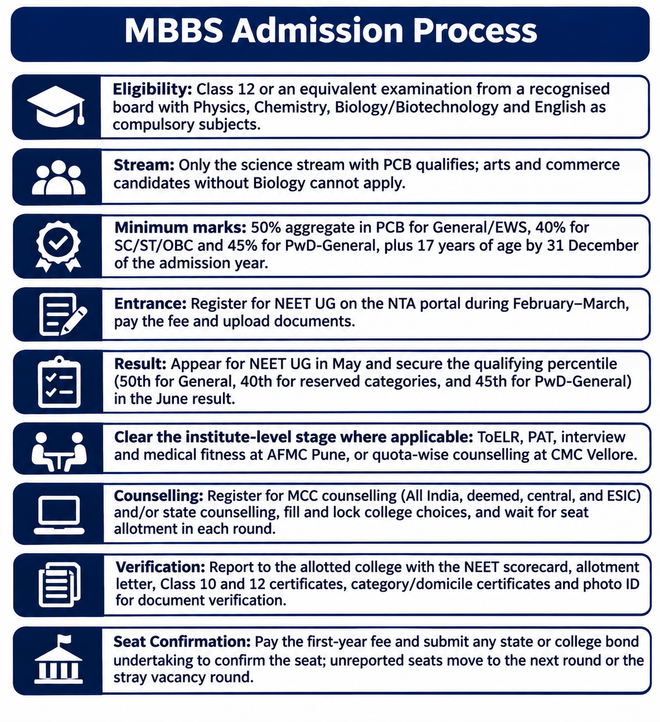
Ques. Which is a better choice for a clinical career: MBBS or BDS?
Ans. MBBS leads to registration as an allopathic physician with the widest scope, including hospital medicine, surgery, government medical services and every MD/MS specialisation, while BDS is a 5-year dental degree that limits practice to oral health and MDS specialisations. BDS cutoffs are lower, and a candidate certain about dentistry saves a year of NEET re-attempts. Verdict: MBBS is the better choice for a broad clinical career; BDS only when dentistry itself is the goal.
Ques. Which MBBS colleges are budget-friendly?
Ans. Mostly, government colleges are considered to be budget-friendly, such as AIIMS Delhi, which charges INR 5.3 K in academic fees for the full course; Maulana Azad Medical College costs INR 12.9 K; and AIIMS Bhubaneswar costs about INR 5.8 K. Among private colleges, CMC Vellore at INR 2.82 lakh and state-quota seats in private colleges (regulated by state fee committees) are the most affordable options.
Ques. What is the starting salary after MBBS?
Ans. During the compulsory internship, central institutes such as AIIMS pay a stipend of about INR 30,070 per month, while state colleges pay roughly INR 12 K to INR 42 K depending on the state. After internships, junior residents and medical officers in government hospitals earn about INR 55 K to INR 1.2 Lakh per month (INR 6.6–14 LPA), and private-hospital resident medical officers earn about INR 40 K to INR 80 K per month (INR 4.8–9.6 LPA).
Ques. Do MBBS colleges have campus placements?
Ans. MBBS does not follow the corporate campus-placement model. Graduates enter the workforce through the paid internship year, state and central medical officer recruitments (state PSCs, UPSC CMS, ESIC, Railways), junior residency at teaching hospitals, direct hiring by private hospital chains, or NEET PG for postgraduate seats. A few private universities publish MBBS placement data, but the real hiring route is recruitment examinations and hospital residency posts.
Three Myths Busted
- Myth: AIIMS and JIPMER conduct their own MBBS entrance examinations.
- Fact: AIIMS and JIPMER discontinued their separate tests in 2020. Every MBBS seat in India — AIIMS, JIPMER, central universities, deemed universities, ESIC colleges and AFMC Pune — is filled through NEET UG, with MCC allotting the AIIMS and JIPMER seats; AFMC Pune is the only institute that adds its own screening stage after NEET.
- Myth: Management quotas and NRI seats in private colleges can be taken without NEET.
- Fact: No MBBS seat can be allotted to a candidate who has not scored the NEET UG qualifying percentile. Management and NRI seats carry much higher fees, but they are allotted on NEET merit through MCC (deemed universities) or state counselling (private colleges), and an admission outside counselling is treated as irregular by the NMC.
- Myth: Candidates above 25 years of age cannot apply for NEET UG.
- Fact: The upper age limit was removed by the NMC in 2022; there is no maximum age and no cap on attempts. The only age rule is a minimum of 17 years on 31 December of the admission year, and the Class 12 PCB minimum (50%, 40% or 45% by category) still applies.
Types of Admission Routes
| Admission Routes | Detail |
|---|---|
| National-Level Entrance Exam | NEET UG is conducted by NTA for all MBBS seats; MCC allots the 15% All India Quota, AIIMS, JIPMER, central, deemed and ESIC seats. Selection is by NEET All India Rank, category and choice filling across four rounds. |
| State-Level Admission | 85% are state-quota seats in government colleges, plus state-quota and management seats in private colleges run by state DME or CET cells (MCC Tamil Nadu, KEA Karnataka, UP DGME and others). Selection is by NEET state merit rank with domicile eligibility. |
| University-Level Entrance Exam | Central universities (IMS BHU Varanasi, AMU Aligarh, JMI Delhi, DU colleges) and deemed universities (KMC Manipal, SRIHER Chennai, DPU Pune) hold no separate exam. NEET UG scores feed into MCC's central and deemed counselling categories. |
| Institute-Level Entrance Exam | AFMC Pune shortlists on NEET and then conducts ToELR, PAT, interview and a medical examination; CMC Vellore runs its own quota-wise counselling on NEET scores. Final merit at AFMC Pune combines NEET, ToELR and interview marks. |
| Merit-Based Admission | Class 12 marks decide eligibility only; no MBBS seat in India is allotted on board marks. NEET UG rank is the sole merit criterion for every quota, including NRI and management seats. |
Ques. Which is a better choice: MBBS in India or MBBS abroad?
Ans. An Indian MBBS is NMC-recognised on graduation and allows direct state registration after internship, with NEET PG open immediately. A foreign MBBS (Russia, Georgia, Philippines and others) costs INR 25–60 lakh in total, requires the FMGE screening test in India, and the NMC's 2021 rules mandate a 54-month course, a 12-month internship abroad and often a second internship in India. Private Indian seats are costlier at the top end, but the licensing path is shorter and more certain. As for the final choice, an MBBS in India is the better option whenever a government or affordable private seat is within reach; MBBS abroad is only a last option after exhausting Indian counselling.
Ques. Can MD, MS or DNB be pursued after MBBS?
Ans. Yes. After internship and permanent registration, candidates appear for NEET PG (or INI CET for AIIMS, JIPMER, PGIMER Chandigarh and NIMHANS) for 3-year MD/MS seats or 3-year DNB seats at NBEMS-accredited hospitals. A 2-year PG Diploma is also available in some specialities, and super-specialisation (DM/MCh) follows MD/MS through NEET SS.
Ques. Which government jobs are open after MBBS?
Ans. MBBS graduates are eligible for state Medical Officer posts through state PSCs and health departments, UPSC Combined Medical Services (Railways, CGHS, municipal corporations), ESIC Medical Officer, Indian Armed Forces Medical Services (Short Service Commission through AMC), CAPF/BSF/CRPF medical officer posts, and junior residency at AIIMS and state medical colleges. Starting pay at Level 10 of the 7th CPC is INR 56,100 basic plus allowances, which brings a central government Medical Officer to roughly INR 80 K to INR 1 Lakh per month.
Ques. Is MBBS a path to an MBA or hospital-management career?
Ans. Yes. MBBS graduates can pursue an MBA in Healthcare or Hospital Management (IIM Ahmedabad, IIM Bangalore and IIHMR offer dedicated programmes), a Master of Hospital Administration, or an MPH, and move into hospital operations, health insurance, health-tech, pharma medical affairs or consulting. A clinical background is an advantage in these roles, and the Indian Armed Forces, AIIMS and private chains such as Apollo recruit doctor-managers for administrative posts.
Top MBBS Colleges in India
| Top Colleges | Total Course Fee |
|---|---|
| AIIMS, New Delhi | INR 5.3 K |
| Maulana Azad Medical College, New Delhi | INR 12.9 K |
| Vardhman Mahavir Medical College, New Delhi | INR 2.65 Lakh |
| Jawaharlal Institute of Postgraduate Medical Education and Research, Pondicherry | INR 1.1 Lakh |
| Atal Bihari Vajpayee Institute of Medical Sciences & Dr. Ram Manohar Lohia Hospital, New Delhi | INR 2.33 Lakh |
| AIIMS Jodhpur | INR 5.3 K |
Scholarships
- Merit-Based Scholarships: Several deemed universities, including MAHE for KMC Manipal and Amrita for its Kochi and Faridabad campuses, offer tuition concessions to high NEET rankers; the rank bands and waiver percentages are published annually in the institute prospectus and apply only to the year of admission unless renewed on academic performance.
- Entrance-Score Scholarships: State-quota seats in private colleges carry fee caps fixed by state fee regulatory committees, so a strong NEET state rank itself functions as a scholarship — the same college can cost INR 5 Lakh per year on a state-quota seat and INR 20 Lakh or more on a management seat.
- Need-Based Scholarships and Freeships: CMC Vellore keeps its MBBS fee at INR 2.9 Lakh for every quota in return for a service obligation in its network hospitals; AFMC Pune provides free training, accommodation and a stipend against a commissioning liability of 7 years in the Armed Forces Medical Services.
- Government Scholarships (PM-USP Central Sector Scheme): Students from families earning under INR 4.5 Lakh a year who were in the top 20th percentile of their Class 12 board receive INR 12,000 per year for the first three years and INR 20,000 per year for the fourth and fifth years of a professional course such as MBBS, applied through the National Scholarship Portal.
- Category-Based Scholarships (SC/ST/OBC/EBC/DNT/PwD): Post-Matric Scholarships for SC, ST and OBC students and the Top Class Education Scheme for SC and PwD students reimburse tuition and provide a maintenance allowance for MBBS at listed institutes, subject to the family-income ceiling of INR 2.5 Lakh (Post-Matric) and the institute being notified under the scheme.
- State Scholarships: Several states reach MBBS directly — Tamil Nadu's Adi Dravidar/Tribal Welfare and BC/MBC schemes reimburse fees for professional courses, Rajasthan's SJE Post-Matric Scholarship places degree medicine in Group I with hostel maintenance, and most states run post-matric portals with income caps around INR 2.5 Lakh.
- Sports Scholarships: Sports-quota seats exist in a few state counsellings (Punjab, Haryana, Karnataka) with a reduced NEET cutoff, and some deemed universities waive part of the tuition for national-level sportspersons on production of federation certificates.
- Institution-Specific Scholarships: ESIC medical colleges reserve seats with lower fees for wards of insured persons, AMU Aligarh and JMI Delhi offer internal and minority-category concessions, and private universities such as SRMIST Chennai and KIIT Bhubaneswar publish their own merit and need-based grants each year.
Career Opportunities After MBBS
| Career Option | Average Salary (Approx. Starting Years) |
|---|---|
| Junior Resident (Government Teaching Hospital) | INR 6.6–10.8 LPA |
| Medical Officer (State/Central Government) | INR 7–14 LPA |
| Resident Medical Officer / Duty Doctor (Private Hospital) | INR 4.8–9.6 LPA |
| Medical Officer, Armed Forces Medical Services (Captain, SSC) | INR 10–14 LPA |
| General Practitioner (Clinic Practice) | INR 4–10 LPA |
| Emergency Medicine Physician (Private Hospital) | INR 6–10 LPA |
| Clinical Research Associate / Investigator | INR 4–7 LPA |
| Medical Advisor / Medical Affairs Executive (Pharma) | INR 6–12 LPA |
| Public Health Officer (NHM, State Programmes) | INR 5–9 LPA |
| Health Insurance Medical Officer (Claims and Underwriting) | INR 4–8 LPA |
| Medical Writer / Medical Content Specialist | INR 4–8 LPA |
| Telemedicine Physician (Health-Tech) | INR 4–8 LPA |
Popular Specialisation
| Popular Specialisation | Core Focus | Common Career Options |
|---|---|---|
| MD General Medicine | Internal medicine, cardiology basics, diabetes and endocrine care, infectious diseases, critical care | Physician, Hospitalist, DM Cardiology/Nephrology aspirant |
| MS General Surgery | Operative surgery, trauma, surgical oncology, laparoscopy, pre- and post-operative care | General Surgeon, MCh Surgical Gastro/Urology aspirant |
| MD Paediatrics | Neonatology, child growth and development, paediatric infections, immunisation, paediatric emergencies | Paediatrician, Neonatologist, DM Neonatology aspirant |
| MD Radiodiagnosis | X-ray, ultrasound, CT, MRI, interventional radiology | Radiologist, Interventional Radiologist |
| MD Dermatology, Venereology and Leprosy | Skin disorders, cosmetic dermatology, dermatosurgery, STIs, leprosy | Dermatologist, Cosmetic Dermatologist |
| MS Orthopaedics | Fractures and trauma, joint replacement, spine, sports injuries, paediatric orthopaedics | Orthopaedic Surgeon, Sports Medicine Specialist |
Top Recruiters
| Sector | Major Recruiters |
|---|---|
| Hospitals and Healthcare Chains | Apollo Hospitals, Fortis Healthcare, Max Healthcare, Medanta, Narayana Health, Manipal Hospitals |
| Government and Public Sector | AIIMS (all campuses), ESIC, Indian Railways, state health departments, CGHS, Armed Forces Medical Services |
| Pharmaceuticals, CROs and Medical Affairs | Sun Pharma, Cipla, Dr Reddy's Laboratories, IQVIA, Novartis India, Parexel |
| Health-Tech and Health Insurance | Practo, Tata 1mg, Apollo 24 |
| Public Health and Research | ICMR, WHO India, UNICEF India, PATH, Public Health Foundation of India |
Higher Education Options
| Course | Duration |
|---|---|
| MD / MS (via NEET PG or INI CET) | 3 years |
| DNB (NBEMS-accredited hospitals, via NEET PG) | 3 years |
| PG Diploma (selected specialities) | 2 years |
| DM / MCh (super-specialisation, via NEET SS after MD/MS) | 3 years (6-year direct DM/MCh after MBBS at a few institutes) |
| Master of Public Health (MPH) | 2 years |
| Master of Hospital Administration (MHA) / MBA in Healthcare Management | 2 years |
| MSc Clinical Research / MSc Medical Sciences | 2 years |
| PhD / MD-PhD (AIIMS, PGIMER, JIPMER) | 3–5 years |
| USMLE (USA), PLAB/UKMLA (UK), MRCP/MRCS pathways | Variable; licensing examinations plus 2–5 years of residency depending on the country and speciality |
FAQs
Ques. Can arts or commerce students apply for MBBS?
Ans. No. NEET UG eligibility requires Physics, Chemistry, Biology/Biotechnology and English in Class 12 with practical components, so candidates from arts or commerce streams cannot apply unless they clear Class 12 again with the PCB combination from a recognised board (open-school and additional-subject routes are accepted only as per the NTA information bulletin for that year).
Ques. Is Mathematics a compulsory subject for MBBS admission?
Ans. No. Mathematics is not required for NEET UG or MBBS admission; the compulsory subjects are Physics, Chemistry, Biology/Biotechnology and English. PCM students who have taken Biology as an additional subject can appear, provided Biology was studied with practicals for two years.
Ques. What is taught in the first year of MBBS?
Ans. Phase I of the NMC competency-based curriculum (first 13 months) begins with a foundation course on medical ethics, communication and basic skills, and then covers Anatomy, Physiology and Biochemistry, with early clinical exposure, AETCOM (Attitude, Ethics and Communication) modules and introductory community medicine sessions.
Ques. Which entrance exams are required for MBBS admission in 2027?
Ans. Only NEET UG 2027 (tentatively on 2 May 2027, applications February–March 2027) is required for every MBBS college in India. AFMC Pune additionally screens NEET-shortlisted candidates through ToELR, PAT and an interview, and CMC Vellore runs its own quota-wise counselling on NEET scores; neither involves a separate written entrance test.
Ques. Is MBBS admission possible without NEET UG?
Ans. No. NEET UG qualification is mandatory for every MBBS seat in India, including management, NRI, minority and institutional quotas, and since 2018 it is also mandatory for Indian citizens and OCI cardholders joining MBBS abroad who intend to practise in India.
Ques. Is the 1-year internship paid, and is it part of the degree?
Ans. Yes, the 1-year internship is paid, and is part of the degree as the 12-month compulsory rotating internship is part of the 5.5-year programme and must be completed before the degree is awarded and permanent registration is granted by the state medical council. Interns receive a monthly stipend — about INR 30,070 at AIIMS and other central institutes and INR 12 K to INR 42 K at state government colleges depending on the state.
Ques. How many NEET UG attempts are allowed for MBBS?
Ans. There is no limit on the number of NEET UG attempts and no upper age limit. Candidates can appear every year as long as they meet the minimum age of 17 years and the Class 12 PCB marks requirement.



Comments
Found 16 Comments
According to the All India Quota MBBS Seat Matrix for 2023, the total intake of MBBS seats in Andaman & Nicobar Islands Institute of Medical Sciences, Port Blair, is 114. There is only 1 medical college in Andaman, Andaman & Nicobar Islands Institute of Medical Sciences, Port Blair, that offers MBBS Admission.
The NEET cutoff scores for Sikkim Manipal Institute of Medical Sciences (SMIMS) for the year 2023 were released by the authorities on its official website. For the general category, the cutoff scores were 720 marks (opening) and 137 marks (closing). In comparison, for the OBC category, the cutoff scores were 136 marks (opening) and 107 marks (closing). These cutoff scores provide insight into the competitiveness of admissions to SMIMS for MBBS programs and indicate the minimum NEET scores required for candidates to secure admission.
As per the NEET cutoff scores declared for MBBS admission in Puducherry in 2023, the minimum marks needed for different categories are mentioned below. For the General Category students, the cutoff score was 515. For the Backward Class Muslim (BCM) group it was 505. OBC candidates had to score 507 and SC candidates had to score 319 for MBBS admissions in Puducherry.
Dadra and Nagar Haveli has only one government medical college "Shri Vinoba Bhave Institute of Medical Sciences" in Silvassa. There are a total of 177 seats for MBBS. The NEET cutoff scores for Shri Vinoba Bhave Institute of Medical Sciences MBBS Admission were: 720 – 137 for unreserved category students, 136 – 107 for the OBC, ST, and SC category students. The reserved group without physical disability had to score between 136 and 121 whereas, for the OBC with a physical disability it was set at 120 – 107.
What are the top 7 private colleges for MBBS in Puducherry?
Several private institutions offer an MBBS course in Puducherry. Mahatma Gandhi Medical College & Research Institute (MGMCRI), Pondicherry Institute of Medical Sciences (PIMS), Sri Venkateswara Medical College Hospital and Research Centre, VMMC, AVMCH, and PIPMER are some of the top medical colleges that offer an MBBS Course in Pondicherry. You must have a valid NEET score and appear for the CENTAC counselling to seek Pondicherry MBBS Admission 2024.
MBBS is the best career option in India due to its exceptional job security and high pay, with a starting salary ranging from INR 6-8 LPA, candidates have the potential to earn up to INR 20-30 LPA with experience. Moreover, it offers the opportunity for meaningful service to society, personal growth through continuous learning, global opportunities, diverse career options, intellectual stimulation, and high social recognition and is apt for students who wish to become doctors.
Yes, scoring around 500 marks in NEET is an achievement. With such a score, your subsequent percentile and rank typically fall in the range of 7,500 to 50,000, depending on the exact marks obtained and the overall performance of the candidate. This range positions you competitively for admission to various good medical colleges, with opportunities available in both government and private institutions.
Punjab Institute of Medical Sciences , Jalandhar, has a total of 150 seats for the MBBS program. 75 of them are under the Government Quota.
Yes, in India, it is compulsory to qualify the NEET entrance exam to pursue the MBBS degree in both government and private medical colleges. NEET is the centralized entrance examination conducted by the National Testing Agency (NTA) for admission to undergraduate medical courses (MBBS/BDS) in India. After qualifying NEET, candidates must appear for the All-India or State-Level Counselling to seek MBBS Admission in India.
Both MBBS and BDS are popular choices among mental students. Students who complete an MBBS program can choose a specialty from several options such as Cardiology, Gynecology, etc . MBBS graduates may earn more than BDS graduates since BDS focuses solely on dentistry having avenues of being specialized in orthodontics or oral surgery. To choose one out of MBBS or BDS, you must consider parameters like work-life balance, occupation supervision and most importantly your interest of having a medical career or dental career.
The program (tuition) fees at the Punjab Institute of Medical Sciences for MBBS differ based on the quota from which the student is admitted. The MBBS fee under the Government Quota amounts to INR 4,06,000 per year. Those under the Management Quota must pay INR 10,42,000 whereas NRI/OCI Quota students pay USD 1,10,000 annually.
The subjects inlcuded in the final year of MBBS courses are Psychiatry, Dermatology and Venereology, Pediatrics, Anesthesiology, Orthopedics, Obstetrics and Gynecology.
The minimum educational qualification required to pursue MBBS in India is to pass Class XII examination from a recognized board with at least 50% marks taking English and PCB subjects. Admission is based on NEET scores and counseling.
Yes, students seeking admission to MBBS courses in India must be at least 17 years old.
The MBBS course fee for Government medical colleges are very less compared to private colleges. The average course fee for public institutions ranges from INR 1628 to INR 20000, while the course fee for private colleges ranges between INR 3,00,000 to INR 56,00,000.
The total duration for MBBS course is 5 years and 6 months, including the compulsory internship program.