



B.Sc (Ag.) Latest Updates
BSc Agriculture (Bachelor of Science in Agriculture) is a 4-year undergraduate course that students can pursue after Class 12. The course covers crop production, soil science, horticulture, plant breeding and agricultural technology. It also includes practical training and fieldwork.
For BSc Agriculture admission, students generally need to pass Class 12 with science or agriculture subjects and at least 45% to 50% marks, depending on the college. Admission is based on entrance exams such as CUET UG, KCET, MHT CET and AP EAPCET. Some colleges also offer direct admission based on Class 12 marks.
BSc Agriculture Course Highlight
| Top Colleges | Total Course Fees | Specialisation Areas | Average Starting Salary |
|---|---|---|---|
| Sam Higginbottom University of Agriculture Technology and Sciences, Allahabad, Indian Agricultural Research Institute, New Delhi, Punjab Agricultural University, Ludhiana | INR 2.8 K to INR 34.12 Lakh | Agronomy, Horticulture, Soil Science, Plant Breeding, Plant Pathology, Agricultural Economics, Agribusiness | INR 2.5 – 5 LPA approximately |
Quick Facts
- Duration: 4 years, divided into 8 semesters
- Eligibility: Class 12 with PCB, PCM, PCMB or Agriculture-related subjects, depending on university requirements
- Entrance Exam: CUET UG (ICAR), MHT CET, KCET, OUAT UG Entrance Exam, AP EAPCET, SHUATS Online Entrance Test
- Selection: Entrance examination score, qualifying-examination merit, university/state counselling, seat allotment and document verification
- Government Institution Fee Range: INR 2.8 K (Kumaun University, Nainital) to INR 10.67 Lakh (Junagadh Agricultural University, Junagadh)
- Private Institution Fee Range: INR 7.2 K (Pandit S. N. Shukla University, Shahdol) to INR 34.12 Lakh (Yenepoya University, Mangalore)
- Admission Season: Applications start from Jan to Jun, examinations are held between Mar and Jul, and counselling is from May to Sep (tentative).
- Top BSc Agriculture Entrance Exams
1.1 Types of Admission Routes in India
1.2 BSc Agriculture Direct Admission in India
- BSc Agriculture Colleges in India
- BSc Agriculture Scholarships
- Career Opportunities After BSc Agriculture
4.1 Top BSc Agriculture Recruiters
- Higher Education Options After BSc Agriculture
- FAQs
Top BSc Agriculture Entrance Exams
| Exam | Top Colleges / Institutes | Selection Process | Application Deadline (Tentative 2027) | Exam Date (Tentative 2027) |
|---|---|---|---|---|
| CUET UG (ICAR) | Participating ICAR agricultural universities | CUET UG Score + ICAR Counselling | Jan–Feb 2027 | May–Jun 2027 |
| MHT CET | MPKV Rahuri, Dr. PDKV Akola, VNMKV Parbhani | CET Score + CAP Counselling | Feb–Mar 2027 | Apr–May 2027 |
| KCET | UAS Bengaluru, UAS Dharwad, UAS Raichur | CET Rank + KEA Counselling | Feb–Mar 2027 | Apr 2027 |
| AP EAPCET | ANGRAU-affiliated Agriculture Colleges | Entrance Rank + Counselling | Mar–Apr 2027 | May 2027 |
| OUAT UG | Odisha University of Agriculture and Technology | Entrance Exam + Merit + Counselling | Apr–May 2027 | Jun 2027 |
| SHUATS SOET | SHUATS Prayagraj | Online Entrance Test + Admission Process | As notified | Feb–Jul 2027 (multiple tests expected) |
Also Read
CUET ICAR-UG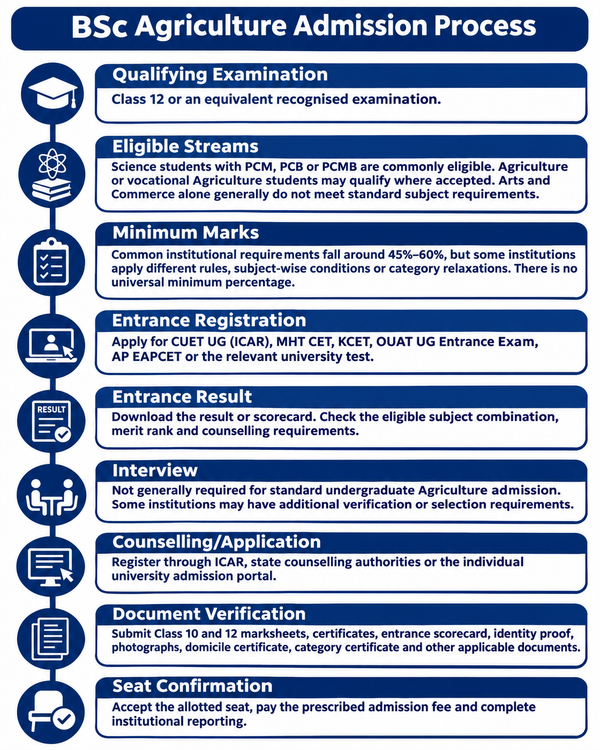
Ques. How is the BSc Agriculture cutoff determined?
Ans. Cutoffs depend on entrance score or rank, category, seat availability, subject eligibility, domicile rules, admission quota, college preferences and counselling round. CUET-based ICAR cutoffs should not be compared directly with KCET, MHT CET or other state entrance cutoffs because their scoring and selection systems differ.
Ques. What is the BSc Agriculture syllabus semester-wise?
Ans. The syllabus varies by university, but a typical course progression includes:
| Semester | Major Subjects / Academic Components |
|---|---|
| Semester 1 | Fundamentals of Agronomy, Soil Science, Agricultural Heritage, introductory agricultural sciences |
| Semester 2 | Crop Physiology, Agricultural Microbiology, Genetics, Agricultural Economics |
| Semester 3 | Field Crop Production, Plant Breeding, Entomology, Agricultural Engineering |
| Semester 4 | Plant Pathology, Agricultural Extension, Soil Fertility, Horticulture |
| Semester 5 | Agricultural Marketing, Crop Improvement, Pest Management, Agricultural Biotechnology |
| Semester 6 | Seed Technology, Protected Cultivation, Farm Management, Post-Harvest Management |
| Semester 7 | Rural Agricultural Work Experience (RAWE), field training and practical learning, where prescribed |
| Semester 8 | Experiential Learning Programme (ELP), project work, internships or enterprise-related training, as prescribed |
This is an indicative subject arrangement, not an official semester-wise curriculum for every university.
Ques. Is BSc Agriculture suitable for students interested in agricultural banking?
Ans. Yes, BSc Agriculture is suitable for students interested in agricultural banking, as the course provides knowledge of crop production, rural economics, farm finance and agricultural marketing. Students interested in Agricultural Field Officer positions can prepare for the relevant banking recruitment examinations. Selection is not automatic and depends on the recruiting organisation's eligibility criteria.
Ques. What should students choose after BSc Agriculture: MSc Agriculture or MBA Agribusiness?
Ans. MSc Agriculture is more closely aligned with agricultural research, technical specialisation and academic careers. MBA Agribusiness is more closely aligned with management, agricultural marketing, procurement, consulting and supply-chain roles. The choice depends on career goals, eligibility, interest and the institute's curriculum.
Three Myths Busted
- Myth: Only students with Biology in Class 12 can pursue BSc Agriculture.
- Fact: Several universities accept PCM, PCB, PCMB or specified Agriculture subjects. However, subject combinations vary by institution and admission quota.
- Myth: BSc Agriculture graduates can work only on farms.
- Fact: Graduates can pursue agricultural banking, seed production, crop advisory, agri-input sales, food supply chains, research support, agribusiness and government recruitment.
- Myth: Every BSc Agriculture college requires an entrance examination.
- Fact: Many institutions use entrance examinations, but some offer Class 12 merit-based admission or direct admission against notified vacancies. There is no universal admission process.
Types of Admission Routes in India
| Admission Route | Entrance Exam / University | Admission Process |
|---|---|---|
| National-Level Entrance | CUET UG (ICAR) | Admission through CUET UG scores, followed by ICAR counselling for eligible seats. |
| State-Level Entrance | MHT CET, KCET, AP EAPCET | Admission based on entrance rank, eligibility, seat availability and state counselling. |
| University-Level Entrance | OUAT UG Entrance Exam | Selection through university entrance exam, merit list and counselling. |
| Institute-Level Entrance | SHUATS SOET | Admission is through an institute-level entrance test, followed by counselling and fee payment. |
| Merit-Based Admission | Tamil Nadu Agricultural University (TNAU) | Selection based on Class 12 marks, prescribed merit criteria and counselling. |
BSc Agriculture Direct Admission in India
| College / University | Minimum Class 12 Marks | Admission Process |
|---|---|---|
| Vellore Institute of Technology (VIT) | 60% overall and 60% in PCB | Class 12 merit-based counselling; no entrance examBSc Agri Applications |
| Mahatma Jyotiba Phule Rohilkhand University | Class 12 pass in science/agriculture; minimum percentage not specified | Class 12 merit-based selectionMJPRU |
| Teerthanker Mahaveer University | 50% in PCM/PCB/PCMB/agriculture | Merit based on Class 12 percentageTMU |
| Amity University, Noida | 60% aggregate for the non-sponsored category, with additional subject requirements | Class 12 eligibility and video-response selection process |
BSc Agriculture Colleges in India
| Top Colleges | Total Course Fees |
|---|---|
| Sam Higginbottom University of Agriculture Technology and Sciences, Allahabad | INR 4.91 Lakh |
| Indian Agricultural Research Institute, New Delhi | INR 51.8 K |
| Punjab Agricultural University, Ludhiana | INR 2.51 Lakh |
| Banaras Hindu University, Varanasi | INR 80 K |
| Chaudhary Charan Singh Haryana Agricultural University, Hisar | INR 80.3 K |
| Lovely Professional University, Jalandhar | INR 10.04 Lakh |
Ques. Does BSc Agriculture offer campus placements?
Ans. Many agricultural universities provide placement assistance or industry interaction, but campus-placement availability and results differ significantly. Recruitment may involve seed companies, fertiliser manufacturers, agribusiness firms and agricultural technology organisations. Students should verify BSc Agriculture-specific placement records rather than relying on university-wide packages.
Ques. What government jobs are available after BSc Agriculture?
Ans. Graduates may apply for eligible Agricultural Officer, Agriculture Field Officer, Agricultural Extension Officer, Seed Inspector, technical assistant and related government positions. Recruitment can take place through state public service commissions, agricultural departments, banking examinations and other agencies. Some roles require additional qualifications, examinations or work experience.
Ques. What is the difference between BSc Agriculture and BTech Agricultural Engineering?
Ans. BSc Agriculture focuses on crop production, soil management, plant protection, agricultural economics and practical agricultural sciences. BTech Agricultural Engineering focuses more on farm machinery, irrigation engineering, agricultural structures, processing systems and engineering applications. Both programmes generally have a four-year duration, but subjects and career pathways differ.
BSc Agriculture Scholarships
- ICAR National Talent Scholarship (NTS-UG): An Agriculture-specific merit scholarship listed on the National Scholarship Portal. Eligibility depends on ICAR admission and scholarship rules, including applicable study-location conditions.
- PM-USP Central Sector Scheme of Scholarship for College and University Students: Supports eligible students based on academic merit, family income and other scheme conditions. BSc Agriculture students may qualify if the programme and institution meet the rules.
- SC/ST Scholarships: Eligible students can apply for central or state post-matric and higher-education scholarship schemes. Benefits depend on category, income and recognised-institution requirements.
- OBC/EBC/DNT Scholarships: PM-YASASVI and applicable state scholarship schemes may support eligible students according to their published conditions.
- Merit-Based Institutional Scholarships: Universities such as Lovely Professional University provide scholarship assessments linked to eligibility and entrance-performance categories, including LPUNEST-based schemes.
- Need-Based Scholarships/Freeships: Some universities and state governments offer financial assistance or tuition concessions to eligible students from lower-income families.
- Sports Scholarships: Available only at institutions operating an applicable sports scholarship programme. Students may need verified competition certificates or sports trials.
Career Opportunities After BSc Agriculture
| Career Option | Average Salary (Approx. Starting Years) |
|---|---|
| Agriculture Field Officer | INR 3.5 – 6 LPA |
| Agricultural Extension Officer | INR 3 – 5 LPA |
| Agronomist / Junior Agronomist | INR 2.5 – 4.5 LPA |
| Crop Production Supervisor | INR 2.4 – 4 LPA |
| Seed Production Officer | INR 2.5 – 4.5 LPA |
| Soil Testing Laboratory Technician | INR 2 – 3.5 LPA |
| Agricultural Research Assistant | INR 2.5 – 4.5 LPA |
| Agribusiness Development Executive | INR 3 – 5 LPA |
| Agricultural Sales and Marketing Executive | INR 2.5 – 5 LPA |
| Quality Control Executive – Agri Products | INR 2.5 – 4.5 LPA |
| Farm Operations Manager / Trainee | INR 2.5 – 4.5 LPA |
| Agri-Supply Chain Executive | INR 3 – 5 LPA |
Top BSc Agriculture Recruiters
| Sector | Major Recruiters |
|---|---|
| Seeds and Plant Breeding | Bayer Crop Science, Syngenta, Corteva Agriscience, Advanta Seeds, Kaveri Seed Company, Rasi Seeds, Nuziveedu Seeds, Mahyco, VNR Seeds, East-West Seed |
| Fertilisers and Crop Nutrition | IFFCO, KRIBHCO, Coromandel International, Chambal Fertilisers, National Fertilizers Limited, Rashtriya Chemicals and Fertilizers, Deepak Fertilisers, Paradeep Phosphates, Yara India, Indian Potash Limited |
| Crop Protection and Agri-Inputs | UPL, Dhanuka Agritech, PI Industries, Rallis India, BASF India, FMC India, Insecticides India, Sumitomo Chemical India, ADAMA India, Crystal Crop Protection |
| Agricultural Machinery and Technology | Mahindra Farm Equipment, John Deere India, TAFE, Escorts Kubota, CNH Industrial India, VST Tillers Tractors, Sonalika Tractors, CLAAS India, AGCO, KUBOTA Agricultural Machinery India |
| Agribusiness, Food Processing and Supply Chain | ITC Agri Business Division, Cargill India, Godrej Agrovet, Adani Wilmar, Olam Agri, ADM India, Ninjacart, DeHaat, BigHaat, WayCool Foods |
| Banking, Rural Finance and Agricultural Insurance | NABARD, State Bank of India, Punjab National Bank, Bank of Baroda, Canara Bank, Union Bank of India, Indian Bank, Bank of India, Agriculture Insurance Company of India, HDFC Bank |
| Government Agriculture and Rural Development | State Agriculture Departments, Department of Agriculture and Farmers Welfare, National Seeds Corporation, Food Corporation of India, Central Warehousing Corporation, State Seed Corporations, State Agricultural Marketing Boards, Krishi Vigyan Kendras, ICAR institutes, State Horticulture Departments |
| Agricultural Research and Development | ICAR-IARI, ICAR-NBPGR, ICAR-NBSS&LUP, ICAR-NCIPM, ICAR-IISS, ICAR-IIRR, ICAR-IIPR, ICAR-IIHR, ICAR-CRIDA, ICRISAT |
Higher Education Options After BSc Agriculture
| Course | Duration |
|---|---|
| MSc Agriculture (Agronomy, Genetics and Plant Breeding, Soil Science, Plant Pathology and other disciplines) | 2 Years |
| MBA Agribusiness Management / MBA Food and Agribusiness Management | 2 Years |
| MSc Horticulture | 2 Years |
| MSc Agricultural Economics / Agricultural Extension Education | 2 Years |
| PhD Agriculture / Allied Agricultural Sciences (after an eligible postgraduate qualification) | Typically 3–5 Years |
FAQs
Ques. Is Biology compulsory for BSc Agriculture?
Ans. Biology is not compulsory at every university. Several institutions accept students with Physics, Chemistry and Mathematics. For example, the Maharashtra Agriculture admission system recognises relevant PCM and PCB routes. However, some universities require particular subject combinations.
Ques. Is CUET compulsory for all BSc Agriculture colleges?
Ans. No. CUET UG is used for ICAR All India Quota admission and by participating institutions under applicable rules. Other colleges may use MHT CET, KCET, AP EAPCET, university entrance tests or qualifying-examination merit. CUET alone does not cover every BSc Agriculture admission route.
Ques. Which BSc Agriculture colleges have relatively low course fees?
Ans. Institutions such as IARI New Delhi, BHU Varanasi, CCS Haryana Agricultural University Hisar and Bidhan Chandra Krishi Viswavidyalaya Mohanpur have relatively low listed course fees. Students should compare the exact programme, current fee schedule, living expenses and admission eligibility before applying.
Ques. What is the average starting salary after BSc Agriculture?
Ans. Early-career salaries in the Indian agricultural sector are approximately INR 2.5–5 LPA for many relevant entry-level roles. Technical, management trainee and specialised positions may pay differently. Salaries depend on skills, employer, location, experience and recruitment method.
Ques. Which BSc Agriculture specialisation is suitable for research careers?
Ans. Genetics and Plant Breeding, Agronomy, Soil Science, Plant Pathology and Entomology are relevant areas for agricultural research. Students commonly pursue an MSc in their chosen discipline and may later pursue a PhD. Research positions have specific academic and recruitment requirements.



Comments