




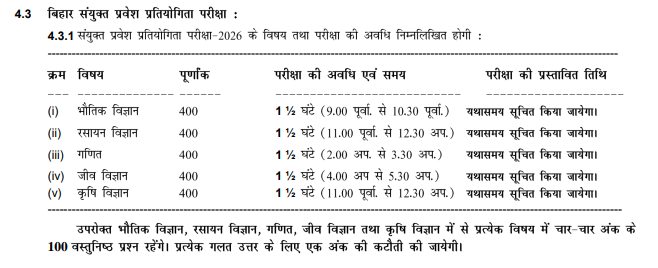
BCECE (Bihar Combined Entrance Competitive Examination) is the state-level Bihar engineering exam for admission into Pharmacy, Agriculture, Nursing, Paramedical, and Dairy Technology courses across Bihar. Each BCECE subject paper carries 100 compulsory MCQs for 400 marks, with +4 for every correct answer and -1 for an incorrect response.
| Direct Link: BCECE Exam Pattern 2027 (Official Notification Awaited) |
- The exam is conducted in offline, OMR-based mode, in English and Hindi, with candidates attempting separate 90-minute papers for each subject in their chosen group.
- The BCECE course list spans six subject-group combinations: PCM, PCB, PCMB, CBA, MBA, and MCA, so the BCECE course list for PCB differs meaningfully from the course list available under PCM or the agriculture-focused groups.
- Some high-weightage topics across the BCECE syllabus include Calculus (22–25 questions) in Mathematics; Organic Chemistry Principles & Hydrocarbons (10–12 questions) in Chemistry; Genetics and Evolution (18–19 questions) in Biology; and Oscillations and Waves (9–10 questions) in Physics.
Related Links:
- BCECE Syllabus 2027: Subject Wise Topics, Topic Wise Weightage and PDF Download
- BCECE 2027 Preparation: Check Subject-wise Preparation Tips, Important Topics, Books, Question Paper PDF Download
Key Summary
- The Bihar Combined Entrance Competitive Examination Board (BCECEB) conducts BCECE.
- The BCECE exam pattern uses a fixed +4/-1 marking scheme across all subject papers, unchanged since the board's 2017 format shift.
- The BCECE course list spans six subject-group combinations: PCM, PCB, PCMB, CBA, MBA, and MCA, so the BCECE course list for PCB differs meaningfully from the course list available under PCM or the agriculture-focused groups.
- The BCECE syllabus is based entirely on the NCERT Class 11 and 12 curriculum for Physics, Chemistry, Mathematics, Biology, and Agriculture.
BCECE Exam Pattern 2027: Overview
The BCECE exam pattern remains a single-stage, offline, OMR-based test, with each subject conducted as its own 90-minute, 100-question paper.
- Every BCECE subject paper includes Physics, Chemistry, Mathematics, Biology, or Agriculture, and carries a 100-question, 400-mark structure, so a candidate's total score scales directly with how many papers their chosen group requires.
- A 3-subject group (like PCM, PCB, CBA, MBA, or MCA) totals 300 questions and 1,200 marks across 4.5 hours.
- The BCECE exam pattern has kept this exact question-and-mark allocation stable since the exam moved to a single-stage format in 2017.
| Particulars | Details |
|---|---|
| Exam Mode | Offline (Pen-and-paper / OMR-based) |
| Question Type | MCQs with 4 options |
| Duration | 90 minutes per subject paper |
| Subjects | Physics, Chemistry, Biology, Mathematics, Agriculture |
| Questions per Subject | 100 MCQs |
| Marks per Subject | 400 |
| Marking Scheme | +4 correct, -1 incorrect, 0 unattempted |
| Medium | English and Hindi |
| Stages | Single stage (one phase) |
| Syllabus Basis | NCERT Class 11 & 12 (Physics, Chemistry, Mathematics, Biology/Agriculture) |
Ques. What is the BCECE full form?
Ans. BCECE stands for Bihar Combined Entrance Competitive Examination, conducted by the Bihar Combined Entrance Competitive Examination Board (BCECEB).
Ques. What is BCECE ka full form in the context of the conducting body?
Ans. BCECEB is the Bihar Combined Entrance Competitive Examination Board, the state body that conducts BCECE and releases its exam date, syllabus, and results.
Check Out:
BCECE Exam Pattern 2027: What's New?
The BCECE board has run a single-stage exam since 2017, and no major structural change is expected for BCECE 2027, based on how consistently the BCECE exam pattern has held across the last six cycles.
- Up until 2016, BCECE ran a two-phase system, a qualifying Preliminary Stage 1, followed by a Mains Stage 2 that decided final college placements. The board permanently removed Stage 1 in 2017 to reduce academic stress and speed up counselling.
- In 2019, BCECE removed MBBS, BDS, and B.Tech engineering admissions entirely, and those now use NEET and JEE Main ranks; thus, BCECE is the primary Bihar engineering exam alternative mainly for Pharmacy, Agriculture, Nursing, and Paramedical seats instead of core engineering degrees.
- The +4/-1 marking scheme has stayed uniform across all six cycles since 2017.
Ques. Is BCECE still used for engineering admissions in Bihar?
Ans. BCECE itself no longer covers B.Tech engineering seats; those moved to JEE Main via UGEAC counselling in 2019, though BCECE remains the primary state Bihar engineering exam route into Pharmacy, Agriculture, Dairy Technology, Nursing, and Paramedical courses.
Also Check: BCECE Mock Test Online Free, Check Subject-wise Mock Test
BCECE Marking Scheme 2027
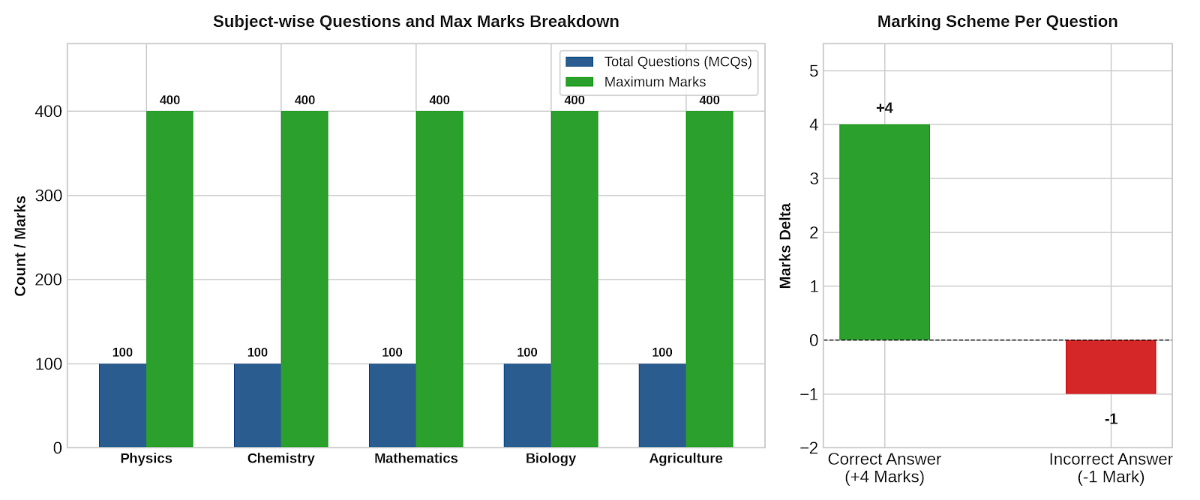
Each independent BCECE subject paper: Physics, Chemistry, Mathematics, Biology, or Agriculture, follows the same fixed evaluation formula:
- +4 for correct,
- -1 for incorrect,
- 0 for unattempted.
Students need to choose 3 subjects in a combination from the 5 subjects available, in accordance with their desired degree program. These 5 subjects include Physics, Chemistry, Mathematics, Biology, and Agriculture.
- As the marking scheme mirrors NEET's +4/-1 structure exactly, NEET aspirants tracking BCECE can reuse their existing strategy of attempting questions without needing to relearn a new penalty system.
- The question count and total marks doubled in the BCECE exam after the two-phase system was removed in 2017. Each paper increased from 50 to 100 questions, while marks increased from 200 to 400 in the BCECE exam pattern.
| Subject Paper | Total Questions | Marks per Question | Negative Marking | Max Marks | Paper Duration |
|---|---|---|---|---|---|
| Physics | 100 MCQs | +4 | -1 | 400 Marks | 90 Minutes |
| Chemistry | 100 MCQs | +4 | -1 | 400 Marks | 90 Minutes |
| Mathematics | 100 MCQs | +4 | -1 | 400 Marks | 90 Minutes |
| Biology | 100 MCQs | +4 | -1 | 400 Marks | 90 Minutes |
| Agriculture | 100 MCQs | +4 | -1 | 400 Marks | 90 Minutes |
| Total (3-Paper Group Combo) | 300 Questions | - | - | 1,200 Marks | 4.5 Hours |
Ques. What is the BCECE marking scheme?
Ans. +4 marks for every correct answer and -1 mark for every incorrect answer, with 0 marks for unattempted questions, is the BCECE exam pattern applied identically across every subject paper.
Ques. Is there a penalty for multiple markings in BCECE?
Ans. Yes. Darkening more than one option for a single question is treated as incorrect and costs -1 mark, even if one of the marked options is correct.
BCECE 2026 Question Paper with Solutions PDF
| BCECE Papers | Question Paper PDF | Solution PDF |
|---|---|---|
| BCECE 2026 Agriculture Question Paper | Download PDF | Check Solution |
| BCECE 2026 Physics Question Paper | Download PDF | Check Solution |
| BCECE 2026 Chemistry Question Paper | Download PDF | Check Solution |
| BCECE 2026 Mathematics Question Paper | Download PDF | Check Solution |
| BCECE 2026 Biology Question Paper | Download PDF | Check Solution |
| Exam Date | Question Paper | Solution PDF |
|---|---|---|
| BCECE Question Paper 2025 (Set 1) | Download PDF | Check Solutions |
| BCECE Question Paper 2025 (Set 2) | Download PDF | Check Solutions |
| BCECE Question Paper 2024 | Download PDF | Check Solutions |
BCECE Subject Combinations 2027
The BCECE course list is built around six subject-group combinations, and which group a candidate picks decides both their BCECE exam syllabus and their eligible degree options.
- PCM: Mainly for B.Tech Dairy Technology and B.Pharma.
- PCB: Opens options like B.Sc Nursing, B.Pharma, Physiotherapy, Occupational Therapy, and Paramedical courses.
- PCMB: Gives the widest course options, covering both PCM and PCB courses.
- Agriculture/Horticulture: 50% seats are for PCM/PCB and 50% for CBA/MBA/MCA groups.
- Nursing & Paramedical: Biology is compulsory, so choose PCB or PCMB.
| Subject Combination | Core Subject Group | Eligible Undergraduate Degree Options |
|---|---|---|
| PCM | Physics, Chemistry, Mathematics | B.Tech (Dairy Technology), B.Pharma, B.Sc (Hons.) Agriculture (partial seats) |
| PCB | Physics, Chemistry, Biology | B.Sc Nursing, B.Pharma, BPT, BOT, B.Sc Paramedical, B.Sc (Hons.) Agriculture/Horticulture, B.F.Sc |
| PCMB | Physics, Chemistry, Mathematics, Biology | All PCM & PCB courses combined |
| CBA | Chemistry, Biology, Agriculture | B.Sc (Hons.) Agriculture/Horticulture, B.F.Sc |
| MBA | Mathematics, Biology, Agriculture | B.Sc (Hons.) Agriculture/Horticulture, B.F.Sc |
| MCA | Mathematics, Chemistry, Agriculture | B.Sc (Hons.) Agriculture/Horticulture |
Ques. What is the BCECE course list for PCB?
Ans. The PCB group opens eligibility for B.Sc Nursing, B.Pharma, Physiotherapy, Occupational Therapy, B.Sc Paramedical courses, and — for partial seats — B.Sc Agriculture and Horticulture.
Ques. Which BCECE group is required for Nursing courses?
Ans. Biology is compulsory for Nursing and Paramedical eligibility, so candidates must choose the PCB or PCMB group.
Also Check:
BCECE Syllabus: High-Weightage Topics
Every subject in the BCECE syllabus is drawn from the NCERT Class 11 and 12 curriculum, but weightage is concentrated in some of the high-yield units per subject.
BCECE Physics: High-Weightage Topics
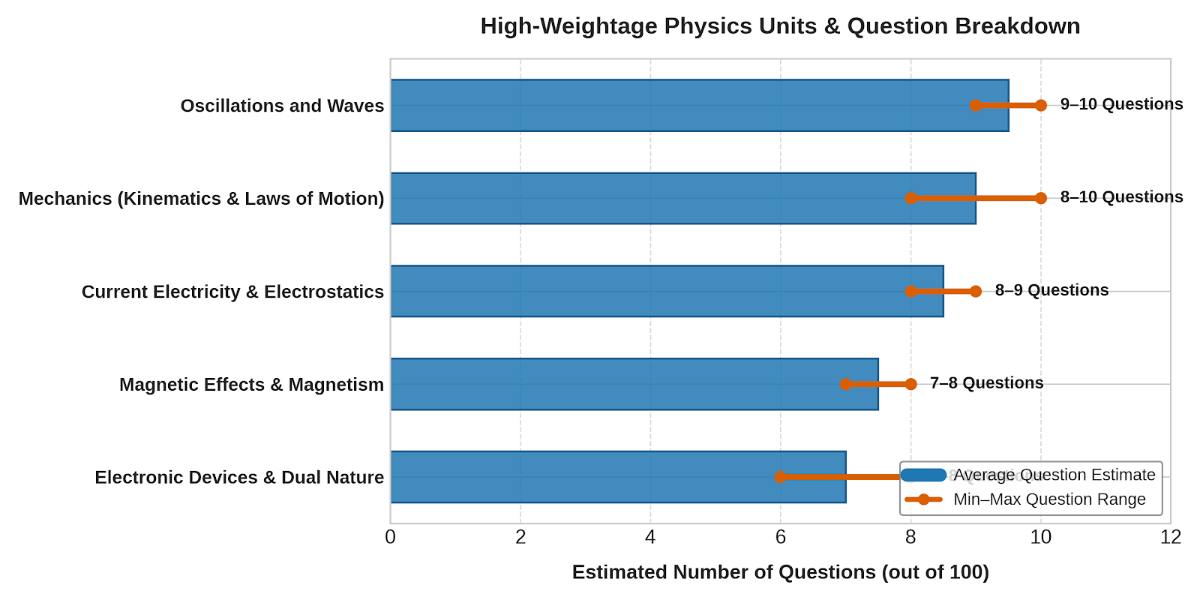
- Mechanics and Electrodynamics together consist of 35–40% of the Physics paper, the largest concentration of weightage among all Physics units.
| High-Weightage Unit | Estimated Questions (of 100) | Core Areas to Target |
|---|---|---|
| Oscillations and Waves | 9–10 | Doppler Effect, SHM Equations, Wave Optics |
| Mechanics (Kinematics & Laws of Motion) | 8–10 | Projectile Motion, Friction, Work-Energy Theorem |
| Current Electricity & Electrostatics | 8–9 | Gauss's Law, Kirchhoff's Laws, Circuit Solving |
| Magnetic Effects & Magnetism | 7–8 | Biot-Savart Law, LCR Circuits, Faraday's Law |
| Electronic Devices & Dual Nature | 6–8 | Logic Gates, Photoelectric Effect, Semiconductors |
BCECE Chemistry: High-Weightage Topics
- Organic Chemistry alone makes up 35–40% of the Chemistry paper, making it the lengthiest and highest-weightage section of the entire BCECE syllabus.
| High-Weightage Unit | Estimated Questions (of 100) | Core Areas to Target |
|---|---|---|
| Organic Chemistry Principles & Hydrocarbons | 10–12 | Named Reactions, SN1/SN2 Mechanisms, Isomerism |
| d- and f-Block Elements | 8–10 | Lanthanide Contraction, Coordination Compounds |
| Chemical Bonding & Molecular Structure | 7–8 | Hybridisation, VSEPR Theory, MOT |
| Chemical & Ionic Equilibrium | 6–7 | Le Chatelier's Principle, pH Calculation |
| Biomolecules & Polymers | 5–6 | Carbohydrates, Protein Structures, Monomers |
BCECE Biology: High-Weightage Topics
- Genetics and Plant Physiology combined account for nearly 37% of the Biology paper, by far the two highest-yield units for candidates using the BCECE course list for PCB.
| High-Weightage Unit | Estimated Questions (of 100) | Core Areas to Target |
|---|---|---|
| Genetics and Evolution | 18–19 | Mendelian Inheritance, DNA Replication, Pedigree Charts |
| Plant Physiology | 16–18 | Photosynthesis, Respiration, Growth Regulators |
| Diversity in the Living World | 10–11 | Kingdom Classification, Taxonomic Hierarchy |
| Cell Structure and Function | 8–9 | Mitosis vs Meiosis, Organelle Functions |
| Human Reproduction & Sexual Rep. in Plants | 7–8 | Gametogenesis, Double Fertilization |
BCECE Mathematics: High-Weightage Topics
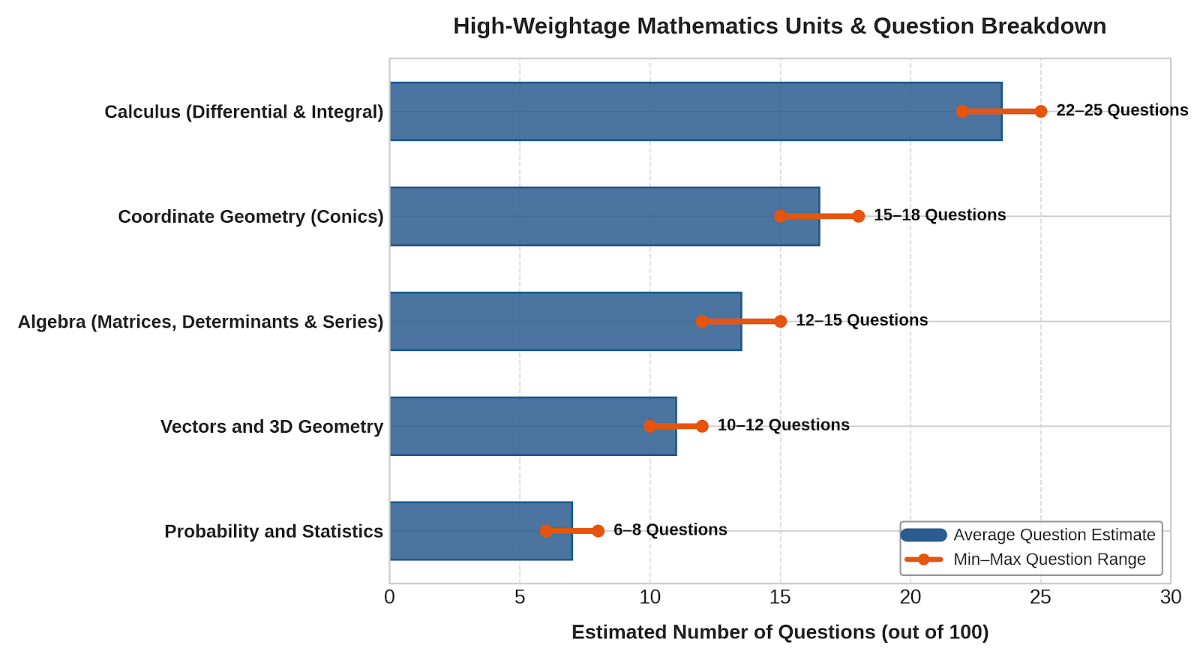
- Calculus alone accounts for up to a quarter of the Mathematics paper, making it the clear first-priority topic in the BCECE exam syllabus for this subject.
| High-Weightage Unit | Estimated Questions (of 100) | Core Areas to Target |
|---|---|---|
| Calculus (Differential & Integral) | 22–25 | Limits, Continuity, Definite Integrals, Maxima-Minima |
| Coordinate Geometry (Conics) | 15–18 | Straight Lines, Circles, Parabola, Ellipse |
| Algebra (Matrices, Determinants & Series) | 12–15 | Cramer's Rule, AP/GP, Quadratic Roots |
| Vectors and 3D Geometry | 10–12 | Shortest Distance, Dot/Cross Products |
| Probability and Statistics | 6–8 | Conditional Probability, Bayes' Theorem |
BCECE Agriculture: High-Weightage Topics
Crop Production carries the highest weightage in the Agriculture paper, with a strong emphasis on Bihar-specific soil and crop conditions.
- Introductory Agriculture & Agrometeorology: 15–18 questions on crop seasons, weather hazards, and tillage.
- Crop Production: 20–22 questions on seed treatment, spacing, and weed control for paddy, wheat, and maize.
- Horticulture: 15–17 questions on propagation methods and fruit/vegetable preservation.
Ques. Is the BCECE syllabus the same as the NEET syllabus?
Ans. Both draw from NCERT Class 11 and 12, so overlap is high, particularly in Biology and Inorganic Chemistry, but BCECE weights Agriculture and state-specific crop topics that NEET does not test at all.
Ques. Does BCECE have sectional choice like JEE or NEET?
Ans. No. All 100 questions in every BCECE subject paper are compulsory, unlike JEE and NEET, which both allow candidates to skip a portion of Section B questions.
What Is the Difficulty Level of BCECE?
BCECE's conceptual difficulty stays close to NCERT level, but its faster pace and compulsory full-paper format make it different from JEE or NEET.
- Past rank matrices show that an aggregate score of 720+ out of 1,200 (roughly 60%) has reliably secured premier seats like MIT Muzaffarpur (Dairy Technology) or Bihar Agricultural University, Sabour.
- Across the past five years, up to 85% of Biology and Inorganic Chemistry questions have been derived directly from NCERT textbook side-notes and exemplar exceptions.
Also Check:
BCECE Exam Pattern vs JEE vs NEET 2027
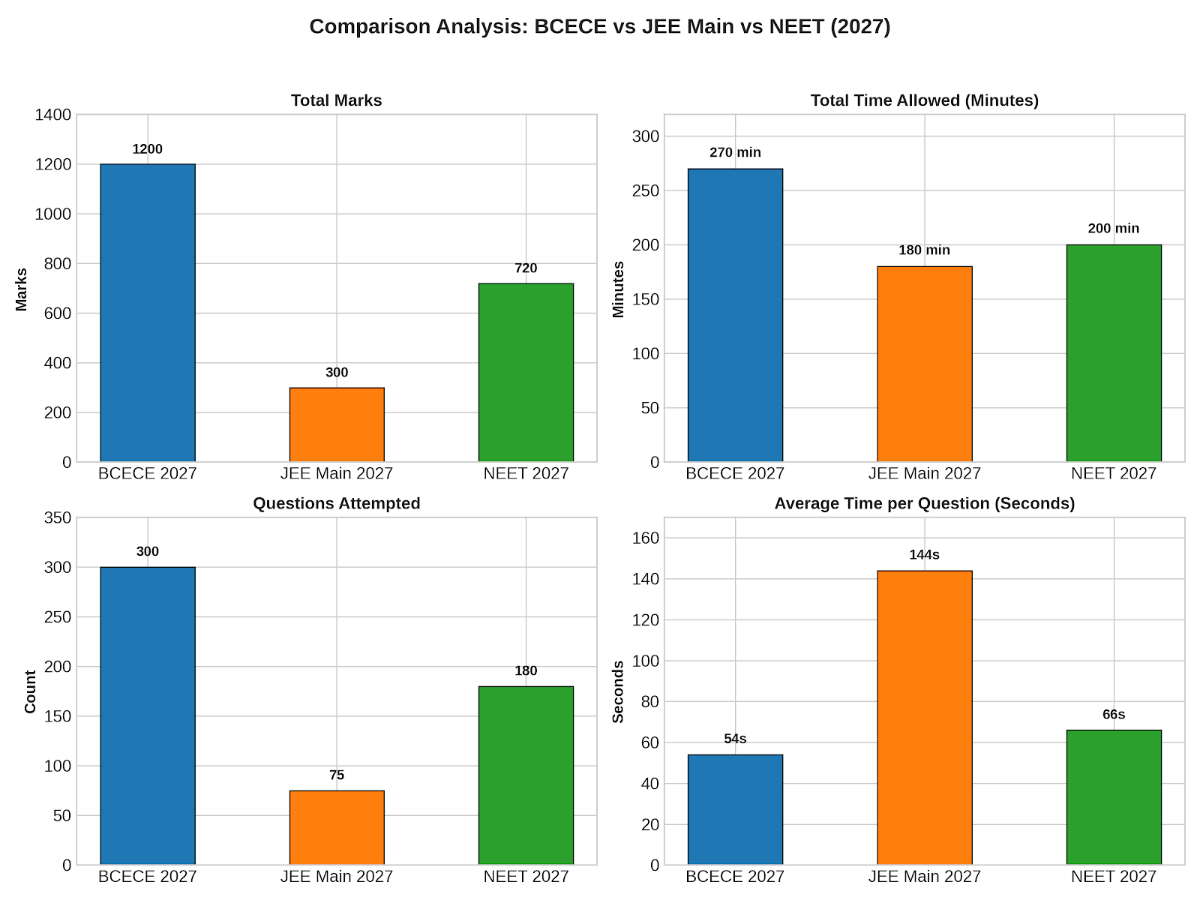
BCECE, JEE Main, and NEET share the same +4/-1 marking scheme, but differ a lot in pacing, structure, and how much choice candidates get within each paper.
- BCECE gives candidates roughly 54 seconds per question, faster than NEET's 66 seconds and much less than JEE Main's 144 seconds, so BCECE rewards quick formula recall and execution speed.
- JEE and NEET aspirants also preparing for BCECE will find the Physics, Chemistry, Mathematics, and Biology content mostly familiar; the main adjustment is pacing, not conceptual difficulty.
- BCECE conducts each subject as a separate paper in its own time slot, unlike JEE and NEET, which combine all subjects into a single exam window, so BCECE tests sustained focus across multiple sittings rather than one continuous exam.
| Feature | BCECE 2027 | JEE Main 2027 | NEET 2027 |
|---|---|---|---|
| Exam Authority | State Board (BCECEB) | NTA | NTA |
| Mode of Exam | Offline (OMR) | Online (CBT) | Offline (OMR) |
| Total Time Allowed | 90 min/subject (4.5 hrs for 3 papers) | 180 min total | 200 min total |
| Structure | Separate papers per subject, in shifts | All subjects combined in one window | All 4 subjects in one window |
| Number of Questions | 300 total (100 per subject) | 90 total (75 attempted) | 200 total (180 attempted) |
| Internal Choice | All questions compulsory | Section B choice (5 out of 10) | Section B choice (10 out of 15 per subject) |
| Marking Scheme | +4 correct, -1 incorrect | +4 correct, -1 incorrect | +4 correct, -1 incorrect |
| Total Marks | 1,200 | 300 | 720 |
| Average Time per Question | 54 seconds | 144 seconds | 66 seconds |
Ques. Is BCECE easier than JEE and NEET?
Ans. Conceptually similar, since all three test NCERT-based content with the same marking scheme — the key difference is pacing: BCECE allows less time per question and offers no sectional choice.
Ques. Where can I check BCECE exam date and registration details?
Ans. All updates on BCECE registration, form date, exam date, result, and counselling are published on the official BCECEB website once the board releases its notification for the cycle.
BCECE 2027 Preparation Tips
Cracking the BCECE exam pattern comes down to combining thorough NCERT reading with heavy question practice, since the exam rewards fast, accurate execution over deep multi-step problem-solving.
| Preparation Strategy | What to Do |
|---|---|
| Build a realistic timeline | Target completing the full BCECE syllabus in around 10 months, keeping the final 2 months for PYQs, revision, and timed mock practice. |
| Choose a preparation track that fits your budget | Choose either a structured paid batch or free, well-reviewed lecture series. Older lectures can also work if the syllabus coverage is current. |
| Read NCERT line by line | Read NCERT thoroughly for Chemistry and Biology along with lectures, as many BCECE Biology and Inorganic Chemistry questions come directly from NCERT. |
| Pair every topic with an NCERT-based question bank | Study a topic and immediately solve questions from the same topic before moving ahead. |
| Use NEET PYQs | When BCECE-specific practice material is limited, use NEET PYQs, especially for Biology and Chemistry. |
| Practice alongside the syllabus | Follow a simple cycle: Study the concept → Solve topic-wise questions → Revise → Attempt PYQs. |
| Use the final two months for execution | Complete PYQs, revise NCERT repeatedly, identify weak chapters, and build speed through timed practice instead of learning new content. |
| Stay confident with difficult papers | A tough BCECE paper becomes manageable when concepts are clear. Consistent preparation throughout the year matters more than the difficulty of one sitting. |
BCECE Exam Pattern FAQs
Ques. What is BCECE?
Ans. BCECE is the Bihar Combined Entrance Competitive Examination, a state-level Bihar engineering exam and professional entrance test conducted by the BCECEB for Pharmacy, Agriculture, Nursing, Paramedical, and Dairy Technology courses.
Ques. What is the BCECE full form?
Ans. Bihar Combined Entrance Competitive Examination — conducted by the Bihar Combined Entrance Competitive Examination Board (BCECEB).
Ques. What is the BCECE exam pattern?
Ans. Each subject paper carries 100 compulsory MCQs for 400 marks, with +4 for a correct answer and -1 for an incorrect one, conducted offline in OMR format over 90 minutes per subject.
Ques. Where can I download the BCECE syllabus PDF?
Ans. The official BCECE syllabus PDF is released by the BCECEB on its official website along with the exam notification; the syllabus itself is based on the NCERT Class 11 and 12 curriculum.
Ques. What is the BCECE course list?
Ans. BCECE offers six subject-group combinations: PCM, PCB, PCMB, CBA, MBA, and MCA, each leading to a different set of eligible undergraduate degree options.
Ques. Is BCECE conducted only in Bihar?
Ans. Yes, BCECE is a Bihar-specific state entrance exam, with exam centres located across cities in Bihar, including Patna, and admissions limited to institutions within the state.



Comments