




BCECE 2027 preparation should be based on the student’s current level, understanding of the syllabus, previous-year question papers, and mock-test practice. Students should focus on important topics in Physics, Chemistry, Mathematics, or Biology while improving their speed, accuracy, and time management.
- BCECE 2027 preparation should begin with the Class 11 and 12 NCERT syllabus, followed by concept building, chapter-wise practice, previous-year questions (PYQs), mock tests, and final revision.
- Solve previous-year papers to understand question patterns and difficulty levels. Practise timed mock tests regularly to improve accuracy, speed, and time management.
- In the final phase, focus on revising important concepts, formulas, reactions, and short notes. Analyse mistakes and avoid starting too many new topics just before the exam.
- Prioritise high-weightage topics in Physics, Chemistry, and Mathematics or Biology, depending on your chosen stream. Give extra attention to frequently tested concepts and numerical problems.
- For Chemistry, revise Physical, Organic, and Inorganic Chemistry, focusing on NCERT-based reactions, equations, periodic trends, and conceptual questions.
- For Physics, focus on core topics such as Current Electricity, Electrostatics, Modern Physics, Optics, and Mechanics. In Mathematics, prioritise Calculus, Coordinate Geometry, Algebra, and Vectors; Biology students should revise Genetics, Human Physiology, Ecology, and Reproduction.
Related Links:
- BCECE 2027 Question Paper: Download Previous Years’ Question Paper and Answer Key PDFs
- BCECE Mock Test 2027 Online Free, Check Subject-wise Mock Test
BCECE Preparation 2027
Candidates preparing for BCECE 2027 should begin by understanding the exam syllabus and building a strong foundation in Physics, Chemistry, Mathematics, or Biology, depending on their chosen course.
Follow these steps to start your preparation effectively:
| Step | Preparation Strategy | What to Do |
|---|---|---|
| 1 | Understand the Syllabus | Review the BCECE 2027 syllabus and identify topics from Class 11 and 12 Physics, Chemistry, Mathematics, or Biology. |
| 2 | Study NCERT Textbooks | Build strong fundamentals using NCERT textbooks and practise basic numerical problems. |
| 3 | Create a Study Timetable | Allocate daily study hours to each subject and dedicate extra time to difficult topics. |
| 4 | Focus on Important Topics | Prioritise frequently tested chapters while ensuring complete syllabus coverage. |
| 5 | Solve Previous-Year Papers | Practise previous-year questions to understand question patterns and difficulty levels. |
| 6 | Attempt Mock Tests | Take regular mock tests to improve speed, accuracy, and time management. |
| 7 | Revise Regularly | Prepare short notes, revise formulas and reactions, and analyse mistakes to improve weak areas. |
Preparation Tip: Avoid relying entirely on expected important topics. Complete the syllabus systematically and practise questions regularly to build confidence for BCECE 2027.
BCECE Preparation 2027: How to crack it in the first attempt?
Cracking BCECE 2027 on the first attempt requires a clear study plan, consistent practice, and regular revision. Candidates should focus on understanding concepts rather than memorising answers and tailor their preparation to the subjects required for their chosen course. Follow these tips to improve your preparation:
- Complete the Syllabus on Time: Divide the syllabus into manageable sections and set weekly targets to cover all subjects before beginning intensive revision.
- Strengthen NCERT Concepts: Study Class 11 and 12 NCERT textbooks, particularly for Chemistry and Biology, while practising numerical problems in Physics and Mathematics.
- Practise Questions Daily: Solve chapter-wise questions after completing each topic to identify conceptual gaps and improve problem-solving speed.
- Use Previous-Year Papers: Practise available BCECE previous-year papers and sample questions to understand the exam pattern and identify topics that need more attention.
- Take Mock Tests Regularly: Attempt timed mock tests and analyse your performance after each test. Focus on reducing repeated mistakes and improving accuracy.
- Revise Short Notes: Maintain a notebook of important formulas, reactions, definitions, and difficult concepts for quick revision before the examination.
- Manage Time Effectively: Follow a realistic daily timetable that balances learning new topics, practising questions, and revising completed chapters.
- Avoid Last-Minute Learning: Use the final weeks for revision, mock tests, and error analysis instead of starting several unfamiliar chapters.
BCECE Preparation 2027: Subject-wise Strategy
Focus on Mathematics or Biology according to your chosen course and the applicable BCECE 2027 requirements. Combine subject-wise preparation with previous-year questions, mock tests, and regular revision.
| Subject | Important Topics | Preparation Strategy |
|---|---|---|
| Physics | Mechanics, Current Electricity, Electrostatics, Optics, Thermodynamics, Modern Physics |
|
| Chemistry | Physical, Organic, and Inorganic Chemistry |
|
| Mathematics | Calculus, Algebra, Coordinate Geometry, Trigonometry |
|
| Biology | Genetics, Human Physiology, Ecology, Reproduction, Biotechnology |
|
Also Read: BCECE Syllabus 2027: Subject-wise Topics, Total Marks, Preparation Tips & Best Books
BCECE Preparation 2027: Physics Preparation Tips
Focus on understanding how formulas work rather than memorising them. Consistent numerical practice, revision, and mock-test analysis can strengthen your Physics preparation for BCECE 2027.
| Preparation Strategy | What to Do |
|---|---|
| Build Conceptual Clarity | Study NCERT textbooks and understand fundamental laws, principles, and derivations before attempting complex questions. |
| Prioritise Important Chapters | Focus on Mechanics, Current Electricity, Electrostatics, Optics, Thermodynamics, and Modern Physics while covering the complete prescribed syllabus. |
| Practise Numerical Questions | Solve problems involving formulas, calculations, and practical applications to improve accuracy and problem-solving speed. |
| Maintain a Formula Notebook | Record important formulas, units, dimensions, and related concepts for quick revision before the exam. |
| Understand Diagrams and Graphs | Practise circuit diagrams, ray diagrams, and graphical questions to strengthen conceptual understanding. |
| Solve Previous-Year Questions | Practise available BCECE previous-year questions and objective questions to understand question patterns and identify weak areas. |
| Take Timed Mock Tests | Attempt regular timed practice tests to improve speed, accuracy, and question selection. |
| Analyse Mistakes and Revise | Review incorrect answers, identify conceptual gaps, and revise challenging chapters regularly. |
BCECE Preparation 2027: Chemistry Preparation Tips
Chemistry can be a scoring subject in BCECE 2027 if candidates balance conceptual understanding, reaction memorisation, and regular practice. Candidates should prepare Physical, Organic, and Inorganic Chemistry separately while following the prescribed syllabus.
| Preparation Strategy | What to Do |
|---|---|
| Study NCERT Textbooks | Read Class 11 and 12 NCERT Chemistry textbooks to understand fundamental concepts, reactions, definitions, and examples. |
| Divide the Syllabus | Prepare Physical Chemistry through numerical practice, Organic Chemistry through reaction mechanisms, and Inorganic Chemistry through conceptual and factual revision. |
| Practise Numerical Problems | Solve questions on Chemical Equilibrium, Thermodynamics, Chemical Kinetics, and Solutions to improve calculation speed and accuracy. |
| Prepare Reaction Notes | Maintain a notebook of important organic reactions, reagents, reaction conditions, and chemical equations for quick revision. |
| Revise Inorganic Chemistry | Focus on periodic properties, chemical bonding, coordination compounds, and other topics included in the prescribed syllabus. |
| Solve Chapter-wise MCQs | Practise objective questions after completing each chapter to test your understanding and identify weak areas. |
| Attempt Mock Tests and PYQs | Solve previous-year questions and timed mock tests to improve speed, accuracy, and familiarity with the question format. |
| Revise Regularly | Review completed chapters every week, analyse mistakes, and revisit concepts that need more practice. |
BCECE Preparation 2027: Biology Preparation Tips
Biology preparation for BCECE 2027 requires thorough textbook reading, regular revision, and consistent practice of multiple-choice questions (MCQs). Candidates should focus on understanding biological processes, remembering scientific terminology, and interpreting diagrams accurately.
| Preparation Strategy | What to Do |
|---|---|
| Read NCERT Textbooks Carefully | Study Class 11 and 12 NCERT Biology textbooks to understand concepts, definitions, examples, and biological processes. |
| Focus on Important Topics | Prioritise Genetics, Human Physiology, Reproduction, Ecology, Cell Biology, and Biotechnology while covering the complete prescribed syllabus. |
| Practise Diagram-Based Questions | Revise labelled diagrams, biological structures, life cycles, and flowcharts to strengthen visual recall and conceptual understanding. |
| Prepare Chapter-wise Short Notes | Record scientific names, biological terms, examples, processes, and important differences for quick revision. |
| Solve MCQs Regularly | Practise chapter-wise objective questions to improve recall and identify concepts that require further revision. |
| Revise Frequently | Follow a weekly revision schedule to retain factual information and strengthen previously studied topics. |
| Attempt Previous-Year Questions | Solve available BCECE previous-year papers and relevant practice questions to understand question formats and recurring concepts. |
| Take Mock Tests | Attempt timed subject-wise tests and analyse incorrect answers to improve accuracy and identify weak areas. |
BCECE Preparation 2027: Mathematics Preparation Tips
Mathematics preparation for BCECE 2027 requires a clear understanding of formulas, regular problem-solving practice, and effective time management.
- Students should begin with the basic concepts of Class 11 and 12 Mathematics before moving on to complex numerical problems.
| Preparation Strategy | What to Do |
|---|---|
| Understand the Syllabus | Review the BCECE Mathematics syllabus and identify important topics such as Calculus, Algebra, Coordinate Geometry, Trigonometry, and Probability. |
| Build Conceptual Clarity | Understand mathematical concepts thoroughly instead of memorising formulas without knowing their applications. |
| Prepare a Formula Notebook | Maintain a separate notebook of important formulas, identities, theorems, and shortcut methods for quick revision. |
| Practise Questions Daily | Start with basic numerical problems and gradually progress to questions of greater difficulty. |
| Solve Previous-Year Papers | Practise previous-year BCECE questions to understand the exam pattern, recurring question types, and difficulty level. |
| Attempt Mock Tests | Take timed mock tests regularly to improve calculation speed, accuracy, and question-selection skills. |
| Revise Weak Topics | Analyse mistakes after each practice session and devote additional time to topics that need improvement. |
| Improve Calculation Speed | Learn mental calculation techniques and shortcuts while ensuring that accuracy is not compromised. |
BCECE Preparation 2027: Mock Test
| BCECE Mock Test | Download PDF |
|---|---|
| Mock Test 1 | Download PDF |
| Mock Test 2 | Download PDF |
| Mock Test 3 | Download PDF |
| Mock Test 4 | Download PDF |
| Mock Test 5 | Download PDF |
BCECE Preparation 2027: 3-month Plan
Chemistry and Biology questions in BCECE are directly sourced or derived from NCERT textbooks. Ensure line-by-line reading.
- Formula & Reaction Notebook: Maintain a separate notebook for Physics formulas, Mathematical theorems, and Organic/Inorganic Chemistry reaction mechanisms for daily quick revision.
- Time Management: Allocate 6 to 8 hours daily during Month 1, increasing to 8 to 10 hours daily in Months 2 and 3 for mock tests and analysis.
| Month | Focus Area | Key Objectives & Tasks |
|---|---|---|
| Month 1 | Core Concepts & High-Weightage Topics |
|
| ||
| ||
| ||
| Core Concepts & Core Practice | Physics: Current Electricity, Magnetism. | |
| Chemistry: Thermodynamics, Equilibrium, Organic Chemistry basics. | ||
| Math/Bio: Algebra (Matrices, Determinants) or Genetics & Evolution. | ||
| Action: Complete chapter-end questions and standard question bank MCQs. | ||
| High-Weightage Expansion |
| |
| ||
| ||
| ||
| Class 11th & 12th Bridge + Initial Review |
| |
| ||
| ||
| ||
| Month 2 | Chapter-Wise PYQs & Speed Building |
|
| ||
| ||
| Intensive Problem Solving |
| |
| ||
| ||
| Full-Length Mock Tests (Phase 1) |
| |
| ||
| Target Weakness & Revision |
| |
| ||
| ||
| Month 3 | Advanced Mock Tests & Strategy |
|
| ||
| Rapid Formula & Reaction Revision |
| |
| ||
| Final Mock Tests & Analysis |
| |
| ||
| Light Revision & Mental Prep |
| |
| ||
|
Also Read: BCECE 2027 Topper Marks: AIR 1 Score and Subject-Wise Breakdown
BCECE Preparation 2027: 6-month Plan
For the BCECE Preparation, cover Class 11 and 12 fundamentals thoroughly through NCERT during the first 5 months.
Reserve the final month strictly for previous years' questions, high-yield formula revisions, and timed full-length mock tests.
| Month | Topics/Tasks to Cover | Recommended Strategy |
|---|---|---|
| Month 1: Understand the Syllabus | Review the BCECE syllabus and exam pattern. Start with basic concepts in Physics, Chemistry, and Mathematics/Biology, as applicable. | Follow NCERT textbooks, identify important topics, and prepare a realistic daily timetable. |
| Month 2: Complete Core Concepts | Cover fundamental chapters, important formulas, chemical reactions, and essential numerical concepts. | Study regularly, prepare short notes, and solve topic-wise MCQs after each chapter. |
| Month 3: Continue Syllabus Completion | Study advanced chapters, practise numerical problems, and revise previously completed topics. | Focus on conceptual clarity and maintain a record of difficult questions and mistakes. |
| Month 4: Practice Previous-Year Questions | Solve BCECE previous-year questions, practise chapter-wise tests, and revisit weak areas. | Analyse question patterns, improve accuracy, and revise formulas and key concepts daily. |
| Month 5: Revision and Mock Tests | Revise the completed syllabus, attempt full-length mock tests, and practise mixed-topic questions. | Simulate exam conditions and analyse each test to identify areas requiring improvement. |
| Month 6: Final Preparation | Revise short notes, important formulas, reactions, and frequently tested concepts. Attempt regular mock tests. | Focus on weak topics, manage time effectively, and avoid starting large new topics during the final days. |
How to score 500 plus marks in BCECE 2027?
To score 500+ marks in BCECE 2027, candidates should focus on conceptual clarity, important topics, regular MCQ practice, and previous-year question papers.
- An effective BCECE Preparation 2027 strategy should include daily revision, regular mock tests, and time management.
- And consistent analysis of mistakes to improve speed and accuracy before the exam.
- To achieve a top score in BCECE 2027 (out of 1200 marks across 3 subjects, with 400 marks per subject), aim for an accuracy rate of 80% or higher.
- Follow a high-yield preparation strategy, as each correct answer carries +4 marks and each incorrect answer incurs a -1 mark penalty.
- Practise time management carefully, as you have approximately 54 seconds per question (100 questions in 90 minutes per subject).
| Preparation Step | Study Strategy |
|---|---|
| Understand the Syllabus | Review the BCECE 2027 syllabus and exam pattern. Identify important topics in Physics, Chemistry, and Mathematics/Biology based on your chosen stream. |
| Build Conceptual Clarity | Study NCERT textbooks and focus on understanding fundamental concepts, formulas, reactions, and numerical methods. |
| Prioritise Important Topics | Focus on high-priority chapters and frequently tested concepts while ensuring balanced preparation across subjects. |
| Practise MCQs Daily | Solve topic-wise multiple-choice questions to improve accuracy, problem-solving skills, and familiarity with question patterns. |
| Solve Previous-Year Papers | Practise BCECE previous-year questions to understand the exam format, question difficulty, and commonly tested concepts. |
| Revise Regularly | Prepare short notes containing important formulas, chemical reactions, definitions, and difficult concepts for quick revision. |
| Attempt Mock Tests | Take mock tests under exam-like conditions to improve speed, accuracy, and time management. |
| Analyse Mistakes | Review incorrect answers, identify weak topics, and practise similar questions to avoid repeating mistakes. |
| Manage Negative Marking | Attempt questions carefully, avoid blind guessing, and prioritise questions you can solve confidently. |
| Focus on Final Revision | Revise important concepts, practise weak areas, and review short notes instead of starting multiple unfamiliar topics at the last minute. |
Important Topics for BCECE Preparation 2027
| Subject | Important Topics to Focus On |
|---|---|
| Physics | Laws of Motion, Work, Energy and Power, Current Electricity, Electrostatics, Optics, Magnetism, Thermodynamics, Modern Physics, and Waves |
| Chemistry | Chemical Bonding, Coordination Compounds, Chemical Equilibrium, Electrochemistry, Chemical Kinetics, Organic Chemistry, Thermodynamics, Solutions, and Periodic Properties |
| Mathematics | Calculus, Matrices and Determinants, Probability, Vectors and 3D Geometry, Coordinate Geometry, Complex Numbers, Permutations and Combinations, and Trigonometry |
| Biology | Cell Biology, Genetics and Evolution, Human Physiology, Plant Physiology, Ecology, Reproduction, Biotechnology, and Biology in Human Welfare |
Key Pillars to Score 90%+ Marks
- Master NCERT Word-for-Word: Over 85% of Chemistry and Biology questions, and fundamental conceptual questions in Physics/Math, are direct derivations from Class 11 and 12 NCERT textbooks.
- Speed & Elimination Strategy: Since you have under a minute per question, prioritize direct factual and formula-based questions first, skipping lengthy numericals on your first pass.
- Target High-Weightage Chapters: Focus heavily on key revenue units like Calculus & Coordinate Geometry in Math, Organic & Coordination Chemistry, Genetics & Physiology in Biology, and Mechanics & Electrodynamics in Physics.
Also Read:
BCECE Preparation 2027: Time management tips for students
Effective time management is essential for BCECE Preparation 2027, as candidates need to balance syllabus completion, revision, and regular question practice.
- A well-planned routine helps students improve accuracy, strengthen weak areas, and prepare confidently for the examination.
1. Adopt the "3-Pass Strategy"
Divide your 90 minutes into three strict passes rather than solving sequentially:
- Pass 1 (First 30–35 Minutes): Target 100% direct, memory-based, or single-step formula questions. In Chemistry or Biology, almost 40–50% of questions are factual NCERT lines requiring 15–20 seconds each.
- Pass 2 (Next 35–40 Minutes): Tackle moderate-length numericals in Physics or multi-step concepts in Math.
- Pass 3 (Final 15 Minutes): Attempt remaining skipped questions that require extra calculation and finalize your OMR sheet.
2. The 90-Second Skip Rule
Never let a single question drag down your score. If you cannot identify the formula or approach within 20 seconds of reading a question, skip it immediately and mark it for Pass 2. Spending 3 minutes on one stubborn question costs you 3 easy questions elsewhere.
3. Standardize Subject Order
If taking the joint PCM/PCB exam:
- Start with Chemistry/Biology: These subjects yield the highest score-to-time ratio.
- End with Physics/Mathematics: These require maximum calculation and scratchpad work, so finishing theoretical questions early prevents last-minute panic.
4. Factor in OMR Bubbling Time
Filling 100 OMR bubbles takes 8 to 10 minutes. Never leave OMR filling to the final 5 minutes. Bubble your answers in blocks (e.g., page-by-page or every 15 questions) to avoid offset errors and time crunches.
Phase 2: Daily Study & Preparation Time Management
1. Use the 60-30-10 Daily Split
Allocate your daily study hours across three core activities:
| Focus Area | Allocation | Execution |
|---|---|---|
| New Concepts & NCERT | 60% | Dedicated block for reading NCERT line-by-line and understanding core theory. |
| Timed MCQ Drilling | 30% | Solving questions strictly against a stopwatch (target: 60 questions in 50 minutes). |
| Revision & Formula Drill | 10% | Review formula notebooks, named reactions, and sticky notes daily. |
2. Practice "Stopwatch Solving"
Never solve practice sets at a leisurely pace. When doing chapter-wise question banks at home:
- Set a timer for 45 minutes per 50-question block.
- Track your solving rate (questions per minute) alongside your accuracy percentage.
3. Protect Peak Energy Hours
- Morning (High Cognitive Load): Reserve for Physics numericals, Complex Math, or difficult Organic Chemistry mechanisms.
- Afternoon/Evening (Medium Energy): Dedicate to NCERT reading, Biology/Inorganic memorization, and watching problem-solving tutorials.
- Night (Low Energy): Use for formula revision, error notebook reviews, and quick flashcard drills.
4. Build an Error Log to Stop Time-Wasting
Maintain a dedicated log categorizing every wrong question from practice tests into three buckets:
- Type A (Calculation Error): Slow speed / poor scratchpad organization.
- Type B (Conceptual Gap): Need to re-read the topic.
- Type C (Time Trap): Lengthy question that should have been skipped in Pass 1.
Reviewing this log weekly ensures you don't repeat the same time-wasting mistakes on exam day.
Best Books for the BCECE Preparation 2027
Complete the relevant Class 11 and 12 textbooks before moving to reference books.
- Avoid collecting multiple books that cover the same topics.
- Use BCECE question papers and mock tests to understand question patterns and improve speed.
- Maintain short notes for formulas, chemical reactions, biological diagrams, and important concepts.
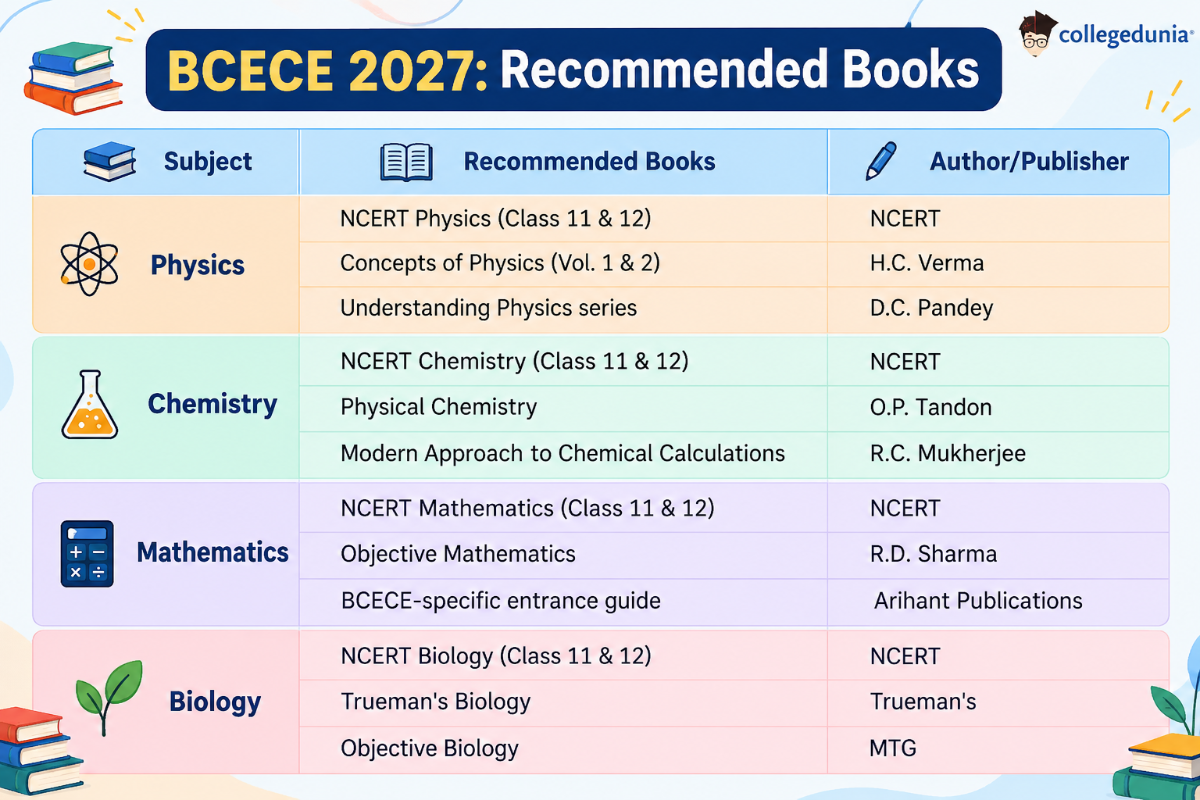
| Subject | Recommended Books | Author/Publisher | Best For |
|---|---|---|---|
| Physics | NCERT Physics (Class 11 & 12) | NCERT | Conceptual understanding and fundamentals |
| Physics | Concepts of Physics (Vol. 1 & 2) | H.C. Verma | Concept building and numerical practice |
| Physics | Understanding Physics series | D.C. Pandey | Objective questions and problem-solving |
| Chemistry | NCERT Chemistry (Class 11 & 12) | NCERT | Core concepts, reactions, and theory |
| Chemistry | Physical Chemistry | O.P. Tandon | Numerical problems and conceptual practice |
| Chemistry | Modern Approach to Chemical Calculations | R.C. Mukherjee | Physical Chemistry calculations |
| Mathematics | NCERT Mathematics (Class 11 & 12) | NCERT | Fundamental concepts and exercises |
| Mathematics | Objective Mathematics | R.D. Sharma | MCQ practice and problem-solving |
| Mathematics | BCECE-specific entrance guide | Arihant Publications | Exam-oriented practice |
| Biology | NCERT Biology (Class 11 & 12) | NCERT | Diagrams, concepts, and factual revision |
| Biology | Trueman's Biology | Trueman's | Detailed explanations and topic revision |
| Biology | Objective Biology | MTG | MCQ practice and revision |
BCECE Preparation 2027 FAQs
Ques. Is the BCECE exam tough?
Ans. No, the BCECE exam is generally considered moderate and is easier than national-level exams like JEE Main or NEET. However, its difficulty lies in the tight time constraint, requiring you to solve 100 NCERT-based questions in just 90 minutes per subject, making speed and accuracy the primary factors for success.
Ques. Is NCERT enough for BCECE?
Ans. NCERT books are a good foundation for BCECE preparation, especially for understanding Physics, Chemistry, Mathematics, and Biology concepts. However, NCERT alone may not be sufficient to score high marks. Practise previous-year question papers, mock tests, and additional numerical problems to improve speed, accuracy, and exam readiness.
Ques. How much rank is required for BCECE?
Ans. For BCECE, a rank under 1,000–2,000 can improve your chances of getting admission to a top government college, while lower-ranked candidates may also secure seats depending on the course, category, and college.
Ques. How important is negative marking in BCECE and how should I handle it during preparation?
Ans. Each subject paper has 100 MCQs (4 marks for correct, –1 for incorrect, 0 for unattempted). Negative marking makes accuracy crucial. During preparation, practice only attempting questions you are reasonably sure about. In mock tests, analyse your accuracy rate and avoid random guessing. Train yourself to leave doubtful questions rather than risk losing marks.
Ques. How should I manage time while preparing for multiple subjects (e.g., PCM or PCB)?
Ans. Divide study hours proportionally based on your strengths and the weightage of topics. Aim for consistent daily coverage of all subjects rather than focusing on one for long stretches. Practice solving 100 questions in 90 minutes for each subject regularly. In the final 2–3 months, prioritise full-length mock tests under timed conditions and analyse weak areas weekly.
Ques. Is coaching necessary for BCECE 2027, or can self-study be enough?
Ans. Self-study is sufficient if you follow a disciplined plan, stick to NCERT + standard reference books, solve previous year papers, and take regular mocks. Coaching can help with structured guidance, doubt-clearing, and a competitive environment, especially if you struggle with consistency or concepts. Many toppers succeed through pure self-study combined with online resources and test series.



Comments