




CAT 2026 is scheduled for November 29, 2026, giving candidates around seven weeks to do their preparation into exam performance. With CAT 2026 scheduled for November 29, 2026, the remaining three months can be used for focused preparation, practice and revision.
At this stage, CAT preparation should focus less on completing every topic and more on mock tests, previous year question papers, revision, accuracy and question selection.
Candidates can track progress, such as improving mock-test accuracy from around 70-75% during the initial stage to 80% or higher as preparation progresses.
- Prioritise Arithmetic & Algebra (Quant), LRDI set families, and RC-based VARC, as these have the highest weightage, instead of trying to complete every topic.
- Regular mocks should be followed by detailed analysis of attempts, time management, question selection, and mistakes to identify score gaps and improve exam strategy.
- Aim to improve reading speed and accuracy, while tracking attempts and correct answers across mocks.
- Practise different set types and track how often you select the right set and solve it accurately.
- Prioritise Arithmetic and Algebra first, then measure improvement through timed mixed-question practice.
- Read 45-60 minutes daily for VARC, practise LRDI sets by identifying set families, and solve CAT-level questions under timed conditions.
CAT 2026 Preparation Kit
Prepare Smart. Practice Better.
Access essential CAT preparation resources for every stage of your exam preparation.
Complete CAT 2026 Syllabus
Get the complete CAT 2026 syllabus covering VARC, DILR and Quantitative Aptitude.
Download PDF →CAT PYQ Papers
Practice with CAT previous year question papers to understand the exam pattern and question trends.
Download PDF →CAT 2026 Exam Preparation Plan
Follow a structured preparation plan covering revision, practice, PYQs, sectional tests and mocks.
Download PDF →Related Articles:
- CAT 2026 Preparation Online: Coaching, Free Courses, Study Material, Online YouTube and Reddit
- CAT Topic-Wise Weightage for QA, VARC and DILR, Check Previous Years’ Questions
- CAT Study Material 2026: Download Free CAT Study Material PDF for VARC, DILR, and Quant

Key Summary
- Focus on high-scoring topics: Prioritise Arithmetic, Algebra, LRDI set practice, and RC-based VARC preparation.
- Follow a phased 4-month plan: Build concepts first, move to application, and finish with revision and mock-intensive practice.
- Analyse every mock: Track mistakes, time management, question selection, and accuracy to improve scores.
- Prioritise consistency over resources: Regular practice, error tracking, and limited quality materials are key for CAT success.
CAT Preparation 2026: What Should Be the Focus Now?
The final 50 days should be divided into phases instead of following the same routine every day. The focus should gradually move from concept revision to timed practice and then exam simulation.
| Period | Main Focus | What to Track |
|---|---|---|
| Oct 7–20 | Concept revision + weak-area identification | Topic accuracy, time taken, recurring mistakes |
| Oct 21–Nov 10 | PYQs + sectionals + mixed practice | Sectional scores, attempts, accuracy |
| Nov 11–20 | Full mocks + strategy refinement | Mock score, question selection, time management |
| Nov 21–28 | Revision + error log + exam strategy | Consistency across mocks |
| Nov 29 | CAT 2026 | Execute the tested strategy |
As per a video on the YouTube channel CATKing, candidates preparing for CAT 2026 can follow a clear plan. In the final two months, the focus should be on accuracy, PYQs, mock tests, and revision.
- Candidates should gradually increase preparation intensity:
- 5-6 hours/day in October, with greater focus on practice and mocks, and
- 6+ hours/day in November, shifting focus to revision, mocks, and exam readiness.
- Instead of trying to cover every topic, the strategy prioritises areas where you can target maximum CAT marks. It includes Arithmetic & Algebra in Quant, major LRDI set families, and RC-based VARC preparation.
- Accuracy over attempts in mocks. A lower number of correct attempts with high accuracy is more valuable than attempting more questions with negative marking.
- Every mock should be analysed in three ways:
- Attempt Analysis: Which questions should have been attempted but were missed? Which questions should have been skipped?
- Time Analysis: Where was time wasted? Which questions consumed too much time without enough return?
- Mistake Analysis: Identify errors due to concepts, calculation mistakes, wrong selection, or pressure handling.
Also Read: CAT 2026 Preparation Online: Coaching, Free Courses
Month Oct: Intensive Practice and Performance Improvement
In month 2, focus on expanding the concepts learnt and applying them in practice:
- Finish remaining Arithmetic and begin Algebra topics like equations, inequalities, functions, and powers.
- Move towards CAT-level LRDI sets and improve RC accuracy through deeper analysis.
- Start regular sectional tests and mocks with detailed mistake analysis
| Area | Topics to Cover | Strategy |
|---|---|---|
| Quant | Remaining Arithmetic and Algebra | Strengthen weak concepts and improve problem-solving speed through CAT-level practice. |
| VARC | Mixed RC passages and VA questions | Increase attempts while analysing the reasons behind incorrect answers. |
| LRDI | Games & Tournaments, Arrangements, Puzzles and other major set types | Practise different set formats and improve set selection and accuracy. |
| PYQs | CAT previous-year questions | Solve PYQs extensively to understand question patterns and difficulty levels. |
| Mocks | Around 1 mock every 4–5 days | Analyse each mock for attempts, time usage, accuracy and recurring mistakes. |
Ques. How many hours should I study daily for CAT 2026 preparation?
Ans. Aspirants should gradually increase preparation time from around 4–5 hours/day in the first month to 6+ hours/day during the final months, depending on their preparation level and availability.
Month Nov: Final Revision and Exam Readiness
The final month should focus on revision, mock-intensive practice and developing a consistent exam-day strategy rather than learning new topics.
| Area | Topics to Cover | Strategy |
|---|---|---|
| Quant | Complete revision and weak areas | Revise formulas, concepts and previous mistakes while strengthening important weak areas. |
| VARC | RC and VA practice | Practise under timed conditions and refine question-selection and option-elimination strategies. |
| LRDI | Mixed CAT-level sets and PYQs | Focus on set selection, accuracy and solving under exam-like conditions. |
| Mocks | Frequent full-length mocks | Analyse every mock and finalise a consistent approach for all three sections. |
| Overall | Revision and exam strategy | Avoid starting major new topics and focus on consistency, accuracy and exam readiness. |
Source: YouTube
An IIM Bangalore student has given the CAT Preparation Tips & Strategy 2026 on a Reddit thread r/CATpreparation:
- The roadmap maps preparation by phases rather than topics. It gives
- 30% for foundation building,
- 10% for PYQs,
- 20% for strategy development, and
- 40% for mock-intensive revision.
- High-ROI preparation is prioritised, focusing on Arithmetic & Algebra in Quant, daily reading for VARC, and struggling through LRDI sets independently before viewing solutions to improve problem-solving ability.
- Mock analysis forms the largest part of the plan. Attempt sectionals followed by daily mocks and detailed analysis in the final three months.
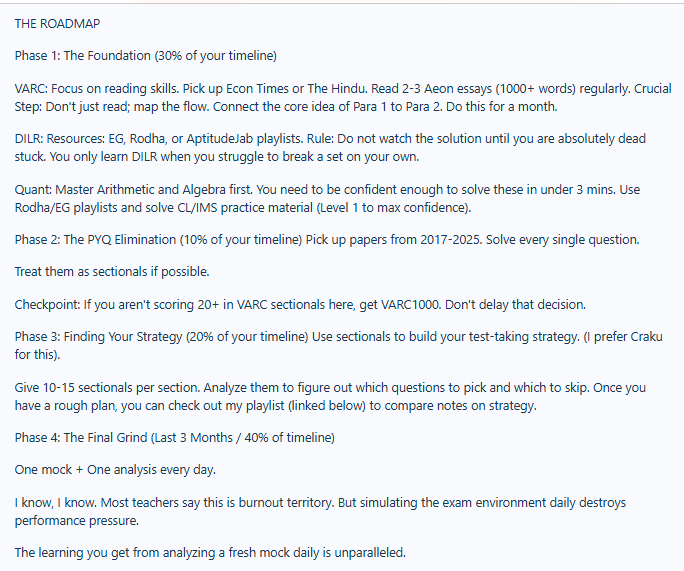
Source: Reddit
Ques. Can I crack CAT 2026 with only 3 months of preparation?
Ans. Yes, a focused 3-month strategy can work if students prioritise high-weightage topics, practise consistently, analyse mocks properly, and avoid wasting time on low-return areas.
Also Check: CAT Preparation of Quantitative Aptitude
CAT 2026 Preparation: Previous Year Questions
Below are the previous year questions PDF with solutions for 2025-2021. The PYQs are for the Slot 1 exam of each section:
| Year | CAT DILR Slot | Question Paper | Solution PDF |
|---|---|---|---|
| CAT 2025 | DILR Question Paper | Download Pdf | Click Here |
| VARC Question Paper | Download Pdf | Click Here | |
| Quant Question Paper | Download Pdf | Click Here | |
| CAT 2024 | VARC Question Paper | Download PDF | Click Here |
| DILR Question Paper | Download PDF | Click Here | |
| QA Question Paper | Download PDF | Click Here | |
| CAT 2023 | DILR Question Paper | Download PDF | Click Here |
| VARC Question Paper | Download PDF | Click Here | |
| Quant Question Paper | Download PDF | Click Here | |
| CAT 2022 | DILR Question Paper | Download PDF | Check Solutions |
| VARC Question Paper | Download PDF | Check Solutions | |
| Quant Question Paper | Download PDF | Check Solutions | |
| CAT 2021 | DILR Question Paper | Download PDF | Check Solutions |
| VARC Question Paper | Download PDF | Check Solutions | |
| Quant Question Paper | Download PDF | Check Solutions |
Ques. Is mock analysis more important than attempting more mocks?
Ans. Yes. A mock without analysis provides limited improvement. Analysing mistakes, missed opportunities, and time usage helps improve actual CAT performance.
Ques. How can I improve my VARC score for CAT 2026?
Ans. Regular reading, RC practice, analysing answer choices, and understanding why options are correct or incorrect are key to improving VARC accuracy.
Also Read:
CAT 2026 Preparation Strategy: Subject-Wise Plan
- Start with a diagnostic test for VARC, DILR and QA to identify concept gaps, accuracy issues and time-management problems.
- Balance topic-wise and mixed practice: Build concepts first, then solve CAT PYQs and timed mixed sets to improve application skills.
- Use sectional tests and mocks regularly to improve speed, question selection and exam-day time management across all three sections.
- Maintain an error log and revise recurring mistakes, difficult questions and important concepts every week.
CAT QA Preparation Plan: October to November 29
- October focuses on identifying and strengthening weak areas, while November gradually moves towards mixed and timed practice.
- Arithmetic and Algebra get early priority because building these fundamentals gives candidates more time to improve before mixed-question practice begins.
- Candidates should track recurring errors instead of simply counting their scores after each test.
- Revising formulas, PYQs and previously incorrect questions can be more useful than learning several new topics just before CAT.
| Preparation Phase | Dates | Primary Focus | What to Do |
|---|---|---|---|
| Phase 1: Find Score Gaps | Oct 7–15 | Diagnose weaknesses | Take a QA sectional test and classify mistakes into concept gaps, approach issues, calculation errors, question selection and time management. |
| Phase 2: Build Core Strength | Oct 16–31 | Arithmetic & Algebra | Revise concepts → solve CAT PYQs → practise mixed timed questions. Focus on identifying the right approach without knowing the topic beforehand. |
| Phase 3: Mixed QA Practice | Nov 1–15 | Application & speed | Reduce topic-wise practice and increase mixed sets, sectional tests, PYQs and full-length mocks. |
| Phase 4: Fix Recurring Errors | Nov 16–22 | Mock analysis | Identify the five most common mistakes and practise specifically to eliminate them. |
| Phase 5: Final Revision | Nov 23–28 | Accuracy & confidence | Revise formulas, incorrect questions, selected PYQs, short timed sets and mock-analysis notes. Avoid starting several new topics. |
| CAT 2026 | Nov 29 | Exam Day | Apply the question-selection and time-management strategy developed during mocks. |
Check: How to Attempt the VARC Section for a 99 Plus Percentile
CAT VARC Preparation Plan: October to November 29
- Candidates should first understand why they are getting questions wrong before trying to solve more questions.
- Passage selection is a major part of VARC strategy. The objective is to identify passages that offer the best potential accuracy within the available time.
- Mock analysis should identify specific error patterns, such as inference mistakes, rushed reading or choosing between closely matched options.
| Preparation Phase | Dates | Primary Focus | What to Do |
|---|---|---|---|
| Phase 1: Measure RC Performance | Oct 7–15 | Diagnose weaknesses | Track accuracy, time per passage, passage selection, inference and option-elimination errors. |
| Phase 2: RC + VA Practice | Oct 16–31 | Build consistency | Practise 10–12 timed RC passages, VA sessions, PYQs, sectionals and mock tests every week. |
| Phase 3: Improve Passage Selection | Nov 1–15 | Selection + accuracy | Identify passages offering the best balance of reading time, question difficulty and expected accuracy. |
| Phase 4: Correct Accuracy Gaps | Nov 16–22 | Fix recurring errors | Analyse mock performance and target specific problems such as inference, main idea, close options and VA logic. |
| Phase 5: Maintain Reading Rhythm | Nov 23–28 | Final revision | Continue daily RC practice, selected VA questions, PYQs and error-log revision without changing the overall strategy. |
| CAT 2026 | Nov 29 | Exam execution | Follow the tested passage-selection, question-attempt and time-management strategy. |
CAT DILR Preparation Plan: October to November 29
- DILR preparation should focus on set selection, not just solving volume. A candidate can improve significantly by learning which sets to attempt and which to leave.
- Timed practice becomes increasingly important in November, as CAT requires candidates to make decisions under strict sectional time limits.
- Mock analysis should track time lost on difficult sets, not just the final DILR score. This helps identify poor selection decisions.
| Preparation Phase | Dates | Primary Focus | What to Do |
|---|---|---|---|
| Phase 1: Build Set-wise Record | Oct 7–15 | Diagnose strengths and weaknesses | Track sets attempted, completed, accuracy and time across arrangements, distribution, games, scheduling, tables and caselets. |
| Phase 2: Shift to Timed Sets | Oct 16–31 | Speed + accuracy | Practise complete and timed sets, DILR PYQs, sectionals and mocks. Focus on solving the right sets rather than maximising attempts. |
| Phase 3: Improve Set Selection | Nov 1–15 | Selection strategy | Practise scanning all sets quickly and ranking them based on difficulty, familiarity, time requirement and solving potential. |
| Phase 4: Measure Selection Efficiency | Nov 16–22 | Mock analysis | Track sets selected, completed, questions correct, time lost and unproductive attempts after every mock. |
| Phase 5: Final Revision | Nov 23–28 | Consolidation | Reattempt selected PYQs, revise incorrect sets, practise limited timed sets and review set-selection mistakes. |
| CAT 2026 | Nov 29 | Exam execution | Quickly scan the DILR section, select the most manageable sets and avoid spending excessive time on unproductive sets. |
CAT Sample Question Papers 2026- Download PDF
CAT Preparation 2026: Mock Tests
Quantitative Aptitude
View All (18) →Verbal Ability and Reading Comprehension
View All (16) →Data Interpretation & Logical Reasoning
View All (18) →For more Mock Tests, check: Free CAT Mock Test 2026: Free PDF Download, Solutions and Performance Analysis
Ques. Which Quant topics should I prioritise for CAT 2026?
Ans. Arithmetic and Algebra should be prioritised as they contribute significantly to CAT Quant questions. Geometry and Number Systems should be covered during later revision phases.
Ques. Should CAT aspirants complete the entire syllabus before taking mocks?
Ans. No. Students should start mocks after building basic concepts and continue taking them alongside preparation to improve strategy and question selection.
CAT 2026 Preparation: Weekday vs Weekend Study Plan
Candidates preparing for CAT 2026 with limited daily time can divide their preparation into short weekday study blocks and longer weekend sessions.
| Day | Study Plan | Suggested Time |
|---|---|---|
| Monday–Friday: Morning | Solve 1 RC passage with 4–5 questions, followed by 3–4 VA questions. Review answers and add repeated mistakes to the error log. | 25-30 minutes |
| Monday–Friday: Short Breaks | Revise QA fundamentals such as Algebra, Percentages, Time & Work, Time-Speed-Distance and Ratios. Also revise DILR concepts such as arrangements, Venn logic and game constraints. | 10-15 minutes |
| Monday–Friday: Evening | Complete 1 QA topic, practise one LRDI topic/set and review the day's mistakes. | 60-90 minutes |
| Saturday | Take a full-length mock or sectional tests, followed by detailed analysis. Practise 4–5 LRDI sets and complete one QA topic. | 4-5 hours |
| Sunday | Revise weak areas identified from the week's performance, practise 3 RCs or around 15 VA questions, and solve CAT PYQs. | 3-4 hours |

Check: CAT 2026 Exam Pattern: 68 Questions in 120 Minutes Expected, No Change Announced from 2025
CAT 2026 Preparation Books
CAT 2026 Preparation Books include the following:
- QA books focus on concept-building and graded practice, with Arun Sharma’s LOD structure helping students move from basics to CAT-level difficulty.
- DILR resources are designed around set-based learning, helping aspirants practise different puzzle formats and improve selection ability.
- VARC books strengthen RC and verbal skills, but consistent reading practice and mock analysis remain essential for improving accuracy.
| Section | Book |
|---|---|
| Quantitative Aptitude (QA) | How to Prepare for Quantitative Aptitude for CAT by Arun Sharma (McGraw Hill) |
| Quantitative Aptitude (QA) | Quantitative Aptitude for CAT by Nishit K. Sinha (Pearson) |
| Data Interpretation & Logical Reasoning (DILR) | How to Prepare for Data Interpretation for CAT & How to Prepare for Logical Reasoning for CAT by Arun Sharma (McGraw Hill) |
| Data Interpretation & Logical Reasoning (DILR) | Logical Reasoning and Data Interpretation for CAT by Nishit K. Sinha (Pearson) |
| Verbal Ability & Reading Comprehension (VARC) | How to Prepare for Verbal Ability and Reading Comprehension for CAT by Arun Sharma & Meenakshi Upadhyay (McGraw Hill) |
| Verbal Ability & Reading Comprehension (VARC) | Word Power Made Easy by Norman Lewis |
Check: Best Books for CAT 2026 Preparation: VARC, DILR and Quantitative Aptitude
Ques. How many mock tests should I attempt before CAT 2026?
Ans. The number depends on preparation level, but students should gradually increase mocks and attempt multiple mocks in the final month with detailed analysis after every test.
Also Read:
CAT Preparation 2026: Toppers Tips
CAT toppers Chavan Pruthviraj, Mateen Sharif, and Vivekananda give the following advice to aspirants, as per a YouTube video on Cracku - MBA CAT Preparation:
- Be consistent with your preparation: Study regularly, even on low-motivation days, and focus on steady daily progress rather than occasional long study sessions.
- Treat every mock as a learning opportunity: Analyse mistakes, improve question selection, and refine your time management instead of getting discouraged by low scores.
- Prioritise practice over collecting resources: Solve quality questions, revise mistakes, and master a limited set of reliable study materials instead of constantly searching for new ones.
Ques. How should I maintain an error log for CAT preparation?
Ans. An error log should include the question type, mistake reason, correct approach, time spent, and the lesson learned to prevent repeating similar mistakes.
Ques. How should I prepare for CAT LRDI?
Ans. LRDI preparation should focus on practising different set families, improving interpretation skills, and learning when to select or skip sets during the exam.
Ques. What should be the focus during the last month before CAT 2026?
Ans. The last month should focus on revision, mock tests, weak-area improvement, formula revision, PYQs, and finalising exam-day strategy rather than learning new concepts.
Ques. What are the biggest mistakes CAT aspirants should avoid?
Ans. Students should avoid irregular preparation, excessive resource collection, ignoring mock analysis, attempting too many questions without accuracy, and neglecting weaker sections.
CAT 2026 Preparation: Important Do's and Don'ts
| Parameter | Do's | Don'ts |
|---|---|---|
| Syllabus | Prioritise important topics based on preparation level. | Do not spend excessive time trying to master every topic at once. |
| PYQs | Solve and analyse previous-year questions regularly. | Do not treat PYQs as questions to solve without analysis. |
| Mock Tests | Take regular mocks and analyse each one. | Do not take multiple mocks without reviewing mistakes. |
| Accuracy | Improve accuracy before increasing attempts. | Do not chase attempts at the cost of accuracy. |
| Sections | Maintain preparation across all three sections. | Do not completely ignore a weak section. |
| Revision | Revise formulas, concepts and mistakes regularly. | Do not start several new resources near the exam. |
| Resources | Use a limited set of reliable resources. | Do not keep changing books or preparation sources. |
CAT Preparation Tips & Strategy 2026 FAQS
Ques. How should I start my CAT 2026 preparation?
Ans. Candidates should begin by understanding the CAT syllabus and exam structure, taking a diagnostic test and identifying their strengths and weaknesses. They can then create a study plan covering QA, VARC and DILR.
Ques. How many hours should I study daily for CAT 2026?
Ans. There is no fixed number of hours applicable to every candidate. The uploaded four-month strategy suggests gradually increasing study intensity from around 4–5 hours per day initially to 6+ hours per day during later preparation, but candidates should adapt this according to their schedule and preparation level.
Ques. Which topics should I prioritise for CAT 2026?
Ans. Candidates with limited preparation time can prioritise Arithmetic and Algebra in QA, RC in VARC, and important DILR set types before expanding their preparation to other topics.
Ques. When should I start taking CAT mock tests?
Ans. Candidates should not wait until they have completed the entire syllabus. A diagnostic test can be taken early to assess preparation, followed by regular sectional and full-length mocks as preparation progresses.
Ques. Is mock analysis important for CAT preparation?
Ans. Yes. Mock analysis helps candidates identify avoidable mistakes, time-management problems, question-selection errors and weak concepts. The analysis should be used to improve the strategy for the next mock.
Ques. How many CAT previous year papers should I solve?
Ans. Candidates should solve multiple years of CAT PYQs and revisit difficult questions during revision. The current preparation resource includes papers from CAT 2021 to CAT 2025 for practice.
Ques. Which book is best for CAT preparation?
Ans. There is no single best book for every candidate. For QA and DILR, the draft recommends resources by Arun Sharma and Nishit K. Sinha, while Arun Sharma and Meenakshi Upadhyay's VARC book is listed for verbal preparation. Candidates should select resources based on their preparation level and use them consistently.
Ques. How can I improve my VARC score for CAT 2026?
Ans. Candidates should build a regular reading habit, practise RCs and VA questions, improve option elimination and analyse mistakes after sectional tests and mocks.
Ques. How should I prepare for DILR?
Ans. Candidates should regularly practise different types of sets and focus on identifying manageable sets quickly. Analysing missed or incorrectly attempted sets can help improve set selection and problem-solving ability.
Ques. What should I focus on in the last month before CAT 2026?
Ans. The final month should primarily be used for revision, mock tests, weak-area improvement, PYQs and finalising the exam strategy. Candidates should avoid unnecessarily starting several new topics or resources.



Comments