




The Central Board of Secondary Education (CBSE) has released the Sample Question Papers (SQPs) and Marking Schemes for the Class 10 and Class 12 Board Examinations 2027. The official CBSE Class 10 datesheet is expected to be out soon, by the end of October or early November 2026.
The CBSE opened the List of Candidates (LOC) submission portal on September 24, 2026. The last date to submit LOC forms without a late fee has passed on 21st October. Any remaining forms can still be submitted till the extended deadline of 30th October 2026, with a late fee of ₹2,000 per student.
- The CBSE Class 10 Board exam fee is ₹1,600 for students studying in schools in India. It covers registration and examination fees for up to 5 main subjects until 21 October 2026.
- The late-fee window runs until October 30, 2026 for online payments and October 26, 2026 for challan payments.
- The CBSE Class 10 2027 Board Exam is expected to be conducted in February 2027.
- The 2nd phase of the CBSE Class 10 examination (improvement exams) is expected to be conducted in May 2027, providing an opportunity to improve performance.
- In the CBSE Class 10 2026 exam, 23.8 lakh students registered for the Board Exam, of whom 23.4 lakh appeared for the examination and 93.60% passed.
- Over the 2024–2026 period, CBSE Class 10 papers were generally reported as moderate, with the overall difficulty varying across subjects and sets.
Related Links:
- CBSE Class 10 Registration 2027: Check Dates, Fees Required, Registration Process & Form Correction
- CBSE Class 10 Syllabus 2027: Subject-wise Topics, Deleted Chapters and PDF Download
- CBSE Class 10 Mock Test 2027
CBSE Class 10 2027 Key Highlights
| Particulars | Details |
|---|---|
| Exam Name | CBSE Class 10 Board Exam 2027 |
| Conducting Body | Central Board of Secondary Education (CBSE) |
| Academic Session | 2026–27 |
| Registration/LOC | Expected in late August/September 2026 |
| Expected Registration Deadline | Around September 30, 2026 |
| Number of Board Exams | 2 exams in the same academic year |
| First/Main Exam | Expected on 15 February 2027 |
| Second Exam | Expected in May–June 2027 |
| Second Exam Purpose | Improvement/second opportunity for eligible students |
| Second Exam Eligibility | Students meeting CBSE's prescribed eligibility criteria |
| Exam Pattern | Subject-wise theory and internal assessment as prescribed by CBSE |
| Passing Criteria | Generally 33% marks in the applicable subjects |
| Syllabus | CBSE Class 10 Curriculum 2026–27 |
| Preparation Focus | NCERT, competency-based questions, sample papers & previous-year questions |
CBSE Class 10 2027 Two Board Exams: How the New System Works?
CBSE started holding the CBSE Class 10 Board Exam 2x a year from 2026, giving eligible students an additional opportunity to improve their performance.
- Phase 1 is the main board exam & every student must appear in it.
- Phase 2 is optional and works as an improvement exam, not as a second chance to skip the first one.
| Point | Phase 1 | Phase 2 |
|---|---|---|
| Compulsory | Yes, for all students | No, optional |
| When It Is Held | February to March | May to June |
| Subjects Allowed | All subjects you registered for | Maximum 3 subjects |
| Which Subjects | All | Science, Maths, Social Science, Languages |
| Practical Exams | Held once before theory papers | Not repeated; marks carry forward |
| Syllabus | Full syllabus | Same full syllabus |
| Score Counted | Best of two per subject | Best of two per subject |
Who Can Appear in CBSE Class 10 Phase 2
CBSE has set clear categories for the CBSE Class 10 2nd exam. You should check which one applies to you before you apply.
- CBSE expects around 40% of students to take the Phase 2 exam each year.
- The board evaluates 20 to 30 lakh answer books for this second round.
| Category | Can You Appear in Phase 2 |
|---|---|
| Improvement | Yes, in up to 3 subjects if you passed Phase 1 |
| Compartment | Yes, to clear the subject you did not pass |
| Subject Replacement | Yes, if you want to swap a subject to improve your result |
| Essential Repeat | No, you wait for next February |
| Absent in 3 or More Subjects | No, you fall under Essential Repeat |
Source: Central Board of Secondary Education
Also Read:
CBSE Class 10 2027: Important Dates
Over the last two cycles, the CBSE 10th Board Exam has consistently started in February—on February 15, 2025, and February 17, 2026.
- CBSE 10th Exam 2027 is tentatively expected to begin around mid-February 2027, with the final dates to be confirmed by CBSE.
| Event | Expected Date/Timeline |
|---|---|
| CBSE Class 10 2027 Registration/LOC Begins | August 2026 |
| Last Date for LOC Submission | September 30, 2026 |
| CBSE Class 10 2027 Date Sheet | November–December 2026 |
| CBSE Class 10 Admit Card | February 2027 |
| Class 10 First/Main Board Exam | February 17 – March 6, 2027 |
| Class 10 First/Main Exam Result | April–May 2027 |
| Second Board Exam LOC/Registration | April 2027 |
| Class 10 Second Board Exam | May 5 – May 20, 2027 |
| Second Board Exam Admit Card | Early May 2027 |
| Second Board Exam Result | July 2027 |
CBSE Class 10 2027: Previous Years’ Exam Date Trend
The CBSE Class 10 Exam has generally started in February in recent years.
- The 2022 examination was an exception due to the special two-term pattern introduced during the COVID-19 period.
- From 2023 onward, the main examination has consistently begun around February 15–17.
- Based on this trend, the CBSE Class 10 Exam 2027 is expected to begin in mid-February 2027.
| Year | CBSE Class 10 Exam Dates |
|---|---|
| 2026 | February 17 – March 11, 2026 |
| 2025 | February 15 – March 18, 2025 |
| 2024 | February 15 – April 10, 2024 |
| 2023 | February 15 – March 21, 2023 |
| 2022 | April 26 – May 24, 2022 |
Also Read: CBSE Class 10 Exam Dates 2027: Date Sheet Expected October 2026, Time Table and Two Board Exams
CBSE Class 10 2027: Registration
The CBSE Class 10 Registration/LOC Process is expected to begin in the 1st week of September 2026.
- Schools will likely be required to complete the submission by September 30, 2026.
- Unlike individual applications, CBSE Class 10 students generally complete the registration through their respective schools.
| Event | Timeline |
|---|---|
| Registration/LOC Begins | 5th September 2026 (Expected) |
| Last Date to Register | September 30, 2026 (Expected) |
| Registration Mode | Through respective CBSE-affiliated school |
| Second Exam Registration | Expected: April 2027 |
Also Read: CBSE Class 10 Registration 2027: Check Dates, Fees Required, Registration Process & Form Correction
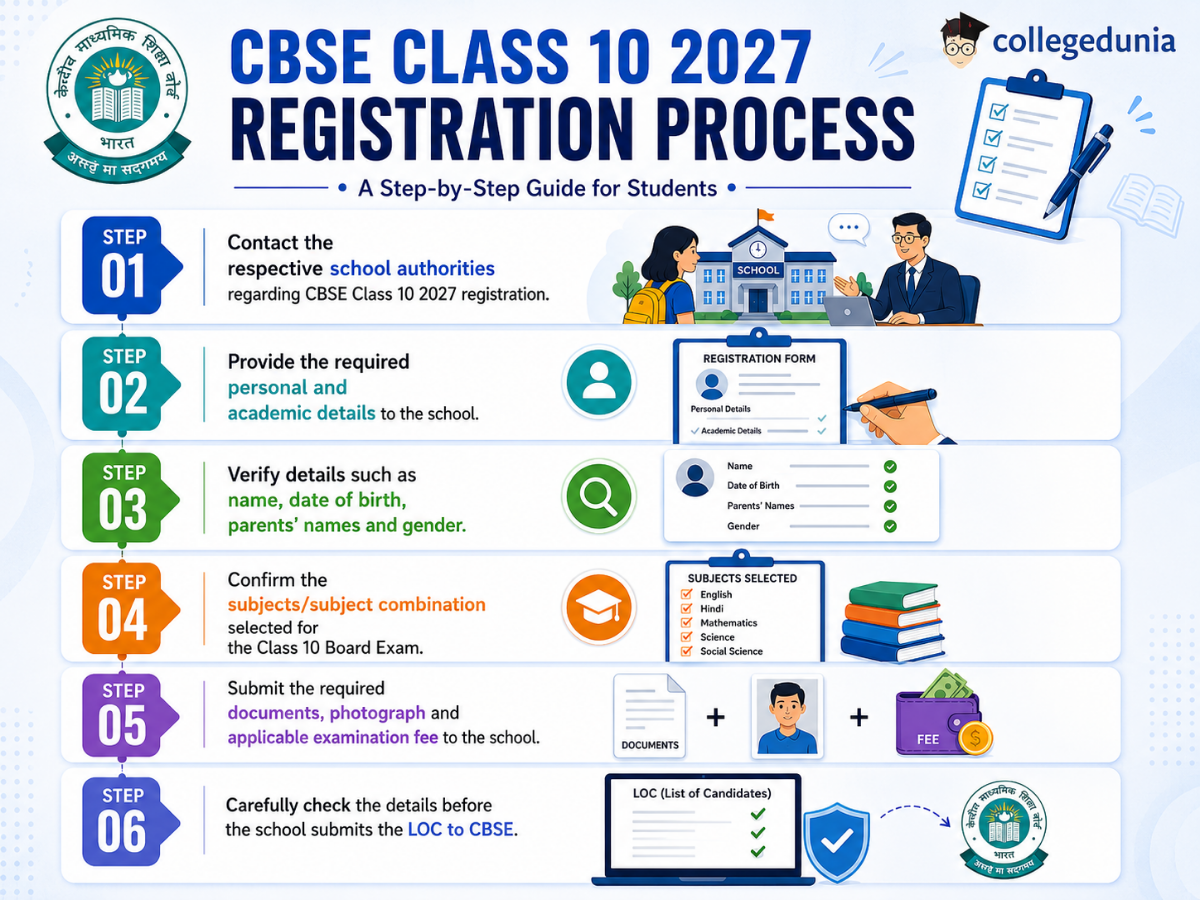
How to fill out the CBSE Class 10 2027 Registration Form?
Students do not generally submit the CBSE Class 10 Registration Form individually. Their respective schools collect and verify the required information and submit the List of Candidates (LOC) online to CBSE.
The registration process generally involves:
- Step 1 – Contact the respective school authorities regarding CBSE Class 10 2027 registration.
- Step 2 – Provide the required personal and academic details to the school.
- Step 3 – Verify details such as name, date of birth, parents' names and gender.
- Step 4 – Confirm the subjects/subject combination selected for the Class 10 Board Exam.
- Step 5 – Submit the required documents, photograph and applicable examination fee to the school.
- Step 6 – Carefully check the details before the school submits the LOC to CBSE.
CBSE Class 10 2027 Photo & Signature Requirements
For CBSE Class 10 2027 registration/LOC, students should provide a recent photograph and signature as required by their respective school.
- Since the LOC is submitted by the school, the school authorities are responsible for uploading and verifying the required student details and documents.
| Requirement | CBSE Class 10 2027 |
|---|---|
| Photograph | Recent passport-size photo, white background, high contrast |
| Signature | Clear candidate signature |
| File format | As specified in CBSE LOC portal |
| Maximum file size | No fixed MB/KB limit specified in the regular LOC notification |
CBSE Class 10 2027: Eligibility Criteria
Students appearing for the CBSE 10th Exam 2027 must meet CBSE's academic, attendance, registration, and subject-related requirements.
- Since CBSE introduced the 2-board-examination system in 2026, students should also understand the separate eligibility conditions for the first and second examinations.
| Eligibility Requirement | Details for CBSE Class 10 2027 |
|---|---|
| School Affiliation |
|
| Class |
|
| Registration/LOC |
|
| Attendance |
|
| Subjects |
|
| First Board Exam |
|
| Second Board Exam |
|
| Attendance for Second Exam |
|
| Private Candidates |
|
Important Eligibility Rule for the Second Exam
The second examination is not simply a compulsory second attempt.
- Under CBSE's two-examination framework, students who meet the prescribed eligibility conditions can appear for the second CBSE Class 10 Exam.
- It provides an additional opportunity to improve their marks in eligible subjects.
- CBSE's 2026 instructions stated that students placed in the Essential Repeat (ER) category were not eligible for the second examination.
CBSE Class 10 2027 Exam Pattern
In recent exam cycles, the CBSE 10th Exam 2027 has consistently followed a 50% competency-based, 20% MCQ, and 30% descriptive-question structure for the theory papers.
- The 80-mark theory + 20-mark internal assessment framework has also remained unchanged, highlighting CBSE's continued focus on application-based learning.
- The paper includes MCQs, competency-based, case-based, and descriptive questions, emphasising application and analytical skills.
- The main exam is expected in February–March 2027, followed by a second exam in May–June 2027 for eligible students seeking improvement in up to 3 subjects, as per CBSE rules.
| Particular | Exam Pattern |
|---|---|
| Total Marks | 100 marks per subject |
| Theory Exam | 80 marks |
| Internal Assessment | 20 marks |
| Theory Exam Duration | Generally 3 hours |
| Question Types | MCQs, competency-based, case/source-based, short-answer and long-answer questions |
| Competency-Based Questions | CBSE has placed significant emphasis on application, analysis & real-world understanding |
| Board Exams | Two opportunities: First/Main Exam and Second Exam |
| Second Exam | Eligible students can use it for improvement in up to 3 subjects, as per CBSE rules |
| Main Exam | Expected in February–March 2027 |
| Second Exam | Expected in May–June 2027 |
| Internal Assessment | School-based assessment conducted throughout the academic session |
| Syllabus | CBSE Class 10 Curriculum 2026–27 |
Check: CBSE Class 10 Exam Pattern 2027: Subject-wise Marks, Question Types & Marking Scheme
CBSE Class 10 2027 Subject-wise Marks & Weightage
The CBSE Class 10 Exam gives the highest weightage to Algebra in Mathematics, Chemical Substances and World of Living in Science, and all 4 core areas equally in Social Science.
- Each subject carries 100 marks, including 80 theory marks and 20 internal assessment marks.
- Mathematics: Algebra has the highest weightage at 20 marks, followed by Geometry (15) and Trigonometry (12).
- Science and Social Science: Chemical Substances and World of Living carry 25 marks each in Science, while History, Geography, Political Science, and Economics carry 20 marks each in Social Science.
- Language Papers: English gives the highest weightage to Literature (40 marks). In Hindi A and B, textbook-based questions carry 30 and 28 marks, respectively, making them key revision areas.
| Subject | Theory Marks | Internal Assessment | Unit/Section-wise Weightage |
|---|---|---|---|
| Mathematics | 80 | 20 | Number Systems – 6; Algebra – 20; Coordinate Geometry – 6; Geometry – 15; Trigonometry – 12; Mensuration – 10; Statistics & Probability – 11 |
| Science | 80 | 20 | Chemical Substances – 25; World of Living – 25; Natural Phenomena – 12; Effects of Current – 13; Natural Resources – 5 |
| Social Science | 80 | 20 | History – 20; Geography – 20; Political Science – 20; Economics – 20 |
| English Language & Literature | 80 | 20 | Reading Skills – 20; Writing Skills with Grammar – 20; Language through Literature – 40 |
| Hindi A | 80 | 20 | अपठित बोध – 14; व्यावहारिक व्याकरण – 16; पाठ्यपुस्तक/पूरक पाठ्यपुस्तक – 30; रचनात्मक लेखन – 20 |
| Hindi B | 80 | 20 | अपठित बोध – 14; व्यावहारिक व्याकरण – 16; पाठ्यपुस्तक/पूरक पाठ्यपुस्तक – 28; रचनात्मक लेखन – 22 |
Also Read:
CBSE Class 10 2027: Syllabus
For students preparing for the CBSE 10th Exam 2027, the main subjects include Mathematics, Science, Social Science, English, Hindi and other language/skill subjects depending on the student's subject combination.
- For the CBSE Class 10 Exam, CBSE provides separate subject-wise curriculum documents covering the prescribed topics and textbooks.
- These documents also outline the assessment structure and internal assessment guidelines.
| Subject | Major Areas Covered |
|---|---|
| Mathematics | Number Systems, Algebra, Coordinate Geometry, Geometry, Trigonometry, Mensuration, Statistics & Probability |
| Science | Chemical Substances, World of Living, Natural Phenomena, Effects of Current, Natural Resources |
| Social Science | History, Geography, Political Science and Economics |
| English Language & Literature | Reading, Grammar & Writing, Literature |
| Hindi | Reading, Grammar, Literature and Writing |
| Other Languages/Skill Subjects | Varies according to the subject selected |
What is new in the CBSE Class 10 2027 Syllabus?
The 2026–27 curriculum places greater emphasis on competency-based education, experiential learning, flexibility & holistic development.
- The CBSE 10th Board Exam Syllabus for 2027 is aligned with the National Curriculum Framework for School Education (NCF-SE) 2023.
- It places greater emphasis on competency-based and application-oriented learning.
- This places greater emphasis on conceptual understanding and application-based learning in classroom teaching and assessment.
Also Read:
CBSE Class 10 2027: Preparation Tips
A 5-month study plan for CBSE Class 10 2027 should balance syllabus completion, revision, competency-based practice, and mock tests. The aim should be to finish the syllabus early enough to leave the final month mainly for revision and full-length papers.
-
Follow a 3-month plan using NCERT, covering foundational and remaining chapters, and prepare short notes and formula sheets.
-
Solve chapter-wise PYQs, competency-based questions, and sample papers. Revise each subject and maintain an error log.
-
Take 2–3 full-length mock tests weekly in the final month, analyse mistakes, and revise weak topics, maps, and diagrams.
| Month | Primary Focus | What to Do |
|---|---|---|
| Month 1 | Build Concepts | Start with NCERT and cover the foundational chapters of all major subjects. Prepare short notes, formulas, definitions & important concepts. |
| Month 2 | Syllabus Completion | Cover the remaining chapters systematically. Give extra time to difficult/high-weightage topics in Mathematics, Science and Social Science. |
| Month 3 | Complete Syllabus + Practice | Finish any pending chapters and begin chapter-wise PYQs, competency-based and case-based questions. |
| Month 4 | First Revision | Revise the complete syllabus subject-wise. Solve sample papers and previous-year papers under timed conditions and maintain an error log. |
| Month 5 | Final Revision & Mocks | Focus on weak areas, formulas, maps, diagrams and important concepts. Take 2–3 full-length mock tests every week and analyse mistakes after each test. |
Also Read:
CBSE Class 10 2027: Admit Card
The CBSE 10th Exam 2027 Admit Card is expected to be released by the CBSE in February 2027, shortly before the board examinations.
- Regular students will receive their admit cards through their respective schools.
- Private candidates can download them from the official CBSE website.
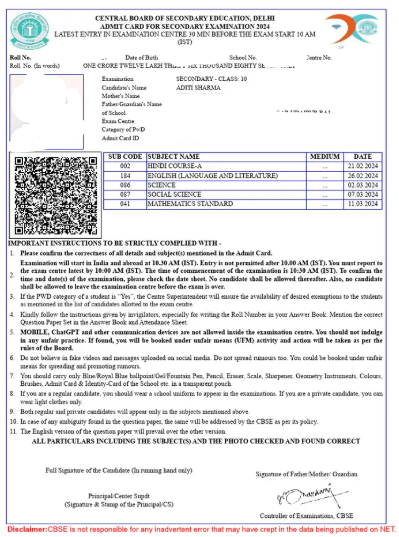
- The admit card will contain important details such as the student’s name, roll number, exam dates, subject-wise exam schedule, examination centre, and important instructions.
- Students must carry their admit card to the examination centre on every exam day, as it is required for entry to the examination hall.
Details Mentioned on CBSE Class 10 Admit Card 2027
The following information is expected to be provided on the admit card:
- Student’s name and roll number
- School number and centre number
- Name and address of the examination centre
- Subject names and examination dates
- Examination timings
- Student’s photograph and other identification details
- Important instructions for the board examination
Also Read: CBSE 10th Admit Card 2027: Admit Card @cbse.gov.in, Datesheet, Paper Timings
CBSE Class 10 2027 Exam Day Guidelines
Exam day can feel stressful, but a little preparation can help students stay calm and avoid unnecessary mistakes. Here’s a quick Do’s & Don’ts checklist to keep in mind before entering the exam hall:
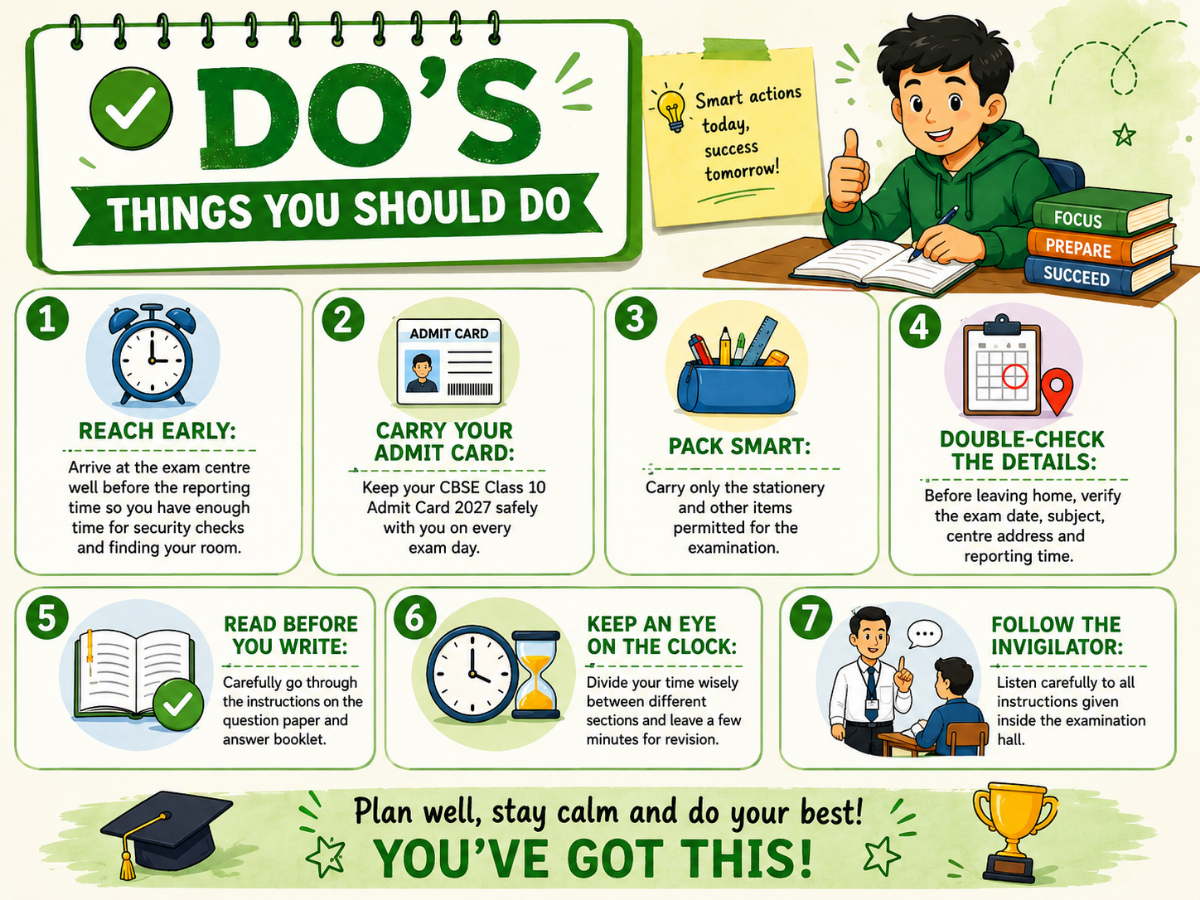
Do’s: Things You Should Do
- Reach early: Arrive at the exam centre well before the reporting time so you have enough time for security checks and finding your room.
- Carry your admit card: Keep your CBSE Class 10 Admit Card 2027 safely with you on every exam day.
- Pack smart: Carry only the stationery and other items permitted for the examination.
- Double-check the details: Before leaving home, verify the exam date, subject, centre address and reporting time.
- Read before you write: Carefully go through the instructions on the question paper and answer booklet.
- Keep an eye on the clock: Divide your time wisely between different sections and leave a few minutes for revision.
- Follow the invigilator: Listen carefully to all instructions given inside the examination hall.
Don’ts: Mistakes to Avoid
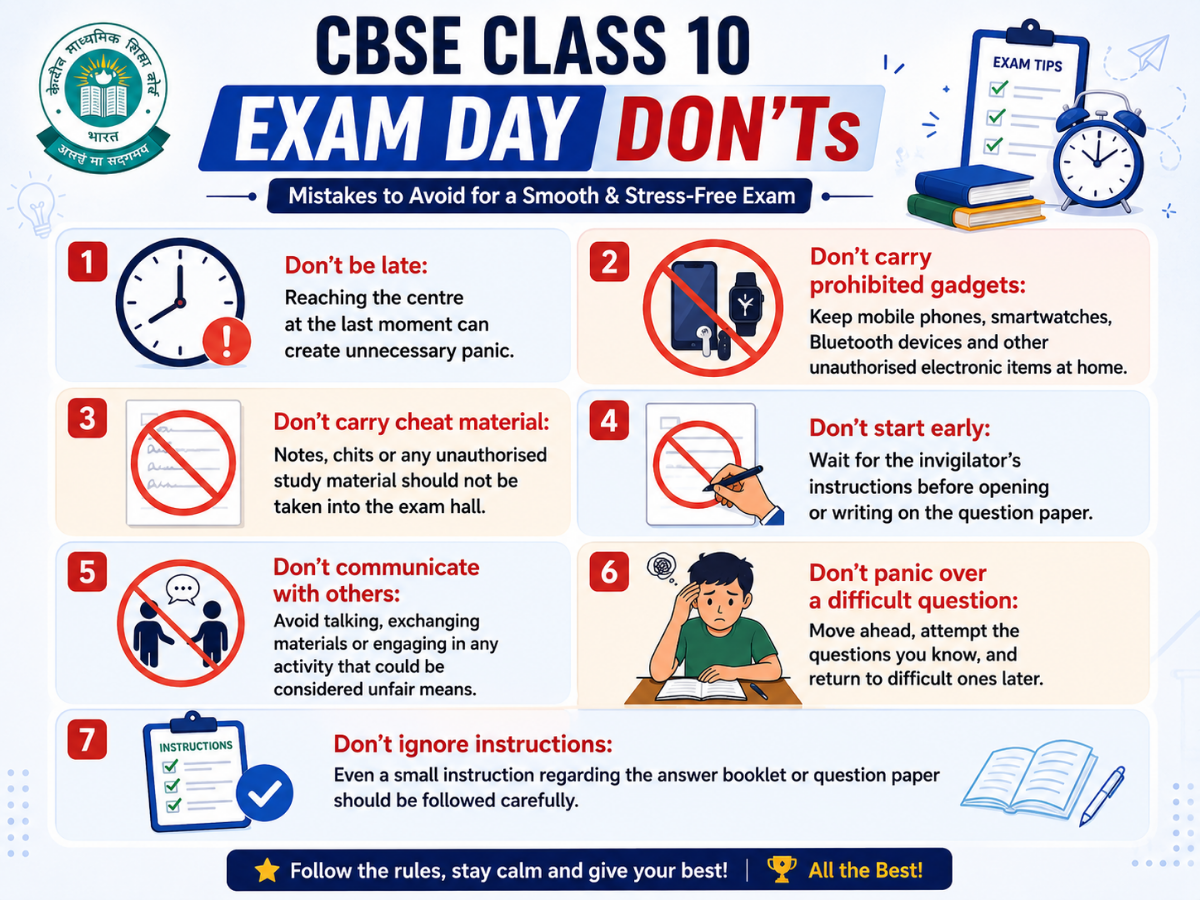
- Don’t be late: Reaching the centre at the last moment can create unnecessary panic.
- Don’t carry prohibited gadgets: Keep mobile phones, smartwatches, Bluetooth devices and other unauthorised electronic items at home.
- Don’t carry cheat material: Notes, chits or any unauthorised study material should not be taken into the exam hall.
- Don’t start early: Wait for the invigilator’s instructions before opening or writing on the question paper.
- Don’t communicate with others: Avoid talking, exchanging materials or engaging in any activity that could be considered unfair means.
- Don’t panic over a difficult question: Move ahead, attempt the questions you know, and return to difficult ones later.
- Don’t ignore instructions: Even a small instruction regarding the answer booklet or question paper should be followed carefully.
CBSE Class 10 2027: Answer Key
The CBSE Class 10 Answer Key 2027 will help students check their answers after the board examinations and get a preliminary idea of their performance.
- CBSE may not release a single official answer key for every Class 10 subject.
- However, unofficial answer keys are usually prepared by teachers, coaching institutes & educational platforms.
- They are generally available on the same day as the exam or within 1–2 days.
- For example, the CBSE Class 10 Science 2025 unofficial answer key was available on February 20, the day of the examination.
- Students can use the answer key to match their responses, identify incorrect answers, and estimate their probable marks.
- However, the estimated score should be treated as tentative until CBSE announces the official CBSE Class 10 Result 2027.
CBSE Class 10 2027: Result
CBSE Class 10 Result 2027 is expected to be released around 4–8 weeks after the completion of the board examinations. However, the exact result date will be announced by CBSE.
- For example, in 2026, the CBSE Class 10 main exams were held from February 17 to March 11, and the result was declared on April 15—about 35 days after the last exam.
How to Check CBSE Class 10 Result 2027?
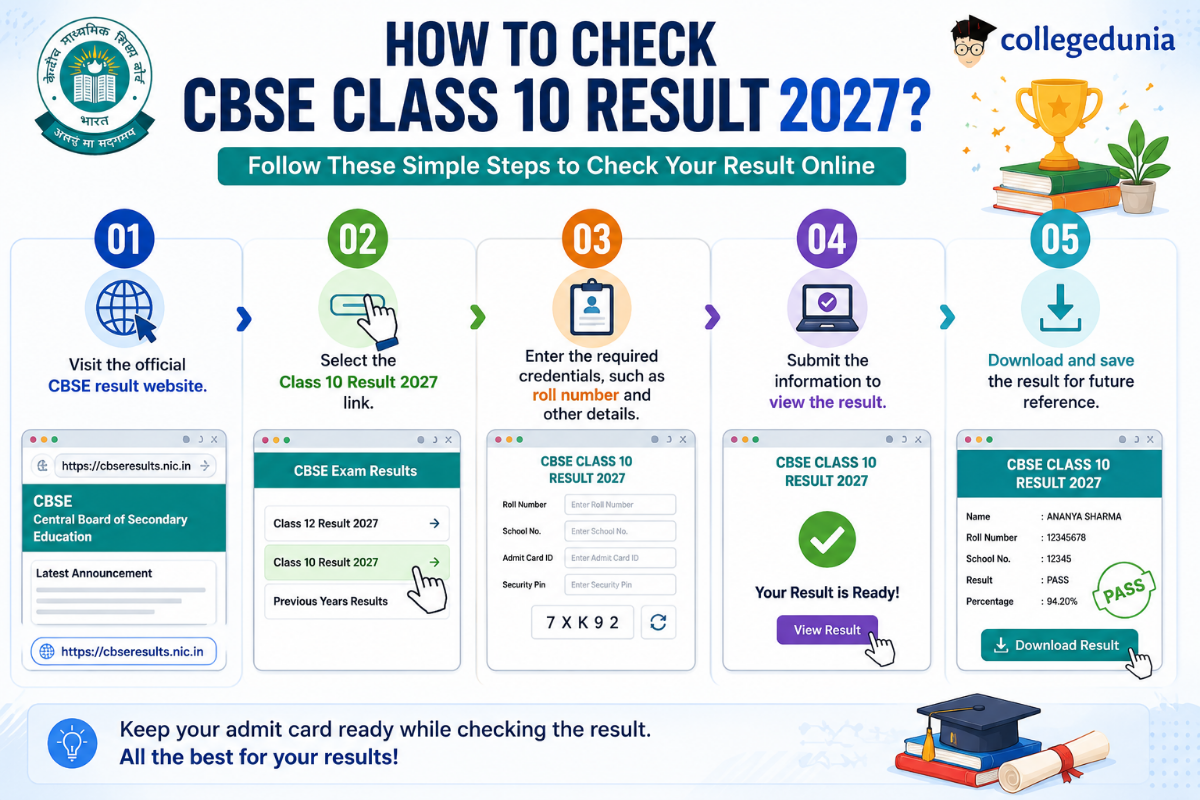
- Visit the official CBSE result website.
- Select the Class 10 Result 2027 link.
- Enter the required credentials, such as roll number and other details.
- Submit the information to view the result.
- Download and save the result for future reference.
CBSE Class 10 2027: Previous Years’ Result Date Trend
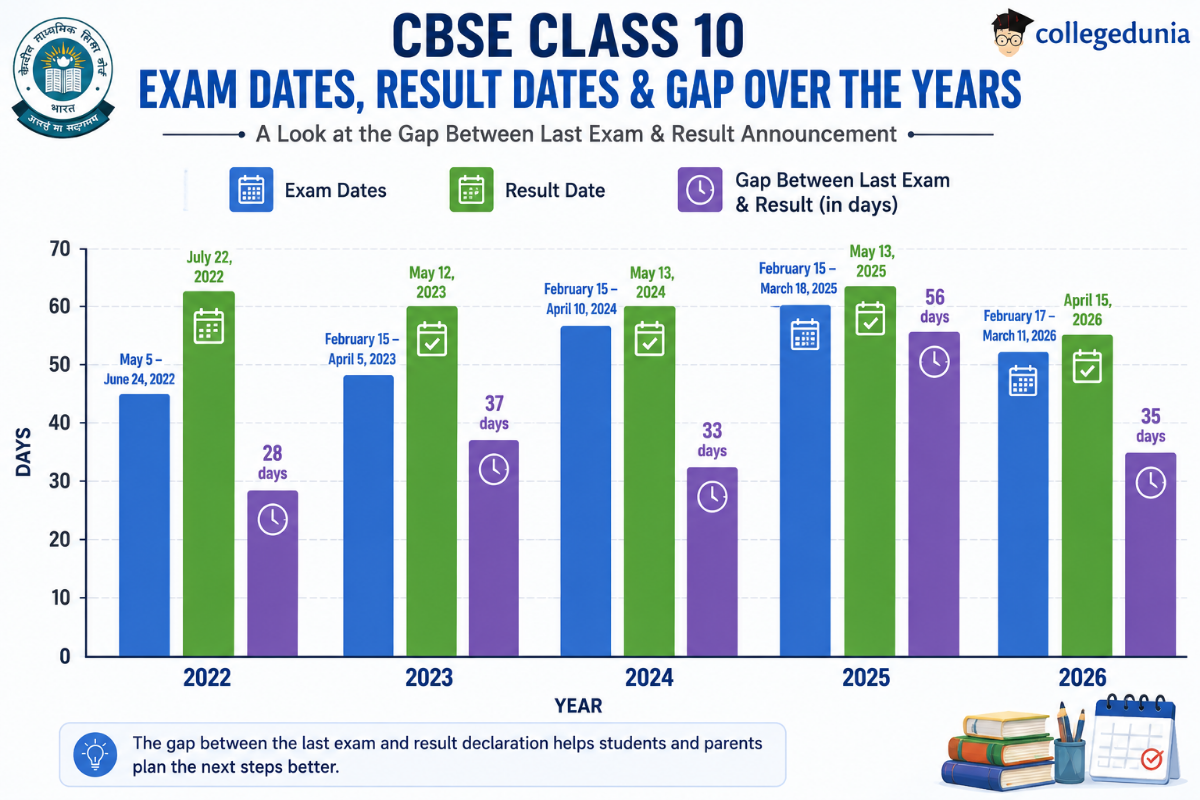
Over these five years, the CBSE 10th Board Exam result was declared 28–56 days after the last examination, indicating that students have generally waited around 1–2 months for the Class 10 result.
-
CBSE Class 10 results were declared 28–56 days after the last exam across 2022–2026, with 2025 having the longest gap.
-
In 2026, results were announced on April 15, just 35 days after the last exam, following the March 11 conclusion of examinations.
| Year | Exam Dates | Result Date | Gap Between Last Exam & Result |
|---|---|---|---|
| 2026 | February 17 – March 11, 2026 | April 15, 2026 | 35 days |
| 2025 | February 15 – March 18, 2025 | May 13, 2025 | 56 days |
| 2024 | February 15 – April 10, 2024 | May 13, 2024 | 33 days |
| 2023 | February 15 – April 5, 2023 | May 12, 2023 | 37 days |
| 2022 | May 5 – June 24, 2022 | July 22, 2022 | 28 days |
Also Read:
CBSE Class 10 2027: Passing Marks
For CBSE Class 10, students generally need to secure at least 33% marks in each subject to qualify.
- CBSE’s pass criteria require candidates to score at least 33% in all five external subjects.
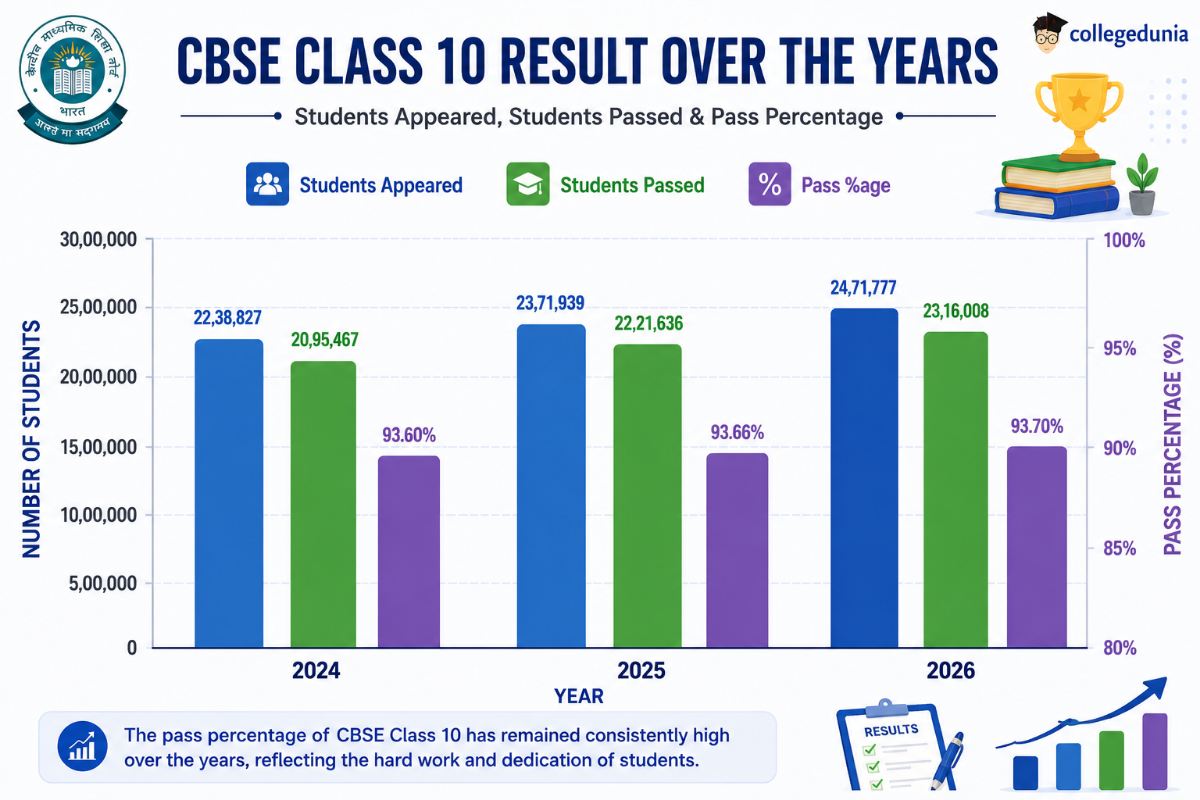
- The number of students passing the CBSE Class 10 Exam increased from 20.95 lakh in 2024 to 22.22 lakh in 2025, and further to 23.16 lakh in 2026.
| Year | Students Appeared | Students Passed | Pass %age |
|---|---|---|---|
| 2026 | 24,71,777 | 23,16,008 | 93.70% |
| 2025 | 23,71,939 | 22,21,636 | 93.66% |
| 2024 | 22,38,827 | 20,95,467 | 93.60% |
CBSE Class 10 2027 Grading System
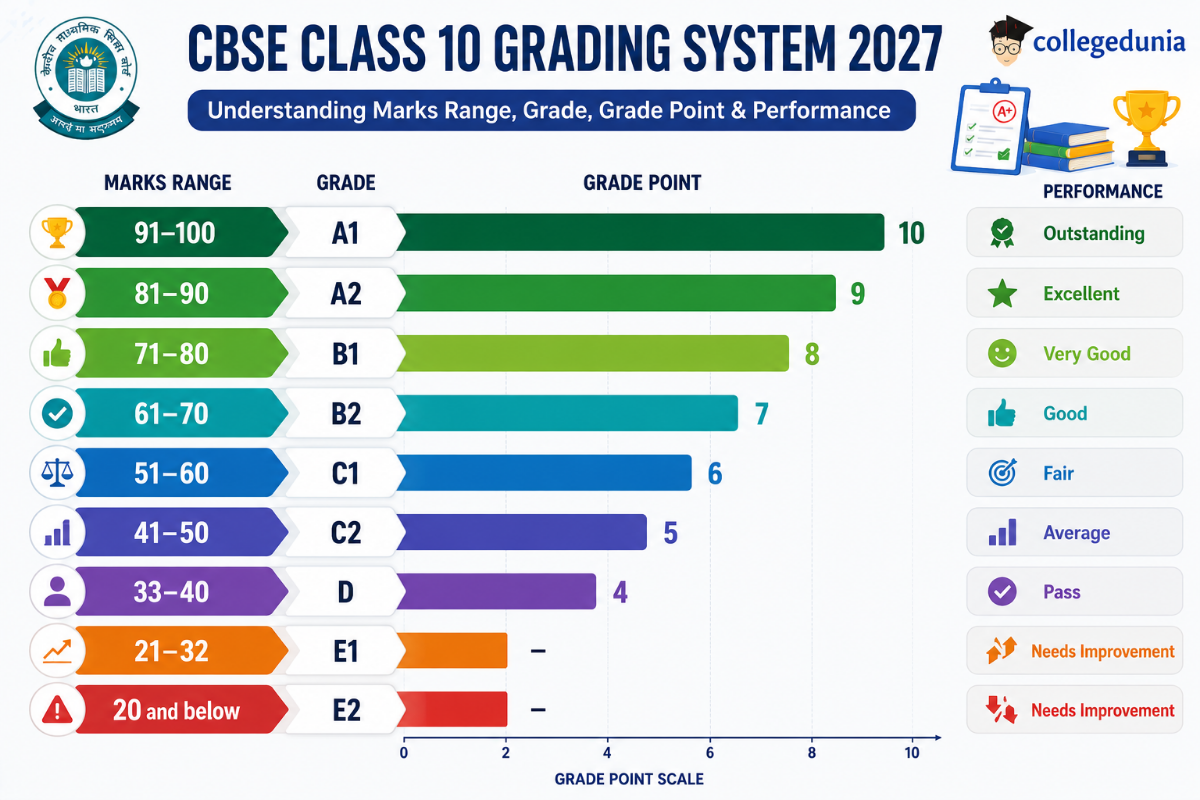
The CBSE Class 10 grading system 2027 is expected to follow the Board's established nine-point grading scale, where students are awarded grades from A1 to E based on their marks. CBSE uses grades to indicate a student's relative performance rather than treating the grade as a direct percentage equivalent.
| Marks Range | Grade | Grade Point | Performance |
|---|---|---|---|
| 91–100 | A1 | 10 | Outstanding |
| 81–90 | A2 | 9 | Excellent |
| 71–80 | B1 | 8 | Very Good |
| 61–70 | B2 | 7 | Good |
| 51–60 | C1 | 6 | Fair |
| 41–50 | C2 | 5 | Average |
| 33–40 | D | 4 | Pass |
| 21–32 | E1 | — | Needs Improvement |
| 20 and below | E2 | — | Needs Improvement |
Also Read: CBSE Class 10 Grading System 2026: 9-Point Scale A1 to E, CGPA Calculation and Percentage Formula
CBSE Class 10: Toppers for 2026
For 2026, Ayusman Mohapatra was reported to have scored a perfect 500/500.
- Odisha's official CM website also lists Tina Rath and Alisha Biswal as scoring 500/500.
- For 2025, Ayan Dutta's 500/500 score has been reported by ABP.
| Year | Reported Topper / Top Scorer | Marks | Percentage |
|---|---|---|---|
| 2026 | Ayusman Mohapatra | 500/500 | 100% |
| 2025 | Ayan Dutta | 500/500 | 100% |
| 2024 | Sanjana Bhat | 500/500 | 100% |
| 2023 | Prakhar Mittal, Rimzhim Agarwal, Nandini Garg & Sreelakshmi G. | 499/500 | 99.8% |
| 2022 | Diya Namdev & Mayank Yadav | 500/500 | 100% |
Also Read: CBSE Class 10 Toppers 2026: Check Year-Wise Toppers Names, Marks and Percentage
CBSE Class 10: Compartment Exams
From 2026 onwards, CBSE’s two-board examination system changes how this opportunity is provided: students placed in Compartment after the first/main examination can appear in the Second Board Examination under the Compartment category.
| Particular | Details |
|---|---|
| Who can appear? | Students placed in the Compartment category |
| When? | The Second Board Examination is conducted after the first/main examination; the 2026 examination was scheduled in May. |
| Subjects | Students appear in the subject(s) in which they are placed in Compartment |
| Syllabus | The examination follows the full syllabus prescribed for that academic year. |
| Result status | Students who clear the Compartment subject can be declared Pass, subject to CBSE's applicable result rules |
| If not cleared | Further opportunities are governed by CBSE's applicable Compartment/Board examination rules |
How Does the Compartment System Work Under the 2-Board Policy?
The key change is the introduction of a Second Board Examination for CBSE 10th Board Exam students.
- It changes the traditional compartment exam system.
- Earlier, the CBSE 10th Board Exam compartment exams were generally conducted separately after the main results.
- Under the new system, eligible students can appear in the Second Board Examination.
- Students placed in the Compartment category after the first exam can use this opportunity to clear the subject.
The CBSE Class 10 Second Board Examination also offers students a chance to improve their scores.
- Students can improve their performance in up to 3 eligible main subjects.
- Compartment students can use the exam to clear their compartment subject(s).
What If a Student Fails the Compartment Exam?
A student who does not clear the required subject should not assume that Class 10 is automatically over.
- CBSE provides further examination opportunities under its applicable rules, including subsequent chances for eligible Compartment candidates.
- The exact opportunity available depends on the student's category and the examination year.
Also Read:
- CBSE Class 10 Social Science Set 1 - (32/1/1) Question Paper 2026 with Solution PDF
- CBSE Class 10 Hindi Course B Set 1 - (4/4/1) Question Paper 2026 with Solution PDF
- CBSE Class 10 Mathematics Basic Set 1 - (430/5/1) Question Paper 2026 with Solution PDF
- CBSE Class 10 Science Set 5 - 31(B) Question Paper 2026 with Solution PDF
CBSE Class 10 2027 FAQs
Ques. Will CBSE conduct the 10th board in 2027?
Ans. Yes. CBSE will conduct Class 10 Board Examinations in 2027. The two-board examination system introduced from 2026 is set to continue, with a main examination followed by a Second Board Examination. CBSE’s official framework states that the main exam is held around mid-February, while the second exam is conducted in May.
Ques. Will CBSE Class 10 2027 be tough?
Ans. The difficulty level of the CBSE Class 10 2027 exam cannot be predicted in advance, as it depends on the question paper set and the topics tested. However, students can expect questions based on the prescribed syllabus, with a mix of knowledge-based, application-based, and competency-focused questions. Regular revision, solving sample papers, and practising previous years' questions can help students handle the exam confidently.
Ques. Is 70% bad in 10th?
Ans. No, 70% in Class 10 is not bad. It indicates that you have cleared the examination with a decent overall score. While higher marks can be helpful for admission to certain schools or streams, Class 10 marks are only one part of your academic journey. Students can improve their performance in Class 11 and 12 by focusing on conceptual understanding, regular practice, and consistent study.
Ques. Is the second board exam in May 2027 compulsory?
Ans. No. Phase 1 (February–March) is compulsory for all students. Phase 2 (May) is optional and meant for students who want to improve their scores (usually in up to 3 subjects). Internal assessment marks remain the same and are not repeated.
Ques. Has the CBSE Class 10 Syllabus 2026–27 (for 2027 exams) been released?
Ans. Yes. The official syllabus for the 2026–27 academic session has been released on the CBSE Academic website (cbseacademic.nic.in). Students should download the subject-wise PDFs for Maths, Science, Social Science, English, Hindi, and other subjects.

%20with%20Solutions.png?h=112&w=263&mode=stretch)
%20with%20Solutions.png?h=112&w=263&mode=stretch)
%20with%20Solutions.png?h=112&w=263&mode=stretch)
%20with%20Solutions.png?h=112&w=263&mode=stretch)
%20with%20Solutions.png?h=112&w=263&mode=stretch)
%20with%20Solutions.png?h=112&w=263&mode=stretch)




Comments
Found 71 Comments
You can check here for the CBSE Class 10 Question Paper(Available): Download PDF & Check CBSE Previous Year Question Papers with solutions.
No, the exact same question paper will not come in the Central Board of Secondary Education compartment exam 2026. Mock tests like Mock 10 only help you understand patterns, difficulty, and important topics. Prepare concepts well, as questions may be similar in style but not identical in the actual exam.
To register on Collegedunia, visit the official website and click on “Sign Up.” Enter your email or mobile number, verify with OTP, and create a password. For login, click “Login,” enter your registered details, and access personalized college information, courses, fees, and admission updates.
You can officially download CBSE Class 10 sample papers from the CBSE Academic website. Visit cbseacademic.nic.in, go to the Sample Question Papers section, select Class X, choose the subject and year, and download the PDF. These papers are released by CBSE and follow the latest syllabus and marking scheme.
For a cube of edge 2 cm, the largest right circular cone that can be carved has:
Volume of cone=V=1/3.pi.r^2.h=2.0944 cm^3
Preparing for board exams in a few days is possible with a smart, focused plan. First, identify high-weightage chapters and study them thoroughly from the NCERT textbook. Make short notes, formulas, and definitions. Practice previous year questions and sample papers daily to understand the pattern. Revise every night and avoid new topics at the last moment. Sleep well, eat properly, and stay calm.
You can check here for the CBSE Class 10 English Question Paper with Solution: Download PDF
You can check here for the CBSE Class 10 Hindi Question Paper 2025. Available- Download Previous Year Papers with Solutions
Life processes are the essential biological activities that living organisms perform to survive, grow, and maintain life. These include nutrition for obtaining energy, respiration for releasing energy, transportation of materials within the body, and excretion to remove waste. The processes like reproduction, growth, and response to stimuli help organisms continue their species and adapt to their surroundings. All these coordinated activities differentiate living beings from non-living things and ensure the continuous functioning of life.
The CBSE Previous Year Question Paper Class 10 is available here for candidates who want to prepare for their compartment exam for better preparation. You can check here for the CBSE Class 10 Question Paper with solution.
To download previous year papers for CBSE Class 10, visit the official Central Board of Secondary Education website at cbse.gov.in. Go to the “Examinations” or “Academic Repository” section, then select “Question Papers.” Choose the desired year and subject to access and download the PDF versions of previous exam papers for practice and preparation.
The CBSE Class 10th Board Exam was conducted from 15th February to 13th March; more than 21 lakh students appeared for the exam. You can download the papers from the official website. You can also check here for the CBSE Class 10 Question Paper
You can download official sample papers for the CBSE Class 10 Compartment Examination from the Central Board of Secondary Education (CBSE) website. These papers are available for various subjects and are intended to help students prepare effectively. These sample papers are designed to give students an idea of the exam pattern and types of questions that may appear in the compartment examination. They are an excellent resource for practice and revision.
You can check here for the CBSE Class 10 Question Paper 2025: Check Previous Year Question Paper with Solution PDF. The subject-wise question papers along with the solutions are available for download. The question paper contains 50% competency-based questions, 20% MCQs, and 30% subjective questions.
You can check here for the CBSE Class 10 Social Science Question Paper Available- Download Previous Year Papers with Solutions
To officially download CBSE Class 10 Urdu question papers, visit the Central Board of Secondary Education (CBSE) official site and use the Previous Years’ Question Papers page at cbse.gov.in where PDFs for Urdu (Core/Elective) are listed by year and exam type.
You can check here for the CBSE Class 10 Science Question Paper 2025 Available- Download Previous Year Papers with Solutions