




CEED 2027 (Common Entrance Examination for Design) is a national-level postgraduate entrance exam conducted by IIT Bombay for admission to M.Des and Ph.D. in Design programmes. The CEED 2027 registration process has started on October 1, 2026, at 1:00 PM. The exam is scheduled for January 17, 2027, across designated centres in India.
- Notification and Registration: The CEED 2027 registration process started on October 1, 2026, at 1:00 PM at ceed.iitb.ac.in. Candidates can register with the regular fee till October 31, 2026, at 11:59 PM. Registration with a late fee of INR 500 will be available till November 6, 2026, at 5:00 PM.
- Exam Date: CEED 2027 will be conducted on January 17, 2027, from 9:00 AM to 12:00 Noon. The exam will be held in two parts Part A and Part B at designated exam centres across India.
- Admit Card: The CEED 2027 admit card will be available for download from January 1, 2027, at 1:00 PM.
- Result: The CEED 2027 result will be declared on March 3, 2027, and scorecards will be available for download from March 10, 2027.
Related Links:
- CEED Application Process 2027: Registration Date (Out), Last Date to Apply, Direct Link & Documents Required
-
CEED 2027 Exam Dates: Registration Open till October 31, Exam Schedule and Admit Card Date

What is CEED 2027?
CEED full form is Common Entrance Examination for Design. It is a national-level entrance exam conducted by IIT Bombay on behalf of all participating institutions. A valid CEED score is required for admission to M.Des (Master of Design) and Ph.D. in Design programmes at IITs, IISc Bengaluru, and IIITDMs across India.
CEED 2027 is the gateway for design aspirants who want to pursue postgraduate design education at India’s top technical institutes. The exam tests a candidate’s drawing skills, design thinking, spatial ability, creativity, and scientific awareness. Unlike most entrance exams, CEED has no age limit and no cap on the number of attempts — any graduate or final-year student from any stream can apply.
The CEED 2027 exam is conducted in two parts on the same day. Part A is a computer-based objective test that acts as a qualifying round. Part B is an offline drawing and design test that makes up 75% of the final score. Only candidates who clear the Part A cutoff get their Part B papers evaluated and receive a rank.
| Particulars | Details |
|---|---|
| Full Form | Common Entrance Examination for Design |
| Conducting Body | IIT Bombay |
| Exam Level | National Level (Postgraduate) |
| Exam Mode | Part A: Computer-Based Test (CBT); Part B: Offline (Pen and Paper) |
| Exam Duration | 3 Hours total (Part A: 1 hour + Part B: 2 hours) |
| CEED 2027 Exam Date | January 17, 2027 |
| Official Website | ceed.iitb.ac.in |
| Programmes Offered | M.Des and Ph.D. in Design |
| Participating Institutes | 11 (IITs, IISc Bengaluru, IIITDMs) |
| Total M.Des Seats (Approx.) | 302 |
| Score Validity | 1 year from result declaration |
| Frequency | Once a year |
The CEED score is valid for one year. This means a CEED 2027 score can only be used for admissions to the 2027–28 academic session. If you do not get admission in this cycle, you will need to appear for CEED 2028. CEED is different from UCEED, which is for admission to B.Des (undergraduate) programmes — CEED is exclusively for postgraduate and doctoral design admissions.
Related Link: CEED Exam Centers 2027: Expected with Admit Card, City List and Center Change Policy
CEED 2027 Important Dates
The CEED 2027 official notification is expected on October 1, 2026. The dates below are based on the official exam schedule and previous year patterns. All CEED 2027 events are upcoming as of today, so the table is arranged in chronological order from the earliest to the latest event.
| Event | CEED 2027 Date |
|---|---|
| CEED 2027 Notification Release | October 1, 2026 |
| Registration and Application Form Opens | October 1, 2026 |
| Last Date for Regular Registration | October 31, 2026 |
| Last Date for Registration with Late Fee | November 6, 2026 |
| CEED 2027 Admit Card Release | January 1, 2027 |
| CEED 2027 Exam Date | January 17, 2027 |
| Release of final answer key for Part-A | January 26, 2027 |
| CEED 2027 Result Declaration | March 03, 2027 |
| Scorecard Download Window | March 10, 2027 |
Source: ceed.iitb.ac.in
Related Link: CEED 2027 Eligibility Criteria: Age Limit, Qualification, Attempts, Reservation
CEED 2027 Eligibility Criteria
The CEED 2027 eligibility criteria will be officially confirmed in the notification releasing on October 1, 2026. Based on previous years, the eligibility rules are as follows. CEED 2027 is open to candidates from all academic streams.
Educational Qualification
You must have completed a graduate degree, diploma, or postgraduate degree programme of at least three years after clearing 10+2 (Class 12). Candidates from all streams are welcome — engineering, architecture, fine arts, design, science, commerce, humanities, or any other discipline can apply for CEED 2027.
If you are in the final year of your qualifying degree, you can still apply for CEED 2027. However, you must complete your degree and satisfy all eligibility requirements before the admission deadline specified by the participating institute, which is typically by July 2027.
Age Limit and Attempts
There is no age limit for CEED 2027. There is also no cap on the number of attempts. You can appear for CEED as many times as you want across different years.
Minimum Percentage
CEED itself does not specify a minimum percentage for appearing in the exam. However, each participating institute has its own eligibility requirements for the admission stage. Most IITs require a minimum of 55% marks (50% for SC/ST/PwD candidates) in the qualifying degree for shortlisting candidates for portfolio review and interview. Check each institute’s admission brochure for exact requirements.
| Eligibility Parameter | Requirement |
|---|---|
| Educational Qualification | Graduate or Diploma (minimum 3 years after 10+2), any stream |
| Final Year Students | Eligible to apply |
| Age Limit | No age limit |
| Number of Attempts | No limit |
| Stream Restriction | None — all streams eligible |
| Minimum Marks in Qualifying Degree | None for the exam; institute-level requirements apply for admissions (typically 55%) |
Also Check: CEED Exam Pattern 2027: Part A and Part B Paper Pattern, Marking Scheme, Total Marks and Duration
CEED 2027 Application Form
The CEED 2027 application form will be available online at ceed.iitb.ac.in starting October 1, 2026. You must register on the portal before filling the form. The application process is entirely online.
How to Apply for CEED 2027 — Step by Step
- Step 1 – New Registration: Visit ceed.iitb.ac.in and click on the CEED 2027 application link. Enter your email ID and mobile number to create a new account. Verify your email to activate your login.
- Step 2 – Fill the Application Form: Log in and fill in your personal details, educational qualification, exam category, and exam city preferences. You can choose up to three preferred exam cities in order of preference.
- Step 3 – Upload Documents: Upload a recent passport-size photograph and your signature in the prescribed format and size. Upload category/caste certificate if claiming a reservation benefit.
- Step 4 – Pay Application Fee: Pay the non-refundable application fee online using a debit card, credit card, or net banking. Save the payment receipt.
- Step 5 – Submit and Print: Review all details carefully, then click Submit. Download the confirmation page and keep a printout for future reference.
Documents Required for CEED 2027 Application
- Passport-size photograph (as per specified file size and dimensions)
- Scanned signature (as per specified dimensions)
- Qualifying degree certificate or marksheet (final-year students may submit enrollment proof)
- Category certificate — SC/ST/OBC-NCL/EWS/PwD (if applicable)
- Valid photo ID (Aadhaar card, passport, or government-issued ID)
You cannot edit personal or academic details in the CEED application form after final submission. Check everything carefully before clicking Submit.
Also Check: CEED Design Drawing & Writing Skills Sample Paper- Download PDF
CEED 2027 Application Fee
The CEED 2027 application fee is officially confirmed in the notification on October 1, 2026. The fee is paid online and is non-refundable.
| Category | Application Fee (CEED 2027) |
|---|---|
| General / OBC-NCL / EWS (Male candidates) | Rs. 4,000 |
| SC / ST / PwD (Male candidates) and All Female Candidates | Rs. 2,000 |
| Additional Late Fee (if registering after the regular deadline) | Rs. 500 extra |
- The application fee is non-refundable under all circumstances, including if the exam is cancelled or rescheduled.
- Payment is made online through debit card, credit card, or net banking only.
- If you submit the form after the regular deadline but within the late-fee window, you pay the standard fee plus INR 500 late fee.
Also Check: CEED 2027 Registration Begins at ceedapp.iitb.ac.in; Check Last Date to Apply
CEED 2027 Exam Pattern
The CEED 2027 exam pattern has two compulsory parts — Part A and Part B. Both parts are conducted on the same day. Part A is a computer-based objective test. Part B is an offline drawing test. Only candidates who clear the Part A cutoff will have their Part B papers evaluated.
Part A – Computer-Based Test (CBT)
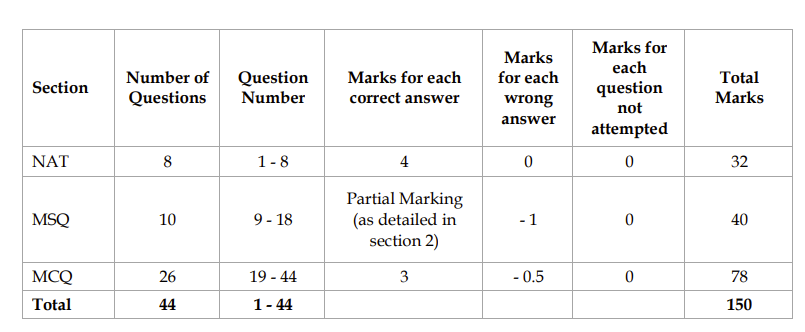
Part A is a 1-hour online test conducted in CBT mode. It carries a maximum of 150 marks and has 44 questions across three types.
| Question Type | Number of Questions | Marking Scheme |
|---|---|---|
| MCQ (Multiple Choice Questions) | 26 | +1 for correct; −0.5 for each wrong answer |
| MSQ (Multiple Select Questions) | 10 | Partial Marking, - 1 mark for each wrong answer |
| NAT (Numerical Answer Type) | 8 | 4 Marks vary per question; no negative marking |
| Total | 44 | Maximum 150 marks |
Source: ceed.iitb.ac.in
Part B – Offline Drawing Test
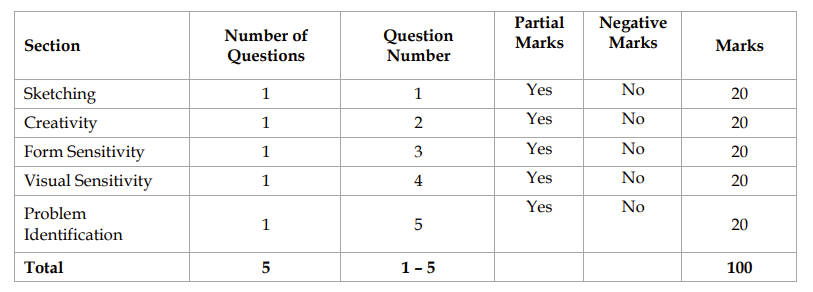
Part B is a 2-hour offline test conducted with a physical question paper and drawing booklet. It carries a maximum of 100 marks and has 5 drawing and design questions of 20 marks each. This part tests your drawing skills, creativity, design thinking, and visual communication ability. Part B answer books are evaluated manually by trained design faculty from participating IITs.
| Component | Number of Questions | Marks per Question | Total Marks |
|---|---|---|---|
| Drawing and Design Questions | 5 | 20 | 100 |
Source: ceed.iitb.ac.in
CEED 2027 Score Calculation
The final CEED 2027 score is calculated on a scale of 0 to 100. Here is how it works.
- Part A raw marks (out of 150) are first normalized to a 100-point scale.
- Final CEED Score = 0.25 × Normalized Part A Score + 0.75 × Part B Score
- Part B carries 75% of the final score — drawing skills and design thinking matter the most for your rank.
- If you do not clear the Part A qualifying cutoff, your Part B paper will not be evaluated and you will not appear on the CEED 2027 merit list.
| Exam Component | Duration | Maximum Marks | Weightage in Final Score |
|---|---|---|---|
| Part A (Computer-Based) | 1 hour | 150 | 25% |
| Part B (Offline Drawing) | 2 hours | 100 | 75% |
| Total | 3 hours | — | Final CEED Score out of 100 |

Source: ceed.iitb.ac.in
Part B is not just about artistic talent. Clarity of design thinking, labelled sketches, and a structured approach to problem-solving are equally important and contribute significantly to your Part B score.
Related Link: CEED Question Paper PDF : Download Solution PDF and Answer Key
CEED 2027 Syllabus
The CEED 2027 syllabus covers both Part A and Part B topics. There is no single prescribed textbook for CEED. The exam tests your overall design awareness, analytical skills, drawing ability, and creative thinking. Here is a topic-by-topic breakdown.
CEED 2027 Part A Syllabus
Part A of the CEED 2027 syllabus covers seven broad topic areas. Questions under each area test your reasoning, awareness, and design sensitivity.
| Topic Area | What It Tests |
|---|---|
| Visualization and Spatial Ability | 3D visualization, rotation of objects, understanding spatial relationships, and unfolding of shapes |
| Observation and Design Sensitivity | Attention to visual detail, product design awareness, form and function understanding, identifying design problems |
| Environmental and Social Awareness | Knowledge of social and cultural issues, sustainability in design, awareness of environmental impact |
| Analytical and Logical Reasoning | Data interpretation, logical sequences, number series, pattern recognition, and analytical problem-solving |
| Language and Creativity | Verbal ability, understanding of metaphors, word associations, creative thinking through language |
| Design Thinking and Problem Solving | Evaluating design solutions, user-centred design concepts, identifying design opportunities |
| Practical and Scientific Knowledge | Basic science (physics, materials, optics), technology awareness, product usage and mechanisms |
CEED 2027 Part B Syllabus
Part B is a drawing and design test with no fixed syllabus. Questions typically require you to demonstrate the following skills in your answer booklet.
- Freehand Drawing: Sketching objects, products, people, and environments with correct proportions and perspective
- Creative Skills: Generating innovative ideas and expressing them visually through annotated sketches
- Form Sensitivity: Understanding shapes, surface textures, materials, and product forms
- Visual Communication: Conveying design ideas clearly through diagrams, exploded views, and labelled drawings
- Problem Identification: Identifying real-world design problems and proposing visual solutions
- Observation and Memory Drawing: Drawing objects, scenes, or products from memory or from a given description
Practicing Part B questions from CEED 2024, 2025, and 2026 official papers is the most effective way to understand what is expected. Previous year question papers are available on the official CEED website at ceed.iitb.ac.in after registration closes each year.
Related Link: CEED Syllabus 2027: Part A, Part B, Subject-Wise Topics and PDF Download
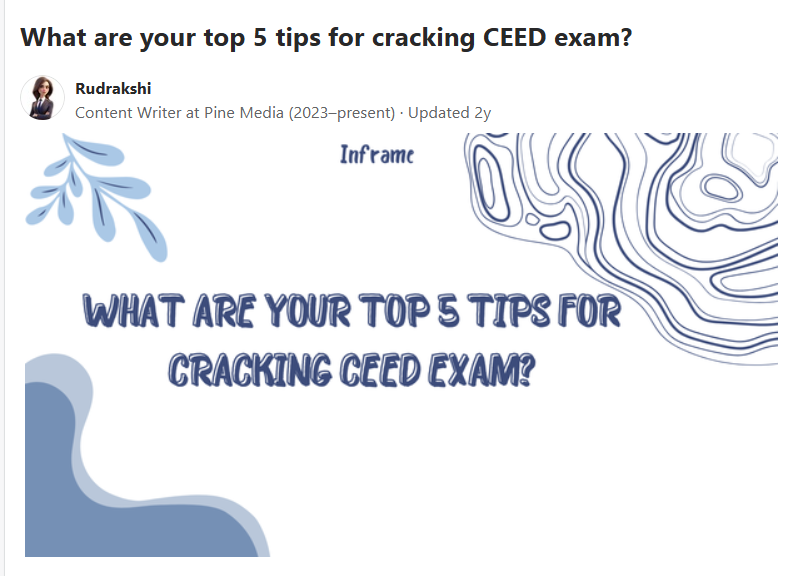
On discussion forums such as Quora, a user shared tips to crack CEED 2027 exam.- Familarize yourself with CEED exam pattern and syllabus.
- Practicse sketching variety of objects and scenes to improve freehand drawing skills.
- Improve spatial and visualization skills by practising problems related to 2D and SD objects.
- Work on practice papers and PYQs to enhance your analytical and logical reasoning skills.
- Regularly read newspaper and magazines to art and design to enhance your general awareness.
- Regularly take CEED mock test and analyze them to understand to identify strengths and weaknesses.
Source: Quora
CEED 2027 Admit Card
IIT Bombay will release the CEED 2027 admit card on the official website at ceed.iitb.ac.in. The admit card is expected around January 2, 2027, approximately two weeks before the exam date. In 2026, the CEED admit card was released on January 2, 2026, giving candidates 16 days before the exam. You cannot appear for the exam without the admit card.
How to Download the CEED 2027 Admit Card
- Visit ceed.iitb.ac.in and click on the CEED 2027 admit card download link
- Log in with your registered email ID and password
- Your admit card will load on screen — check all details carefully
- Download it and take a colour printout to carry on exam day
Details Printed on the CEED 2027 Admit Card
- Candidate’s name and photograph
- Application number and roll number
- Exam centre name, full address, and city
- Exam date (January 17, 2027) and reporting time
- Important instructions for the exam day
You must carry a colour printout of the admit card along with a valid government-issued photo ID (Aadhaar, passport, voter ID, or driving licence) on the exam day. Only a soft copy on a mobile phone will not be accepted.
If any details on the CEED 2027 admit card are incorrect — such as your name spelling, category, or exam centre city — report the error to IIT Bombay through the official CEED helpdesk immediately after downloading. Do not wait until the exam day to raise discrepancies.
Related Link: CEED Admit Card 2027: Release Date, Download Link, Exam Day Guidelines & Documents Required
CEED 2027 Result and Scorecard
The CEED 2027 result is expected in March 2027. IIT Bombay will announce the result on the official website ceed.iitb.ac.in. In 2026, the CEED result was declared on March 4, 2026. The CEED 2027 result will include your qualifying status, final score, All India Rank, and category rank.
What the CEED 2027 Result Includes
- Qualifying Status: Whether you cleared the Part A cutoff and qualify for the merit list
- CEED Score: Your final score out of 100 (calculated from both Part A and Part B)
- All India Rank (AIR): Your rank among all qualified candidates overall
- Category Rank: Separate ranks for General, OBC-NCL/EWS, SC, ST, and PwD categories
CEED 2027 Scorecard Download
After the result declaration, IIT Bombay will release individual scorecards on the candidate portal. In 2026, scorecards were available from March 10, 2026, to July 31, 2026. The CEED 2027 scorecard is expected to follow a similar timeline.
You can download your scorecard from the CEED portal by logging in with your registered email ID. The scorecard is valid for one year from the result date — you can use a CEED 2027 score only for the 2027–28 academic session admissions. After this period, a fresh CEED score is required.
Tie-Breaking Rule in CEED 2027
If two candidates have the same final CEED score, ranks are assigned using the following tie-breaking order: higher Part B score wins first; if still tied, higher Part A score wins; if still equal, the older candidate (by date of birth) gets the better rank.
Related Link:
CEED 2027 Cutoff
The CEED 2027 cutoff will be announced along with the result in March 2027. There are two types of cutoffs in CEED: the Part A qualifying cutoff (to have your Part B evaluated) and the admission cutoff at individual institutes (to secure a seat). Both are different and should not be confused.
Part A Qualifying Cutoff — How It Works
The Part A cutoff is not a fixed number. It is calculated fresh each year using candidate performance data:
- Formula: Part A Cutoff = Mean Score of all Part A candidates + Standard Deviation ÷ 2
- The General category cutoff = Mean + SD/2
- OBC-NCL/EWS cutoff = 90% of General category cutoff
- SC/ST/PwD cutoff = 50% of General category cutoff
CEED 2026 Part A Qualifying Cutoff (Reference)
The CEED 2026 Part A qualifying cutoff was calculated based on a mean Part A score of 39.35 and a standard deviation of 16.89.
| Category | CEED 2026 Part A Cutoff | CEED 2027 Cutoff |
|---|---|---|
| General | 47.80 | To be announced (March 2027) |
| OBC-NCL / EWS | 43.02 | To be announced |
| SC / ST / PwD | 23.90 | To be announced |
Source: IIT Bombay CEED Official Website
What is a Good CEED 2027 Score?
Clearing the Part A cutoff only gets your Part B evaluated — it does not guarantee a seat at any institute. For admission to top IITs like IIT Bombay, IIT Delhi, and IIT Guwahati, you generally need a final CEED score of 60 or above out of 100 and a rank within the top 150 in your category. A score of 70 or above significantly improves your chances. For IIITDM Jabalpur and IIITDM Kancheepuram, a score around 45–55 may be sufficient depending on the year.
IIT Bombay releases the qualifying cutoff, but the admission cutoff for each M.Des programme is determined separately by that institute during its individual admission process. These programme-level cutoffs vary each year based on the number of applicants and available seats.
Related Link:
CEED 2027 Marks vs Rank
The CEED marks vs rank data helps you understand what score range typically corresponds to which All India Rank. Since CEED 2027 has not been conducted yet, the table below is based on previous year trends and historical performance data. Use it as a target-setting guide for your CEED 2027 preparation.
| CEED Score Range (out of 100) | Expected AIR (General Category) | Admission Prospects |
|---|---|---|
| 75 – 85+ | AIR 1 – 30 | Top programmes at IIT Bombay, IIT Delhi, IISc |
| 65 – 74 | AIR 31 – 100 | Good prospects at IIT Guwahati, IIT Hyderabad, IIT Kanpur |
| 55 – 64 | AIR 101 – 200 | IIT Roorkee, IIT Jodhpur, and IIT Gandhinagar possible |
| 45 – 54 | AIR 201 – 400 | IIITDM Jabalpur and IIITDM Kancheepuram possible |
| 35 – 44 | AIR 400 – 600 | Admission at top institutes difficult; limited options |
| Below 35 | AIR 600+ | Very difficult; consider retaking CEED |
The CEED 2025 All India Rank 1 holder scored 82.38 out of 100, which is a useful reference for the highest achievable scores. Since Part B carries 75% of the final score, a candidate with excellent drawing and design thinking skills can score significantly higher than someone who only focuses on Part A preparation. Clearing the Part A cutoff and then excelling in Part B is the winning strategy for CEED 2027.
Related Link: CEED Cutoff 2027: Category-Wise Cutoff Marks, Good Score, Previous Year Cutoff Trends, and Marks vs Rank
CEED 2027 Participating Institutes
The CEED 2027 score is accepted by 11 participating institutes for M.Des and Ph.D. in Design admissions. These include IITs, IISc Bengaluru, and two IIITDMs. Across all 11 institutes, approximately 302 M.Des seats are available for the 2027–28 academic session.
Admission to each institute is done independently — after receiving your CEED 2027 score and rank, you must apply directly to each institute you are interested in. Each institute runs its own shortlisting, portfolio review, and interview processes, which is why your portfolio quality is as important as your CEED score.
| Institute | Location | Programme(s) via CEED 2027 |
|---|---|---|
| IISc Bengaluru | Bengaluru, Karnataka | Ph.D. in Design |
| IIT Bombay | Mumbai, Maharashtra | M.Des, Ph.D. in Design |
| IIT Delhi | New Delhi | M.Des, Ph.D. in Design |
| IIT Gandhinagar | Gandhinagar, Gujarat | M.Des |
| IIT Guwahati | Guwahati, Assam | M.Des, Ph.D. in Design |
| IIT Hyderabad | Hyderabad, Telangana | M.Des, Ph.D. in Design |
| IIT Jodhpur | Jodhpur, Rajasthan | M.Des |
| IIT Kanpur | Kanpur, Uttar Pradesh | M.Des, Ph.D. in Design |
| IIT Roorkee | Roorkee, Uttarakhand | M.Des, Ph.D. in Design |
| IIITDM Jabalpur | Jabalpur, Madhya Pradesh | M.Des |
| IIITDM Kancheepuram | Kancheepuram, Tamil Nadu | M.Des |
Popular M.Des Specialisations at CEED 2027 Institutes
- IIT Bombay: Industrial Design, Visual Communication, Interaction Design, Mobility and Vehicle Design, Animation
- IIT Delhi: Product Design, Communication Design
- IIT Guwahati: Product Design, Communication Design
- IIT Kanpur: Industrial Design
- IIT Roorkee: Industrial Design
- IIT Hyderabad: Visual Design
- IIITDM Jabalpur: Design (Product, Visual and Interaction focus)
IIT Gandhinagar was added as a CEED participating institute in 2026, making it one of the newest entries to the CEED network. Ph.D. seat numbers vary across institutes and are determined independently by each institute each year.
Related Link: List of Top Colleges in India Accepting CEED
CEED Admission Process After Result
CEED does not have a centralised counselling or seat allotment process. After the CEED 2027 result is declared in March 2027, you need to apply separately to each participating institute you are interested in. Each institute follows its own admission calendar and selection criteria.
Step-by-Step CEED Admission Process
- Step 1 – Check CEED 2027 Score and Rank: Download your CEED 2027 scorecard from ceed.iitb.ac.in. Note your All India Rank and category rank. Use these to identify which institutes you are competitive for.
- Step 2 – Apply to Individual Institutes: Check the admission portals of each IIT and IIITDM you want to apply to. Most institutes open their M.Des admission applications in March–April 2027 after the CEED result. Each institute has its own application form and deadline.
- Step 3 – Prepare and Submit Portfolio: Most IITs require a portfolio of your design work as part of the shortlisting process. Your portfolio should include original sketches, completed design projects, photographs of physical models (if any), and examples of your design thinking process. Shortlisting is typically based on CEED score plus portfolio quality.
- Step 4 – Appear for Written Test and/or Interview: Shortlisted candidates are called for a studio test (written design task) and/or a personal interview. The final merit list at each institute is based on a combination of CEED score, portfolio, test, and interview performance. IIT Bombay, for example, uses a formula of 70% CEED score and 30% studio test and interview.
- Step 5 – Accept Seat Offer: If you receive an admission offer, pay the seat deposit fee and complete document verification within the specified deadline to secure your seat. Classes for the 2027–28 session typically begin in July or August 2027.
A strong CEED 2027 score improves your shortlisting chances, but your portfolio and interview performance determine the final offer. Start working on your portfolio well before the CEED result — do not wait until March 2027.
Related Link: CEED 2027 Counselling: Expected March 2027, Participating Institutes and IIT MDes Selection
CEED 2027 Preparation Tips
With the CEED 2027 notification expected on October 1, 2026, and the exam on January 17, 2027, you have about 3.5 months from the notification date to prepare. Here are practical, focused tips for both Part A and Part B.
Part A Preparation Tips
- Know your question types: Part A has MCQs (with negative marking), MSQs (partial credit, no negative marking), and NAT questions (no negative marking). Be careful with MCQs — wrong answers cost you 0.33 marks each.
- Practise spatial reasoning daily: Solve 3D visualization puzzles, cube folding problems, and mirror image questions. Previous year CEED and UCEED Part A papers are the best resource — both share similar question patterns.
- Read and observe widely: Questions on observation, design sensitivity, and environmental awareness come from everyday life — products you use, design you see around you, science from Class 11–12 level. Stay curious about how things are designed and why.
- Target the cutoff strategically: Based on CEED 2026, the General category Part A cutoff was about 47.80 out of 150. Focus on clearing this comfortably — around 55–60 raw marks — but do not over-prepare Part A at the expense of Part B, since Part B is worth 75% of your final score.
Part B Preparation Tips
- Draw every day without exception: There is no shortcut to Part B improvement. Spend at least 45–60 minutes daily on freehand drawing. Sketch products, interiors, outdoor scenes, and people. Work on getting proportions and perspective (1-point and 2-point) right.
- Solve past Part B papers under timed conditions: Completing a full Part B in exactly 2 hours is a skill in itself. Practice finishing all 5 questions within the time limit. Part B papers from previous years are available on ceed.iitb.ac.in after each cycle.
- Think out loud in your drawings: Part B rewards structured thinking, not just drawing skill. Label your sketches, add brief annotation notes, show multiple idea iterations before selecting one to develop. The evaluator should be able to understand your design intent from your drawings alone.
- Study product and communication design: Build knowledge of iconic products, design history, typography, packaging, and wayfinding design. Being able to reference real design examples in your Part B answers adds depth and shows design awareness.
- Improve your shading and tonal work: Good shading — showing light, shadow, material texture, and depth — makes your drawings look more resolved and professional. Practise with pencil grades (HB, 2B, 4B) or with a ball pen for confident line work.
General CEED 2027 Preparation Advice
- Download and study the official CEED 2027 brochure (available from October 1, 2026, on ceed.iitb.ac.in) for the exact syllabus and question format.
- Take at least 2–3 full mock tests in December 2026, simulating both Part A (1 hour) and Part B (2 hours) back-to-back. This builds the exam stamina needed to stay creative and sharp through a 3-hour test.
- Join design communities and peer-review groups where you can get feedback on your Part B practice work from other CEED aspirants and mentors.
- Build your portfolio alongside your exam preparation — start organising your best design projects now, since you will need a strong portfolio within weeks of the result declaration in March 2027.
Related Link: CEED Mock Test (Available), Free Online Mock test, Sectional Tests, PDFs
Frequently Asked Questions (FAQs) about CEED 2027
Ques. What is CEED exam and what is it for?
Ans. CEED stands for Common Entrance Examination for Design. It is a national-level entrance exam conducted by IIT Bombay for admission to M.Des (Master of Design) and Ph.D. in Design programmes at 11 participating institutes including IITs, IISc Bengaluru, and IIITDMs. CEED 2027 is scheduled for January 17, 2027.
Ques. Who is eligible for CEED 2027?
Ans. You are eligible for CEED 2027 if you hold a graduate degree, diploma, or postgraduate degree of at least three years after 10+2, from any stream. Final-year students are also eligible to apply. There is no age limit and no restriction on which academic discipline you come from.
Ques. Is there any age limit for CEED?
Ans. No, there is no age limit for CEED. Candidates of any age can apply as long as they meet the educational qualification requirement — a completed or ongoing graduate degree of at least three years after 10+2.
Ques. How many attempts are allowed for CEED 2027?
Ans. There is no limit on the number of attempts for CEED. You can appear as many times as you want across different years. However, the CEED score is valid for one year only, so you must secure admission in the same academic cycle — the CEED 2027 score is valid only for 2027–28 admissions.
Ques. How is the CEED 2027 score calculated?
Ans. The CEED 2027 final score is calculated using this formula: Final Score = 0.25 × Normalized Part A Score + 0.75 × Part B Score. The final score is out of 100. Part A score (out of 150) is first normalized to 100, then the weighted formula is applied. Your Part B is evaluated only if you clear the Part A qualifying cutoff for your category.
Ques. When will CEED 2027 registration open?
Ans. CEED 2027 registration is expected to open on October 1, 2026, along with the official notification at ceed.iitb.ac.in. The regular registration deadline is expected around November 5, 2026. A late fee window is expected to remain open until around November 10, 2026.
Ques. What is a good score in CEED to get into IITs?
Ans. For admission to top IITs like IIT Bombay, IIT Delhi, and IIT Guwahati, you generally need a CEED score of 60 or above out of 100, with a General category rank within the top 150. A score of 70 or above strengthens your chances significantly. For IIITDM Jabalpur and IIITDM Kancheepuram, a score around 45–55 may be sufficient, depending on the year’s applicant pool.
Ques. What is the difference between CEED and UCEED?
Ans. Both CEED and UCEED are conducted by IIT Bombay, but they serve different levels of study. UCEED is an undergraduate design entrance exam for admission to B.Des (Bachelor of Design) programmes at IITs. CEED is a postgraduate design entrance exam for M.Des and Ph.D. programmes. CEED requires a graduate degree for eligibility, while UCEED is for candidates who have cleared or are appearing in Class 12.
Ques. Can I apply for CEED 2027 if I am in my final year of graduation?
Ans. Yes. Final-year students are eligible to appear for CEED 2027. However, you must complete your degree and meet the institute’s specific eligibility requirements before the joining deadline, which is typically by July 2027. If you do not complete the degree by the required date, your admission offer may be cancelled by the institute.
Ques. How is the Part A cutoff in CEED calculated?
Ans. The CEED Part A qualifying cutoff is not a fixed number — it changes every year based on actual candidate performance. The formula is: General Cutoff = Mean Part A Score + Standard Deviation ÷ 2. The OBC-NCL/EWS cutoff is 90% of the General cutoff, and the SC/ST/PwD cutoff is 50% of the General cutoff. In 2026, the General cutoff was 47.80, OBC-NCL/EWS was 43.02, and SC/ST/PwD was 23.90.
Ques. Which institutes accept CEED 2027 scores for M.Des admission?
Ans. The 11 institutes that accept CEED 2027 scores are: IISc Bengaluru, IIT Bombay, IIT Delhi, IIT Gandhinagar, IIT Guwahati, IIT Hyderabad, IIT Jodhpur, IIT Kanpur, IIT Roorkee, IIITDM Jabalpur, and IIITDM Kancheepuram. Together, these institutes offer approximately 302 M.Des seats for the 2027–28 session. Admission is decentralised — you must apply to each institute separately after the CEED result.
Disclaimer: The information on CEED 2027 dates, fees, eligibility, and other details is based on the official CEED 2026 notification and previous year patterns. The official CEED 2027 notification is expected on October 1, 2026, at ceed.iitb.ac.in, which will confirm all details for the 2027 cycle. Candidates are advised to check the official website regularly for the latest updates.





%20-%202026-03-10T184526.296.png?h=112&w=263&mode=stretch)




Comments
Found 2 Comments
If you have applied, then you will be notified on you registered mail ID provided by you at the time of registration and application.
If you have completed your MBA degree with at least 60% marks and have qualified for GATE/ CSIR/ UGC/NET/ICAR/ICMR/ DST-INSPIRE Fellowship, you are eligible to apply for admission in Ph.D in Management program at IITs. Work experience is required only for sponsored students.