




The CEED exam pattern 2027 has 44 objective questions in Part A for 150 marks and 5 subjective questions in Part B for 100 marks. The CEED marking scheme awards +4 marks for a correct NAT answer while deducting 1 mark for a wrong MSQ and 0.5 marks for a wrong MCQ.
- The CEED exam will be held on January 17, 2027 in a single forenoon session.
- The CEED Part A and Part B exam pattern has Part A in CBT mode while Part B is answered in a paper booklet.
- CEED Part A has 8 NAT, 10 MSQ and 26 MCQ questions.
- The CEED Part B section carries five subjective questions of 20 marks each on design, drawing and writing skills.
- The CEED exam duration is 3 hours, with 1 hour for Part A and 2 hours for Part B.
- As per the CEED exam pattern 2027, Part A cannot be attempted once Part B begins.
- CEED total marks are 250 while the final score uses 0.25 × Part A + 0.75 × Part B which caps the weighted score at 112.5.
- Booklets for Part B are marked only for those candidates who can clear the Part A cutoff, which was 47.80 marks in the General category for CEED 2026.
- The CEED paper pattern has stayed unchanged since 2024, when Part A moved from 100 marks and 41 questions to 150 marks and 44 questions.
Related Links:
- CEED Syllabus 2027: Part A and Part B Topics, Weightage and PDF Download
- CEED Previous Year Question Papers (Available)- Download PDF with Solutions [2026-2010]
- CEED Mock Test, Free Online Mock test, Sectional Tests, PDFs

Key Summary
- CEED full form is Common Entrance Exam for Design, the IIT Bombay test for MDes and PhD design admissions across IISc and participating IITs.
- Part A works only as a screening stage so its marks decide whose Part B booklet reaches an examiner, not the candidate's rank.
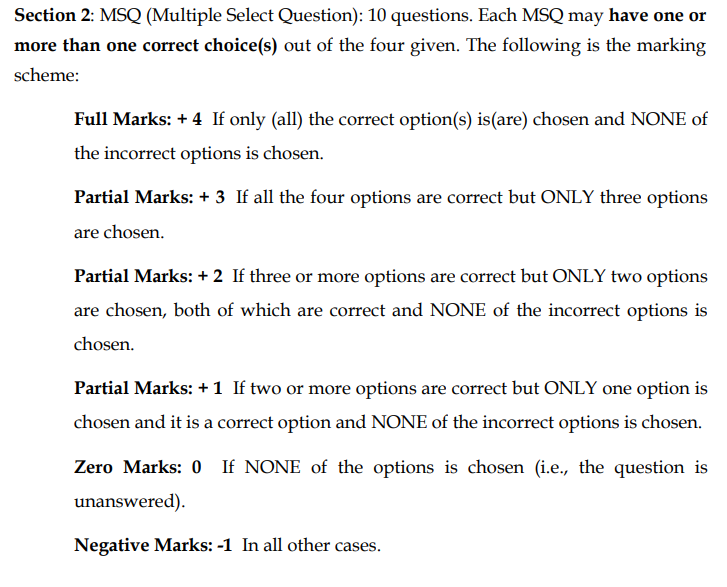
- MSQs are the only Part A questions with partial credit where +3, +2 or +1 applies as long as no wrong option is selected.
- Part B answers are marked on printed criteria such as proportion, originality, rendering quality and clarity of communication.
- The CEED Part A cutoff is statistical, calculated as μ + σ/2 for General, with 0.9δ for OBC-NCL/EWS and 0.5δ for SC/ST/PwD.
CEED Exam Pattern 2027 Overview
CEED Exam 2027 includes a single forenoon shift on January 17 with Part A held from 9-10 am as the screening stage.
- Candidates clearing the Part A cutoff will have their 100 mark
- Part B design booklets evaluated for the final 0.25:0.75 weighted rank.
- CEED Part A has objective aptitude questions
- Part B tests drawing, creativity and communication through subjective questions.
| Particulars | Part A (Computer-Based) | Part B (Pen & Paper) | Overall |
|---|---|---|---|
| Duration | 1 hour | 2 hours | 3 hours |
| Mode | Online (CBT) | Offline (answer booklet) | Hybrid |
| Total Questions | 44 | 5 | 49 |
| Question Types | NAT (8), MSQ (10), MCQ (26) | Sketching, Creativity, Form Sensitivity, Visual Sensitivity, Problem Identification | Objective + Subjective |
| Total Marks | 150 | 100 | 250 |
| Marking Scheme | NAT: +4 (no negative)MSQ: Partial up to +4 (–1 otherwise)MCQ: +3 (–0.5 for wrong) | 20 marks each (no negative marking; partial marks possible) | - |
| Final Score Weightage | 25% | 75% | Final Score = 0.25 × Part A + 0.75 × Part B |
| Purpose | Screening (cut-off based shortlisting) | Design, drawing & problem-solving evaluation | Ranking for M.Des admissions |
Also Check:
Ques. How many questions are there in the CEED exam?
Ans. The CEED exam has 49 questions in total based on the 2026 pattern. Part A has 44 questions comprising 26 NAT, 10 MSQ and 8 MCQ questions, while Part B has 5 questions testing design, drawing and creative skills.
You can watch the YouTube video "CEED 2027 - Eligibility Criteria, Exam Date, Application form, Exam Pattern, Counseling" by Multigrow Education to understand the CEED exam pattern 2027 in detail. The video covers the two-section structure, the 150 and 100 mark split, the 1-hour and 2-hour timings, Part A question types and the Part B drawing questions.
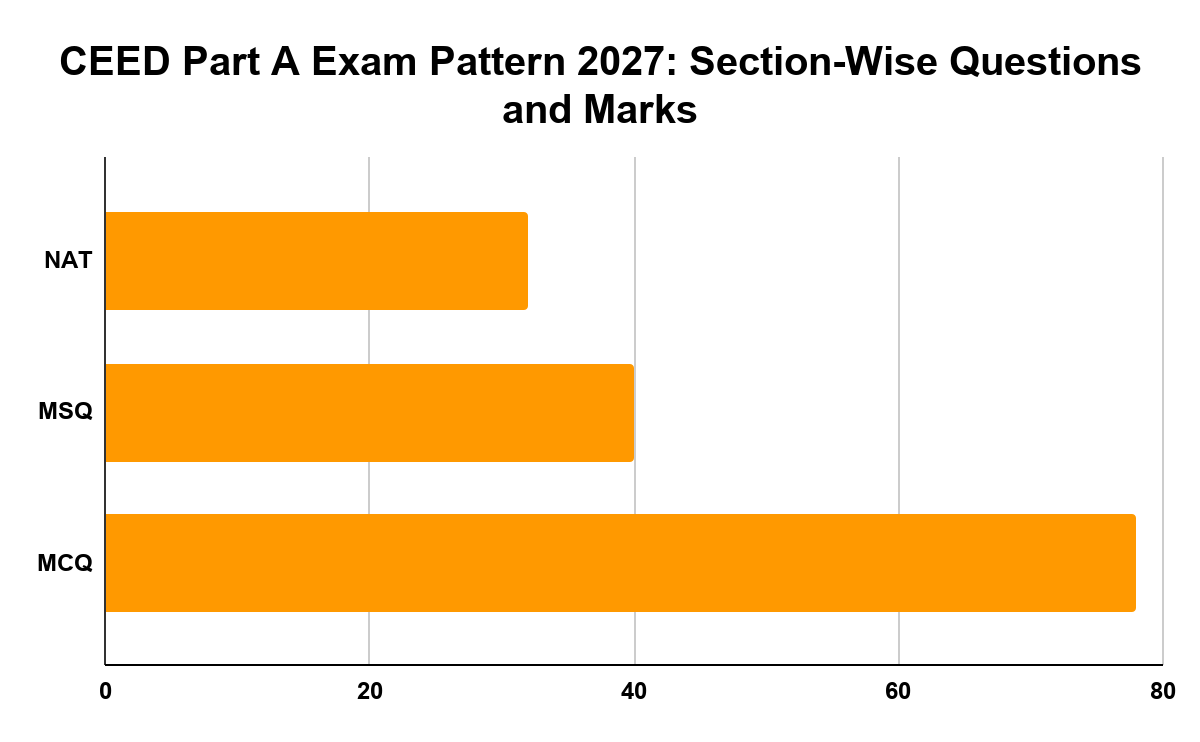
CEED Part A Exam Pattern 2027: Section-Wise Questions and Marks
CEED Part A Exam Pattern 2027 has 44 questions to be answered in 60 minutes, covering NAT, MSQ and MCQ sections.
- NAT and MSQ offer 72 marks from 18 questions, at 4 marks per fully correct answer under the CEED marking scheme.
- With 44 questions in 60 minutes, candidates get about 82 seconds per question.
| Section | Question Type | No. of Questions | Answer Format | Total Marks |
|---|---|---|---|---|
| NAT | Numerical Answer Type | 8 | Enter a number via virtual keyboard | 32 |
| MSQ | Multiple Select Questions | 10 | Select one or more correct options | 40 |
| MCQ | Multiple Choice Questions | 26 | Select only one correct option | 78 |
| Total | — | 44 | — | 150 |
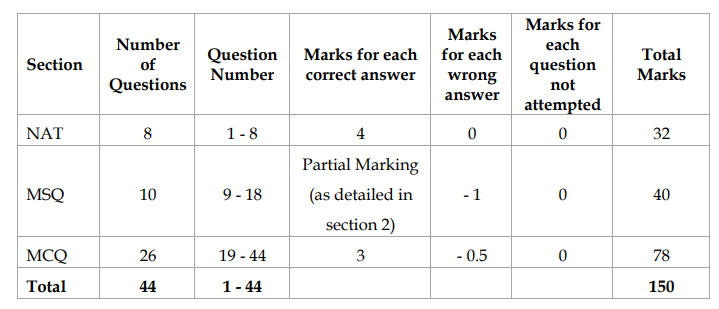
Source: CEED Official Information Brochure
Also Check:
Ques. Can candidates use a calculator for CEED Part A NAT questions?
Ans. No, candidates cannot use a calculator for CEED Part A NAT questions. The CEED 2026 Information Brochure prohibits calculators and other electronic gadgets inside the examination hall.
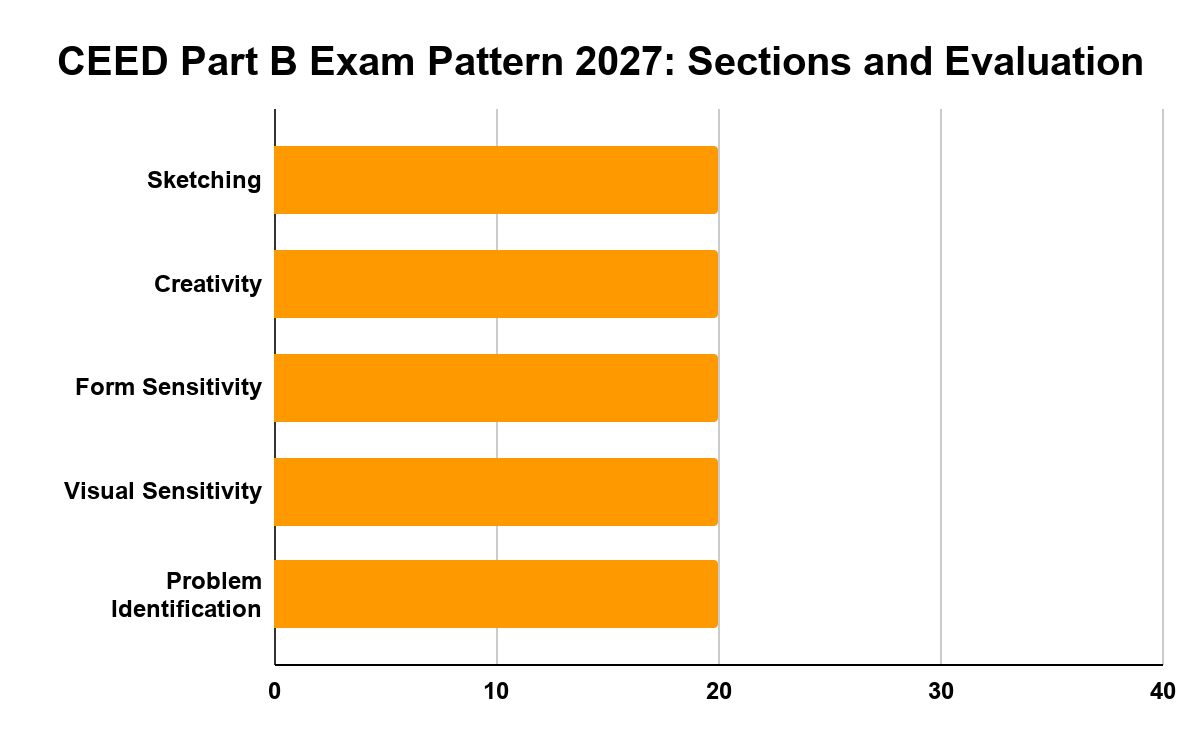
CEED Part B Exam Pattern 2027: Sections and Evaluation
CEED Part B Exam Pattern 2027 has five mandatory questions of 20 marks each with the section carrying 100 marks and lasting two hours.
- The CEED Part B paper covers Sketching, Creativity, Form Sensitivity, Visual Sensitivity and Problem Identification with about 24 minutes per section.
| Section | Number of Questions | Marks | Evaluation Criteria (as printed in recent CEED papers) |
|---|---|---|---|
| Sketching | 1 | 20 | Character and Expressions; Proportion and Composition; Quality of Sketching; Environment and Props |
| Creativity | 1 | 20 | Originality; Graphical Narrative (Story Communication); Humour and Surprise; Clarity and Neatness of Sketches |
| Form Sensitivity | 1 | 20 | Uniqueness of the form; Form-Function relevance and relationship; Detailing; Rendering quality |
| Visual Sensitivity | 1 | 20 | Consistency of visual language; Thematic appropriateness; Effective communication; Composition, Clarity and Neatness |
| Problem Identification | 1 | 20 | Variety and uniqueness of the problems; Relevance of the problems; Practical feasibility of the design solutions; Clarity in communication |
| Total | 5 | 100 | — |
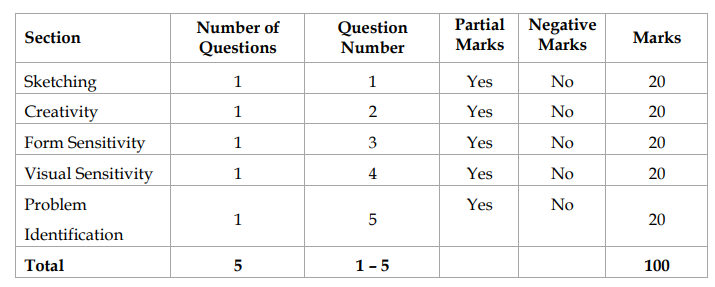
Source: CEED Official Information Brochure
Also Check:
- CEED Design Drawing & Writing Skills Sample Paper 2026- Download PDF
- CEED 2014 Question Paper with Solution PDF
Ques. Can I use colour pencils in CEED Part B?
Ans. Yes, colour pencils can be used in CEED Part B, unless a question specifically prohibits their use. The CEED 2025 instructions also permitted crayons and sketch pens in Part B. However, individual questions can prescribe specific materials, as seen in CEED 2026.
CEED Marking Scheme 2027: Part A and Part B
CEED Marking Scheme 2027 gives NAT +4 for correct answers while wrong or unattempted answers get zero marks.
- MSQ questions carry +4 for full credit, +3/+2/+1 for partial credit and -1 for wrong answers.
- MCQs carry +3 for correct answers and -0.5 for wrong answers in CEED Part A.
- CEED Part B has five 20 mark questions with no negative marking while unattempted answers get zero.
| Part | Question Type | Correct Answer | Wrong Answer | Not Attempted | Partial Marks |
|---|---|---|---|---|---|
| Part-A | NAT (Numerical Answer Type) | +4 | 0 | 0 | No |
| MSQ (Multiple Select Question) | +4 (full marks) | –1 | 0 | Yes | |
| MCQ (Multiple Choice Question) | +3 | –0.5 | 0 | No | |
| Part-B | Sketching | 20 | No negative | 0 | Yes |
| Creativity | 20 | No negative | 0 | Yes | |
| Form Sensitivity | 20 | No negative | 0 | Yes | |
| Visual Sensitivity | 20 | No negative | 0 | Yes | |
| Problem Identification | 20 | No negative | 0 | Yes |
Also Check:
Ques. What is the CEED marking scheme 2027 for NAT questions?
Ans. For CEED Part A NAT questions, each correct answer carries 4 marks, with no negative marking or partial marking. Unattempted NAT questions receive 0 marks; the 2027 marking scheme will be confirmed in the official brochure.
CEED MSQ Partial Marking 2027
CEED MSQ Partial Marking 2027 has 10 MSQ questions from Q9-Q18, carrying 40 marks with scores from +4 to -1.
- Under CEED MSQ partial marking, a single incorrect option cancels all credit and deducts -1 mark.
- Choosing one confirmed correct option earns at least +1 mark and the full +4 marks when that is the only right answer.
| Scenario | Marks Awarded |
|---|---|
| Only (all) the correct option(s) chosen and none of the incorrect options chosen | +4 (Full Marks) |
| All four options are correct but only three options are chosen | +3 |
| Three or more options are correct but only two correct options are chosen (and none incorrect) | +2 |
| Two or more options are correct but only one correct option is chosen (and none incorrect) | +1 |
| Question left unanswered (none of the options chosen) | 0 |
| All other cases (including any incorrect option chosen) | –1 |
Source: CEED Official Information Brochure
Also Check:
Ques. What happens if I select a wrong option in a CEED MSQ?
Ans. Selecting an incorrect option in a CEED MSQ results in -1 mark. Partial marks are awarded only when selected options are correct and no incorrect option is chosen; otherwise, -1 mark is given.
CEED Final Score Calculation 2027
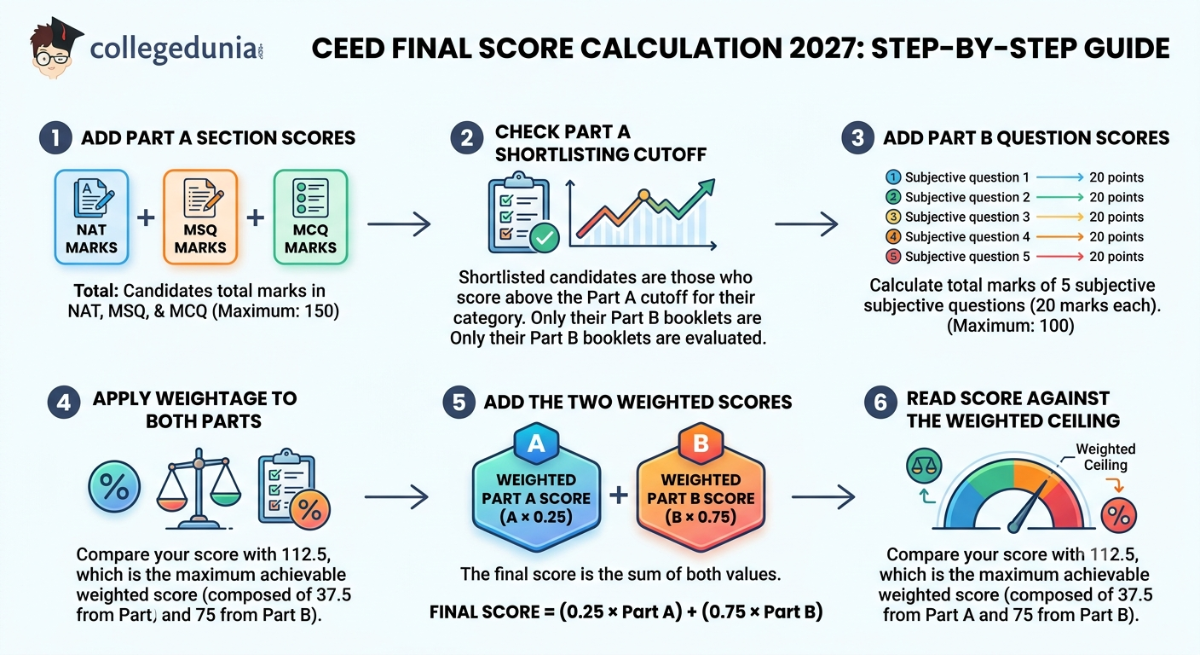
The CEED final score calculation combines both parts of the CEED paper pattern after shortlisting.
- Step 1: Add the Part A Section Scores
Candidates need to total their NAT, MSQ and MCQ marks which together carry a maximum of 150 marks in Part A.
- Step 2: Check the Part A Shortlisting Cutoff
Candidates must score above the Part A cutoff for their category as Part B answer booklets are evaluated only for shortlisted candidates.
- Step 3: Add the Part B Question Scores
The candidates have to calculate the marks of 5 subjective questions carrying 20 marks each and thus the total marks would be 100 in Part B.
- Step 4: Applying Weightage to Both the Parts
The candidates need to multiply their Part A marks by 0.25 and Part B marks by 0.75 since Part B has more weightage.
- Step 5: Add the Two Weighted Scores
The final score is the sum of both weighted values written as
| Final Score = (0.25 × Part A) + (0.75 × Part B) |
- Step 6: Read the Score Against the Weighted Ceiling
Candidates need to compare their result with 112.5 which is the highest weighted score and made up of 37.5 from Part A and 75 from Part B.
Example: Suppose a General category candidate attempts CEED Part A as follows:
- NAT: 6 correct, 2 skipped = 6 × 4 = 24 marks
- MSQ: 5 fully correct, 2 partial at +2, 1 wrong, 2 skipped = 20 + 4 - 1 = 23 marks
- MCQ: 18 correct, 4 wrong, 4 skipped = 54 - 2 = 52 marks
Part A totals 99 out of 150, clearing the CEED 2026 General cutoff of 47.80. With 62 out of 100 in Part B, the final score is 0.25 × 99 + 0.75 × 62 = 24.75 + 46.50 = 71.25 out of 112.5.
Ques. Is there re-evaluation of CEED answer sheets?
Ans. No, there is no provision for re-evaluation or re-totalling of CEED answer sheets. IIT Bombay also does not entertain requests to show the evaluated answer books.
CEED Exam Question Papers:
| CEED 2026 Question Paper PDF | CEED 2025 Question Paper |
| CEED 2024 Question Paper with Solution PDF | CEED 2023 Question Paper with Solution PDF |
| CEED 2022 Question Paper with Solution PDF |
Ques. Is the CEED Part A cutoff the same every year?
Ans. No, the CEED Part A cutoff is not the same every year. It is calculated using the mean and standard deviation of that year's Part A scores, so the cutoff changes according to the overall performance of candidates.
CEED Exam Duration and Timings 2027
CEED Exam Duration 2027 run from 9 AM to 12 noon with Part A from 9-10 AM and Part B from 10 AM to 12 noon.
- Candidates must report by 7 AM for biometrics and Part A answers cannot be changed once Part B begins.
| Part | Duration | Timings | Mode of Examination |
|---|---|---|---|
| Part-A | 1 hour | 9:00 AM – 10:00 AM | Computer-based (NAT, MSQ, MCQ) |
| Part-B | 2 hours | 10:00 AM – 12:00 Noon | Questions on screen; answers in answer booklet |
| Full Exam | 3 hours | 9:00 AM – 12:00 Noon | Combined |
Source: ceed.iitb.ac.in (CEED 2026 Information Brochure, Section 1.10)
Also Check:
Ques. Is there a break between CEED Part A and Part B?
Ans. No, there is no separate break between CEED Part A and Part B. Both parts are conducted in the same examination session, with Part A followed by Part B according to the prescribed exam schedule.
Has the CEED Exam Pattern Changed Over the Years?
CEED Exam Pattern Changes Over the Years began in 2024 when Part A rose to 150 marks with 44 questions while Part B stayed at five 20 mark questions.
- The CEED exam pattern still has a 3 hour duration and 25:75 Part A-Part B weightage as followed in earlier years.
| Aspect | Pre-2024 (e.g., 2021–2023) | 2024–2026 (Current) | Change Status |
|---|---|---|---|
| Part-A Total Marks | 100 | 150 | Increased |
| Part-A Questions | 41 (NAT 8, MSQ 10, MCQ 23) | 44 (NAT 8, MSQ 10, MCQ 26) | Increased |
| NAT Marking | +3 each | +4 each | Increased |
| MSQ Marking | +3 (with partial / –0.2) | +4 full / partial (+3/+2/+1) / –1 | Revised |
| MCQ Marking | +2 / –0.5 | +3 / –0.5 | Increased |
| Part-B Structure | 5 questions × 20 marks = 100 | 5 questions × 20 marks = 100 | No change |
| Total Duration | 3 hours (1 hr + 2 hrs) | 3 hours (1 hr + 2 hrs) | No change |
| Final Score Weightage | 0.25 × Part-A + 0.75 × Part-B | 0.25 × Part-A + 0.75 × Part-B | No change |
| Part-B Evaluation | Only for Part-A shortlisted candidates | Only for Part-A shortlisted candidates | No change |
Also Check:
| CEED 2025 Official Paper | CEED 2024 Official Paper |
| CEED 2023 Official Paper | CEED 2022 Official Paper |
| CEED 2021 Official Paper | CEED 2020 Official Paper |
Ques. Is the CEED Exam Pattern 2027 different from CEED 2026?
Ans. The CEED 2027 exam pattern has not been officially announced yet, so no confirmed difference from CEED 2026 can be stated. The CEED 2026 pattern had Part A with 44 questions and Part B with 5 questions; the 2027 pattern will be confirmed in the official IIT Bombay brochure.
CEED Exam Pattern vs Other Design Entrance Exams
CEED Exam Pattern vs Other Design Entrance Exams gives Part B two hours and 75% weightage for five drawing questions, twice the UCEED subjective section time.
- CEED and UCEED evaluate drawing only after candidates clear the Part A statistical cut-off unlike NID’s studio and interview stages.
| Parameter | CEED (M.Des / PhD) | UCEED (B.Des) | NID DAT (B.Des / M.Des) |
|---|---|---|---|
| Level | Postgraduate | Undergraduate | UG + PG |
| Conducting Body | IIT Bombay | IIT Bombay | National Institute of Design |
| Total Duration | 3 hours | 3 hours | Prelims: 3 hours + Mains (Studio + Interview) |
| Part-A / Objective | 1 hour, 44 Qs, 150 marks (NAT/MSQ/MCQ) | 2 hours, ~57 Qs, 200 marks (NAT/MSQ/MCQ) | Written Prelims ( pen-paper ) |
| Part-B / Subjective | 2 hours, 5 Qs, 100 marks (Sketching, Creativity, Form, Visual, Problem ID) | 1 hour, 2 Qs, 100 marks (Sketching + Design Aptitude) | Studio Test + Interview |
| Total Marks | 250 | 300 | Varies (Prelims + Mains) |
| Final Score Weightage | 25% Part-A + 75% Part-B | Combined (Part-B only if shortlisted) | Prelims + Mains weighted |
| Negative Marking | Yes (Part-A only) | Yes (Part-A only) | Limited / None in creative sections |
| Evaluation of Drawing | Only for Part-A shortlisted candidates | Only for Part-A shortlisted candidates | Studio Test for shortlisted |
Also Check:
| CEED Product Design and Development Mock Test 1 | CEED Product Design and Development Mock Test 2 |
| CEED Product Design and Development Mock Test 3 | CEED Product Design and Development Mock Test 4 |
Ques. Is the CEED exam pattern for MDes the same for all specialisations?
Ans. Yes, the CEED exam pattern is common for all MDes specialisations. The exam has Part A and Part B, and the same paper is used for candidates applying to different design specialisations; individual institutes may have separate admission criteria.
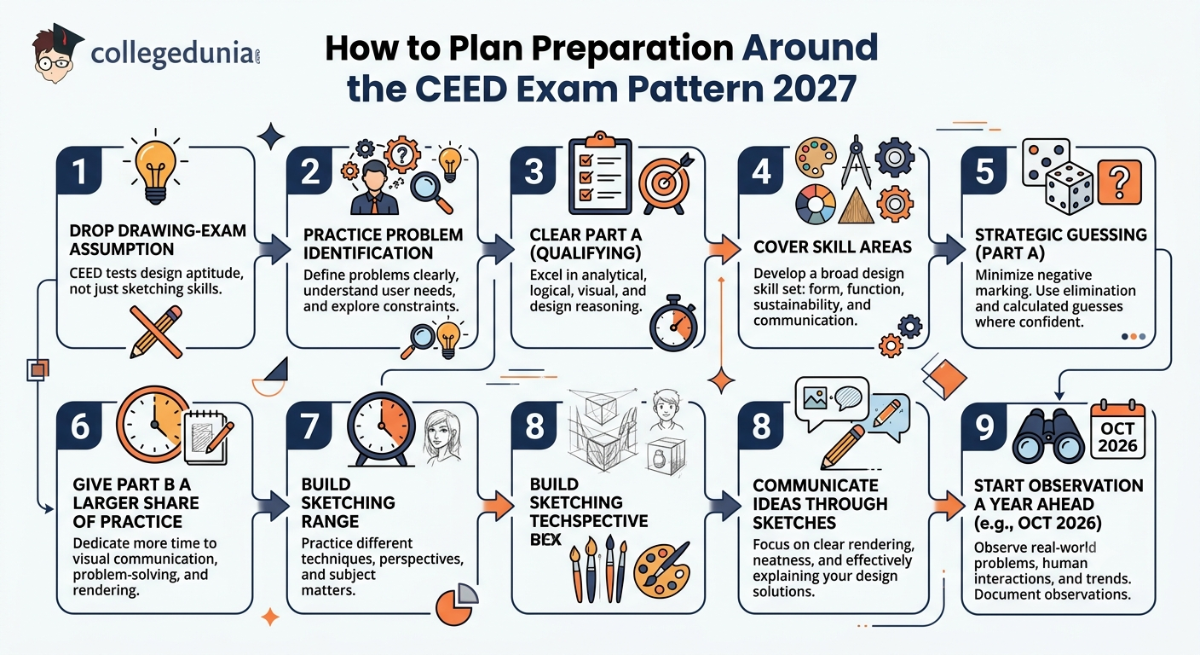
How to Plan Preparation Around the CEED Exam Pattern 2027
The CEED Exam Pattern 2027 tests design aptitude rather than drawing talent so preparation should follow what each part actually measures.
- Step 1: Drop the Drawing-Exam Assumption
Candidates need to prepare for visual perception, logical reasoning and design thinking since strong artists still fail when they treat CEED as a sketching test.
- Step 2: Practise Identifying Problems Before Solving Them
Spotting a real-world issue and answering it visually is the core skill and it decides marks in the Problem Identification question of Part B.
- Step 3: Clear Part A Before Anything Else
Candidates must target the Part A cutoff first because the CEED Part B sections reach an examiner only after shortlisting.
- Step 4: Cover All Four Part A Skill Areas
Preparation has to span visualisation, spatial reasoning, environmental and social awareness and language as questions rotate across these areas.
- Step 5: Guess Only After Elimination
Under the CEED marking scheme, NAT answers carry no deduction but a wrong MCQ costs 0.5 marks and a wrong MSQ costs 1 mark, so blind guessing drains the score.
- Step 6: Give Part B the Larger Share of Practice
Candidates should spend more hours on Part B which contributes 75 points of the 112.5 maximum weighted score against 37.5 from CEED Part A.
- Step 7: Build Sketching Range, Not Just Neatness
Practice must cover perspective, human figures and scene creation since the Sketching question asks for a described situation rather than a decorative drawing.
- Step 8: Communicate the Idea Through the Sketch
Examiners look for a concept that reads clearly from the page so candidates have to answer the exact question asked instead of producing an attractive but unrelated drawing.
- Step 9: Start Observing a Year Ahead
Candidates should begin daily observation practice well before registration opens around October 2026 as observation skills cannot be built in the final weeks.
Also Check:
| CEED Logical Reasoning Mock Test 1 | CEED Logical Reasoning Mock Test 2 |
| CEED Logical Reasoning Mock Test 3 | CEED Logical Reasoning Mock Test 4 |
Ques. Should I skip MSQs in CEED if I am unsure?
Ans. Candidates should be cautious with CEED MSQs when unsure, as an incorrect option attracts -1 mark, while an unattempted question carries 0 marks. Partial marks are available only for specific combinations of correct options without selecting any incorrect option.
According to a Reddit discussion, candidates discussed CEED eligibility and preparation, particularly the drawing section and its similarity to UCEED. The discussion highlighted Part B drawing, creativity, visual sensitivity and problem identification, with 75% weightage for Part B and regular timed practice recommended.

Source: Reddit
CEED Exam Pattern 2027: Frequently Asked Questions (FAQs)
Ques. Is the CEED Part B answer booklet shown to candidates after evaluation?
Ans. No, the evaluated CEED Part B answer booklet is not shared with candidates. IIT Bombay also states that there is no provision for re-evaluation of Part B.
Ques. Does a wrong answer in CEED Part A affect Part B marks?
Ans. No, a wrong answer in CEED Part A does not directly affect Part B marks. Part A and Part B are evaluated separately, although both contribute to the final CEED score, with 25% weightage for Part A and 75% for Part B.
Ques. Can a CEED MSQ have all four options correct?
Ans. Yes, a CEED MSQ can have all four options correct. If all four are correct and all four are selected, the candidate receives the full 4 marks; selecting only three correct options earns 3 marks.
Ques. Is the CEED exam difficult?
Ans. The CEED exam is considered challenging as it tests visual perception, drawing, creativity, logical reasoning, communication and problem-solving skills through Part A and Part B.
Ques. How many attempts for CEED?
Ans. There is no fixed limit on the number of CEED attempts. Candidates can appear in CEED in multiple years if they meet the eligibility criteria for the respective examination year.
Ques. Which colleges accept CEED?
Ans. CEED scores are accepted by participating institutes including IISc Bengaluru, IIT Bombay, IIT Delhi, IIT Gandhinagar, IIT Guwahati, IIT Hyderabad, IIT Jodhpur, IIT Kanpur and IIT Roorkee, among others. Several result-sharing institutes also accept CEED scores.
Ques. Who is eligible for the CEED exam?
Ans. Candidates must have completed a minimum three-year degree, diploma or postgraduate degree after Class 12, or be appearing for the final examination by the specified deadline. GD Arts diploma holders meeting the prescribed criteria are also eligible.
Ques. What are the fees for the CEED entrance exam?
Ans. For CEED 2026, the registration fee was ₹4,000 for other candidates and ₹2,000 for women and SC/ST/PwD candidates, excluding applicable service charges. A ₹500 late fee was also applicable.
Ques. Are CEED and UCEED different?
Ans. Yes. CEED is primarily for postgraduate design admissions, including MDes and PhD programmes, while UCEED is an undergraduate entrance exam for admission to BDes programmes.



Comments