




The Consortium of Medical, Engineering, and Dental Colleges of Karnataka sets the COMEDK UGET Exam Pattern 2027. Aligned with the 10+2 / 2nd PUC standard, the national-level entrance test will be conducted in an online Computer-Based Test (CBT) format in the English language. The exam will be conducted at more than 400 designated test centres across over 200 cities in India. It will consist of MCQ-type questions from Physics, Chemistry & Mathematics.
The COMEDK UGET is expected to remain largely unchanged from previous years.
- COMEDK UGET 2027 is an 180-minute computer-based test with 180 questions for 180 marks.
- The exam has 60 questions and a total of 60 marks. Every correct answer earns +1 mark; there is no negative marking — wrong or unattempted answers score 0.
- About 67% of the syllabus comes from Class 12 CBSE content and 33% from Class 11.
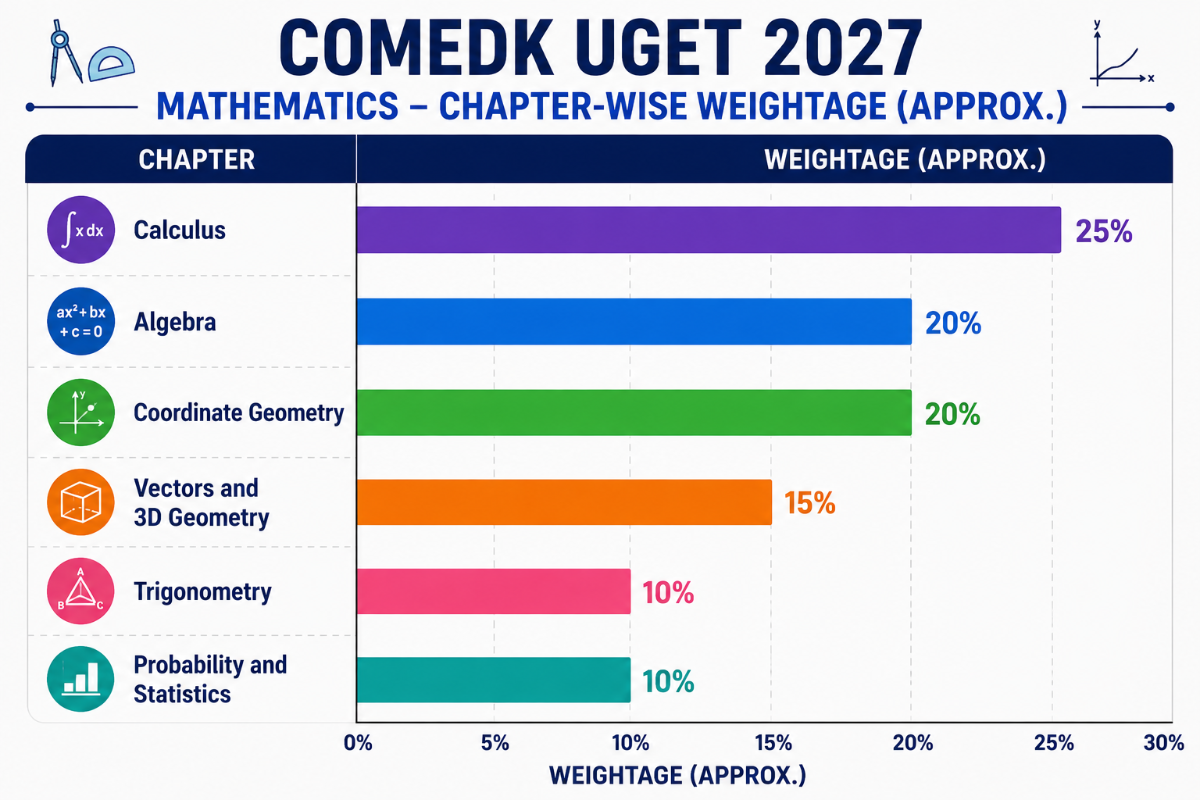
- In Mathematics, Calculus (25%), Algebra (20%), and Coordinate Geometry (20%) carry the highest weightage.
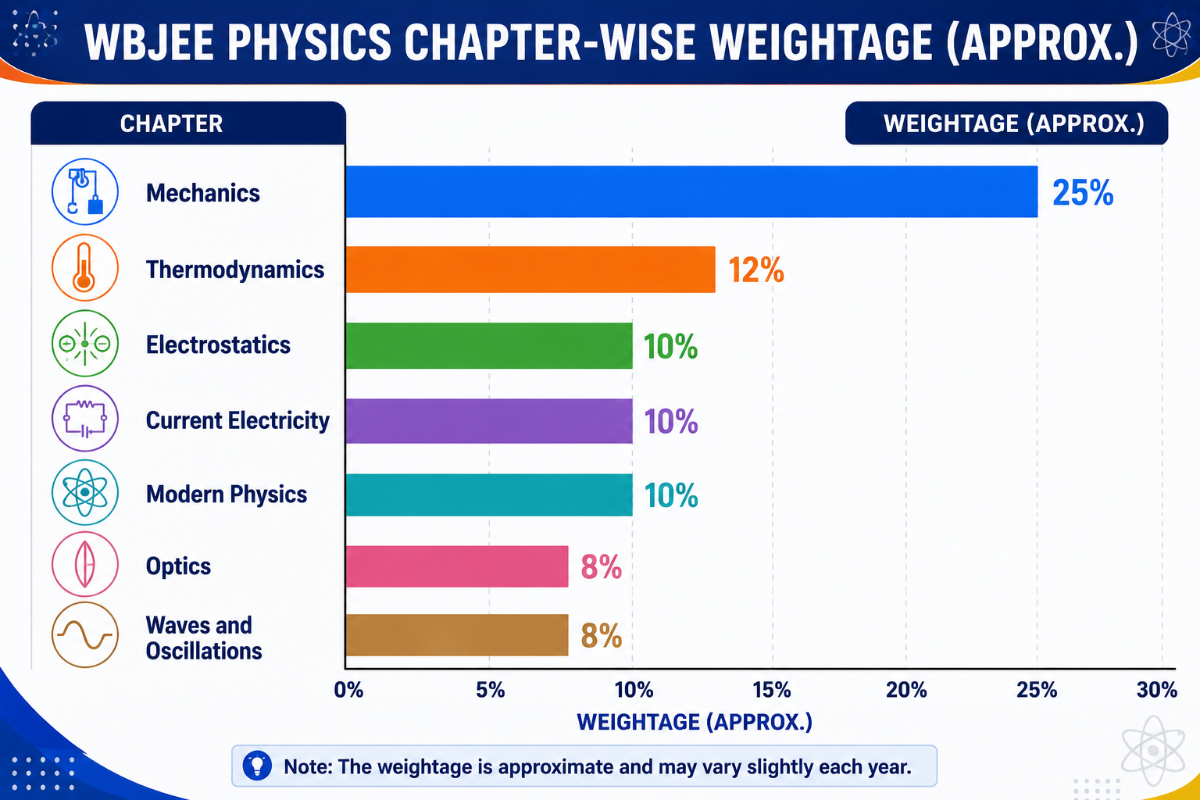
- In Physics, the section is heavily dominated by Mechanics (25%), Heat & Thermodynamics (12%), and Electrostatics (10%).
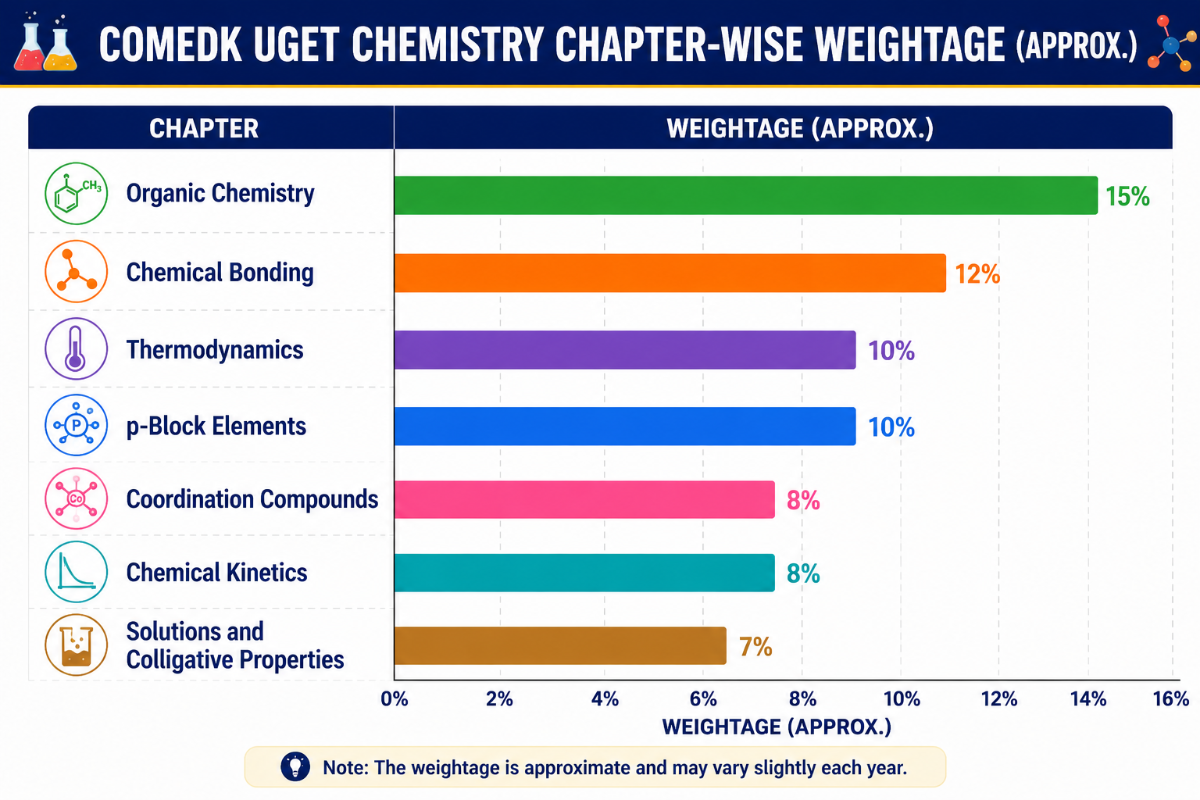
- In Chemistry, high-weightage areas include Physical Chemistry topics (25%), Organic Chemistry (15%), and Chemical Bonding (12%).
Related Links:
- COMEDK UGET Syllabus 2027: Subject-Wise Topics, Weightage and PDF Download
- COMEDK UGET Previous Year Question Papers with Solutions- Download PDF
COMEDK UGET Paper Pattern 2027
The COMEDK UGET 2027 exam pattern is expected to follow the established PCM structure, with Physics, Chemistry, and Mathematics carrying equal weightage.
The latest official 2026 pattern has 180 MCQs for 180 marks, with 1 mark for each correct answer and no negative marking.
| Particulars | COMEDK UGET 2027 Details |
|---|---|
| Exam Mode | Computer-Based Test (CBT) |
| Medium of Exam | English |
| Subjects | Physics, Chemistry & Mathematics |
| Total Questions | 180 MCQs |
| Physics | 60 Questions |
| Chemistry | 60 Questions |
| Mathematics | 60 Questions |
| Total Marks | 180 Marks |
| Marks per Correct Answer | 1 Mark |
| Negative Marking | No negative marking |
| Question Type | Multiple Choice Questions (MCQs) |
| Exam Duration | 3 Hours |
| Total Sections | 3 |
| Marking Scheme | +1 for every correct answer; 0 for an incorrect answer |
| Level of Questions | Based on the Class 11 and 12 syllabus |
Also Read:
- COMEDK UGET Exam Dates 2027: Expected May 2027, Registration, Admit Card and Result Schedule
- COMEDK UGET 2026 Eligibility, B.Tech, and B.Arch Requirements, Minimum Qualifying Marks, Reservation Criteria
Ques. Is the COMEDK UGET 2027 Exam conducted only in English?
Ans. Yes. COMEDK UGET 2027 is expected to be conducted only in English. The question paper is provided in English, and candidates must read and answer all questions in English.
COMEDK UGET 2027 Section-wise Exam Pattern
COMEDK UGET Exam Pattern 2027 gives equal weightage to all three sections: Physics, Chemistry, and Mathematics, with 60 questions carrying 60 marks in each section.
- Physics and Chemistry are grouped with a 2-hour window to attempt 120 questions, while Mathematics gets a separate 1-hour window for its 60 questions.
- This means you can't freely move time between the Maths section and the other two.
COMEDK UGET 2027 Subject-wise Exam Pattern
COMEDK UGET Exam Pattern 2027 is expected to have an equal distribution across Physics, Chemistry, and Mathematics, with 60 MCQs from each subject. Each section is worth 60 marks, making the paper 180 questions for 180 marks in total.
COMEDK UGET Exam Pattern 2027 for Physics
| Aspect | Details |
|---|---|
| No. of Questions | 60 |
| Total Marks | 60 |
| Weightage | 33.3% of overall paper |
| Nature of Questions | More numerical, problem-solving-based questions |
| High-weightage Chapters | Mechanics (~25%), Thermodynamics (~12%), Electrostatics (~10%), Current Electricity (~10%), Modern Physics (~10%), Optics (~8%), Waves and Oscillations (~8%) |
| Key Focus Areas | Mechanics and electromagnetism together carry around 40% weightage of the total physics syllabus |
COMEDK UGET Exam Pattern 2027 for Chemistry
| Aspect | Details |
|---|---|
| No. of Questions | 60 |
| Total Marks | 60 |
| Weightage | 33.3% of overall paper |
| Nature of Questions | Physical Chemistry holds 25% weightage, while Biomolecules and Polymers have just 1–2% |
| High-weightage Chapters | Organic Chemistry (~15%), Chemical Bonding (~12%), Thermodynamics (~10%), p-Block Elements (~10%), Coordination Compounds (~8%), Chemical Kinetics (~8%), Solutions and Colligative Properties (~7%) |
COMEDK UGET Exam Pattern 2027 for Mathematics
| Aspect | Details |
|---|---|
| No. of Questions | 60 |
| Total Marks | 60 |
| Weightage | 33.3% of overall paper |
| Nature of Questions | Prioritizes speed and accuracy — with 1 minute per question on average, COMEDK is primarily a speed test compared to JEE Main's deeper problem-solving demands |
| High-weightage Chapters | Calculus (~25%), Algebra (~20%), Coordinate Geometry (~20%), Vectors and 3D Geometry (~15%), Trigonometry (~10%), Probability and Statistics (~10%) |
| Key Focus Areas | Algebra, Calculus, Probability, Binomial Theorem, and Applications of Derivatives make up about 70% of the section |
What’s the subject-wise topic weightage in the COMEDK UGET Exam Pattern 2027? (based on recent years' trend)
Historical trends show that COMEDK UGET allocates around 67% of questions (~120 marks) to Class 12 and 33% (~60 marks) to Class 11.
- In Mathematics, Calculus (25%) and Algebra (20%) carry the highest weightage.
- In Physics, Mechanics (25%) and Electrostatics/Current Electricity (20%) are the major scoring areas.
- In Chemistry, Organic Chemistry (15%) and Chemical Bonding (12%) have significant weightage.
Physics — Chapter-wise Weightage
| Chapter | Weightage (Approx.) |
|---|---|
| Mechanics | 25% |
| Thermodynamics | 12% |
| Electrostatics | 10% |
| Current Electricity | 10% |
| Modern Physics | 10% |
| Optics | 8% |
| Waves and Oscillations | 8% |
Chemistry — Chapter-wise Weightage
| Chapter | Weightage (Approx.) |
|---|---|
| Organic Chemistry | 15% |
| Chemical Bonding | 12% |
| Thermodynamics | 10% |
| p-Block Elements | 10% |
| Coordination Compounds | 8% |
| Chemical Kinetics | 8% |
| Solutions and Colligative Properties | 7% |
Note: Physical Chemistry overall holds around 25% weightage, while Biomolecules and Polymers make up just 1–2%.
Mathematics — Chapter-wise Weightage
| Chapter | Weightage (Approx.) |
|---|---|
| Calculus | 25% |
| Algebra | 20% |
| Coordinate Geometry | 20% |
| Vectors and 3D Geometry | 15% |
| Trigonometry | 10% |
| Probability and Statistics | 10% |
COMEDK UGET 2027 MCQ Pattern
COMEDK UGET Exam Pattern 2027 is structured as an online Computer-Based Test (CBT) featuring a total of 180 Multiple-Choice Questions (MCQs) evenly split across Physics, Chemistry, and Mathematics.
| COMEDK UGET Features | Details |
|---|---|
| Exam Mode | Computer-Based Test (CBT) |
| Question Type | Objective Multiple-Choice Questions (MCQs) |
| Total Questions | 180 questions (60 each for Physics, Chemistry, and Mathematics) |
| Total Marks | 180 marks |
| Duration | 3 hours (180 minutes) |
| Medium | English |
COMEDK UGET Exam Pattern 2027: Marking Scheme
COMEDK UGET Exam Pattern 2027 has 180 MCQs carrying 180 marks, with +1 for each correct answer. The same structure was followed in recent exams, with no negative marking.
| Aspect | Details |
|---|---|
| Marks for Correct Answer | +1 mark awarded for each correct answer |
| Marks for Incorrect Answer | No marks deducted for wrong answers |
| Marks for Unattempted Question | No negative marking for unattempted questions either |
| Total Questions | 180 |
| Total Marks | 180 (60 marks each from Physics, Chemistry, Mathematics) |
| Question Type | MCQs with four options, one of which is correct |
| Tie-Breaking Rule | If test scores are tied, the candidate with fewer incorrect answers (least negative responses) is ranked higher; other tie-breaking methods may be used if needed |
Is there negative marking in COMEDK UGET Exam Pattern?
No, there is no negative marking in the COMEDK UGET exam.
- Marking scheme: Each correct answer is awarded 1 mark, while wrong answers carry no penalty.
- Attempt everything: Since there's no negative marking, candidates should attempt all questions — guessing can only help, never hurt, your raw score.
How does the tie-breaker work for the COMEDK UGET Exam Pattern 2027?
When two or more candidates score the same total marks in COMEDK UGET 2027, the rank is determined using the following sequential tie-breaking criteria:
- Least Number of Incorrect Answers: Priority is given to the candidate who has the lowest count of wrong responses across the entire exam.
- Subject-Wise Marks Priority: If the tie persists, scores in individual subjects are compared in order of weightage—first Mathematics, followed by Physics, and lastly Chemistry.
- Age Criterion: If candidates remain tied after evaluating both error counts and subject-wise scores, the older candidate (based on date of birth) is awarded the higher rank.
Also Read: COMEDK Chapter-Wise Weightage 2027: Check Subject-Wise Weightage, Paper Analysis
COMEDK UGET Exam Pattern 2027: Ideal Time Allocation for Physics, Chemistry, and Mathematics
Since the COMEDK UGET paper has 180 questions to be attempted within a 3-hour exam session, candidates can use the following as a practical time-management strategy.
| Subject | Questions | Marks | Suggested Time | Approx. Time/Question | Strategy |
|---|---|---|---|---|---|
| Physics | 60 | 60 | 50 minutes | ~50 sec | Attempt familiar formula-based questions first; skip lengthy calculations initially. |
| Chemistry | 60 | 60 | 45 minutes | ~45 sec | Prioritise direct conceptual, factual, and numerical questions. |
| Mathematics | 60 | 60 | 70 minutes | ~70 sec | Reserve more time for lengthy calculations and multi-step problems. |
| Review & Buffer | — | — | 15 minutes | — | Revisit marked questions and check unanswered questions. |
| Total | 180 | 180 | 180 minutes | 1 minute/question | Maintain a steady pace and avoid spending too long on one question. |
COMEDK UGET vs JEE Main vs KCET: Which Exam is Better?
COMEDK UGET Exam Pattern 2027 is an important entrance exam for candidates seeking admission to top private engineering colleges in Karnataka.
- Unlike KCET, which primarily caters to Karnataka students, COMEDK UGET is open to candidates from across India.
- Compared to JEE Main, COMEDK UGET generally has more straightforward MCQs and focuses on speed and accuracy, with 180 questions to be attempted in 180 minutes and no negative marking.
| Parameter | COMEDK UGET | JEE Main | KCET |
|---|---|---|---|
| Conducting Body | COMEDK Consortium | National Testing Agency (NTA) | KEA (Karnataka Examination Authority) |
| Exam Mode | Online (Computer-Based Test) | Online (Computer-Based Test) | Offline (Pen-and-Paper / OMR) |
| Language / Medium | English only | 13 Languages (English, Hindi, regional) | English & Kannada |
| Total Duration | 3 Hours (180 Minutes) | 3 Hours (180 Minutes) | 80 Minutes per paper (240 mins total across subjects) |
| Total Questions | 180 Questions | 75 Questions (out of 90 options) | 180 Questions (60 per paper) |
| Total Marks | 180 Marks | 300 Marks | 180 Marks |
| Question Format | 100% MCQs | Single Choice MCQs + Numerical Value Questions | 100% MCQs |
| Subject Weightage | PCM (60 Qs each) | PCM (25 Qs each) | PCM (60 Qs per subject paper) |
| Marking Scheme | +1 for correct, 0 for wrong | +4 for correct, -1 for wrong | +1 for correct, 0 for wrong |
| Negative Marking | No | Yes (-1 mark per wrong response) | No |
| Eligibility / Scope | Open to All-India candidates | Open to All-India candidates | Restricted to Karnataka Domicile students |
| Difficulty Level | Moderate (Speed-focused) | High (Concept & calculation-intensive) | Easy to Moderate (Direct NCERT/PU Board) |

Source: Reddit
A user on Reddit was asking for advice “COMEDK uni gauge or UGET? Which one do I apply for?”
Apply for COMEDK UGET if you want admission to private engineering colleges in Karnataka (like RVCE, BMSCE, MSRIT).
Although Uni-GAUGE and COMEDK UGET share the same exam paper conducted at the same time, they lead to different counseling processes and target different institutions.
COMEDK UGET Vs Uni-GAUGE
| Feature | COMEDK UGET | Uni-GAUGE |
|---|---|---|
| Purpose | Admission to participating engineering colleges in Karnataka | Admission to participating private/deemed universities across India |
| Exam | Same combined exam | Same combined exam |
| Questions | 180 MCQs | 180 MCQs |
| Subjects | Physics, Chemistry & Mathematics | Physics, Chemistry & Mathematics |
| Total Marks | 180 | 180 |
| Marking Scheme | +1 for correct answer; no negative marking | +1 for correct answer; no negative marking |
| Application Form | Same application form can be used | Same application form can be used |
| Result | Separate COMEDK rank card with percentile and rank | Separate Uni-GAUGE score card |
| Counselling | Centralised counselling conducted by COMEDK | Separate counselling by individual participating universities |
| Best For | Students targeting COMEDK-participating colleges in Karnataka | Students seeking more private university options across India |
How to prepare based on the COMEDK UGET Exam Pattern 2027?
COMEDK UGET Exam Pattern 2027 preparation should focus on building strong concepts, practising timed questions, and improving calculation speed. Students should also take regular mock tests to identify weak areas, improve accuracy, and develop an effective question-attempting strategy.
| Preparation Stage | What to Do |
|---|---|
| Know the Exam Pattern | Understand the subject-wise marks, number of questions, duration, MCQ format, and marking scheme of COMEDK UGET 2027. |
| Complete the Syllabus | Divide Physics, Chemistry, and Mathematics into weekly targets. Prioritise important and difficult chapters while following the prescribed syllabus. |
| Build Concepts | Study NCERT and other reliable resources thoroughly. Create short notes and understand concepts before moving to advanced problem-solving. |
| Practise MCQs | Solve topic-wise and mixed MCQs regularly. Focus on improving calculation speed, accuracy, and question-selection skills. |
| Strengthen Problem-Solving | Practise numerical and application-based questions in Physics, Chemistry, and Mathematics, especially from frequently tested concepts. |
| Solve Previous Papers | Attempt previous years' COMEDK papers to understand the difficulty level, recurring concepts, and overall question style. |
| Attempt Mock Tests | Take full-length COMEDK mock tests under the 180-minute exam time limit. Analyse every test to identify weak areas and avoid repeated mistakes. |
| Revise Regularly | Maintain separate revision slots for formulas, reactions, concepts, shortcuts, and frequently made mistakes. |
| Practise Time Management | Since COMEDK emphasises speed, practise completing questions quickly without compromising accuracy. Learn when to skip lengthy or doubtful questions. |
| Final Revision | In the last 2–3 weeks, focus on mock tests, previous papers, formulas, high-weightage topics, and weak areas instead of starting major new topics. |
COMEDK UGET Exam Pattern 2027 FAQs
Ques. Is COMEDK UGET based only on the Class 12th Syllabus?
Ans. No, COMEDK UGET is not based only on the Class 12 syllabus. The exam covers topics from both Class 11 and Class 12, with questions generally drawn from the complete PCM syllabus.
Ques. Which subject has the highest weightage in the COMEDK Exam?
Ans. Mathematics has the highest weightage in the COMEDK UGET exam, with 60 questions carrying 60 marks. Physics and Chemistry each have 60 questions and 60 marks as well, making the weightage equal across all three subjects.
Ques. Is COMEDK UGET easy or tough?
Ans. COMEDK UGET is generally considered moderate in difficulty, with questions based on the Class 11 and Class 12 PCM syllabus. The exam can feel challenging due to its time-bound nature, requiring candidates to solve 180 questions in 180 minutes.
Ques. Is the COMEDK UGET Exam harder than JEE Main?
Ans. COMEDK UGET is generally considered easier than JEE Main, as its questions are mostly based on the Class 11 and 12 syllabus with comparatively moderate difficulty.
However, the exam is time-intensive, so speed and accuracy are important for securing a good score.
Ques. Is COMEDK harder than KCET?
Ans. COMEDK UGET is generally considered slightly tougher than KCET, particularly because of its higher competition and time pressure. However, both exams follow the Class 11 and 12 syllabus, and the difficulty can vary depending on the candidate's preparation.
Ques. Is COMEDK UGET a government body or private?
Ans. COMEDK UGET is conducted by the Consortium of Medical, Engineering and Dental Colleges of Karnataka (COMEDK), a private, autonomous organisation.
It is not a government body and conducts entrance examinations for participating private engineering colleges in Karnataka.



Comments