




IIT Madras has released the GATE 2027 syllabus along with the official information brochure on July 20. The syllabus covers three parts: General Aptitude, Engineering Mathematics, and nine core CS subjects.
The CSE syllabus has been revised in 2027 with some changes introduced in Digital Logic, Computer Organization & Architecture, and Computer Networks.
- The official CSE syllabus PDF is now available on the GATE 2027 website, gate2027.iitm.ac.in.
- The paper includes 65 questions worth 100 marks to be attempted in 3 hours.
- General Aptitude carries 15 marks, and the subject compulsory part carries 85 marks.
- The Engineering Mathematics section contributes around 13 marks in the CSE paper.
- The core section has nine subjects, from Digital Logic to Computer Networks.
Candidates can start their GATE preparation by using the GATE CSE 2027 syllabus, as around 7 months are left for the exam since the exam is scheduled for February 2027.
Also Check:
Key Summary
- IIT Madras is the organising institute for GATE 2027. The responsibility is rotated among IISc Bengaluru and seven IITs.
- The GATE CSE 2027 syllabus has General Aptitude, Engineering Mathematics, and nine core subjects.
- The paper carries 100 marks, with 15 marks for General Aptitude and 85 for the subject part.
- Algorithms and Discrete Mathematics carry the highest combined weightage in the GATE CS paper.
- The GATE CS syllabus 2027 has been revised. IIT Madras has released the official syllabus PDF with the brochure.
GATE CSE Syllabus 2027: Overview
IIT Madras is the organising institute for the Graduate Aptitude Test in Engineering (GATE) 2027 as per the rotational policy.
- The GATE CSE paper tests your conceptual understanding of core computer science at the graduation level.
- The syllabus is divided into General Aptitude, Engineering Mathematics, and nine core subjects.
- The paper carries 100 marks and is conducted for a 3-hour duration in computer-based mode.
- The General Aptitude section is common to every GATE paper, and the rest of the syllabus is subject-specific.
Related Links:
GATE CSE 2027 Exam Pattern and Marks Distribution
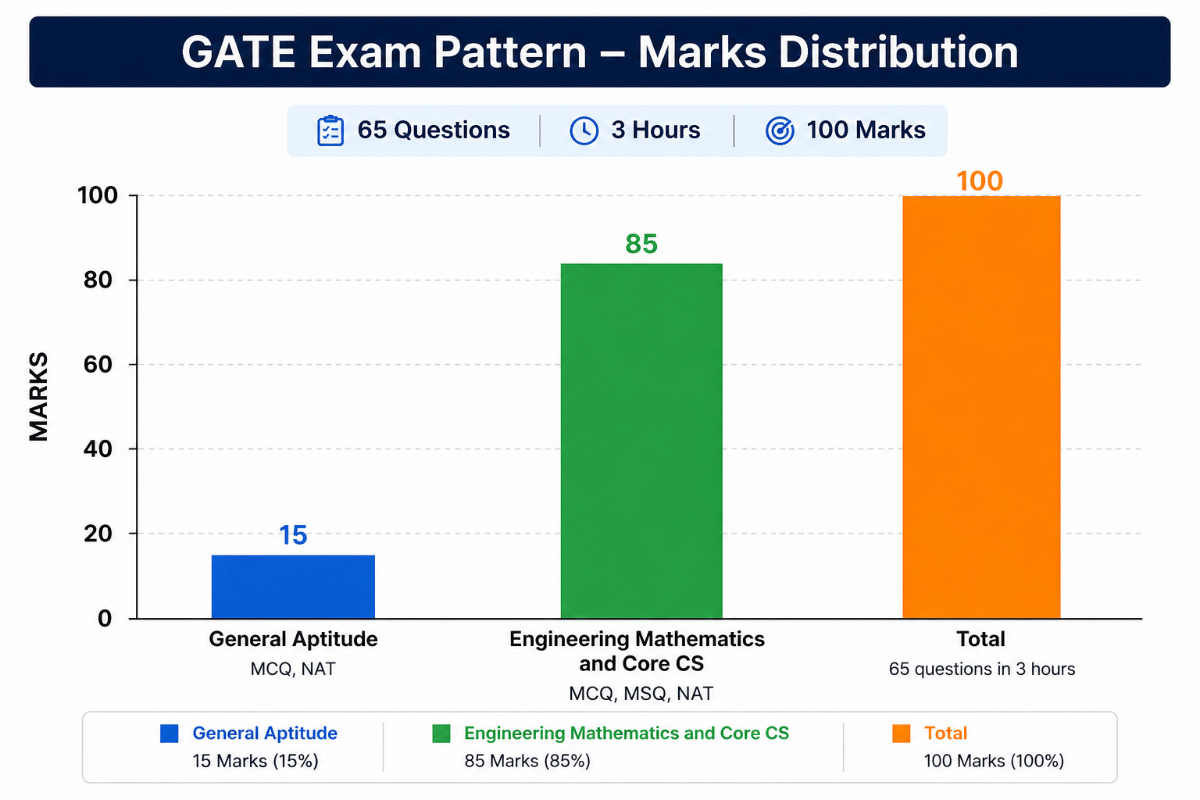
The GATE CSE 2027 paper is a computer-based test conducted over a 3-hour duration. The marks are distributed across three parts as given below:
| Section | Marks | Question Types |
|---|---|---|
| General Aptitude | 15 | MCQ, NAT |
| Engineering Mathematics and Core CS | 85 | MCQ, MSQ, NAT |
| Total | 100 | 65 questions in 3 hours |

Source: gate2027.iitm.ac.in
GATE CSE 2027 Marking Scheme
The GATE 2027 paper has three question types: MCQ (Multiple Choice Questions), MSQ (Multiple Select Questions), and NAT (Numerical Answer Type).
- The MCQ has one correct option, the MSQ has one or more correct options, and NAT needs a numerical value.
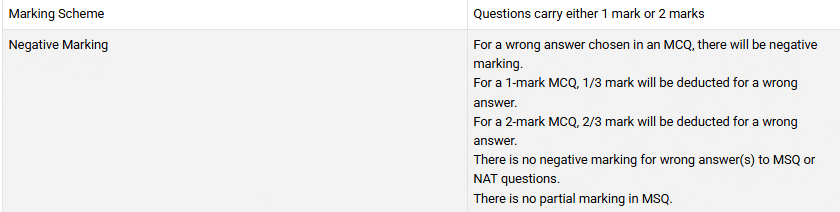
- For a 1-mark MCQ, you lose 1/3 mark for a wrong answer, and for a 2-mark MCQ, you lose 2/3 mark for a wrong answer.
- Negative marking applies only to MCQs, while MSQ and NAT have no negative marking. There is also no partial marking in MSQ, unlike MCQs.
Source: gate2027.iitm.ac.in
GATE CSE Syllabus 2027: What's New
The GATE CSE syllabus has been revised by IIT Madras for 2027. Out of the nine core subjects, the syllabus of 3 subject has been revised.
- The three subjects in which changes are made are Digital Logic, Computer Organization & Architecture, and Computer Networks.
- The other 6 subjects have seen no additions or removals of topics. Candidates can check the changed syllabus in the table below.
| Section | GATE CSE 2026 Syllabus | GATE CSE 2027 Syllabus | Detailed Changes |
|---|---|---|---|
| Digital Logic | Boolean Algebra, Combinational & Sequential Circuits, Minimization, Number Representation, Fixed & Floating Point Arithmetic | Boolean Algebra and Minimization (Algebraic Technique, Karnaugh Map, Tabular Method), Design of Combinational & Sequential Circuits, Number Representation & Arithmetic | Explicit mention of Karnaugh Maps, Tabular (Quine–McCluskey) Method, and Algebraic Minimization. "Design of circuits" is emphasized. No new concepts added. |
| Computer Organization & Architecture | Machine Instructions, Addressing Modes, ALU, Datapath, Control Unit, Pipeline, Main Memory, Cache, Secondary Storage | Machine Instructions, Addressing Modes, ALU, Datapath, Hardwired & Microprogrammed Control Unit, Pipeline, Cache Mapping Techniques, Memory Hierarchy | Explicit addition of Hardwired Control, Microprogrammed Control, and Cache Mapping. References to "Main Memory" and "Secondary Storage" are streamlined under memory hierarchy. |
| Computer Networks | OSI & TCP/IP Models, Physical Layer, Data Link Layer, Ethernet, Switching, ARP, DHCP, ICMP, IPv4/IPv6, Routing Algorithms, UDP, TCP, Congestion Control, DNS, HTTP, FTP, Email | TCP/IP-based networking, Physical Layer, Data Link Layer, Ethernet, Switching, IPv4/IPv6, Routing Basics, TCP, Congestion Control, DNS, HTTP | Explicit references to OSI Model, ARP, DHCP, ICMP, UDP, FTP, Email protocols, and several routing protocol details have been removed from the syllabus wording. DNS and HTTP remain explicitly listed. |
Source: GATE 2027, IIT Madras
GATE CSE Core Subjects Syllabus 2027
The core section has nine Computer Science subjects. The table below lists the key topics in each.
- The top five to six subjects account for most of the 85 core marks, so your priority should be these high-weightage chapters.
- Subjects such as Algorithms, Data Structures, and Theory of Computation appear in every GATE CSE paper.
| Subject | Key Topics |
|---|---|
| Digital Logic | Boolean algebra and minimization – algebraic technique, Karnaugh map, tabular method. Design of combinational and sequential circuits. Number representation and arithmetic (fixed and floating point). |
| Computer Organization and Architecture | Instruction set and addressing modes. Design of arithmetic and logic unit (ALU). Design of control unit – hardwired and microprogrammed. Memory interfacing and hierarchy: performance, cache memory mapping. I/O interface (interrupt and DMA). Instruction pipelining, pipeline hazards. |
| Programming and Data Structures | Programming in C. Recursion. Arrays, stacks, queues, linked lists, trees, binary search trees, binary heaps,graphs. |
| Algorithms | Searching, sorting, hashing. Asymptotic worst case time and space complexity. Algorithm design techniques: greedy, dynamic programming and divide‐and‐conquer. Graph traversals, minimum spanning trees, shortest paths. |
| Theory of Computation | Regular expressions and finite automata. Context-free grammars and push-down automata. Regular and context-free languages, pumping lemma. Turing machines and undecidability |
| Compiler Design | Lexical analysis, parsing, syntax-directed translation. Runtime environments. Intermediate code generation. Local optimisation, Data flow analyses: constant propagation, liveness analysis, common sub expression elimination. |
| Operating System | System calls, processes, threads, inter‐process communication, concurrency and synchronization. Deadlock. CPU and I/O scheduling. Memory management and virtual memory. File systems. |
| Databases | ER‐model. Relational model: relational algebra, tuple calculus, SQL. Integrity constraints, normal forms. File organization, indexing (e.g., B and B+ trees). Transactions and concurrency control. |
| Computer Networks | Principles of Layering; Basics of switching (circuit, packet and virtual circuit) and performance metrics; Data link layer: error detection, Medium Access Control, Ethernet; Distance vector and link state routing; IPv4 - Fragmentation, CIDR Notation, Network Address Translation; TCP- flow control and congestion control, socket API; DNS and HTTP. |
Highest-Weightage Chapters in GATE CSE
Based on the previous year's papers, some chapters appear in almost every GATE CSE paper. The Focus of candidates should be on these high-yield areas, rather than wasting time on low return areas:
- Algorithms: dynamic programming, greedy methods, graph algorithms, and time-complexity analysis.
- Data Structures: trees, binary search trees, heaps, and hashing.
- Theory of Computation: finite automata, regular languages, and pumping lemma.
- Operating System: process scheduling, synchronization, deadlock, and virtual memory.
- Databases: normalization, SQL queries, and transactions with concurrency control.
- Computer Networks: TCP and congestion control, IP addressing, and routing.
- Discrete Mathematics: graph theory, combinatorics, and set relations.
Related Links:
GATE CSE General Aptitude Syllabus 2027
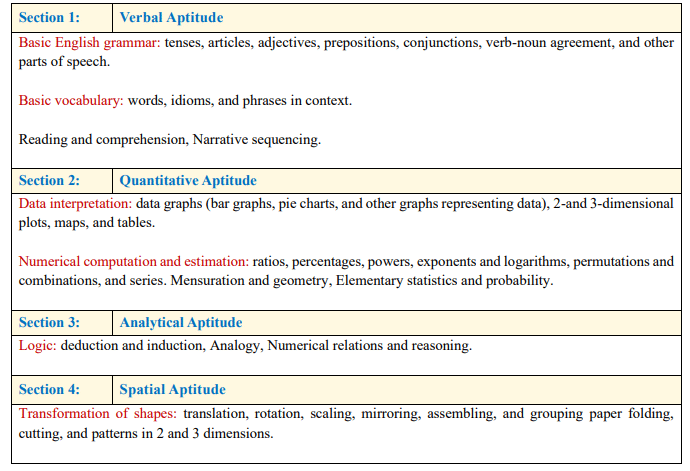
The General Aptitude section is common to all 30 GATE papers and carries 15 marks. It has four major areas, which are given below:
- General Aptitude is a scoring area, so candidates should not ignore this section in their GATE CSE preparation.
| Area | Topics Covered |
|---|---|
| Verbal Aptitude | Basic English Grammar: tenses, articles, adjectives, prepositions, conjunctions, verb–noun agreement, and other parts of speech.Basic Vocabulary: words, idioms, and phrases in context.Reading comprehension and narrative sequencing. |
| Quantitative Aptitude | Data Interpretation: data graphs (bar graphs, pie charts, and other graphs representing data), 2D and 3D plots, maps, and tables.Numerical Computation and Estimation: ratios, percentages, powers, exponents and logarithms, permutations and combinations, series, mensuration and geometry, elementary statistics, and probability. |
| Analytical Aptitude | Logic: deduction and induction, analogy, numerical relations, and reasoning. |
| Spatial Aptitude | Transformation of Shapes: translation, rotation, scaling, mirroring, assembling, grouping, paper folding, paper cutting, and patterns in 2D and 3D dimensions. |
Source: gate2027.iitm.ac.in
Also Check: GATE 2027 General Aptitude Handwritten Notes
GATE CSE Engineering Mathematics Syllabus 2027
Engineering Mathematics carries 13 marks in the GATE CSE paper. As it overlaps with core CS topics, it has high value in the paper.
- Discrete Mathematics is one of the highest-scoring topics in GATE CSE, so candidates are advised to prepare it thoroughly. It also supports algorithms, theory of computation, and databases.
The official syllabus for the EM is given below:
| Topic | Syllabus |
|---|---|
| Discrete Mathematics | Propositional and first-order logic; Sets, relations, functions, partial orders and lattices; Monoids; Groups; Graphs: connectivity, matching, colouring; Combinatorics: counting, recurrence relations, generating functions. |
| Linear Algebra | Matrices, determinants, systems of linear equations, eigenvalues and eigenvectors, LU decomposition. |
| Calculus | Limits, continuity and differentiability, maxima and minima, Mean Value Theorem, integration. |
| Probability and Statistics | Random variables; Uniform, normal, exponential, Poisson and binomial distributions; Mean, median, mode and standard deviation; Conditional probability and Bayes' theorem. |
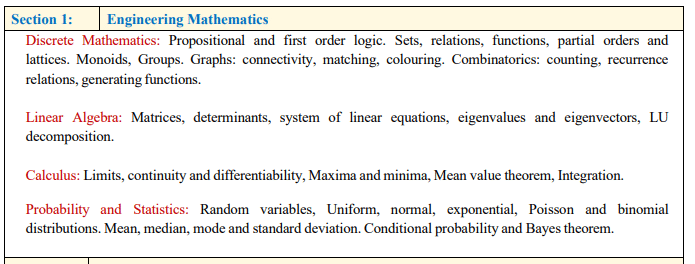
Source: gate2027.iitm.ac.in
Also Check: GATE CSE 2027 Engineering Mathematics Notes
Related Links:
GATE CSE Syllabus 2027: Subject-Wise Weightage
The subject-weightage given below is based on GATE CSE trends from 2022 to 2026. The exact marks may vary year to year.
- Algorithms and Engineering Mathematics together often carry 25 to 30 marks, which is around 25 to 30% of the paper.
- The General Aptitude section accounts for 15 marks every year, which is constant.
- Other important subjects are Programming and Data Structures, Theory of Computation, and Operating Systems.
| Section | Approximate Marks |
|---|---|
| General Aptitude | 15 |
| Engineering Mathematics (with Discrete Maths) | 13 to 15 |
| Algorithms | 8 to 10 |
| Programming and Data Structures | 8 to 10 |
| Theory of Computation | 7 to 9 |
| Operating System | 7 to 9 |
| Computer Organization and Architecture | 6 to 8 |
| Databases | 6 to 8 |
| Computer Networks | 6 to 8 |
| Compiler Design | 5 to 7 |
| Digital Logic | 4 to 6 |
Related Links:
Best Books for GATE CSE 2027
Candidates can use the GATE CS 2027 subject-wise books given below. GATE toppers and teachers have recommended the following books for GATE aspirants:
- For strengthening your preparation, the books can be supplemented with mock tests and previous year papers.
| Subject | Book | Author |
|---|---|---|
| Discrete Mathematics | Discrete Mathematics and Its Applications | Kenneth Rosen |
| Algorithms | Introduction to Algorithms | Cormen, Leiserson, Rivest, Stein |
| Theory of Computation | Introduction to Automata Theory | Hopcroft, Motwani, Ullman |
| Operating System | Operating System Concepts | Silberschatz, Galvin, Gagne |
| Databases | Database System Concepts | Silberschatz, Korth, Sudarshan |
| Computer Networks | Computer Networking: A Top-Down Approach | Kurose and Ross |
| Computer Organization | Computer Organization | Carl Hamacher |
| Digital Logic | Digital Design | Morris Mano |
| Compiler Design | Compilers: Principles, Techniques and Tools | Aho, Lam, Sethi, Ullman |
Also Check: GATE CSE 2027 Best Books
How to Download GATE CSE Syllabus 2027 PDF
Follow these steps to download the official GATE CSE syllabus PDF once it is released.
- Visit the official GATE 2027 website at gate2027.iitm.ac.in.
- Look for the "Syllabus" link under the GATE 2027 section.
- Click on "Computer Science and Information Technology (CS)" to open the PDF.
- Press Ctrl + S on Windows or Cmd + S on Mac to save the PDF.
- Keep the PDF handy and tick off topics as you finish them.
GATE CSE 2027 Preparation Tips
Given below is the phase-wise preparation plan for the GATE CS 2027. Candidates can follow the plan to score well in the exam:
- The preparation plan should be supplemented with mock tests and the GATE PYQs, as these are the most useful steps, and the question patterns repeat across years.
| Phase | Duration | Subjects | Primary Goal | Practice & Revision |
|---|---|---|---|---|
| Phase 1: Foundation | Weeks 1–4 | Engineering Mathematics, General Aptitude | Build problem-solving skills and strengthen fundamentals | Daily topic-wise practice, weekly revision, PYQs after every topic |
| Phase 2: Programming Core | Weeks 5–8 | Digital Logic, C Programming, Data Structures | Master programming concepts and implementation-based questions | Solve PYQs subject-wise, coding practice, and short notes |
| Phase 3: Theoretical Core | Weeks 9–12 | Algorithms, Theory of Computation, Compiler Design | Develop algorithmic thinking and understand computational concepts | Topic-wise tests, PYQs, formula, and concept revision |
| Phase 4: Systems Core | Weeks 13–16 | Operating Systems, Database Management Systems, Computer Networks, Computer Organization & Architecture | Complete high-weightage system subjects | Mixed subject tests, PYQs after each subject, and revise weak topics |
| Phase 5: Integration & Practice | Weeks 17–20 | Complete Syllabus Revision | Connect concepts across all subjects and improve accuracy | Subject-wise mock tests, previous year papers, error log maintenance |
| Phase 6: Mock Test & Final Revision | Final 8 Weeks | Entire Syllabus | Maximize score through exam simulation | 25–30 full-length mock tests, analyze mistakes, revise short notes and formula sheets before every mock, focus on weak areas |
GATE 2027 Computer Science Syllabus Breakdown: What to Study First and Subject Priority
The following video breaks down the GATE CS syllabus and shows the topics and subjects' priority as per their weightage. The main takeaways are given below.
- The paper is divided into General Aptitude (15 marks), Engineering Mathematics (13 marks), and core CS (about 72 marks).
- Algorithms and Data Structures together carry the highest weightage, often 16 to 20 marks combined.
- Discrete Mathematics is the top-scoring maths area and also helps in Algorithms and the theory of Computation.
- Candidates should first cover the Study Programming, Data Structures, and Discrete Maths, since they provide the basics for Algorithms, TOC, and Compiler Design.
Watch on YouTube: GATE 2027 Computer Science Syllabus Breakdown
GATE 2027 Computer Science: Best Subject Sequence to Cover Complete Syllabus
The following video suggests a smart order to cover the full GATE 2027 CS syllabus. The main takeaways are given below.
- Begin with Programming in C and Data Structures to build the coding base.
- Take Algorithms right after, since it depends on data structures like trees and graphs.
- Do Digital Logic before Computer Organization and Architecture, as circuits lead into the datapath.
- Cover Theory of Computation before Compiler Design, since parsing builds on automata and grammars.
- Finish with Operating Systems, DBMS, and Computer Networks, which are more self-contained.
Watch on YouTube: GATE 2027 Computer Science Best Subject Sequence
GATE CSE 2027 Complete Guide: Exam Pattern, Eligibility, Cutoff, M.Tech, PSU Strategy, Mistakes
The following video provides a full guide to the GATE CSE paper beyond the syllabus. The main takeaways are listed below.
- Exam pattern: 65 questions for 100 marks in 3 hours, mixing MCQ, MSQ, and NAT types.
- Eligibility: You can apply from the third year of a bachelor's degree, with no upper age limit.
- Cutoff: The qualifying marks for GATE CSE are around 30 for General, 27 for OBC, and 20 for SC, ST, and PwD.
- Score use: A strong score unlocks M.Tech seats at IITs and NITs and also provides an opportunity for PSU recruitment.
- Common mistakes: skipping General Aptitude and not solving previous year papers.
Watch on YouTube: GATE CSE 2027 Complete Guide
GATE 2027 Preparation: How to Complete GATE 2027 Syllabus Fast and Backlog Strategy
The video given below provides a strategy to cover your syllabus backlogs and finish your GATE CS syllabus on time. The main takeaways are listed below.
- Spread the nine core subjects across fixed monthly blocks so nothing piles up.
- Give the two toughest subjects, such as Algorithms and TOC, extra weeks in the plan.
- Clear backlogs with short daily catch-up slots instead of long weekend sessions.
- Solve subject-wise previous year papers right after you finish each subject.
- Reserve the final two months only for full-length mock tests and revision.
Watch on YouTube: GATE 2027 Syllabus Completion and Backlog Strategy
GATE CSE Syllabus 2027: FAQs
Ques. Is the GATE CSE 2027 syllabus the same as last year?
Ans. The GATE CSE official syllabus for 2027 has been released. There have been some changes in the official GATE CSE syllabus. Candidates are advised to refer to the latest syllabus available on the official website, gate2027.iitm.ac.in.
Ques. Who will release the GATE CSE 2027 syllabus?
Ans. IIT Madras is the organising institute for GATE 2027. It has released the syllabus with the information brochure on its official website, gate2027.iitm.ac.in.
Ques. Which subject has the highest weightage in GATE CSE?
Ans. Subjects such as Algorithms and Engineering Mathematics, which include Discrete Maths, carry the highest combined weightage of around 25 percent. Together they contribute to around 25-30 marks in the exam.
Ques. How many subjects are in the GATE CSE 2027 syllabus?
Ans. The GATE CS syllabus has General Aptitude, Engineering Mathematics, and nine core Computer Science subjects. The official subject-wise syllabus PDFss will be released soon on the official website of GATE 2027.
Ques. How many marks is the General Aptitude section?
Ans. The General Aptitude section carries 15 marks out of the total 100 marks in the exam. The General Aptitude section is common to every GATE paper.
Ques. Where can I download the GATE CSE 2027 syllabus PDF?
Ans. The organising institute, i.e., IIT Madras, has released the official syllabus PDF. Candidates can now download it from the official GATE 2027 website.
Ques. Is there negative marking in GATE CSE?
Ans. Yes, there is negative marking in the GATE exam. However, the negative marking is only for MCQs. MSQ and NAT questions have no negative marking.
Ques. Which are the best books for GATE CSE 2027?
Ans. As per the recommendation of the toppers and teachers, you can use Rosen for Discrete Maths, Cormen for Algorithms, and Silberschatz for Operating Systems. Candidates should supplement them with previous year papers and mock tests.
Ques. How many months are needed to cover the GATE CSE syllabus?
Ans. A 10- to 12-month preparation plan works well for most of the students. However, you can finish the syllabus early with strong basics and daily practice.
Ques. Is Engineering Mathematics important for GATE CSE?
Ans. Yes, the Engineering Mathematics section is important for the GATE CS exam as it carries around 13 marks and overlaps with core topics. The discrete maths topic is especially of high value for the exam.
Ques. When will GATE 2027 be held?
Ans. The official dates have been released by the organising institute. GATE 2027 is to be held on 6, 7, 13, 14, 20, and 21 February 2027 by IIT Madras.



Comments