




The JCECE syllabus covers Physics, Chemistry, Mathematics, and Biology, depending on the selected subject group. Candidates can appear through PCM, PCB, or PCMB groups. JCECE syllabus is based on the Class 11 and 12 NCERT curriculum.
- JCECE uses objective-type, single-correct MCQs. The PCM/PCB papers have 150 questions, while PCMB has 200 questions.
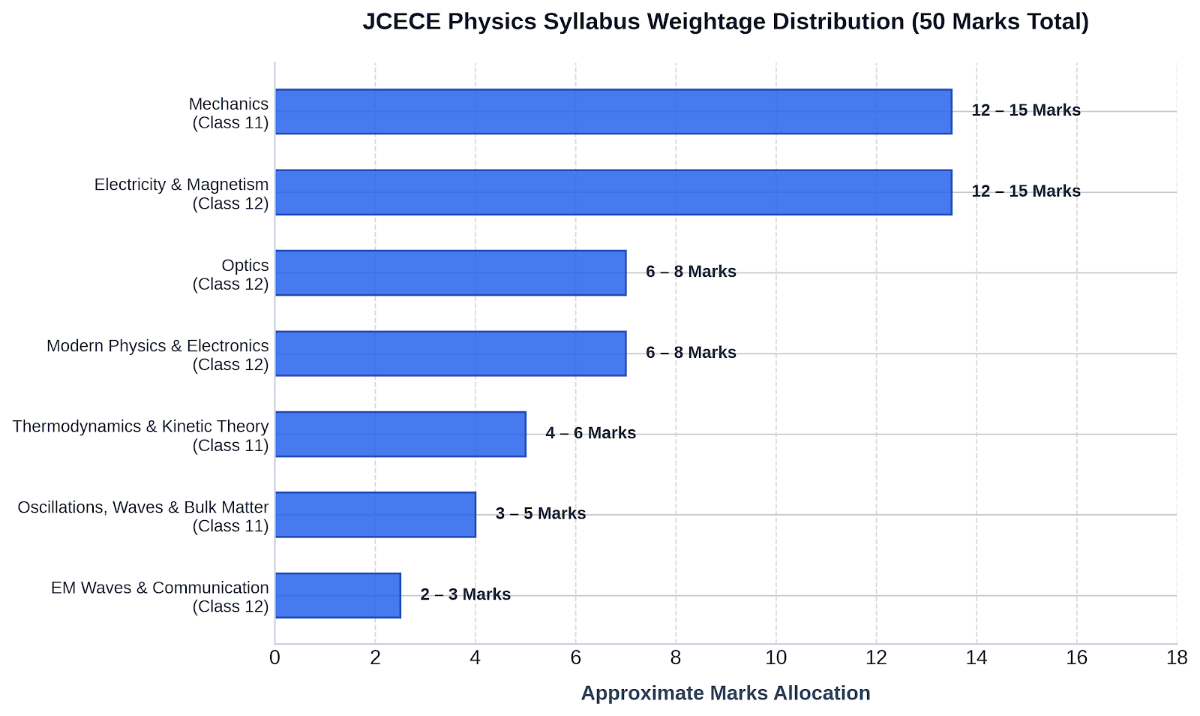
- The Physics syllabus has 20 units. Mechanics and Electricity & Magnetism are major focus areas, with around 12–15 marks each as indicated in the provided analysis.
- Chemistry is divided into Physical, Inorganic, and Organic Chemistry, covering 26 units in total. Important areas include Chemical Kinetics, Solutions, Chemical Bonding, Coordination Compounds, Biomolecules, Aldehydes/Ketones/Carboxylic Acids, etc.
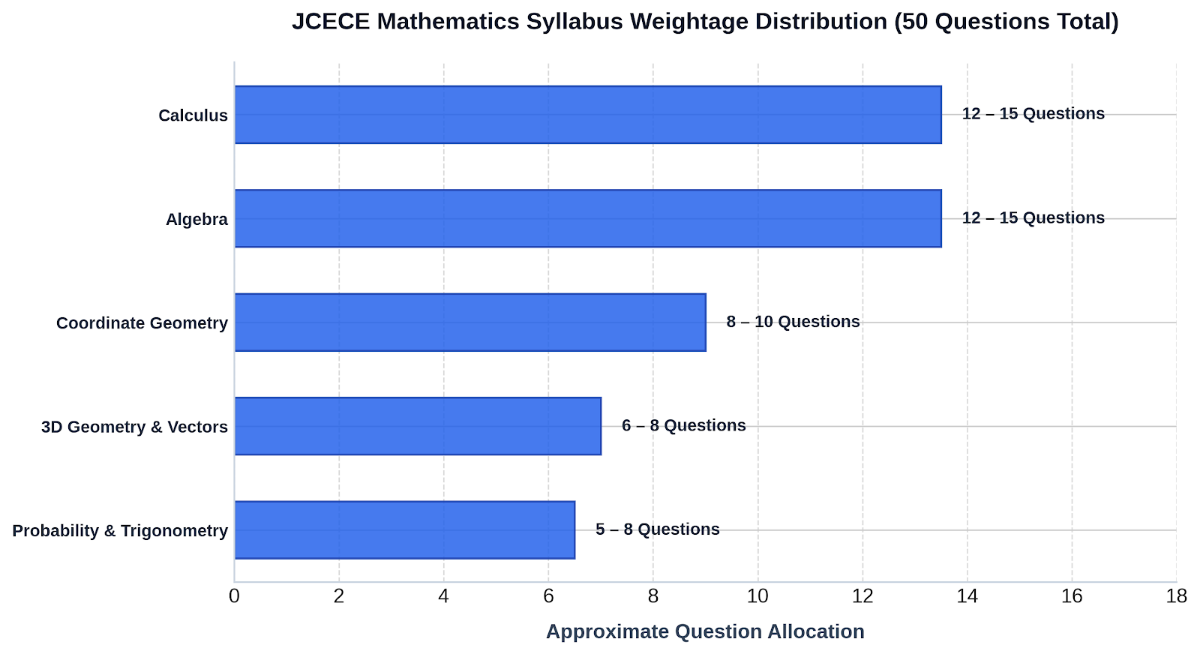
- The Mathematics syllabus includes 17 units. Calculus, Algebra, Coordinate Geometry, and Vectors & 3D Geometry form major scoring areas according to the previous year analysis.
- The Biology syllabus has 10 broad units; Human Physiology, Genetics & Evolution, Plant Physiology, Ecology, and Reproduction are identified as important areas.
JCECE is conducted by the Jharkhand Combined Entrance Competitive Examination Board (JCECEB) for admission to various undergraduate programmes in agriculture and allied fields.
Related Links:
- JCECE Exam Pattern 2027: Marking Scheme, Sections, Duration and Total Marks
- JCECE Sample Papers 2027: Last 5 Years PYQs PDF Download and Subject-wise Weightage
Key Summary
- NCERT-based syllabus: JCECE covers the Class 11 and 12 syllabus across Physics, Chemistry, Mathematics and Biology.
- Three subject groups: Candidates can choose PCM, PCB or PCMB based on their eligibility and preferred programme.
- High-weightage topics matter: Focus on areas such as Mechanics, Electricity & Magnetism, Calculus, Algebra, Human Physiology and Genetics.
- Practice improves performance: Regular MCQ practice, formula/reaction revision, mock tests, and mistake analysis can help improve speed and accuracy.
| Table of Contents |
JCECE Syllabus 2027: Overview
The syllabus for the JCECE exam depends on the group chosen by the student based on their Class 12 stream.
- The exam is based on the Class 11 and 12 syllabus by NCERT and includes Physics, Chemistry, Mathematics, and Biology, with candidates appearing through PCM, PCB or PCMB groups.
- JCECE consists of objective-type MCQs in English and Hindi. The PCM/PCB papers have 150 questions and 150 marks, while the PCMB paper has 200 questions and 200 marks.

Source: Official JCECE Information Bulletin 2026
| Parameter | Details |
|---|---|
| Conducting Body | Jharkhand Combined Entrance Competitive Examination Board (JCECEB) |
| Total Marks | • 150 Marks for PCM or PCB groups• 200 Marks for the PCMB group (1 mark per correct answer) |
| Total Questions | • 150 Questions for PCM / PCB (50 questions per subject)• 200 Questions for PCMB |
| Total Duration | • 3 Hours (180 minutes) for PCM / PCB streams• 4 Hours (240 minutes) for the PCMB stream |
| Syllabus Level | Class 11 & Class 12 standards |
| Subjects Included | Physics, Chemistry, Mathematics, and Biology |
| Subject Groups | PCM group, PCB group, and PCMB group. |
| Question Types | Objective type, Multiple Choice Questions (MCQs) with a single correct option |
| Language of Paper | Bilingual; available in both English and Hindi |
This video discusses the JCECE exam that is conducted for admission to Jharkhand Combined Agriculture, Nursing and Paramedic programs. It discusses the exam syllabus, exam pattern, and all other important details to start your preparation.
JCECE Physics Syllabus 2027
In the JCECE exam, the Physics section appears in the papers of all 3 groups: PCB, PCM, and PCMB.
- The Physics syllabus includes topics from both Class 11 and 12. A total of 20 chapters together constitute the JCECE syllabus.
- Mechanics from Class 11 and Electricity & Magnetism from Class 12 are the high-yield topics in Physics, contributing about 12-15 marks each.
| Unit No. | Unit Name | Key Topics |
|---|---|---|
| 1 | Physical World and Measurement | Physical World, Scope of Physics, SI Units, Significant Figures, Errors in Measurement, Dimensional Analysis and Applications. |
| 2 | Kinematics | Motion in a Straight Line, Uniform and Non-Uniform Motion, Motion in a Plane, Scalars and Vectors, Projectile Motion, Relative Motion, Uniform Circular Motion. |
| 3 | Laws of Motion | Newton’s Three Laws, Inertia, Linear Momentum, Impulse, Conservation of Momentum, Static and Kinetic Friction, Circular Motion Dynamics, Banking of Roads. |
| 4 | Work, Energy and Power | Work-Energy Theorem, Kinetic and Potential Energy, Conservation of Mechanical Energy, Power, Elastic and Inelastic Collisions. |
| 5 | Motion of System of Particles and Rigid Body | Centre of Mass, Moment of Inertia, Radius of Gyration, Torque, Angular Momentum, Theorems of Perpendicular and Parallel Axes, Rolling Motion. |
| 6 | Gravitation | Kepler’s Laws, Newton’s Law of Gravitation, Gravitational Field and Potential, Escape Velocity, Orbital Velocity, Satellites, Weightlessness. |
| 7 | Properties of Bulk Matter | Elasticity (Stress, Strain, Moduli), Pascal’s Law, Viscosity, Surface Tension, Capillarity, Bernoulli’s Theorem, Thermal Properties of Matter. |
| 8 | Thermodynamics | Zeroth, First, and Second Laws of Thermodynamics, Isothermal and Adiabatic Processes, Heat Engines, Carnot Cycle, Refrigerators, Entropy. |
| 9 | Kinetic Theory of Gases | Kinetic Theory Assumptions, Ideal Gas Equation, Pressure and Kinetic Energy, Gas Laws, Specific Heats (Cp and Cv), Mean Free Path, Degrees of Freedom. |
| 10 | Oscillations and Waves | Simple Harmonic Motion, Energy in SHM, Damped and Forced Oscillations, Resonance, Wave Motion, Beats, Doppler Effect, Standing Waves and Harmonics. |
| 11 | Electrostatics | Electric Charges, Coulomb’s Law, Electric Field and Potential, Gauss’s Law, Capacitance, Parallel Plate Capacitor, Dielectrics, Energy Stored in a Capacitor. |
| 12 | Current Electricity | Ohm’s Law, Resistivity, EMF and Internal Resistance, Kirchhoff’s Laws, Wheatstone Bridge, Potentiometer, Cells in Series and Parallel. |
| 13 | Magnetic Effects of Current and Magnetism | Biot-Savart Law, Ampere’s Law, Moving Charges in Magnetic Field, Cyclotron, Magnetic Dipole, Earth’s Magnetic Field, Hysteresis. |
| 14 | Electromagnetic Induction and Alternating Currents | Faraday’s Law, Lenz’s Law, Motional EMF, Eddy Currents, Self and Mutual Inductance, AC Circuits (LCR Series), Resonance, Power Factor, Transformers. |
| 15 | Electromagnetic Waves | Displacement Current, Maxwell’s Equations, Nature of EM Waves, Electromagnetic Spectrum (Radio, Microwave, Infrared, Visible, UV, X-rays, Gamma Rays) and their applications. |
| 16 | Optics | Ray Optics: Reflection, Refraction, Total Internal Reflection, Lenses, Mirrors, Prisms, Optical Instruments. Wave Optics: Huygens’ Principle, Interference (Young’s Double Slit), Diffraction, Polarisation. |
| 17 | Dual Nature of Radiation and Matter | Photoelectric Effect, Einstein’s Photoelectric Equation, Work Function, Threshold Frequency, de Broglie Wavelength, Davisson-Germer Experiment. |
| 18 | Atoms and Nuclei | Bohr’s Model, Energy Levels, Hydrogen Spectrum, Nuclear Structure, Mass Defect, Binding Energy, Radioactive Decay (Alpha, Beta, Gamma), Half-Life, Nuclear Fission and Fusion. |
| 19 | Electronic Devices | Semiconductors (n-type, p-type), p-n Junction Diode, Rectifiers (Half-Wave and Full-Wave), Zener Diode, Transistors as Switch and Amplifier, Logic Gates (AND, OR, NOT, NAND, NOR), Boolean Algebra. |
| 20 | Communication Systems | Elements of Communication System, Bandwidth, Amplitude and Frequency Modulation, Ground Wave, Sky Wave, Space Wave, Satellite Communication, Optical Fibre. |
JCECE Physics Syllabus: High Weightage Topics 2027
The Physics section consists of 50 total questions, each carrying 1 mark. It makes it a total of 50 marks for Physics.
- Practice problems from Mechanics, Thermal Physics, Electricity & Magnetism, especially rotational motion, banking of roads, thermodynamics, circuits, galvanometers and LCR resonance.
- Revise frequently used formulas such as escape/orbital velocity, Carnot efficiency, apparent depth, shunt resistance, and resonance frequency for faster problem-solving.
| Topic Cluster | High-Weightage Chapters | Approx. Questions / Marks | Prep Strategy |
|---|---|---|---|
| Mechanics (Class 11) |
| 12 – 15 Marks | Focus on core derivations, Moment of Inertia formulas, and projectile motion. |
| Electricity & Magnetism (Class 12) |
| 12 – 15 Marks | High number of formula-based numericals (e.g., Kirchhoff's laws, capacitance). |
| Optics (Class 12) |
| 6 – 8 Marks | Quick scoring area. Expect direct applications of mirror/lens formulas and Young's Double Slit experiment. |
| Modern Physics & Electronics (Class 12) |
| 6 – 8 Marks | Highly theoretical with high-recall value. Focus on the Photoelectric effect and logic gates. |
| Thermodynamics & Kinetic Theory (Class 11) |
| 4 – 6 Marks | Very predictable question types centering around work done in adiabatic/isothermal graphs. |
| Oscillations, Waves & Bulk Matter (Class 11) |
| 3 – 5 Marks | Focus on time periods of springs/pendulums and wave velocity equations. |
| EM Waves & Communication Systems (Class 12) |
| 2 – 3 Marks | Purely theoretical. Memorizing the uses and frequencies of the EM spectrum yields fast marks. |
| Total | 50 Marks | Every wrong answer penalizes you by -0.25 marks, so precision is key. | |
Also Check:
JCECE Chemistry Syllabus 2027
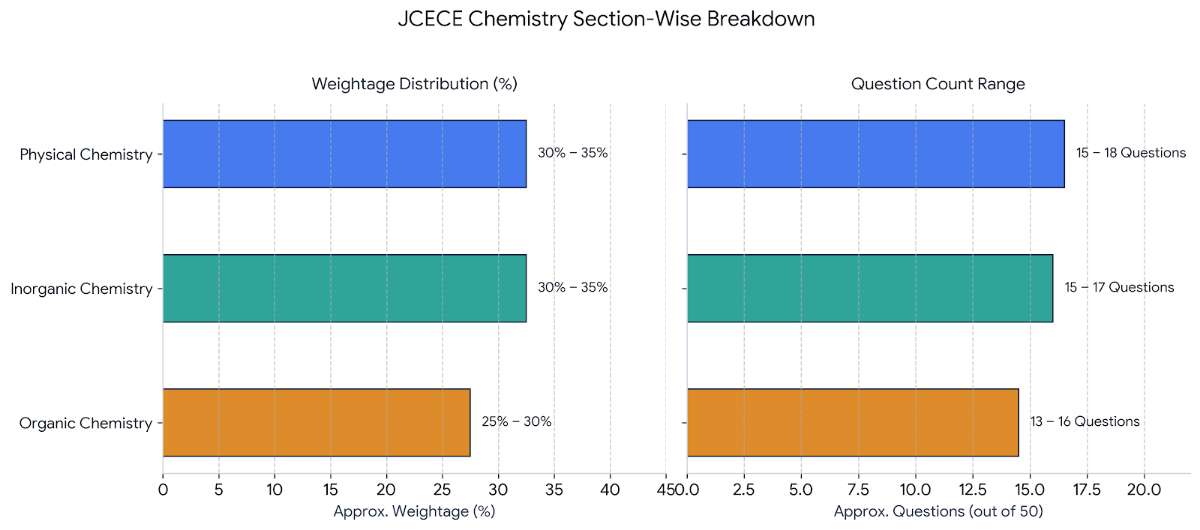
The Chemistry section consists of 50 multiple-choice questions (50 Marks), distributed almost equally among the three major branches: Physical, Inorganic, and Organic Chemistry.
- Compared to the Physics and Mathematics sections, which require long, multi-step calculations, the Chemistry syllabus is highly conceptual.
- In the organic segment, the syllabus focuses heavily on specific Named Reactions, e.g., Aldol Condensation, Cannizzaro Reaction, Hoffmann Bromamide Degradation and distinct chemical identification tests, like Hinsberg's Test, Lucas Test, Iodoform Test.
- For Inorganic Chemistry, the syllabus prioritizes anomalous behaviors and exceptions over general rules.
Physical Chemistry
| Unit | Topics Covered |
|---|---|
| 1. Some Basic Concepts of Chemistry | Mole concept, atomic/molecular mass, stoichiometry, limiting reagent, percentage composition |
| 2. Structure of Atom | Bohr model, quantum numbers, orbitals, electronic configuration, atomic principles |
| 3. States of Matter | Gas laws, ideal gas equation, kinetic theory, real gases, van der Waals equation |
| 4. Thermodynamics | Enthalpy, Hess’s law, bond enthalpy, entropy, Gibbs free energy, spontaneity |
| 5. Equilibrium | Chemical and ionic equilibrium, Kp/Kc, Le Chatelier’s principle, pH, buffers, Ksp |
| 6. Redox Reactions | Oxidation number, redox balancing, disproportionation reactions |
| 7. Electrochemistry | Electrochemical cells, electrode potential, EMF, Nernst equation, Faraday’s laws, batteries, corrosion |
| 8. Chemical Kinetics | Rate law, order, molecularity, half-life, Arrhenius equation, activation energy |
| 9. Solutions | Concentration terms, colligative properties, osmotic pressure, van’t Hoff factor |
| 10. Surface Chemistry | Adsorption, catalysis, colloids, Tyndall effect, Brownian motion, coagulation |
Inorganic Chemistry
| Unit | Topics Covered |
|---|---|
| 11. Classification of Elements & Periodicity | Periodic table, periodic trends, atomic radius, ionisation energy, electronegativity |
| 12. Chemical Bonding & Molecular Structure | Ionic/covalent bonds, VSEPR, hybridisation, molecular shapes, MOT, hydrogen bonding |
| 13. s-Block Elements | Alkali and alkaline earth metals, properties and important compounds |
| 14. p-Block Elements | Groups 13–18, important compounds, allotropes, oxoacids, interhalogen compounds |
| 15. d- and f-Block Elements | Transition metals, oxidation states, magnetic/colour properties, lanthanides, actinides |
| 16. Coordination Compounds | Werner’s theory, nomenclature, isomerism, VBT, CFT and applications |
| 17. Isolation of Metals | Ores, concentration, reduction methods and metal refining |
Organic Chemistry
| Unit | Topics Covered |
|---|---|
| 18. General Organic Chemistry | Electronic effects, reaction mechanisms, electrophiles/nucleophiles, stereoisomerism, nomenclature |
| 19. Hydrocarbons | Alkanes, alkenes, alkynes, benzene and electrophilic substitution reactions |
| 20. Haloalkanes & Haloarenes | Preparation, properties, SN1/SN2, elimination and polyhalogen compounds |
| 21. Alcohols, Phenols & Ethers | Preparation, reactions, acidity, Williamson synthesis and ether cleavage |
| 22. Aldehydes, Ketones & Carboxylic Acids | Nucleophilic addition, aldol, Cannizzaro, oxidation/reduction and esterification |
| 23. Organic Compounds Containing Nitrogen | Amines, diazonium salts, cyanides, isocyanides and nitro compounds |
| 24. Biomolecules | Carbohydrates, proteins, nucleic acids, vitamins and hormones |
| 25. Polymers | Addition/condensation polymers, natural and synthetic polymers, biodegradable polymers |
| 26. Chemistry in Everyday Life | Drugs, medicines, food preservatives, sweeteners, soaps and detergents |
JCECE Chemistry Chapter-wise Weightage
Revise VSEPR shapes, hybridisation, MOT, bond order, magnetic behaviour, oxidation states, nomenclature, CFT/VBT and isomerism. These topics are highly suitable for direct conceptual and application-based questions.
| Section | High-Weightage Chapters | Approx. Questions | Approx. Weightage |
|---|---|---|---|
| Physical Chemistry | Chemical Kinetics, Solutions, Electrochemistry, Equilibrium, Thermodynamics | 15–18 | 30–35% |
| Inorganic Chemistry | Chemical Bonding, Coordination Compounds, p-Block, d-Block Elements | 15–17 | 30–35% |
| Organic Chemistry | Biomolecules, Aldehydes/Ketones/Carboxylic Acids, Amines, Haloalkanes | 13–16 | 25–30% |
Also Check: JCECE 2027 Chemistry Good Attempts for a Safe Score
JCECE Mathematics Syllabus 2027
The math section contains 50 questions (50 Marks) for PCM and PCMB candidates.
- Although the syllabus is based on the NCERT Class 11 and 12 curriculum, previous JCECE papers show a slightly higher focus on important Class 12 concepts.
- The Mathematics syllabus involves lengthy calculations and multiple steps to solve problems.
- The JCECE math exam asks direct, formula-driven numerical applications over abstract or highly theoretical mathematical proofs.
| Unit No. | Unit Name | Key Topics |
|---|---|---|
| 1 | Sets, Relations and Functions | Sets and Set Operations (Union, Intersection, Complement), Types of Relations (Reflexive, Symmetric, Transitive, Equivalence), Types of Functions, Composition and Inverse of Functions. |
| 2 | Complex Numbers and Quadratic Equations | Algebra of Complex Numbers, Modulus and Argument, Polar Form, De Moivre’s Theorem, Roots of Unity, Nature of Roots, Relation between Roots and Coefficients. |
| 3 | Matrices and Determinants | Types of Matrices, Matrix Operations (Addition, Multiplication, Transpose), Properties of Determinants, Minors and Cofactors, Adjoint and Inverse of a Matrix, Cramer’s Rule, System of Linear Equations. |
| 4 | Permutations and Combinations | Fundamental Principle of Counting, Factorial, Permutations (with and without Repetition), Circular Permutations, Combinations and Applications. |
| 5 | Mathematical Induction | Principle of Mathematical Induction, Base Step and Inductive Step, Proof of Algebraic Identities and Series Sums. |
| 6 | Binomial Theorem | Binomial Theorem for Positive Integral Indices, Pascal’s Triangle, General Term, Middle Term, Term Independent of x. |
| 7 | Sequences and Series | Arithmetic Progression (AP), Geometric Progression (GP), Arithmetic-Geometric Progression, Harmonic Progression, Sum of Special Series (Σn, Σn², Σn³), Infinite GP. |
| 8 | Limits, Continuity and Differentiability | Standard Limits, Algebra of Limits, L’Hôpital’s Rule, Continuity (Types of Discontinuity), Differentiability, Rolle’s Theorem, Lagrange’s Mean Value Theorem. |
| 9 | Application of Derivatives | Rate of Change, Tangent and Normal to a Curve, Monotonic Functions, Maxima and Minima (First and Second Derivative Tests), Approximations. |
| 10 | Integral Calculus | Indefinite Integrals (Substitution, Integration by Parts, Partial Fractions), Definite Integrals (Properties, Newton-Leibniz Theorem), Area Under Curves, Area Between Two Curves. |
| 11 | Differential Equations | Order and Degree, Formation of Differential Equations, Solution Methods (Variable Separable, Homogeneous, Linear First-Order), Applications in Growth and Decay Problems. |
| 12 | Coordinate Geometry | Straight Lines (Slope, Various Forms, Distance), Circles (Standard Equations, Tangent, Chord of Contact), Parabola, Ellipse, Hyperbola (Standard Forms, Foci, Directrix, Tangents, Normals, Eccentricity). |
| 13 | Three-Dimensional Geometry | Direction Cosines and Ratios, Equations of Lines and Planes in 3D (Vector and Cartesian Forms), Angle Between Lines and Planes, Shortest Distance Between Skew Lines. |
| 14 | Vector Algebra | Types of Vectors, Position Vectors, Scalar (Dot) Product, Vector (Cross) Product, Scalar Triple Product, Applications in Geometry. |
| 15 | Statistics and Probability | Measures of Dispersion (Mean Deviation, Variance, Standard Deviation), Classical Probability, Conditional Probability, Bayes’ Theorem, Binomial Distribution, Random Variables and Expectation. |
| 16 | Trigonometry | Trigonometric Functions and Identities, Compound and Multiple Angle Formulas, Sum-to-Product and Product-to-Sum Identities, Inverse Trigonometric Functions (Domain, Range, Properties), Properties of Triangles (Sine and Cosine Rules). |
| 17 | Mathematical Reasoning | Statements and Truth Values, Logical Connectives (AND, OR, NOT, IF-THEN, IFF), Converse, Inverse, Contrapositive, Tautology, Contradiction, Direct and Indirect Proof. |
JCECE Mathematics Syllabus: High Weightage Topics 2027
The following 3 are the highest weightage topics in the Mathematics section of the JCECE exam:
- Calculus (Highest Weightage): Includes limits, continuity, application of derivatives, definite/indefinite integrals, and differential equations.
- Coordinate Geometry: Heavy focus on straight lines, circles, and conic sections (Parabola, Ellipse, Hyperbola). The board frequently tests standard forms and geometric properties.
- Vectors & 3D Geometry: Features direct numerical questions on dot products, cross products, shortest distances, and direction cosines.
| Topic Cluster | High-Weightage Chapters | Approx. Questions | Approx. Weightage |
|---|---|---|---|
| Calculus | Integral Calculus, Application of Derivatives, Differential Equations, Limits | 12–15 | 25–30% |
| Algebra | Matrices and Determinants, Complex Numbers, Sequences and Series, P&C | 12–15 | 25–30% |
| Coordinate Geometry | Conics (Parabola, Ellipse, Hyperbola), Circles, Straight Lines | 8–10 | 15–20% |
| 3D Geometry and Vectors | Three-Dimensional Geometry, Vector Algebra | 6–8 | 12–15% |
| Probability and Trigonometry | Probability (Bayes’ Theorem), Inverse Trigonometry, Properties of Triangles | 5–8 | 10–15% |
JCECE Biology Syllabus 2027
The JCECE Biology syllabus contains 50 questions (50 Marks) for PCB and PCMB stream candidates.
- JCECE Biology syllabus is completely aligned with the standard Class 11 and Class 12 NCERT science textbooks.
- Focus on processes such as photosynthesis, respiration, reproduction, DNA replication, transcription and translation, along with important diagrams and terminology.
| Unit No. | Unit Name | Key Topics |
|---|---|---|
| 1 | Diversity of Living Organisms | Biological Classification (Five Kingdoms: Monera, Protista, Fungi, Plantae, Animalia), Plant Kingdom (Algae, Bryophyta, Pteridophyta, Gymnosperms, Angiosperms), Animal Kingdom (Phyla with Distinguishing Characteristics). |
| 2 | Structural Organisation in Plants and Animals | Morphology of Flowering Plants (Root, Stem, Leaf, Flower, Fruit, Seed), Anatomy of Plants (Meristematic and Permanent Tissues), Animal Tissues (Epithelial, Connective, Muscular, Neural). |
| 3 | Cell Structure and Function | Cell Theory, Prokaryotic and Eukaryotic Cells, Cell Organelles (Mitochondria, Chloroplast, ER, Ribosomes, Golgi Apparatus, Lysosome), Cell Membrane, Nucleus, Cell Division (Mitosis and Meiosis). |
| 4 | Plant Physiology | Transport in Plants (Osmosis, Plasmolysis, Mineral Absorption), Photosynthesis (Light Reactions, Calvin Cycle, C3 and C4 Pathways, CAM), Respiration in Plants (Glycolysis, Krebs Cycle, ETC), Plant Growth Regulators (Auxins, Gibberellins, Cytokinins, ABA, Ethylene). |
| 5 | Human Physiology | Digestion and Absorption (Digestive System, Enzymes), Breathing and Gas Exchange (Lung Volumes, Gas Transport), Circulation (Heart, Cardiac Cycle, Blood, Lymph), Excretion (Nephron, Urine Formation), Locomotion (Joints, Muscle Contraction), Neural Control (Neuron, Brain, Reflex Arc), Endocrine System (Hormones, Feedback Mechanisms). |
| 6 | Reproduction | Modes of Reproduction, Sexual Reproduction in Flowering Plants (Pollination Types, Double Fertilisation, Seed and Fruit Development), Human Reproduction (Gametogenesis, Fertilisation, Embryo Development), Reproductive Health (MTP, Contraception, STIs). |
| 7 | Genetics and Evolution | Mendel’s Laws, Deviations from Mendelism (Incomplete Dominance, Co-dominance, Multiple Alleles), Chromosomal Theory, Sex Determination, Linkage and Crossing Over, DNA Replication, Transcription, Translation, Genetic Code, Mutation, Evolution Theories (Darwin, Modern Synthetic), Hardy-Weinberg Law. |
| 8 | Biology and Human Welfare | Human Health and Disease (Innate and Acquired Immunity, Vaccines, Common Diseases: Typhoid, Malaria, AIDS, Cancer), Food Production (Animal Husbandry, Plant Breeding), Microbes in Human Welfare (Fermentation, Sewage Treatment, Biogas, Antibiotics). |
| 9 | Biotechnology and its Applications | Principles of Biotechnology, Recombinant DNA Technology (Restriction Enzymes, Cloning Vectors, PCR, Gel Electrophoresis), Applications in Medicine (Insulin, Gene Therapy), Agriculture (Bt Crops, Golden Rice), Biosafety and Ethics. |
| 10 | Ecology and Environment | Organisms and Populations (Adaptations, Population Growth Models), Ecosystems (Food Chains, Energy Flow, Nutrient Cycling), Biodiversity (Levels, Hotspots, Conservation, In-situ and Ex-situ), Environmental Issues (Air and Water Pollution, Ozone Depletion, Greenhouse Effect). |
JCECE Biology Syllabus: High Weightage Topics 2027
The board splits the paper nearly perfectly down the middle:
- Botany (~25 Questions): Focuses heavily on Plant Physiology, Ecology, and Plant Reproduction.
- Zoology (~25 Questions): Focuses heavily on Human Physiology, Animal Kingdom classification, and Human Evolution.
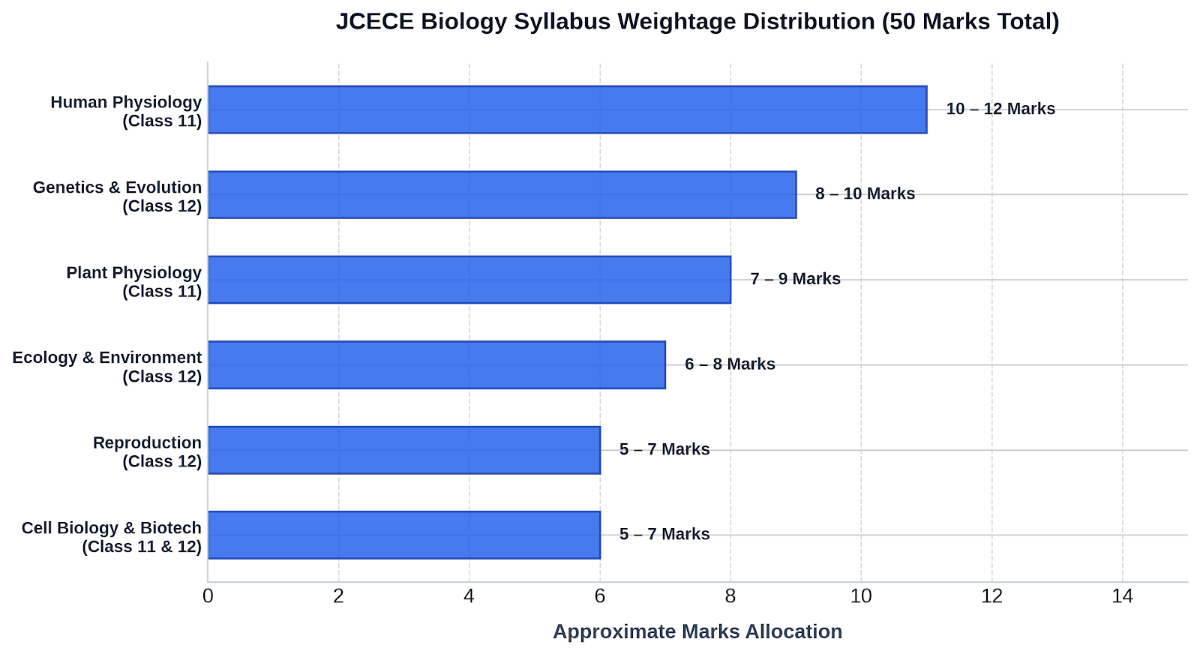
| Topic Cluster | High-Weightage Focus Chapters | Approx. Questions |
|---|---|---|
| Human Physiology (Class 11) |
| 10 – 12 Marks |
| Genetics & Evolution (Class 12) |
| 8 – 10 Marks |
| Plant Physiology (Class 11) |
| 7 – 9 Marks |
| Ecology & Environment (Class 12) |
| 6 – 8 Marks |
| Reproduction (Class 12) |
| 5 – 7 Marks |
| Cell Biology & Biotech (Both) |
| 5 – 7 Marks |
Also Check: JCECE 2026 Good Attempts in Mathematics: Accuracy vs Speed Guide
Courses Available Through the JCECE Examination 2027
JCECE does not serve as the primary entrance exam for popular programmes such as regular B.Tech engineering courses in Jharkhand.
- Admission to these programmes is generally offered through JEE Main or NEET UG, followed by the state counselling process.
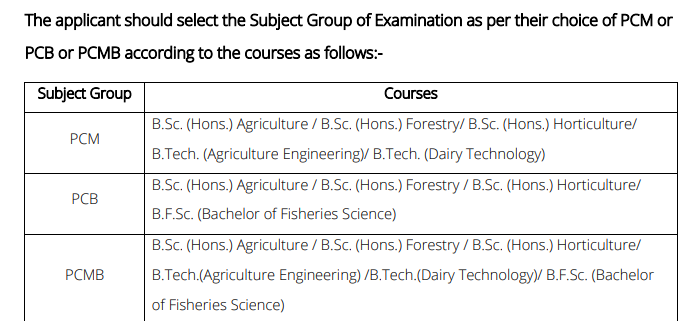
- The JCECE exam is strictly for professional, technical, and applied science degrees, as mentioned below:
Source: Official JCECE Information Bulletin 2026
| Course/Programme | Required JCECE Subject Group | Who Can Apply? |
|---|---|---|
| B.Sc. (Hons.) Agriculture, Forestry and Horticulture | PCM or PCB or PCMB | Students seeking undergraduate programmes in Agriculture, Forestry, or Horticulture |
| B.V.Sc. & A.H. | PCB or PCMB | Students aspiring to pursue Veterinary Science and Animal Husbandry |
| B.Tech in Dairy Technology & Agricultural Engineering | PCM or PCMB | Students interested in Dairy Technology or Agricultural Engineering |
| B.F.Sc. (Bachelor of Fisheries Science) | PCB or PCMB | Students interested in pursuing Fisheries Science |
| B.Tech Lateral Entry | — | Diploma holders seeking direct admission to the 2nd year (3rd semester) of B.Tech |
Also Check:
| Sample Paper | PDF Download |
|---|---|
| JCECE Physics Sample Paper | Download PDF |
| JCECE Chemistry Sample Paper | Download PDF |
| JCECE Biology Sample Paper | Download PDF |
| JCECE Mathematics Sample Paper | Download PDF |
Best Books to Prepare for the JCECE Exam 2027
To secure a top rank in the JCECE 2027 Exam, students must prepare using the NCERT standard books.
- Because the JCECE paper consists of highly direct, formula-based, and concept-driven questions. Using NCERT books will be enough for preparation.
- For Physics & Mathematics: The numerical and problem setups are modeled entirely on the concepts and exercises found in these core textbooks.
- For Biology & Chemistry: Nearly 85-90% of the questions are direct statements or reactions taken straight out of the NCERT pages.
| Subject | Core Books | Reference Book |
|---|---|---|
| Physics | Concepts of Physics Vol. 1 & 2 – H.C. Verma | |
| Chemistry | Modern Approach to Chemical Calculations – R.C. Mukherjee | |
| Mathematics | Mathematics for JEE – R.D. Sharma | |
| Biology | Objective Biology – Dinesh / Trueman’s Elementary Biology |
JCECE Exam Syllabus vs NEET-UG vs JEE Main
JCECE mainly covers agriculture, forestry, veterinary, fisheries, and allied programmes, while NEET-UG is primarily for medical and dental admissions. JEE Main is used mainly for engineering, B.Arch, and B.Planning programmes.
Below is the key distinction between the 3 exams:
- JCECE offers flexibility through PCM, PCB and PCMB groups. NEET-UG is based on PCB, whereas JEE Main focuses on PCM.
- JCECE generally has lower competition, with around 20,000–30,000 applicants, compared with the very high competition in NEET-UG and JEE Main, which attract applicants in the millions.
- JCECE questions are generally more direct, formula-based and NCERT-oriented, while NEET-UG requires stronger conceptual application in Biology, Physics and Chemistry. JEE Main involves more complex, multi-concept numerical and conceptual problems.
| Parameter | JCECE | NEET-UG | JEE Main |
|---|---|---|---|
| Groups Included |
|
|
|
| Admissions For |
|
|
|
| Competition | Low to ModerateAround 20,000 – 30,000 applicants. | Extremely HighOver 2 to 2.5 million applicants fighting for limited medical seats. | Extremely HighAround 1.2 to 1.4 million engineering aspirants. |
| Syllabus Level | Class 11 & 12 NCERTStraightforward interpretation of textbook lines. | Class 11 & 12 NCERTDeep, highly analytical application of NCERT concepts. | Class 11 & 12 Highly conceptual. Requires multi-layered theory application. |
| Question Type | Single-Correct MCQs Fast-paced, direct data retrieval, and formula-based numericals. | Single-Correct MCQsHeavy on Assertion-Reasoning, Statement-based matching, and deep conceptual logic. | MCQs + Numerical Value QuestionsComplex, multi-concept problems. |
Also Check:
JCECE Preparation Tips 2027
JCECE Candidates should follow the NCERT-based syllabus while prioritising important topics and improving speed through timed practice.
- Complete the Class 11 and 12 topics for your chosen PCM, PCB or PCMB group before moving to intensive question practice.
- Prioritise important topics in Physics, Chemistry, Mathematics and Biology to make revision more efficient.
- Solve regular MCQs, take timed mock tests, and analyse mistakes to improve performance in the exam.
| Preparation Tip | What to Do |
|---|---|
| Follow the NCERT Syllabus | Build your preparation around the Class 11 and 12 NCERT syllabus, as JCECE questions are based on these levels. |
| Make a Physics Formula Sheet | Revise formulas for escape/orbital velocity, Carnot efficiency, shunt resistance, capacitance and LCR resonance for quick calculations. |
| Practise Chemistry Numericals | Pay special attention to Chemical Kinetics, Solutions, Electrochemistry, Equilibrium and Thermodynamics. |
| Revise Inorganic Chemistry Thoroughly | Memorise periodic trends, chemical bonding, coordination compounds, p-block and d/f-block concepts, including important exceptions. |
| Practise Organic Reactions | Revise important reactions and mechanisms such as Aldol, Cannizzaro, SN1/SN2, elimination, Hinsberg and diazonium reactions. |
| Build Mathematics Speed | Practise lengthy, multi-step problems from Calculus, Algebra, Coordinate Geometry, Vectors and 3D Geometry. |
| Practise MCQs Regularly | Since the exam uses single-correct objective questions, solve topic-wise and mixed MCQs after completing each chapter. |
| Revise and Analyse Mistakes | Maintain an error notebook for incorrect questions, formulas, reactions, and factual points, and revise it regularly before the exam. |
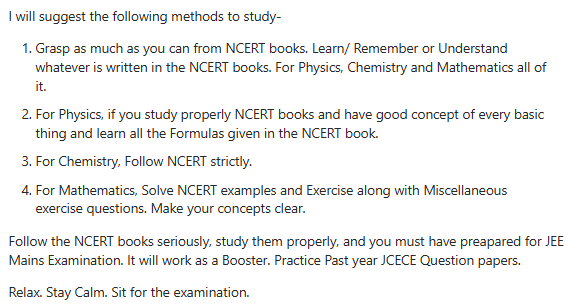
As per students on Quora, below are some JCECE preparation tips to use in your studies:
- Focus strictly on NCERT books for Physics, Chemistry, and Mathematics. Learn core concepts, memorize all formulas, and solve all worked examples, exercises, and miscellaneous questions.
- Treat JEE Main prep as a rank booster, practice past-year JCECE question papers, and stay calm and relaxed during the examination.

Source: Quora
JCECE Exam Syllabus 2027: FAQs
Ques. Which subjects are included in the JCECE syllabus?
Ans. The syllabus includes Physics, Chemistry, Mathematics and Biology. Candidates prepare subjects according to their selected PCM, PCB or PCMB group.
Ques. Is the JCECE syllabus the same for PCM and PCB candidates?
Ans. No. PCM candidates prepare Physics, Chemistry and Mathematics, while PCB candidates prepare Physics, Chemistry and Biology. PCMB candidates prepare all four subjects.
Ques. What are the important topics to prepare for JCECE?
Ans. Candidates should prioritise Mechanics, Electricity & Magnetism, Calculus, Algebra, Chemical Kinetics, Electrochemistry, Human Physiology, Genetics and Ecology, along with thorough NCERT revision.
Ques. Is JCECE based on the Class 11 and 12 syllabus?
Ans. Yes. The official 2026 bulletin states that the JCECE question papers are based on the common Class 11 and 12 syllabus notified by CBSE.



Comments