




The JEE Main Chemistry Syllabus 2027 brings together 3 major sections: Physical, Organic, and Inorganic Chemistry. These sections cover 20 major Chemistry chapters from the Class 11 and Class 12 NCERT syllabus. They include core areas such as Mole Concept, Atomic Structure, Equilibrium, Coordination Compounds, and Hydrocarbons.
- In JEE Main 2027, Physical Chemistry includes topics such as Some Basic Concepts of Chemistry, Atomic Structure, Chemical Bonding, Thermodynamics, Equilibrium, Electrochemistry, Chemical Kinetics, and Solutions.
- Organic Chemistry covers topics including Basic Principles of Organic Chemistry, Hydrocarbons, Haloalkanes & Haloarenes, Alcohols, Phenols & Ethers, Aldehydes & Ketones, Amines, Biomolecules, and Practical Chemistry.
- Inorganic Chemistry includes Classification of Elements & Periodicity, p-Block Elements, d- and f-Block Elements, Coordination Compounds, and Principles Related to Qualitative Analysis.
- The JEE Main Chemistry syllabus focuses on conceptual clarity, chemical reasoning, reaction mechanisms, and numerical problem-solving, with questions based on Class 11 and 12 concepts.
- High-weightage Chemistry topics include Chemical Bonding (6–8%), Coordination Compounds (5–7%), Thermodynamics (5–7%), Organic Chemistry – Basic Principles & Techniques (5–7%), Aldehydes, Ketones & Carboxylic Acids (5–7%), and Electrochemistry (4–6%), based on previous-year question trends.
JEE Main Chemistry Syllabus 2027 PDF Download
The JEE Main Chemistry Syllabus 2027 PDF will be available on the official website of the National Testing Agency (NTA) once it is released. Candidates can download the PDF to access the complete Chemistry syllabus for JEE Main 2027.
Related Links:
- JEE Main Exam Pattern 2027: Total Questions for BE/BTech & BArch/BPlan, Marking Scheme, Total Mark
- JEE Main Paper Analysis: Check Shift-Wise Difficulty Level, Student Reactions, and Paper Review
- JEE Main 2027 Preparation Guide: Study Plan, Strategy, Tips & Resources
JEE Main Chemistry Syllabus 2027: Overview
| Particulars | Details |
|---|---|
| Subject | Chemistry |
| Sections | Physical Chemistry, Inorganic Chemistry, Organic Chemistry |
| Level | Class 11 and Class 12 |
| Syllabus Basis | Primarily aligned with NCERT Chemistry concepts |
| Major Topics | Mole Concept, Atomic Structure, Chemical Bonding, Thermodynamics, Equilibrium, Electrochemistry, Coordination Compounds, Hydrocarbons, Biomolecules, etc. |
| Question Type | Multiple-choice and numerical-value questions |
| Total Questions | 25 questions |
| Total Marks | 100 marks |
| Preparation Focus | NCERT concepts, important reactions, formulas, numerical problems, and previous-year questions |
What is the Syllabus of JEE Main Chemistry 2027?
JEE Main Chemistry Syllabus 2027 covers three major sections: Physical Chemistry, Organic Chemistry, and Inorganic Chemistry.
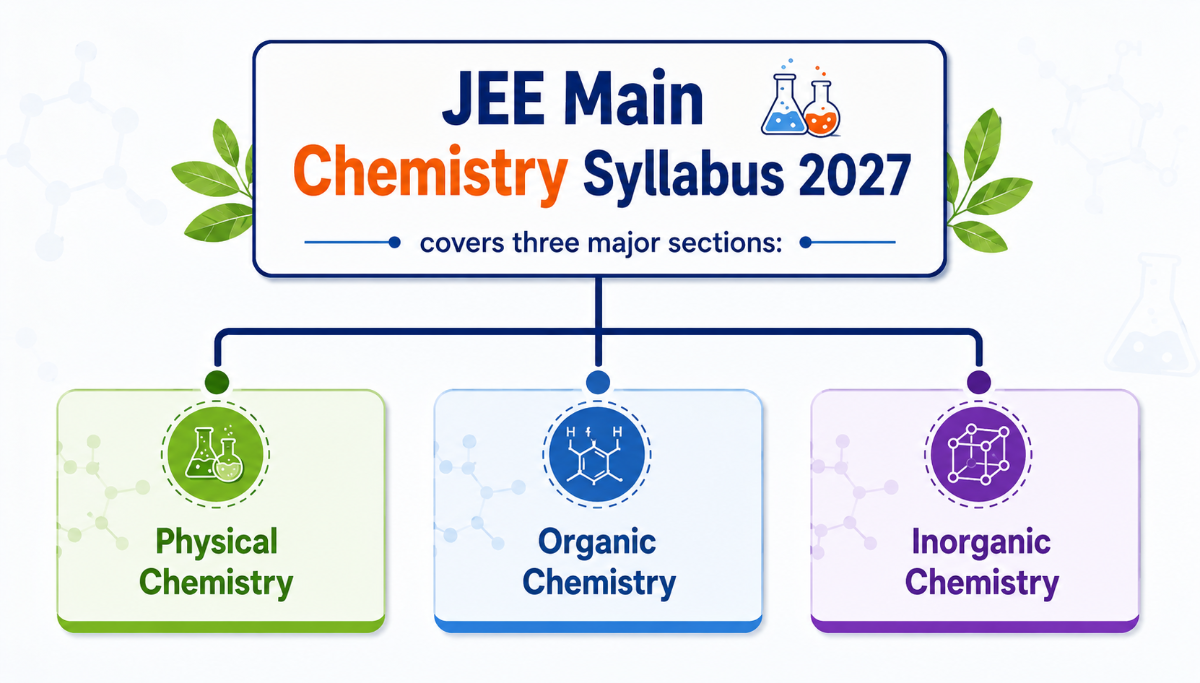
- Physical Chemistry focuses on topics such as Some Basic Concepts of Chemistry, Atomic Structure, Thermodynamics, Equilibrium, Electrochemistry, Chemical Kinetics, and Solutions.
- Inorganic Chemistry includes key topics such as Classification of Elements and Periodicity, Chemical Bonding, Coordination Compounds, p-Block Elements, d- and f-Block Elements, and Qualitative Analysis.
- Organic Chemistry covers topics including Purification and Characterisation of Organic Compounds, Basic Principles of Organic Chemistry, Hydrocarbons, Haloalkanes and Haloarenes, Alcohols, Phenols and Ethers, Biomolecules, and Practical Chemistry.
- The JEE Main Chemistry syllabus is based on the topics prescribed by NTA, with the latest officially available syllabus covering the three Chemistry sections and their respective units.
JEE Main Chemistry Syllabus 2027: Chapter-Wise
The official NTA syllabus for JEE Main 2027 has not been released yet and is expected to remain identical to the reduced 2026 version (aligned with rationalised NCERT).
Physical Chemistry
| Chapter | Key Topics to Cover | Handwritten Notes |
|---|---|---|
| Some Basic Concepts in Chemistry | Mole concept, stoichiometry, empirical & molecular formula | Main Mole Concept Handwritten Notes PDF Download |
| Atomic Structure | Bohr model, quantum numbers, electronic configuration | Structure of Atom Handwritten Notes PDF |
| Chemical Bonding & Molecular Structure | Ionic/covalent bonding, VSEPR, hybridisation, molecular orbital theory | Chemical Bonding and Molecular Structure Handwritten Notes PDF |
| Chemical Thermodynamics | Enthalpy, entropy, Gibbs energy, Hess's law | Thermodynamics Handwritten Notes PDF |
| Solutions | Concentration, solubility, colligative properties | |
| Equilibrium | Chemical equilibrium, ionic equilibrium, pH, buffer solutions | Equilibrium Handwritten Notes PDF |
| Redox Reactions & Electrochemistry | Oxidation-reduction, electrochemical cells, Nernst equation | Redox Reactions Handwritten Notes PDF |
| Chemical Kinetics | Rate of reaction, order, rate constant, Arrhenius equation |
Inorganic Chemistry
| Chapter | Key Topics to Cover | Handwritten Notes |
|---|---|---|
| Classification of Elements & Periodicity | Periodic trends, atomic properties, periodic table | Classification of Elements and Periodicity in Properties Handwritten Notes PDF |
| p-Block Elements | Properties and important compounds of p-block elements | JEE Main Study Notes for p-Block Elements |
| d- and f-Block Elements | Transition elements, lanthanides, actinides | d & f Block Elements Handwritten Notes |
| Coordination Compounds | Ligands, coordination number, nomenclature, isomerism, bonding | Coordination Compounds Handwritten Notes |
| Practical Chemistry | Qualitative analysis, salt analysis, basic chemical tests | Principles Related To Practical Chemistry JEE Mains Questions |
Organic Chemistry
Also Read:
- JEE Main Chapter Wise Weightage 2027: Check Chemistry, Physics, and Maths Weightage Last 10 Years
- JEE Main Chemistry Syllabus 2027: Latest Chemistry Syllabus PDF, High-Weightage Topics, Preparation Tips & Study Plan
- JEE Main Maths Syllabus 2027: Chapter-Wise Topics, Weightage, PDF & Deleted Syllabus
Which Chemistry Chapters are Important for JEE Main 2027?
The JEE Main Chemistry Syllabus 2027 includes several chapters that candidates should prioritise based on their frequency and relevance in recent JEE Main Chemistry papers. However, candidates should also aim to cover the complete syllabus for comprehensive preparation.
- Based on the January and April 2026 sessions, Coordination Compounds, Organic Compounds Containing Oxygen, Hydrocarbons, and Organic Compounds Containing Nitrogen were among the frequently tested topics.
| Chapter / Unit | Section | Expected Questions | Approx. Weightage | Priority Level |
|---|---|---|---|---|
| Coordination Compounds | Inorganic | 2–3 | 8–10% | Very High |
| Chemical Bonding and Molecular Structure | Physical/Inorganic | 2–3 | 8–10% | Very High |
| Equilibrium (Chemical + Ionic) | Physical | 1–2 | 6–8% | Very High |
| Organic Compounds Containing Oxygen (Aldehydes, Ketones, Carboxylic Acids) | Organic | 1–2 | 5–7% | High |
| p-Block Elements (Trends – Groups 13–18) | Inorganic | 1–2 | 5–7% | High |
| Chemical Thermodynamics | Physical | 1–2 | 5–7% | High |
| Atomic Structure | Physical | 1–2 | 5–7% | High |
| d- and f-Block Elements | Inorganic | 1–2 | 5–7% | High |
| Solutions (Colligative Properties) | Physical | 1–2 | 4–6% | High |
| Hydrocarbons + GOC (Some Basic Principles) | Organic | 1–2 | 5–7% | High |
| Electrochemistry | Physical | 1 | 3–5% | Medium-High |
| Chemical Kinetics | Physical | 1 | 3–5% | Medium-High |
In this YouTube video by Simply Concise, candidates will get to know which chapters carry high weightage in the JEE Main Chemistry syllabus and how they must devise a way to cover those topics.
Also Read:
What are some easy topics in Chemistry for JEE Main 2027?
JEE Main Chemistry Syllabus 2027 includes several relatively easier and scoring topics that can help candidates. These topics build confidence and secure marks with focused preparation. Topics such as Biomolecules, Coordination Compounds, Chemical Kinetics, Solutions, and basic Organic Chemistry can be prioritised.
| Chemistry Branch | Easy/Scoring Topics | What to Focus On |
|---|---|---|
| Physical Chemistry | Some Basic Concepts of Chemistry | Mole concept, stoichiometry, concentration terms |
| Solutions | Molarity, molality, concentration, colligative properties | |
| Chemical Kinetics | Rate law, order of reaction, half-life | |
| Atomic Structure | Bohr model, quantum numbers, electronic configuration | |
| Organic Chemistry | Biomolecules | Carbohydrates, proteins, vitamins, nucleic acids |
| Hydrocarbons | Basic reactions of alkanes, alkenes and alkynes | |
| Haloalkanes & Haloarenes | Nomenclature and common reactions | |
| Organic Chemistry – Basic Principles | IUPAC nomenclature, isomerism, basic reaction mechanisms | |
| Inorganic Chemistry | Coordination Compounds | Nomenclature, ligands, coordination number, isomerism |
| Classification of Elements & Periodicity | Periodic trends and properties | |
| d- and f-Block Elements | General properties, oxidation states, important compounds | |
| Chemical Bonding | VSEPR theory, hybridisation, molecular shapes |
Also Read: Top 6 Easy Chemistry Chapters for JEE Main with Important Formulae & PYQs
Deleted Topics in JEE Main Chemistry Syllabus 2027
The JEE Main Chemistry Syllabus 2027 has not been officially released by NTA yet, so a confirmed list of deleted Chemistry topics for 2027 is not available.
If NTA retains the same syllabus framework for 2027, the topics excluded from the 2026 syllabus may continue to remain outside the syllabus.
| Chemistry Unit/Chapter | Deleted Topics |
|---|---|
| Some Basic Concepts in Chemistry | Physical quantities and their measurements; precision and accuracy; significant figures; SI units; dimensional analysis |
| Atomic Structure | Thomson's atomic model; Rutherford's atomic model; limitations of Thomson's and Rutherford's models |
| States of Matter | Entire chapter deleted, including gaseous state, gas laws, ideal gas equation, kinetic theory of gases and real gases |
| Surface Chemistry | Entire chapter deleted |
| Hydrogen | Entire chapter deleted |
| s-Block Elements | Entire chapter deleted, covering alkali and alkaline earth metals |
| General Principles and Processes of Isolation of Metals | Entire chapter deleted |
| Environmental Chemistry | Entire chapter deleted |
| Alcohols, Phenols and Ethers | Entire chapter deleted |
| Polymers | Entire chapter deleted |
| Chemistry in Everyday Life | Entire chapter deleted |
Also Read: Deleted Syllabus of JEE Mains 2027 Chemistry: Complete List of Removed Topics & Chapters
Is the JEE Main Chemistry Syllabus 2027 the same as the NCERT Syllabus?
The JEE Main Chemistry Syllabus 2027 is not exactly the same as the NCERT Chemistry syllabus, although there is significant overlap between the two. JEE Main Chemistry covers concepts from the Class 11 and 12 curriculum, but NTA defines its own examination syllabus.
| JEE Main Chemistry | NCERT Chemistry |
|---|---|
| Prescribed by NTA for the JEE Main examination | Prescribed by NCERT for school-level education |
| Covers selected concepts from Class 11 and 12 Chemistry | Covers the broader Class 11 and 12 Chemistry curriculum |
| Divided into Physical, Organic and Inorganic Chemistry | Also covers Physical, Organic and Inorganic Chemistry |
| Some NCERT topics may be excluded from the JEE Main syllabus | Includes topics according to the NCERT curriculum |
| Questions are designed according to the JEE Main syllabus and exam requirements | Content is primarily designed for conceptual learning at the school level |
| NCERT textbooks are highly useful for preparing Chemistry concepts and factual portions | NCERT textbooks provide the core study material for the subject |
Is NCERT enough for JEE Main Chemistry Syllabus 2027?
NCERT is an important resource for JEE Main Chemistry, particularly for Inorganic and Organic Chemistry, but candidates should not rely on NCERT alone.
- Students should first follow the official JEE Main Chemistry Syllabus 2027.
- Use NCERT for theory, reactions, definitions, and important facts, followed by previous-year questions and regular practice.
How to Complete the JEE Main Chemistry Syllabus 2027?
JEE Main 2027 follows the usual January–April schedule; Session 1 is likely to be around January 2027, leaving roughly 5 months from August 2026. This makes it important to complete the Chemistry syllabus systematically rather than trying to cover everything at once.
| Month | Primary Focus | What to Do |
|---|---|---|
| August 2026 | Build the foundation |
|
| September 2026 | Complete core chapters |
|
| October 2026 | Finish remaining syllabus |
|
| November 2026 | First revision |
|
| December 2026 | Intensive practice |
|
| January 2027 | Final revision |
|
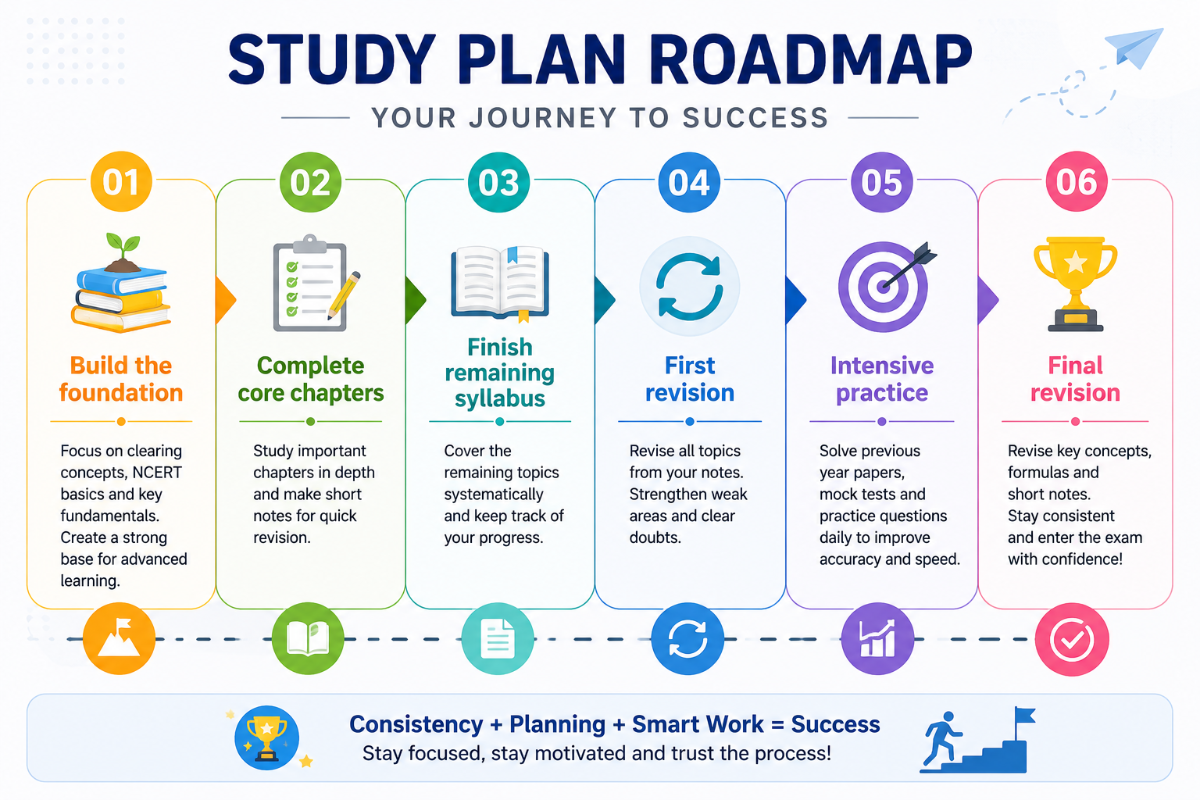
A JEE candidate was asking on Reddit, “How to complete the Organic Chemistry Syllabus in 2 Months?”

Source: Reddit
Complete JEE Main Organic Chemistry in 2 months with an 8-week plan covering concepts, practice, NCERT, and PYQs. Study sequentially from GOC and hydrocarbons to build a solid foundation.
| Week | Topics to Cover | Study Focus |
|---|---|---|
| Week 1 | Some Basic Principles of Organic Chemistry | IUPAC nomenclature, isomerism, electronic effects, reaction intermediates, and basic reaction mechanisms |
| Week 2 | Hydrocarbons | Alkanes, alkenes, alkynes, aromatic hydrocarbons and important reactions |
| Week 3 | Organic Compounds Containing Halogens | Haloalkanes, haloarenes, nucleophilic substitution, elimination and important conversions |
| Week 4 | Organic Compounds Containing Oxygen – I | Alcohols, phenols and ethers; preparation, properties and reactions |
| Week 5 | Organic Compounds Containing Oxygen – II | Aldehydes, ketones and carboxylic acids; important reactions and reaction mechanisms |
| Week 6 | Organic Compounds Containing Nitrogen | Amines, diazonium salts, preparation, properties and important reactions |
| Week 7 | Biomolecules + Practical Chemistry | Carbohydrates, proteins, vitamins, nucleic acids and important organic qualitative tests |
| Week 8 | Complete Revision + PYQs | Revise reactions and mechanisms, solve JEE Main PYQs, and take Chemistry mock tests |
Also Read:
JEE Main Chemistry Syllabus 2027 Mock Test
| JEE Main Chemistry Mock Test 2027 | Download PDF |
|---|---|
| JEE Main Chemistry Mock Test 1 | Click here |
| JEE Main Chemistry Mock Test 2 | Click here |
| JEE Main Chemistry Mock Test 3 | Click here |
| JEE Main Chemistry Mock Test 4 | Click here |
| JEE Main Chemistry Mock Test 5 | Click here |
| JEE Main Chemistry Mock Test 6 | Click here |
| JEE Main Chemistry Mock Test 7 | Click here |
| JEE Main Chemistry Mock Test 8 | Click here |
| JEE Main Chemistry Mock Test 9 | Click here |
| JEE Main Chemistry Mock Test 10 | Click here |
| JEE Main Chemistry Mock Test 11 | Click here |
| JEE Main Chemistry Mock Test 12 | Click here |
Also Read:
JEE Main Chemistry Sample Papers
After completing the JEE Main Chemistry Syllabus 2027, students should solve as many sample papers as possible. This helps improve speed, accuracy, time management, and exam readiness.
| JEE Main Sample Paper | Direct Link |
|---|---|
| JEE Main Chemistry Sample Paper 1 | Download PDF |
| JEE Main Chemistry Sample Paper 2 | Download PDF |
| JEE Main Chemistry Sample Paper 3 | Download PDF |
| JEE Main Chemistry Sample Paper 4 | Download PDF |
| JEE Main Chemistry Sample Paper 5 | Download PDF |
| JEE Main Chemistry Sample Paper 6 | Download PDF |
| JEE Main Chemistry Sample Paper 7 | Download PDF |
| JEE Main Chemistry Sample Paper 8 | Download PDF |
| JEE Main Chemistry Sample Paper 9 | Download PDF |
| JEE Main Chemistry Sample Paper 10 | Download PDF |
| JEE Main Chemistry Sample Paper 11 | Download PDF |
| JEE Main Chemistry Sample Paper 12 | Download PDF |
| JEE Main Chemistry Sample Paper 13 | Download PDF |
| JEE Main Chemistry Sample Paper 14 | Download PDF |
| JEE Main Chemistry Sample Paper 15 | Download PDF |
| JEE Main Chemistry Sample Paper 16 | Download PDF |
| JEE Main Chemistry Sample Paper 17 | Download PDF |
| JEE Main Chemistry Sample Paper 18 | Download PDF |
| JEE Main Chemistry Sample Paper 19 | Download PDF |
| JEE Main Chemistry Sample Paper 20 | Download PDF |
Also Read:
JEE Main Chemistry Syllabus 2027 FAQs
Ques. Has the JEE Main Chemistry syllabus changed for 2027?
Ans. No official changes have been announced yet. The 2027 syllabus is expected to remain the same as the reduced 2026 version.
Ques. When will the official JEE Main 2027 Chemistry syllabus PDF be released?
Ans. NTA is expected to release it along with the information bulletin around October 2026 on jeemain.nta.nic.in.
Ques. Is Solid State removed from JEE Main Chemistry 2027?
Ans. Yes. Solid State (and most of States of Matter) remains excluded.
Ques. Is Polymers in the JEE Main Chemistry syllabus 2027?
Ans. No. Polymers have been completely removed and are not part of the current reduced syllabus.
Ques. Is 70 a bad score in JEE Main?
Ans. Scoring 70 marks in JEE Main is not necessarily bad, as your percentile depends on the paper’s difficulty and overall candidate performance. However, for admission to top NITs, IIITs and GFTIs, a higher score is generally needed.
Ques. Are s-Block Elements and Hydrogen deleted?
Ans. Yes. Both the full chapters of s-Block Elements and Hydrogen are excluded.
Ques. Is Surface Chemistry / Environmental Chemistry / Metallurgy removed?
Ans. Yes. Surface Chemistry, Environmental Chemistry, and General Principles & Processes of Isolation of Metals (Metallurgy) are fully deleted.
Ques. Is p-Block completely removed or only reduced?
Ans. It is partially reduced. Detailed group-wise compound preparations and properties (especially Groups 13–14) are cut, but general trends across Groups 13–18 are still included.
Ques. Is the JEE Main Chemistry syllabus the same as NCERT?
Ans. No. It is based on NCERT but is a reduced version. Several NCERT chapters and topics are excluded from JEE Main.
Ques. Which Chemistry chapters are easiest / highest scoring for 2027?
Ans. Coordination Compounds, Chemical Bonding, Periodicity, Atomic Structure, Equilibrium, Solutions, GOC, and Hydrocarbons are among the highest-scoring.



Comments