




JEE Main Physics Syllabus 2027 covers 20 units with around 30 distinct chapters, including Mechanics, Heat and Thermodynamics, Electromagnetism, Optics, Modern Physics, and Electronic Devices at the Class 11 and 12 levels.
The JEE Main Physics syllabus 2027 is expected to follow the 2026 syllabus, as no major revisions have been announced so far.
- The syllabus includes Class 11 (45-48%) and Class 12 (52-55%) Physics topics, covering chapters from Kinematics and Laws of Motion to Optics, Atoms & Nuclei, and Electronic Devices.
- JEE Main Physics is part of the 300-mark Paper 1, with 25 questions in Physics, 20 MCQs and 5 numerical-value questions, carrying 100 marks.
- Candidates can improve their Physics score by prioritising JEE Main PYQs, regular mock tests, formula revision, and analysis of mistakes.
Related Links:
- JEE Main 2027: Notification Expected in October, Exam Dates, Syllabus, and High-Weightage Chapters
- JEE Main Physics Preparation 2026: Check Monthly Preparation Plan, Way to Score 100+, Weightage & Books
- JEE Main Physics Exam Pattern: Check Marking Scheme, Total Marks, Latest Changes
Key Summary
- JEE Main Physics Syllabus 2027 is expected to remain similar to the 2026 syllabus, covering major Class 11 and 12 Physics topics.
- High-priority areas include Modern Physics, Electrostatics, Current Electricity, Magnetism, EMI & AC, and Heat & Thermodynamics.
- Students should focus on PYQs, mock tests, formula revision, and mistake analysis for effective preparation.
- HC Verma, DC Pandey, NCERT, and JEE Main PYQs can be used selectively for concept building and practice.
JEE Main Physics Syllabus PDF Download
The official JEE Mains Physics syllabus PDF 2027 will be published by the National Testing Agency (NTA)after the official Notification is released. The notification is expected to be released in October 2026.
- Students can refer to the official JEE Mains Physics syllabus PDF 2026, as the 2027 syllabus 2027 is expected to remain the same.
- The syllabus includes 20 Core Theoretical Units (Class 11 & 12 NCERT) and 1 Experimental Skills Section.
- The exam contains 2 sections:
- Section A contains 20 Multiple Choice Questions (Theory/Application);
- Section B contains 10 Numerical Value Questions (Experimental/Analytical), where you must attempt any 5.
Ques. What is the JEE Main Physics Syllabus 2027?
Ans. It is a curriculum prescribed by the National Testing Agency (NTA) consisting of 20 core theoretical units derived from NCERT Class 11 and 12, along with 1 practical section evaluating experimental laboratory skills.
Ques. Has the JEE Main Physics Syllabus 2027 been released?
Ans. No, the official 2027 Information Brochure containing the syllabus has not been released yet. It is tentatively expected to drop between October and November 2026.
Also Check:
Class 11 JEE Syllabus for Physics
The table below covers the complete Class 11 Physics topic structure, from mathematical foundations and mechanics to thermal physics, waves, and gravitation
- Kinematics, Laws of Motion, Work-Energy, Circular Motion, COM, Rotation, and Gravitation form a major portion of the Class 11 syllabus and require strong numerical practice.
- Mathematical tools, graphs, vectors, calculus, thermodynamics, fluids, and waves provide the foundation needed to solve JEE Main Physics problems.
| Class 11 Section | Detailed sub-topics mentioned in the transcript | Handwritten Notes |
|---|---|---|
| Mathematical Tools | Functions & Trigonometry: Polynomial, logarithmic and exponential functions; graphs of basic functions; trigonometric ratios and identities; small-angle approximation. Vectors: Scalar and vector quantities; unit vectors; position and displacement vectors; vector addition/subtraction; triangle and parallelogram laws; resolution of vectors in a plane; scalar (dot) and vector (cross) products. Calculus: Limits; differentiation of algebraic, trigonometric, exponential, and logarithmic functions; applications of derivatives, including maxima/minima and rate of change; integration as the reverse of differentiation; definite and indefinite integrals; area under a curve. | JEE Main Units and Dimensions Handwritten Notes PDF |
| Kinematics | Rectilinear (1D) Motion: Frame of reference; distance and displacement; average and instantaneous speed/velocity; uniform and non-uniform motion; acceleration; position-time, velocity-time and acceleration-time graphs; equations of motion under constant acceleration; motion under gravity. Projectile (2D) Motion: Motion in a plane with constant acceleration; horizontal and oblique projectile motion; trajectory; time of flight; maximum height; horizontal range. Relative Motion: Relative velocity; relative motion in 1D and 2D; rain-man, river-boat and swimmer problems. | JEE Main Study Notes for Kinematics, Sample Questions, Preparation Plan and Tricks |
| Laws of Motion | Newton's Laws & Force: Force and inertia; Newton's First and Second Laws; linear momentum (F = ma); impulse and impulse-momentum theorem; Newton's Third Law; free-body diagrams (FBDs); connected bodies; pulley-string systems; lift problems. Conservation of Momentum: Conservation of linear momentum; recoil of a gun; explosion of a bomb. Friction: Contact force and normal reaction; static and kinetic friction; coefficients of friction; laws of friction; angle of friction; angle of repose; blocks on rough horizontal and inclined planes. | JEE Main Laws of Motion Handwritten Notes PDF 2026 |
| Work, Power & Energy | Work: Work done by constant and variable forces; kinetic energy. Work-Energy Theorem: Derivation and applications for constant and variable forces. Potential Energy & Conservation: Conservative/non-conservative forces; gravitational and elastic potential energy; (F=-dU/dx); stable, unstable and neutral equilibrium; conservation of mechanical energy. Power: Average and instantaneous power; (P=\vec F\cdot\vec v); efficiency. Collisions: Elastic and inelastic collisions in 1D and 2D; coefficient of restitution (e). | NCERT Handwritten Notes Class 11 Physics Chapter 5 Work, Energy and Power |
| Circular Motion | Kinematics: Angular displacement (\theta), angular velocity, angular acceleration; relation between linear and angular quantities; tangential acceleration; centripetal/radial acceleration. Dynamics: Centripetal force; centrifugal force as a pseudo-force; uniform and non-uniform circular motion; banking of roads; safe speed on curved tracks; bending of a cyclist; vertical circle motion. | JEE Main Circular Motion Handwritten Notes PDF 2026 |
| Centre of Mass & Collisions | Centre of Mass: COM of a two-particle and (N)-particle system; COM of continuous rigid bodies including uniform rod, semi-circular ring/disc, hemisphere and cone; motion, velocity and acceleration of COM; conservation of linear momentum of a particle system in the absence of external forces. | JEE Main Study Notes for Center of Mass: Previous Year Solved Questions and Study Tips |
| Rotational Motion / Rigid Body Dynamics | Kinematics & Torque: Rigid-body rotation; rotational equations of motion; moment of force and torque; angular momentum) torque and angular momentum of a system of particles. Moment of Inertia (MOI): Radius of gyration; Parallel Axis Theorem; Perpendicular Axis Theorem; MOI of rod, ring, disc, cylinder, and sphere; rotational kinetic energy. Rotational Dynamics & Rolling: Translational and rotational equilibrium; (\tau=I\alpha); conservation of angular momentum; pure rolling; rolling on a rough inclined plane; kinetic energy of a rolling body. | JEE Main Study Notes for Rotational Dynamics: Important Formulas, Study Tips and Solved Questions |
| Simple Harmonic Motion (SHM) | Oscillations: Periodic and oscillatory motion; period and frequency; displacement as a function of time; definition and differential equation of SHM. SHM Dynamics: Velocity, acceleration and phase; kinetic and potential energy transformations; spring-mass systems in series and parallel; simple pendulum and derivation of its time period; angular SHM. | NCERT Handwritten Notes Class 11 Physics Chapter 13 Oscillations |
| Properties of Matter | Elasticity: Deforming/restoring force; stress and strain; Hooke's Law; stress-strain curve; Young's, Bulk and Shear moduli; elastic potential energy in a stretched wire. Fluid Mechanics: Fluid pressure; Pascal's Law; hydraulic lift; pressure variation with depth; atmospheric pressure; buoyancy and Archimedes' Principle; streamline/turbulent flow; critical velocity; Reynolds number; Continuity Equation; Bernoulli's Principle; Venturi meter; aerodynamic lift; Torricelli's law. Viscosity & Surface Tension: Viscous force; Newton's law of viscosity; coefficient of viscosity; Stokes' Law; terminal velocity; surface energy and surface tension; angle of contact; excess pressure in liquid drops and soap bubbles; capillary rise/ascent formula. | NCERT Handwritten Notes Class 11 Physics Chapter 10 Thermal Properties of Matter |
| Heat & Thermal Physics | Calorimetry & Expansion: Temperature scales; thermal expansion of solids, liquids and gases; anomalous expansion of water; heat capacity; specific and molar heat capacity; principle of calorimetry; latent heat; change of state. Thermodynamics: Thermal equilibrium; Zeroth Law; work, internal energy and heat; First Law; isothermal, adiabatic, isobaric and isochoric processes; (P-V) diagrams; work in individual processes; reversible/irreversible processes; Second Law; heat engines and refrigerators. Kinetic Theory of Gases (KTG): Ideal gas equation; assumptions of KTG; pressure of an ideal gas; kinetic interpretation of temperature; RMS speed; degrees of freedom; Law of Equipartition of Energy; (C_v) and (C_p) of monoatomic, diatomic and polyatomic gases; mean free path. | JEE Main Study Notes for KTG & Thermodynamics: Basic Concepts, Tips and Sample Questions |
| Waves | Wave Basics: Wave motion; longitudinal and transverse waves; speed of progressive waves; Newton's formula and Laplace's correction for sound; displacement relation for a progressive harmonic wave. Superposition & Strings: Principle of superposition; reflection at fixed/free boundaries; standing waves in strings; fundamental mode; harmonics. Sound Waves: Open and closed organ pipes; vibrations of air columns; longitudinal standing waves; beats. | NCERT Handwritten Notes Class 11 Physics Chapter 14 Waves |
| Gravitation | Gravitational Force & Field: Kepler's Laws; Newton's Universal Law of Gravitation; acceleration due to gravity (g); variation of (g) with altitude, depth and Earth's rotation; gravitational field intensity. Gravitational Potential & Satellites: Gravitational potential; gravitational potential energy; escape velocity; orbital velocity; time period and energy of satellites; geostationary and polar satellites. | NCERT Handwritten Notes Class 11 Physics Chapter 7 Gravitation |
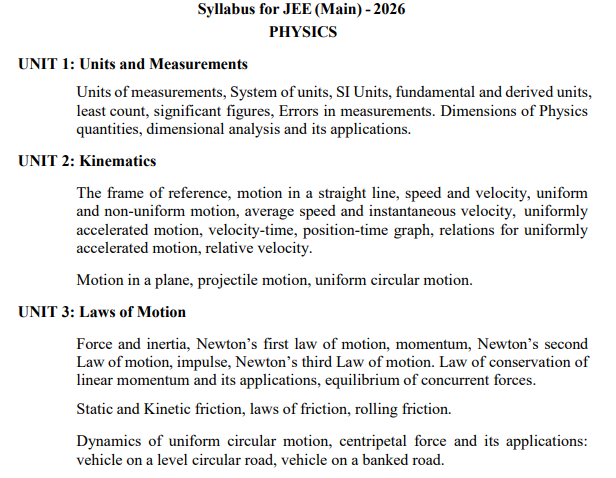
Source: JEE Main Official Syllabus PDF 2026
Ques. How many Physics questions are asked in JEE Main Paper 1?
Ans. There are exactly 25 questions to be answered. The paper contains Section A with 20 compulsory Multiple Choice Questions (MCQs) and Section B with 5 compulsory Numerical Value Questions (NVQs).
Related Articles:
Class 12 JEE Syllabus for Physics
The Class 12 Physics portion covers electrostatics, current electricity, magnetism, EMI, optics, modern physics, and electronic devices, providing a comprehensive set of topics for JEE Main preparation.
- Focus strongly on Electrostatics, Current Electricity, Magnetism, EMI & AC, and Optics, as these units involve extensive numerical and conceptual applications.
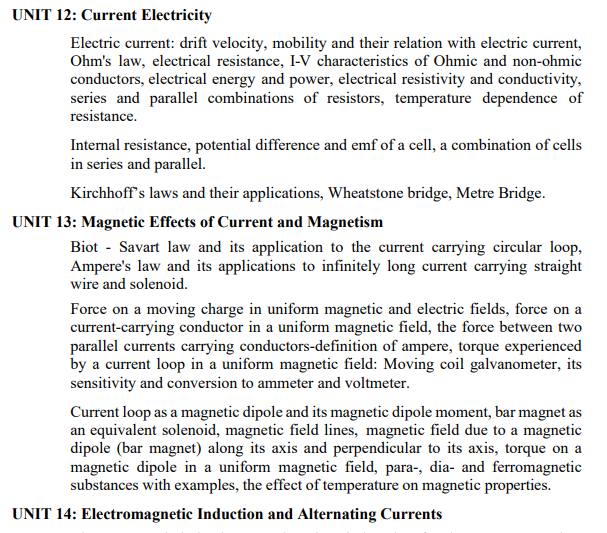
Source: JEE Main Official Syllabus PDF 2026
| Class 12 Section | Detailed sub-topics | Handwritten Notes |
|---|---|---|
| Electrostatics | Electric Charges & Fields: Electric charge and conservation; Coulomb's Law; force between multiple charges; superposition principle; continuous charge distribution. Electric Field: Field due to a point charge; electric field lines; electric dipole and dipole moment; torque on a dipole in a uniform electric field. Electric Flux & Gauss's Law: Electric flux; Gauss's Law; applications to an infinitely long charged wire, infinite plane sheet and uniformly charged thin spherical shell. Electric Potential: Potential and potential difference; potential due to point charge, dipole, and system of charges; equipotential surfaces; potential energy of two point charges and an electric dipole. Capacitance: Conductors and insulators; dielectrics and polarization; capacitance; capacitors in series/parallel; parallel-plate capacitor with/without dielectric; energy stored in a capacitor. | Electrostatic Potential Handwritten Notes Class 12 - Free PDF |
| Current Electricity | Electric Current & Conduction: Flow of charge in metallic conductors; drift velocity; mobility; relation between current and drift velocity; Ohm's Law; resistance; linear and non-linear V-I characteristics. Electrical Energy & Power: Resistivity; conductivity; temperature dependence of resistance; electrical energy and power. EMF & Circuits: Internal resistance; potential difference; emf; cells in series and parallel. Kirchhoff's Laws: Junction and loop rules; simple applications. Circuit Instruments: Wheatstone bridge and Meter Bridge. | Current Electricity Class 12 Handwritten Notes Free PDF |
| Magnetic Effects of Current & Magnetism | Biot-Savart Law: Magnetic field concept; Biot-Savart Law; field due to a current-carrying circular loop. Ampere's Law: Application to infinitely long straight wire and straight solenoid. Force on Moving Charges: Lorentz force on moving charges in electric and magnetic fields. Force on Conductors: Force on current-carrying conductor; force between parallel current-carrying conductors; torque on a current loop; moving-coil galvanometer; current sensitivity; conversion into ammeter and voltmeter. Magnetism & Matter: Current loop as magnetic dipole; magnetic dipole moment; revolving electron; bar magnet as equivalent solenoid; magnetic field lines. | JEE Main Study Notes for Magnetism: Check Quick Notes, Sample Questions |
| Electromagnetic Induction & Alternating Currents | Electromagnetic Induction: Electromagnetic induction; Faraday's Laws; induced emf/current; Lenz's Law; energy conservation; eddy currents; self-induction and mutual induction. AC Circuits: Alternating current/voltage; peak and RMS values; reactance; impedance; series LCR circuit; resonance; quality factor (Q-factor). AC Power: Power in AC circuits; wattless current. Electrical Machines: AC generator and voltage transformer. | Electromagnetic Induction And Alternating Currents JEE Mains Questions - List Of Most Asked Questions With Solutions |
| Electromagnetic Waves | EM Wave Properties: Displacement current; electromagnetic waves; characteristics; transverse nature of EM waves. Electromagnetic Spectrum: Radio waves including AM/FM; microwaves; infrared; visible light; ultraviolet; X-rays; gamma rays; basic uses and frequency/wavelength ranges. | JEE Main Study Notes for Electromagnetic Waves: Quick Notes, Tips and Sample Questions |
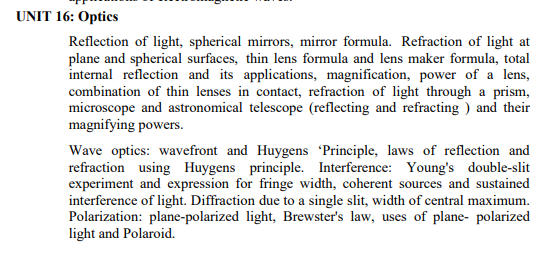
| Optics | Ray Optics: Reflection and refraction at plane and spherical surfaces; total internal reflection and applications; deviation and dispersion through prism. Lenses & Mirrors: Lens formula; thin-lens formula; Lens Maker's Formula; magnification; power of lens; combination of thin lenses in contact. Optical Instruments: Simple and compound microscopes; reflecting and refracting astronomical telescopes; magnifying power. Wave Optics: Wavefront; Huygens' principle; reflection/refraction using Huygens' principle; interference; Young's Double-Slit Experiment; fringe width; coherent sources; sustained interference; single-slit diffraction and central maximum; polarization; plane-polarized light; Brewster's Law; Malus's Law. | Ray Optics and Optical Instruments Handwritten Notes Class 12 |
| Dual Nature of Matter & Radiation | Photoelectric Effect: Dual nature of radiation; photoelectric effect; Hertz and Lenard observations; Einstein's photoelectric equation; particle nature of light. Matter Waves: Wave nature of particles; de Broglie relation. | Dual Nature of Radiation Handwritten Notes Class 12 Free PDF |
| Atoms & Nuclei | Atomic Structure: Alpha-particle scattering; Rutherford model; Bohr model of hydrogen atom; energy levels; hydrogen spectrum; radius of electron orbits; electron velocity. Nuclear Physics: Composition and size of nucleus; atomic masses; mass-energy relation; mass defect; binding energy per nucleon and its variation with mass number; nuclear fission and fusion. | Nuclei Class 12 Notes Handwritten Free PDF |
| Electronic Devices | Semiconductors: Energy bands in solids at a qualitative level; conductors, insulators and semiconductors. Junction Diodes: Intrinsic/extrinsic semiconductors; p-n junction; I-V characteristics in forward and reverse bias. Diode Applications: Half-wave and full-wave rectifiers; Zener diode characteristics; Zener diode as voltage regulator. | Class 12 Physics Electronic Devices Handwritten Notes PDF |
Ques. Is NCERT Physics enough for JEE Main preparation?
Ans. NCERT is excellent for your conceptual understanding and mastering Section B experimental text. However, it is not enough on its own to build the rigorous mathematical derivation and problem-solving speed needed to clear the cutoff. You must supplement it with standard objective reference question banks.
Also Check:
JEE Main Previous Year Paper 2026
Below are the JEE Main 2026 previous year exam papers for both Session 1 and 2, for each shift:
| JEE Main 2026 Session 1 | Question Paper PDF | Solution PDF | JEE Main 2026 Session 2 | Question Paper PDF | Solution PDF |
|---|---|---|---|---|---|
| JEE Main 21st Jan Shift 1 | Download Pdf | View Solutions | JEE Main April 2 Shift 1 | Download Pdf | View Solutions |
| JEE Main 21st Jan Shift 2 | Download Pdf | View Solutions | JEE Main April 2 Shift 2 | Download Pdf | View Solutions |
| JEE Main 22nd Jan Shift 1 | Download Pdf | View Solutions | JEE Main April 4 Shift 1 | Download Pdf | View Solutions |
| JEE Main 22nd Jan Shift 2 | Download Pdf | View Solutions | JEE Main April 4 Shift 2 | Download Pdf | View Solutions |
| JEE Main 23rd Jan Shift 1 | Download Pdf | View Solutions | JEE Main April 5 Shift 1 | Download Pdf | View Solutions |
| JEE Main 23rd Jan Shift 2 | Download Pdf | View Solutions | JEE Main April 5 Shift 2 | Download Pdf | View Solutions |
| JEE Main 24th Jan Shift 1 | Download Pdf | View Solutions | JEE Main April 6 Shift 1 | Download Pdf | View Solutions |
| JEE Main 24th Jan Shift 2 | Download Pdf | View Solutions | JEE Main April 6 Shift 2 | Download Pdf | View Solutions |
| JEE Main 28th Jan Shift 1 | Download Pdf | View Solutions | JEE Main April 8 Shift 2 | Download Pdf | View Solutions |
| JEE Main 28th Jan Shift 2 | Download Pdf | View Solutions | JEE Main 2026 B.Arch | Download Pdf | View Solutions |
JEE Main Physics Syllabus 2027: Deleted Topics
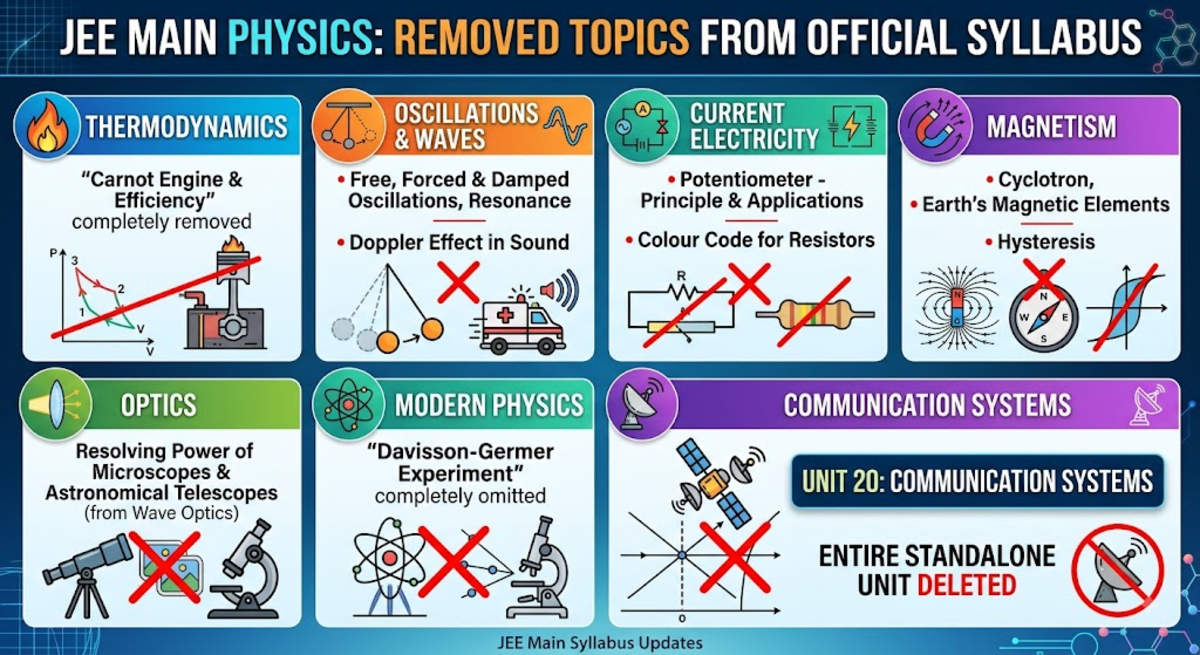
Based on the JEE Main syllabus analysis over the years, the following topics were dropped or discontinued in the last 3 years.
- The exam syllabus was restructured in the 2024 cycle, and the syllabus has remained the same after that. Below are the topics removed from the syllabus:
| Physics Chapter | Changes in the JEE Main Official Syllabus PDF 2026 |
|---|---|
| Thermodynamics | “Carnot engine and its efficiency” has been completely removed from the Thermodynamics section. |
| Oscillations & Waves | “Free, forced and damped oscillations, resonance” and “Doppler Effect in sound” have been removed. |
| Current Electricity | “Potentiometer – principle and its applications” and “Colour code for resistors” have been removed. |
| Magnetism | “Cyclotron,” “Earth's magnetic elements,” and “Hysteresis” have been removed. |
| Optics | “Resolving power of microscopes and astronomical telescopes” has been removed from Wave Optics. |
| Modern Physics | “Davisson-Germer experiment” has been completely omitted. |
| Communication Systems | The entire standalone Unit 20: Communication Systems has been deleted from the current official syllabus. |
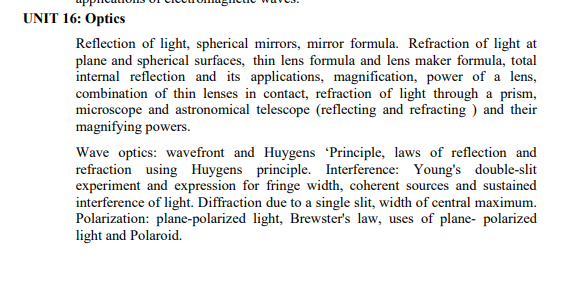
Source: JEE Main Syllabus 2023
Source: JEE Main Syllabus 2026
Check Out:
- JEE Main Laws of Motion Handwritten Notes PDF 2026
- JEE Main Circular Motion Handwritten Notes PDF 2026
- JEE Main Study Notes for Mathematical Reasoning: Important Notes, Short-cut Methods and Solved Questions
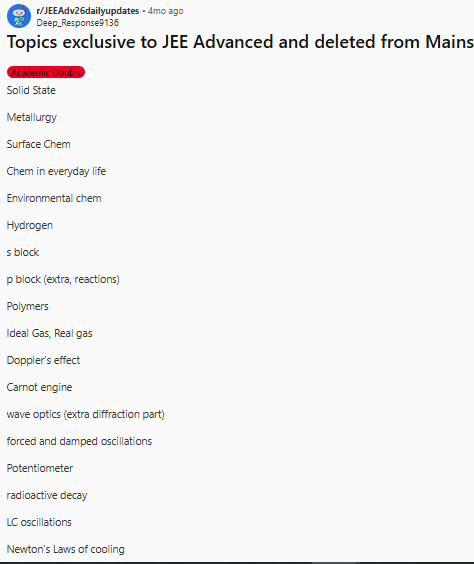
As per the student discussions on Reddit, deleted topics from the JEE Main Physics syllabus are as follows:
- Doppler's effect
- Carnot engine
- Wave optics (extra diffraction part)
- Forced and damped oscillations
- Potentiometer
- Radioactive decay
- Newton's Laws of cooling
Source: Reddit
Ques. Which Class 11 Physics chapters are included in JEE Main 2027?
Ans.
- Physics and Measurement (Units & Dimensions)
- Kinematics (1D and 2D Motion)
- Laws of Motion
- Work, Energy, and Power
- Rotational Motion (Rigid Body Dynamics)
- Gravitation
- Properties of Solids and Liquids (Properties of Matter)
- Thermodynamics & Kinetic Theory of Gases (KTG)
- Oscillations and Waves (Simple Harmonic Motion)
Check Out:
JEE Main Physics Sample Papers - Download PDF
Below are JEE Mains Physics sample papers PDF for effective preparation:
| Sample Paper | PDF Download |
|---|---|
| JEE Main Physics Sample Paper 1 | Download PDF |
| JEE Main Physics Sample Paper 2 | Download PDF |
| JEE Main Physics Sample Paper 3 | Download PDF |
| JEE Main Physics Sample Paper 4 | Download PDF |
| JEE Main Physics Sample Paper 5 | Download PDF |
| JEE Main Physics Sample Paper 6 | Download PDF |
| JEE Main Physics Sample Paper 7 | Download PDF |
| JEE Main Physics Sample Paper 8 | Download PDF |
| JEE Main Physics Sample Paper 9 | Download PDF |
| JEE Main Physics Sample Paper 10 | Download PDF |
| JEE Main Physics Sample Paper 11 | Download PDF |
| JEE Main Physics Sample Paper 12 | Download PDF |
| JEE Main Physics Sample Paper 13 | Download PDF |
| JEE Main Physics Sample Paper 14 | Download PDF |
| JEE Main Physics Sample Paper 15 | Download PDF |
| JEE Main Physics Sample Paper 16 | Download PDF |
| JEE Main Physics Sample Paper 17 | Download PDF |
| JEE Main Physics Sample Paper 18 | Download PDF |
| JEE Main Physics Sample Paper 19 | Download PDF |
| JEE Main Physics Sample Paper 20 | Download PDF |
JEE Mains Physics Syllabus High-Weightage Topics
Below are the high-weightage topics in the JEE Main Physics syllabus:
- Modern Physics and Magnetism, EMI, and AC can contribute around 3–4 questions each, making them especially important for quick score improvement.
- Current Electricity, Heat & Thermodynamics, and Electrostatics can each contribute around 2–3 questions, so they should be prioritized after the top-weightage topics.
| Chapter / Topic | Key Topics to Cover | Expected No. of Questions |
|---|---|---|
| Modern Physics | Atomic Structure; Photoelectric Effect; Matter Waves; Binding Energy | 3–4 Questions |
| Current Electricity | Basic Circuits; Kirchhoff's Laws; Wheatstone Bridge; Galvanometer; Ammeter; Voltmeter | 2–3 Questions |
| Heat & Thermodynamics | Thermodynamic Processes; (\Delta Q,\Delta U,W); KTG; (C_p,C_v); Calorimetry; Heat Transfer; Thermal Conductivity | 2–3 Questions |
| Electrostatics | Coulomb's Law; Electric Field; Potential; Gauss's Law; Electric Flux; Electric Dipole; Basic Capacitors | 2–3 Questions |
| Magnetism + EMI + AC | Magnetic Effects of Current; Electromagnetic Induction (EMI); Alternating Current (AC); Transformer Efficiency | 3–4 Questions |
| Work, Power & Energy | Work-Energy Theorem; Basic Work-Energy Applications; Mechanical Energy; Power | 1–2 Questions |
| Ray Optics | Mirror Formula; Lens Formula; Lens Maker's Formula; Sign Convention | 1–2 Questions |
| Oscillations & Waves | SHM; Sound Waves; String Waves; Basic Wave Formulas; Wave Velocity | 1–2 Questions |
| Wave Optics | YDSE; Interference; Basic Wave Optics Formulas; Huygens' Principle | 1 Question |
| Centre of Mass & Momentum | Centre of Mass Calculation; Conservation of Momentum | 1 Question |
Ques. Which Physics topics are easiest to score in JEE Main?
Ans. Modern Physics, Units & Measurements, Current Electricity, and Semiconductor Diodes are considered high-yield and straightforward because they are formula-driven and rarely feature complex mechanical tracking.
Ques. Which Physics chapters should I study first for JEE Main 2027?
Ans. Start by solidifying Mathematical Tools and Vectors, then transition immediately into Kinematics, Units & Dimensions, and Current Electricity. This builds the foundational calculus and linear algebra needed to tackle more complex units.
Also Check:
Books to Prepare for JEE Main Physics Syllabus 2027
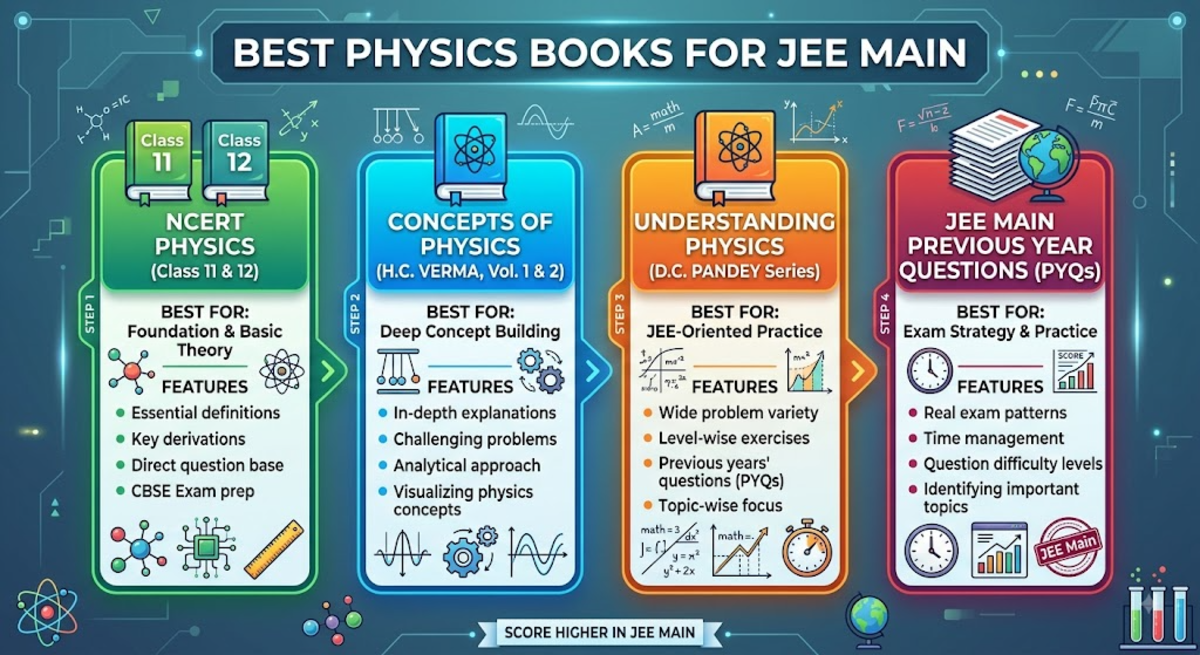
As per the YouTube video Best Books for IIT JEE Physics | A list by Mohit Goenka, below are the most important books for JEE Main Physics syllabus 2027 preparation:
- Concepts of Physics by HC Verma helps in building conceptual clarity and application of topics learned, while Class 11 and 12 books help clear the basics.
- For practice, go for previous papers and mock test series; the book Understanding Physics by DC pandey, also offers JEE-oriented study material for practice.
| Book | Best For | How to Use for JEE Main |
|---|---|---|
| Concepts of Physics – H.C. Verma (Vol. 1 & 2) | Concept building and quality problems | Top reference book. Read theory, solved examples, and selected exercises. Revise difficult/marked questions multiple times. |
| Understanding Physics – D.C. Pandey | JEE-oriented practice | Do Solved Examples and Level 1 thoroughly for JEE Main. |
| JEE Main Previous Year Questions (PYQs) | Actual exam pattern and question practice | Solve at least the last 5 years chapter-wise, preferably more if time permits. |
| NCERT Physics Class 11 & 12 | Basic theory, definitions, and selected modern-physics concepts | Use selectively, particularly for Modern Physics, Semiconductors, and factual/conceptual portions. |
Ques. How many marks does the JEE Main Physics Syllabus 2027 carry?
Ans. The Physics section carries 100 marks out of the total 300 marks allocated to Paper 1.
Ques. Which books are best for JEE Main Physics 2027?
Ans. Use Concepts of Physics (Vol 1 & 2) by Dr. H.C. Verma for building clean structural theory, and DC Pandey’s Objective Physics for JEE Main or BM Sharma (Cengage Physics) for practicing variable multi-step problems.
Check Out:
- Units, Dimensions & Vectors - JEE Mains Previous Year Questions with Solutions and Weightage
- JEE Main 2026 Session 2 Paper Analysis Out: Check Shift-wise Difficulty Level, Student Reactions and Paper Review
- JEE Main Physics Question Papers 2026: Download Previous Year Question Papers with Solution PDFs (2026-2013)
Check out the YouTube video By Eduniti - Physics by Mohit Goenka_IITKGP for more information
JEE Main Physics Preparation Tips
Based on Reddit discussions, below are some effective preparation strategies for the JEE Mains Physics syllabus:
- PYQs are the priority: Once concepts are clear, spend more time solving and analysing JEE Main PYQs than collecting additional study material.
- Revise your mistakes repeatedly: Maintain a short formula/error notebook and revisit it during every revision cycle, especially for Modern Physics, Atoms & Nuclei.
| Preparation Area | JEE Main Physics Tip |
|---|---|
| Theory | Build clear concepts chapter-wise from one reliable source. |
| PYQs | Solve chapter-wise JEE Main PYQs from recent years. |
| Mock Tests | Take regular chapter-wise and full-length Physics tests. |
| Short Notes | Maintain concise formula, concept and mistake notes. |
| Modern Physics | Read NCERT for Modern Physics, Atoms & Nuclei. |
| Mistake Analysis | Analyse every wrong and guessed question after tests. |
| Resources | Avoid too many books; prioritize concepts, PYQs and mocks. |
| Revision | Repeatedly revise formulas, marked PYQs and mistakes. |
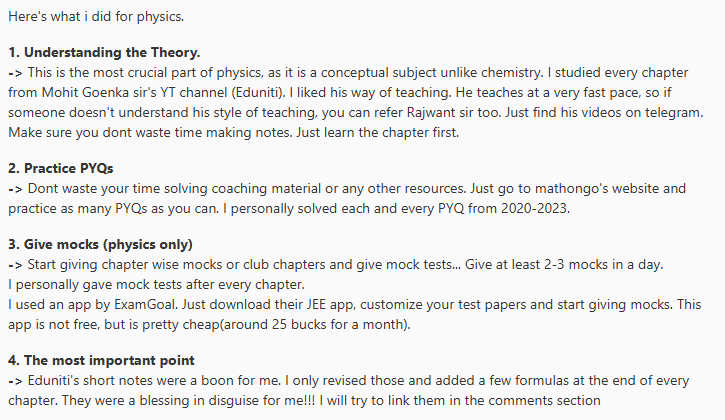

Source: Reddit
JEE Main Physics Syllabus 2027 FAQs
Ques. Where can I download the official JEE Main Physics Syllabus PDF?
Ans. Once active, you can download it from the official NTA portal at jeemain.nta.nic.in. Until then, you can reliably use the existing NTA Restructured Syllabus Repository Link to plan your preparation, as the blueprints are identical.
Ques. Is the JEE Main Physics Syllabus 2027 expected to change?
Ans. No structural updates are expected. NTA firmly locked the curriculum during the major 2024 rationalization, and the exact same streamlined parameters apply to the 2027 exam cycle.
Ques. Which Class 12 Physics chapters are included in JEE Main 2027?
Ans.
- Electrostatics (Electric Charges, Fields, and Capacitors)
- Current Electricity
- Magnetic Effects of Current and Magnetism
- Electromagnetic Induction (EMI) and Alternating Currents (AC)
- Electromagnetic Waves
- Optics (Ray Optics and Wave Optics)
- Dual Nature of Matter and Radiation
- Atoms and Nuclei
- Electronic Devices (Semiconductors)
Ques. What are the highest-weightage Physics chapters in JEE Main?
Ans. Modern Physics (Atoms, Nuclei, Dual Nature) yields the highest question count (~3–4 questions). This is followed closely by the Current Electricity block and Heat & Thermodynamics.
Ques. How should I prepare Physics for JEE Main 2027?
Ans.
- Derive equations line-by-line rather than memorizing formulas.
- Maintain a separate book strictly for tracking error trends during test practice.
- Spend at least 60% of your physics timeline solving the last 5 years of official NTA Chapter-wise Previous Years Questions (PYQs).



Comments