




The KCET syllabus 2027 PDF will be released by the Karnataka Examinations Authority (KEA) on the official website cetonline.karnataka.gov.in.
The KCET syllabus 2027 covers four papers: Physics, Chemistry, Mathematics, and Biology.
- The KCET syllabus 2027 is drawn from the Karnataka Board PUC 1 and 2 curriculum (Class 11 & 12).
- The Karnataka Common Entrance Test syllabus has been prescribed by the Department of Pre-University Education (DPUE), Karnataka.
- Based on previous year trends, Calculus in Mathematics, Organic Chemistry, Optics, and Modern Physics are some of the high-weightage topics.
- Around 80 - 90% of the KCET exam questions are directly covered from the Class 11 & 12 NCERT books.
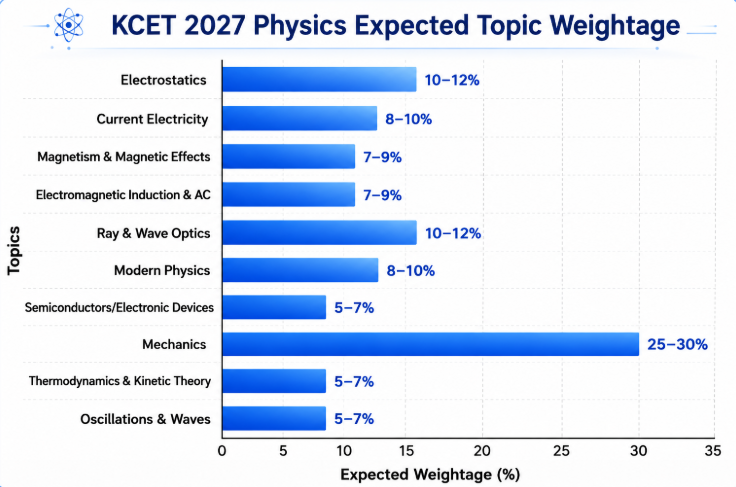
- KCET Physics important topic weightage includes Electrostatics with 10–12%, Current Electricity with 8–10%, and Ray & Wave Optics with 10–12%.
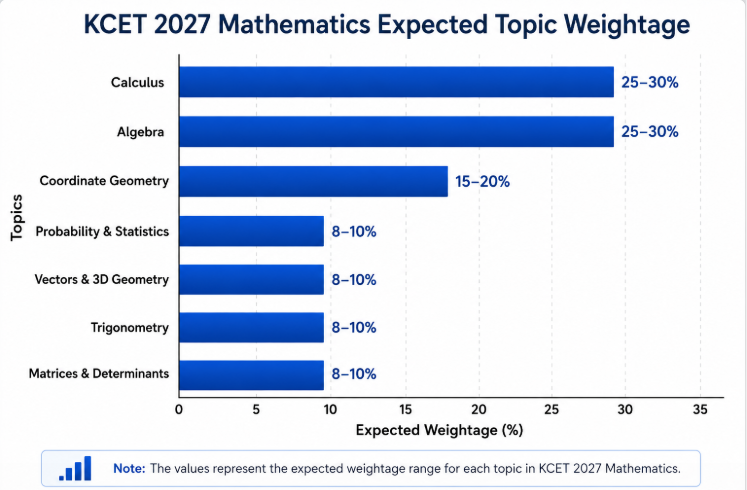
- Some of the KCET Maths high-weightage topics are Calculus with 25–30%, Algebra with 25–30%, Coordinate Geometry with 15–20%, and Probability & Statistics with 8–10%.
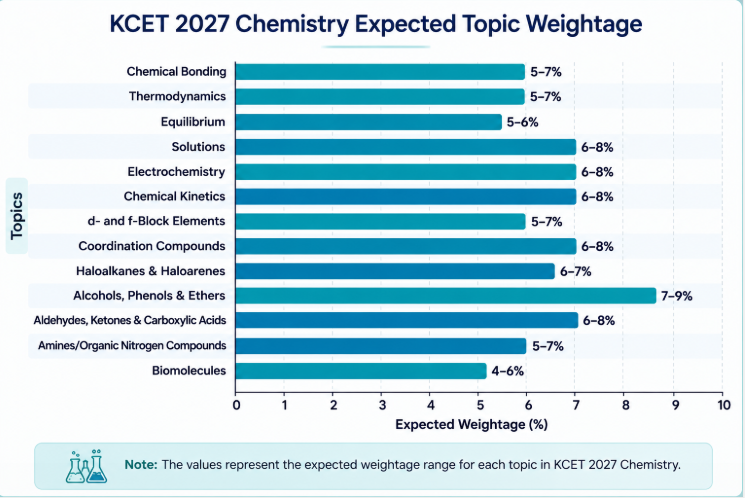
- The KCET exam Chemistry high-weightage topics are Alcohols, Phenols & Ethers with 7–9%, Chemical Kinetics with 6–8%, and Thermodynamics with 5–7%.
- PCM: The total number of questions asked is 180 for 180 marks.
- PCB: There are a total of 180 MCQ questions for 180 marks.
Related Links:
- KCET Exam Analysis 2026: Check Previous Year Question Difficulty Level, Important Topics
- KCET Physics Syllabus 2027: Download PDF, Check Topic-Wise Weightage
- KCET Mathematics Syllabus 2027 PDF Download Link, Important Chapters, Topic-Wise Weightage
Key Summary
- KCET PCM paper consists of 180 questions in total for 180 marks.
- KCET PCB paper consists of 180 questions in total for 180 marks.
- The KCET exam questions carry 1 mark each.
- There is no negative marking.
- Each subject of KCET consists of 60 MCQ questions.
KCET Syllabus 2027: Check Key Highlights
The KCET syllabus 2027 includes Physics, Chemistry, and Mathematics/Biology subjects. Each subject contains 60 MCQ questions for 60 marks.
Each question carries 1 mark.
| Particulars | Details |
|---|---|
| Exam Name | Karnataka Common Entrance Test (KCET) |
| Conducting Body | Karnataka Examinations Authority (KEA) |
| Papers (Subjects) | Physics, Chemistry, Mathematics, Biology |
| Questions per Paper | 60 MCQs |
| Marks per Paper | 60 marks (1 mark per question) |
| Duration per Paper | 80 minutes |
| Negative Marking | No |
| Syllabus Basis | Karnataka State Board 1st and 2nd PUC (Class 11 and 12) - DPUE Karnataka |
| Medium | English and Kannada |
| For Engineering Admissions | Physics, Chemistry, Mathematics (PCM) |
| For Pharmacy/Agriculture Admissions | Physics, Chemistry, Biology (PCB) |
Related Links:
- KCET Chapter-Wise Weightage: Check Important Topics, Subject-Wise Weightage
- KCET Biology Syllabus 2027: Check PDF Download Link, Topic-Weightage, Preparation Tips
- Download KCET Chemistry Syllabus 2027 PDF, Check Direct Link, Topic-Wise Weightage
Ques. What is the KCET syllabus 2027 based on?
Ans. The KCET 2027 exam syllabus is mainly based on the Karnataka Board 1st and 2nd PUC, that is, Class 11 & 12. The syllabus topics for KCET are designed in a way that covers topics directly from Class 11 & 12 NCERT textbooks. However, the KCET syllabus PDF 2027 is not out yet.
KCET Syllabus PDF Download Link 2027
The KCET exam syllabus PDF download link has not been released yet. It will be shared with you as soon as it is out.
| Subjects | PDF Download Link |
|---|---|
| Physics | Click Here (To be announced) |
| Chemistry | Click Here (To be announced) |
| Mathematics | Click Here (To be announced) |
| Biology | Click Here (To be announced) |
Is There Any Change Made in the KCET 2027 Exam Syllabus?
No, as of now, the Karnataka Examinations Authority (KEA) has not announced any changes in the KCET syllabus 2027.
The KCET 2027 syllabus is expected to be the same as the previous year. However, the official notification and the syllabus PDF have not been released yet.
If there are any changes announced after the official notification is out. Students will be notified and the updated syllabus structure will be shared.
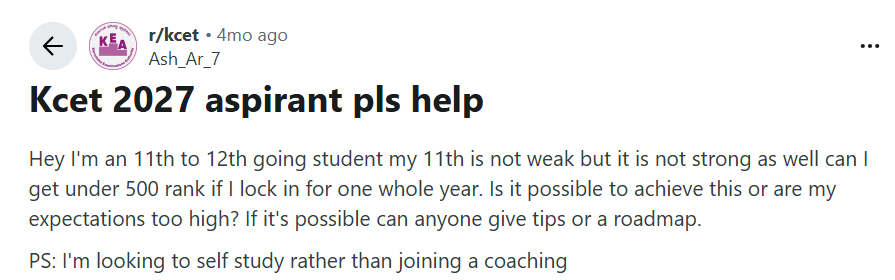
A Reddit user asked how to score 500 marks on the KCET exam.
Replying to that, another user shared their own experience and strategy.
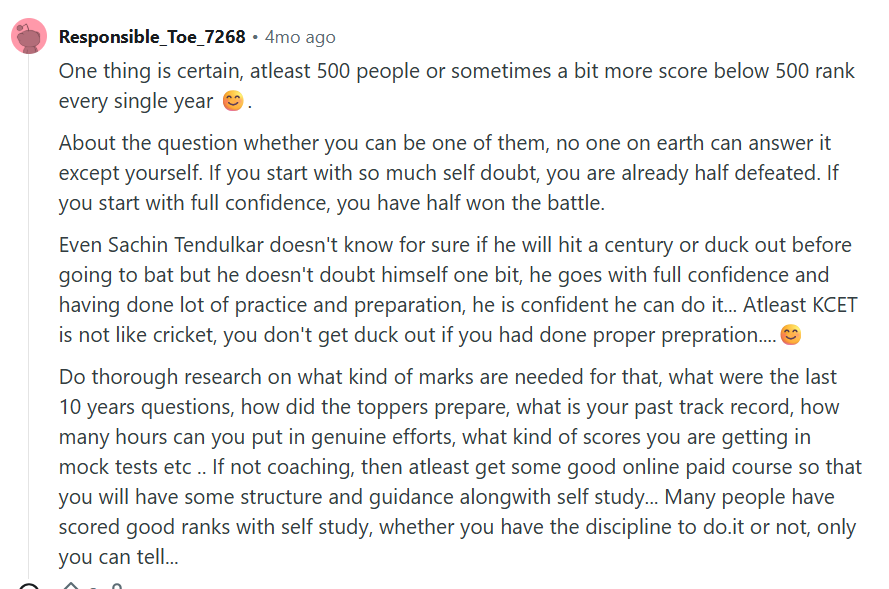
Source: Reddit
What is the KCET 2027 Exam Syllabus?
The KCET syllabus 2027 subjects are Physics, Chemistry, Mathematics, and Biology. Check out the detailed topics for each of the subjects shared below.
Each of the KCET subjects consists of 60 MCQ questions.
KCET Physics Syllabus 2027
The KCET exam syllabus 2027 for Physics includes Units and Measurements, Gravitation, Electromagnetic Induction and Alternating Currents, and many more topics.
KCET Chemistry Syllabus 2027
The KCET exam syllabus 2027 topics for Chemistry include Classification of Elements and Periodicity, General Principles and Processes of Isolation of Elements, Organic Chemistry – Basic Principles and Techniques, etc.
KCET Mathematics Syllabus 2027
Some of the KCET syllabus 2027 topics for Mathematics are Trigonometric Functions, Continuity and Differentiability, Applications of Integrals, Introduction to 3D Geometry, and many more.
KCET Biology Syllabus 2027
Check out the KCET syllabus 2027 topics for Biology shared below. Some of the topics are Cell Structure and Functions and Plant Physiology.
- Diversity in the Living World
- Structural Organisation in Plants and Animals
- Cell Structure and Functions
- Plant Physiology
- Human Physiology
- Reproduction
- Genetics and Evolution
- Biology and Human Welfare
- Biotechnology
- Ecology and Environment
Related Links:
- KCET Exam Preparation Tips 2027: Check Guidelines, Book List, Syllabus, Important Topics
- KCET Question Paper: Download Year-Wise Question Paper with Solutions
Ques. What are the highest-weightage topics in KCET Physics?
Ans. The highest-weightage topics as per the KCET syllabus 2027 for Physics are Electrostatics, Current Electricity, Magnetism, Electromagnetic Induction, Optics, and Modern Physics.
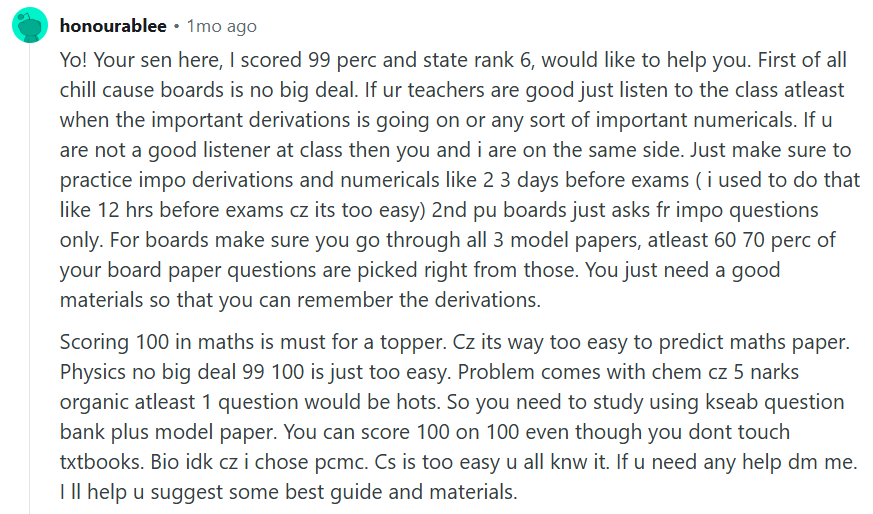
A Reddit user asked for help to score good marks in the 2nd PUC Board.
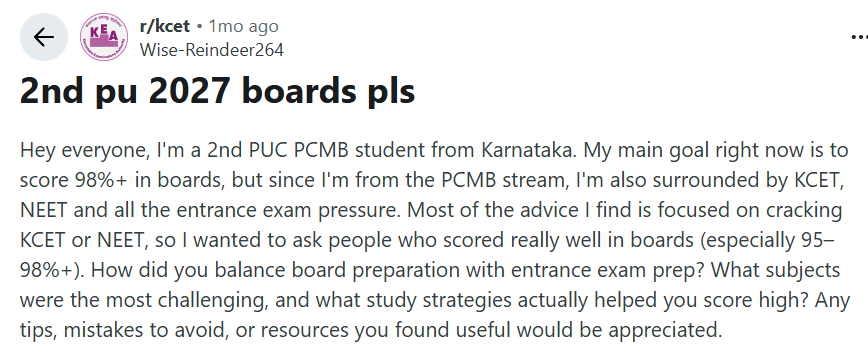
Replying to that, another user shared their own strategy.
Source: Reddit
KCET Exam Syllabus Weightage 2027
Check out the KCET 2027 subject-wise syllabus weightage provided below.
KCET Physics Topic-Wise Weightage 2027
Some of the highly weighted topics of the KCET Physics paper are Electrostatics, Electromagnetic Induction, Optics, and Modern Physics.
| Topics | Expected Weightage |
|---|---|
| Electrostatics | 10–12% |
| Current Electricity | 8–10% |
| Magnetism & Magnetic Effects | 7–9% |
| Electromagnetic Induction & AC | 7–9% |
| Ray & Wave Optics | 10–12% |
| Modern Physics | 8–10% |
| Semiconductors/Electronic Devices | 5–7% |
| Mechanics | 25–30% |
| Thermodynamics & Kinetic Theory | 5–7% |
| Oscillations & Waves | 5–7% |
KCET Chemistry Topic-Wise Weightage 2027
Alcohols, Phenols and Ethers, Solutions, Electrochemistry, Chemical Kinetics, and Coordination Compounds are some of the important topics for the KCET Chemistry paper.
| Topics | Expected Weightage |
|---|---|
| Chemical Bonding | 5–7% |
| Thermodynamics | 5–7% |
| Equilibrium | 5–6% |
| Solutions | 6–8% |
| Electrochemistry | 6–8% |
| Chemical Kinetics | 6–8% |
| d- and f-Block Elements | 5–7% |
| Coordination Compounds | 6–8% |
| Haloalkanes & Haloarenes | 6–7% |
| Alcohols, Phenols & Ethers | 7–9% |
| Aldehydes, Ketones & Carboxylic Acids | 6–8% |
| Amines/Organic Nitrogen Compounds | 5–7% |
| Biomolecules | 4–6% |
KCET Mathematics Topic-Wise Weightage 2027
The KCET syllabus 2027 important topics for Maths are Integrals, Continuity and Differentiability, Determinants, Probability, Matrices, Vectors, and 3D Geometry.
| Topics | Expected Weightage |
|---|---|
| Calculus | 25–30% |
| Algebra | 25–30% |
| Coordinate Geometry | 15–20% |
| Probability & Statistics | 8–10% |
| Vectors & 3D Geometry | 8–10% |
| Trigonometry | 8–10% |
| Matrices & Determinants | 8–10% |
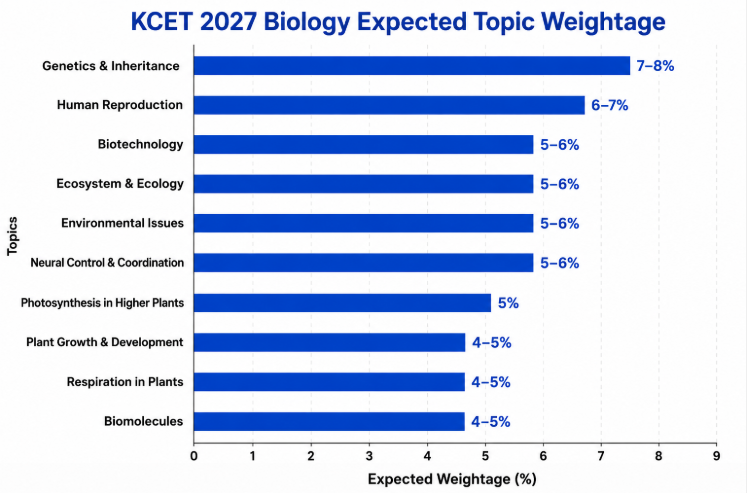
KCET Biology Topic-Wise Weightage 2027
Check out the KCET exam syllabus 2027 weightage for the Biology paper given below.
Some of the important topics are Genetics & Inheritance, Environmental Issues, Human Reproduction, and Plant Growth & Development.
| Topics | Expected Weightage |
|---|---|
| Genetics & Inheritance | 7–8% |
| Human Reproduction | 6–7% |
| Biotechnology | 5–6% |
| Ecosystem & Ecology | 5–6% |
| Environmental Issues | 5–6% |
| Neural Control & Coordination | 5–6% |
| Photosynthesis in Higher Plants | 5% |
| Plant Growth & Development | 4–5% |
| Respiration in Plants | 4–5% |
| Biomolecules | 4–5% |
How Can We Download the KCET Exam Syllabus 2027?
The steps candidates can follow to download the KCET syllabus 2027 are given below.
- Step 1: Go to the official website of the Karnataka Examinations Authority (KEA) - cetonline.karnataka.gov.in.
- Step 2: Check for the “KCET Syllabus PDF” link on the homepage.
- Step 3: Click on the relevant link received.
- Step 4: The subject-wise syllabus PDF will be displayed on the screen.
- Step 5: Check and download the subject-wise PDFs.
Which Books Are Best for KCET Exam Preparation?
The list of KCET books students must refer to prepare well for the KCET exam 2027 is shared below.
| Subject | Book Name | Author / Publisher |
|---|---|---|
| Physics | NCERT Physics (Class 11 and 12) | NCERT |
| Physics | Physics for Karnataka CET and COMEDK | K.L. Gomber and K.L. Gogia |
| Physics | MTG Objective Karnataka CET Physics | MTG Editorial Board |
| Chemistry | NCERT Chemistry (Class 11 and 12) | NCERT |
| Chemistry | MTG Objective Karnataka CET Chemistry | MTG Editorial Board |
| Chemistry | Physical Chemistry | O.P. Tandon |
| Mathematics | NCERT Mathematics (Class 11 and 12) | NCERT |
| Mathematics | MTG Objective Karnataka CET Mathematics | MTG Editorial Board |
| Mathematics | Mathematics for Class 11 and 12 | R.D. Sharma |
| Biology | NCERT Biology (Class 11 and 12) | NCERT |
| Biology | MTG Objective Karnataka CET Biology | MTG Editorial Board |
| Biology | Trueman’s Elementary Biology (Vol 1 and 2) | K.N. Bhatia and M.P. Tyagi |
KCET Exam Pattern 2027: Check Exam Structure
The KCET exam pattern 2027 consists of a total of 180 MCQ questions for PCM. Further, for PCB, there are a total of 180 MCQ questions for 180 marks.
Each question carries 1 mark.
| Particulars | Details |
|---|---|
| Exam Mode | Offline/Pen-and-Paper |
| Question Type | MCQs |
| Questions per Subject | 60 |
| Marks per Question | 1 |
| Negative Marking | No |
| Physics | 60 marks |
| Chemistry | 60 marks |
| Mathematics/Biology | 60 marks |
| PCM Total | 180 marks |
| PCB Total | 180 marks |
KCET Previous Year Question Papers:
KCET Syllabus 2027 FAQs
Ques. Is the KCET syllabus 2027 difficult?
Ans. The KCET 2027 syllabus is considered manageable for students, as the syllabus topics are mainly covered based on the Karnataka Board 1st and 2nd PUC, that is, Class 11 & 12 topics. Students are already familiar with the Class 11 & 12 syllabus topics; thus, it cannot be considered difficult.
Ques. Will the KCET 2027 syllabus change?
Ans. No, no such announcement has been made by the official authority as of now. It is expected that the syllabus will remain the same. However, the official syllabus PDF for the 2027 academic year has not been released yet. It will be released by the KEA on the official website.
Ques. Which Chemistry chapters are important for the KCET 2027 exam?
Ans. Some of the important or high-weighted chapters of the KCET 2027 Chemistry paper are Chemical Bonding, Solutions, Electrochemistry, Chemical Kinetics, Coordination Compounds, Alcohols/Phenols/Ethers, and Aldehydes/Ketones/Carboxylic Acids.
Ques. How many questions are asked in the KCET exam?
Ans. The KCET exam paper consists of two subject groups. One is Physics, Chemistry, and Maths (PCM), and the other is Physics, Chemistry, and Biology (PCB). Each of the subject groups contains 180 MCQ questions for 180 marks. Thus, each question carries +1 mark. Further, there is no negative marking.
Ques. Which KCET books 2027 are best for preparation?
Ans. The list of KCET books 2027 students must use to prepare well for the upcoming examination is Class 11 & 12 NCERT. The questions are directly asked from the NCERT books. Further, students must also practice previous years' question papers.



Comments