




MAT (Management Aptitude Test) 2026 is conducted by the All India Management Association (AIMA) in two modes: Computer-Based Test (CBT) and Paper-Based Test (PBT).
- MAT exam pattern 2026 consists of a 120-minute objective test with 150 questions for 150 raw marks.
- As per MAT marking scheme, a correct answer earns +1 mark, and for each incorrect response, 0.25 marks is deducted.
- The exam has 5 sections: Language Comprehension, Intelligence & Critical Reasoning, Data Analysis & Sufficiency, Mathematical Skills, and Indian & Global Environment.
- The Indian & Global Environment section is reported separately and excluded from the composite.
- There is no sectional time limit - you manage the full 120 minutes across all 5 sections at your own pace.
- The composite percentile score (200–800 scale) is computed from Sections 1 - 4 only.
- The IBT (Internet-Based Test) mode was discontinued in 2025; only CBT and PBT are available in 2026.
Related Links:
- MAT Syllabus: PDF Download Links, Section-Wise Topics and Weightage
- MAT Exam Preparation Tips 2026: Check Section-Wise Preparation Strategy, Books and Study Plan
Key Summary
- Both modes have the same number of sectional questions, marking scheme and total marks.
- AIMA offers MAT in 4 sessions per year - you can appear in multiple sessions, and B-schools use your best score.
- AIMA holds MAT in four sessions annually: February, May, September, and December.
- Students can appear in one or more sessions of the MAT exam each year.
- Over 600 B-schools in India accept MAT scores for MBA/PGDM admissions.
MAT Exam Pattern 2026: Check Highlights
The MAT exam is conducted for admissions into MBA programs in India. It is conducted in two modes, four times a year.
| Parameter | Details |
|---|---|
| Exam Name | MAT (Management Aptitude Test) 2026 |
| Conducting Body | All India Management Association (AIMA) |
| Exam Mode | CBT (Computer-Based Test) | PBT (Paper-Based Test) |
| Question Type | Multiple Choice Questions (MCQ) — Single Correct Answer |
| Number of Sections | 5 |
| Questions per Section | 30 |
| Total Questions | 150 |
| Total Raw Marks | 150 |
| Composite Score Range | 200 - 800 (scaled from Sections 1 - 4 performance) |
| Section-Wise Score Range | 0 - 100 per section (individually reported) |
| Duration | 120 minutes - no sectional time limit |
| Negative Marking | -0.25 marks per wrong MCQ answer |
| Medium | English |
| Annual Sessions | February, May, September, December |
| Official Website | mat.aima.in |
Related Links:
MAT Exam Pattern 2026: Check Section-Wise Structure
The section-wise marks distribution as per the MAT 2026 exam pattern is provided below.
- Each section consists of 30 questions for 30 marks, 1 mark for each question.
- The number of good attempts varies based on the subjects.
| Subjects | No. of Questions | Marks per Question | Total Marks | Total No. of Good Attempts |
|---|---|---|---|---|
| Language Comprehension | 30 | 1 | 30 | 13 - 15 |
| Intelligence and Critical Reasoning | 30 | 1 | 30 | 12 - 15 |
| Data Analysis and Sufficiency | 30 | 1 | 30 | 12 - 14 |
| Mathematical Skills | 30 | 1 | 30 | 11 - 13 |
| Economic and Business Environment | 30 | 1 | 30 | 8 - 10 |
A video by “Manoeuvre MBA - CAT TO CET Preparation” will help students learn all details related to the MAT 2027 exam.
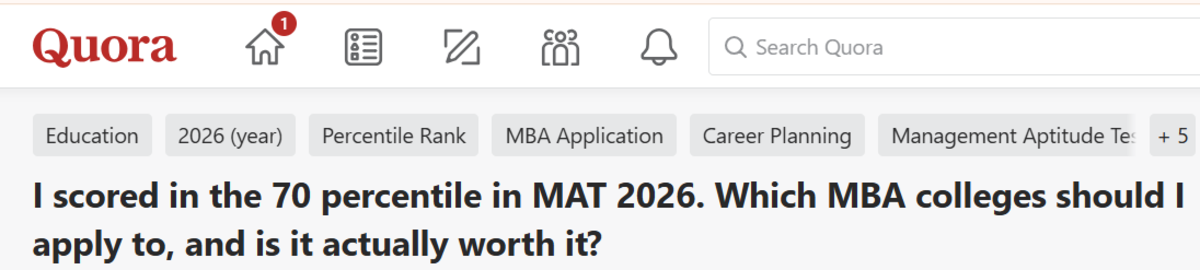
A Quora user said that he secure 70 percentile in the MAT 2026 exam, which MBA colleges he should apply for.
In response to that, another user shared a list of MBA colleges.
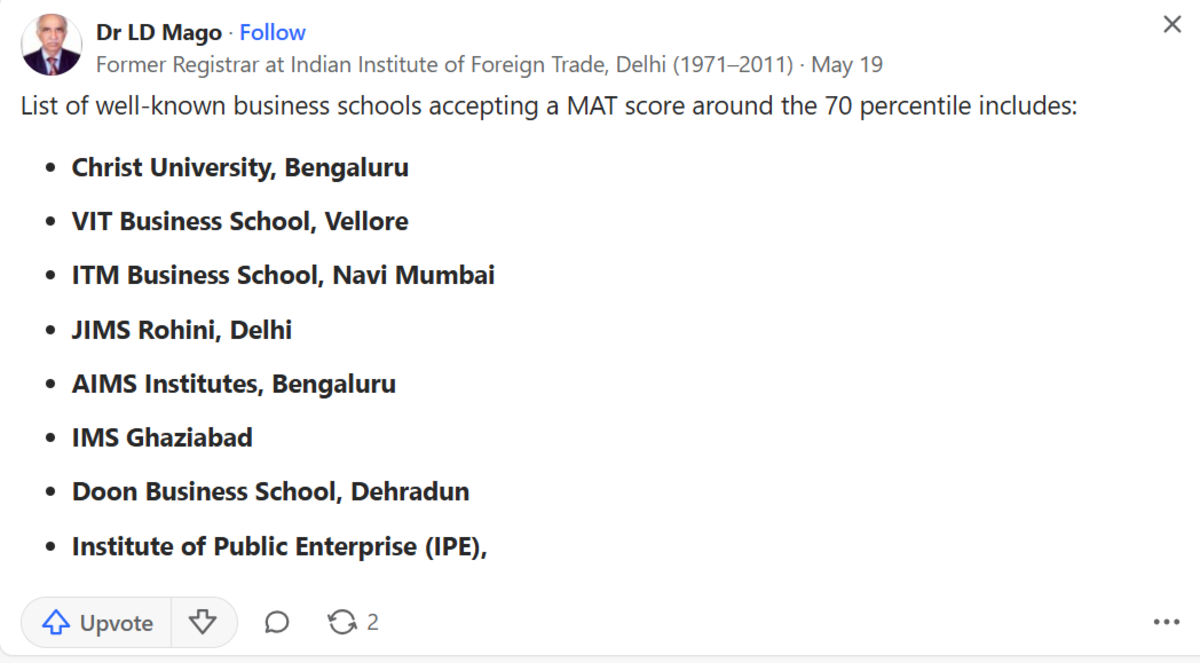
Source: Quora
MAT Marking Scheme 2026
MAT 2026 applies a uniform marking scheme across all five sections and both exam modes.
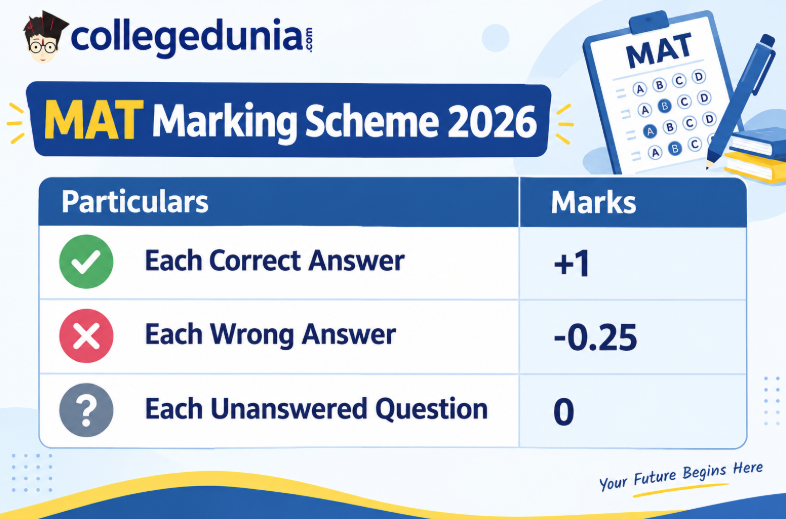
- Every correct MCQ answer earns +1 mark, a wrong answer deducts 0.25 marks, and unattempted questions carry no penalty.
- The same rule applies whether you take the CBT or PBT, and across all four annual sessions.
| Particulars | MAT Marking Scheme |
|---|---|
| Each Correct Answer | +1 |
| Each Wrong Answer | -0.25 |
| Each Unanswered Question | 0 |
Ques. How Are MAT Scores Calculated?
Ans. AIMA converts raw section scores to a scaled score of 0–100 per section. The composite MAT score (200–800) is then derived from scaled performance across Sections 1–4. This scaling ensures scores remain comparable across different sessions and sittings held throughout the year.
Related Links:
- MAT Registration 2026: Check Session-Wise Form-Filling Start and End Date, Steps to Register, and Fees
- MAT Admit Card 2026: Check Session-Wise Release Date, Direct Link, Steps to Download
- MAT Exam Centres 2026: Check CBT & PBT Exam Centre List, Allotment Process
A Quora user asked what the MAT exam pattern is.
In response, another user said that the MAT exam pattern has undergone numerous changes. The exam is conducted 4 times a year.
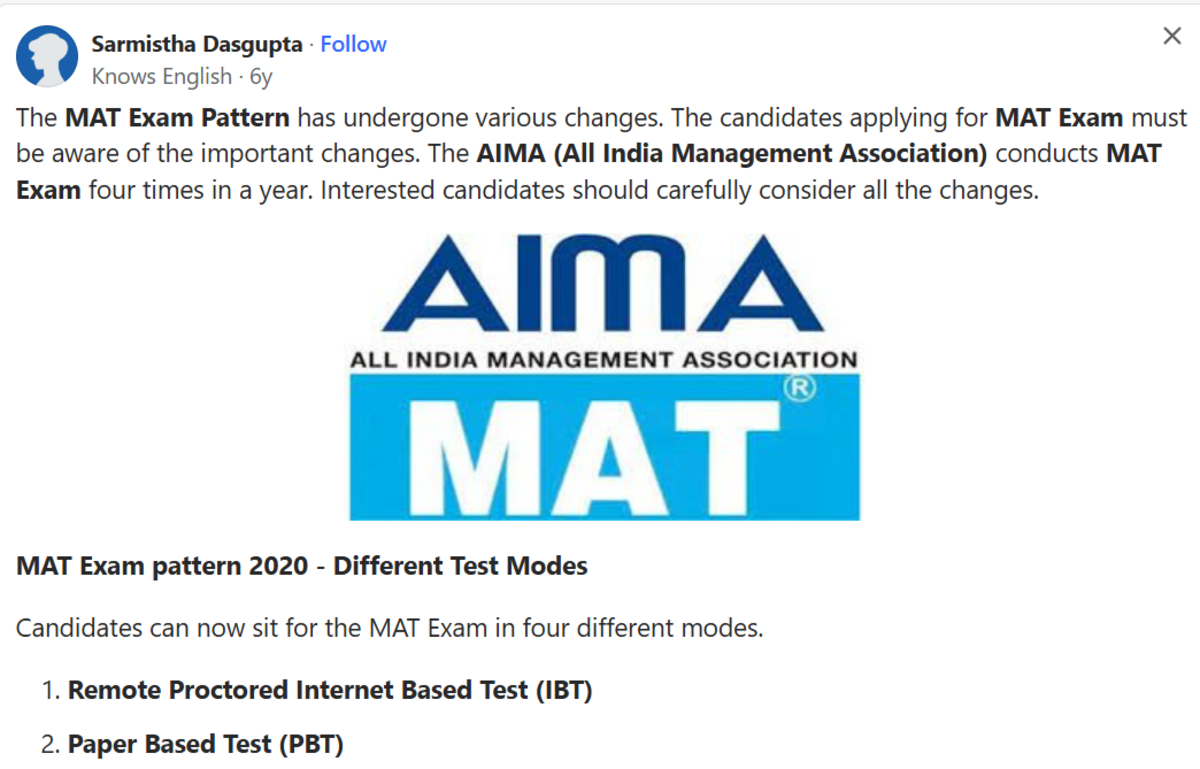
Source: Quora
MAT Subject-Wise Exam Pattern 2026
All five MAT 2026 sections carry equal weight - 30 questions and 30 raw marks each.
- The composite score uses only Sections 1 - 4
- A strong performance across all sections strengthens your B-school application.
- The breakdown below shows key topic clusters and typical question distribution within each section.
Section 1: Language Comprehension
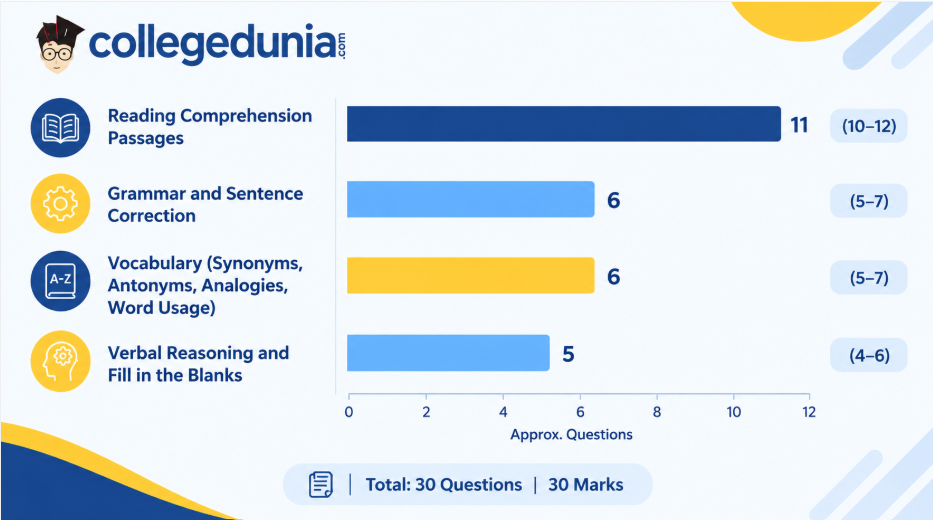
Reading Comprehension Passages, Vocabulary, Grammar and Sentence Correction, and Verbal Reasoning and Fill in the Blanks are a few topics covered under the MAT 2026 language comprehension paper.
| Topic Area | Approx. Questions | Marks |
|---|---|---|
| Reading Comprehension Passages | 10–12 | 10–12 |
| Grammar and Sentence Correction | 5–7 | 5–7 |
| Vocabulary (Synonyms, Antonyms, Analogies, Word Usage) | 5–7 | 5–7 |
| Verbal Reasoning and Fill in the Blanks | 4–6 | 4–6 |
| Total | 30 | 30 |
Section 2: Intelligence and Critical Reasoning
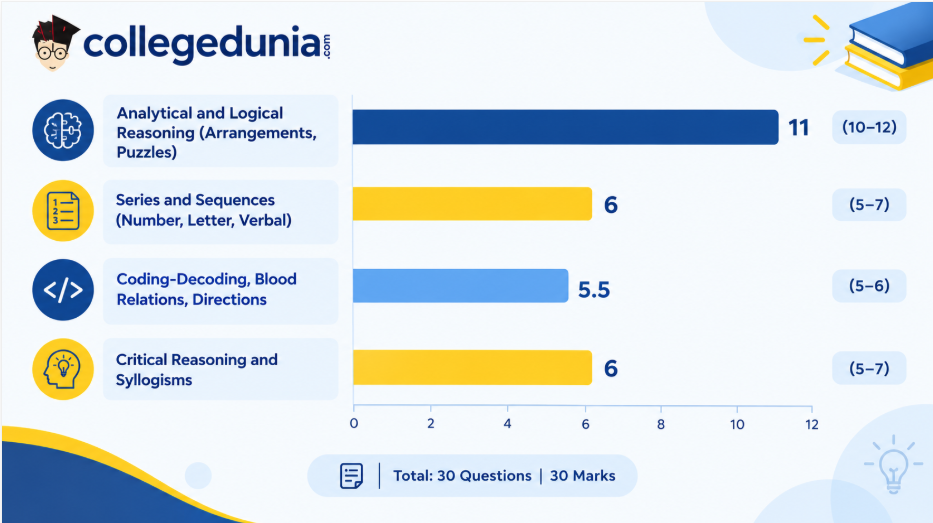
The MAT exam 2026 Intelligence and Critical Reasoning section consists of Analytical and Logical Reasoning, Series and Sequences, Coding-Decoding, and Critical Reasoning and Syllogisms topics.
| Topic Area | Approx. Questions | Marks |
|---|---|---|
| Analytical and Logical Reasoning (Arrangements, Puzzles) | 10–12 | 10–12 |
| Series and Sequences (Number, Letter, Verbal) | 5–7 | 5–7 |
| Coding-Decoding, Blood Relations, Directions | 5–6 | 5–6 |
| Critical Reasoning and Syllogisms | 5–7 | 5–7 |
| Total | 30 | 30 |
Section 3: Data Analysis and Sufficiency
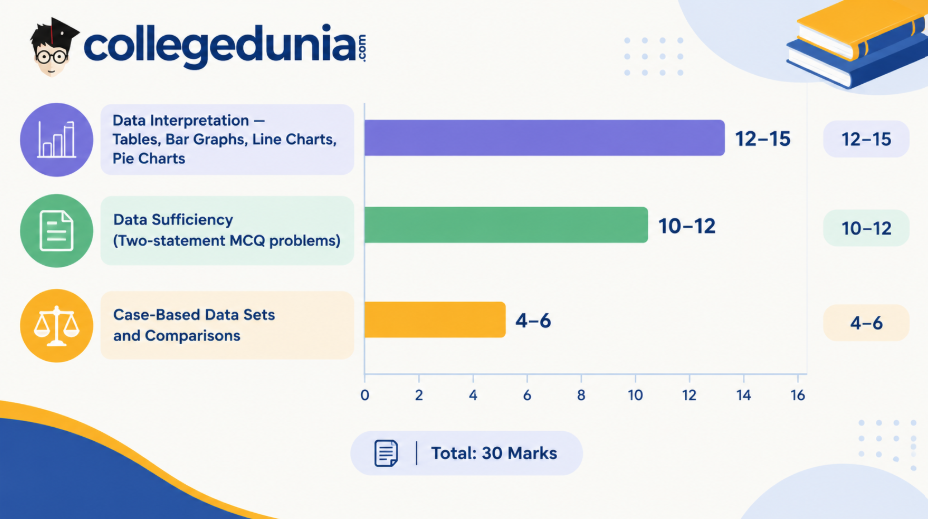
The MAT 2026 exam Data Analysis and Sufficiency paper consists of Data Interpretation, Data Sufficiency, and Case-Based Data Sets and Comparisons topics.
| Topic Area | Approx. Questions | Marks |
|---|---|---|
| Data Interpretation — Tables, Bar Graphs, Line Charts, Pie Charts | 12–15 | 12–15 |
| Data Sufficiency (Two-statement MCQ problems) | 10–12 | 10–12 |
| Case-Based Data Sets and Comparisons | 4–6 | 4–6 |
| Total | 30 | 30 |
Section 4: Mathematical Skills
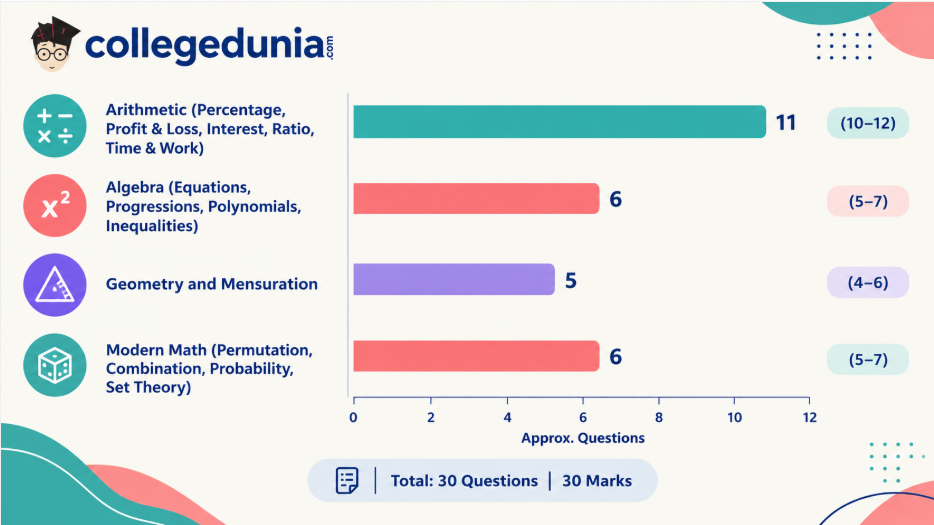
The mathematical skills cover Arithmetic, Algebra, Modern Math, Geometry, and Mensuration topics for 30 marks.
| Topic Area | Approx. Questions | Marks |
|---|---|---|
| Arithmetic (Percentage, Profit & Loss, Interest, Ratio, Time & Work) | 10–12 | 10–12 |
| Algebra (Equations, Progressions, Polynomials, Inequalities) | 5–7 | 5–7 |
| Geometry and Mensuration | 4–6 | 4–6 |
| Modern Math (Permutation, Combination, Probability, Set Theory) | 5–7 | 5–7 |
| Total | 30 | 30 |
Section 5: Economics and Business Environment
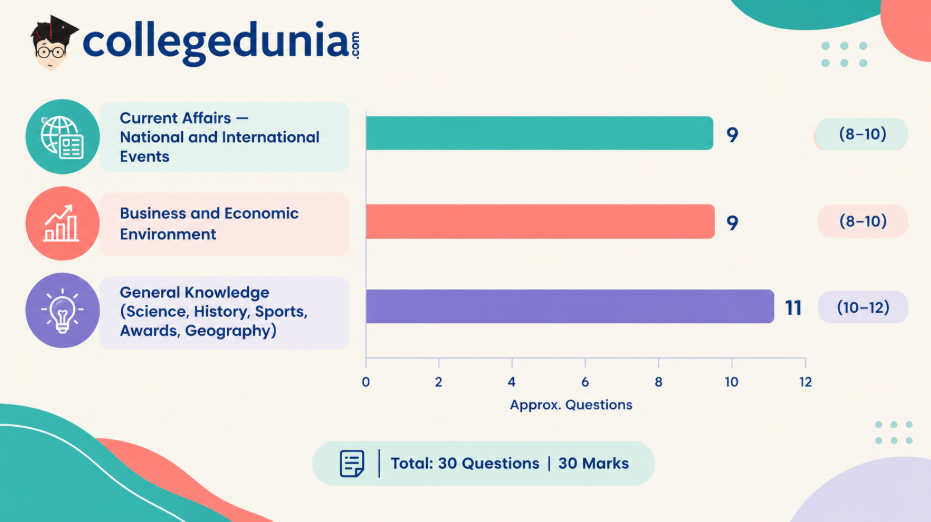
The MAT exam 2026 Economics and Business Environment section consists of Current Affairs, General Knowledge, and Business and Economic Environment.
| Topic Area | Approx. Questions | Marks |
|---|---|---|
| Current Affairs — National and International Events | 8–10 | 8–10 |
| Business and Economic Environment | 8–10 | 8–10 |
| General Knowledge (Science, History, Sports, Awards, Geography) | 10–12 | 10–12 |
| Total | 30 | 30 |
Ques. What modes is MAT 2026 available in?
Ans. MAT 2026 is available in two modes: CBT (Computer-Based Test) and PBT (Paper-Based Test). The IBT (Internet-Based Test) mode was discontinued by AIMA from 2025 and is not offered in any 2026 session. You can register for one or both modes in the same session for an additional fee.
Also Read:
- MAT Mathematical Skills Syllabus 2026: Subject-Wise Topics, Section-Wise Weightage and PDF Download
- MAT Language Comprehension Syllabus 2026: Section-Wise Topics, Subject-Wise Weightage and PDF Download
- MAT Intelligence and Critical Reasoning Syllabus 2026: Topic-Wise Syllabus, Section-Wise Topics, Weightage and PDF Download
MAT Exam Pattern: Changes in 2026 vs Previous Year
The MAT exam pattern has been revised in 2024. Earlier, in 2023, the exam pattern had some changes. The MAT exam pattern has been consistent for the 2024, 2025, and 2026 academic years.
Students must check the MAT exam pattern 2026 vs 2023 provided below, as changes were announced after 2023.
| Particulars | MAT 2023 | MAT 2024, 2025, & 2026 |
|---|---|---|
| Total questions | 200 | 150 |
| Exam Duration | 150 minutes | 120 minutes |
| Exam modes | IBT, PBT, CBT | PBT and CBT |
| Total Sections | 5 | 5 |
| Questions in Each Section | 40 | 30 |
| Environment section | Indian & Global Environment | Economic & Business Environment |
| Correct answer | +1 mark | +1 mark |
| Negative Marking | -0.25 marks | -0.25 marks |
Ques. Has the MAT 2026 exam pattern changed from 2025?
Ans. No major changes have been made. The MAT 2026 pattern — 5 sections, 30 questions each, 150 total, 120 minutes, +1/-0.25 marking — is unchanged from 2025. The IBT mode, already discontinued in 2025, remains absent in 2026. Your 2025 preparation material and strategies remain fully applicable.
Also Read:
MAT 2026: Check Section-Wise Important Topics & Weightage
The MAT exam 2026 consists of 5 sections: Language Comprehension, Intelligence & Critical Reasoning, Data Analysis & Sufficiency, Mathematical Skills, and Indian & Global Environment.
| Section | High-Frequency Topics | Share in Composite Score |
|---|---|---|
| Language Comprehension | RC passages, Vocabulary (Synonyms/Antonyms), Sentence Correction | 25% (1 of 4 scored sections) |
| Intelligence & Critical Reasoning | Seating Arrangement, Syllogisms, Blood Relations, Series | 25% |
| Data Analysis & Sufficiency | DI Sets (Tables, Pie Charts, Bar Graphs), Data Sufficiency | 25% |
| Mathematical Skills | Arithmetic (Profit & Loss, TSD, T&W), Geometry, Number System | 25% |
| Indian & Global Environment | Current Affairs (last 6 months), Business GK, Static GK | Not counted in composite percentile |
Ques. How many times is MAT held in 2026?
Ans. AIMA conducts MAT four times in 2026 — in February, May, September, and December. As of October 2026, the first three sessions have already taken place. The December 2026 session is upcoming, with the PBT exam on December 20 and CBT on December 27.
A video by “ElitePrep Education” will help students learn how to score 700+ marks in the MAT exam.
Also Read:
How to Prepare Based on MAT Exam Pattern 2026?
MAT’s equal-section structure — 30 questions per section, no sectional time limit — rewards balanced preparation and disciplined time management. The tips below are drawn directly from the pattern’s specific features.
- Treat all four composite sections equally in your study plan. Sections 1–4 each contribute equal weight (30 questions × 1 mark) to the composite score. Neglecting any one section costs you proportionally, unlike exams where subjects carry unequal marks.
- Practice full 120-minute mock tests with no sectional breaks. MAT has no per-section timer, so your pacing strategy determines your score ceiling. Simulate complete mocks under a single 120-minute clock to build the stamina and time-allocation instincts the actual exam requires.
- Apply selective skipping to manage the -0.25 penalty. Four wrong answers in MAT cancel one correct answer’s gain. If you are unsure about a question, skip it — an unattempted question is always worth more than a guessed wrong one. Target a high accuracy rate over a high attempt rate.
- Aim for 100+ correct answers across Sections 1–4 for a 700+ composite score. A composite score of 700 and above is widely cited as competitive for AIMA-affiliated institutions. This typically corresponds to answering approximately 100 of the 120 composite-section questions correctly, with high accuracy across all four sections.
- Build Section 5 (GK) through daily reading, not intensive syllabus study. The Indian and Global Environment section covers live current affairs, business news, and general knowledge that no fixed syllabus captures fully. Fifteen minutes of daily news reading through the exam cycle is more effective than any last-minute revision sprint.
- For CBT: familiarise yourself with the test interface before exam day. Practise navigating screen-based passages, using the question palette, and flagging questions for review. Interface familiarity prevents wasted time on exam day, which directly eats into your 120-minute limit.
What is a Good Score in the MAT 2026 Exam?
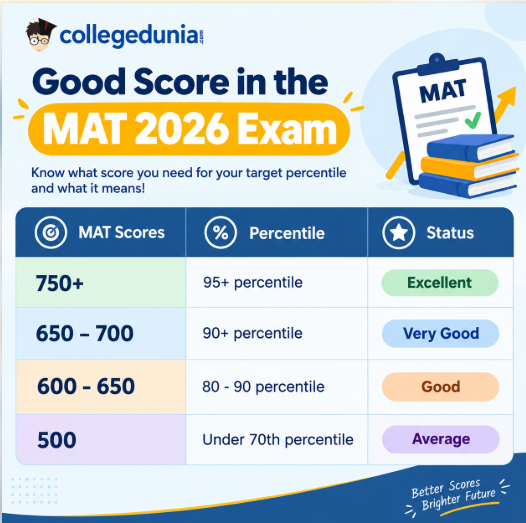
The MAT exam composite score is measured on a scale of 200 - 800. Each question carries 1 mark. As per the MAT exam pattern 2026, 750+ marks out of 800 is considered an excellent score.
| MAT Scores | Percentile | Status |
|---|---|---|
| 750+ | 95+ percentile | Excellent |
| 650 - 700 | 90+ percentile | Very Good |
| 600 - 650 | 80 - 90 percentile | Good |
| 500 | Under 70th percentile | Average |
Download and Practice MAT Sample Papers:
MAT vs CAT Exam Pattern: Check Details
Students must go through the MAT vs CAT exam pattern 2026 details shared below.
- MAT is considered easier than the CAT exam.
- The MAT exam is conducted 4 times a year, whereas CAT is only conducted once a year.
- MAT exam does not include a sectional time limit, whereas the CAT includes a sectional time limit.
| Particulars | MAT Exam | CAT Exam |
|---|---|---|
| Examination Mode | PBT and CBT | CBT |
| Exam Frequency | 4 times a year | Once a year |
| Exam Duration | 120 minutes | 120 minutes |
| Sectional Time Limit | No | Yes (40 minutes per section ) |
| No. of Attempts | 8 | 1 |
| Total Sections | 5 | 3 |
| Total No. of Questions | 150 | 68 |
| Total Marks | 150 | 204 |
| Marking Scheme |
|
|
| Difficulty Level | Easy to Moderate | Moderate to Difficult |
MAT Exam Pattern 2026 FAQs
Ques. How many questions are asked in MAT 2026?
Ans. MAT 2026 has 150 questions in total — 30 questions in each of the 5 sections. Sections 1–4 carry 120 questions that count toward the composite score; Section 5 (Indian and Global Environment) has 30 questions reported separately.
Ques. What is the total duration of MAT 2026?
Ans. MAT 2026 is a 120-minute (2-hour) exam. There is no per-section time limit — you manage all 120 minutes across the five sections at your own pace, choosing the order of attempt freely.
Ques. Is there negative marking in MAT 2026?
Ans. Yes. MAT 2026 deducts 0.25 marks for every wrong MCQ answer across all five sections. Unattempted questions carry no penalty. Avoid random guessing — four wrong answers cancel out one correct answer’s gain.
Ques. What is the MAT 2026 composite score scale?
Ans. AIMA reports MAT scores on a scaled composite score of 200 to 800. This composite is derived from your performance in Sections 1–4 only — Language Comprehension, Intelligence and Critical Reasoning, Data Analysis and Sufficiency, and Mathematical Skills. Each section is also individually reported on a 0–100 scale.
Ques. Is the Indian and Global Environment section counted in the MAT composite score?
Ans. No. The Indian and Global Environment section (Section 5) is excluded from the MAT composite score. AIMA reports it as a separate score on a 0–100 scale. Most B-schools use only the composite (200–800) for shortlisting, though some institutions consider the Section 5 score during GD-PI-WAT rounds.
Ques. Are the MAT 2026 CBT and PBT exam patterns the same?
Ans. Yes. The exam pattern is identical across both modes — 5 sections, 30 questions per section, 150 total questions, 120-minute duration, and the same +1/-0.25 marking scheme. The difference is only in delivery: screen-based navigation for CBT and an OMR bubble sheet for PBT.
Ques. Can you appear in multiple MAT 2026 sessions?
Ans. Yes. AIMA allows you to appear in more than one session within the same year. B-schools typically accept the best score across all sessions, so appearing multiple times is a strategic advantage — your best score counts, and there is no penalty for re-attempting.
Ques. Is there a sectional time limit in MAT 2026?
Ans. No. MAT 2026 has no per-section time limit. The full 120 minutes is shared across all five sections. You choose the order in which you attempt sections and decide how much time to spend on each — making personal time management a key factor in your overall score.
Ques. What is a good MAT 2026 score for top B-schools?
Ans. A composite MAT score of 700 and above is generally competitive for AIMA-affiliated top B-schools. Scores of 600–699 qualify for many mid-tier institutions, while a score above 750 places you in the top percentile bracket sought by the most selective AIMA member schools.



Comments
Found 1 Comment
MAT Exam Time:
How to Start the MAT Exam:
Mock Test for MAT: