




MHT CET syllabus is based on the Maharashtra State Board Class 11 and Class 12 curriculum. As per MHT CET Physics Syllabus, 80% weightage is given to Class 12 topics and 20% weightage to Class 11 topics.
- Candidates appearing for PCM and PCB should know that 25% weightage is assigned to MHT CET Physics Syllabus.
- MHT CET Physics important topics of Class 12 include Kinetic Theory of Gases and Radiation, Oscillations, Atoms, Molecules and Nuclei.
- Gravitation, Sound, and Semiconductors are important topics from MHT CET Maths Class 11.
- Around 65% of Physics questions are numerical-based, based on past years' trends.
- A strong understanding of formulas, conceptual clarity and numerical practice based on MHT CET Physics chapter wise weightage will help you score maximum marks.
- According to MHT CET exam pattern, Physics section has 50 MCQs worth 1 mark; no negative marking for incorrect answers.
Related Articles:
- MHT CET Syllabus 2027: Subject-Wise Topics, Weightage and PDF
- MHT CET Chapterwise Weightage 2027: 50% Maths and Biology Weightage, Important Chapters
Key Summary
- Class 12 chapters contribute approximately 40 out of 50 questions in the MHT CET Physics section.
- Preparation must be based on Maharashtra State Board (SCERT) textbooks, not NCERT alone.
- The difficulty level of MHT CET Physics is moderate based on students' reviews and past years' paper analysis.
- The MHT CET Maths syllabus is expected to remain unchanged from 2026; no revisions have been officially announced.
MHT CET Physics Overview
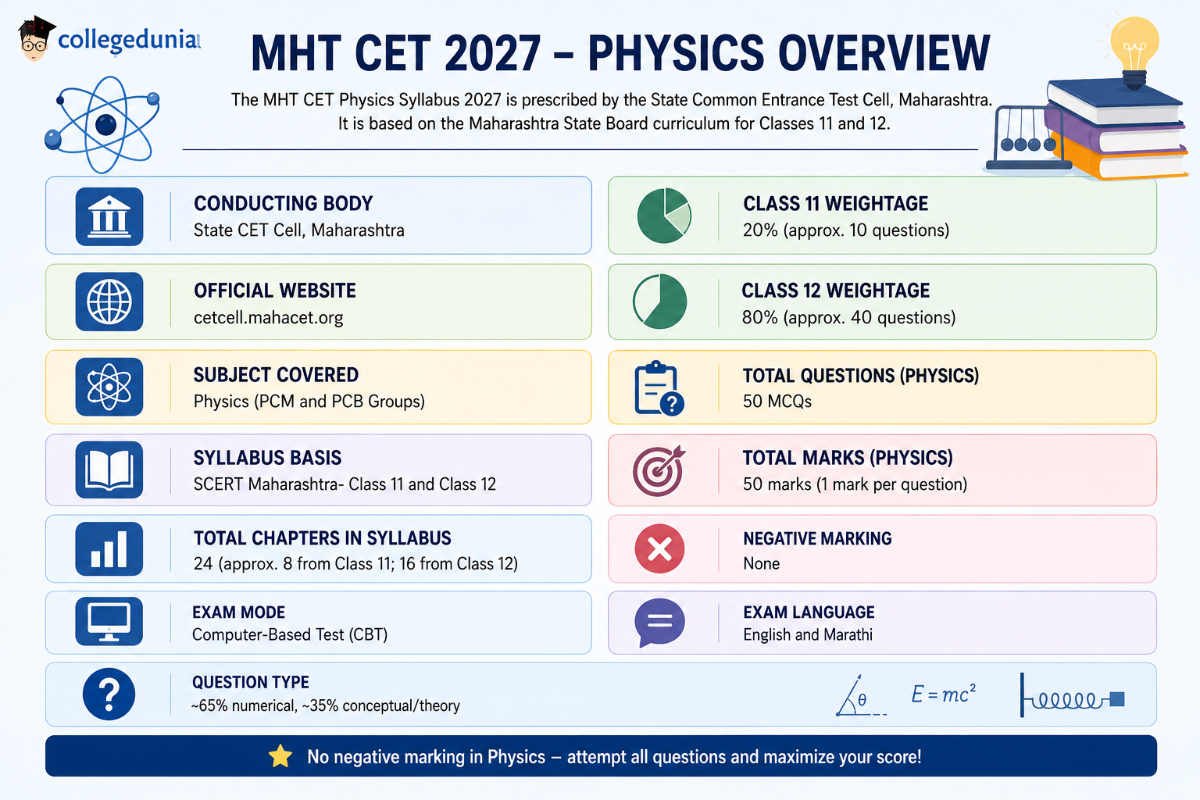
The MHT CET Physics Syllabus 2027 is prescribed by the State Common Entrance Test Cell, Maharashtra. It is based on the Maharashtra State Board curriculum for Classes 11 and 12.
| Parameter | Details |
|---|---|
| Conducting Body | State CET Cell, Maharashtra |
| Official Website | cetcell.mahacet.org |
| Subject Covered | Physics (PCM and PCB Groups) |
| Syllabus Basis | SCERT Maharashtra- Class 11 and Class 12 |
| Class 11 Weightage | 20% (approx. 10 questions) |
| Class 12 Weightage | 80% (approx. 40 questions) |
| Total Questions (Physics) | 50 MCQs |
| Total Marks (Physics) | 50 marks (1 mark per question) |
| Negative Marking | None |
| Total Chapters in Syllabus | 24 (approx. 8 from Class 11; 16 from Class 12) |
| Exam Mode | Computer-Based Test (CBT) |
| Exam Language | English and Marathi |
| Question Type | ~65% numerical, ~35% conceptual/theory |
Related Articles:
- Courses Offered under MHT CET- Colleges, Eligibility, and Future Career Options
- High Weightage Topics in MHT CET- Check 15 Most Repeated Chapters
Ques. What is the MHT CET Physics chapter wise weightage?
Ans. MHT CET Physics weightage prioritises Class 12 topics at roughly 80% (40 questions) and Class 11 topics at 20% (10 questions). Top high-weightage chapters include: Kinetic Theory of Gases and Radiation (12%), Oscillations and Waves (8%) and Atoms, Molecules, and Nuclei (8%).
MHT CET Physics Syllabus 2027
The table below details the chapter list of MHT CET Physics Syllabus for Classes 11 and 12. Candidates are advised to complete the MHT CET Physics Syllabus of Class 12 first as it has 80% weightage.
MHT CET Physics Syllabus Class 11 Topics
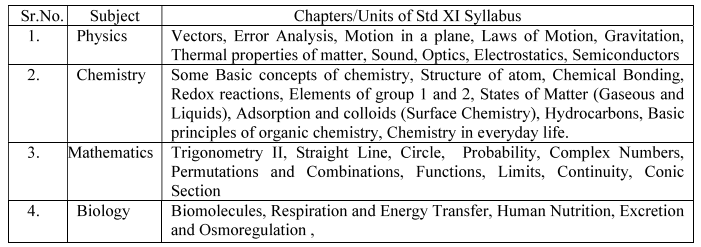
Only select chapters from Class 11 are part of the MHT CET Physics syllabus. These chapters have 20% weightage and can significantly affect your percentile, so do not skip them.
| Chapter | Key Topics |
|---|---|
| Scalars and Vectors | Scalar and vector quantities; addition and subtraction of vectors; resolution of vectors; dot product and cross product; unit vectors; triangle and parallelogram law |
| Motion in a Plane (Kinematics) | Equations of motion; projectile motion; circular motion (uniform and non-uniform); relative velocity; motion along a curved path |
| Laws of Motion | Newton's three laws; linear momentum; impulse; conservation of momentum; friction (static, kinetic, rolling); banking of roads; pseudo force |
| Gravitation | Newton's law of gravitation; acceleration due to gravity (g) and its variation; gravitational potential energy; escape velocity; orbital velocity; satellites; Kepler's laws |
| Thermal Properties of Matter | Thermal expansion (linear, area, volume); specific heat capacity; calorimetry; change of state; latent heat; heat transfer (conduction, convection, radiation); Newton's law of cooling |
| Sound (Waves) | Wave motion; transverse and longitudinal waves; speed of sound; superposition of waves; stationary waves; vibrations in strings and air columns; resonance; Doppler effect |
| Optics | Basic ray optics and refraction of light principles |
| Electrostatics and Semiconductors | Semiconductor physics and electronic basics, Field Concepts |
Source: cetcell.mahacet.org
MHT CET Physics Syllabus Class 12 Topics
MHT CET Class 12 Physics chapters contribute approximately 80% of the Physics paper and include the most numerically intensive and conceptually rich topics.
| Chapters | Topics |
|---|---|
| Rotational Dynamics | Moment of inertia; theorems of parallel and perpendicular axes, Angular momentum; torque; conservation of angular momentum, Rolling motion; rotational kinetic energy; equations of rotational motion, Centre of mass; equilibrium of rigid bodies |
| Mechanical Properties of Fluids | Pressure in fluids; Pascal's law; Archimedes' principle; buoyancy, Surface tension; surface energy; angle of contact; capillarity, Viscosity; Stokes' law; terminal velocity; streamline and turbulent flow, Bernoulli's theorem and its applications |
| Kinetic Theory of Gases and Radiation | Kinetic theory of gases; assumptions; pressure of a gas; RMS speed; mean speed, Degrees of freedom; law of equipartition of energy; specific heats (Cv and Cp), mean free path; Avogadro's number, Thermal radiation; black body radiation; Stefan's law; Wien's displacement law; Newton's law of cooling |
| Thermodynamics | Thermal equilibrium; zeroth law; first law of thermodynamics; internal energy, Isothermal, adiabatic, isochoric, and isobaric processes, Second law; heat engines; Carnot engine; refrigerator; efficiency and COP, Entropy (qualitative understanding) |
| Oscillations | Simple Harmonic Motion (SHM) definition, equations, and characteristics, Displacement, velocity, acceleration, and energy in SHM, Simple pendulum; spring-mass system; angular SHM, Damped oscillations; forced oscillations; resonance |
| Superposition of Waves | Principle of superposition; formation of stationary waves, Vibrations in strings (fundamental mode and harmonics), Vibrations in open and closed pipes, Beats; Doppler effect (revisited at Class 12 level) |
| Wave Optics | Huygens' principle; reflection and refraction using wave theory, Interference of light; Young's double slit experiment (YDSE); fringe width; conditions for bright and dark fringes, Diffraction; single slit diffraction; diffraction grating, Polarisation; Malus's law; Brewster's law; polaroids |
| Electrostatics | Coulomb's law; electric field and field lines; superposition principle, Electric potential and potential difference; equipotential surfaces, Electric flux; Gauss's law and its applications, Capacitor; capacitance; parallel plate capacitor; dielectrics; energy stored in a capacitor; combination of capacitors |
| Current Electricity | Electric current; drift velocity; Ohm's law; resistance; resistivity and conductivity, Colour coding of resistors; temperature dependence of resistance, EMF and internal resistance; cells in series and parallel; Kirchhoff's laws, Wheatstone bridge; metre bridge; potentiometer and its applications |
| Magnetic Effects of Electric Current | Biot-Savart law; magnetic field due to a straight wire, circular loop, solenoid, and toroid, Force on a moving charge in a magnetic field; Lorentz force; cyclotron, Force on a current-carrying conductor; torque on a current loop, Moving coil galvanometer; conversion to ammeter and voltmeter |
| Magnetism | Magnetic dipole moment; bar magnet as a magnetic dipole, Earth's magnetism; magnetic elements; declination, dip, and horizontal component, Dia-, para-, and ferromagnetic materials; Curie's law; hysteresis, Permanent magnets and electromagnets |
| Electromagnetic Induction | Faraday's laws of electromagnetic induction; Lenz's law, Motional EMF; eddy currents and their applications, Self-inductance; mutual inductance; coefficient of coupling, Energy stored in an inductor; transformers |
| AC Circuits | Alternating EMF and current; RMS and peak values; phasor diagrams, Purely resistive, inductive, and capacitive circuits; impedance, Series LCR circuit; resonance; quality factor; power in AC circuits; power factor, LC oscillations; choke coil |
| Dual Nature of Radiation and Matter | Photoelectric effect; Einstein's photoelectric equation; work function; threshold frequency, de Broglie hypothesis; matter waves; de Broglie wavelength, Davisson-Germer experiment; Heisenberg uncertainty principle |
| Structure of Atoms and Nuclei | Bohr's model of the hydrogen atom; energy levels; spectral series; atomic nucleus; protons and neutrons; mass defect; binding energy per nucleon; nuclear reactions; fission and fusion; radioactivity; alpha, beta, gamma decayHalf-life; decay constant; radioactive decay law |
| Semiconductor Devices | Energy bands in solids; conductors, insulators, and semiconductors, Intrinsic and extrinsic semiconductors; p-type and n-type, p-n junction diode; forward and reverse bias; I-V characteristics; rectifier circuits (half-wave and full-wave), Zener diode; LED; photodiode; solar cell (brief introduction), Transistor (n-p-n and p-n-p); transistor as an amplifier and switch; logic gates (AND, OR, NOT, NAND, NOR) |
Watch the video to know the complete list of the syllabus for MHT CET 2027 by Pradeep Giri Sir for PCM and PCB students;
Related Article: MHT CET Chapter Wise Weightage: Most Important Chapters & High Scoring Topics
Ques. How to get 99.99 percentile in MHT CET?
Ans. Candidates who are thorough with the Maharashtra State textbooks of Class 11 and 12, practice mock tests regularly, follow a disciplined study plan, maintain error logs, and master numerical formulas will score 99.99 percentile in MHT CET.
MHT CET Physics Syllabus 2027: Chapter-Wise Weightage
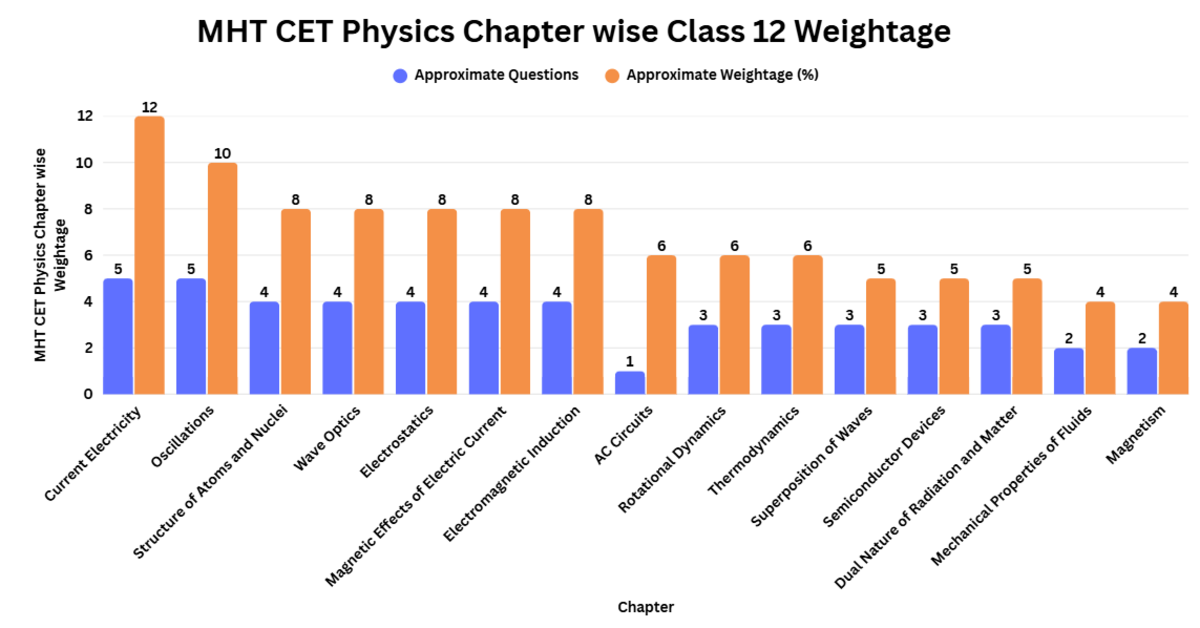
The table below is based on previous year trends and expert analysis. The official CET Cell does not publish exact MHT CET Physics chapter wise weightage, but these percentages reflect consistent patterns observed across multiple years.
MHT CET Physics Chapter-Wise Weightage Class 12
| Chapter | Approximate Questions | Approximate Weightage (%) |
|---|---|---|
| Kinetic Theory of Gases and Radiation | 4-5 | 10-12% |
| Current Electricity | 4-5 | 8-10% |
| Oscillations | 3-4 | 7-8% |
| Structure of Atoms and Nuclei | 3-4 | 7-8% |
| Wave Optics | 3-4 | 6-8% |
| Electrostatics | 3-4 | 6-8% |
| Magnetic Effects of Electric Current | 3-4 | 6-8% |
| Electromagnetic Induction | 2-3 | 5-6% |
| AC Circuits | 2-3 | 5-6% |
| Rotational Dynamics | 2-3 | 4-6% |
| Thermodynamics | 2-3 | 4-6% |
| Superposition of Waves | 2-3 | 4-5% |
| Semiconductor Devices | 2-3 | 4-5% |
| Dual Nature of Radiation and Matter | 2-3 | 4-5% |
| Mechanical Properties of Fluids | 1-2 | 2-4% |
| Magnetism | 1-2 | 2-4% |
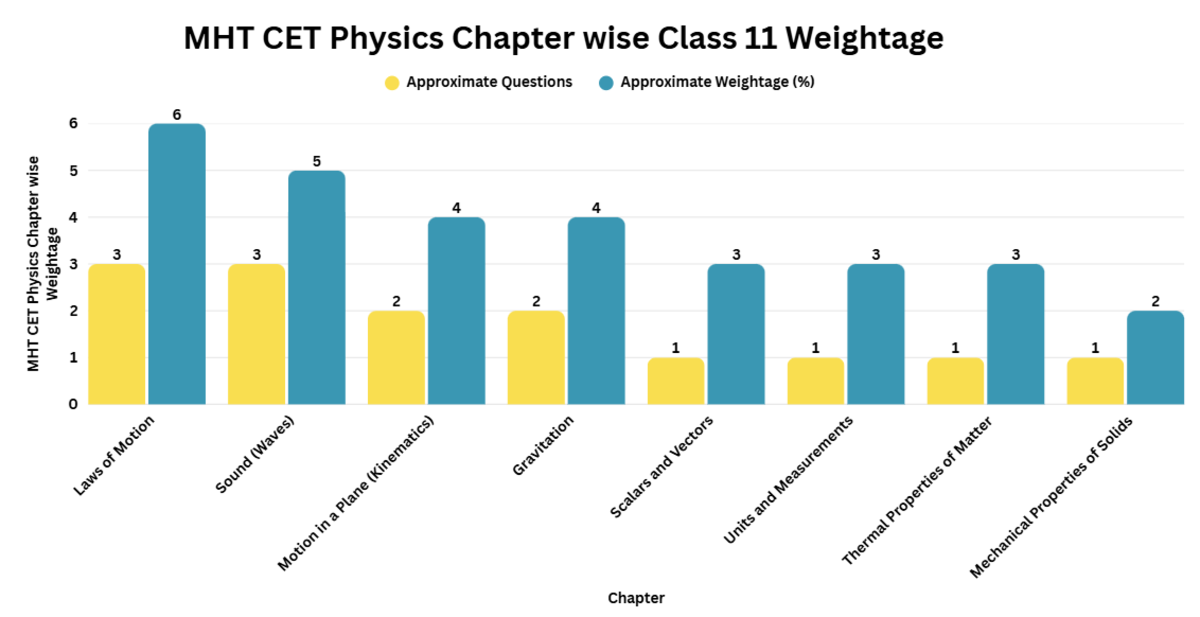
MHT CET Physics Chapter-Wise Weightage Class 11
| Chapter | Approximate Questions | Approximate Weightage (%) |
|---|---|---|
| Laws of Motion | 2-3 | 4-6% |
| Sound (Waves) | 2-3 | 4-5% |
| Motion in a Plane (Kinematics) | 2 | 3-4% |
| Gravitation | 1-2 | 3-4% |
| Scalars and Vectors | 1 | 2-3% |
| Units and Measurements | 1 | 2-3% |
| Thermal Properties of Matter | 1 | 2-3% |
| Mechanical Properties of Solids | 1 | 1-2% |
Also Read: MHT CET: Physics Chapters That Carry the Most Weight
Ques. Is 40,000 a good rank in MHT CET?
Ans. No, 40000 is not a good rank in MHT CET. You will not get CSE specializations at any top colleges. You have a strong chance of securing mid-tier private colleges in core and allied engineering courses.
Must Do Chapters of MHT CET Physics to Score 99 Percentile
The must do chapters of MHT CET Maths to score 99 percentile in the Physics section are listed below:
| Must Do Chapters of MHT CET Physics 2027 | |
|---|---|
| Rotational Dynamics | Wave Optics |
| Electrostatics | Atoms, Molecules and Nuclei |
| Current Electricity | Motion in a Plane |
| Gravitation | Optics |
| Electrostatics | Gravitation |
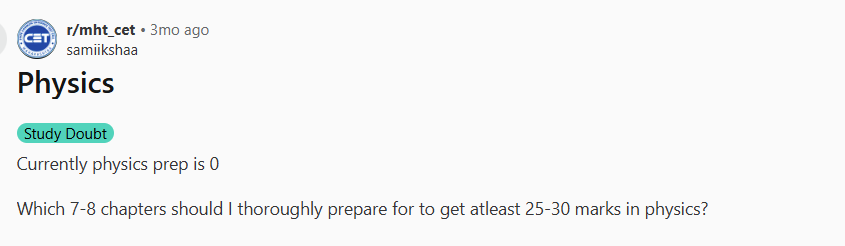
According to a Reddit post, a user wanted to know what chapters should be studied to score 25- 30 marks in MHT CET Physics.
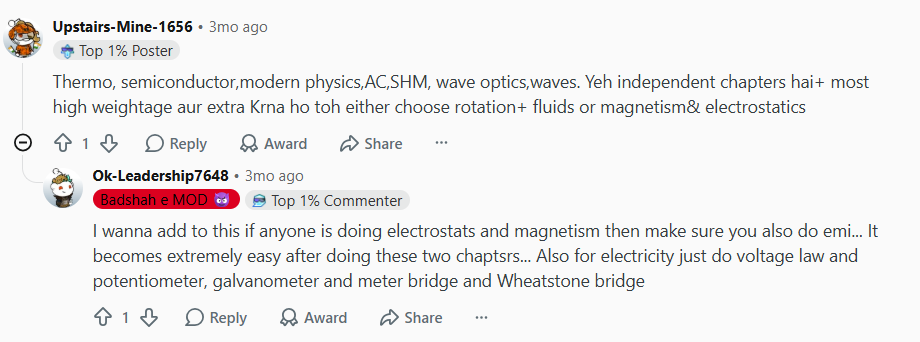
Based on the discussion, a user commented to study thermodynamics, semiconductors, modern physics, AC, SHM, and wave optics, as these are independent chapters with high weightage. If he/she wants to study extra chapters, choose rotation, fluids or magnetism and electrostatics. Pair EMI with electrostatics and magnetism as it becomes easy to cover after completing the latter chapters.
Source: Reddit
Related Article: How to Prepare for MHT CET Physics?
Ques. Can I get COEP with 99.5 percentile in MHT CET?
Ans. Yes, with 99.5 percentile in MHT CET you will get admission to COEP college in core engineering or allied courses. CSE will be available for reserved category candidates.
MHT CET Physics Most Important Topics
Based on previous year papers and expert analysis, the table below lists the most important topics.
Follow this table of MHT CET Physics important topics based on priority order to score maximum marks out of 50.
| Topic Cluster | Most Important Sub-Topics | Priority |
|---|---|---|
| Current Electricity | Kirchhoff's laws, Wheatstone bridge, potentiometer, internal resistance and EMF problems | Very High |
| Kinetic Theory and Radiation | Ideal gas equation, RMS speed, specific heats ratio (γ), Stefan's law, Wien's law | Very High |
| Oscillations | SHM equations, time period of spring-mass system, energy in SHM, resonance | Very High |
| Structure of Atoms and Nuclei | Bohr's model, energy levels, radioactive decay, half-life, binding energy | Very High |
| Electrostatics | Gauss's law applications, capacitor energy, parallel plate capacitor, dielectrics | High |
| Wave Optics | YDSE fringe width, conditions for interference, single slit diffraction, Malus's law | High |
| Magnetic Effects | Biot-Savart law, force on current-carrying conductor, moving coil galvanometer | High |
| Electromagnetic Induction | Faraday's laws, Lenz's law, motional EMF, self-inductance, mutual inductance | High |
| AC Circuits | Series LCR resonance, power factor, impedance, phasor diagrams | High |
| Laws of Motion (Class 11) | Newton's laws applications, friction problems, banking of roads, pseudo force | High |
| Semiconductor Devices | p-n junction diode, rectifier circuits, Zener diode, logic gates, transistor as amplifier | Moderate |
| Dual Nature of Radiation | Einstein's photoelectric equation, de Broglie wavelength, Davisson-Germer experiment | Moderate |
Watch the video by PW MHT CET to know the top 10 most important chapters for MHT CET Physics:
Related Articles:
- How to Attempt 150 MHT CET Questions Without Losing Accuracy
- MHT CET Paper Analysis: PCM Exam, Shift-wise Analysis, Difficulty Level, & Subject-wise Weightage
Ques. What is a good score in MHT CET Physics?
Ans. A good score in MHT CET Physics (out of 50 marks) is generally 35 to 40+ marks, which helps secure a high overall percentile for top engineering and pharmacy colleges.
Best Books for MHT CET Physics 2027
You should start preparation with Maharashtra State Board SCERT textbooks and supplement them with the following reference books recommended by toppers and subject experts.
| Book Name | Author / Publisher | Why Useful |
|---|---|---|
| MCQ Physics for MHT CET | A. J. Bapat- Marvel Publications | Comprehensive MCQ bank with chapter-wise questions; directly aligned with SCERT Maharashtra topics and CET paper style |
| Complete Reference Manual MH-CET Physics | M. K. Dikshit- Arihant Publications | Strong theory coverage with shortcuts; useful for both concept building and numerical problem practice |
| Concepts of Physics- Volumes 1 and 2 | H. C. Verma- Bharati Bhawan | Best for building strong conceptual understanding in Mechanics, Electrostatics, and Modern Physics; ideal for numerical depth beyond board level |
| MHT CET Physics (Class 12) | Marvel Publications | Exam-focused MCQ practice for all Class 12 chapters; includes topic-wise tests and full-length model papers |
| Physics Class 11 and 12 (SCERT Maharashtra Board) | Maharashtra State Bureau of Textbook Production and Curriculum Research | The primary and most authoritative source; CET questions are closely based on textbook exercises and examples |
| 27 Years MHT CET Physics Previous Solved Papers | Target Publications | Analysing past papers reveals frequently repeated question types; builds familiarity with CET's numerical style |
Related Article: MHT CET Books 2027: Best Books for Physics, Chemistry, Maths and Biology
Ques. What books should I follow for MHT CET Physics Syllabus 2027?
Ans. Start with SCERT Maharashtra Class 11 and 12 Physics textbooks. Then use MCQ Physics for MHT CET by A. J. Bapat (Marvel Publications) and Complete Reference Manual MH-CET Physics by M. K. Dikshit (Arihant). For concept depth, refer to Concepts of Physics by H. C. Verma (Volumes 1 and 2).
MHT CET Physics Syllabus 2027 vs Previous Year
The MHT CET 2027 syllabus for Physics is expected to remain the same as 2026. No official revision has been announced by the State CET Cell.
The table below shows the status of each chapter compared to the previous year.
| Chapter / Topic | Status (2026 vs 2027) |
|---|---|
| Units and Measurements (Cl 11) | Unchanged |
| Scalars and Vectors (Cl 11) | Unchanged |
| Motion in a Plane / Kinematics (Cl 11) | Unchanged |
| Laws of Motion (Cl 11) | Unchanged |
| Gravitation (Cl 11) | Unchanged |
| Mechanical Properties of Solids (Cl 11) | Unchanged |
| Thermal Properties of Matter (Cl 11) | Unchanged |
| Sound / Waves (Cl 11) | Unchanged |
| Rotational Dynamics (Cl 12) | Unchanged |
| Mechanical Properties of Fluids (Cl 12) | Unchanged |
| Kinetic Theory of Gases and Radiation (Cl 12) | Unchanged |
| Thermodynamics (Cl 12) | Unchanged |
| Oscillations (Cl 12) | Unchanged |
| Superposition of Waves (Cl 12) | Unchanged |
| Wave Optics (Cl 12) | Unchanged |
| Electrostatics (Cl 12) | Unchanged |
| Current Electricity (Cl 12) | Unchanged |
| Magnetic Effects of Electric Current (Cl 12) | Unchanged |
| Magnetism (Cl 12) | Unchanged |
| Electromagnetic Induction (Cl 12) | Unchanged |
| AC Circuits (Cl 12) | Unchanged |
| Dual Nature of Radiation and Matter (Cl 12) | Unchanged |
| Structure of Atoms and Nuclei (Cl 12) | Unchanged |
| Semiconductor Devices (Cl 12) | Unchanged |
Note: Always cross-verify with the official MHT CET 2027 syllabus PDF once released at cetcell.mahacet.org, as the State CET Cell may revise topics without prior announcement.
Related Article: MHT CET Exam Pattern 2027: Marking Scheme, Subject Weightage and Difficulty Level
Ques. Which are the easiest chapters in MHT CET Physics 2027?
Ans. Mathematical Logic does not apply to Physics, but the most directly scorable chapters are Semiconductor Devices (logic gates), Dual Nature of Radiation (photoelectric effect formula), Units and Measurements, and Scalars and Vectors. These are formula-based and require minimal deep understanding to score full marks.
How to Download MHT CET Physics Syllabus 2027 PDF
Follow these steps to download the official MHT CET Physics syllabus PDF from the State CET Cell's website.
- Step 1: Visit the official website at cetcell.mahacet.org.
- Step 2: Look for the "MHT CET 2027" section or the "Syllabus / Information Brochure" link on the homepage or under the latest notifications tab.
- Step 3: Click on the syllabus link. A PDF file will open in a new browser tab.
- Step 4: Press Ctrl + S (Windows) or Cmd + S (Mac) to save the file to your device.
- Step 5: Alternatively, click the download icon in your PDF viewer to save the file locally.
Note: The official MHT CET 2027 syllabus PDF is not yet released.
Related Article: MHT CET 2027 Exam Date: Expected Schedule, PCM and PCB Session Dates and Registration
Ques. Is Wave Optics important for MHT CET Physics 2027?
Ans. Yes, Wave Optics is a high-weightage Class 12 chapter in MHT CET Physics. Young's Double Slit Experiment (YDSE), fringe width calculations, single slit diffraction, and Malus's law for polarisation are asked frequently. You should dedicate at least 3-4 days to mastering Wave Optics numericals.
MHT CET Physics Syllabus Preparation Tips 2027
Electricity and Magnetism (Current Electricity, Electrostatics, Magnetic Effects, EMI, AC)
- This cluster of five chapters together contributes 30-35% of the Physics paper, so treat it as your highest-priority zone.
- Master Kirchhoff's laws and Wheatstone bridge derivations; these appear in almost every CET shift.
- For Electrostatics, practise all numerical forms of Gauss's law (sphere, cylinder, plane)
- Electromagnetic Induction numerical problems often combine Faraday's law with energy conservation so practise both together.
- Series LCR resonance and power factor questions in AC Circuits are highly repetitive, so solve at least 30 such problems before the exam.
Kinetic Theory, Thermodynamics, and Oscillations
- Kinetic Theory of Gases has the highest single-chapter weightage in Physics; do not leave it incomplete.
- Memorise the ratios of specific heats and their derivations from equipartition.
- For Thermodynamics, focus on work done in different processes and efficiency of Carnot engine word problems.
- SHM problems in Oscillations are largely formula-based so systematic formula revision over 2-3 days can yield 3-4 marks directly.
Modern Physics (Atoms, Nuclei, Dual Nature, Semiconductors)
- Together, these four chapters contribute 20-25% of the Physics paper and are relatively conceptual.
- Bohr's model numerical problems (energy levels, frequency, wavelength of emitted photon) are asked in every attempt, so practise all hydrogen atom transitions.
- Radioactive decay problems are direct and highly scoring, so master the decay equations.
- Logic gates are easy 1-mark questions, so spend one day on them and secure those marks.
Mechanics and Waves (Class 11 and Class 12)
- Laws of Motion and Rotational Dynamics together can yield 5-7 marks, so focus on friction, banking, moment of inertia, and angular momentum conservation.
- Wave Optics is a high-scoring Class 12 chapter. Always solve for fringe width, path difference, and angular fringe width formula questions.
- Sound and Superposition of Waves from Class 11 and 12 test stationary waves and beats
- For Gravitation (Class 11), focus on orbital velocity, escape velocity, and satellite time-period derivations.
Ques. How should I complete the full MHT CET Physics syllabus in 5 months?
Ans. Divide preparation into three phases. First, cover all Class 12 Physics chapters (Months 1-3) starting with Electricity and Magnetism, followed by Modern Physics and Mechanics. Second, complete Class 11 chapters with focus on Laws of Motion, Sound, and Gravitation (Month 4). Third, revise chapter-wise, solve previous year papers, and take full-length mock tests (Months 5).
Related Articles:
MHT CET Physics Syllabus 2027 FAQs
Ques. Is the MHT CET 2027 Physics syllabus the same as 2026?
Ans. The MHT CET 2027 Physics syllabus is expected to remain unchanged from 2026. No official revision has been announced by the State CET Cell. Always confirm from the official notification at cetcell.mahacet.org once released.
Ques. How many chapters are there in MHT CET Physics 2027?
Ans. The MHT CET Physics syllabus covers approximately 24 chapters in total — around 8 from Class 11 and 16 from Class 12 of the SCERT Maharashtra curriculum.
Ques. Which chapter has the highest weightage in MHT CET Physics 2027?
Ans. Kinetic Theory of Gases and Radiation carries the highest single-chapter weightage at approximately 10-12%, followed by Current Electricity and Oscillations at 8-10% each. The Electricity and Magnetism cluster (5 chapters combined) contributes 30-35% of the Physics paper.
Ques. How many questions are asked from Class 11 in MHT CET Physics?
Ans. Approximately 10 out of 50 questions (20% weightage) are from Class 11 Physics chapters. Key Class 11 chapters include Laws of Motion, Gravitation, Kinematics, Sound, Scalars and Vectors, and Thermal Properties of Matter.
Ques. Where can I download the MHT CET 2027 Physics syllabus PDF?
Ans. The official syllabus PDF is released at cetcell.mahacet.org. The 2027 PDF is not yet available. Check the official website regularly after the notification is expected around November-December 2026.
Ques. Is NCERT enough for MHT CET Physics 2027?
Ans. NCERT alone is not sufficient. MHT CET Physics is based on the SCERT Maharashtra State Board syllabus, not NCERT. You must study from Maharashtra State Board Class 11 and 12 Physics textbooks. NCERT can supplement concept clarity in topics like Modern Physics and Thermodynamics, but SCERT textbooks are the primary source.
Ques. What is the difficulty level of MHT CET Physics compared to JEE Main?
Ans. MHT CET Physics is slightly easier than JEE Main. However, the State CET Cell states that the difficulty level of Physics in MHT CET is at par with JEE Main. The key difference is that CET questions are more formula-application-based and less conceptually abstract than JEE Main questions.
Ques. What percentage of MHT CET Physics questions are numerical?
Ans. Around 65% of MHT CET Physics questions are numerical-based. The remaining 35% are conceptual or theory-based. Chapters like Current Electricity, Electrostatics, Kinetic Theory, and Oscillations are almost entirely numerical.



Comments
Found 1 Comment
Physics in MHT CET can be challenging for some students. It covers a wide range of topics, including mechanics, thermodynamics, electromagnetism, optics, and modern physics. Understanding fundamental concepts and practicing problem-solving are essential. While some find certain topics easier, others may struggle. Regular practice, solving previous years’ papers, and time management during the exam are crucial. A positive mindset and consistent effort can help overcome challenges.