




The NEET PG Exam Pattern 2027 is expected to follow the updated format of 180 MCQs carrying 720 marks, with the examination conducted for 3 hours 30 minutes. The NEET PG Exam pattern 2027 is divided into 5 sections of 36 questions each, with 42 minutes allotted to every section.
- Medicine usually accounts for around 12–15% with Cardiology, Neurology, Respiratory Medicine and Gastroenterology among important topics.
- Surgery contributes around 10–12% with Trauma, Acute Abdomen, GI Surgery, Breast and Thyroid among high-weightage topics in the NEET PG exam.
- OBG accounts for nearly 7–9% with high-risk pregnancy, PPH, pre-eclampsia, ectopic pregnancy and infertility among key NEET PG topics.
- Pathology and PSM may each contribute around 8–10% and 5–7% in the NEET PG exam with Neoplasia, Haematology, Epidemiology and Biostatistics among important areas.
- Pharmacology and Microbiology carry around 8–10% and 5–7% with drug mechanisms, antimicrobials, Bacteriology and Virology among high-yield topics.
- Candidates get an average of 70 seconds per question in each 36 question section, which makes section-wise time management important.
Related Links:
- NEET PG Syllabus: Revised, Subject-Wise Topics, Weightage and PDF Download
- NEET PG Exam Chapter Wise Weightage: Check Subject Wise Number of Questions, Marks, High Weightage Topics
- NEET PG Exam Analysis - Check Subject-wise Analysis, Difficulty Level
Key Summary
- Clinical and image-based questions are expected to remain important with ECGs, X-rays and histology among the image-based areas.
- Medicine, Surgery and OBG are expected to form a major share of the NEET PG 2027 subject-wise weightage.
- The 2026 revision reduced questions from 200 to 180 while keeping the overall exam duration at 210 minutes.
- Single best response MCQs with four options are expected in the NEET PG 2027 question paper.
- General Medicine is estimated at 40–45 questions giving it one of the largest subject-wise shares in the paper.
- General Surgery is estimated at around 40 questions including related areas such as Orthopaedics, Anaesthesia and Radiology.
NEET PG Exam Pattern 2027: Overview
NEET PG Exam Pattern 2027 is expected to follow the 180-question format after the reduction from 200 questions in 2026.
- The 210-minute exam duration in the NEET PG Exam pattern 2027 gives candidates around 70 seconds per question under the reduced question count.
- The single-shift CBT format means candidates are expected to face the same question paper without multi-shift score normalisation in the NEET PG exam.
- Each section in the NEET PG exam pattern 2027 has a 42-minute time limit after which candidates cannot return to the completed section.
- The fixed sectional timing makes time management across all five sections an important part of the NEET PG exam pattern 2027.
| Particulars | Details |
|---|---|
| Exam Name | National Eligibility cum Entrance Test – Postgraduate (NEET PG) 2027 |
| Conducting Body | National Board of Examinations in Medical Sciences (NBEMS) |
| Exam Mode | Computer-Based Test (CBT) |
| Exam Shift | Single Shift |
| Language / Medium | English only |
| Total Questions | 180 Multiple Choice Questions (MCQs) |
| Total Marks | 720 |
| Exam Duration | 3 hours 30 minutes (210 minutes) |
| Number of Sections | 5 time-bound sections (Group A, B, C, D & E) |
| Questions per Section | 36 |
| Time per Section | 42 minutes (strict; no going back to previous section) |
| Type of Questions | Single best response MCQs (4 options each) |
| Marking Scheme | +4 for correct answer−1 for incorrect answer0 for unattempted |
| Syllabus | MBBS curriculum as prescribed by NMC |
NEET PG Exam Pattern: Key Analysis
- The revised NEET PG Exam pattern makes time management more important with 36 questions to be attempted within each 42-minute section.
- Clinical-based questions may have greater importance while image-based and video-based questions can add another layer to question interpretation. These remain trend-based observations not an official NBEMS blueprint.
- Subject-wise questions are not confined to specific sections. The 19 MBBS subjects are distributed across all five sections so candidates cannot prepare for each section by subject alone.
- The reduction from 200 to 180 questions gives about 70 seconds per question in the latest format. The 210-minute duration remains unchanged, making the revised structure less volume-heavy.
Candidates can check out this video on YouTube for more information:
Also Read:
- NEET PG Exam Preparation Tips, Important Topics, And Recommended Books
- NEET PG Question Papers: 2010 to 2025 PDFs Free Download with Solutions and Answer Key
Ques. What are the latest updates on NEET PG 2027?
Ans. As of now, NBEMS has not released the official NEET PG 2027 notification or exam schedule. The latest confirmed update is for NEET PG 2026, which is scheduled for August 30, 2026.
NEET PG Exam Pattern: Year-wise Changes
The NEET PG Exam Pattern has changed significantly across the last few exam cycles. The major changes have been in the number of questions, total marks and section-wise timing.
1) 300 Question Format: Up to 2020
- NEET PG Exam Pattern 2020 included 300 Multiple Choice Questions carrying a total of 1200 marks with the duration of the examination being 3.5 Hours.
2) 200 Question Format: 2021–2023
- The new NEET PG Exam pattern in 2021 has seen a reduction in the number of questions from 300 to 200 and in the maximum marks from 1,200 to 800.
3) Time-Bound Section Format: 2024 Onwards
- NBEMS introduced mandatory time bound sections for the NEET PG exam pattern 2024. The five section format had 40 questions and 42 minutes per section. Candidates could not return to a completed section.
- The 2026 revision reduced the paper to 180 questions and each section contains 36 questions with a 42 minute sectional limit and the 210-minute exam duration remains unchanged.
| Year / Period | Total Questions | Total Marks | Sections | Time per Section | Duration | Marking Scheme | Key Changes / Notes |
|---|---|---|---|---|---|---|---|
| Up to 2020 | 300 | 1200 | No sectional lock | — | 3.5 hours | +4 / −1 | Traditional format; higher question volume |
| 2021 – 2023 | 200 | 800 | No strict sectional lock | — | 3.5 hours | +4 / −1 | Major reduction from 300 to 200 questions |
| 2024 – 2025 | 200 | 800 | 5 sections (40 Qs each) | 42 minutes | 3.5 hours | +4 / −1 | Time-bound sections introduced (Groups A–E) |
| 2026 | 180 | 720 | 5 sections (36 Qs each) | 42 minutes | 3.5 hours | +4 / −1 | Questions cut by 20; more time per question (~70 sec) |
| 2027 (Expected) | 180 | 720 | 5 sections (36 Qs each) | 42 minutes | 3.5 hours | +4 / −1 | Likely continuation of 2026 pattern (subject to official bulletin) |
Ques. Is NEET PG more difficult than NEET?
Ans. Yes. NEET PG is generally considered more difficult than NEET UG because it tests the entire MBBS syllabus and includes more clinical, application-based and case-based questions.
According to a Reddit discussion, candidates discussed the NEET PG 2026 revised format of 180 questions, with concerns about managing lengthy questions within the available time. The discussion viewed the additional 5 minutes and 20 fewer questions positively while also highlighting concerns about test-centre facilities and preparation with less than 60 days remaining.
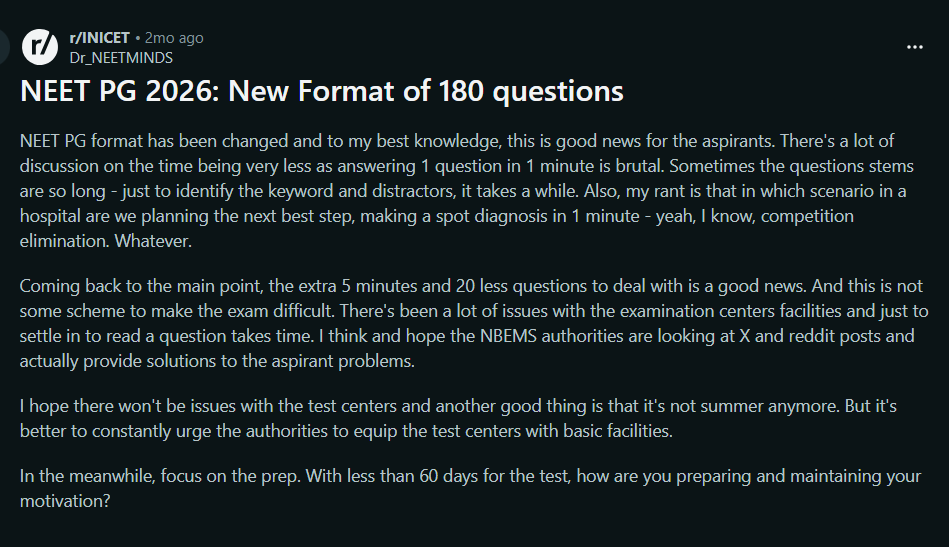
Source: Reddit
Also Read:
NEET PG Exam Pattern 2027: Question Types
NEET PG Exam Pattern 2027 Question Types are expected to include a major share of clinical subjects with Medicine, Surgery and OBG contributing over 80 questions combined.
- Clinical subjects may account for around 45% of the 180 question NEET PG paper, keeping them central to score improvement.
- Image based questions are estimated at 10–15% including questions based on ECGs, X-rays and histology slides.
| Question Type | Approx. Share | Description | Common in Subjects |
|---|---|---|---|
| Direct Recall / Fact-based | 35–40% | Single-fact questions (e.g., drug of choice, anatomical landmark, definition) | Anatomy, Physiology, Biochemistry, Pharmacology, Microbiology |
| Clinical Vignette / Scenario-based | 30–35% | Patient case followed by diagnosis, investigation, or management question | Medicine, Surgery, OBG, Paediatrics |
| Image-based | 10–15% | ECG, X-ray, CT/MRI, histology, fundus, rash, etc. shown on screen | Radiology, Pathology, Ophthalmology, Dermatology, Medicine |
| Comparison-based (“All except”, A vs B) | 10–15% | Differentiate mechanisms, features, drugs, or exceptions | Pharmacology, Pathology, Microbiology |
| Multi-step Reasoning / Application | 5–10% | Calculations, sequence interpretation, or integrated concepts across subjects | Mixed (Clinical + Para-clinical) |
Also Read:
Ques. Is a 20,000 rank good in NEET PG?
Ans. 20,000 is a decent rank in NEET PG and can provide options in several MD/MS branches, depending on category and counselling round. More competitive branches and top government colleges generally require a better rank.
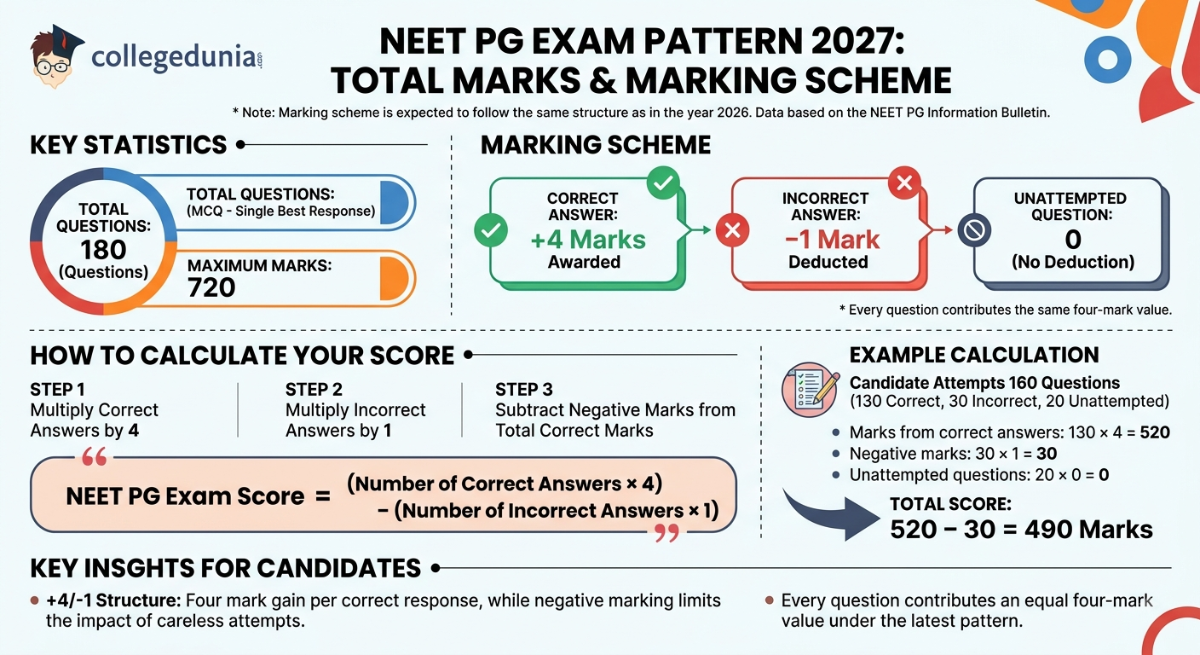
NEET PG Exam Pattern 2027: Total Marks & Marking Scheme
NEET PG Exam Pattern 2027 Marking scheme is expected to follow the same structure as in the year 2026. NEET PG Exam pattern 2027 total marks are expected to be 720 which contains 180 questions.
- Each correct answer will be awarded +4 marks and for incorrect answers, 1 mark will be deducted while for unanswered questions there will be no deduction.
| Question Type | Correct Answer | Incorrect Answer | Unattempted Question | Total Questions | Maximum Marks |
|---|---|---|---|---|---|
| MCQ (Single Best Response) | +4 | −1 | 0 | 180 | 720 |
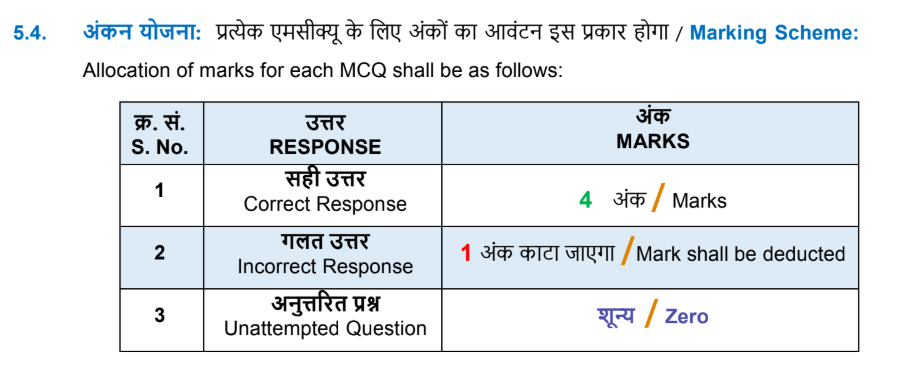
Source: NEET PG Information Bulletin
NEET PG Exam Pattern 2027: Section-Wise Duration and Questions
NEET PG Exam Pattern 2027 Section-Wise duration is expected to give 42 minutes to each of the five sections with no return to a section after its timer ends.
- The 180 question NEET PG paper is expected to have 36 questions in each section with all 19 MBBS subjects covered across Groups A to E.
- Questions from the 19 MBBS subjects are expected to be mixed across the five sections rather than arranged subject-wise.
- The 36 questions per section give candidates nearly 70 seconds per question, around seven seconds more than under the earlier 40 question format.
| Section | Number of Questions | Maximum Marks | Time Allotted | Key Rule |
|---|---|---|---|---|
| Group A | 36 | 144 | 42 minutes | Auto-submit after time ends; no return |
| Group B | 36 | 144 | 42 minutes | Auto-submit after time ends; no return |
| Group C | 36 | 144 | 42 minutes | Auto-submit after time ends; no return |
| Group D | 36 | 144 | 42 minutes | Auto-submit after time ends; no return |
| Group E | 36 | 144 | 42 minutes | Auto-submit after time ends; no return |
| Total | 180 | 720 | 210 minutes | — |
Note: Based on the confirmed 2026 pattern. Official 2027 confirmation will come from NBEMS.
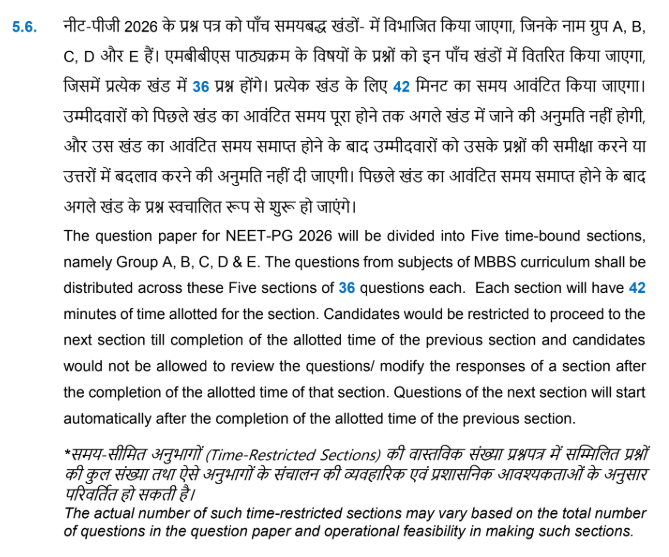
Source: NEET PG Information Bulletin
Also Read:
Ques. What are the 5 sections in NEET PG?
Ans. NEET PG is divided into five time-bound sections — A, B, C, D and E. Each section has 40 questions and 42 minutes are allotted. Candidates cannot return to a section after moving to the next one.
Ques. Can candidates switch between sections in NEET PG?
Ans. No. Once a section's 42-minute window ends, the system automatically advances to the next section, and the completed section cannot be revisited under any circumstances.
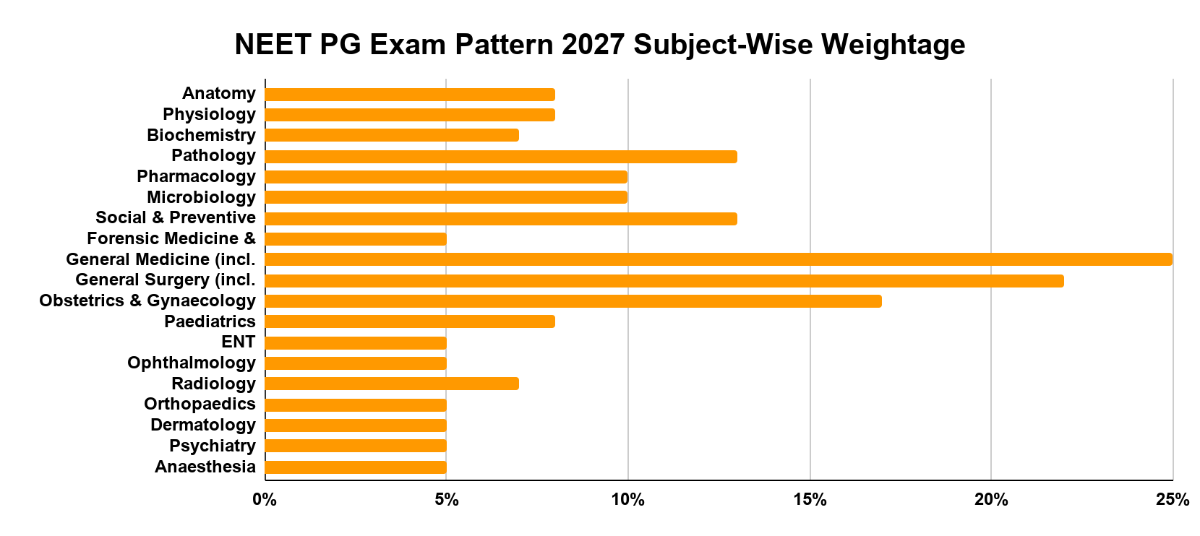
NEET PG Exam Pattern 2027 Subject-Wise Weightage
NEET PG Exam Pattern 2027 Subject-Wise Weightage is expected to give a major share of the paper to clinical subjects with around 70–75 questions.
- Medicine, Surgery and OBG are expected to remain key areas with their combined weightage influencing the overall NEET PG Exam 2027 score.
- General Medicine and General Surgery together may account for up to 85 questions which is nearly half of the estimated 180 questions in NEET PG Exam 2027.
- Pre-clinical subjects are expected to contribute around 40–45 questions in NEET PG Exam 2027 combined under the estimated subject-wise distribution.
- Candidates should give greater preparation time to clinical subjects while covering the remaining MBBS subjects as part of the NEET PG 2027 syllabus.
| Category | Subject | Estimated Questions | Estimated Weightage |
|---|---|---|---|
| Pre-Clinical Subjects (~40-45 Questions Total) | Anatomy | 13 - 15 | 7 – 8% |
| Physiology | 13 - 15 | 7 – 8% | |
| Biochemistry | 11 - 13 | 6 – 7% | |
| Para-Clinical Subjects (~65-70 Questions Total) | Pathology | 22 - 23 | 12 – 13% |
| Pharmacology | 18 | 10% | |
| Microbiology | 18 | 10% | |
| Social & Preventive Medicine (PSM) | 22 - 23 | 12 – 13% | |
| Forensic Medicine & Toxicology (FMT) | 9 | 5% | |
| Clinical Subjects (~70-75 Questions Total) | General Medicine (incl. Derma, Psych) | 40 - 45 | 22 – 25% |
| General Surgery (incl. Ortho, Anaesth, Radio) | 40 | 22% | |
| Obstetrics & Gynaecology | 27 - 31 | 15 – 17% | |
| Paediatrics | 13 - 14 | 7 – 8% | |
| ENT | 9 | 5% | |
| Ophthalmology | 9 | 5% | |
| Radiology | 10 - 13 | 6 – 7% | |
| Orthopaedics | 9 | 5% | |
| Dermatology | 7 - 9 | 4 – 5% | |
| Psychiatry | 7 - 9 | 4 – 5% | |
| Anaesthesia | 7 - 9 | 4 – 5% | |
| Total | - | 180 | 720 |
NEET PG Exam Pattern: Subject-Wise Question Distribution Trend (2020-2025)
| Subject | 2020 | 2021 | 2022 | 2023 | 2024 (Shift 1) | 2024 (Shift 2) | 2025 |
|---|---|---|---|---|---|---|---|
| Anatomy | 17 | 7 | 5 | 8 | 7 | 16 | 9 |
| Physiology | 17 | 5 | 6 | 9 | 6 | 6 | 5 |
| Biochemistry | 16 | 12 | 10 | 15 | 14 | 9 | 15 |
| Microbiology | 20 | 11 | 12 | 13 | 8 | 8 | 12 |
| Pathology | 25 | 15 | 10 | 12 | 16 | 21 | 12 |
| Pharmacology | 20 | 16 | 15 | 12 | 8 | 18 | 15 |
| Forensic Medicine | 10 | 10 | 8 | 8 | 9 | 4 | 6 |
| Community Medicine | 25 | 17 | 12 | 15 | 22 | 15 | 16 |
| Ophthalmology | 10 | 8 | 6 | 8 | 11 | 8 | 5 |
| ENT | 10 | 6 | 9 | 6 | 11 | 6 | 5 |
| Medicine | 28 | 21 | 23 | 17 | 17 | 17 | 19 |
| Surgery | 27 | 18 | 25 | 27 | 15 | 12 | 18 |
| Obstetrics and Gynaecology | 30 | 19 | 25 | 18 | 19 | 20 | 20 |
| Pediatrics | 10 | 8 | 14 | 10 | 7 | 8 | 6 |
| Anaesthesia | 4 | 5 | 2 | 3 | 5 | 5 | 4 |
| Dermatology | 8 | 6 | 7 | 4 | 5 | 5 | 5 |
| Psychiatry | 9 | 5 | 2 | 5 | 6 | 6 | 6 |
| Orthopaedics | 6 | 5 | 7 | 6 | 8 | 7 | 5 |
| Radiology | 8 | 6 | 2 | 4 | 6 | 9 | 5 |
Source: YouTube
Also Read:
Ques. Which subject has more weightage in NEET PG?
Ans. General Medicine and General Surgery generally have the highest weightage in NEET PG, followed by Obstetrics & Gynaecology, Pathology, PSM and Pharmacology. NBEMS does not release an official subject-wise weightage, so these figures are based on previous-year trends.
How to Calculate NEET PG Exam 2027 Score:
Candidates can calculate the NEET PG Exam 2027 score by multiplying the number of correct answers by the marks awarded for each correct response. The negative marks are then subtracted from the marks earned for correct answers.
Formula:
NEET PG Exam Score = (Number of Correct Answers × 4) - (Number of Incorrect Answers x 1)
Example:
Suppose a candidate attempts 160 questions with 130 correct and 30 incorrect responses.
- Marks from correct answers: 130 × 4 = 520
- Negative marks: 30 × 1 = 30
- Unattempted questions: 20 × 0 = 0
- Total score: 520 − 30 = 490 marks
Also Read:
| NEET PG 2002 Question Paper with Solutions PDF | NEET PG 2001 Question Paper with Solutions PDF |
| NEET PG 2003 Question Paper with Solutions PDF | NEET PG 2012 Question Paper with Solutions PDF |
Ques. What is a good score for NEET PG?
Ans. A score of 550+ is generally considered a good target in NEET PG. For highly competitive clinical branches and top government colleges, candidates may need 600–650+ marks. The required score varies by branch, college, category and counselling round.
NEET PG Exam Pattern 2027 vs INI-CET vs FMGE: Comparison
Comparing the NEET PG Exam Pattern 2027 with INI-CET and FMGE helps candidates understand differences in question count, duration, marking and paper structure.
The table below compares the latest available NEET PG, INI-CET and FMGE exam patterns.
| Parameter | NEET PG 2027 | INI-CET | FMGE |
|---|---|---|---|
| Conducting Body | NBEMS | AIIMS New Delhi | NBEMS |
| Purpose | MD/MS/PG Diploma admission | PG admission at Institutes of National Importance | Screening test for foreign medical graduates |
| Exam Mode | Computer-Based Test | Computer-Based Test | Computer-Based Test |
| Total Questions | 180 | 200 | 300 |
| Total Marks | 720 | 200 | 300 |
| Duration | 210 minutes | 180 minutes | 300 minutes |
| Question Type | Single-correct MCQs | Single and multiple-correct MCQs | Single-correct MCQs |
| Sections / Blocks | 5 sections | 4 blocks | 2 parts |
| Questions per Section/Block | 36 | 50 | 150 per part |
| Time per Section/Block | 42 minutes | 45 minutes | 150 minutes per part |
| Correct Answer | +4 | +1 | +1 |
| Incorrect Answer | −1 | −1/3 | 0 |
| Unattempted | 0 | 0 | 0 |
| Subject Approach | Integrated clinical questions | Strong integration with basic and clinical sciences | Broad MBBS-based coverage |
| Clinical Scenario Focus | High | High | Similar clinical orientation |
| Negative Marking | Yes | Yes | No |
Source: YouTube
Also Read:
Ques. Which exam is tougher, NEET PG or FMGE?
Ans. NEET PG is generally considered tougher than FMGE because it is a competitive ranking exam with negative marking, while FMGE is a qualifying exam. NEET PG also requires stronger accuracy and rank-oriented preparation.
NEET PG Exam Pattern 2027: Frequently Asked Questions (FAQs)
Ques. What is a good study plan for NEET PG 2027?
Ans. Candidates should divide preparation into three phases — concept building, PYQ and revision practice, and full-length mock tests. Regular revision of all major subjects and analysing mistakes can help improve accuracy and retention.
Ques. Is the NEET exam pattern changed for 2027?
Ans. No change has been officially announced for NEET PG 2027 yet. Candidates should wait for the NBEMS 2027 Information Bulletin for the confirmed number of questions, duration and section-wise pattern.
Ques. Is 470 a good score in NEET PG?
Ans. 470 marks can be considered a good score, but the admission chances depend on rank, category, counselling round, speciality and college preference. The qualifying cutoff alone does not determine admission chances.
Ques. Is 29,000 a good rank in NEET PG?
Ans. 29,000 is a decent rank, but it may not be enough for highly sought-after branches in top government colleges. Candidates can have better options in less competitive branches and private/deemed colleges, depending on category and counselling.
Ques. Which is more difficult, NEET PG or INI-CET?
Ans. INI-CET is generally considered tougher than NEET PG because it has more application-based, clinical and image-based questions and tighter time pressure. NEET PG has a broader paper and places greater emphasis on accuracy and recall.



Comments