




NEET 2027 Syllabus is prescribed by the National Medical Commission (NMC) at nmc.org.in. NEET Chemistry syllabus is based on the NCERT curriculum for Classes 11 and 12 and covers inorganic, organic and physical chemistry.
As per the NEET exam pattern, Chemistry carries 45 questions out of 180.
- NEET Physical Chemistry syllabus includes topics such as Atomic Structure, Chemical Bonding and Molecular Structure, and Chemical Thermodynamics.
- NEET Organic Chemistry syllabus covers Hydrocarbons, Organic Compounds Containing Oxygen, Halogen, Nitrogen and General Organic Chemistry.
- NEET Inorganic Chemistry syllabus comprises p- d- and f- block elements, Coordination Compounds, and Classification of Elements and Periodicity in Properties.
- Aldehydes, Ketones, and Carboxylic Acids; Chemical Bonding and Molecular Structure; Coordination Compounds and Hydrocarbons are the highest weightage chapters. These together account for 30% weightage.
- The primary textbook to follow is NCERT Chemistry (Class 11 and Class 12), along with MTG Objective NCERT at your Fingertips for topic-wise MCQs.
Related Links:
- NEET 2027 Syllabus: Biology, Physics, Chemistry Topics, Weightage and PDF Download
- NEET Exam Pattern and Marking Scheme

Key Summary
- NEET Chemistry consists of 45 questions worth 180 marks, split nearly equally across Physical, Organic, and Inorganic Chemistry.
- Most important chapters for NEET are Aldehydes, Ketones, and Carboxylic Acids, GOC, Chemical Bonding and Molecular Structure, Coordination Compounds, and Equilibrium.
- Candidates are advised to read every line, table, reaction, and formula from NCERT to crack NEET Chemistry.
- Practice NEET PYQs and mocks to understand the question types and frequently asked topics to score well in Chemistry.
- NEET Chemistry is considered moderate and scoring subject, though it requires conceptual understanding, application based questions.
- As per NEET marking scheme, candidates will get +4 marks for each correct answer and -1 for an incorrect response.
NEET Chemistry Syllabus 2027: Inorganic Chemistry
NEET Inorganic Chemistry syllabus focuses on periodic trends, chemical bonding concepts, coordination compounds and properties of elements. Check out the list-wise details of the NEET Chemistry syllabus 2027 for inorganic chemistry in the table below:
| Chapter Name | Topics Covered |
|---|---|
| Classification of Elements and Periodicity in Properties | Modern periodic law, periodic table, electronic configuration, atomic and ionic radii, ionisation enthalpy, electron gain enthalpy, valency, oxidation states, periodic trends |
| p-Block Elements | General introduction to Groups 13- 18, electronic configuration, trends in physical and chemical properties, anomalous behaviour of the first element in each group |
| d- and f-Block Elements | Transition elements, electronic configuration, oxidation states, atomic radii, colour, magnetic properties, catalytic behaviour, complex formation, lanthanoids, actinides, lanthanoid contraction |
| Coordination Compounds | Werner’s theory, ligands, coordination number, denticity, chelation, IUPAC nomenclature, isomerism, bonding, valence bond theory, crystal field theory, colour, magnetic properties and applications |
Related Link: NEET Chemistry Exam Pattern: Check Marking Scheme, and Important Topics
Ques. What are the best books for the NEET Chemistry syllabus 2027?
Ans. NCERT Chemistry textbooks for Classes 11 and 12 should be the priority. Additionally, students can use MTG Objective NCERT at Your Fingertips and a suitable Physical Chemistry question bank.
NEET Chemistry Syllabus 2027: Organic Chemistry
NEET Organic Chemistry syllabus focuses on reaction mechanisms, named reactions, functional groups, conversions and biomolecules. Check out the list-wise details of the NEET Chemistry syllabus 2027 for organic chemistry in the table below:
| Chapter Name | Topics Covered |
|---|---|
| Purification and Characterisation of Organic Compounds | Crystallisation, sublimation, distillation, differential extraction, chromatography, qualitative and quantitative analysis, detection of elements, empirical and molecular formula calculations |
| Some Basic Principles of Organic Chemistry | Tetravalency of carbon, hybridisation, structural representations, classification, IUPAC nomenclature, isomerism, electronic effects, reaction intermediates and types of organic reactions |
| Hydrocarbons | Alkanes, alkenes, alkynes, aromatic hydrocarbons, preparation, properties, reactions and mechanisms |
| Organic Compounds Containing Halogens | Haloalkanes, haloarenes, nomenclature, nature of carbon-halogen bonds, physical and chemical properties, substitution reactions and environmental effects |
| Organic Compounds Containing Oxygen | Alcohols, phenols, ethers, aldehydes, ketones and carboxylic acids; nomenclature, preparation, properties and important reactions |
| Organic Compounds Containing Nitrogen | Amines, nomenclature, classification, preparation, properties, reactions and diazonium salts |
| Biomolecules | Carbohydrates, proteins, amino acids, enzymes, vitamins, nucleic acids and their biological importance |
| Principles Related to Practical Chemistry | Detection of functional groups, preparation of inorganic and organic compounds, chemical tests, titrimetric exercises, salt analysis and experiments included in the prescribed syllabus |
Related Link: NEET Chemistry Chapter Wise Weightage: Chapter Wise Weightage, Number of Questions and Important Chapters
Ques. How can I complete the NEET Chemistry syllabus 2027 on time?
Ans. Students should divide the syllabus into Physical, Organic, and Inorganic Chemistry, set weekly chapter targets, revise NCERT regularly, and solve previous-year questions. They should reserve the final weeks for revision and mock tests.
NEET Chemistry Syllabus 2027: Physical Chemistry
NEET Physical Chemistry syllabus focuses on Numerical problems, formulae, chemical calculations and conceptual understanding. Check out the list-wise details of the NEET Chemistry syllabus 2027 for physical chemistry in the table below:
| Chapter Name | Topics Covered |
|---|---|
| Some Basic Concepts in Chemistry | Matter and its nature, Dalton’s atomic theory, atoms and molecules, laws of chemical combination, atomic and molecular masses, mole concept, molar mass, empirical and molecular formulae, stoichiometry |
| Atomic Structure | Electromagnetic radiation, photoelectric effect, hydrogen spectrum, Bohr’s model, dual nature of matter, de Broglie relationship, Heisenberg uncertainty principle, quantum numbers, atomic orbitals, electronic configuration |
| Chemical Thermodynamics | System and surroundings, types of systems, work, heat, energy, first law of thermodynamics, enthalpy, Hess’s law, entropy, spontaneity, Gibbs energy |
| Solutions | Types of solutions, concentration terms, solubility, vapour pressure, Raoult’s law, ideal and non-ideal solutions, colligative properties, abnormal molar mass, van’t Hoff factor |
| Equilibrium | Physical and chemical equilibrium, equilibrium constants, Le Chatelier’s principle, ionic equilibrium, acids and bases, pH, buffers, solubility product |
| Redox Reactions and Electrochemistry | Oxidation and reduction, oxidation number, balancing redox reactions, electrochemical cells, electrode potential, Nernst equation, conductance, electrolysis, batteries |
| Chemical Kinetics | Rate of reaction, factors affecting reaction rates, rate law, order and molecularity, integrated rate equations, half-life, temperature dependence, activation energy, Arrhenius equation |
On discussion forums such as Reddit, a user shared some tips for NEET Chemistry: follow NCERT and PYQs. Study the NCERT Class 12 textbook for organic chemistry and p-and d-block elements properly. For practical chemistry, practice NCERT modules. For the rest of the topics, practice NCERT and PYQs of NEET and JEE Main. Study at least 8- 10 hours for Physics.

Source: Reddit
Related Link: How to Study Chemistry for NEET? Check Chapter-wise Tips, Books, Study Plan
Ques. Is Inorganic Chemistry included in the NEET Chemistry syllabus 2027?
Ans. Yes, Inorganic Chemistry is an important part of the syllabus. Topics include periodicity, chemical bonding, p-block elements, d- and f-block elements, and coordination compounds, as prescribed in the applicable official syllabus.
NEET Chemistry Syllabus 2027: Chapter-wise Weightage Based on Trends
NEET Chemistry syllabus chapter-wise weightage based on the last 5 years' data is tabulated below.
Start your NEET Chemistry 2027 preparation from the most frequently asked to the least asked topics.
NEET Chemistry Chapter-wise Weightage 2027: Must-Do Topics
The table below shows the number of questions asked in NEET Chemistry in the last 5 years' data. The following topics should be your high priority for preparation:
| Topic | 2021 | 2022 | 2023 | 2024 | 2025 | 2026 |
|---|---|---|---|---|---|---|
| Coordination Compounds | 2 | 1 | 2 | 6 | 5 | 6 |
| Hydrocarbons | 3 | 3 | 1 | 5 | 4 | 6 |
| Chemical Bonding | 4 | 3 | 3 | 2 | 3 | 3 |
| Thermodynamics | 3 | 2 | 1 | 4 | 3 | 3 |
| Solutions | 3 | 3 | 0 | 5 | 3 | 2 |
| GOC/ Basic Principles | 0 | 2 | 3 | 4 | 4 | 2 |

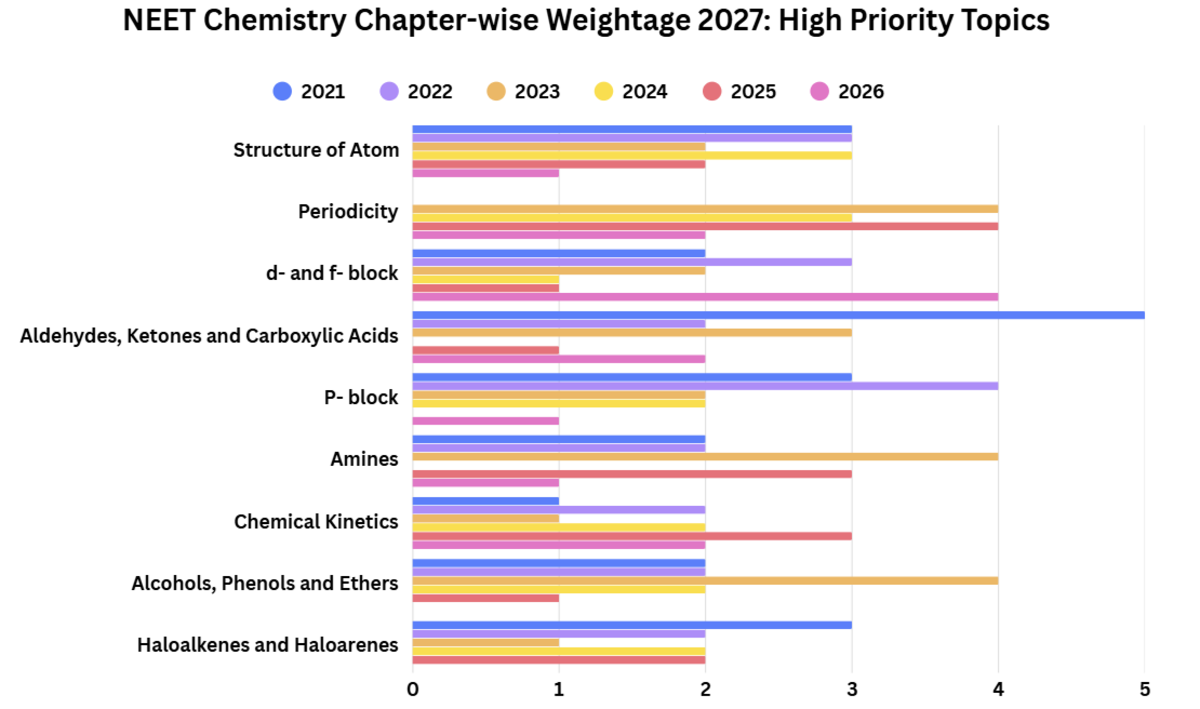
NEET Chemistry Chapter-wise Weightage 2027: High Priority Topics
The table below shows the number of questions asked in NEET Chemistry in the last 5 years' data. The following topics should be your priority for preparation after completing the must-do chapters:
| Topic | 2021 | 2022 | 2023 | 2024 | 2025 | 2026 |
|---|---|---|---|---|---|---|
| Structure of Atom | 3 | 3 | 2 | 3 | 2 | 1 |
| Periodicity | 0 | 0 | 4 | 3 | 4 | 2 |
| d- and f- block | 2 | 3 | 2 | 1 | 1 | 4 |
| Aldehydes, Ketones and Carboxylic Acids | 5 | 2 | 3 | 0 | 1 | 2 |
| P- block | 3 | 4 | 2 | 2 | 0 | 1 |
| Amines | 2 | 2 | 4 | 0 | 3 | 1 |
| Chemical Kinetics | 1 | 2 | 1 | 2 | 3 | 2 |
| Alcohols, Phenols and Ethers | 2 | 2 | 4 | 2 | 1 | 0 |
| Haloalkenes and Haloarenes | 3 | 2 | 1 | 2 | 2 | 0 |
NEET Chemistry Chapter-wise Weightage 2027: Moderate Priority Topics
The table below shows the number of questions asked in NEET Chemistry in the last 5 years' data. The following topics have moderate weightage, but do not skip them, as they can help you improve your rank. Start these after completing the high-priority topics.
| Topic | 2021 | 2022 | 2023 | 2024 | 2025 | 2026 |
|---|---|---|---|---|---|---|
| Basic Concept/Mole Concept | 1 | 1 | 1 | 1 | 3 | 2 |
| Biomolecules | 1 | 0 | 1 | 1 | 2 | 3 |
| Equilibrium | 1 | 1 | 1 | 3 | 1 | 1 |
| Electrochemistry | 1 | 2 | 2 | 1 | 0 | 2 |
| Redox Reaction | 1 | 1 | 1 | 1 | 1 | 2 |

Related Link: Chemistry Mock Test Series for NEET Free- Attempt Online Free Chemistry Mock Test, Download PDF
Ques. Where can I download the NEET Chemistry syllabus 2027 PDF?
Ans. Candidates can check the official NEET website for syllabus notifications and PDF updates. You can directly download the NEET 2027 Syllabus PDF from the NTA website.
NEET Chemistry Syllabus 2027: What to Study in Each Chapter?
The following topics from each chapter in Physical, Organic and Inorganic Chemistry are listed below. You must study these chapters to score well in NEET Chemistry 2027.
NEET Physical Chemistry Syllabus 2027: Important Topics to Cover
| Chapters/Units | Topics to Study |
|---|---|
| Mole Concept | Limiting Reagent, Stoichiometry |
| Thermodynamics | ΔH- ΔU relation, ΔG & spontaneity, Hess’s law |
| Equilibrium | Kp–Kc relation, pH of solutions, Buffer solutions, Ksp |
| Solutions | Colligative properties, Osmotic pressure, van ’t Hoff factor |
| Electrochemistry | Nernst equation, Faraday’s laws, Conductivity |
| Chemical Kinetics | First-order, half-life, Arrhenius |
NEET Inorganic Chemistry Syllabus 2027: Important Topics to Cover
| Chapters/Units | Topics to Study |
|---|---|
| Chemical Bonding | VSEPR, Hybridisation, MOT, Bond Order, Magnetic Nature, Dipole Moment |
| Periodicity | Atomic Radius, IE, EGE, EN |
| d/f block | Oxidation States, Colour, Magnetic Property, Lanthanide Contraction, KMnO₄ and K₂Cr₂O₇ |
| Coordination Compound | Nomenclature, Isomerism, CFT, Magnetic Moment, Oxidation State |
| P- block | NCERT trends, important compounds, anomalous behaviour |
NEET Organic Chemistry Syllabus 2027: Important Topics to Cover
| Chapters/Units | Topics to Study |
|---|---|
| GOC | Resonance, Inductive Effect, Hyperconjugation, Stability, Acidity/ Basicity |
| Hydrocarbons | Ozonolysis, Aromatic substitution |
| Haloalkenes and Haloarenes | Grignard Reagent |
| Alcohols, Phenols and Ethers | Phenol reactions |
| Aldehydes, Ketones and Carboxylic acids | Nucleophilic addition, Aldol condensation, Cannizzaro, Haloform reaction |
| Amines | Basicity, Diazonium salts, azo coupling |
| Biomolecules | Amino Acids, Proteins, Carbohydrates and Enzymes |
Watch the YouTube video by “PW NEET English” to learn in detail about the NEET Chemistry 2027 syllabus, chapter-wise weightage and important topics to cover.
Related Link: Download NEET Chemistry Question Paper PDFs
Ques. Are numerical questions asked in NEET Physical Chemistry?
Ans. Yes. Physical Chemistry includes numerical problems based on concepts, formulae, and calculations. Students should practise questions from topics such as solutions, equilibrium, thermodynamics, and electrochemistry.
NEET Chemistry Syllabus 2027: What to Practice?
NEET Chemistry topics that you should practice are tabulated below:
| Chapter | Repeated Question Types | What to Practice |
|---|---|---|
| Chemical Bonding | Molecular shape, bond order, magnetic nature | VSEPR+ Hybridisation + MOT |
| Thermodynamics | Heat/Energy Calculation | Heat Law + ΔH-/ΔU |
| Equilibrium | pH Calculation | Acid/Base |
| Solutions | Colligative Property | ΔT/ ΔT/pie |
| Kinetics | Time/ Half-life | First-order equation |
| Coordination Compounds | Complex Identification | Nomenclature + Oxidation State |
| Chemical Bonding | Magnetic Behaviour | CFT/ VBT |
| Hydrocarbons | Product Prediction | Markonivkov/ Ozonolysis |
| GOC | Stability Comparison | Resonance/ Inductive/ Hyperconjugation |
| Carboxylics | Product Prediction | Nucleophilic addition |
| Amines | Product Reaction | Diazotisation |
Ques. How can I improve my accuracy in NEET Chemistry numerical questions?
Ans. Learn the relevant formulae, practise calculations without looking at solutions, maintain a formula notebook, and analyse mistakes after each test. Regular timed practice can also help reduce calculation errors.
NEET Chemistry Syllabus 2027: Deleted Units
The NEET Chemistry syllabus 2027 deleted chapters have been tabulated below:
| Classes | Deleted Topics |
|---|---|
| Class 11 | States of Matter, s- block, hydrogen, environmental chemistry |
| Class 12 | Solid state, surface chemistry, metallurgy, polymers, chemistry in everyday life |
Related Link: NEET Previous Year Question Papers- Download PDF with Solution
Ques. What is the best order to study the NEET Chemistry syllabus 2027?
Ans. A practical order is to study basic concepts, atomic structure, periodicity, chemical bonding, and foundational Organic Chemistry before moving to advanced chapters. Students should also revise Inorganic Chemistry regularly rather than leaving it until the end.
Ques. When should I start taking mock tests for NEET Chemistry 2027?
Ans. Start chapter-wise tests as soon as you complete individual topics. Once you have covered a substantial portion of the syllabus, begin full-length mock tests and use the results to identify weak areas.
Books for NEET Chemistry 2027
The best books to prepare for NEET Chemistry 2027 are tabulated below.
- Most questions are direct textbook recall; your book choice should support memory retention over problem-solving.
- Do not replace your NCERT textbook with any reference book, since NEET Chemistry questions closely follow the exact textbook.
| Book Name | Author/Publisher | Why This Book |
|---|---|---|
| NCERT Chemistry Class 11 & 12 | NCERT | Inorganic Chemistry in NEET is almost entirely NCERT-based; line-by-line reading is essential |
| Physical Chemistry | O.P. Tandon (G.R. Batla & Sons) | Thorough theory and numerical coverage for Physical Chemistry units |
| Objective Chemistry for NEET | R.K. Gupta (Arihant) | Organic and Inorganic MCQ practice in the NEET question format |
Related Link: Best Books for NEET 2027 Preparation: Biology, Physics and Chemistry
NEET Chemistry Syllabus 2027: Preparation Tips
- Understand the NEET Chemistry syllabus: Cover all prescribed Class 11 and 12 topics and prioritise chapters based on your preparation level and previous-year question trends.
- Follow NCERT textbooks: Read NCERT Chemistry thoroughly, especially for Inorganic Chemistry and Organic Chemistry theory, reactions and examples.
- Focus on Physical Chemistry numericals: Practise questions from Mole Concept, Thermodynamics, Equilibrium, Solutions, Electrochemistry and Chemical Kinetics regularly.
- Strengthen Organic Chemistry fundamentals: Learn General Organic Chemistry (GOC), reaction mechanisms, electronic effects and isomerism before moving to advanced reactions.
- Revise Inorganic Chemistry regularly: Memorise important trends, exceptions, chemical properties and coordination compound concepts using NCERT tables and short notes.
- Solve previous years' questions (PYQs): Practise NEET Chemistry questions from previous years to understand recurring concepts, question formats and difficulty levels.
- Take mock tests: Attempt timed Chemistry sectional tests and full-length NEET mock tests to improve speed, accuracy and time management. Identify weak chapters, revise concepts and solve similar questions until you become confident.
- Maintain a formula and reaction notebook: Note important formulas, named reactions, reagents, exceptions and common calculation mistakes for quick revision.
- Revise consistently: Schedule weekly revision of Physical, Organic and Inorganic Chemistry instead of studying a chapter only once.
- Avoid guesswork: Practise eliminating incorrect options carefully, keeping NEET's negative-marking rules in mind.
- Balance all three sections: Do not focus exclusively on high-weightage chapters; build a strong foundation across the complete prescribed syllabus.
Download NEET Chemistry Previous Year Question Paper
| Year-wise NEET Question Paper PDF | Link |
|---|---|
| NEET 2026 Question Paper PDF | Check Here |
| NEET 2025 Question Paper PDF | Check Here |
| NEET 2024 Question Paper PDF | Check Here |
| NEET 2023 Question Paper PDF | Check Here |
| NEET 2022 Question Paper PDF | Check Here |
Related Links:
NEET Chemistry Syllabus 2027: FAQs
Ques. What is the NEET Chemistry syllabus 2027?
Ans. The NEET Chemistry syllabus 2027 covers Physical Chemistry, Organic Chemistry, and Inorganic Chemistry. It includes topics such as atomic structure, chemical bonding, thermodynamics, equilibrium, hydrocarbons, coordination compounds, and biomolecules.
Ques. Is the NEET Chemistry syllabus 2027 based on NCERT?
Ans. Yes, NCERT Chemistry textbooks for Classes 11 and 12 are important preparation resources for NEET. Students should also check the official NEET 2027 syllabus to ensure that they cover all prescribed topics.
Ques. Which topics are included in Physical Chemistry for NEET 2027?
Ans. NEET Physical Chemistry includes topics such as basic concepts of chemistry, atomic structure, chemical thermodynamics, solutions, equilibrium, redox reactions, and electrochemistry, as specified in the applicable syllabus.
Ques. Which topics are included in Organic Chemistry for NEET 2027?
Ans. NEET Organic Chemistry includes topics such as basic principles of organic chemistry, hydrocarbons, compounds containing halogens, oxygen- and nitrogen-containing compounds, and biomolecules.
Ques. How many questions are asked from Chemistry in NEET UG?
Ans. The NEET Chemistry section has 45 questions, carrying a total of 180 marks under the established exam pattern. As per NEET marking scheme, candidates will get +4 marks for each correct answer and -1 for an incorrect response.
Ques. Which is the most important chapter in NEET Chemistry 2027?
Ans. Chemical Bonding, Chemical Thermodynamics, Equilibrium, Coordination Compounds, Electrochemistry, and Organic Chemistry fundamentals are useful topics to prioritise. The chapter-wise weightage may vary, so students should prepare the complete prescribed syllabus.
Ques. Is NCERT enough for NEET Chemistry 2027 preparation?
Ans. NCERT textbooks for Classes 11 and 12 are an essential foundation. Students should also practise NEET previous-year questions, numerical problems, and mock tests to improve accuracy and speed.
Displaying neet chemistry syllabus 22-10-26.html.



Comments
Found 1 Comment
What is the syllabus for NEET 2024?