




NMAT Preparation 2026 requires a fundamentally different approach from exams like CAT or XAT. Conducted by the Graduate Management Admission Council (GMAC), NMAT by GMAC 2026 is expected to be held in a testing window from November to December 2026, accepting over 75,000 candidates across 50+ B-schools in India and abroad. Unlike most MBA entrance exams, NMAT allows candidates to attempt the exam up to three times per testing cycle, making strategic, well-paced preparation the key differentiator between an average score and a 230+ performance.
- Registration Opens: NMAT 2026 registration is expected to open in August 2026 — last year it opened on August 1, 2025. Register early as preferred test slots and centres fill up fast.
- Exam Window: NMAT 2026 is tentatively scheduled from November to December 2026 — a 45-day window. In 2025, the window ran from November 5 to December 19, 2025.
- Cut-off Target: NMIMS Mumbai requires an overall score of 209+ (sectional cut-off: 62). Targeting 220-230+ gives you a competitive buffer across multiple NMAT colleges.
- Retake Policy: You get one free retake; a second retake costs a separate fee. Best score across attempts is considered — plan your attempt schedule early.
Related Links:

What is NMAT 2026?
NMAT by GMAC (Narsee Monjee Management Aptitude Test) is a national-level MBA entrance exam conducted by the Graduate Management Admission Council for admission into MBA and PGDM programmes. NMAT 2026 is one of the most student-friendly MBA entrance exams in India, known for its no negative marking policy, adaptive format, flexible testing window, and multiple attempt option.
The exam is accepted by 50+ B-schools including NMIMS Mumbai, XIM Bhubaneswar, K J Somaiya Institute of Management, VIT Vellore, Shiv Nadar University, IBS Group, and partner universities in South Africa, Morocco, the Philippines, Hungary, and Nigeria. Over 75,000 candidates are expected to appear for NMAT 2026.
| Feature | Details |
|---|---|
| Conducting Body | Graduate Management Admission Council (GMAC) |
| Full Form | Narsee Monjee Management Aptitude Test |
| Mode of Exam | Computer-Based Test (CBT) at centres; Online Proctored at home |
| Total Questions | 108 |
| Total Duration | 120 minutes |
| Sections | Language Skills, Quantitative Skills, Logical Reasoning |
| Negative Marking | No |
| Attempts Allowed | Up to 3 (1 attempt + 2 retakes) |
| Score Range | 36 to 360 |
| Exam Window (Expected) | November to December 2026 |
| Colleges Accepting | 50+ B-schools in India and abroad |
NMAT 2026 Exam Pattern and Marking Scheme
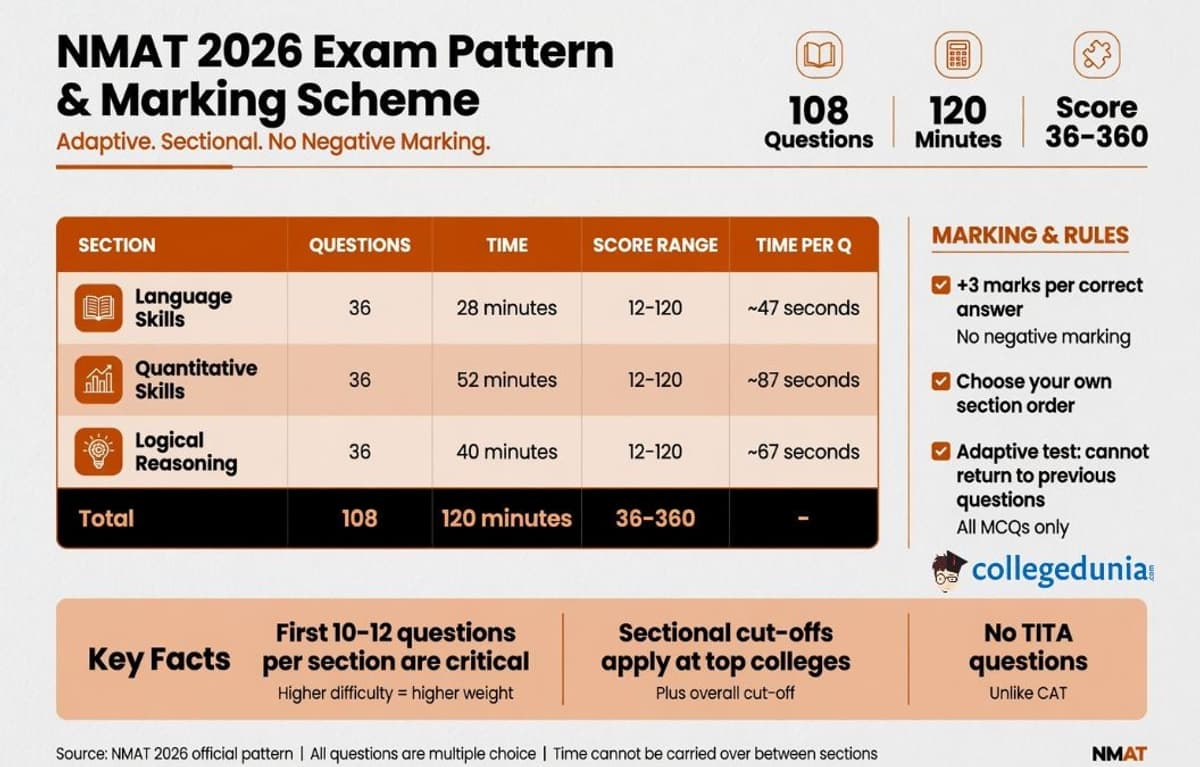
Understanding the NMAT exam pattern is the non-negotiable first step in any effective NMAT preparation strategy. NMAT 2026 consists of three timed sections with no option to carry over time between sections. The adaptive nature of NMAT means that early accuracy in each section determines the difficulty level of subsequent questions — and higher-difficulty questions carry more weight in score calculation. This makes your first 10-12 questions in each section especially critical.
| Section | No. of Questions | Time Limit | Score Range | Time Per Question |
|---|---|---|---|---|
| Language Skills | 36 | 28 minutes | 12–120 | ~47 seconds |
| Quantitative Skills | 36 | 52 minutes | 12–120 | ~87 seconds |
| Logical Reasoning | 36 | 40 minutes | 12–120 | ~67 seconds |
| Total | 108 | 120 minutes | 36–360 | – |
Key structural rules for NMAT 2026 candidates to note:
- You can choose the order in which you attempt the three sections.
- Once you move past a question, you cannot return to it (adaptive format).
- All questions are MCQ-type — there are no TITA (Type in the Answer) questions unlike CAT.
- Three marks are awarded for each correct answer; no penalty for wrong answers.
- Sectional cut-offs apply at top colleges alongside overall cut-off scores.
Related Links:
NMAT 2026 Syllabus: Section-wise Topics
NMAT by GMAC does not publish a fixed official syllabus, but analysis of previous year papers consistently reveals a defined set of topics across all three sections. Your NMAT syllabus preparation should be guided by topic frequency and score contribution rather than attempting to cover all possible topics exhaustively.
| Section | Key Topics |
|---|---|
| Language Skills | Reading Comprehension (400+ word passages), Vocabulary (Synonyms, Antonyms, Analogies), Grammar & Usage, Fill in the Blanks, Jumbled Paragraphs, Prepositions, Sentence Correction |
| Quantitative Skills | Arithmetic (Percentages, Ratios, Averages, Profit & Loss, Time-Speed-Distance), Algebra (Quadratic Equations, Logarithms), Geometry & Mensuration, Data Interpretation (Bar Graphs, Pie Charts, Line Graphs), Permutations & Combinations, Probability, Number Systems |
| Logical Reasoning | Seating Arrangements, Blood Relations, Direction Sense, Series (Number, Letter), Syllogisms, Critical Reasoning, Decision Making, Numerical Grids, Family Tree, Verbal Reasoning |
Important: NMAT is a performance-based test, not a syllabus-completion exam. Prioritise high-frequency topics and accuracy over attempting to cover every possible concept.
NMAT Topper Preparation Strategy | What to Study & How to Plan Ft. Omung Bhardwaj NMIMS Mumbai
CATKing's video featuring Omung Bhardwaj, an NMIMS Mumbai student and NMAT topper, is one of the most watched and cited NMAT preparation resources among aspirants. The video covers how he planned his preparation, section priorities, and what he specifically studied to crack the NMAT and secure a seat at NMIMS Mumbai.
Key takeaways from this topper strategy that directly apply to your NMAT 2026 preparation:
- Start with your strongest section to build early momentum on exam day — confidence in the first section sets a positive adaptive trajectory.
- Language Skills is the most underestimated section, yet it offers the quickest improvement gains. Toppers consistently rank it as the best section to master first.
- Logical Reasoning requires the most daily practice time due to the variety of question types. Omung recommends solving at least 3 LR sets daily throughout preparation.
- Do not neglect sectional cut-offs — even a 240+ overall score cannot compensate for a weak sectional performance at colleges like NMIMS.
- The retake option is a strategic asset, not a safety net. Plan your first attempt as the real attempt; treat the second as a targeted improvement attempt.
NMAT Preparation 2026: Section-wise Strategy
Language Skills: 36 Questions in 28 Minutes
Language Skills is widely underestimated by NMAT aspirants, yet it offers the highest scoring potential when approached correctly. With only 47 seconds per question on average, the key is building reading fluency and vocabulary over weeks, not cramming word lists in the last few days. Focus consistently on reading comprehension passages (aim for 2-3 passages daily), and build your vocabulary through reading quality editorials rather than memorising long word lists.
High-priority topics for Language Skills:
- Reading Comprehension: Passages are typically 400 words. Practice identifying main idea, inference, tone, and author's purpose rapidly.
- Vocabulary: Focus on Synonyms, Antonyms, Analogies, and contextual word usage. Word Power Made Easy by Norman Lewis is the most recommended resource for this.
- Grammar and Sentence Correction: Cover Subject-Verb Agreement, Tense Consistency, Modifiers, and Parallelism.
- Jumbled Paragraphs and Fill in the Blanks: Practice elimination-based approaches to solve faster.
Quantitative Skills: 36 Questions in 52 Minutes
The Quantitative Skills section provides the most time per question (87 seconds), making it possible to score well even without exceptional speed if your conceptual foundation is strong. Begin with basics — LCM, HCF, prime numbers, odd/even properties — before moving to advanced topics like Coordinate Geometry and Probability. Data Interpretation questions within this section require fast calculation; practise DI sets regularly from the third month onwards.
High-priority topics for Quantitative Skills:
- Arithmetic: Percentages, Profit and Loss, Ratios and Proportions, Time-Speed-Distance, and Simple and Compound Interest constitute the highest share of questions.
- Data Interpretation: Bar graphs, Pie charts, and Line graphs — practice reading data sets quickly without a calculator.
- Algebra: Linear and Quadratic equations, Logarithms — these appear regularly and respond well to formula-based practice.
- Modern Maths: Permutations and Combinations, and Probability — typically 3-5 questions per NMAT paper.
Logical Reasoning: 36 Questions in 40 Minutes
Logical Reasoning is the most diverse section in NMAT and the one that most students find hardest to improve quickly. The section rewards regular, varied practice more than any other approach. Unlike CAT, NMAT LR questions are mostly standalone or 2-3 question sets rather than lengthy 5-question sets, which means speed and quick pattern recognition are at a premium.
High-priority topics for Logical Reasoning:
- Seating Arrangements and Blood Relations: These are the most frequently appearing question types in NMAT.
- Series: Number series, Letter series, and Mixed series — practice identifying patterns fast.
- Syllogisms and Critical Reasoning: Appear regularly; respond well to structured approach practice.
- Decision Making and Numerical Grid: Unique to NMAT-style papers; practice from official NMAT mock tests.
NMAT 2026 Full Guide | Syllabus, Exam Pattern, Eligibility, Dates & Preparation Tips
This comprehensive video guide covers everything a first-time NMAT aspirant needs to understand before beginning their preparation — from the full NMAT 2026 syllabus breakdown and adaptive exam pattern to eligibility conditions and key registration dates. It is especially useful for students who are preparing for NMAT alongside CAT or other MBA exams and need to quickly orient themselves to how NMAT differs in structure and approach.
Core themes covered in the video that directly shape your NMAT 2026 preparation approach:
- NMAT is a computer-adaptive test — difficulty adjusts per question based on your earlier responses. This is fundamentally different from the fixed-difficulty format of CAT.
- Eligibility is accessible: a Bachelor's degree with 50% marks from a recognised university qualifies you. Final-year students can also apply. There is no age limit or mandatory work experience.
- Registration typically opens in August and closes in October — candidates who register early get access to better test slot options and dates.
- The testing window spans approximately 45 days, allowing you to strategically time your attempt based on preparation readiness.
NMAT 2026 Study Plan: 30/60/90-Day Schedule
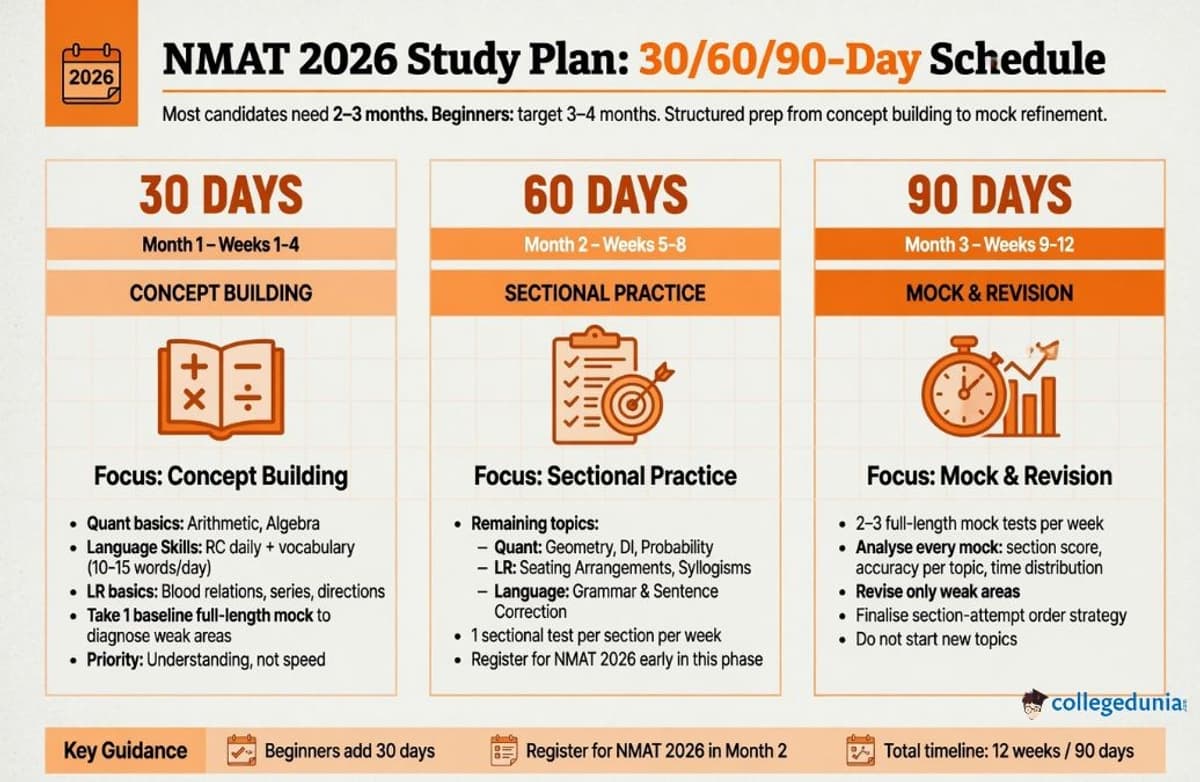
Most candidates need 2 to 3 months of focused preparation to crack NMAT 2026 with a competitive score. Beginners without prior MBA exam exposure should target 3 to 4 months. The structured study plan below covers the full preparation cycle from concept building to mock-based refinement.
| Month | Focus Area | Key Activities |
|---|---|---|
| Month 1 (Weeks 1-4) | Concept Building | Cover Quant basics (Arithmetic, Algebra), Language Skills foundations (RC daily, vocabulary 10-15 words/day), LR basics (blood relations, series, directions). Take one baseline full-length mock to diagnose weak areas. Do not focus on speed yet. |
| Month 2 (Weeks 5-8) | Sectional Practice | Cover remaining topics: Geometry, DI, Probability in Quant; Seating Arrangements, Syllogisms in LR; Grammar and Sentence Correction in Language. Take 1 sectional test per section per week. Register for NMAT 2026 early in this phase. |
| Month 3 (Weeks 9-12) | Mock & Revision | Take 2-3 full-length mock tests per week. Analyse every mock: section score, accuracy per topic, time distribution. Revise only weak areas. Finalise section-attempt order strategy. Do not start new topics. |
First 30 Days: Foundation Phase
- Take one full-length NMAT mock before starting — your baseline score tells you exactly where to focus first.
- Spend the first two weeks on Quantitative basics: arithmetic, percentages, ratios, and algebra.
- Begin vocabulary building from day one: 10-15 new words daily through reading, not rote memorisation.
- Practise basic reasoning puzzles — blood relations, directions, and series — for 30 minutes daily.
Days 31–60: Sectional Practice Phase
- Cover remaining Quant topics: geometry, probability, and data interpretation.
- Work through 2-3 Reading Comprehension passages daily.
- Practise Logical Reasoning sets: seating arrangements, syllogisms, and critical reasoning.
- Start taking sectional timed tests — one per section per week.
Days 61–90: Mock & Refinement Phase
- Take 2-3 full-length mock tests per week under actual exam conditions.
- Analyse every mock for accuracy rate, section-wise time management, and error patterns.
- Finalise your section-attempt order based on where you consistently score highest first.
- Aim to hit your target score consistently across mocks before scheduling your actual exam.
Daily Preparation Plan to Ace NMAT Exam | Complete Strategy Guide
CATKing's NMAT daily preparation plan video outlines a practical day-by-day schedule that balances all three sections throughout the preparation period. The guide is particularly useful for working professionals and students preparing for NMAT alongside college studies who need a realistic, time-efficient preparation framework rather than a full-time study approach.
Key points from this daily strategy guide for NMAT 2026 preparation:
- Dedicate the first 45 minutes of every study session to Language Skills — RC and vocabulary practice improve cumulatively and cannot be rushed in the final week.
- Alternate between Quant and LR in the second half of each session, spending roughly equal time on both unless one section is a clear weak spot.
- Solve at least one timed mini-test (10-12 questions per section) every alternate day to keep speed sharp even during the concept phase.
- Sunday is dedicated to full-length mock analysis, not new concept learning. Review errors methodically and note recurring mistake patterns.
- Avoid studying more than 4-5 hours daily in a sustained manner — NMAT preparation is about consistency over months, not cramming bursts.
Best Books for NMAT Preparation 2026
The right books form the foundation of effective NMAT 2026 preparation. The NMAT by GMAC Official Guide is the single most important resource, as it is the only source that contains authentic NMAT-style questions created by the actual exam conducting body. Supplement it with standard MBA preparation books for concept building.
| Section | Book | Author/Publisher |
|---|---|---|
| All Sections (Official) | NMAT by GMAC Official Guide | GMAC (Graduate Management Admission Council) |
| Quantitative Skills | How to Prepare for Quantitative Aptitude for CAT (13th Edition) | Arun Sharma (McGraw Hill) |
| Quantitative Skills | Quantitative Aptitude Quantum CAT | Sarvesh K. Verma |
| Quantitative Skills | Quantitative Aptitude for Competitive Examinations | R.S. Aggarwal |
| Language Skills (Vocabulary) | Word Power Made Easy | Norman Lewis |
| Language Skills (RC & Grammar) | How to Prepare for Verbal Ability and Reading Comprehension | Arun Sharma & Meenakshi Upadhyay |
| Logical Reasoning | How to Prepare for Logical Reasoning for CAT | Arun Sharma |
| Logical Reasoning | A Modern Approach to Logical Reasoning | R.S. Aggarwal |
Students Ask: "Is 3 Months Preparation Enough for NMAT?" (From Quora & Careers360)
One of the most frequently asked questions by NMAT aspirants across Quora, Careers360, and MBA forums is whether 3 months of preparation is sufficient to crack NMAT. The answer, based on student experiences shared across these platforms, is a clear yes — with the right approach.
A highly upvoted Careers360 response from an NMAT qualifier summarises the community consensus well: NMAT does not require you to study 12 to 14 hours daily like CAT or XAT, but it does demand a strategic approach to selecting and answering questions under time pressure. Students who treated NMAT like CAT — spending months on advanced maths and complex LR sets — often found themselves over-prepared on difficulty but under-prepared on speed and adaptive test-taking.
Here is how the 3-month timeline typically breaks down for most aspirants based on community-shared plans:
- Month 1: Concept revision and baseline mock assessment. Students report that identifying your weak section in week one saves weeks of misdirected study.
- Month 2: Topic-wise practice and first sectional tests. The most common mistake shared on forums is skipping regular timed practice during this phase and over-investing in reading theory.
- Month 3: Full-length mocks, error analysis, and refining section-attempt order. Students who took 15 or more full mocks reported significantly more confidence on exam day.
Important from student discussions: If you are simultaneously preparing for CAT 2026, your NMAT preparation timeline can be compressed to 4-6 weeks of NMAT-specific practice, as the core concepts significantly overlap.
What NMAT Takers on Reddit and MBA Forums Say About Mock Tests
Across Reddit's r/MBA, PagalGuy, and InsideIIM forums, mock test strategy is the single most discussed topic among NMAT aspirants. The community experience across multiple exam cycles consistently surfaces the same findings for NMAT 2026 preparation.
The most upvoted insight from MBA forums: official NMAT mocks from GMAC are significantly more representative of actual exam difficulty and adaptive pattern than third-party mock tests. Multiple test takers have noted that students who relied exclusively on coaching institute mocks found the actual NMAT adaptive format surprising, while students who practised on official GMAC mocks felt the real exam was closely calibrated to what they had practised.
Key mock test advice from student communities:
- Take your first mock before beginning preparation — not after — to get an unbiased baseline. Most students who did this report it reshaped their entire preparation focus.
- Do not take back-to-back mocks without deep analysis. Forum discussions consistently flag that students who took 30 mocks without proper review improved less than those who took 12-15 mocks with thorough post-mock analysis.
- Simulate real exam conditions during every mock: no interruptions, no pausing, same time of day as your actual exam slot.
- Track your score trend across mocks — not just the final score but section-wise accuracy and time usage per section. Many students discovered hidden Quant speed issues only through mock analysis, not through section scores alone.
- The NMAT adaptive format means your wrong answers early in a section can cascade into easier (lower-scoring) questions. Forum posts from toppers confirm that aiming for 80%+ accuracy in the first 10-12 questions of each section is more impactful than raw speed throughout.
How to Score 230+ in NMAT 2025? Last Minute Strategy by Toppers
This highly-watched video from Great Lakes Gurgaon-enrolled toppers Shikhar Jolly (scored 229) and fellow NMAT qualifiers breaks down the specific last-minute strategies that helped them push out of the 200-210 score plateau that stalls many mid-level NMAT aspirants. The video is especially relevant for candidates in the 60-to-30-day window before their NMAT exam date.
The actionable last-minute strategies shared by NMAT scorers of 220-230+ in this video:
- Switch from concept learning to 100% mock-and-analyse mode at least 30 days before your exam. No new topics. Only revision and error correction.
- Practice your section-attempt order in every mock — do not walk into the actual exam still experimenting with which section to attempt first.
- In the Language Skills section, avoid spending more than 5 minutes on any single RC passage. Train yourself to skip difficult passages and return only if time allows.
- The 200-210 score ceiling often comes from poor accuracy in the first 8-10 questions of each section when nerves are highest. Do a dedicated drill of solving first 10 questions from each section under simulated pressure.
- On exam day, arrive early, stay hydrated, and use the tutorial time before the exam to mentally warm up — do not skip it.
Students Ask: "Which Books Should I Use for NMAT?" (From Quora)
On Quora, the question "Which books should I use for NMAT preparation?" has received over 40 answers from past NMAT takers, coaching faculty, and B-school students. The community response has evolved significantly since NMAT transitioned to a computer-adaptive format, and the book recommendations have shifted accordingly.
The most consistently upvoted Quora answers make three key observations that every NMAT 2026 aspirant should know before buying preparation material:
- No single book is a complete solution. The most successful NMAT takers report using 3-4 sources — one official guide, one Quant book, one vocabulary resource, and one LR workbook — rather than trying to find one comprehensive all-in-one guide.
- The adaptive format changes book selection priorities. Since NMAT became adaptive, the emphasis has shifted toward practising question-type familiarity over topic depth. Quora answers consistently flag that books written for CAT's fixed-difficulty format can over-train students for the wrong level of complexity.
- The NMAT by GMAC Official Guide is non-negotiable. Multiple Quora answers from NMIMS and K J Somaiya students mention that the official guide is the only source with authentic adaptive-pattern practice questions. Third-party books may cover concepts well but do not replicate the actual NMAT question style.
Additional reading tips shared frequently on Quora for NMAT Language Skills preparation: reading The Hindu editorials, Economic Times opinion pieces, and Harvard Business Review excerpts is more effective than any single RC practice book, as it builds genuine reading speed and comprehension rather than pattern-matching skills.
NMAT 2026 Mock Test Strategy: How to Prepare Using Full-Length Tests
Mock tests are the backbone of NMAT 2026 preparation. NMAT mock tests serve a dual purpose: they build exam temperament under timed pressure, and they reveal exactly which topics and question types are costing you the most score in each section.
A structured mock test approach for NMAT 2026:
- Take 20-30 mock tests in total across the preparation period — not all in the final month.
- Start with one diagnostic mock in week one (before any preparation) to get a baseline.
- From month two onwards, take at least one full-length mock per week under actual exam conditions.
- In month three, scale up to 2-3 mocks per week.
- After every mock, spend 2x the test duration on analysis: identify wrong answers, near-misses, and time-drain questions.
- Track your section-wise accuracy separately from overall score — a 200+ overall score with a 50 sectional score in one section will not meet cut-off at NMIMS.
Important: NMAT is highly speed-oriented. Blind guessing is not penalised, but strategic skipping of difficult questions in the adaptive format can lower your question difficulty level. Attempt every question, but prioritise accuracy in the first 10-12 questions of each section.
Related Links:
NMAT 2026 Cut-off: Target Scores for Top B-Schools
Understanding the NMAT cut-off for your target colleges should directly inform your preparation score target. Setting your target score at least 10-15 points above the expected cut-off gives you a buffer for off-day performance and sectional variability.
| College | Expected Overall Cut-off 2026 | Sectional Cut-off (Approx.) |
|---|---|---|
| NMIMS Mumbai (MBA Core) | 209+ | 62 per section |
| NMIMS Mumbai (MBA Pharma Management) | 190+ | 50 per section |
| NMIMS Bengaluru / Hyderabad | 190–200+ | 50 per section |
| XIM Bhubaneswar (PGDM) | 210+ | Sectional minimum applies |
| K J Somaiya Institute of Management | 200+ | 50 per section |
| Shiv Nadar University | 195+ | Varies |
| VIT Vellore / Chennai | 180+ | Varies |
| IBS Group | 170+ | Varies |
Students Ask: "Should I Use All Three NMAT Attempts?" (From Reddit & Pagalguy)
The three-attempt policy is one of NMAT's most discussed features on MBA preparation forums. Reddit's MBA and Indian MBA subreddits, as well as PagalGuy threads, contain extensive discussions from students who have navigated the multi-attempt strategy across previous NMAT cycles.
The community view on using all three attempts for NMAT 2026 preparation:
- The first attempt should always be treated as the real exam. Forum discussions consistently warn against using the first attempt as a "trial run." NMIMS has in certain years considered only the first attempt score for shortlisting purposes, which makes under-preparation for the first attempt a risky strategy.
- Retakes are most valuable for targeted improvement, not broad re-preparation. Students who scored 180-200 in their first attempt and spent 2-3 weeks specifically drilling their weakest section consistently report 15-25 point improvements in retakes. Students who "started fresh" across all sections rarely improved by more than 5-8 points.
- Gap between attempts matters. GMAC requires a minimum 15-day gap between attempts. Forum advice suggests using this gap for intensive targeted practice (1-2 mock tests every 2-3 days, focused on the problem section) rather than broad revision.
- Not all colleges average or consider all attempts. Most top NMAT colleges take your best score. However, verify individual college policies at the time of application, as policies can change cycle to cycle.
NMAT 2026 Eligibility Criteria
NMAT 2026 has one of the most accessible eligibility structures among all major MBA entrance exams in India. There is no age restriction, no mandatory work experience requirement, and no domain restriction on undergraduate discipline.
- Educational Qualification: Bachelor's degree or equivalent from a recognised university with a minimum of 50% aggregate marks.
- Final Year Students: Students in their final year of undergraduate study are eligible to appear for NMAT 2026, subject to submitting proof of graduation before the date of joining the programme.
- Work Experience: Not mandatory for most programmes. Some specialised MBA programmes at NMIMS (such as Executive MBA) may have work experience requirements — check individual programme eligibility.
- Number of Attempts: One attempt plus up to two retakes per testing cycle. Best score is considered for shortlisting by most colleges.
NMAT 2026 Important Dates (Expected)
| Event | Expected Date 2026 | 2025 Reference Date |
|---|---|---|
| NMAT 2026 Registration Opens | August 2026 (Expected) | August 1, 2025 |
| NMAT 2026 Registration Closes | October 2026 (Expected) | October 18, 2025 |
| Exam Slot Scheduling Opens | August 2026 (with registration) | August 1, 2025 |
| NMAT 2026 Exam Window Starts | November 2026 (Expected) | November 5, 2025 |
| NMAT 2026 Exam Window Ends | December 2026 (Expected) | December 19, 2025 |
| Retake Registration | Post first attempt | 15-day minimum gap required |
| NMAT 2026 Score Declaration | Post exam window closes | Scores released within 48 hours of each attempt |
Note: All dates above are tentative based on previous year patterns. Official NMAT 2026 dates will be announced by GMAC on the official website. Candidates should bookmark nmat.org and check regularly from July 2026 onwards.
NMAT 2026 Exam Day Tips
All preparation ultimately comes down to execution on the day of your scheduled NMAT exam. These exam day tips are drawn from topper interviews and student experiences shared across forums and counselling sessions:
- Arrive at the test centre at least 30 minutes before your scheduled slot. Late arrivals are not admitted.
- Carry valid photo ID (Aadhaar, PAN, Passport, or Driving License) — the same ID you used during registration.
- Use the tutorial time before the actual test to mentally switch into exam mode. Do not skip it.
- Attempt your pre-planned section order. Do not change strategy on exam day based on the first question being hard.
- Focus on the first 10-12 questions of each section with maximum accuracy — these set your adaptive difficulty trajectory for the remainder of that section.
- Do not leave any question unanswered. Since there is no negative marking, attempt every question even if you are unsure.
- Avoid last-minute revision on exam day. Sleep well the night before and eat a light meal before the test.
Colleges Accepting NMAT Scores 2026
NMAT by GMAC 2026 scores are accepted by 50+ institutions for MBA and PGDM admissions in India and internationally. Top colleges accepting NMAT scores include:
- NMIMS Mumbai, Bengaluru, Hyderabad, Navi Mumbai, Indore, and Dhule
- XIM Bhubaneswar (XIMB)
- K J Somaiya Institute of Management, Mumbai
- Shiv Nadar School of Management, Greater Noida
- VIT Vellore and VIT Chennai
- IBS Group (Mumbai, Gurgaon, Pune, Bengaluru, Hyderabad)
- Alliance University, Bengaluru
- ISB Hyderabad (for Executive MBA — check programme eligibility)
- International partner universities in South Africa, Morocco, Philippines, Hungary, and Nigeria
Frequently Asked Questions (FAQs) on NMAT Preparation 2026
Ques. How many months of preparation are required for NMAT 2026?
Ans. Most candidates need 2 to 3 months of focused NMAT preparation. Beginners with no prior MBA exam exposure should aim for 3 to 4 months. Candidates who are simultaneously preparing for CAT 2026 can typically crack NMAT with 4 to 6 additional weeks of NMAT-specific practice, as the core concepts overlap significantly.
Ques. Is NMAT easier than CAT?
Ans. Yes, NMAT is considered moderately easier than CAT in terms of overall difficulty level and question complexity. However, NMAT's adaptive format, strict sectional time limits, and no-review-allowed policy make it a unique challenge that requires dedicated preparation beyond just CAT-level readiness. Speed and accuracy in the first few questions of each section are more critical in NMAT than in CAT.
Ques. Can I crack NMAT 2026 without coaching?
Ans. Yes, self-study with structured resources is equally effective for NMAT preparation. The NMAT by GMAC Official Guide, standard Quant and LR books by Arun Sharma, Word Power Made Easy, and regular mock tests on the official GMAC platform are sufficient for most candidates to achieve a competitive score without coaching.
Ques. What is a good score in NMAT 2026?
Ans. A score of 210 to 220 is considered good for NMAT 2026, making you competitive at most NMAT-accepting colleges. A score of 220 to 240 is excellent and makes you competitive at NMIMS Mumbai. Scores of 240 and above put you among the top percentile of test takers.
Ques. How many mock tests should I take for NMAT 2026?
Ans. Aim for 20 to 30 full-length mock tests across your preparation period. More importantly, analyse each mock thoroughly — reviewing errors and identifying speed bottlenecks is more valuable than simply increasing the number of tests taken.
Ques. Can I choose the order of sections in NMAT 2026?
Ans. Yes, NMAT allows candidates to choose which section they attempt first. Most toppers recommend starting with your strongest section to build confidence and set a favourable adaptive difficulty trajectory early in the exam. Practise your preferred section order across all mock tests before exam day.
Ques. Should I use all three NMAT attempts?
Ans. You do not need to use all three attempts. The best strategy is to be fully prepared for your first attempt and treat it as the primary one. Use the retake option if you genuinely believe targeted improvement in one or two specific sections can significantly boost your overall score. Check your target college's attempt policy before scheduling retakes, as some colleges have attempt-specific preferences.
Ques. What is the best NMAT preparation book?
Ans. The NMAT by GMAC Official Guide is the most important book for NMAT preparation. Supplement it with Arun Sharma's Quantitative Aptitude for CAT for Quant and LR, Word Power Made Easy by Norman Lewis for vocabulary, and the Arun Sharma-Meenakshi Upadhyay Verbal Ability book for Language Skills.
Ques. What is the section-wise cut-off for NMIMS Mumbai in NMAT 2026?
Ans. Based on the 2025 cut-off trends, NMIMS Mumbai requires an overall NMAT score of 209+ with a sectional minimum of approximately 62 per section for the MBA (Core) programme. The MBA Pharmaceutical Management programme has a lower cut-off of approximately 190 overall with a 50 sectional minimum. These figures are expected to remain similar for NMAT 2026.
Ques. What topics should I prioritise in NMAT 2026 preparation?
Ans. For Quantitative Skills, prioritise Arithmetic, Data Interpretation, and Algebra. For Language Skills, focus on Reading Comprehension, Vocabulary, and Grammar. For Logical Reasoning, prioritise Seating Arrangements, Blood Relations, Series, and Syllogisms. These topics collectively cover the highest proportion of NMAT questions across all previous exam cycles.



Comments