




The SAT exam pattern for 2026-27 follows a digital, multistage adaptive format with two sections: Reading, Writing, and Mathematics. The exam contains 98 questions and lasts 2 hours and 14 minutes, including two separately timed modules in each section. The difficulty of the second module depends on a student's performance in the first module.
Each section is scored between 200 and 800, giving a total SAT score range of 400-1600. The exam is conducted through the Bluebook application, and students can use an on-screen or approved handheld calculator throughout the Math section.
Related Links:
- SAT Exam Syllabus 2026
- How Does Adaptive Testing Work in the Digital SAT?
- SAT Exam Preparation Book List
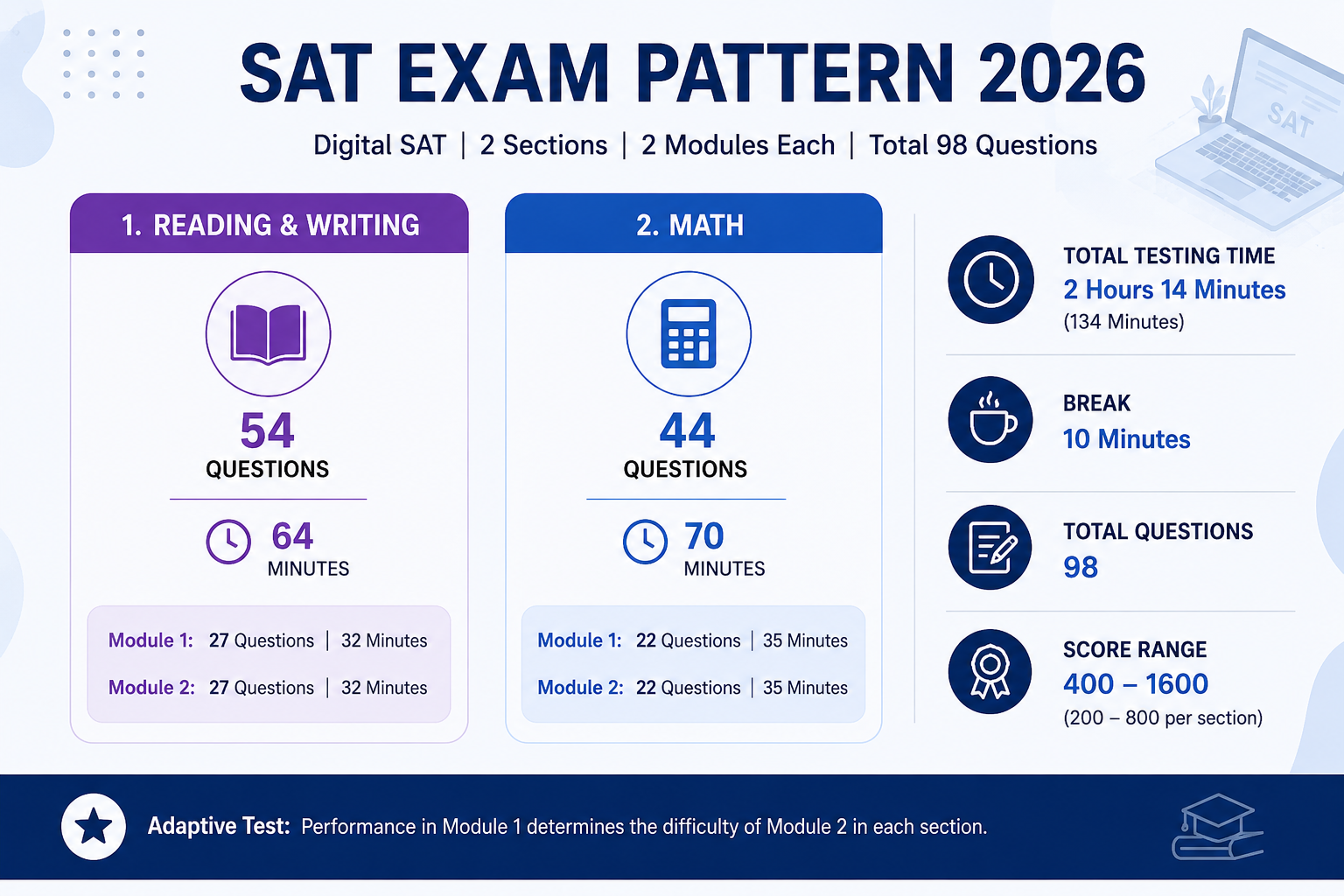
Digital SAT Exam Pattern 2026–27: Highlights
The Digital SAT is an online exam taken using the Bluebook app.
- It consists of two sections: Reading and Writing and Mathematics.
- Each section is divided into two adaptive modules, and the total testing time is 2 hours and 14 minutes.
- The SAT is scored on a scale of 400 to 1600.
| Particulars | Highlights |
|---|---|
| Exam Name | Scholastic Assessment Test |
| Examination Mode | Digital (Bluebook app) |
| Total Number of Questions Asked | 98 |
| Number of Sections | 2 (Reading, Writing, and Math) |
| Reading and Writing | 54 questions, 64 minutes |
| Mathematics | 44 questions, 70 minutes |
| Total Testing Time | 2 hours 14 minutes |
| Section-Wise Score Range | 200 - 800 each |
| Total Score Range | 400-1600 |
Read:
How Does the Digital SAT Adaptive Format Work?
The Digital SAT follows a multistage adaptive testing format in which each section contains two modules. All students begin with the first module, which includes questions of varying difficulty levels. Based on their performance, students receive a second module with a different mix of question difficulty.
- Module 1: Contains a mix of easy, medium, and difficult questions.
- Module 2: The difficulty mix is adjusted based on performance in Module 1.
- Separate timing: Reading and Writing modules have 32 minutes each, while Math modules have 35 minutes each.
- Navigation: Students cannot return to a previous module after submitting it and moving forward.
SAT Examination Pattern 2026: Check Section-Wise Distribution
The SAT pattern 2026 consists of 2 sections. The number of questions asked and the time duration for both sections vary.
| SAT Section | No. of Questions | Duration | Score Range |
|---|---|---|---|
| Reading and Writing | 54 | 64 minutes | 200-800 |
| Mathematics | 44 | 70 minutes | 200-800 |
| Total | 98 | 134 minutes | 400-1600 |
Note: Students receive a 10-minute break between the two sections.
SAT Reading and Writing Section: Content-Wise Weightage 2026-27
The SAT Reading and Writing section includes 54 questions. Here’s a breakdown of the content domains of the Reading & Writing section:
| Content Domain | Approx. Weightage |
|---|---|
| Craft and Structure | 28% |
| Information and Ideas | 26% |
| Standard English Conventions | 26% |
| Expression of Ideas | 20% |
| Total | 100% |
- Craft and Structure: Tests vocabulary in context, text structure, and the author's purpose and perspective.
- Information and Ideas: Assesses students' ability to identify central ideas, interpret details, and analyse evidence.
- Standard English Conventions: Covers grammar, punctuation, sentence structure, and standard written English.
- Expression of Ideas: Tests how well students communicate ideas, improve text organisation, and make effective rhetorical choices.
SAT Exam Mathematics 2026: Section-wise Distribution
The SAT Mathematics section includes 44 questions.
| Math Content Area | Approximate Number of Questions | Approx. Weightage* |
|---|---|---|
| Algebra | 13 - 15 | 35% |
| Advanced Math | 13 - 15 | 35% |
| Problem-Solving and Data Analysis | 5 - 7 | 15% |
| Geometry and Trigonometry | 5 - 7 | 15% |
| Total | 44 | 100% |
Reading and Writing
- Craft and Structure: Tests vocabulary in context, text structure, author's purpose, and connections between related texts.
- Information and Ideas: Assesses comprehension, central ideas, details, inferences, and interpretation of textual and graphical evidence.
- Standard English Conventions: Covers grammar, sentence structure, usage, and punctuation.
- Expression of Ideas: Tests the ability to revise text, improve organisation, use transitions, and make effective rhetorical choices.
Mathematics
- Algebra: Covers linear equations, linear functions, systems of equations, and linear inequalities.
- Advanced Math: Includes nonlinear equations and functions, such as quadratic, exponential, polynomial, rational, and radical expressions.
- Problem-Solving and Data Analysis: Covers ratios, rates, percentages, statistics, probability, and data interpretation.
- Geometry and Trigonometry: Includes area, volume, lines, angles, triangles, circles, and right-triangle trigonometry.
Also read: SAT Results
SAT Exam Syllabus 2026-27: Check Topic-Wise Weightage
The SAT syllabus 2026-27 covers four content domains in Reading and Writing and four in Mathematics. The syllabus tests reading comprehension, vocabulary, grammar, algebra, advanced mathematical concepts, data analysis, geometry, and trigonometry. The following tables provide the topic-wise syllabus and approximate weightage for each domain.
SAT Reading and Writing Syllabus: 2026-27 Topics and Weightage
Reading and Writing assesses students' ability to understand short passages, interpret evidence, analyse vocabulary, and apply standard English grammar. Its four content domains are listed below.
| Domain | Syllabus Topics/Skills | Approx. Domain Weightage |
|---|---|---|
| Craft and Structure | Words in Context; Text Structure and Purpose; Cross-Text Connections | 28% |
| Information and Ideas | Central Ideas and Details; Command of Evidence (Textual and Quantitative); Inferences | 26% |
| Standard English Conventions | Boundaries; Form, Structure, and Sense | 26% |
| Expression of Ideas | Rhetorical Synthesis; Transitions | 20% |
SAT Exam Mathematics Syllabus Topics 2026
The Mathematics section assesses algebraic reasoning, nonlinear functions, data interpretation, and geometric concepts. It is divided into four content domains.
| Domain | Topic | Approx. Domain Weightage |
|---|---|---|
| Algebra | Linear equations in one variable; linear equations in two variables; linear functions; systems of linear equations; linear inequalities | 35% |
| Advanced Math | Equivalent expressions; quadratic and other nonlinear equations; systems of nonlinear equations; nonlinear functions; exponential equations and functions; polynomial, rational, and radical equations | 35% |
| Problem-Solving and Data Analysis | Ratios, rates, and proportions; percentages; one-variable and two-variable data; scatterplots; probability; inference and margin of error; statistical claims | 15% |
| Geometry and Trigonometry | Area and volume; lines, angles, and triangles; right triangles and trigonometry; circles | 15% |
How Is the SAT Syllabus Divided?
- Reading and Writing has 54 questions across four content domains.
- Mathematics has 44 questions across four content domains.
- The percentages indicate approximate domain representation, not fixed question counts for every test.
- Both sections use two adaptive modules.
SAT Exam Pattern Total Marks 2026
The SAT exam 2027 score range for both the Reading and Writing and Mathematics sections is 200 - 800 each. The SAT exam pattern total score range is 400 - 1600.
| Section | Score Range |
|---|---|
| Reading and Writing | 200 - 800 |
| Mathematics | 200 - 800 |
| Total | 400 - 1600 |
How Is the SAT Score Calculated?
The SAT does not follow a simple one-mark-per-question scoring system. College Board uses an adaptive scoring model that considers the difficulty characteristics of questions and students' responses across both modules of each section.
- Reading and Writing scores range from 200 to 800.
- Mathematics scores range from 200 to 800.
- Both section scores are combined to calculate the total score.
- Students are not penalised for incorrect answers.
Also read:
- SAT Exam Best Coaching Centre List: Check Top Coaching Classes in India
- SAT Online Preparation Classes: Check Fees, Curriculum
Ques. Is there any negative marking for the SAT exam 2026?
Ans. No, the SAT exam does not follow the negative marking policy. Thus, students can attempt all the questions mentioned on the screen without any hesitation. Students are free to proceed with answering the questions based on assumptions if they have doubts between two options or are not sure of the answer for any question.
SAT Exam Question Types 2026-27
The Digital SAT includes multiple-choice questions in both Reading and Writing and Math. The Math section also includes student-produced response questions, where students enter their calculated answers instead of selecting from given options.
Reading and Writing question types:
- Main ideas and supporting details
- Inferences and evidence-based reasoning
- Words and phrases in context
- Text structure, purpose, and cross-text relationships
- Grammar, punctuation, and sentence structure
- Transitions and rhetorical synthesis
Math question types:
- Linear equations, systems of equations, and inequalities
- Quadratic and other nonlinear equations and functions
- Ratios, percentages, and proportions
- Tables, graphs, scatterplots, and data interpretation
- Statistics and probability
- Geometry and trigonometry
What Are Student-Produced Questions in the SAT Math Paper?
Student-produced response questions require students to calculate an answer and enter it into the response field instead of choosing from multiple options. These questions appear in the Math section of the Digital SAT.
Students should practise entering numerical answers carefully and checking their calculations before moving to the next question.
Read more: SAT Math Question Types.
Also read:
- SAT Subject Test Preparation: Check Guidelines, Book List
- How to Manage SAT Exam Preparation Time Effectively?
Ques. Is 800 a good score in the SAT 2027 exam?
Ans. No, securing 800 marks in total in the SAT 2027 exam will not be considered a good score. The SAT score is calculated out of 1600, and securing 800 means exactly half of the overall score. Securing 800 marks means your percentile will be near the 10th percentile and is below the average score required.
Also read:
SAT Practice Papers 2026 Free
The SAT exam practice papers for the use of students are provided below.
| SAT Practice Test | Question Paper | Answer Sheet | Answer Explanation |
|---|---|---|---|
| SAT Practice Test 1 | Check Here | Check Here | Check Here |
| SAT Practice Test 2 | Check Here | Check Here | Check Here |
| SAT Practice Test 3 | Check Here | Check Here | Check Here |
| SAT Practice Test 4 | Check Here | Check Here | Check Here |
| SAT Practice Test 5 | Check Here | Check Here | Check Here |
| SAT Practice Test 6 | Check Here | Check Here | Check Here |
| SAT Practice Test 7 | Check Here | Check Here | Check Here |
| SAT Practice Test 8 | Check Here | Check Here | Check Here |
FAQs
Ques. How many questions are asked in the SAT exam 2027?
Ans. The SAT exam consists of 98 questions. There are mainly two sections, namely Reading and Writing and Math. For the Reading and Writing section, the number of questions is 54, and for the Math section, there are a total of 44 questions.
Ques. What is the SAT exam duration in 2027?
Ans. The SAT exam duration is 2 hours and 14 minutes. The exam is conducted in digital mode using the Bluebook app. For the Reading and Writing section, students are allotted 64 minutes, and for the Math section, 70 minutes are allotted to complete the paper.
Ques. Can we use a calculator in the SAT exam 2027?
Ans. Calculators are allowed throughout the Math section of the SAT but are not permitted in Reading and Writing. Students can use the Desmos scientific or graphing calculator built into the Bluebook testing app or bring an approved handheld calculator. Handheld calculators must be non-CAS models. Calculators with CAS functionality, symbolic algebra programs, QWERTY keyboards, wireless connectivity, cameras, or audio/video recording features are prohibited.
Ques. What are the topics covered in the SAT exam Reading and Writing section?
Ans. The Reading and Writing section of the SAT exam consists of Craft and Structure, Information and Ideas, Standard English Conventions, and Expression of Ideas. The test is conducted to analyse the inferences, central ideas, text structure, grammar, and punctuation skills of the students.
Ques. Is SAT a difficult exam?
Ans. The difficulty of the SAT examination completely depends on the practice of the candidates. The materials and resources are available in both online and offline modes, but it depends on how a candidate uses them for their preparation. Thus, it completely relies on your performance, and it is advised that students prepare well for the SAT examination to secure high marks.
*The article might have information for the previous academic years, which will be updated soon subject to the notification issued by the University/College.



Comments