




UCEED Exam Pattern 2027 follows a 3 hour paper with 300 total marks. The examination is divided into Part A and Part B covering objective aptitude, drawing and design skills.
- UCEED Part A have 57 questions for 200 marks across NAT, MSQ and MCQ formats.
- The Part A structure includes 14 NAT, 15 MSQ and 28 MCQ questions with partial marking for MSQs.
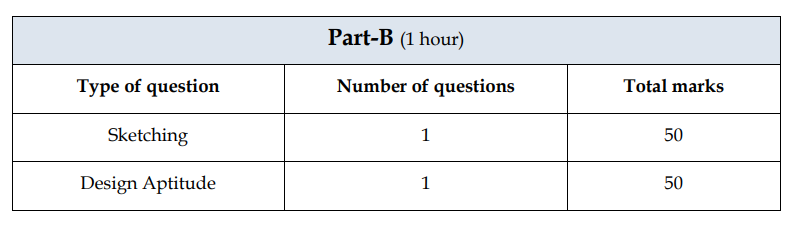
- UCEED Part B have 2 subjective questions for 100 marks on Sketching and Design Aptitude. UCEED Part B contains two 50-mark questions on Sketching and Design Aptitude, making it 100 marks
- NAT questions carry +4 marks without negative marking, while MCQs carry +3 marks with a −0.71 mark penalty for incorrect answers.
- MSQs follow partial marking, with a −1 mark penalty applicable under the prescribed marking conditions.
- Candidates will get 2 hours for Part A and 1 hour for Part B in the UCEED exam.
Related Links:
- UCEED Syllabus 2027: Part A and Part B Topics, Weightage, and PDF Download
- UCEED 2026 Question Paper with Answer key Available- Download PDF
- UCEED Study Materials - Recommended Books, Online Materials, PYQs, and Syllabus
Key Summary
- UCEED 2027 is scheduled for January 17, 2027, as per the latest official exam schedule.
- The UCEED exam pattern follows separate Part A and Part B evaluation, with Part A covering objective question types.
- UCEED Part A includes NAT, MSQ and MCQ sections with different marking rules for each question type.
- UCEED Part B tests Sketching and Design Aptitude through subjective evaluation by examiners.
- The UCEED marking scheme gives partial marks in MSQs, while NAT has no negative marking and MCQs carry a negative mark for incorrect answers.
UCEED Exam Pattern 2027 Overview
The UCEED Exam Pattern 2027 follow a 3-hour format with Part B evaluated only for candidates shortlisted through Part A.
- UCEED Part A have 57 questions for 200 marks covering NAT, MSQ and MCQ formats.
- The Part A structure includes 14 NAT, 15 MSQ and 28 MCQ questions with partial marking for MSQs.
- UCEED Part B contains two 50-mark questions on Sketching and Design Aptitude making it worth 100 marks.
- Part B answers are manually evaluated by expert examiners after Part A shortlisting.
- The detailed UCEED 2027 information including the confirmed exam pattern and other admission details will be released by IIT Bombay as per its announced schedule.
| Particulars | Details |
|---|---|
| Conducting Body | IIT Bombay |
| Exam Date | January 17, 2027 (Sunday) |
| Total Duration | 3 hours (180 minutes) |
| Part A Duration | 2 Hour (120 Minutes) |
| Part B Duration | 1 Hour (60 minutes) |
| Total Marks | 300 |
| Part A Marks | 200 |
| Part B Marks | 100 |
| Medium | English |
| Mode | Part A: Computer-Based Test (CBT)Part B: Pen & Paper (Offline) |
| Parts | Part A + Part B (both compulsory) |
| Part A Questions | 57 |
| Part B Questions | 2 |
| Part A Question Types | NAT, MSQ, MCQ |
| Part B Question Types | Sketching, Design Aptitude |
| Evaluation Note | Part B is evaluated only if the candidate clears the Part A cutoff. Final rank is based on combined Part A + Part B scores. |
Also Check:
- UCEED Mock Test, Free Online Mock test, Sectional Tests, PDFs
- UCEED Sample Papers with Solutions PDF Free Download
Ques. Is UCEED tougher than JEE?
Ans. Both exams test different skills. UCEED focuses on design aptitude, visualisation, creativity, reasoning and drawing, while JEE focuses mainly on Physics, Chemistry and Mathematics. So, the difficulty depends on the candidate's strengths.
UCEED Exam Pattern: Year-Wise Changes
UCEED Exam Pattern changes became significant in 2024, when Part A was reduced from 68 questions and 240 marks to 57 questions and 200 marks.
- The 2024 UCEED exam pattern increased Part B to 100 marks which changes the balance between objective and subjective evaluation.
- Since 2024, UCEED Part A has retained 57 questions while Part B has continued with two subjective questions.
- Part B changed from one 60 mark sketching question to two 50 mark questions on Sketching and Design Aptitude.
- The revised UCEED exam pattern gives 100 of 300 marks to Part B which increases its share of the paper.
- The 2025 and 2026 UCEED papers retained the same 57 question Part A and two question Part B structure.
| Year | Part A Questions (NAT + MSQ + MCQ) | Part A Marks | Part A Duration | Part B Questions | Part B Marks | Total Marks | Key Change |
|---|---|---|---|---|---|---|---|
| 2020–2023 | 18 + 18 + 32 = 68 | 240 | ~2.5 hours | 1 (Sketching only) | 60 | 300 | Older format with higher Part A weightage |
| 2024 | 14 + 15 + 28 = 57 | 200 | 2 hours | 2 (Sketching + Design Aptitude) | 100 | 300 | Major revision: Part A reduced, Part B expanded & duration adjusted |
| 2025 | 14 + 15 + 28 = 57 | 200 | 2 hours | 2 (Sketching + Design Aptitude) | 100 | 300 | No change |
| 2026 | 14 + 15 + 28 = 57 | 200 | 2 hours | 2 (Sketching + Design Aptitude) | 100 | 300 | No change |
| 2027 (Expected) | 14 + 15 + 28 = 57 | 200 | 2 hours | 2 (Sketching + Design Aptitude) | 100 | 300 | Expected to continue unchanged |
Key Changes in UCEED Exam Pattern
- The 2024 revision shifted more scoring weight to Part B which increases its share of the 300-mark paper from 20% to 33.3%.
- The current format tests three objective question types in Part A: NAT, MSQ and MCQ.
- MSQs use partial marking which makes option selection important in the UCEED marking scheme.
- The current paper has separate time limits for Part A and Part B, with 2 hours and 1 hour, respectively.
- IIT Bombay's official archive shows the 57 question Part A and 2 question Part B structure continuing through the 2025 and 2026 papers.
Also Check:
- UCEED Aptitude Sample Papers - Download PDF | Previous Year Papers
- UCEED Drawing & Creativity Sample Papers
Ques. Which year was the UCEED paper toughest?
Ans. Among recent UCEED papers, 2022 is often considered one of the toughest, with the paper rated moderate to difficult. The 2023 paper was also considered challenging, while 2024–2026 were generally easier to moderate.
UCEED Part A Exam Pattern 2027: NAT, MSQ and MCQ
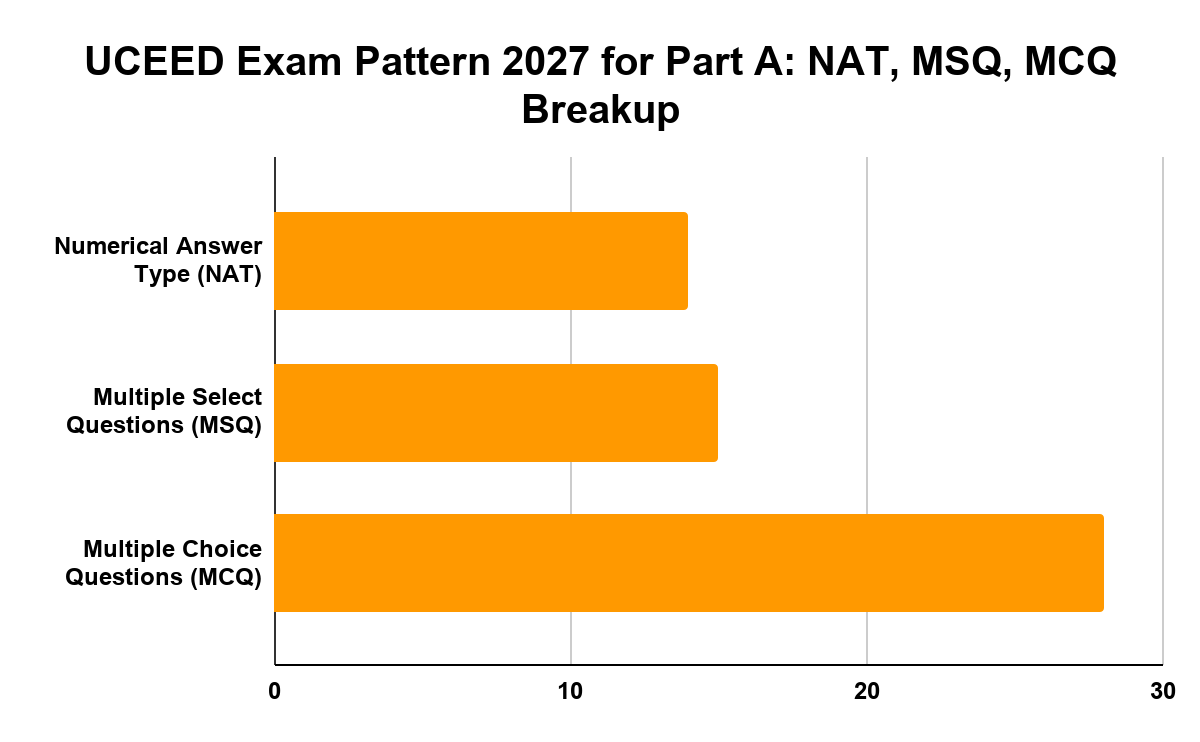
UCEED Part A Exam Pattern 2027 have 57 questions for 200 marks, with 2 hours allotted to the section.
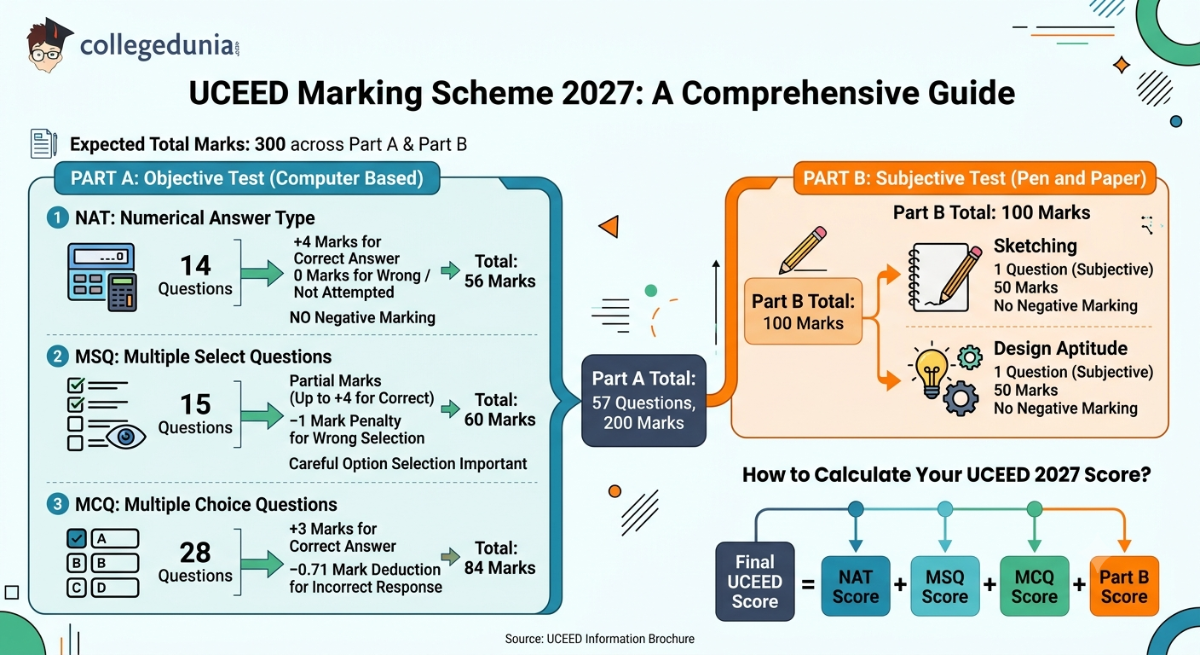
- UCEED Part A includes 14 NAT questions worth 56 marks and 15 MSQ questions carrying 60 marks.
- MCQs have the highest question count, with 28 questions carrying 84 marks in the UCEED Part A exam pattern.
| Section | Question Type | No. of Questions | Total Marks |
|---|---|---|---|
| 1 | Numerical Answer Type (NAT) | 14 | 56 |
| 2 | Multiple Select Questions (MSQ) | 15 | 60 |
| 3 | Multiple Choice Questions (MCQ) | 28 | 84 |
| Total | — | 57 | 200 |
Also Check:
- UCEED Complete (Full-length) Sample Papers - Download Free PDF
- UCEED, CEED 2024 Final Answer Key Out; Download PDF Link Here
Ques. What is the exam pattern for the UCEED 2027 exam?
Ans. The UCEED 2027 exam pattern have Part A and Part B for a total duration of 3 hours. Based on the latest pattern, Part A has NAT, MSQ and MCQ questions, while Part B has drawing and design aptitude questions. The final 2027 pattern will be confirmed by IIT Bombay.
UCEED Part B Exam Pattern 2027: Sketching and Design Aptitude
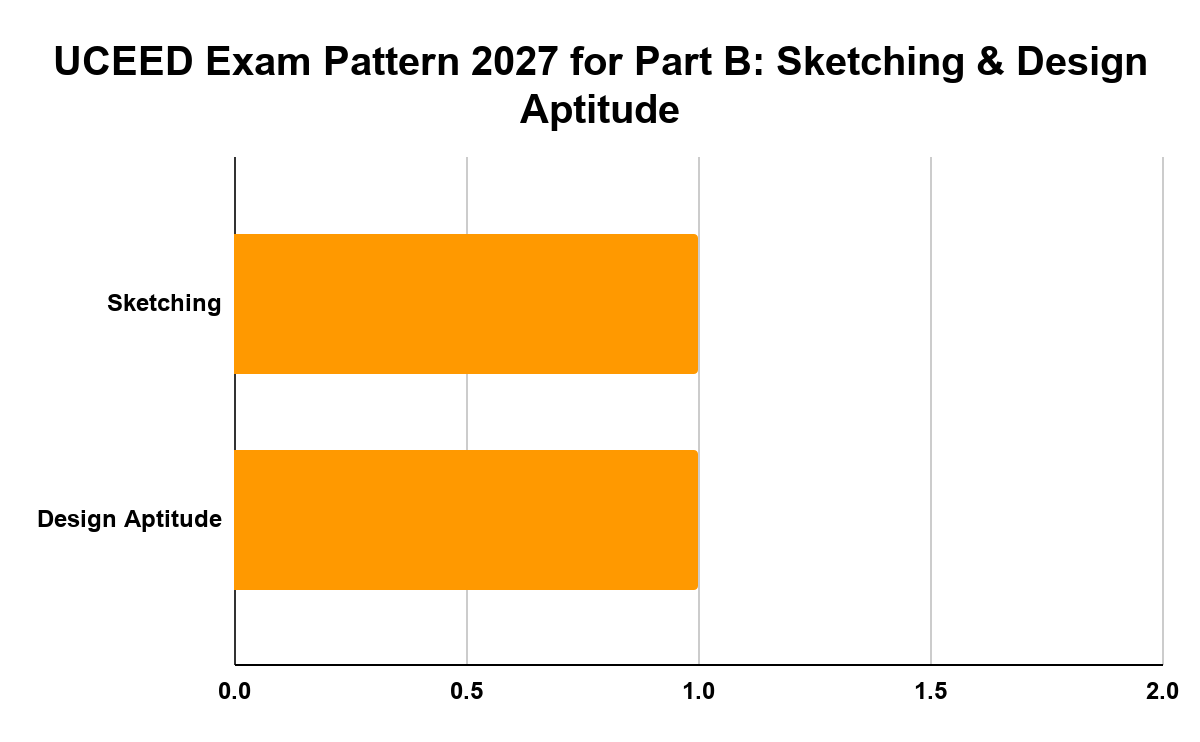
UCEED Part B Exam Pattern 2027 carries 100 marks within 60 minutes for two compulsory subjective questions.
- Sketching and Design Aptitude carries 50 marks each in UCEED Part B.
- The Part B questions are displayed on the computer screen while candidates write or draw their answers in the answer booklet.
- UCEED Part B has no negative marking with the responses assessed through subjective evaluation.
- The evaluation tests drawing skills and design aptitude with Part B accounting for 100 marks in the UCEED paper.
| Type of Question | Number of Questions | Evaluation Type |
|---|---|---|
| Sketching | 1 | Subjective (drawing) |
| Design Aptitude | 1 | Subjective |
| Total | 2 | – |
Also Check:
| UCEED 2024 Question Paper with Answer Key | UCEED 2020 Question Paper with Answer Key |
| UCEED 2015 Question Paper with Answer Key | UCEED 2016 Question Paper with Answer Key |
Ques. What is considered a good score in UCEED Part B?
Ans. There is no fixed good score for Part B because it is evaluated subjectively and the overall rank depends on Part A + Part B marks. In UCEED 2026, Part B carried 100 marks, with two questions of 50 marks each. A higher Part B score improves the overall rank, especially when candidates have similar total marks.
UCEED has two parts which are Part A tests visualisation, logic and observation while Part B focuses on drawing and creative expression.
- Part A has 57 questions across NAT, MSQ and MCQ carrying 200 marks in the latest official pattern.
- NAT questions have no options requiring candidates to enter a numerical answer directly on the computer.
- MSQ questions can have multiple correct options while incorrect selections can attract a −1 mark penalty under the latest pattern.
- Part B has 2 drawing questions worth 50 marks each and candidates get 1 hour after completing the 2 hour Part A.
Candidates can check this video on Youtube for more information:
UCEED Marking Scheme 2027
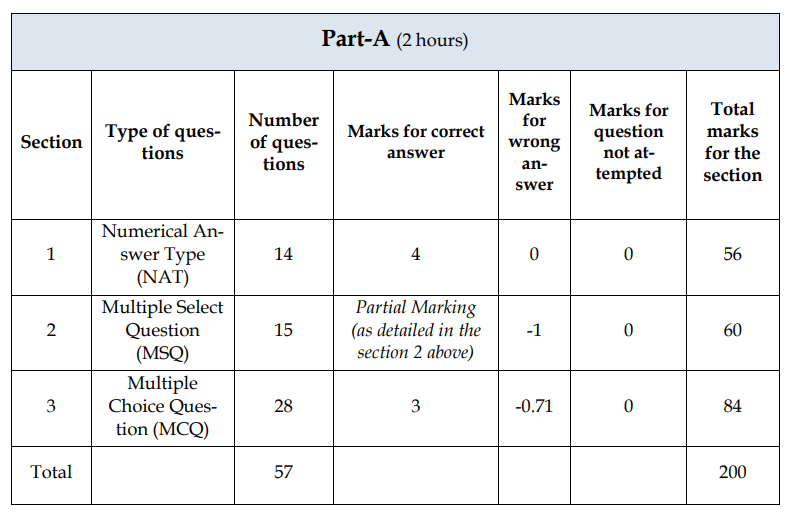
The UCEED Marking Scheme 2027 will award 300 total marks which are divided between Part A and Part B. The UCEED 2027 marking scheme includes negative marking for selected Part A question types.
- NAT questions carry 56 marks in total and have no negative marking for incorrect responses.
- MSQ questions carry a −1 mark penalty for a wrong selection while partial marks can be awarded for certain correct selections.
- MCQ questions carry +3 marks for a correct answer and a −0.71 mark deduction for an incorrect response.
- Part B includes two 50 mark subjective questions with no negative marking, contributing 100 marks to the overall score.
UCEED 2027 Part A Marking Scheme
| Section / Type | No. of Questions | Marks for Correct Answer | Marks for Wrong Answer | Marks if Not Attempted | Total Marks |
|---|---|---|---|---|---|
| Part A | |||||
| Numerical Answer Type (NAT) | 14 | +4 | 0 | 0 | 56 |
| Multiple Select Question (MSQ) | 15 | Partial (up to +4) | –1 | 0 | 60 |
| Multiple Choice Question (MCQ) | 28 | +3 | –0.71 | 0 | 84 |
| Part A Total | 57 | – | – | – | 200 |
Source: UCEED Information Brochure
UCEED 2027 Part B Marking Scheme
| Section / Type | No. of Questions | Marks for Correct Answer | Marks for Wrong Answer | Marks if Not Attempted | Total Marks |
|---|---|---|---|---|---|
| Sketching | 1 | 50 (subjective) | 0 | 0 | 50 |
| Design Aptitude | 1 | 50 (subjective) | 0 | 0 | 50 |
| Part B Total | 2 | – | – | – | 100 |
| Grand Total | 59 | – | – | – | 300 |
Source: UCEED Information Brochure
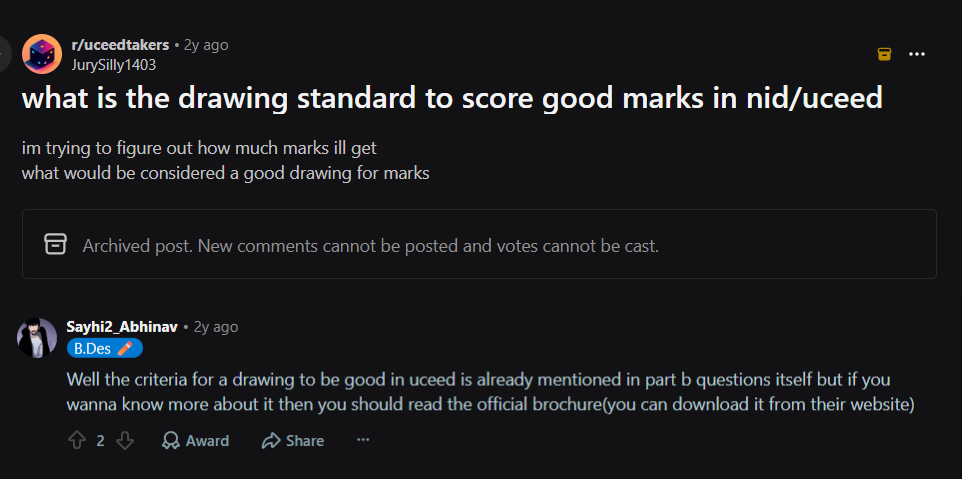
According to a Reddit discussion, candidates asked about the drawing standards required to score well in NID/ UCEED, particularly for Part B. The discussion suggested referring to the official UCEED brochure, where the drawing evaluation criteria are explained.
Source: Reddit
How to Calculate UCEED 2027 Score?
Candidates can calculate the UCEED 2027 score by adding the marks obtained in Part A and Part B. The UCEED score calculation can be done using the following steps:
- Calculate NAT Score: Multiply the number of correct NAT answers by 4.
- Calculate MSQ Score: Add the marks awarded for each MSQ including applicable partial marks and −1 mark for incorrect selections.
- Calculate MCQ Score: Use the formula (Correct answers × 3) − (Wrong answers × 0.71).
- Calculate Part A Score: Add the NAT, MSQ and MCQ scores.
- Calculate Part B Score: Add the marks obtained in Sketching and Design Aptitude.
- Calculate Final UCEED Score: Add the Part A Score and Part B Score.
| UCEED Score = NAT + MSQ + MCQ + Part B |
Key Points for UCEED 2027 Score Calculation :
- NAT is the safest Part A section for guessing as incorrect answers carry 0 marks and there is no negative marking.
- MSQ requires careful option selection because an incorrect combination can result in a −1 mark penalty although partial marks are available for certain correct selections.
- MCQ carries the highest weight in Part A with 84 marks from 28 questions but each incorrect answer attracts a −0.71 mark deduction.
- Part A carries 200 marks, which is two-thirds of the 300-mark UCEED paper.
- Part B carries 100 marks through only 2 questions which makes each question worth 50 marks.
- Candidates must manage 2 hours for Part A and 1 hour for Part B with both parts compulsory.
Also Check:
| UCEED 2017 Question Paper with Answer Key | UCEED 2018 Question Paper with Answer Key |
| UCEED 2019 Question Paper with Answer Key | UCEED 2026 Question Paper with Answer Key |
Ques. What is the marking scheme for the UCEED 2027 exam?
Ans. The UCEED 2027 marking scheme follow the latest pattern, with Part A carrying 200 marks and Part B carrying 100 marks. In Part A, NAT has no negative marking, MSQ has partial marking with -1 for incorrect answers, and MCQ carries +3 for correct and -0.71 for incorrect answers. The final 2027 scheme will be confirmed by IIT Bombay.
UCEED vs NID DAT vs NATA vs CEED Exam Pattern
UCEED, NID DAT, NATA and CEED are among the major design and architecture entrance exams with different paper structures and evaluation methods. The table below compares the latest available patterns for candidates preparing for the 2027 admission cycle.
| Parameter | UCEED (B.Des – IITs) | NID DAT (B.Des/M.Des – NID) | NATA (B.Arch) | CEED (M.Des – IITs) |
|---|---|---|---|---|
| Conducting Body | IIT Bombay | National Institute of Design (NID) | Council of Architecture (CoA) | IIT Bombay |
| Level | Undergraduate | Undergraduate / Postgraduate | Undergraduate | Postgraduate |
| Total Duration | 3 hours | Prelims: 3 hours + Mains (Studio + Interview) | 3 hours | 3 hours |
| Mode | Hybrid (Part A: CBT + Part B: Pen-paper) | Prelims: Pen-paperMains: Offline Studio | Hybrid (Part A: Offline Drawing + Part B: Online CBT) | Hybrid (Part A: CBT + Part B: Pen-paper) |
| Total Marks | 300 | Prelims: 100Mains: 100 | 200 | 250 |
| Structure | Part A: 57 Qs (NAT 14 + MSQ 15 + MCQ 28) – 200 marks (2 hrs)Part B: 2 Qs (Sketching + Design Aptitude) – 100 marks (1 hr) | Prelims: ~26 Qs (22 Objective + 4 Subjective) – 100 marksMains: Studio Test + Interview | Part A: 3 Drawing/Composition Qs – 80 marks (90 min)Part B: ~50 MCQ/NCQ – 120 marks (90 min) | Part A: 44 Qs (NAT 8 + MSQ 10 + MCQ 26) – 150 marks (1 hr)Part B: 5 Qs (Sketching, Creativity, Form/Visual Sensitivity, Problem ID) – 100 marks (2 hrs) |
| Negative Marking | Yes (MSQ: –1, MCQ: –0.71; NAT: None) | Generally None | None | Yes in Part A (MSQ/MCQ); None in Part B |
| Key Focus | Visual reasoning + Design aptitude + Drawing | Creativity + Observation + Studio skills | Drawing + Spatial + Architectural aptitude | Advanced design thinking + Sketching |
| Difficulty Level | Moderate to High | High | Moderate | High |
| Test Takers | ~15,000–16,000 | ~15,000–20,000+ | ~70,000–85,000 | ~5,000–6,000 |
| Acceptance Level | Very High Competition | Very High Competition | Moderate Competition | High Competition |
Note: Patterns are based on the latest available official structures (2026 cycle) and expected to continue for 2027. Always verify with the official brochure of each exam.
Key Observations for UCEED 2027 Candidates
- UCEED has a highly selective admission process with 245 seats across seven participating institutes in the 2026 cycle.
- NID DAT has multiple B.Des campuses with the 2026 handbook listing 428 seats across the five campuses covered in the table.
- NATA has wider admission applicability as its score is used for B.Arch admissions at approved architecture institutions across India.
- CEED has wider postgraduate acceptance with its 2026 website listing IITs, IISc and several other institutes offering M.Des programmes.
- UCEED and CEED are both conducted by IIT Bombay but UCEED is for undergraduate B.Des admissions while CEED is used for postgraduate design admissions.
Also Check:
| UCEED 2025 Question Paper with Solution PDF | UCEED 2024 Question Paper with Solution PDF |
| UCEED 2023 Question Paper with Solution PDF | UCEED 2022 Question Paper with Solution PDF |
Ques. Is CEED harder than UCEED?
Ans. Yes. CEED is generally considered tougher than UCEED because it is conducted for postgraduate design admissions and includes more advanced design and drawing-based questions. In 2026, candidates also found CEED more demanding than UCEED.
UCEED Exam Pattern 2027: Frequently Asked Questions
Ques. Is 110 a good score in UCEED?
Ans. 110 marks can be considered a good score, but the admission chances depend on the year, category and institute. UCEED ranks are based on combined Part A and Part B marks, so score alone does not guarantee admission.
Ques. Does UCEED have two attempts in a year?
Ans. No. UCEED is conducted once a year. Candidates can attempt the exam a maximum of two times in consecutive years, subject to the eligibility criteria.
Ques. Who is eligible for the UCEED exam in 2027?
Ans. The detailed UCEED 2027 eligibility criteria will be released by IIT Bombay by October 1, 2026. UCEED 2027 will be conducted on January 17, 2027.
Ques. What is a good score in UCEED Part A?
Ans. There is no fixed good score for UCEED Part A because the cutoff changes every year. In UCEED 2026, Part A carried 200 marks, and the final rank was prepared using Part A + Part B marks.
Ques. Is UCEED MCQ based?
Ans. No. UCEED is not only MCQ based. Part A includes NAT, MSQ and MCQ questions, while Part B contains drawing questions.
Ques. Can I give UCEED in 2027 if I passed 12th in 2025?
Ans. Yes, candidates who passed Class 12 in 2025 can appear for UCEED 2027, subject to the official 2027 eligibility criteria. UCEED eligibility is based on the year of passing Class 12 and other conditions notified by IIT Bombay. The UCEED 2027 eligibility criteria are will be released with the official brochure.
Ques. Which exam is tough, NID or UCEED?
Ans. Both are competitive, but UCEED can be more difficult in terms of analytical and visual reasoning, while NID DAT is more challenging for creativity, drawing and subjective questions. The difficulty depends on the candidate's strengths.



Comments