




VITEEE Syllabus 2027 covers Physics, Chemistry, Mathematics (or Biology), Aptitude, and English: five subjects tested in Vellore Institute of Technology’s annual Engineering Entrance Examination.
The Vellore Institute of Technology released the official VITEEE 2027 Information Brochure and Syllabus on October 20, 2026, coinciding with the launch of the online application portal.
- The exam is computer-based, 2 hours 30 minutes long, with 125 multiple-choice questions worth 500 total marks.
- Marking scheme: +4 for each correct answer, −1 for each wrong answer; unanswered questions carry zero marks.
- The VITEEE syllabus is closely aligned with NCERT Class 11 and 12 topics across Physics, Chemistry, and Mathematics.
- Mathematics/Biology carries the highest weightage at 32% (160/500 marks); Physics and Chemistry contribute 28% each.
- Important topics include Optics, Electromagnetic Induction, Integral Calculus, Organic Chemistry, and Analytical Geometry.
- The official syllabus PDF for VITEEE 2026 is available at viteee.vit.ac.in; the 2027 PDF will be published once the notification is released.
| Subject | Units/Sections | Questions |
|---|---|---|
| Physics | 14 Units | 25 |
| Chemistry | 6 Sections | 25 |
| Mathematics (MPCEA) | 10 Units | 40 |
| Biology (BPCEA) | 10 Units | 40 |
| English | – | 5 |
| Aptitude | – | 5 |
| Total (MPCEA/BPCEA) | – | 100 |
This VITEEE Syllabus 2027 guide covers the official PDFs, 2027 changes, unit-wise topics and expected weightage. It also covers JEE Main and NCERT overlap, high-yield units, study hours, books, a five-month plan and mocks.
Related Links:
- VITEEE 2027: Registration Open, Eligibility, Exam Dates, Cutoff and Revised Syllabus
- VITEEE exam dates 2027: full schedule

VITEEE Syllabus 2027 PDF Download (Official, Subject-Wise)
VIT publishes the VITEEE Syllabus 2027 as five separate PDFs on vit.ac.in. The same text appears as Annexure 18.3 in the 37-page prospectus.
- The five PDFs total 11 pages: Chemistry 4, Physics 2, Maths 2, Biology 2, English and Aptitude 1.
- Science and Maths units rose from 34 in 2026 to 40 in 2027. Physics alone doubled from 7 to 14 units.
- The Chemistry PDF grew from 3 pages to 4, the clearest sign of added content.
- English and Aptitude text is word-for-word the same as 2026, so you can refer to last year's VITEEE question papers
| Subject PDF | Units 2026 | Units 2027 | Pages 2027 | Change level | Official link |
|---|---|---|---|---|---|
| Physics | 7 | 14 | 2 | Major (restructured) | Physics 2027 PDF |
| Chemistry | 7 | 6 | 4 | Major (topics added) | Chemistry 2027 PDF |
| Mathematics | 10 | 10 | 2 | Moderate | Maths 2027 PDF |
| Biology | 10 | 10 | 2 | Minor | Biology 2027 PDF |
| English and Aptitude | 5 aptitude areas + English | Same | 1 | None | English and Aptitude 2027 PDF |
| Full prospectus | — | — | 37 | Pattern changed | VITEEE 2027 prospectus |

Source: VIT, VITEEE 2027 Physics syllabus PDF, page 1 (units 1–7 shown).
How to download VITEEE Syllabus 2027:
Open viteee.vit.ac.in, go to Admission Guidelines, then Syllabus, and click each subject name. Each link opens a PDF directly; no login is required.

Ques. Has VIT released the official VITEEE Syllabus 2027 PDF?
Ans. Yes. VIT released five subject-wise 2027 PDFs on vit.ac.in in October 2026. The same syllabus is mentioned in Annexure 18.3 of the VITEEE 2027 prospectus.
Ques. Do I need to log in to download the VITEEE 2027 syllabus?
Ans. No. The subject PDFs open directly from the Syllabus tab on viteee.vit.ac.in. Only the application form needs a login.
Ques. Is the 2026 syllabus PDF still useful for 2027?
Ans. Only for Biology, English and Aptitude, which barely changed. Physics, Chemistry and Maths need the 2027 PDFs because units were added and removed.
VITEEE Syllabus 2027 Changes: What Is New vs 2026
- Physics has new four Class 11 units: Units and Measurements, Kinematics, Rotation and Gravitation, and Oscillations and Waves. None of these existed in the 2026 PDF.
- Chemistry merges 7 units into 6 but adds about 10 topic blocks. These include the periodic table, ionic equilibrium, colloids and everyday-life chemistry.
- Maths keeps 10 units but adds 9 sub-topics, such as cubic equations, statistics and Bernoulli's equation. It drops Binomial and Poisson distributions.
- Biology adds only 5 phrases, such as reproductive health and thalassemia. English and Aptitude stay unchanged.
| Subject | Added in 2027 | Removed from 2026 list | Prep impact |
|---|---|---|---|
| Physics | Units and measurements, errors; kinematics; Newton's laws; rotation, MI, rolling; gravitation, satellites; SHM, waves, Doppler; kinetic theory; Stefan–Wien, Newton cooling; RC circuits; Malus's law; XOR/XNOR gates | Transistor as amplifier/oscillator; Boolean algebra, De Morgan; Van de Graaff; cyclotron; tangent galvanometer; Newton's rings; Nicol prism; Thomson and Millikan experiments; carbon resistor colour code | High: about 45–50 extra study hours of Class 11 content (estimate) |
| Chemistry | Lewis, VSEPR, MOT, H-bond; zeroth and third laws, Hess's law; ionic equilibrium, Henderson, Ksp; periodic trends; Groups 13–18 compounds; CFT; band theory; colloids; aromaticity, Friedel–Crafts; haloform; vitamins; everyday-life chemistry | Xenon fluorides; X-ray diffraction | High: inorganic p-block and Class 11 physical chemistry return |
| Mathematics | Cubic and biquadratic equations; LPP applications; rate of change; Cauchy MVT; indefinite integrals; Bernoulli's equation; central tendency and dispersion; types of binary operations; product rule, P&C; contingency | Binomial and Poisson distributions | Moderate: about 15–20 extra hours (estimate) |
| Biology | Reproductive health; thalassemia; mechanism of evolution; movements in plants; hyper- and hyposecretion disorders | None | Low |
| English and Aptitude | None | None | None |
Topics Removed from the VITEEE Syllabus 2027
- VIT removed about 15 named Physics topics, mostly Class 12 instrument and device content.
- The removed transistor and Boolean-algebra block covered roughly half the old Semiconductor unit.
- Chemistry lost only 2 named items, so 2026 Chemistry notes stay usable; the new work lies in the additions.
| Subject | Topic dropped in 2027 | What to do |
|---|---|---|
| Physics | Transistor characteristics, amplifier, oscillator | Skip; keep diode, Zener, LED, solar cell |
| Physics | Boolean algebra laws, De Morgan's theorem, gates from discrete components | Skip; learn truth tables for 7 gates instead |
| Physics | Van de Graaff generator, cyclotron, tangent galvanometer | Skip device questions |
| Physics | Newton's rings, thin-film colours, Nicol prism, double refraction | Skip; keep YDSE, single slit, Malus, Brewster |
| Physics | Thomson e/m, Millikan oil drop, isobars and isotones, radio-carbon dating | Skip; keep Bohr model and decay law |
| Physics | Carbon resistor colour code, tangent law | Skip |
| Chemistry | Xenon fluoride compounds | Skip |
| Chemistry | X-ray diffraction in solids | Skip; keep unit cell and packing |
| Mathematics | Binomial and Poisson distributions | Skip; keep expectation and variance |
Ques. Is the VITEEE 2027 syllabus reduced or increased?
Ans. It increased. Physics doubled from 7 to 14 units, and Chemistry added about 10 topic blocks. Only Maths dropped one item: Binomial and Poisson distributions.
Ques. Which subject changed the most in VITEEE 2027?
Ans. Physics. It now covers all Class 11 mechanics, waves and thermal physics, which the 2026 PDF did not list.
Ques. Are transistors in the VITEEE 2027 syllabus?
Ans. No. The 2027 Electronics unit lists diodes, LED, photodiode, solar cell, Zener and logic gates only. Transistor topics were removed.
VITEEE Physics Syllabus 2027 (Unit-Wise)
The VITEEE Physics syllabus 2027 lists 14 units for 25 questions. Seven units come from Class 11 and seven from Class 12. Class 12 topics are covered in our Class 12 Physics handwritten notes.
- Class 11 now supplies 7 of 14 units. In 2026, only one Physics unit (Mechanics and Properties of Matter) drew on Class 11.
- 25 questions over 14 units means fewer than 2 questions per unit on average. Breadth beats depth in Physics now.
- Thermal Physics (unit 7) lists the most items, 21 by our count, followed by Modern Physics with 18. Units and Measurements lists the fewest, 9.
- Unit 14 shrank: transistors and Boolean algebra are gone, but XOR and XNOR gates were added.
| Unit (VITEEE 2027) | Key topics VIT lists | Class | Collegedunia notes / PYQs |
|---|---|---|---|
| 1. Units and Measurements | SI units, dimensional analysis, significant figures, least count, zero error, % uncertainty | 11 | Units handwritten notes |
| 2. Kinematics and Newtonian Dynamics | 1D/2D motion, graphs, relative motion, projectile, circular motion, Newton's laws, friction, pulleys | 11 | — |
| 3. Work, Energy and Momentum | Work by variable force, power, energy conservation, impulse, centre of mass, 2D collisions, restitution | 11 | — |
| 4. Rotational Dynamics and Gravitation | Torque, MI, parallel/perpendicular axis, rolling, Kepler's laws, orbits, escape velocity | 11 | Rotation handwritten notes |
| 5. Mechanical Properties of Matter | Hooke's law, moduli, Pascal, buoyancy, Bernoulli, viscosity, Stokes, surface tension, capillarity | 11 | — |
| 6. Oscillations and Mechanical Waves | SHM energy, spring combinations, pendulum, resonance, standing waves, beats, Doppler effect | 11 | — |
| 7. Thermal Physics | Calorimetry, conduction, Stefan–Boltzmann, Wien, Newton cooling, kinetic theory, heat engines, Carnot, entropy | 11 | Thermodynamics handwritten notes |
| 8. Electrostatics | Coulomb, field, potential, dipole, Gauss's law, conductors, shielding, capacitors, dielectrics | 12 | Electrostatics PYQs |
| 9. Current Electricity | Drift speed, resistivity, emf, Kirchhoff, Wheatstone, metre bridge, potentiometer, galvanometer conversion | 12 | Current electricity PYQs |
| 10. Magnetism | Lorentz force, helical motion, Biot–Savart, Ampere, forces between currents, dipoles, dia/para/ferro | 12 | — |
| 11. EMI and EM Waves | Faraday, Lenz, eddy currents, inductance, RC circuits, AC, LCR resonance, transformers, EM spectrum | 12 | — |
| 12. Optics | Mirrors, lenses, lens-maker, TIR, prism, microscopes, telescopes, YDSE, single slit, Malus and Brewster | 12 | Optics PYQs |
| 13. Modern Physics | Photoelectric effect, de Broglie, Bohr model, binding energy, radioactive decay, half-life, fission, fusion | 12 | Modern physics PYQs |
| 14. Electronics | Energy bands, diode I-V, rectifier, LED, photodiode, solar cell, Zener, logic gates incl. XOR and XNOR | 12 | — |
Ques. How many units are in the VITEEE Physics syllabus 2027?
Ans. There are 14 units, up from 7 in 2026. Units 1–7 are Class 11 topics and units 8–14 are Class 12 topics.
Ques. Is rotational motion in the VITEEE 2027 syllabus?
Ans. Yes. Unit 4 covers torque, moment of inertia, parallel- and perpendicular-axis theorems, rolling without slipping and gravitation. The 2026 syllabus did not list it.
Ques. Are logic gates in VITEEE Physics 2027?
Ans. Yes. Unit 14 lists NOT, AND, OR, NAND, NOR, XOR and XNOR gates. Boolean algebra and De Morgan's theorem were removed.
VITEEE Chemistry Syllabus 2027
The VITEEE Chemistry syllabus 2027 has 6 units for 25 questions. It is the longest PDF at 4 pages. Revise chapter theory with the Class 12 Chemistry handwritten notes.
- Inorganic Chemistry (unit 3) grew the most. It now names 20+ specific compounds, from borax and silicones to sulphuric acid manufacture.
- Organic content spans units 5 and 6, about one-third of the syllabus text. Expect 7–8 of 25 questions from it (estimate).
- VIT lists 7 name reactions by name: Clemmensen, Wolff–Kishner, Cannizzaro, Claisen–Schmidt, benzoin, aldol and haloform.
- The PDF names exact preparations, such as anisole, benzophenone, lactic acid and benzylamine. These are direct question sources.
| Unit (VITEEE 2027) | Key topics VIT lists | Class | Collegedunia notes / PYQs |
|---|---|---|---|
| 1. Physical Chemistry | Atomic structure (Bohr, Sommerfeld, quantum numbers, spectra), bonding (VSEPR, MOT), thermodynamics, chemical kinetics | 11 + 12 | Structure of Atom handwritten notes; Kinetics PYQs |
| 2. Analytical Chemistry | Electrochemistry, conductance, Nernst, cells, corrosion, chemical and ionic equilibrium, solutions, environmental chemistry | 11 + 12 | Electrochemistry PYQs |
| 3. Inorganic Chemistry | Periodic trends, s-block, p-block (Groups 13–18 compounds), d-block, Cu/Ag/Au/Zn extraction, lanthanides | 11 + 12 | p-Block study notes |
| 4. Coordination and Material Chemistry | IUPAC, isomerism, Werner, VBT, CFT, haemoglobin and chlorophyll, solid state, adsorption, catalysis, colloids | 12 | Coordination handwritten notes |
| 5. Organic Basics and Functionalised Compounds | GOC, isomerism, R/S, aromaticity, Friedel–Crafts, alcohols, ethers, aldehydes, ketones, name reactions, Grignard | 11 + 12 | Carbonyl compounds PYQs |
| 6. Acids, Nitrogen Compounds, Biomolecules and Polymers | Carboxylic acids and derivatives, nitro compounds, amines, diazonium salts, biomolecules, vitamins, polymers, everyday-life chemistry | 12 | — |
Ques. How many units are in VITEEE Chemistry 2027?
Ans. Six: Physical, Analytical, Inorganic, Coordination and Material, Organic basics with functional compounds, and acids, nitrogen compounds, biomolecules and polymers.
Ques. Is p-block in the VITEEE 2027 syllabus?
Ans. Yes. Groups 13 to 18 are fully listed, including boron, silicon, nitrogen, phosphorus, oxygen, sulphur and halogen compounds. The 2026 list covered only a few p-block items.
Ques. Is chemistry in everyday life in the VITEEE 2027 syllabus?
Ans. Yes. Unit 6 lists drugs such as analgesics and antacids, food preservatives, sweeteners and soaps and detergents. NCERT dropped this chapter in 2023.
VITEEE Mathematics Syllabus 2027
The VITEEE Maths syllabus 2027 has 10 units for 40 questions, the largest section. The Class 12 Maths handwritten notes cover most Class 12 units.
- Maths carries 160 of 400 marks, 60 more than Physics or Chemistry alone.
- Calculus spans three units (6, 7, 8). Expect 12–13 of 40 questions from it (estimate).
- Coordinate geometry spans units 3 and 5. Expect about 9 questions (estimate).
- Five 2027 Maths topics are not in NCERT at all. They are rank of a matrix, cubic equations, Cauchy MVT, Taylor series and Bernoulli's equation.
| Unit (VITEEE 2027) | Key topics VIT lists | Class | Collegedunia notes / PYQs |
|---|---|---|---|
| 1. Matrices and Applications | Determinants, adjoint, inverse, rank, consistency, 3-variable systems, LPP, cubic and biquadratic equations | 12 | Matrices PYQs |
| 2. Trigonometry and Complex Numbers | Trig and inverse trig, heights and distances, Argand plane, polar form, De Moivre, cube and fourth roots | 11 + 12 | Complex numbers PYQs |
| 3. 2D Analytical Geometry | Straight lines, family of lines, general conic, parabola, ellipse, hyperbola, parametric form, chord of contact | 11 | Conic sections handwritten notes |
| 4. Vector Algebra | Scalar and vector products, scalar and vector triple products | 12 | Vector algebra PYQs |
| 5. 3D Analytical Geometry | Direction cosines, skew lines, shortest distance, lines and planes, coplanarity | 12 | 3D geometry PYQs |
| 6. Differential Calculus | Limits, continuity, tangents, normals, rate of change, Rolle, Lagrange, Cauchy MVT, Taylor, Maclaurin, maxima | 11 + 12 | Differentiability PYQs |
| 7. Integral Calculus | Indefinite and definite integrals, properties, reduction formulae, area, length of curves | 12 | — |
| 8. Ordinary Differential Equations | Formation, order, degree, variables separable, homogeneous, linear, Bernoulli's equation | 12 | — |
| 9. Probability and Statistics | Axioms, conditional probability, Bayes, random variables, expectation, variance, central tendency, dispersion | 11 + 12 | Probability PYQs |
| 10. Discrete Mathematics | Sets, relations, functions, binary operations, AP/GP/HP, binomial theorem, P&C, mathematical logic | 11 + 12 | — |
Ques. What is new in the VITEEE Maths syllabus 2027?
Ans. VIT added cubic and biquadratic equations, rate of change, Cauchy MVT, indefinite integrals, Bernoulli's equation, statistics and permutations. Binomial and Poisson distributions were removed.
Ques. Is linear programming in VITEEE 2027?
Ans. Yes. Unit 1 lists LPP in two variables with simple applications. JEE Main 2027 does not include LPP.
Ques. Which Maths unit is most important for VITEEE 2027?
Ans. Calculus. Units 6, 7 and 8 together should yield about 12–13 of 40 questions, by our estimate.
VITEEE Biology Syllabus 2027 for BPCEA (PCB/PCMB)
BPCEA candidates answer 40 Biology questions instead of Maths. Biology opens only 6 B.Tech programmes in 2027, down from 7 in 2026. Check VITEEE eligibility before choosing this stream. The Class 12 Biology NCERT notes map to units 3, 4, 5, 9 and 10.
- Biology changed least of all subjects: 5 phrases added and nothing removed.
- Class 12 supplies 5 of 10 units, but those 5 carry about 20 of 40 expected questions (estimate).
- Unit 5 lists 11 named diseases, from malaria to ringworm. Each is a likely one-line question.
- BPCEA candidates need 60% in PCB and 50% in Biology in Class 12, per the 2027 criteria.
| Unit (VITEEE 2027) | Key topics VIT lists | Class | Expected Qs (estimate) |
|---|---|---|---|
| 1. Taxonomy | Three domains, Whittaker, Bentham–Hooker, non-chordates to phylum, chordates to class, plant anatomy, cockroach | 11 | 3 |
| 2. Cell and Molecular Biology | Cell organelles, cell cycle, mitosis, meiosis, DNA/RNA, replication, transcription, translation, lac operon, DNA repair | 11 + 12 | 4–6 |
| 3. Reproduction | Asexual modes, flowering-plant reproduction, apomixis, gametogenesis, menstrual cycle, reproductive health, ART | 12 | 4–5 |
| 4. Genetics and Evolution | Linkage, crossing over, Mendelian ratios and deviations, sex determination, thalassemia, Hardy–Weinberg | 12 | 4–6 |
| 5. Human Health and Diseases | Malaria, dengue, chikungunya, COVID, typhoid, immunology, vaccines, cancer, HIV/AIDS, drug abuse | 12 | 3 |
| 6. Biochemistry | Carbohydrates, lipids, proteins, enzymes, glycolysis, fermentation, Krebs cycle | 11 | 3 |
| 7. Plant Physiology | Transport, nutrients and deficiency, transpiration, photosynthesis, ETC, growth regulators, nitrogen fixation | 11 | 4 |
| 8. Human Physiology | Digestion, respiration, circulation, excretion, endocrine, nervous, muscular systems, hormonal disorders | 11 | 4–6 |
| 9. Biotechnology and Applications | rDNA, GMOs, insulin, gene therapy, stem cells, Bt crops, tissue culture, SCP, biopiracy, DNA fingerprinting | 12 | 4–5 |
| 10. Biodiversity, Ecology and Environment | Ecosystem pyramids, nutrient cycles, succession, hotspots, Ramsar sites, pollution, climate change | 12 | 3 |
Ques. Can PCB students take VITEEE 2027?
Ans. Yes. PCB and PCMB students can choose BPCEA and attempt Biology instead of Maths. They qualify for 6 programmes, including Biotechnology, CSE (Bioinformatics) and Health Sciences and Technology.
Ques. Did the VITEEE Biology syllabus change for 2027?
Ans. Only slightly. VIT added reproductive health, thalassemia, mechanism of evolution, movements in plants and hormonal disorders. No unit was removed.
Ques. How many Biology questions are in VITEEE 2027?
Ans. There are 40 Biology questions worth 160 marks, with a 50-minute section limit.
B.Tech Programmes Open to BPCEA Candidates in VITEEE 2027
- ECE (Biomedical Engineering) at VIT Vellore appeared in the 2026 BPCEA list but is missing from the 2027 list.
- Three of the six programmes run at VIT Bhopal; Biotechnology runs at three campuses.
| Programme | Campus |
|---|---|
| B.Tech Biotechnology | Vellore, Chennai, AP |
| B.Tech CSE (Bioinformatics) | Vellore |
| B.Tech Health Sciences and Technology | Vellore |
| B.Tech Bioengineering | Bhopal |
| B.Tech CSE (Health Informatics) | Bhopal |
| B.Tech CSE (Education Technology) | Bhopal |
VITEEE English and Aptitude Syllabus 2027
English and Aptitude share one 10-minute section with 10 questions and 40 marks. VIT's one-page PDF names 5 aptitude areas and 3 English skills.
- At 60 seconds per question, this is the tightest section. A data-sufficiency item with two statements needs about 45 seconds.
- The aptitude list names 23 question formats across 5 areas, from mixed charts to mirror-image clocks.
- Aptitude fell from 10 to 5 questions in 2027. It is now worth 20 marks, down from 40 in 2026.
- English tests passage comprehension, lines of poems, grammar and pronunciation at Class 12 level.
| Area | Question formats VIT lists | Practice link |
|---|---|---|
| Data Interpretation | Tables, pie charts, bar charts, line graphs, mixed charts | DI PYQs with solutions |
| Data Sufficiency | All topics combined (2 statements) | VITEEE aptitude PYQs |
| Syllogism | 2 and 2, 3 and 2, 2 and 4, 3 and 4, 3 and 3 statement–conclusion sets | — |
| Number Series, Coding–Decoding | Number series, letter-to-letter, letter-to-number, mixed coding | — |
| Clocks, Calendars, Directions | Clock mirror images, angles, gain or loss, odd days, repeating calendars, direction and distance | — |
| English | Short passage or poem lines, grammar, pronunciation | VITEEE grammar PYQs |
Ques. How many English questions are in VITEEE 2027?
Ans. Five English questions worth 20 marks. They test comprehension of a short passage or poem lines, grammar and pronunciation.
Ques. What is asked in VITEEE Aptitude 2027?
Ans. Five questions from data interpretation, data sufficiency, syllogism, number series and coding, and clocks, calendars and directions.
Ques. How much time do English and Aptitude get in VITEEE 2027?
Ans. They share a 10-minute block for 10 questions. That is 60 seconds per question, the least of any section.
VITEEE 2027 Exam Pattern and Marking Scheme
The VITEEE 2027 exam pattern is the second change in two years. The table tracks all three recent patterns.
- Questions and time both decrease by 20% (125 to 100; 150 to 120 minutes). Average time per question stays at 72 seconds.
- Physics and Chemistry lost 10 questions each (35 to 25). Maths/Biology kept all 40, so its share of marks rose from 32% to 40%.
- Aptitude questions decreased from 10 to 5 questions. English and Aptitude together now carry only 40 of 400 marks.
- Sectional timers are new. A student can no longer borrow spare Chemistry minutes for Maths.

Source: VITEEE 2027 prospectus, section 7.1 (b) and (c): question split and section-wise time allocation.
Check full details are on the VITEEE exam pattern page.
VITEEE Chapter-Wise Weightage 2027 (Expert Estimate)
VIT does not publish chapter-wise weightage, and it does not release official question papers. The figures below are a Collegedunia expert estimate.
Check detailed VITEEE 2027 chapter-wise weightage
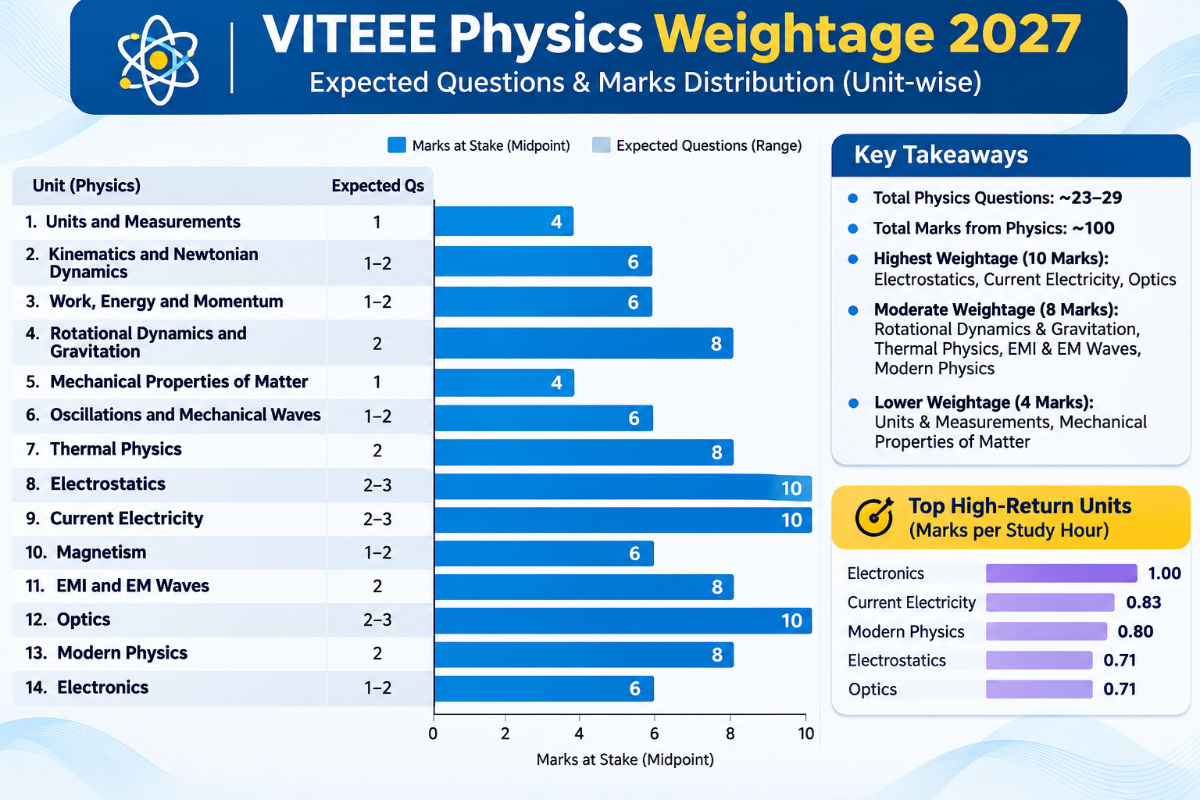
VITEEE Physics Weightage 2027
- Electrostatics, Current Electricity and Optics lead at 2–3 questions each, about 10 marks apiece.
- The four new Class 11 units together should add about 6 questions, roughly 24 marks (estimate).
- Units and Measurements and Mechanical Properties of Matter are 1-question units, worth 4 marks each.
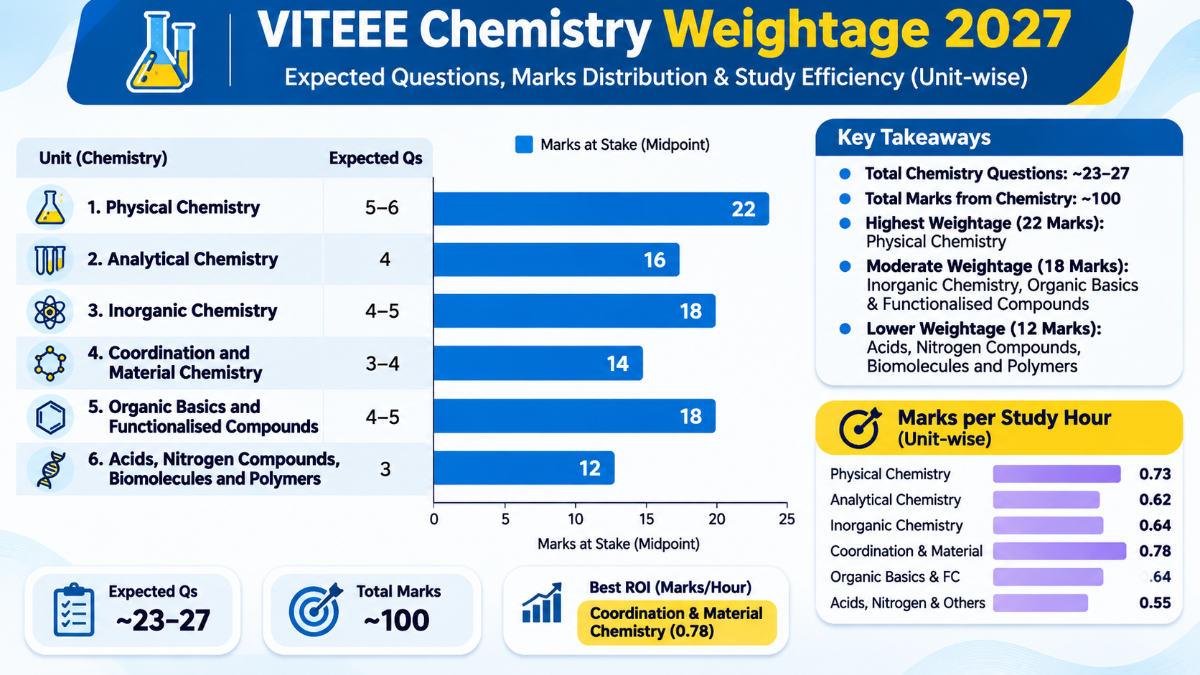
VITEEE Chemistry Weightage 2027
- Physical Chemistry leads with 5–6 questions, about 22 marks, driven by atomic structure, bonding and kinetics.
- Inorganic Chemistry rises to 4–5 questions after the p-block expansion (estimate).
- Unit 6 (acids, amines, biomolecules, polymers) is the lightest at about 3 questions.
VITEEE Maths Weightage 2027
- Differential Calculus and 2D Geometry lead with 5–6 questions each, about 22 marks apiece.
- Vector Algebra is the best return on time: 3–4 questions for about 8 study hours.
- Discrete Maths covers 8 sub-topics for only 2–3 questions, the weakest marks-per-hour ratio.

Ques. Does VIT publish chapter-wise weightage for VITEEE 2027?
Ans. No. VIT publishes only the subject split: 40, 25, 25, 5 and 5 questions. Any chapter-wise figure, including this one, is an expert estimate.
Ques. Which Physics chapters carry the most weight in VITEEE 2027?
Ans. Electrostatics, Current Electricity and Optics, at 2–3 questions each by our estimate. Together they could yield 7–8 of 25 questions.
Ques. Which Maths chapter is most scoring in VITEEE?
Ans. Vector Algebra gives about 14 marks for roughly 8 hours of study. Its formulas are short and its questions are mostly direct.
VITEEE Syllabus 2027 vs JEE Main 2027 vs CBSE Class 12
We matched every VITEEE 2027 unit against the NTA JEE Main 2027 syllabus. Unit lists for JEE sit on the JEE Main Physics syllabus, Chemistry syllabus and Maths syllabus pages. Overlap is weighted by expected VITEEE questions.
- Physics overlaps about 89% with JEE Main 2027. Thermal Physics is the weakest match at 65%. JEE Main 2027 has no Carnot engine, Stefan–Wien laws or Newton's cooling.
- Chemistry overlaps about 73%. Coordination and Material Chemistry is only 45% common, since JEE Main 2027 has no solid state, colloids or catalysis.
- Maths overlaps about 79%. Matrices and Differential Calculus are the least common, at about 60% each.
- Across PCM, overlap averages about 80%. The extra 20% is from 9 of 30 PCM units.
| Subject | Overlap with JEE Main 2027 | Lowest-overlap unit | Coverage in CBSE Class 12 NCERT (2026–27) |
|---|---|---|---|
| Physics | 89% | Thermal Physics (65%) | 7 of 14 units (units 8–14); units 1–7 are Class 11 |
| Chemistry | 73% | Coordination and Material (45%) | Units 2, 4 and 6 are mostly Class 12, but solid state, colloids and polymers left NCERT 12 in 2023 |
| Mathematics | 79% | Matrices, Differential Calculus (60%) | Units 4, 5, 7 and 8 fully; units 1, 6, 9 and 10 partly |
| Biology | Not applicable | — | 5 of 10 units (3, 4, 5, 9, 10) |
Overlap is a Collegedunia analysis of the official VITEEE 2027 and JEE Main 2027 syllabus texts. The CBSE column shows which VITEEE units the current Class 12 NCERT books teach.
VITEEE-Only Topics Not in JEE Main 2027
- We found 24 VITEEE 2027 topics that JEE Main 2027 does not list. A JEE-only student would see them first in the VITEEE hall.
- Chemistry holds the most VITEEE-only material: s-block, metallurgy, solid state, colloids, polymers and everyday-life chemistry.
- Most VITEEE-only Physics items are single formulas, such as Malus's law. Each takes under an hour to learn.
| Subject | VITEEE-only topic (not in JEE Main 2027) | VITEEE unit |
|---|---|---|
| Physics | Doppler effect in sound | 6 |
| Physics | Stefan–Boltzmann and Wien laws, Newton's law of cooling | 7 |
| Physics | Heat engines, refrigerators, Carnot limit, entropy | 7 |
| Physics | Potentiometer | 9 |
| Physics | RC charging and discharging | 11 |
| Physics | Malus's law | 12 |
| Physics | Radioactive decay, half-life, mean life, activity | 13 |
| Physics | XOR and XNOR gates | 14 |
| Chemistry | s-block elements (alkali and alkaline earth metals) | 3 |
| Chemistry | Extraction of Cu, Ag, Au and Zn; borax, silicones, zeolites, ozone, H2SO4 process | 3 |
| Chemistry | Solid state, band theory, adsorption, catalysis, colloids, emulsions | 4 |
| Chemistry | Haemoglobin and chlorophyll as bioinorganic compounds | 4 |
| Chemistry | Corrosion and its prevention; environmental pollution | 2 |
| Chemistry | Sommerfeld model; eigenvalues and eigenfunctions | 1 |
| Chemistry | Polymers, vitamins, chemistry in everyday life | 6 |
| Chemistry | Named syntheses: lactic acid, anisole, benzophenone, benzylamine | 5–6 |
| Maths | Rank of a matrix; linear programming | 1 |
| Maths | Cubic and biquadratic equations (theory of equations) | 1 |
| Maths | Heights and distances; De Moivre's theorem; cube and fourth roots | 2 |
| Maths | Rolle's, Lagrange's and Cauchy's mean value theorems | 6 |
| Maths | Taylor and Maclaurin series; errors and approximations | 6 |
| Maths | Reduction formulae; length of curves | 7 |
| Maths | Bernoulli's differential equation | 8 |
| Maths | Binary operations; mathematical logic and truth tables | 10 |
Ques. Is the VITEEE 2027 syllabus the same as JEE Main?
Ans. No. About 80% overlaps across PCM by our analysis. VITEEE adds 24 topics JEE Main 2027 does not list, such as LPP, potentiometer, solid state and polymers.
Ques. Can I prepare for VITEEE and JEE Main together?
Ans. Yes. Finish JEE Main topics first, then spend about 40–50 hours on VITEEE-only topics in March and April 2027.
Ques. Is VITEEE easier than JEE Main?
Ans. VITEEE questions are mostly single-concept MCQs at 72 seconds each. The challenge in 2027 is speed under sectional timers and negative marking, not multi-step depth.
Topics in VITEEE 2027 That NCERT No Longer Covers
VIT tells candidates to refer to NCERT books, but the 2023 NCERT rationalisation removed several chapters VIT still lists. These gaps need non-NCERT material.
- At least 12 VITEEE 2027 topic blocks are absent from the current NCERT books, across all four science subjects.
- Chemistry has the largest gap: 6 blocks, including whole former chapters such as Solid State and Surface Chemistry.
- Older NCERT editions (before 2023–24) still contain most of these chapters and serve as free source material.
| Subject | VITEEE 2027 topic | NCERT status | Where to study |
|---|---|---|---|
| Chemistry | Solid state (unit cell, packing, defects, band theory) | Removed from Class 12 in 2023 | Older NCERT Class 12 Ch 1 |
| Chemistry | Surface chemistry (adsorption, catalysis, colloids) | Removed from Class 12 in 2023 | Older NCERT Class 12 Ch 5 |
| Chemistry | Metallurgy of Cu, Ag, Au, Zn | Removed from Class 12 in 2023 | Older NCERT Class 12 Ch 6 |
| Chemistry | s-block elements | Removed from Class 11 in 2023 | Older NCERT Class 11 Ch 10 |
| Chemistry | Polymers; chemistry in everyday life | Removed from Class 12 in 2023 | Older NCERT Class 12 Ch 15–16 |
| Chemistry | p-block Groups 13–18 compounds | Removed from Classes 11 and 12 in 2023 | p-block study notes |
| Maths | Rank of a matrix; cubic and biquadratic equations | Never in NCERT | State-board Class 12 books or reference books |
| Maths | Rolle's and Lagrange's MVT | Removed from Class 12 in 2023 | Older NCERT Class 12 Ch 5 |
| Maths | Cauchy MVT; Taylor–Maclaurin; Bernoulli's equation; reduction formulae | Never in NCERT | Calculus reference books |
| Maths | Binary operations; mathematical logic | Removed in 2023 | Older NCERT Class 12 Ch 1; Class 11 Ch 14 |
| Biology | Apiculture, animal husbandry, plant breeding, single cell protein | Removed from Class 12 in 2023 | Older NCERT Class 12 Ch 9 |
| Biology | Transport in plants; mineral nutrition; digestion and absorption | Removed from Class 11 in 2023 | Older NCERT Class 11 |
Ques. Is NCERT enough for VITEEE 2027?
Ans. Not fully. At least 12 listed topic blocks fall outside current NCERT. Solid state, s-block and rank of a matrix need older NCERT editions or reference books.
Ques. Which NCERT edition should I use for VITEEE 2027?
Ans. Use the current NCERT for core theory. Use pre-2023 NCERT chapters for solid state, surface chemistry, metallurgy, polymers and the other removed topics.
Important Topics for VITEEE 2027: High-Yield vs Low-Yield Units
We ranked each unit by expected marks per study hour. The ratio uses the weightage estimate and the study-hour estimate in this guide. Test each high-yield unit with VITEEE previous year papers.
- Maths units return the most marks per hour, from 0.71 to 1.75. Physics and Chemistry units return 0.50 to 1.00.
- Vector Algebra (1.75) and 3D Geometry (1.40) top the list. Together they offer about 28 marks for about 18 hours.
- Electronics (1.00) is the best Physics unit: 1–2 questions for about 6 hours of diode and gate work.
- Low yield is not 'skip'. With fixed section timers, every unit still feeds its own 25- or 40-question block.
| Subject | High-yield units (marks per hour) | Low-yield units (marks per hour) | Must-know sub-topics |
|---|---|---|---|
| Physics | Electronics (1.00); Current Electricity (0.83); Modern Physics (0.80) | Mechanical Properties of Matter (0.50); Oscillations and Mechanical Waves (0.50) | Kirchhoff and bridge circuits, Gauss's law, lens-maker formula, photoelectric equation, decay law |
| Chemistry | Coordination and Material Chemistry (0.78); Physical Chemistry (0.73); Inorganic Chemistry (0.64) | Analytical Chemistry (0.62); Acids, Nitrogen Compounds, Biomolecules and Polymers (0.55) | Quantum numbers, VSEPR shapes, Nernst equation, CFT colours, unit-cell density, name reactions |
| Mathematics | Vector Algebra (1.75); 3D Analytical Geometry (1.40); Matrices and Applications (1.29) | Integral Calculus (0.90); Discrete Mathematics (0.71) | Triple products, shortest distance of skew lines, adjoint and inverse, Bayes' theorem, De Moivre |
Top 15 Sub-Topics to Revise Before VITEEE 2027
- These sub-topics appear explicitly in the 2027 PDFs and sit inside high-yield units.
- Six of the 15 are Maths sub-topics, matching the 40% share of marks Maths carries.
| # | Sub-topic | Subject and unit | Notes / practice |
|---|---|---|---|
| 1 | Scalar and vector triple product | Maths, unit 4 | Vector algebra PYQs |
| 2 | Shortest distance between skew lines | Maths, unit 5 | 3D geometry PYQs |
| 3 | Inverse by adjoint; consistency of systems | Maths, unit 1 | Matrices PYQs |
| 4 | Bayes' theorem; conditional probability | Maths, unit 9 | Probability PYQs |
| 5 | De Moivre's theorem; cube roots of unity | Maths, unit 2 | Complex numbers PYQs |
| 6 | Tangents, normals and chord of contact of conics | Maths, unit 3 | Conic sections notes |
| 7 | Kirchhoff's laws; Wheatstone and metre bridge | Physics, unit 9 | Current electricity PYQs |
| 8 | Gauss's law; capacitor combinations | Physics, unit 8 | Electrostatics PYQs |
| 9 | Photoelectric effect; radioactive half-life | Physics, unit 13 | Modern physics PYQs |
| 10 | Diode I-V curves; truth tables of 7 gates | Physics, unit 14 | — |
| 11 | Quantum numbers; hydrogen spectral series | Chemistry, unit 1 | Structure of Atom notes |
| 12 | Nernst equation; Kohlrausch's law | Chemistry, unit 2 | Electrochemistry PYQs |
| 13 | CFT, colour and magnetism of complexes | Chemistry, unit 4 | Coordination notes |
| 14 | Unit-cell density and packing efficiency | Chemistry, unit 4 | — |
| 15 | Seven listed name reactions | Chemistry, unit 5 | Carbonyl PYQs |
Ques. What are the most important topics for VITEEE 2027?
Ans. By marks per study hour, Vector Algebra, 3D Geometry and Matrices lead in Maths. Electronics, Current Electricity and Coordination Chemistry lead elsewhere.
Ques. Which Physics topics can I leave for VITEEE 2027?
Ans. None safely. The lowest-yield units, like Kinematics and Rotation, still carry 1.5–2 questions each, and Physics has its own 30-minute block.
How Long Does the VITEEE Syllabus 2027 Take to Cover?
These study-hour figures are Collegedunia estimates for a Class 12 student starting in November 2026. They count first-pass learning plus problem practice, not revision.
- An MPCEA candidate needs about 474 hours for a first pass. That splits into 154 Physics, 152 Chemistry, 148 Maths and 20 English-Aptitude hours.
- From November 1, 2026 to April 26, 2027 there are 25 weeks. A first pass at 20 hours a week takes about 24 weeks, which leaves almost no revision time.
- At 25 hours a week, the first pass takes about 19 weeks. That frees 6 weeks for mocks.
- Rotational Dynamics (16 hours) and Physical Chemistry (30 hours) are the biggest single time sinks.
| Subject | Units | First-pass hours (estimate) | Largest unit (hours) | Smallest unit (hours) |
|---|---|---|---|---|
| Physics | 14 | 154 | Rotational Dynamics and Gravitation (16) | Units and Measurements; Electronics (6 each) |
| Chemistry | 6 | 152 | Physical Chemistry (30) | Coordination and Material (18) |
| Mathematics | 10 | 148 | 2D Geometry; Differential Calculus (22 each) | Vector Algebra (8) |
| Biology (BPCEA) | 10 | 124 | Cell Biology; Human Physiology (16 each) | Human Health and Diseases (8) |
| English + Aptitude | 5 areas | 20 | Syllogism and DI (8) | Clocks and calendars (3) |
Ques. How many hours does the VITEEE 2027 syllabus need?
Ans. About 474 hours for MPCEA and 450 for BPCEA, by our estimate. That covers first-pass learning and practice, not revision.
Ques. Can I finish the VITEEE syllabus in 3 months?
Ans. Only with prior Class 11 and 12 coverage. A fresh start needs about 474 hours, which is 40 hours a week over 12 weeks.
VITEEE Mock Tests and Previous Year Papers for the 2027 Syllabus
VIT does not release official VITEEE question papers. Memory-based papers on the VITEEE question paper page remain the main practice source. Pair them with VITEEE mock tests.
- Papers before 2026 used +1/0 marking and 35 Physics and Chemistry questions. Rescore them at +4/−1 to read them as 2027 scores.
- Pre-2027 papers miss the new Physics units, so add Class 11 mechanics questions from JEE Main papers.
- Practise every mock in four timed blocks: 50, 30, 30 and 10 minutes.
| Resource | What it covers | 2027 fit | Link |
|---|---|---|---|
| VIT official mock test | Exam interface and question types | Full (opens March 2027, tentative) | vit.ac.in |
| Collegedunia VITEEE mock tests | Full-length and chapter-wise tests | Check pattern note on each test | VITEEE mock tests |
| Subject-wise mocks | Physics, Chemistry, Maths, Biology | Use with section timers | Subject-wise tests on the mock test page |
Ques. Does VIT release official VITEEE question papers?
Ans. No. VIT does not publish past papers or answer keys. Available papers are memory-based reconstructions by students and coaching bodies.
Ques. When is the official VITEEE 2027 mock test?
Ans. The VITEEE 2027 prospectus says VIT will post a mock test on vit.ac.in, tentatively in March 2027.
VITEEE 2026 Question Paper with Solution PDF
| Exam Name | Question Paper PDF | Solution PDF |
|---|---|---|
| VITEEE 2026 May 3 Shift 1 Question Paper | Download PDF | Check Solutions |
| VITEEE 2026 May 3 Shift 2 Question Paper | Download PDF | Check Solutions |
| VITEEE 2026 May 2 Shift 1 Question Paper | Download PDF | Check Solutions |
| VITEEE 2026 May 2 Shift 2 Question Paper | Download PDF | Check Solutions |
| VITEEE 2026 May 1 Shift 1 Question Paper | Download PDF | Check Solutions |
| VITEEE 2026 May 1 Shift 2 Question Paper | Download PDF | Check Solutions |
| VITEEE 2026 April 30 Shift 1 Question Paper | Download PDF | Check Solutions |
| VITEEE 2026 April 30 Shift 2 Question Paper | Download PDF | Check Solutions |
| VITEEE 2026 April 29 Shift 1 Question Paper | Download PDF | Check Solutions |
| VITEEE 2026 April 29 Shift 2 Question Paper | Download PDF | Check Solutions |
| VITEEE 2026 April 28 Shift 1 Question Paper | Download PDF | Check Solutions |
| VITEEE 2026 April 28 Shift 2 Question Paper | Download PDF | Check Solutions |



Comments