




XAT Quant Syllabus 2027 covers Arithmetic, Algebra, Geometry, Number System, Modern Math and Data Interpretation. The QADI section carries 28 questions, the highest of any section in XAT 2027. The XAT Quant syllabus tests both conceptual understanding and the ability to solve problems accurately under time pressure.
While Data Interpretation focuses on analysing tables, charts, and graphs, Quantitative Ability requires strong mathematical fundamentals and logical thinking. A clear understanding of the XAT Quant syllabus helps candidates prioritize high-weightage topics and prepare more effectively for the exam.
- XLRI does not release an official XAT Quant syllabus PDF. Topics are mapped from papers over the past 5 years.
- Arithmetic and Algebra together contribute roughly 45 to 50 percent of the QA questions.
- Experts suggest 14 to 16 attempts at 70 percent accuracy to clear the sectional cutoff.
- Prepare effectively for the XAT Quant Syllabus 2027 by solving PYQs and taking regular Mock Tests.
Related Links:
- XAT Exam Pattern 2027: Section-wise Topics, Weightage, Duration, and Marking Scheme
- XAT Previous Year Question Paper (Available): Download XAT Question Paper with Solutions PDF
- XAT Quant Preparation: Questions, Syllabus, Pattern, Books, Preparation Tips for XAT QA & DI
XAT Quant Syllabus 2027 Overview
| Particular | Details |
|---|---|
| Section Name | Quantitative Aptitude & Data Interpretation (QADI) |
| No. of Questions | 28 (Approx.) |
| Weightage in Part 1 | Around 37% (28 out of 75 questions) |
| Marks per Question | +1 for every correct answer |
| Negative Marking | -0.25 for every incorrect answer |
| Question Types | MCQs with Quantitative Aptitude and Data Interpretation questions |
| Difficulty Level | Moderate to Difficult |
| Major Topics | Arithmetic, Algebra, Geometry, Number System, Modern Mathematics, Data Interpretation |
| Skills Tested | Numerical ability, analytical thinking, logical interpretation, and problem-solving speed |
| Preparation Focus | Build concepts, practice topic-wise questions, solve previous year papers, and take sectional mocks. |
XAT Quant Syllabus 2027: Topic-Wise List
The XAT Quant Syllabus 2027 covers all the major mathematics topics tested in management entrance exams, with a strong focus on conceptual clarity and application-based problem solving.
XAT Quant Syllabus: Arithmetic
Arithmetic is the highest scoring cluster in XAT Quant. Around 8 to 10 questions come from this area every year.
| Arithmetic Topic | Key Subtopics |
|---|---|
| Percentage | Percentage calculations, percentage change, applications |
| Profit and Loss, Discount | Cost Price (CP), Selling Price (SP), profit/loss, marked price, discounts |
| Simple Interest and Compound Interest | SI and CI formulas, annual growth, installment-based questions |
| Ratio, Proportion and Variation | Ratios, proportions, direct & inverse variation |
| Averages, Mixtures and Alligations | Mean, weighted average, mixture replacement, alligation rule |
| Time, Speed and Distance | Speed, distance, time, relative speed, trains, boats & streams |
| Time and Work, Pipes and Cisterns | Work efficiency, combined work, pipes filling and emptying tanks |
| Partnership | Investment ratios, profit-sharing based on capital and time |
XAT Quant Syllabus: Algebra
Algebra questions in XAT often combine two concepts in one problem. Expect maximum equation-based questions here.
| Algebra Topic | Key Subtopics |
|---|---|
| Linear and Quadratic Equations | Solving linear equations, quadratic equations, roots and their properties |
| Inequalities and Modulus | Linear & quadratic inequalities, absolute value (modulus), solution sets |
| Surds, Indices and Logarithms | Simplification of surds, laws of indices, logarithmic identities and equations |
| Maxima and Minima | Quadratic functions, vertex concept, optimization-based problems |
| Polynomials and Remainder Theorem | Polynomial operations, factor theorem, remainder theorem, polynomial roots |
XAT Quant Syllabus: Geometry and Mensuration
XAT gives noticeably more weight to Geometry than CAT does. Do not skip this cluster.
| Geometry & Mensuration Topic | Key Subtopics |
|---|---|
| Triangles, Similarity and Congruence | Triangle properties, similarity, congruence, Pythagoras' theorem |
| Circles, Tangents and Chords | Chords, tangents, angles in circles, cyclic quadrilaterals |
| Quadrilaterals and Polygons | Properties of quadrilaterals, regular polygons, interior & exterior angles |
| Coordinate Geometry | Straight lines, distance formula, section formula, equations of circles |
| Mensuration of 2D and 3D Figures | Area, perimeter, surface area and volume of common shapes and solids |
| Trigonometry and Heights & Distances | Trigonometric ratios, identities, angles of |
XAT Quant Syllabus: Number System
Number System questions are usually short but conceptually tricky in XAT.
| Number System | Key Subtopics |
|---|---|
| Factors, Multiples, HCF and LCM | Prime factorization, factors, multiples, Highest Common Factor (HCF), Least Common Multiple (LCM) |
| Divisibility Rules and Remainders | Divisibility tests, remainder theorem concepts, modular arithmetic basics |
| Unit Digit and Last Two Digits | Cyclicity of unit digits, last two digits of powers, pattern-based problems |
| Base Systems | Decimal, binary and other number bases, base conversion, arithmetic in different bases |
| Number of Trailing Zeroes | Trailing zeroes in factorials, powers of 5, exponent counting techniques |
XAT Quant Syllabus: Modern Mathematics
Modern Math contributes 3 to 5 questions in a typical XAT paper.
| Modern Math | Key Subtopics |
|---|---|
| Permutation and Combination | Fundamental counting principle, arrangements, selections, circular permutations |
| Probability | Basic probability, conditional probability, independent events, expected value |
| Arithmetic, Geometric and Harmonic Progressions | AP, GP, HP, nth term, sum of series |
| Set Theory and Venn Diagrams | Sets, subsets, union, intersection, complement, Venn diagram applications |
| Functions and Graphs | Domain and range, types of functions, function graphs, transformations |
| Binomial Theorem | Binomial expansion, general term, binomial coefficients, Pascal's Triangle |
XAT Quant Syllabus: Miscellaneous
| Miscellaneous Topic | Key Subtopics |
|---|---|
| Data Sufficiency | Two-statement data sufficiency questions, statement analysis, decision-making |
| Time Zone-Based Calculations | International time zones, GMT/UTC conversions, date and time difference problems |
| Statistics | Mean, median, mode, standard deviation, basic data interpretation |
Also Check: XAT Cutoff: Check XLRI Section-wise Cutoff, Score vs Percentile and Good Score
XAT Quant Syllabus 2027: Data Interpretation
DI in XAT is bundled with Quant in the same section.
- It normally contributes 3 to 4 sets of 3 questions each.
- XAT DI sets test reasoning ability more than raw calculation speed.
- Students often need to decode the data structure before solving.
| DI Set Type | What It Tests | Frequency |
|---|---|---|
| Tables | Multi-column data reading and comparison | High |
| Bar Graphs | Growth rate and share calculation | High |
| Pie Charts | Proportion and part-to-whole analysis | Moderate |
| Line Graphs | Trend reading over time periods | Moderate |
| Mixed Graphs | Two chart types combined in one set | High |
| Caselet DI | Data given in paragraph form | Moderate |
| Data Sufficiency | Judging adequacy of given statements | Moderate |
XAT Question Paper with Solutions PDF
You can also find here the answers and solutions prepared by subject-matter experts here.
| XAT Question Paper | Question Paper PDF | Solution PDF |
|---|---|---|
| XAT 2025 Question Paper with Solutions PDF | Download PDF | Check Solutions |
| XAT 2024 Question Paper with Solutions PDF | Download PDF | Check Solutions |
| XAT 2023 Question Paper with Solutions PDF | Download PDF | Check Solutions |
| XAT 2022 Question Paper with Solutions PDF | Download PDF | Check Solutions |
| XAT 2021 Question Paper with Solutions PDF | Download PDF | Check Solutions |
| XAT 2020 Question Paper with Solutions PDF | Download PDF | Check Solutions |
| XAT 2019 Question Paper with Solutions PDF | Download PDF | Check Solutions |
| XAT 2018 Question Paper with Solutions PDF | Download PDF | Check Solutions |
| XAT 2017 Question Paper with Solutions PDF | Download PDF | Check Solutions |
| XAT 2016 Question Paper with Solutions PDF | Download PDF | Check Solutions |
XAT Quant Syllabus 2027: Topic-Wise Weightage
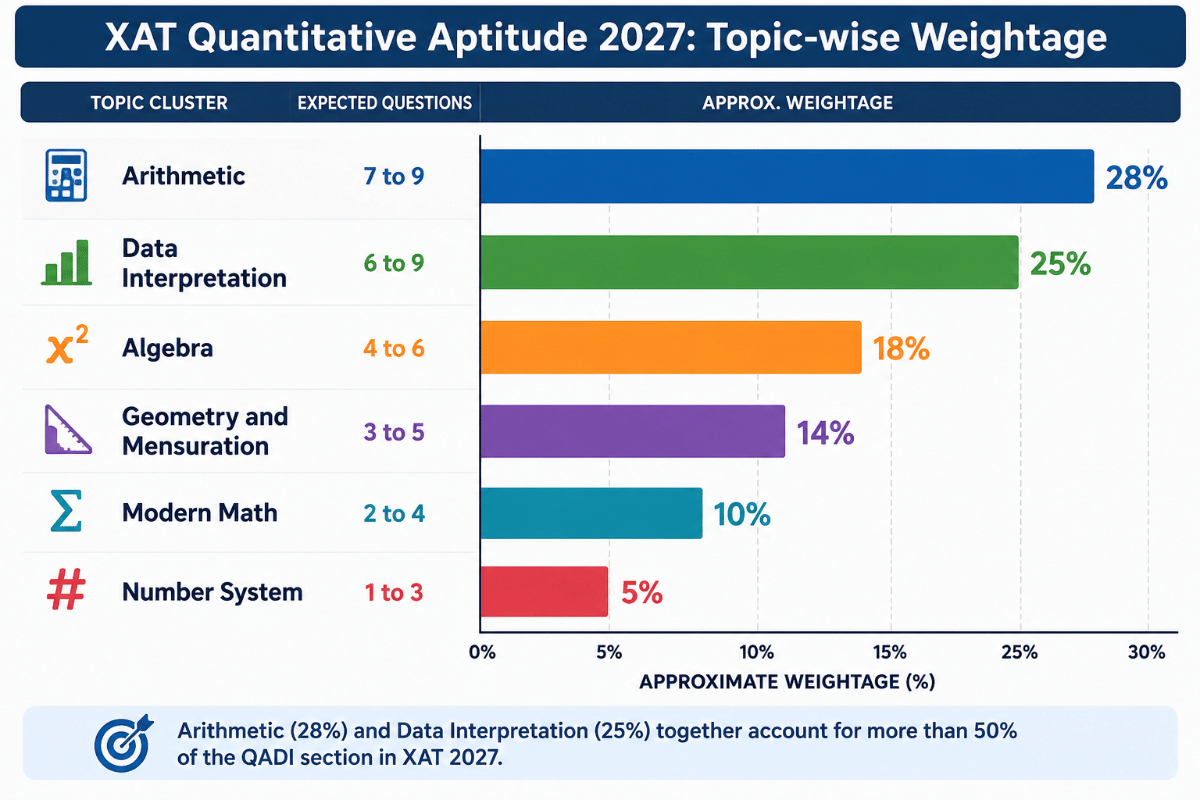
The weightage below is based on trend analysis of XAT 2022 to XAT 2026 papers. Actual numbers shift by one or two questions each year.
Arithmetic and DI together decide almost half your QADI score. Build these two first before touching Modern Math.
| Topic Cluster | Expected Questions | Approx. Weightage |
|---|---|---|
| Arithmetic | 7 to 9 | 28% |
| Data Interpretation | 6 to 9 | 25% |
| Algebra | 4 to 6 | 18% |
| Geometry and Mensuration | 3 to 5 | 14% |
| Modern Math | 2 to 4 | 10% |
| Number System | 1 to 3 | 5% |
Also Check:
XAT Quant Syllabus 2027: High-weightage Topics of Quant & DI
Both exams draw from the same base topic pool. The difference lies in emphasis and question design.
| Topic | Expected Questions | Approx. Weightage | Priority | Key Sub-Topics |
|---|---|---|---|---|
| Arithmetic | 8–10 | 30–35% | Very High |
|
| Data Interpretation | 6–8 | 25–30% | Very High |
|
| Algebra | 5–6 | 18–22% | High |
|
| Geometry & Mensuration | 3–4 | 12–15% | Medium |
|
| Number System | 2–3 | 7–10% | Medium |
|
| Modern Mathematics | 1–3 | 4–10% | Medium |
|
For a better understanding of the syllabus, students can check the below-mentioned YouTube video. This video by Cracku brings students a wholesome guide to XAT Quant Syllabus 2027
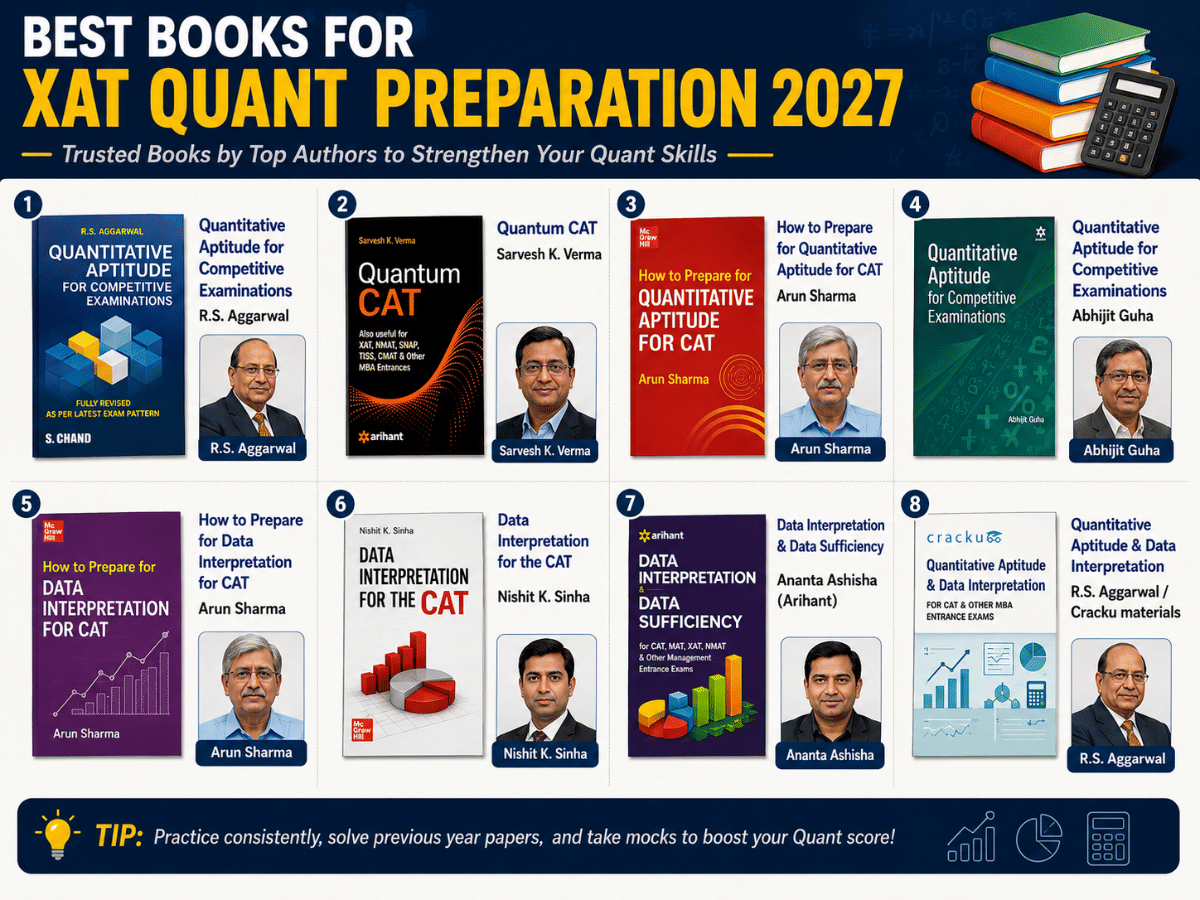
Best Books for XAT Quant Syllabus 2027
| Category | Book Title | Author/Publisher | Why Recommended |
|---|---|---|---|
| Quantitative Ability | Quantitative Aptitude for Competitive Examinations | R.S. Aggarwal | Comprehensive coverage of basics to advanced topics; excellent for Arithmetic and concept clarity. |
| Quantitative Ability | Quantum CAT | Sarvesh K. Verma |
|
| Quantitative Ability | How to Prepare for Quantitative Aptitude for CAT | Arun Sharma | Structured difficulty levels; strong on shortcuts and XAT-level problem-solving. |
| Quantitative Ability | Quantitative Aptitude for Competitive Examinations | Abhijit Guha | Detailed explanations and wide topic range; good for Number System & Mensuration. |
| Data Interpretation | How to Prepare for Data Interpretation for CAT | Arun Sharma | Excellent for all DI formats (Tables, Charts, Caselets, Mixed Graphs); includes progressive difficulty. |
| Data Interpretation | Data Interpretation for the CAT | Nishit K. Sinha | Focused practice sets similar to XAT; strong on calculation-intensive and caselet-based DI. |
| Data Interpretation | Data Interpretation & Data Sufficiency | Ananta Ashisha (Arihant) | Good collection of practice questions with solutions; useful for speed building. |
| Data Interpretation | Quantitative Aptitude & Data Interpretation | R.S. Aggarwal / Cracku materials | Combined approach with ample solved examples tailored for management exams. |
Also Check:
XAT Quant Syllabus 2027: Preparation Tips
The recommended books provide a strong balance of foundational concept-building (R.S. Aggarwal, Arun Sharma) and advanced XAT-level practice (Sarvesh Verma, Nishit Sinha), making them highly effective for covering high-weightage topics like Arithmetic and DI sets.
| Month | Preparation Tips |
|---|---|
| July | Understand the syllabus and exam pattern, identify strengths and weaknesses, and build a daily study schedule. |
| August | Complete core concepts section-wise, practice topic-wise questions, and strengthen fundamentals. |
| September | Increase sectional practice, improve speed and accuracy, and begin solving previous years' papers. |
| October | Attempt 1–2 full-length mock tests every week, analyze mistakes, and revise weak topics. |
| November | Take 2–3 mocks per week, focus on time management, decision-making, and advanced-level practice. |
| December | Revise formulas, grammar rules, vocabulary, and GK/current affairs (if applicable). Analyze final mock tests and fine-tune your strategy. |
| Last Week Before Exam | Avoid new topics, revise short notes, solve a few sectional tests, and maintain a healthy sleep schedule. |

Source: Reddit
A XAT candidate on Reddit is asking for the XAT Quantitative Aptitude syllabus and topic-wise weightage. They are also inquiring about preparation strategies and asking for recommended study resources.
The XAT Quants section heavily emphasizes Geometry, Arithmetic, Algebra, and Data Interpretation, with Geometry and Arithmetic typically carrying the highest weightage (~30–40% each). Candidates prepare by solving past XAT papers (PYQ books), taking targeted mock tests, and using standard quantitative aptitude books like Arun Sharma or online prep modules.
Also Check:
XAT Quant Syllabus 2027: Section-wise Preparation Tips
Allocate 60–70 minutes in the exam for the entire QADI section. Prioritise Arithmetic + DI (cover ~55–60% of paper). Solve at least 2–3 full sectional mocks weekly and analyse errors thoroughly.
| Topic | Key Sub-Topics | Preparation Tips (2027) |
|---|---|---|
| Arithmetic (Highest Weightage) | Percentages, Profit & Loss, Ratio-Proportion, Time & Work, TSD, Averages, SI/CI, Mixtures | Master shortcuts & percentage conversions. Solve 50+ questions daily. Focus on word problems. |
| Data Interpretation | Tables, Bar/Pie Charts, Caselets, Mixed Graphs, Line Graphs | Practice 4–5 sets daily under timed conditions. Emphasise approximation techniques & quick calculations. |
| Algebra | Equations (Linear/Quadratic), Inequalities, Functions, Sequences (AP/GP), Logarithms | Understand conceptual application. Solve previous year XAT + CAT questions. |
| Geometry & Mensuration | Triangles, Circles, Polygons, Coordinate Geometry, 2D/3D Mensuration | Learn key theorems & formulas. Visualise problems; practise diagram-based questions. |
| Number System | HCF/LCM, Divisibility, Remainders, Factors, Cyclicity | Focus on shortcuts for remainders & units digit. Moderate practice is sufficient. |
| Modern Mathematics | Permutation-Combination, Probability, Sets/Venn Diagrams | Limited questions but high accuracy possible. Solve standard variety from Arun Sharma/Sarvesh Verma. |
Also Check:
XAT Quant Syllabus 2027: Exam Pattern
The Quantitative Aptitude & Data Interpretation (QADI) section is the highest-weighted section in XAT 2027, carrying 28 out of 75 questions (around 37%) in Part 1. Since there is no sectional time limit, candidates can decide how much time to allocate to Quant based on their strengths.
| Particulars | Details |
|---|---|
| Section Name | Quantitative Aptitude & Data Interpretation (QADI) |
| Number of Questions | 28 |
| Total Questions in Part 1 | 75 |
| Approximate Weightage | 37% of Part 1 |
| Marks per Question | 1 Mark |
| Negative Marking | -0.25 for each incorrect answer |
| Unattempted Questions | No penalty for the first 8 unattempted questions; thereafter, -0.10 mark per additional unattempted question |
| Sectional Time Limit | No |
| Overall Exam Duration | 180 Minutes (Part 1) |
Also Check:
XAT Quant Syllabus 2027 FAQs
Ques. Is the XAT Quant syllabus 2027 the same as last year?
Ans. Yes, XLRI has notified no change in the syllabus or exam pattern for XAT 2027. The topic pool remains identical to XAT 2026.
Ques. How many questions come from Quant in XAT 2027?
Ans. The Quantitative Ability and Data Interpretation section carries 28 questions. This is the largest section in Part 1 of the exam.
Ques. Which topic has the highest weightage in XAT Quant?
Ans. Arithmetic carries the highest weightage at roughly 28 percent. Data Interpretation follows closely at around 25 percent.
Ques. What is the expected number of questions from Data Interpretation in XAT 2027?
Ans. DI is expected to have 6–8 questions (around 25–30% weightage) in the QADI section of 28 questions. It usually appears in 2–3 sets.
Ques. How difficult is the DI section in XAT compared to CAT?
Ans. XAT DI is generally more calculation-intensive and slightly trickier than CAT. It demands strong approximation skills and careful interpretation of mixed data sets.
Ques. What type of DI questions are asked in XAT?
Ans. XAT DI questions are mainly asked in the form of Tables, Caselets, Bar Graphs, Pie Charts, Line Graphs, and Mixed Charts. They are often calculation-intensive and may include tricky time-zone or multi-source data sets, requiring strong approximation and quick interpretation skills.
Ques. Is XAT Quant tougher than CAT Quant?
Ans. XAT Quant is generally rated tougher. Questions are longer, each has five options, and Geometry carries more weight.
Ques. How much time should I give to the QADI section?
Ans. Experts suggest 55 to 60 minutes out of the 170 minutes in Part 1. There is no sectional time limit in XAT.
Ques. What is the negative marking in XAT Quant?
Ans. You lose 0.25 marks for each wrong answer. You also lose 0.10 marks for every unattempted question beyond eight.
Ques. Is Geometry included in the XAT Quant syllabus 2027?
Ans. Yes. Geometry, Mensuration and Coordinate Geometry are all part of the syllabus. Together they contribute 3 to 5 questions.
Ques. How many attempts are enough to clear the XAT QADI cutoff?
Ans. Around 14 to 16 correct oriented attempts at 70 percent accuracy is the common target. This usually clears the sectional cutoff for XLRI.
Ques. Can I prepare for XAT Quant & DI without coaching?
Ans. Yes. Standard books plus XAT previous year papers are sufficient for most aspirants. Regular mock analysis matters more than coaching.
Ques. How should I cover the XAT Quant & DI syllabus in six months?
Ans. In the first 3 months, build strong fundamentals in Arithmetic, Algebra, Geometry, and Number System using R.S. Aggarwal and Arun Sharma, while solving basic DI sets daily.
In the next 3 months, shift to advanced practice, previous years’ XAT papers, full-length mocks, and intensive DI caselets to improve speed and accuracy.



Comments