




XAT syllabus 2027 is divided into 4 sections, including Verbal Ability and Logical Reasoning, Decision Making, Quantitative Aptitude & Data Interpretation, and General Knowledge.
- Topics included in VALR XAT syllabus 2027 include reading comprehension, vocabulary, analogy, parajumbles, grammar, critical and analytical reasoning, and cloze tests.
- XAT syllabus for Decision Making includes topics like Ethical dilemmas in workplace, Managerial caselets, Business decisions, and situations involving fairness.
- XAT exam syllabus for QA & DI includes topics such as Arithmetic, geometry, algebra, mensuration, modern math, and data interpretation.
- Topics included in the XAT syllabus 2027 for GK are Economy, politics, business, sports, awards, science, world events, and the Constitution of India.
Related Articles:

Key Summary
- XAT 2027 scores of General Knowledge are used by XLRI Jamshedpur for final selection.
- From XAT syllabus 2027, a total of 95 questions will be asked, with 28 from QA and DI, 26 from VALR, 21 from DM and 20 from GK.
- To prepare the XAT syllabus 2027, you must strategize preparation based on the XAT 2027 sectional weightage.
- VALR XAT syllabus focuses on command over English and logical structuring of thoughts.
- Syllabus for XAT DM Evaluates ethical judgment and real-world decision-making ability.
- XAT 2027 syllabus for QA & DI focuses on strong numerical ability and analytical skills.
Section-Wise XAT Syllabus 2027
XAT 2027 syllabus is divided into 2 parts, including 4 sections. The XAT question paper is prepared based on the XAT syllabus for 4 sections: VALR, DM, QD & DI, and GK.
- In XAT syllabus 2027 for VALR, VA includes topics like Reading Comprehension, Para-Completion and Jumbled Sentences, Grammar, and Cloze Tests.
- LR section of VALR XAT syllabus 2027 includes topics from Critical and Analytical Reasoning.
- DI section in QA & DI XAT syllabus includes topics such as Graphs, charts, and tables requiring insightful analysis.
- GK section of XAT syllabus 2027 is divided into Static GK and Current Affairs.
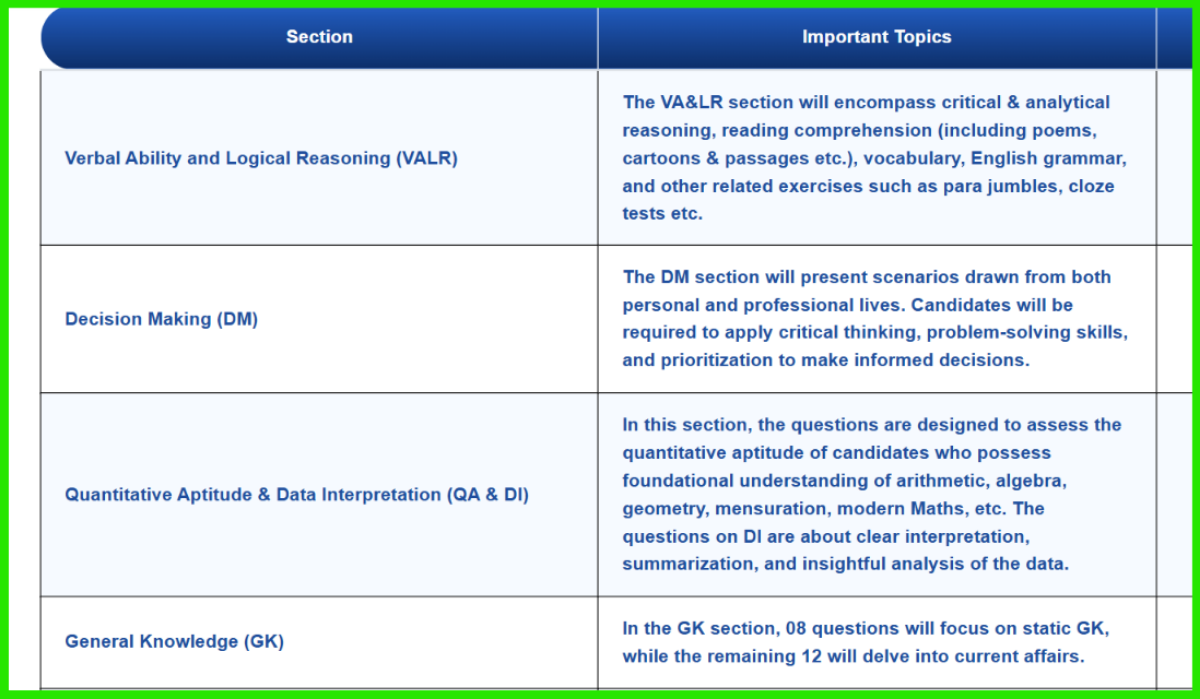
| XAT Section | XAT Syllabus |
|---|---|
| XAT Verbal Ability and Logical Reasoning Syllabus | Reading Comprehension (poems, cartoons, passages), vocabulary, analogy, parajumbles, grammar, critical & analytical reasoning, cloze tests |
| XAT Decision Making Syllabus | Ethical dilemmas in workplace situations, Managerial caselets, Business decision scenarios; situations involving fairness, distribution & prioritization |
| XAT Quantitative Aptitude & Data Interpretation Syllabus | Arithmetic, geometry, algebra, mensuration, modern math, and data interpretation requiring insightful analysis |
| XAT General Knowledge Syllabus | Economy, politics, business, sports, awards, science, world events, Constitution of India |
Source: Official XAT Exam Syllabus Page
Also Check:
- CAT VALR Syllabus and Topic-Wise Weightage
- CAT DM Syllabus and Topic-Wise Weightage
- CAT QA & DI Syllabus and Topic-Wise Weightage
Ques. What are the important topics in XAT QA syllabus 2027?
Ans. As per the official website, important topics in XAT syllabus 2027 for QA include Arithmetic, geometry, algebra, mensuration, and modern math.
XAT Syllabus 2027: Topic-Wise Weightage
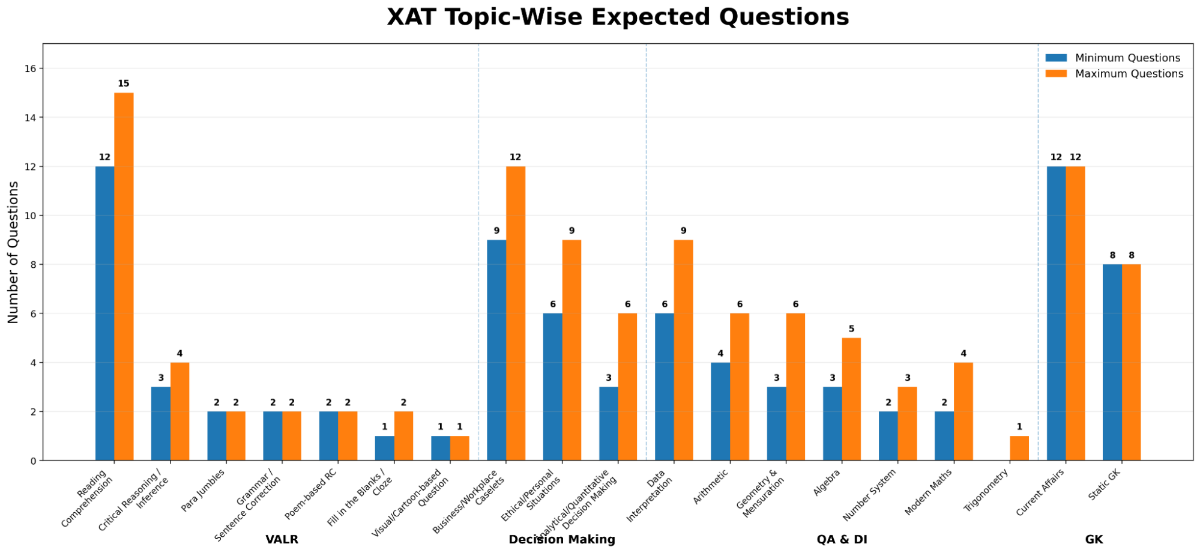
XAT topic-wise weightage can be analyzed based on past years’ papers. Maximum weightage in XAT exam is given to QA and DI sections, with a total of 28 questions. VALR carries 26 questions, and DM and GK carry 21 and 20 questions, respectively.
- In VALR, maximum weightage is given to Reading Comprehension, which covers around 46-58% of the VALR section.
- Critical Reasoning in VALR section carries around 3-4 questions.
- In DM section of the XAT Syllabus 2027, high-weightage topics include Business/Workplace Caselets (43-57%), and Ethical/Personal Situations (29-43%).
- DI carries the highest weightage in the XAT QA & DI section and covers around 21-32% of the section, followed by Arithmetic (14-21%) and Geometry (11-21%).
- In GK section of XAT syllabus 2027, you can expect around 12 questions from Static GK topics and 8 questions from Current Affairs topics.
| Section | Topic | Expected Questions | Approx. Weightage |
|---|---|---|---|
| VALR | Reading Comprehension | 12–15 | 46–58% |
| Critical Reasoning / Inference | 3–4 | 12–15% | |
| Para Jumbles | 2 | 8% | |
| Grammar / Sentence Correction | 2 | 8% | |
| Poem-based RC | 2 | 8% | |
| Fill in the Blanks / Cloze | 1–2 | 4–8% | |
| Visual/Cartoon-based question | 1 | 4% | |
| Decision Making | Business/Workplace Caselets | 9–12 | 43–57% |
| Ethical/Personal Situations | 6–9 | 29–43% | |
| Analytical/Quantitative Decision Making | 3–6 | 14–29% | |
| QA & DI | Data Interpretation | 6–9 | 21–32% |
| Arithmetic | 4–6 | 14–21% | |
| Geometry & Mensuration | 3–6 | 11–21% | |
| Algebra | 3–5 | 11–18% | |
| Number System | 2–3 | 7–11% | |
| Modern Maths | 2–4 | 7–14% | |
| Trigonometry | 0–1 | 0–4% | |
| GK | Current Affairs | 12 | 60% |
| Static GK | 8 | 40% |
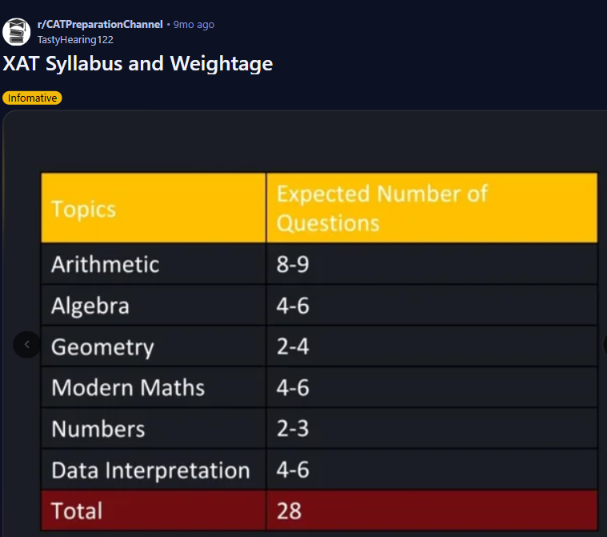
User on Reddit shared XAT QA and DI weightage analysis. As per the analysis shared by the user on Reddit, maximum weightage is given to Arithmetic, with the number of questions ranging from 8-9.
- DI, Algebra, and Modern Maths each are given a weightage of 4-6 questions.
- Geometry is given around 2-4 questions weightage, whereas Numbers topic is given weightage of 2-3 questions
Source: Reddit
XAT 2027 Important Books
| XAT Section | Book Name | Author / Publisher |
|---|---|---|
| Verbal Ability & Logical Reasoning (VALR) | How to Prepare for Verbal Ability & Reading Comprehension for CAT | Arun Sharma & Meenakshi Upadhyay |
| Word Power Made Easy | Norman Lewis | |
| High School English Grammar & Composition | Wren & Martin | |
| A Modern Approach to Verbal & Non-Verbal Reasoning | R.S. Aggarwal | |
| Verbal Ability and Reading Comprehension | Ajay Singh | |
| Analytical Reasoning | M.K. Pandey | |
| Decision Making (DM) | Jabbing the XAT (with solved papers) | R.K. Jha |
| Target XAT (Past Papers & Mock Tests) | Disha Publication / Disha Experts | |
| Analytical and Logical Reasoning | Arihant Publications | |
| Quantitative Ability & Data Interpretation (QA & DI) | How to Prepare for Quantitative Aptitude for CAT | Arun Sharma |
| How to Prepare for Data Interpretation for CAT | Arun Sharma | |
| Quantitative Aptitude for Competitive Examinations | R.S. Aggarwal | |
| Data Interpretation for the CAT | Nishit K. Sinha | |
| Quantitative Aptitude for Competitive Examinations | Abhijit Guha | |
| Quantum CAT | Sarvesh K. Verma | |
| General Knowledge (GK) | Lucent’s General Knowledge | Dr. Binay Karna / Lucent Publications |
| General Knowledge (latest edition) | Manohar Pandey | |
| Manorama Yearbook | Malayala Manorama |
Also Check:
XAT Syllabus 2027: Question Paper Pattern
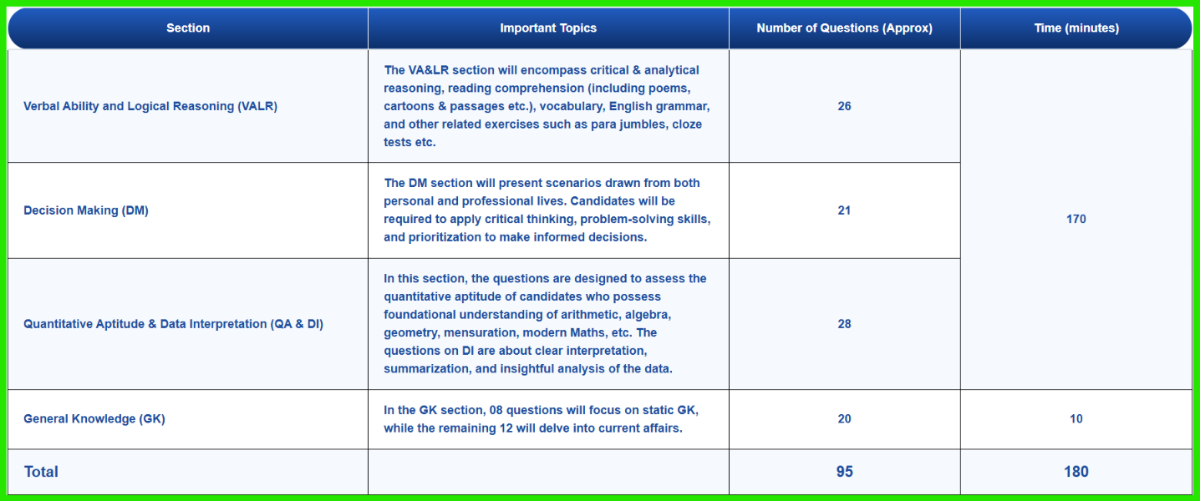
XAT question paper will be divided into 2 parts, including Part 1 and Part 2. Part 1 includes sections like VALR, DM, and QA & DI. However, Part 2 includes only topics from General Knowledge.
- VALR section of XAT question paper will carry around 26 questions.
- Decision Making section of XAT syllabus 2027 carries around 21 questions.
- You will face around 20 questions from the QA and DI sections of the XAT 2027 syllabus.
- Around 10 questions will be asked from the General Knowledge section of the XAT 2027 exam syllabus.
- You will have to solve around 95 questions in XAT 2027 question paper.
- Duration of Part 1 of XAT question paper is 170 minutes, and 10 minutes for Part 2, with a total duration of 180 minutes for XAT question paper.
| Part | XAT Section | Number of Questions | Duration |
|---|---|---|---|
| Part 1 | Verbal Ability and Logical Reasoning (VALR) | 26 | 170 |
| Decision Making (DM) | 21 | ||
| Quantitative Aptitude & Data Interpretation (QA & DI) | 28 | ||
| Part 2 | General Knowledge (GK) | 20 | 10 |
| Total | 95 | 180 | |
Source: Official Website
XAT 2027 Marking Scheme
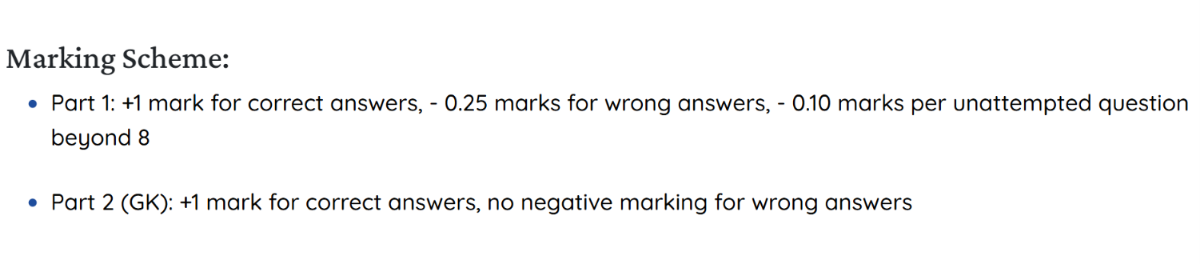
XAT 2027 marking scheme is different for each part of the XAT 2027 question paper. Part 1 has negative marking for incorrect and unattempted questions. However, there is no negative marking in Part 2.
- For each correct response in XAT Part 1 and Part 2, you will get +1 mark.
- For each incorrect response in XAT Part 1, you will get -0.25 marks deducted from the overall score.
- For unattempted questions beyond 8 in XAT Part 1, you will get -0.10 marks deducted from the overall score.
| Part | Marking Scheme |
|---|---|
| Part 1 |
|
| Part 2 |
|
Source: Official Website
Ques. Is XAT and CAT exam pattern the same?
Ans. No, XAT exam pattern is different from CAT examination. XAT has 4 sections (VALR, DM, QA & DI, and GK; however, CAT exam has 3 sections (VARC, DILR and QA).
- The total number of questions in XAT is 95, whereas the total number of questions in CAT is 68.
- Total marks in XAT are 95, whereas total marks in CAT are 102.
- XAT marking scheme includes +1 mark for correct response and -0.25 for incorrect answers.
- CAT marking scheme includes +3 marks for a correct answer and -1 mark for an incorrect answer.
- XAT has negative marking for unattempted questions beyond 8; however, there is no negative marking in CAT for unattempted questions.
XAT 2027 Syllabus Preparation Tips
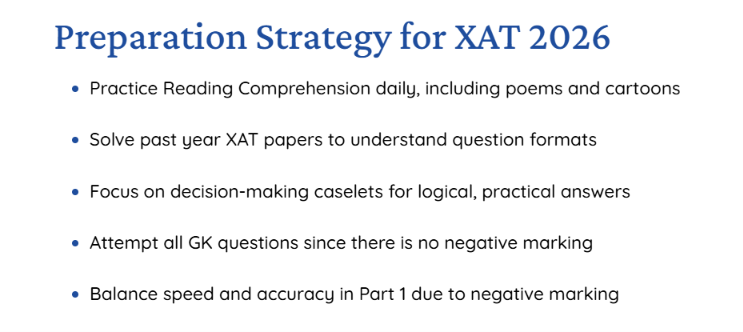
- Check Syllabus: You must go through the syllabus thoroughly and check the topics included in each section.
- Weightage Analysis: Analyze sectional and topic-wise weightage and prioritize topics accordingly.
- Study Material: Collect relevant and standard study material and books recommended by experts to cover the syllabus.
- Solve PYQs: Solve past years’ question papers to understand the format of questions.
- Mock Tests: Attempt regular mock tests to improve time management skills and identify weak areas.
- Attempt: Answer all GK questions as there is no negative marking in the section.
- Speed and Accuracy: You must balance speed and accuracy while solving Part 1 of XAT 2027 due to negative marking.
Source: Official Website
Also Read
XAT Previous Year’s Question Papers PDF
| XAT Exam Year | XAT Question Papers With Solution |
|---|---|
| XAT 2026 | Download PDF |
| XAT 2025 | Download PDF |
| XAT 2024 | Download PDF |
| XAT 2023 | Download PDF |
| XAT 2022 | Download PDF |
| XAT 2021 | Download PDF |
| XAT 2020 | Download PDF |
| XAT 2019 | Download PDF |
| XAT 2018 | Download PDF |
| XAT 2017 | Download PDF |
| XAT 2016 | Download PDF |
Section-Wise XAT 2027 Practice Papers
| Section | XAT Practice Papers PDF |
|---|---|
| VARC | Download PDF |
| DM | Download PDF |
| Quant | Download PDF |
| GK | Download PDF |
Also Read:
XAT Syllabus 2027: Mock Tests
| Section | XAT 2027 Mock Tests |
|---|---|
| VALR | Attempt Here |
| DM | Attempt Here |
| QA & DI | Attempt Here |
| GK | Attempt Here |
Read More:
XAT Syllabus 2027 FAQs
Ques. Is there an official XAT syllabus?
Ans. Yes, XLRI Jamshedpur releases XAT syllabus on the official website. You can check the XAT 2027 syllabus on the official website at xatonline.in.
Ques. Has XAT removed essay writing section?
Ans. Yes, essay writing was removed from the XAT syllabus in 2025. Along with this, the number of questions in GK was reduced to 20 from 25, and the sectional time limit in XAT Part 1 was removed.
Ques. What are the XAT syllabus changes for 2027 vs 2026?
Ans. As per the syllabus released by XLRI on the official website, there is no significant change in the XAT syllabus 2027.
Ques. Is XAT syllabus different from CAT?
Ans. Yes, XAT syllabus is different from CAT syllabus. In XAT, there is GK section, which is not present in the syllabus for the CAT exam. Some topics are similar in the VA, LR, DI, and QA sections of XAT and CAT exams.
Ques. What sections are common in XAT and CAT?
Ans. In XAT and CAT, similar sections include Verbal Ability, Logical Reasoning, Data Interpretation, and Quantitative Aptitude. GK and DM sections are extra in XAT 2027 as compared to CAT syllabus 2026.



Comments