
Select Country
Singapore
Explore
Explore More

Study in Singapore
Expert Counselling with 50% Off on Student Visa Fees, Choose from Extensive Colleges and Course options.
Free Profile
Evaluation
150+ Experienced
Counsellor
5+ Years
Average Experience
95% Visa
Success Rate
Unlimited
Follow Ups
Best
SOP Writers
Explore Courses For Singapore
Looking into Study Abroad Colleges and Universities as an international student can be a challenge, but it’s one you can overcome! From how to look for accredited school to what you should write about on your applications, Our expert counsellors will help you at every step


Confusion Ends Here !!
Our expert counselling team has crafted a powerful roadmap for your journey to study in the singapore!
Study in Singapore Guides & Resources
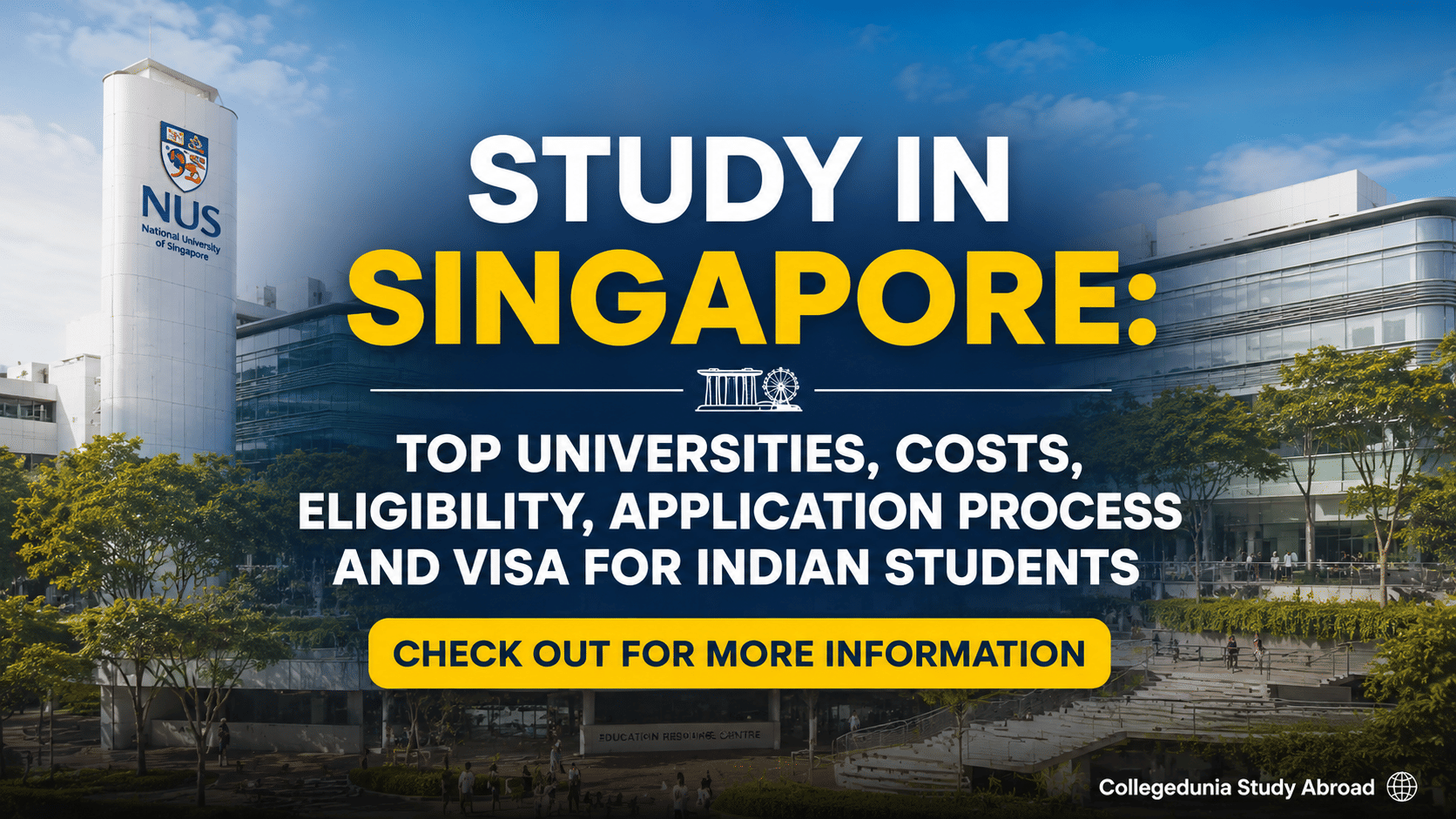
Study in Singapore: Top Universities, Costs, Eligibility, Application Process and Visa
Studying in Singapore puts Indian students inside Asia's top-ranked university system, three flight hours from home, at costs the Tuition Grant can cut sharply. The catch is a three-year work bond. For Indian students, Singapore trades Western-style post-study windows for proximity, rankings and jobs.
- NUS ranks #10 in QS 2027, and NTU sits in the global top 15, both teaching fully in English.
- The MOE Tuition Grant cuts fees 40 to 60% in exchange for a 3-year Singapore work bond.
- NUS and NTU expect 90%+ in Class 12, with acceptance rates near 5 to 10%.
- There is no post-study work visa: graduates stay through an Employment Pass or S Pass job.
| Parameter | Detail |
|---|---|
| Top universities | NUS (#10, QS 2027), NTU, SMU, SUTD, SIT, SUSS |
| Main intake | August, one primary window a year |
| Tuition with MOE grant | About SGD 21,400 to 31,600 a year (INR 15.9 to 23.5 lakh) |
| Tuition without grant | Roughly SGD 30,000 to 55,000 a year |
| Annual total at NUS or NTU | About INR 27 to 42 lakh with the grant |
| Class 12 expectation | 90%+ for NUS and NTU, from about 85% at SMU |
| Student's Pass | SGD 30 application plus SGD 60 issuance |
Currency conversions use SGD 1 = INR 74.32 as of June 2026, and move with the exchange rate.
Also Read,
- Top Universities in Singapore for Indian Students 2026
- Study in Singapore After 12th for Indian Students 2026
- MBA in Singapore: Top Colleges, Eligibility, Costs and Salaries
- Exams to Study in Singapore: IELTS, TOEFL and PTE
Top Universities in Singapore
Six autonomous public universities anchor the system, with NUS and NTU carrying the global rankings and the other four covering specialised and applied ground. Private institutions add a lower-cost tier. The flagship's full profile sits on this National University of Singapore listing. The landscape:
| University | Standing and strength |
|---|---|
| NUS | #10 in QS 2027 after holding #8 through 2024 to 2026, strong across computing, engineering, law and business |
| NTU | Global top 15 (#12 in QS 2026), engineering and technology powerhouse |
| SMU | #511 to 520 overall in QS 2026 yet top 60 by subject in business, law, accounting and economics |
| SUTD | Design-and-technology focused, small cohorts |
| SIT and SUSS | Applied universities, with SIT running an integrated work-study model of paid industry placements |
| Private sector | SIM, MDIS and others from about INR 12 lakh a year, with no bond |
Note: Indian applicants fixate on NUS and NTU and overlook SIT and SUSS because neither appears in the global top 100. That reading misses the design: SIT alternates academic terms with paid industry placements, which for employment-focused students in the 80s percentile range is a stronger route into the Singapore job market than a rejected NUS application.
Also Read,
- Average Salary in Singapore: Complete ROI Analysis
- Top Doctorate Colleges & Universities in Singapore in 2026
- Best US News ranked Universities/Colleges in Singapore
- NUS vs NTU
The Cost and the Tuition Grant Bond
Two fee tiers exist for Indian students: the subsidised rate under the MOE Tuition Grant, which cuts fees 40 to 60%, and the full non-subsidised rate, roughly double. The grant's price is a bond. The wider comparison sits in this guide on the average cost of studying abroad. The money picture:
- With the grant: standard degrees run about SGD 21,400 to 31,600 a year at NUS, around SGD 26,200 at SMU, with medicine an outlier near SGD 87,800.
- Without the grant: roughly SGD 30,000 to 55,000 a year across NUS and NTU programs.
- The bond: taking the grant commits you to 3 years working for a Singapore-registered employer after graduation, signed through the Service Obligation Agreement.
- Living costs: about SGD 11,400 a year on a practical budget, with on-campus rooms at roughly SGD 4,000 to 10,290 and the university's own no-rent estimate near SGD 6,000.
- Annual totals: about INR 27 to 42 lakh at NUS or NTU with the grant, and roughly INR 22 to 32 lakh at affordable private universities.
Important: The grant has a trap with a calendar: the Service Obligation Agreement must be signed within the October window of your entry year, and missing it means paying non-subsidised fees for that academic year with no retroactive grant. Treat the October signing as part of enrolment, not paperwork to defer.
Also Read,
- Cost of Living in Singapore
- Affordable Ways to Study at NUS Singapore
- National University of Singapore (NUS): Fees 2026
- Nanyang Technological University Fees & Deadlines
Admission Eligibility for Indian Students
Singapore's public universities admit on academic strength first: 90%+ in CBSE or ISC for NUS and NTU, from about 85% at SMU, with English proof that strong Indian boards can sometimes waive. Selectivity is real. The undergraduate route in detail sits in this guide on studying in Singapore after 12th for Indian students. The bar:
- Undergraduate academics: 90%+ in Class 12 for NUS and NTU, where acceptance runs about 5 to 10%, and from about 85% at SMU, always program-dependent.
- Postgraduate academics: a strong bachelor's in a related field, with GRE or GMAT asked by selected programs, particularly in business and computing.
- English proof: IELTS or TOEFL at the program's stated band, commonly around IELTS 6.5, with waivers sometimes granted for English-medium board results, confirmed program by program.
- Course-specific extras: portfolios for design at SUTD, interviews and essays at SMU and aptitude assessments where listed.
What the 90% guidance covers and what it does not:
- Covers: the realistic competitive floor Indian boards need for the two flagships.
- Does not: guaranteed admission at any score, since programs weigh subject fit, essays and interviews inside a 5 to 10% acceptance rate.
The Application Process and Timeline
Singapore runs one primary intake in August with a single application window, so the calendar is unforgiving: for August 2027, portals open around October to December 2026. January offers a postgraduate side door. The sequence for the 2027 cycle:
| When | What happens |
|---|---|
| July to September 2026 | Shortlist, book English tests, draft essays |
| October to December 2026 | Application windows open for August 2027; NUS's last UG window ran early December to late February |
| Early 2027 | Deadlines close; interviews and assessments for shortlisted applicants |
| February 2027 onward | On-campus housing windows open and fill fast |
| March to June 2027 | Offers, grant decisions and acceptance |
| June to July 2027 | Student's Pass processing through the university |
| August 2027 | Orientation and classes |
- January 2027 postgraduate seats: NUS runs a January intake for select programs, while NTU adds January and November starts for certain Master's courses, which makes a rejected or missed August application recoverable within the same year.
- Housing tactic: apply for accommodation the week a conditional offer arrives, since NUS and NTU housing windows open around February and close fast.
Note: Singapore punishes late planners more than weak ones. One primary intake, one application window and housing that fills by spring mean a student who starts in October 2026 with tests done competes for everything, while an equally strong student starting in February 2027 has already missed the year.
Also Read,
- Admission to Singapore Universities in 2026 and 2027 Guide
- Singapore Universities Deadlines for International Students
- Singapore Student Visa: Types, Document Required and Cost
The Student's Pass and Life After
The Student's Pass is the simplest visa in this guide's universe: SGD 30 to apply and SGD 60 at issuance, processed through your university, with no blocked account or interview. The complexity sits after graduation. Funding support options are covered in this guide on fully funded scholarships for Indian students. The rules:
- The pass: applied through the university after acceptance, with fees of SGD 30 at application and SGD 60 at issuance, and processing measured in weeks.
- Working while studying: up to 16 hours a week during term on a valid Student's Pass at MOE-approved institutions including the public universities, while many private-college students have no work rights at all.
- No post-study work visa: Singapore offers no automatic stay-back, so graduates remain by landing a job and a pass.
- The passes: the S Pass for mid-level roles carries a minimum of SGD 3,300 a month in 2026, rising to SGD 3,600 from 2027, while the Employment Pass covers professional roles at higher thresholds that rise periodically.
- The bond as a route: grant holders already owe 3 years to a Singapore employer, which turns the obligation into the most structured stay-and-work pathway the country offers, and an Employment Pass can later open Permanent Residence.
Important: Start the job hunt months before graduation, not after. With no post-study window, the gap between convocation and a signed offer is time you cannot legally bridge on a student status, so internships, placement cells and employer networking during the degree carry visa weight, not just career weight.
Also Check:
Study in Singapore is a sharp-edged proposition for Indian students: two universities inside the world's top 15, degrees taught in English three flight hours from home, fees the Tuition Grant cuts hard and a job market that hires its own graduates, set against a 90% entry bar, one application window a year, a 3-year bond behind the subsidy and no post-study cushion. It rewards exactly one profile: the student who starts by October 2026, signs the October agreement on time, applies for housing on the conditional offer and hunts for work before the gown goes on. For that student, Singapore is the region's best-engineered ladder.
FAQs
Ques. Which are the top universities in Singapore?
Ans. The six autonomous universities: NUS at #10 in QS 2027, NTU in the global top 15, SMU, SUTD, SIT and SUSS. SMU ranks in the top 60 by subject for business, law, accounting and economics despite a modest overall rank.
Ques. How much does it cost to study in Singapore?
Ans. With the MOE Tuition Grant, about SGD 21,400 to 31,600 a year in tuition plus roughly SGD 11,400 living, landing near INR 27 to 42 lakh annually at NUS or NTU. Without the grant, tuition roughly doubles.
Ques. What is the MOE Tuition Grant and the 3-year bond?
Ans. A government subsidy cutting fees 40 to 60% in exchange for 3 years working for a Singapore-registered employer after graduation, signed through the Service Obligation Agreement within the October window of your entry year, with no retroactive grant if missed.
Ques. What percentage is required in Class 12 for NUS and NTU?
Ans. Realistically 90% or above in CBSE or ISC, with acceptance rates around 5 to 10%, while SMU considers strong applicants from about 85%. Subject fit, essays and interviews decide among high scorers.
Ques. Is IELTS required for Singapore universities?
Ans. Programs commonly ask around IELTS 6.5 or TOEFL equivalents, and some waive the test for strong English-medium board results. Confirm the waiver with each program before booking, since policies vary course by course.
Ques. When should I apply for the August 2027 intake?
Ans. Windows open around October to December 2026 with deadlines in early 2027, and Singapore runs one primary intake a year. Book tests by September 2026 and apply for housing the week a conditional offer arrives.
Ques. Does Singapore have a January intake?
Ans. For postgraduates, partially: NUS runs a January intake for select programs and NTU adds January and November starts for certain Master's courses, which makes a missed August cycle recoverable without losing a full year.
Ques. How does the Student's Pass work?
Ans. It is processed through your university after acceptance, at SGD 30 application and SGD 60 issuance, with no blocked account or embassy interview, and decisions arrive in weeks rather than months.
Ques. Can Indian students work while studying in Singapore?
Ans. Up to 16 hours a week during term at MOE-approved institutions including the public universities, with full-time work in vacations. Many private-college students have no work rights, so check your institution's status first.
Ques. Can I stay in Singapore after graduating?
Ans. Only with a job: there is no post-study work visa, so graduates move to an S Pass, minimum SGD 3,300 a month in 2026 rising to SGD 3,600 from 2027, or an Employment Pass, and grant holders serve their 3-year bond, which can lead toward Permanent Residence.
Top Universities In Singapore


- Ranked 17 out of 824 Collegedunia Study Abroad, Ranked 10 out of 1504 QS
- 2 Students applied


$49.3K First Year Fees
- Ranked 27 out of 824 Collegedunia Study Abroad, Ranked 12 out of 1504 QS
- 7 Students applied3 Students admitted


- Ranked 554 out of 824 Collegedunia Study Abroad, Ranked 411 out of 1504 QS


$85.7K First Year Fees
- Ranked 163 out of 824 Collegedunia Study Abroad, Ranked 981 out of 2604 US News


Top College Collections For Singapore

Best Business Colleges in SingaporeView Colleges

Best Finance Colleges in SingaporeView Colleges

Best Accounting Colleges in SingaporeView Colleges

Best Computer Science and Engineering Colleges in SingaporeView Colleges

Best Economics Colleges in SingaporeView Colleges


Why to Study in Singapore?
The National University of Singapore (NUS) is ranked 8th in the world and the Nanyang Technological University, Singapore (NTU) is ranked 26th in the world by the QS World University Rankings 2024.
93%
Visa Approval Rate
40+
Total Institutions
summer
Best Intake
$25000 to $40000
Average Study Cost
$5500 to $6500
Living Cost
$120 to $360
Travel Cost

88(iBT)
Min. TOEFL Score

6
Min. IELTS Score

55
Min. PTE Score
Explore Singapore Colleges Ranking
| University |  THE 2026 THE 2026 |  QS 2026 QS 2026 |  US World 2026 US World 2026 |
|---|---|---|---|
 National University of Singapore - NUS | 17 | 8 | 20 |
 Nanyang Technological University - NTU | 30 | 12 | 28 |


Look Further
Our dedicated counselling team, is eager to guide you every step of the way in selecting the perfect university to turn your dreams into reality.
Meet our Counsellors

Hitesh
Senior Counsellor | 3+ Years Of Experience

Nupur Thapar
Senior Counsellor | 4+ Years Of Experience

Aadya Chadha
Senior Counsellor | 6+ Years Of Experience

Ayush
Senior Counsellor | 3+ Years Of Experience

Jashanpreet
Senior Counsellor | 4+ Years Of Experience

Tanuj
Senior Counsellor | 4+ Years Of Experience

Ditipriya
Senior Counsellor | 6+ Years Of Experience

Versha Sharma
Senior Counsellor | 3+ Years Of Experience
Discover Useful Documents and Template For Singapore Admission
Statement of
Purpose (SOP)
Letter of
Recommendation (LOR)
Student
Essay
Curriculum
Vitae (CV)
Interview
Applications
Popular Study in Singapore Videos

INSEAD CAMPUS VLOG, What Happens in INSEAD & RANKING
9.1K views
Popular For Scholarship
Exams For Singapore
![International English Language Testing System [IELTS]](https://img.collegedunia.com//public/college_data/images/logos/ielts.png?h=52&w=52&mode=stretch)
![Test of English as a Foreign Language [TOEFL]](https://img.collegedunia.com//public/college_data/images/logos/unnamed.png?h=52&w=52&mode=stretch)
![Duolingo English Test[DET]](https://img.collegedunia.com//public/college_data/images/logos/Emblem-Green.webp?h=52&w=52&mode=stretch)
![Pearson Test of English [PTE]](https://img.collegedunia.com//public/college_data/images/logos/PYP%20Template%20(70).png?h=52&w=52&mode=stretch)
![Graduate Record Examination [GRE]](https://img.collegedunia.com//public/college_data/images/logos/gre%20(1).png?h=52&w=52&mode=stretch)
![Graduate Management Admission Test [GMAT]](https://img.collegedunia.com//public/college_data/images/logos/PYP%20Template%20(25)-modified.png?h=52&w=52&mode=stretch)
Study in Singapore FAQs
Ques. What are the top 3 universities in Singapore?
The top 3 universities in Singapore as per the QS world university rankings 2023 are as follows:
| Top Universities | QS World University Rankings 2023 |
|---|---|
| National University of Singapore | 11 |
| Nanyang Technological University, Singapore | 19 |
| Singapore Management University | 561 |
According to Times Higher Education world university rankings 2023, the top universities of Singapore like the National University of Singapore and Nanyang Technological University are ranked among the top 50 universities in the world.
Ques. How much does it cost to study at a Singapore college?
The tuition fees for universities in Singapore are affected by the university you choose to attend, the programme you enrol in, as well as your nationality. The average tuition fees for international students in Singapore is around 22,500-43,320 SGD 913.79-26.55 lakhs INR). The estimated expenditure and cost of living in Singapore for an international student ranges from 1,164 SGD to 2,369 SGD (68,352 to 1,39,042 INR).
Ques. Is College in Singapore free?
Some of the universities in Singapore provide free education, but only for national and local students of Singapore. International students are required to pay the mentioned tuition fees as per the choice of program. However, they can apply for various scholarships in Canada for international students. These scholarships can provide full tuition fee waivers (Full Funding), or cover a portion of the tuition fees (Partial Funding)
Ques. Can I study in Singapore in English?
Yes, every undergraduate or postgraduate course will be taught in English since it is the official language of business and education in Singapore. The universities in Singapore demand English proficiency test scores such as IELTS or TOEFL to assess your proficiency in the language. If you are an international student, you need to fulfil the minimum English language requirements as per the respective university or program
Other Abroad Countries
Study in UK
Study in USA
Study in Canada
Study in Australia
Study in Germany
Study in Hong Kong
Study in Ireland
Study in Malaysia
Study in Netherlands
Study in New Zealand
Achieve Your Dream Study Abroad Journey:
Download the Collegedunia Abroad App Today!
Choose
Your Goal
Explore
Countries
Discover
Universities
Book
Counselling
Pick
Your Slot
Connect With
Counsellors


SUBSCRIBE TO OUR NEWS LETTER
COLLEGE NOTIFICATIONSEXAM NOTIFICATIONSNEWS UPDATES
Download the Collegedunia app on 



© 2026 Collegedunia Web Pvt. Ltd. All Rights Reserved