CUET Environmental Studies Question Paper 2024 is available here . NTA conducted CUET 2024 Environmental Studies paper on 24 May in Shift 2. CUET Environmental Studies Question Paper 2024 is based on objective-type questions (MCQs). Candidates get 45 minutes to solve 40 MCQs out of 50 in CUET 2024 question paper for Environmental Studies.

CUET Environmental Studies Question Paper 2024 PDF Download

CUET 2024 Environmental Studies(SET-A) Question Paper with Answer Key download iconDownload Check Solution
CUET 2024 Environmental Studies(SET-B) Question Paper with Answer Key download iconDownload Check Solution
CUET 2024 Environmental Studies(SET-C) Question Paper with Answer Key download iconDownload Check Solution
CUET 2024 Environmental Studies Question Paper with Answer Key(SET-D) download iconDownload Check Solution

CUET 2024 Environmental Studies Solution


Question 1:

The disease "Itai-Itai" is caused by contamination of drinking water with which of the following?

  • (1) Mercury
  • (2) Cadmium
  • (3) Arsenic
  • (4) Chromium
Correct Answer: (2) Cadmium
View Solution

Question 2:

Which of the following are required for photochemical smog formation in the atmosphere?

  • (1) Smoke, water vapour, low temp
  • (2) NOx, SO2, high temp
  • (3) NOx, VOCs, high temp
  • (4) Smoke, NOx, low temp
Correct Answer: (3) NOx, VOCs, high temp
View Solution

Question 3:

Arrange the stages of primary succession of plants from last to first:
(A) Reed-swamp
(B) Submerged plant
(C) Marsh Meadow
(D) Phytoplankton

  • (1) (A), (B), (C), (D)
  • (2) (C), (A), (B), (D)
  • (3) (D), (B), (A), (C)
  • (4) (A), (C), (B), (D)
Correct Answer: (3) (D), (B), (A), (C)
View Solution

Question 4:

Which factors can affect the soil respiration process?
(A) Temperature
(B) Soil moisture
(C) Aeration
(D) Number of microbes
(E) Organic matter quality

  • (1) (A), (C), (E)
  • (2) (A), (B), (C), (D)
  • (3) (B), (C), (D)
  • (4) (A), (B), (C), (D), (E)
Correct Answer: (4) (A), (B), (C), (D), (E)
View Solution

Question 5:

Which is not a criteria air pollutant under NAAQS?

  • (1) CO₂
  • (2) CO
  • (3) O₃
  • (4) Pb
Correct Answer: (1) CO₂
View Solution

Question 6:

Match List-I (Forest Act/Policy) with List-II (Year):
(A) Forest Act
(B) National Forest Policy
(C) Forest Conservation Act
(D) Wildlife Protection Act
List-II
(I) 1927
(II) 1988
(III) 1980
(IV) 1972

  • (1) (A) - (I), (B) - (II), (C) - (III), (D) - (IV)
  • (2) (A) - (II), (B) - (III), (C) - (I), (D) - (IV)
  • (3) (A) - (IV), (B) - (II), (C) - (III), (D) - (I)
  • (4) (A) - (III), (B) - (I), (C) - (II), (D) - (IV)
Correct Answer: (1) (A) - (I), (B) - (II), (C) - (III), (D) - (IV)
View Solution

Question 7:

Arrange from lowest to highest dry weight in a biomass pyramid of a grassland ecosystem:
(A) Primary Producer
(B) Primary Consumer
(C) Secondary Consumer
(D) Tertiary Consumer

  • (1) (A), (B), (C), (D)
  • (2) (A), (C), (B), (D)
  • (3) (D), (C), (B), (A)
  • (4) (D), (C), (A), (B)
Correct Answer: (1) (A), (B), (C), (D)
View Solution

Question 8:

"Curitiba," a city in Brazil, is famously known for its ____________.

  • (1) Organic farming practices
  • (2) Water network projects
  • (3) Integrated transport system
  • (4) Solid waste disposal system
Correct Answer: (3) Integrated transport
View Solution

Question 9:

Which gas gives the lowest contribution to global warming?

  • (1) N₂O
  • (2) NO₂
  • (3) CFCs
  • (4) CH₄
Correct Answer: (2) NO₂
View Solution

Question 10:

Nomadic movements are not considered as migrations because people move ___________.

  • (1) For economic reasons
  • (2) For social factors
  • (3) Without any intention
  • (4) For physical reasons
Correct Answer: (3) Without intention
View Solution

Question 11:

Which of the following does not explain the relationship between human development and economic development?

  • (1) Capability expansion through economic growth
  • (2) Capability expansion through poverty reduction
  • (3) Capability expansion through social services
  • (4) Capability expansion through environmental degradation
Correct Answer: (4) Capability expansion through environmental degradation
View Solution

Question 12:

The Gandhian economy model does not contain elements of ___________.

  • (1) Multiplication of needs
  • (2) Rejection of class-war
  • (3) Protectionism
  • (4) Nationalism
Correct Answer: (1) Multiplication of needs
View Solution

Question 13:

Which method is most suitable for safe disposal of hospital solid waste?

  • (1) Dumping
  • (2) Incineration
  • (3) Pyrolysis
  • (4) Composting
Correct Answer: (2) Incineration
View Solution

Question 14:

Arrange the food distribution process from start to end:
(A) Packaging
(B) Processing
(C) Storage
(D) Marketing

  • (1) (A), (B), (C), (D)
  • (2) (C), (B), (A), (D)
  • (3) (A), (B), (D), (C)
  • (4) (C), (B), (D), (A)
Correct Answer: (2) (C), (B), (A), (D)
View Solution

Question 15:

Which is an incorrect statement regarding GDP?

  • (1) GDP does not measure sustainability of growth
  • (2) GDP helps understand whether an economy is growing
  • (3) GDP reflects annual trends of inflation and prices
  • (4) GDP helps understand shifts in the annual changes in the economy
Correct Answer: (3) GDP reflects annual trends of inflation and prices
View Solution

Question 16:

Match List-I (Protocol/Convention) with List-II (Year):
(A) Kyoto Protocol
(B) Montreal Protocol
(C) Bamako Convention
(D) Basel Convention
List-II
(I) 1987
(II) 1997
(III) 1989
(IV) 1998

  • (1) (A) - (IV), (B) - (I), (C) - (II), (D) - (III)
  • (2) (A) - (IV), (B) - (I), (C) - (III), (D) - (II)
  • (3) (A) - (I), (B) - (IV), (C) - (III), (D) - (II)
  • (4) (A) - (II), (B) - (I), (C) - (III), (D) - (IV)
Correct Answer: (4) (A) - (II), (B) - (I), (C) - (III), (D) - (IV)
View Solution

Question 17:

Petroleum in sedimentary rocks falls under which resource category?

  • (1) Actual resources
  • (2) Potential resources
  • (3) Stock resources
  • (4) Reserve resources
Correct Answer: (2) Potential resources
View Solution

Question 18:

Which water storage types are used in Bihar?
(A) Bhundhis
(B) Ahar
(C) Kulhs
(D) Pynes

  • (1) (A) and (C) only
  • (2) (B) and (D) only
  • (3) (A) and (B) only
  • (4) (C) and (D) only
Correct Answer: (2) (B) and (D) only
View Solution

Question 19:

The diversity of organisms that share the same habitat is called ___________.

  • (1) Beta diversity
  • (2) Gamma diversity
  • (3) Alpha diversity
  • (4) Genetic diversity
Correct Answer: (3) Alpha diversity
View Solution

Question 20:

Which is not a basic pillar of sustainable development?

  • (1) Environmental preservation
  • (2) Social equity
  • (3) Economic growth
  • (4) Urbanization
Correct Answer: (4) Urbanization
View Solution

Question 21:

Which is a Kharif crop?

  • (1) Wheat
  • (2) Rice
  • (3) Cucumber
  • (4) Mustard
Correct Answer: (2) Rice
View Solution

Question 22:

The concept of Joint Forest Management does not include:

  • (1) Government works with locals to manage forests
  • (2) Locals use forest resources sustainably
  • (3) Infrastructure development
  • (4) Sustainable conservation of forests
Correct Answer: (3) Infrastructure development
View Solution

Question 23:

The ability of the environment to absorb waste and pollution is referred to as __________.

  • (1) Source function of ecosystem
  • (2) Sink function of ecosystem
  • (3) Carrying capacity of ecosystem
  • (4) Optimal capacity of ecosystem
Correct Answer: (2) Sink function
View Solution

Question 24:

Which is a main characteristic of perpetual resources?

  • (1) Consumption at a very fast rate
  • (2) Continuous availability at a limited rate
  • (3) Unconditional availability
  • (4) Not formed naturally
Correct Answer: (2) Continuous availability at a limited rate
View Solution

Question 25:

Arrange the following radiation in increasing order of wavelength:
(A) UV-C
(B) UV-B
(C) UV-A
(D) Infra-red
(E) Microwave

  • (1) (C), (B), (A), (D), (E)
  • (2) (A), (B), (C), (E), (D)
  • (3) (A), (B), (C), (D), (E)
  • (4) (E), (D), (C), (B), (A)
Correct Answer: (3) (A), (B), (C), (D), (E)
View Solution

Question 26:

A bee-keeper in an orchard enabling pollination is an example of ___________.

  • (1) Negative production externalities
  • (2) Negative consumption externalities
  • (3) Positive production externalities
  • (4) Positive consumption externalities
Correct Answer: (3) Positive production externalities
View Solution

Question 27:

Arrange the atmospheric layers from the Earth’s surface upwards:
(A) Mesosphere
(B) Stratosphere
(C) Stratopause
(D) Mesopause
(E) Troposphere

  • (1) (E), (C), (B), (D), (A)
  • (2) (E), (C), (B), (A), (D)
  • (3) (E), (B), (C), (A), (D)
  • (4) (E), (B), (C), (D), (A)
Correct Answer: (3) (E), (B), (C), (A), (D)
View Solution

Question 28:

Which of the following is associated with ozone destruction in the stratosphere?
(A) CFCs
(B) Polar stratospheric clouds
(C) UV-B
(D) UV-A
(E) Cl radicals

  • (1) (A) and (E) only
  • (2) (A), (B), and (E) only
  • (3) (A), (C), and (D) only
  • (4) (A), (B), (C), and (E) only
Correct Answer: (2) (A), (B), and (E) only
View Solution

Question 29:

Which of the following are examples of resources?
(A) Materials
(B) Energy
(C) Knowledge
(D) Services

  • (1) (A) and (D) only
  • (2) (A), (B), and (D) only
  • (3) (A), (B), and (C) only
  • (4) (A), (B), (C), and (D)
Correct Answer: (4) (A), (B), (C), and (D)
View Solution

Question 30:

Which treaty prohibits the import of hazardous waste into African nations?

  • (1) The Basel Convention
  • (2) The Capetown Convention
  • (3) The Bamako Convention
  • (4) The Madagascar Convention
Correct Answer: (3) The Bamako Convention
View Solution

Question 31:

Continuous increase of productivity in lakes causes ____________.

  • (1) Biomagnification in lakes
  • (2) Bioaccumulation in lakes
  • (3) Eutrophication in lakes
  • (4) Bioconcentration in lakes
Correct Answer: (3) Eutrophication
View Solution

Question 32:

Dissolved oxygen in water ____________.

  • (1) Remains constant in winter and summer
  • (2) Remains low in winter and high in summer
  • (3) Remains high in winter and low in summer
  • (4) Doesn't depend on water temperature
Correct Answer: (3) Remains high in winter and low in summer
View Solution

Question 33:

Agricultural runoff causing excess suspended particles in water results in __________.

  • (1) High salinity
  • (2) High turbidity
  • (3) High dissolved oxygen
  • (4) High BOD
Correct Answer: (2) High turbidity
View Solution

Question 34:

Water with high algal and phytoplankton growth is expected to have __________.

  • (1) High dissolved oxygen
  • (2) High dissolved oxygen and high BOD
  • (3) Low dissolved oxygen and high BOD
  • (4) Low dissolved oxygen and low BOD
Correct Answer: (3) Low dissolved oxygen and high BOD
View Solution

Question 35:

Which is a limiting nutrient in lakes and ponds?

  • (1) Iron
  • (2) Phosphorus
  • (3) Magnesium
  • (4) Sulphur
Correct Answer: (2) Phosphorus
View Solution

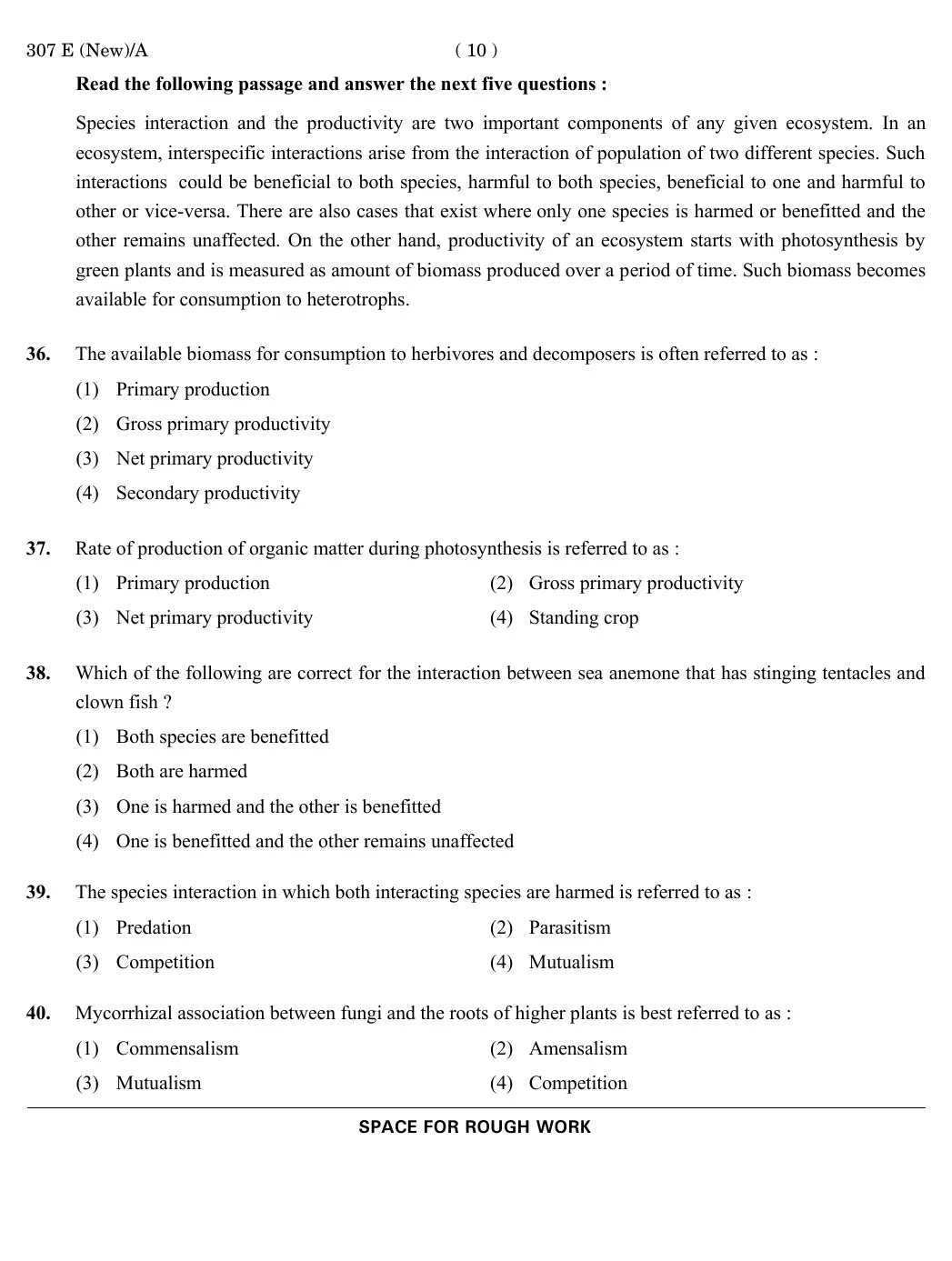
Question 36:

The biomass available for consumption by herbivores and decomposers is __________.

  • (1) Primary production
  • (2) Gross primary productivity
  • (3) Net primary productivity
  • (4) Secondary productivity
Correct Answer: (3) Net primary productivity
View Solution

Question 37:

The rate of organic matter production during photosynthesis is __________.

  • (1) Primary production
  • (2) Gross primary productivity
  • (3) Net primary productivity
  • (4) Standing crop
Correct Answer: (2) Gross primary productivity
View Solution

Question 38:

Interaction between sea anemone and clownfish is an example of __________.

  • (1) Both species benefitted
  • (2) Both are harmed
  • (3) One is harmed, other benefitted
  • (4) One is benefitted, other unaffected
Correct Answer: (1) Both species benefitted
View Solution

Question 39:

The species interaction in which both species are harmed is __________.

  • (1) Predation
  • (2) Parasitism
  • (3) Competition
  • (4) Mutualism
Correct Answer: (3) Competition
View Solution

Question 40:

Mycorrhizal association between fungi and the roots of higher plants is best referred to as __________.

  • (1) Commensalism
  • (2) Amensalism
  • (3) Mutualism
  • (4) Competition
Correct Answer: (3) Mutualism
View Solution

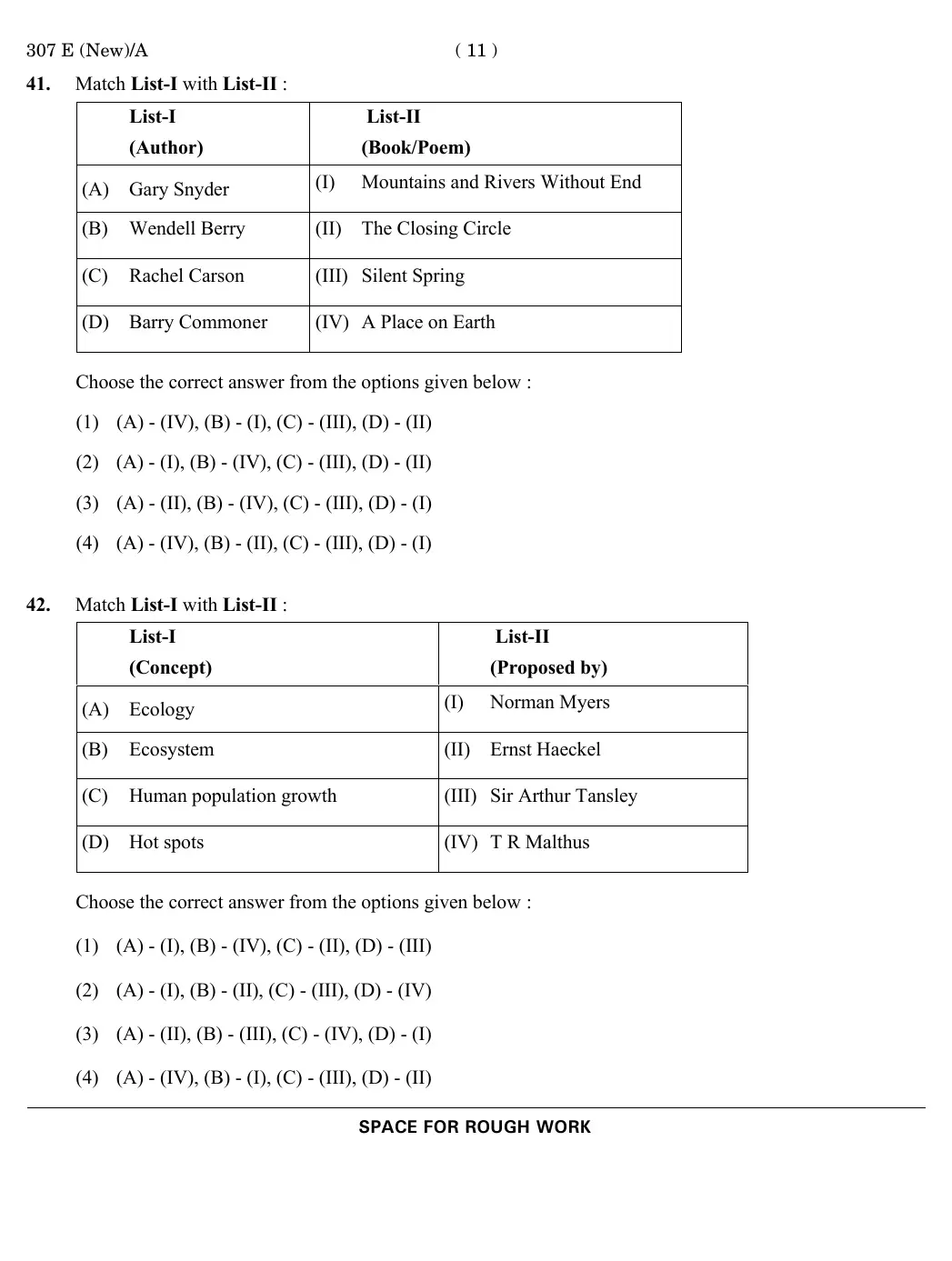
Question 41:

Match List-I (Author) with List-II (Book/Poem):
(A) Gary Snyder
(B) Wendell Berry
(C) Rachel Carson
(D) Barry Commoner
List-II
(I) Mountains and Rivers Without End
(II) The Closing Circle
(III) Silent Spring
(IV) A Place on Earth

  • (1) (A) - (IV), (B) - (I), (C) - (III), (D) - (II)
  • (2) (A) - (I), (B) - (IV), (C) - (III), (D) - (II)
  • (3) (A) - (II), (B) - (IV), (C) - (III), (D) - (I)
  • (4) (A) - (IV), (B) - (II), (C) - (III), (D) - (I)
Correct Answer: (2) (A) - (I), (B) - (IV), (C) - (III), (D) - (II)
View Solution

Question 42:

Match List-I (Concept) with List-II (Proposed by):
(A) Ecology
(B) Ecosystem
(C) Human population growth
(D) Hot spots
List-II
(I) Norman Myers
(II) Ernst Haeckel
(III) Sir Arthur Tansley
(IV) T.R. Malthus

  • (1) (A) - (I), (B) - (IV), (C) - (II), (D) - (III)
  • (2) (A) - (I), (B) - (II), (C) - (III), (D) - (IV)
  • (3) (A) - (II), (B) - (III), (C) - (IV), (D) - (I)
  • (4) (A) - (IV), (B) - (I), (C) - (III), (D) - (II)
Correct Answer: (3) (A) - (II), (B) - (III), (C) - (IV), (D) - (I)
View Solution

Question 43:

The ecological thought that believes in saving forests for their human benefits, like oxygen and rainfall, is known as __________.

  • (1) Deep ecology
  • (2) Social ecology
  • (3) Eco-feminism
  • (4) Shallow ecology
Correct Answer: (4) Shallow ecology
View Solution

Question 44:

Which of the following is not a major goal of WWF?

  • (1) To conserve biological diversity
  • (2) Sustainable use of renewable resources
  • (3) Reduction of pollution and waste
  • (4) Creating a world fund for education
Correct Answer: (4) Creating a world fund for education
View Solution

Question 45:

The first Earth Day was celebrated on __________.

  • (1) 20 April, 1970
  • (2) 22 April, 1970
  • (3) 05 June, 1970
  • (4) 20 April, 1972
Correct Answer: (2) 22 April, 1970
View Solution

Question 46:

The plants and animals that cannot maintain a constant internal environment are called __________.

  • (1) Regulators
  • (2) Migrators
  • (3) Conformers
  • (4) Suspenders
Correct Answer: (3) Conformers
View Solution

Question 47:

The number of individuals of the same species that enter a habitat during a given time period is referred to as __________.

  • (1) Emigration
  • (2) Immigration
  • (3) Natality
  • (4) Mortality
Correct Answer: (2) Immigration
View Solution

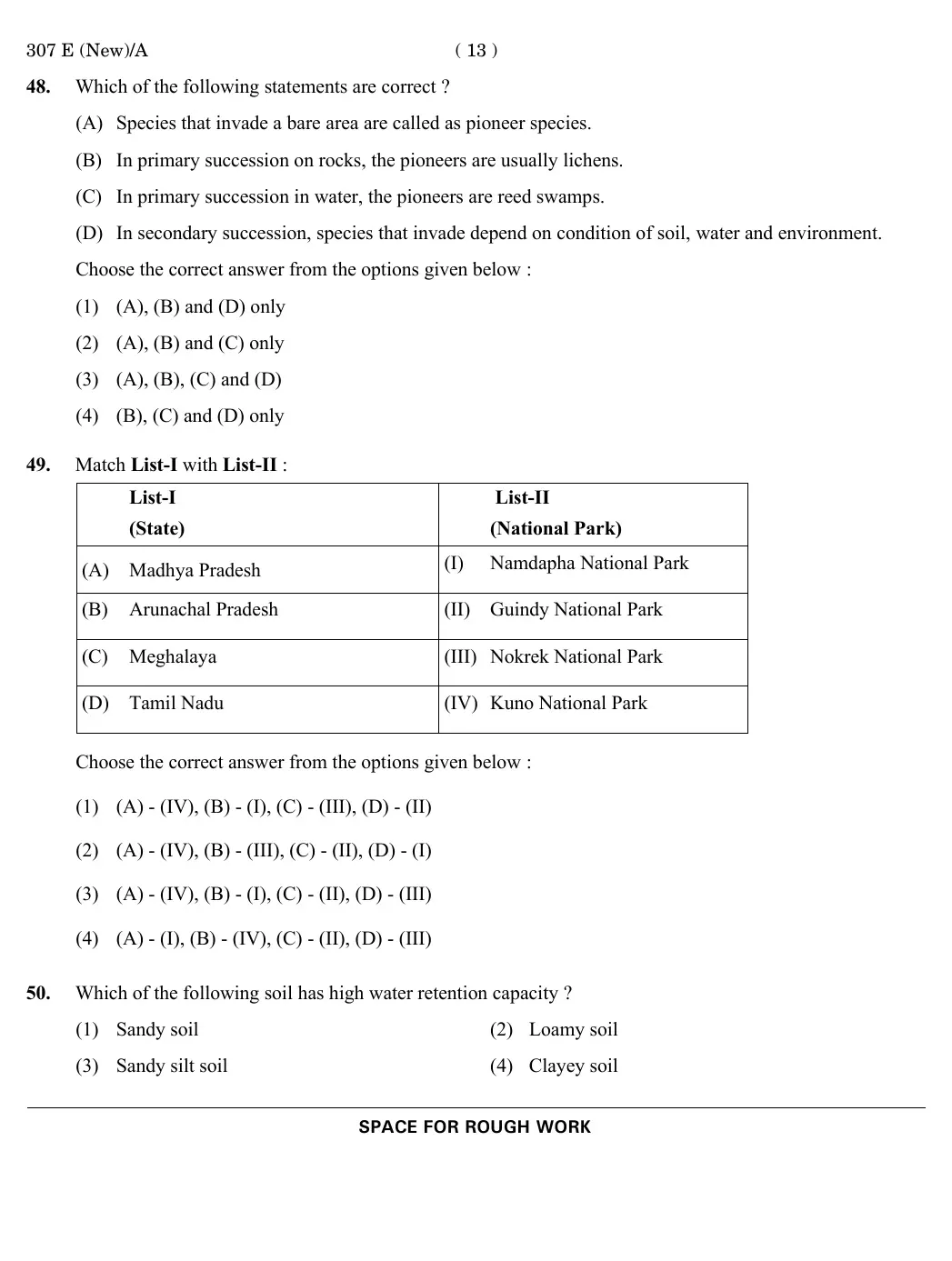
Question 48:

Which of the following statements are correct?
(A) Species that invade a bare area are called pioneers
(B) Pioneers in primary succession on rocks are usually lichens
(C) Pioneers in primary succession in water are reed swamps
(D) In secondary succession, invading species depend on soil, water, and environmental conditions

  • (1) (A), (B), and (D) only
  • (2) (A), (B), and (C) only
  • (3) (A), (B), (C), and (D)
  • (4) (B), (C), and (D) only
Correct Answer: (1) (A), (B), and (D) only
View Solution

Question 49:

Match List-I (State) with List-II (National Park):
(A) Madhya Pradesh
(B) Arunachal Pradesh
(C) Meghalaya
(D) Tamil Nadu
List-II
(I) Namdapha National Park
(II) Guindy National Park
(III) Nokrek National Park
(IV) Kuno National Park

  • (1) (A) - (IV), (B) - (I), (C) - (III), (D) - (II)
  • (2) (A) - (IV), (B) - (III), (C) - (II), (D) - (I)
  • (3) (A) - (IV), (B) - (I), (C) - (II), (D) - (III)
  • (4) (A) - (I), (B) - (IV), (C) - (II), (D) - (III)
Correct Answer: (1) (A) - (IV), (B) - (I), (C) - (III), (D) - (II)
View Solution

Question 50:

Which soil type has high water retention capacity?

  • (1) Sandy soil
  • (2) Loamy soil
  • (3) Sandy silt soil
  • (4) Clayey soil
Correct Answer: (4) Clayey soil
View Solution