


Content Writer
Carbon dioxide is a colourless and odourless gas with the chemical formula of CO2. It is a chemical compound that has two oxygen atoms bonded to one carbon atom through covalency.
- Carbon dioxide is a non-flammable gas found in the atmosphere at normal temperature.
- The compound is soluble in water and can be found in lakes, ice caps, groundwater, and seawater.
- When animals and human beings exhale, carbon dioxide is also released.
- The compound turns into dry ice when solidification takes place and gases at room temperature.
- Carbon dioxide is an important greenhouse gas and helps trap heat in the earth’s atmosphere.
- It is emitted when hydrocarbon fuels such as coal, wood, natural gas, and gasoline are burned.
- The concentration of the compound is 400 ppm in the earth’s atmosphere.
Key Terms: Carbon dioxide, Carbon, Oxygen, Atoms, Molecules, Greenhouse Gas, Carbonates, Carbonic Acid, Calcium, Structure of Carbon Dioxide, Properties of Carbon Dioxide, Preparation of Carbon Dioxide
Carbon Dioxide Structure
[Click Here for Sample Questions]
According to the carbon dioxide structure, the compound consists of a linear molecule with a carbon atom at the center. It is nonpolar and has zero dipole moment.
- Carbon dioxide contains two C-O bonds.
- In this compound, carbon is covalently bonded with oxygen atoms.
- The carbon dioxide structure involves a double bond of a compound consisting of one pi bond and one sigma bond.
- The compound's nonpolar character is due to the fact that the dipole moment of one C-O bond is cancelled by the C-O bond on the other side.
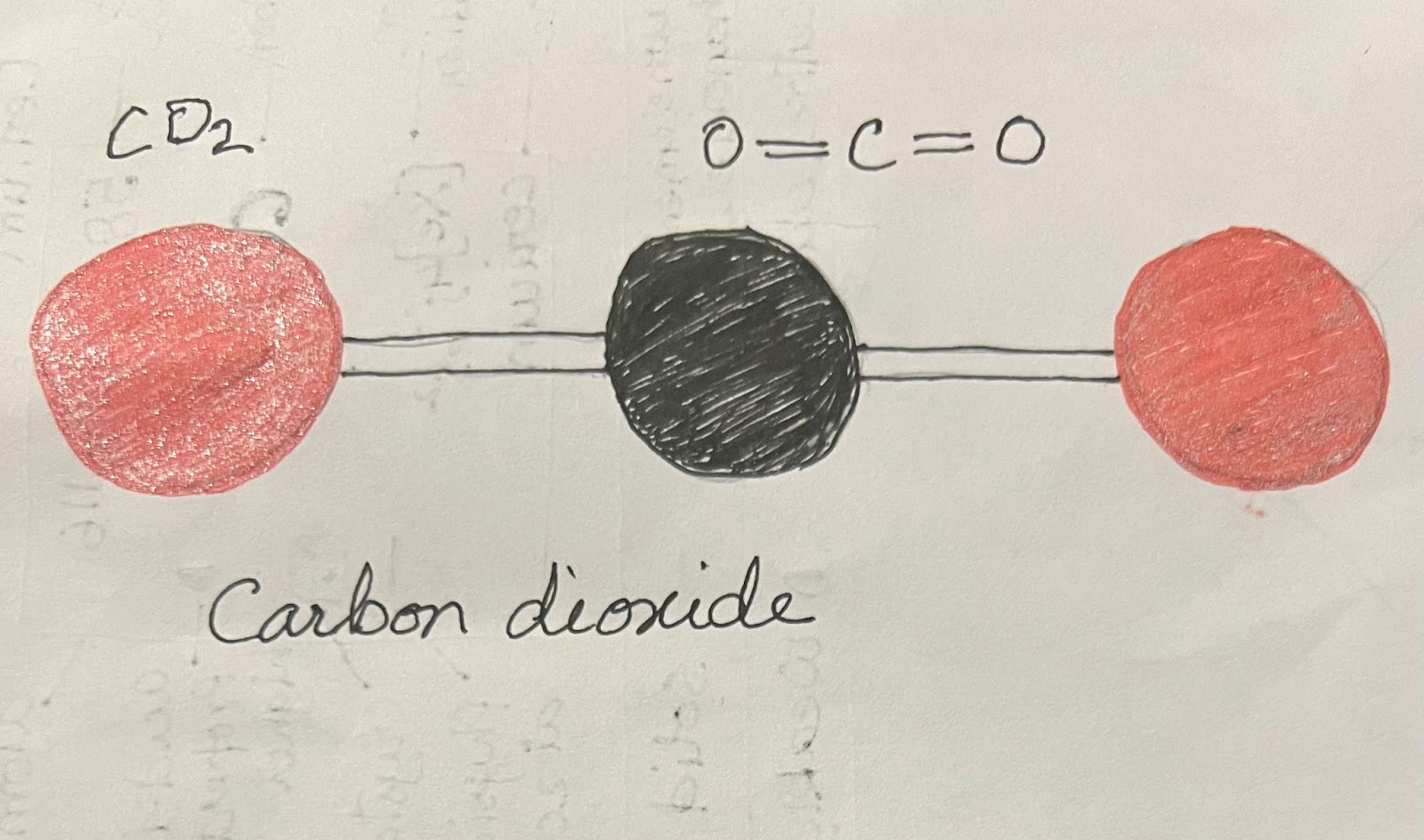
Carbon Dioxide
Preparation of Carbon Dioxide
[Click Here for Sample Questions]
There are different ways for preparation of carbon dioxide, which are as follows:
Laboratory method
Carbon dioxide can be obtained in the laboratory by the action of dilute hydrochloric acid on calcium. The reaction involved in the preparation of carbon dioxide is as follows:
CaCO3 + 2HCl ⇒ CaCl2 + H2O + CO2

Laboratory Method
Industrial Preparation
On a large scale, carbon dioxide is obtained either by heating calcium carbonate or by fermentation of sugars. The reaction involved is as follows:
CaCO3 ⇒ CaO + CO2
C6H12O6 ⇒ 2C2H5OH + 2CO2
Other methods of Preparation
Carbon dioxide can be prepared by burning carbon and hydrocarbons in the presence of excess air. The reaction involved in the preparation of carbon dioxide is as follows:
C + O2 ⇒ CO2
CH4 + 2O2 ⇒ CO2 + 2H2O


Also Read:
| Related Articles | ||
|---|---|---|
| Half Life Formula | Activation Energy Formula | Mass Percent Formula |
Properties of Carbon Dioxide
[Click Here for Sample Questions]
The properties of carbon dioxide is divided into physical and chemical properties which are as follows:
Physical Properties of Carbon Dioxide
The physical properties of carbon dioxide are as follows:
- Carbon dioxide is a colourless and odourless compound.
- It is slightly heavier than air.
- The compound dissolves in water to give carbonic acid.
- It has a low boiling point of 194.5 K and a low melting point of 261.4K.
- Carbon dioxide is easily liquefied into a colourless liquid at ordinary temperatures and 70 atm pressure.
- When this compressed gas is allowed to expand through a nozzle, it solidifies into dry ice.
- The density of the compound is 1.977 g/mol.
The physical properties of carbon dioxide are tabulated below:
| Compound | Data |
|---|---|
| Carbon dioxide | CO2 |
| Molar mass | 44.0095(14) g/mol |
| Specific gravity | 1.53 at 21oC |
| Density | Solid: 1,600 g/L Liquid: 771 g/L Gas: 1.98 g/L |
| Melting point | −56.6 °C |
| Boiling point | −78.5 °C |
| Solubility in water | 0.9 vol/vol at 20oC |
| Henry constant for solubility | 298.15 mol/ kg * bar |

Properties of Carbon Dioxide
Chemical Properties
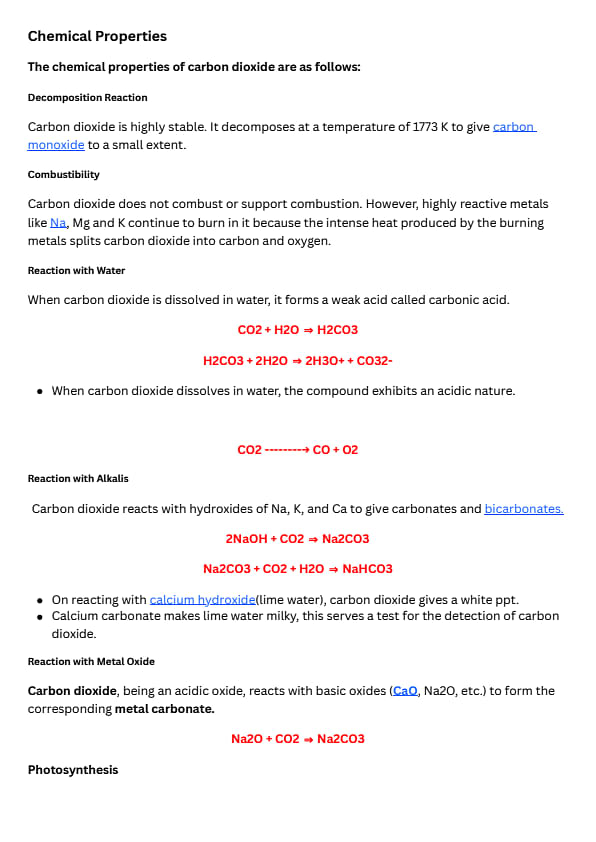
The chemical properties of carbon dioxide are as follows:
Decomposition Reaction
Carbon dioxide is highly stable. It decomposes at a temperature of 1773 K to give carbon monoxide to a small extent.
CO2 --------→ CO + O2
Combustibility
Carbon dioxide does not combust or support combustion. However, highly reactive metals like Na, Mg and K continue to burn in it because the intense heat produced by the burning metals splits carbon dioxide into carbon and oxygen.
Reaction with Water
When carbon dioxide is dissolved in water, it forms a weak acid called carbonic acid.
CO2 + H2O ⇒ H2CO3
H2CO3 + 2H2O ⇒ 2H3O+ + CO32-
- When carbon dioxide dissolves in water, the compound exhibits an acidic nature.
- It will turn blue litmus red.
Reaction with Alkalis
Carbon dioxide reacts with hydroxides of Na, K, and Ca to give carbonates and bicarbonates.
2NaOH + CO2 ⇒ Na2CO3
Na2CO3 + CO2 + H2O ⇒ NaHCO3
- On reacting with calcium hydroxide(lime water), carbon dioxide gives a white ppt.
- Calcium carbonate makes lime water milky, this serves a test for the detection of carbon dioxide.

Reaction with Metal Oxide
Carbon dioxide, being an acidic oxide, reacts with basic oxides (CaO, Na2O, etc.) to form the corresponding metal carbonate.
Na2O + CO2 ⇒ Na2CO3
Photosynthesis
Carbon dioxide is removed from the atmosphere by the process of photosynthesis by plants.
6CO2 + 6 H2O (chlorophyll)⇒ C6H12O6 + O2

Uses of Carbon Dioxide
[Click Here for Sample Questions]
The uses of carbon dioxide are as follows:
- Carbon dioxide is dissolved into cold drink beverages under pressure, which gives fizz to it.
- It is used in the manufacture of washing soda (Na2CO3) and baking soda (NaHCO3).
- The compound in the form of dry ice is used as a refrigerant because it lasts longer than ordinary ice.
- The compound is used to manufacture of urea by Haber’s process.
- Carbon dioxide is used in the manufacturing of ammonium sulphate, which is used as fertilizer.
- It is used in food and oil processing companies.
- The compound is used as a fire extinguisher since it can control the spread of fire.
Environmental Effects of Carbon Dioxide
[Click Here for Sample Questions]
The environmental effects of carbon dioxide are as follows:
- The rise in the level of carbon dioxide will result in an overabundance of greenhouse gases.
- Due to the rise in greenhouse effects, the temperature of Earth keeps on increasing.
- This causes the melting of ice and a rise in ocean level.
- The emission of CO2 will result in the contamination of our clean air, forming an impenetrable layer across the globe.
- Carbon dioxide is released by burning fossil fuels, thus reducing the forest cover.

Environmental Effects of Carbon Dioxide
Things to Remember
- Carbon dioxide can be prepared by burning hydrocarbons or carbon.
- It is a colourless, odourless compound which is heavier than air.
- The compound has relatively low boiling and melting points.
- It is neither combustible nor a supporter of combustion.
- Carbon dioxide is acidic in nature, turns blue litmus red and converts basic hydroxides into the corresponding carbonates.
- CO2 is a major component of photosynthesis and the greenhouse effect, two major processes that help sustain life on this earth.
- It is widely used in industries to produce urea, fertilizers, baking powder, washing soda and as solvents.
Also Read:
Sample Questions
Ques: CO2 is neither combustible nor a supporter of combustion. Why? (2 marks)
Ans: Carbon dioxide is highly stable in nature. Due to its stable nature it can neither release oxygen (which is a supporter of combustion) nor can it form carbon (which is combustible).
Ques: Carbon monoxide is readily absorbed by ammoniacal cuprous chloride but carbon dioxide does not. Why? (2 marks)
Ans: Carbon monoxide acts as a Lewis base due to the presence of a lone pair of electrons on carbon and forms a soluble complex with ammoniacal cuprous chloride solution. On the other hand, CO2 does not act as a lewis base due to the absence of lone pairs of electrons on the carbon atom.
Ques: Explain why:- (2 marks)
a) CO2 is a nonpolar molecule.
b) CO2 cannot reduce metal oxides while CO reduces metallic oxides?
Ans: a. It is so because the dipole moment of one C-O bond is canceled by the C-O bond on the other side.
- It is so because carbon monoxide is a strong reducing agent due to its strong affinity of oxygen. Hence, it reduces metal oxides. On the other hand, carbon dioxide due to its highly stable nature and almost no affinity for oxygen does not reduce metal oxides.
Ques: Why is solid CO2 known as dry ice? (1 mark)
Ans: Because it looks like ice and does wet a piece of paper or cloth as it sublimes without melting.
Ques: CO2 does not burn and does not support combustion, but a burning magnesium wire continues to burn in it, how? (2 marks)
Ans: Burning magnesium continues to burn in an atmosphere of carbon dioxide because Mg produces sufficiently high temperature to break down CO2 into oxygen (supporter of combustion) and carbon( which is combustible).
Ques: Mention two reasons why dry ice is used as a refrigerant? (2 marks)
Ans: Carbon dioxide is used as a refrigerant because:-
- It lasts longer than ordinary ice.
- Temperature achieved is much lower(-40oC), hence food freezes faster.
Ques: What are the physical properties of carbon dioxide? (3 marks)
Ans: The physical properties of carbon dioxide are as follows:
- Nature:- Carbon dioxide is a colourless, odourless It is slightly heavier than air. It dissolves in water to give carbonic acid.
- Boiling and melting point:- It has a low boiling point (194.5 K) and low melting point (261.4K).
- Liquefaction and solidification:- Carbon dioxide is easily liquefied into a colourless liquid at ordinary temperatures and 70 atm pressure. When this compressed gas is allowed to expand through a nozzle, it solidifies into dry ice.
Ques: How carbon dioxide is prepared in industries? (2 marks)
Ans: On a large scale, carbon dioxide is obtained either by heating calcium carbonate or by fermentation of sugars.
CaCO3 ⇒ CaO + CO2
C6H12O6 ⇒ 2C2H5OH + 2CO2
Ques: What are the uses of carbon dioxide? (3 marks)
Ans: The uses of carbon dioxide are as follows:
- Carbon dioxide is dissolved into cold drink beverages under pressure, which gives fizz to it.
- The compound is used to manufacture of urea by Haber’s process.
- Carbon dioxide is used in the manufacturing of ammonium sulphate, which is used as fertilizer.
- The compound is used as a fire extinguisher since it can control the spread of fire.
Ques: What is the structure of carbon dioxide? (2 marks)
Ans: According to this structure, carbon dioxide is a linear molecule with a carbon atom at the center. Carbon dioxide molecule is non- polar and possesses zero dipole moment although it contains two C-O bonds. Its non-polar character is due to the fact that the dipole moment of one C-O bond is canceled by the C-O bond on the other side.
Ques: What happens when carbon dioxide is dissolved in water? (2 marks)
Ans: When carbon dioxide is dissolved in water, it forms a weak acid called carbonic acid.
CO2 + H2O ⇒ H2CO3
H2CO3 + 2H2O ⇒ 2H3O+ + CO32-
Ques: What is carbon dioxide in atmosphere? (3 marks)
Ans: Since CO2 is a naturally occurring gas and is already present in the Earth's atmosphere, we have researched it. Furthermore, carbon dioxide is a greenhouse gas, meaning that it keeps sunlight in the atmosphere of Earth.
- This causes the Earth's atmosphere to warm more, contributing significantly to the damaging effects of global warming on the environment.
- Numerous human activities, including deforestation, the burning of fossil fuels, the usage of greenhouses, etc., are contributing to the rise in CO2 levels.
- All living things are harmed by these elevated CO2 levels since they are upsetting the ecosystem and creating environmental issues.
Ques: What is the importance of carbon dioxide? (3 marks)
Ans: The importance of carbon dioxide are as follows:
- Plants utilize it to complete the process of photosynthesis.
- It serves as a refrigerant in refrigerators.
- Carbon dioxide adds fizz to cold drinks and other liquids.
- It facilitates the rapid growth of greenhouse plants.
- The compound is helpful for a variety of cooking methods.
Ques: What is the most significant greenhouse gas? (2 marks)
Ans: The most significant greenhouse gas on Earth is carbon dioxide, which both absorbs and radiates heat. Greenhouse gases, as opposed to oxygen or nitrogen, which make up the majority of our atmosphere, absorb heat emitted from the Earth's surface and re-emit it in all directions, including back toward the surface.
Ques: What are the benefits of carbon dioxide? (2 marks)
Ans: The advantages of carbon dioxide include preventing the production of hazardous clouds of chlorine gas, using less chlorine, reducing the amount of oxidants in the air, and reducing the amount of trihalomethanes that form in swimming pool water.
Ques: Where is carbon dioxide found? (2 marks)
Ans: The majority of animals are natural sources of carbon dioxide because they exhale it as waste. Burning coal, oil, or natural gas is one of the main human energy-producing activities that results in carbon dioxide emissions.
Ques: What are 5 sources of carbon dioxide? (2 marks)
Ans: Emissions of carbon dioxide come from both natural and human sources. Decomposition, ocean release, and respiration are examples of natural sources. The manufacturing of cement, deforestation, and the combustion of fossil fuels including coal, oil, and natural gas are examples of human sources.
Ques: How much CO2 is found in water? (3 marks)
Ans: Understanding the role of carbon dioxide in water is crucial. Surface waters typically contain less than 10 ppm of this compound, while deep groundwater can hold several hundred ppm. The concentration of carbon dioxide in water significantly influences its pH, making it a major source of acidity in unpolluted water.
Ques: Is carbon dioxide a gas or water? (2 marks)
Ans: Carbon dioxide is a colourless and odourless gas with specific atmospheric pressure and temperature. The compound is relatively noncombustible and nontoxic. Carbon dioxide is heavier than air and may sometimes suffocate due to the displacement of air.
For Latest Updates on Upcoming Board Exams, Click Here: https://t.me/class_10_12_board_updates
Check-Out:



Comments