



Education Content Expert
Solubility is the maximum amount of solute that can be dissolved in a known quantity of solvent at a certain temperature. Solubility is dependent on numerous factors including the type of solute and solvent, temperature, and pressure.
- Solution can be defined as a homogeneous mixture of one or more solutes in a solvent.
- Solute is a substance that can be dissolved into a solution by a solvent.
- Solvent is a chemical substance that dissolves a solute, resulting in a solution.
Solubility Formula is given as:
| \(\begin{array}{l}S = \sqrt{K_{sp}}\end{array}\) |
Here, Ksp refers to the Solubility Product Constant.
| Table of Content |
Key Terms: Solubility, Solubility Formula, Solubility Product, Solution, Solute, Solvent, Temperature, Equilibrium Constant
What is Solubility?
[Click Here for Sample Questions]
Solubility is the maximum amount of solute that can be dissolved in a given amount of solvent at a particular temperature. It is a property that helps determines the dissolving of a given substance in a solvent.
- Solution, Solute, and Solvent are the three primary components considered during Solubility.
- Solution is a special type of homogeneous mixture composed of two or more substances.
- Solute is a substance that is dissolved while Solvent is the medium in which solute is dissolved.
- The solute can either be a solid, liquid, or gas.
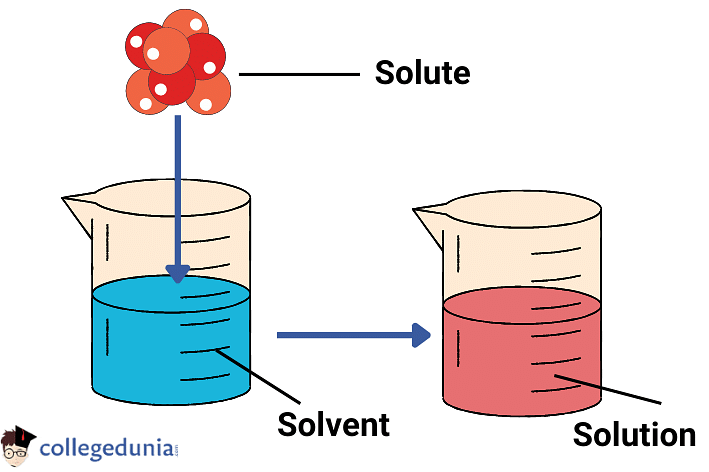
Solutions
Solubility Example
Suppose a person has salt and wants to dissolve it in a glass of water.
- The person puts the salt in water and then stirs it so that it is dissolved.
- If the process is repeated continuously, there will be a point after which no more salt can be dissolved.
- The extra salt will be deposited in the bottom of the vessel.
- The amount of salt after which no more salt can be dissolved is its Solubility.
Read More:
| Relevant Concepts | ||
|---|---|---|
| Solubility Curve | Types of Solutions | Unsaturated Solutions |
| Abnormal Molar Masses | Ideal and Non-Ideal Solutions | Solvent Examples |
Solubility Formula
[Click Here for Previous Year Questions]
Solubility is the amount of solute dissolved in a given solvent at a specific temperature. It is the molarity of the material under excessive undissolved material in a solution at chemical equilibrium. It is dependent on temperature and there should be uniform temperature throughout the system.
Solubility Formula is given as follows:
| \(\begin{array}{l}S = \sqrt{K_{sp}}\end{array}\) |
Where KSP is the Solubility Product Constant. Solubility Product has the same general form as other equilibrium constant expressions.
Solved ExampleExample: Tin Iodide (SnI2) has a molar solubility of 1.28 x 10⁻² mol/L. What will be the Ksp of this compound? Solution: The solubility equilibrium of Tin Iodide (SnI2) is given as: SnI2(s) ⇋ Sn2+(aq) + 2I– (aq) The Ksp expression will be thus written as: Ksp = [Sn2+][I–]2 1 mole of SnI2 gives out 1.0 mol of Sn2+, and 2.0 mol of I–. [Sn2+] = 1.28 × 10⁻² M [I–] = (2) × 1.28 × 10-2 M [I–] = 2.56 × 10⁻²M Substitute the obtained values in Ksp expression, we get Ksp = (1.28 ×× 10-2M)(2.56 × 10⁻²M)2 Thus, Ksp = 8.4 × 10⁻⁶ M2. |
Solubility Product
[Click Here for Sample Questions]
Solubility Product is the maximum product of the molar concentration of the ions which are produced due to the dissociation of the compound.
- The solubilities of ionic compounds that dissociate in water to form cations and anions differ from each other.
- Some compounds are very soluble while others are very insoluble.
- Solubility Product is a type of equilibrium constant whose value is dependent on temperature.
- It is denoted by the symbol Ksp.
- Solubility Product increases in solubility and therefore increases with increasing temperature.
- Low value of the solubility product indicates lower solubility while a higher value of the solubility product indicates greater solubility.
Solutions Detailed Video Explanation
Solubility Product Formula
Solubility Product Constant is used to represent a saturated solution of an ionic compound with low solubility. Saturated solutions are said to be in great equilibrium between ionic compounds and undissolved solids.
Solubility Product Constant is given as follows:
| MxAy (s) ⇢ xMy+(aq) + yAx−(aq) |
The general Equilibrium Constant is given as:
| Kc = [My+]x [Ax−]y |
Significance of Solubility Product
- The size of the Solubility Product determines the solubility of a substance.
- It is a particular type of non-uniform equilibrium constant.
- It is related to saturated solutions that have ionic components not dissolved completely.
- It changes with temperature, thus, the temperature at which it is measured should always be stated.
Factors Affecting Solubility
[Click Here for Previous Year Questions]
Solubility of a substance depends on various physical and chemical properties of the element. It can also be affected by factors such as temperature, pressure, and the kind of bond and forces in between the particles.
Factors Affecting Solubility are as follows:
Temperature
According to Le Chatelier’s Principle, if dissolution is endothermic then the solubility should increase with the increase in temperature, and vice versa if dissolution is exothermic.
- In general, water dissolves solutes at 20° C or 100° C.
- Sparingly soluble solids can be liquified completely by raising the temperature.
- However, in the case of gaseous substances, temperature inversely influences solubility.
- It means as the temperature increases, gases expand and escape from their solvent.

Factors Affecting Solubility
Forces and Bonds
- The type of intermolecular forces and bonds vary from molecule to molecule.
- The chances of solubility between two dissimilar elements are more challenging compared to the like substances.
- For instance, water is a polar solvent in which a polar solute like ethanol is easily soluble.
Pressure
- Gaseous substances are much more influenced by pressure than solids and liquids.
- When the partial pressure of gas rises, the chance of its solubility is also increased.
- A soda bottle is one example of this, where CO2 is bottled under high pressure.
Solubility of Solids in Liquids
[Click Here for Sample Questions]
Solids are a state of matter in which the molecules are closely packed together and contain the least amount of kinetic energy.
- Not every solid can be dissolved in a particular liquid.
- Salt can be dissolved in the water but not naphthalene or anthracene.
- Polar solvents dissolve polar solutes and non-polar solvents dissolve non-polar solutes.
- Naphthalene and anthracene are non-polar but water is polar, hence they cannot be dissolved.
- When a solid solute is added to the solvent, some solute dissolves, and its concentration increases in the solution. This process is called Dissolution.
- Some solute particles in the solution collide with each other and some get separated out of the solution. This process is known as Crystallization.
- There will be a time when the rate of dissolution will be the same as the rate of crystallization, and this point is called Dynamic Equilibrium.
Solubility of Gases in Liquids
[Click Here for Previous Year Questions]
Solubility of Gases is greatly affected by temperature and pressure as well as the nature of the solute and the solvent.
- Solubility of gases increases when the pressure is increased.
- Henry’s Law clearly defines the behavior of solubility of a gas with pressure.
- It states that “the solubility of a gas in a liquid is directly proportional to the partial pressure of the gas present above the surface of liquid or solution”.
- There are many gases that get easily dissolved in water, whereas there are gases that do not dissolve in water under normal conditions.
- Oxygen is occasionally soluble in water whereas HCl or ammonia readily dissolves in water.
Solubility of Liquids in Liquids
[Click Here for Sample Questions]
Water is a universal solvent as it dissolves almost every solute except for a few.
- Solubility is the new bond formation between the solute molecules and solvent molecules.
- The maximum concentration of solute dissolves in a known solvent concentration at a specified temperature.
- Depending on the concentration of solute dissolves in a solvent, solutes are categorized into highly soluble, sparingly soluble, or insoluble.
- When a concentration of 0.1 g or more of a solute can be dissolved in a 100ml solvent, it is said to be soluble.
- On the other hand, if a concentration below 0.1 g is dissolved in the solvent, it is said to be sparingly soluble.
- Thus, solubility is a quantitative expression that is expressed by the unit gram/liter (g/L).
Things to Remember
- Solubility of a substance is the maximum amount of solute that can be dissolved in a given solvent at a specified temperature.
- Solution is a homogeneous mixture of one or more solutes in a particular solvent.
- Solute is a substance that is dissolved in small amounts in the Solvent.
- Solvent is a fluid or medium in which one or more solutes are dissolved.
- Solubility is affected by various factors such as Temperature, Pressure, Force, and Bonds.
- Solubility Formula is expressed as \(\begin{array}{l}S = \sqrt{K_{sp}}\end{array}\) where Ksp is the Solubility Product Constant.
Check More:
Previous Year Questions
- Solubility product constant (Ksp) of salts of types… (JEE Advanced - 2008)
- The solubility of CO2 in water increases with…
- The solubility of BaSO4 in water is 2.33×10⁻³ gram/litre. Its solubility product… (AIIMS - 1998)
- A graph of vapour pressure and temperature for three different… (JEE Main - 2020)
- At 35∘C, the vapor pressure of CS2 is 512 mm Hg… (JEE Main - 2020)
- Two open beakers one containing a solvent and the other… (JEE Main - 2020)
- For an ideal solution, the correct option is… (NEET - 2019)
- In water saturated air the mole fraction of water vapour… (NEET - 2019)
- A solution of sodium sulfate contains 92g of… (JEE Main - 2019)
- Which one of the following statements regarding Henry's law… (JEE Main - 2019)
Sample Questions
Ques. What is Solubility? (3 Marks)
Ans. Solubility of a substance is its maximum amount that can be dissolved in a specified amount of solvent at a specified temperature. It is affected by several factors such as the type of solute and solvent, temperature, force, and pressure.
Example: Sugar cubes added to a cup of tea or coffee forms a very common example of a solution. The property that helps sugar molecules to dissolve in tea or coffee is known as Solubility. A solute is any constituent that can be either solid or liquid or gas liquified in a solvent. Here, Sugar is the solute.
Ques. The Ksp of Copper Bromide, CuBr, is given as 8× 10⁻¹⁰. What will be the molar solubility of Copper Bromide? (3 Marks)
Ans. Copper Bromide is expressed as
CuBr (s) ⇢ Cu+(aq) + Br–(aq)
Ksp = Cu+ + Br–
Ksp = S × S
8× 10–10 = S2
S = √8 × 10⁻¹⁰
S = 2.8 × 10⁻⁵mol/L
Cu+ = Br– = S = 2.8 × 10⁻⁵mol/L
Thus, the solubility of Copper Bromide is 2.8 × 10⁻⁵mol/L.
Ques. What will be the solubility of Silver Chloride, if Ksp of AgCl is 4 x 10⁻⁸? (3 Marks)
Ans. The equilibrium reaction will be as follows:
AgCl ⇢ Ag++ Cl–
Thus, the solubility product constant will be expressed as:
Ksp = [Ag+] [Cl–]
Ksp = S× S
Ksp = S2
4 × 10-8 = S2
S = √4 × 10⁻⁸
S = 2 × 10⁻⁴ mol/L.
[Ag+] = [Cl–] = 2 × 10⁻⁴ mol/L
Thus, the solubility of Silver Chloride will be 2 × 10⁻⁴ mol/L.
Ques. State the factors that affect the value of Ksp? (3 Marks)
Ans. The value of solubility product constant is affected by the following factors:
- Common Ion Effect, i.e. the presence of common ions reduces the value of Ksp.
- Diverse Ion Effect (Ksp values are usually high if solute ions are abnormal).
- Existence of Pair of Ions.
Ques. How does Temperature affect the Solubility of Liquids in Liquids? (3 Marks)
Ans. The solubility of a substance can be increased by increasing the temperature.
- A solute is dissolved in water at 20° C or 100° C.
- Sparingly soluble solids or liquid substances can be dissolved completely by raising the temperature.
- In the case of gaseous substances, temperature inversely influences solubility, i.e. as the temperature increases gases expand and escape from their solvent.
Ques. Write the chemical equation showing how the substance dissociates and write the Ksp expression.
(1) AlPO4
(2) BaSO4
(3) CdS
(4) Cu3(PO4)2
(5) CuSCN
(6) Hg2Br2 (5 Marks)
Ans. The dissociation equation and Ksp expression of the substances is given as follows:
| Dissociation Equation | Ksp Expression |
|---|---|
| AlPO4 ⇌ Al3+ (aq) + PO43¯ (aq) | Ksp = [Al3+] [PO43¯] |
| BaSO4 ⇌ Ba2+ (aq) + SO42¯ (aq) | Ksp = [Ba2+] [SO42¯] |
| CdS ⇌ Cd2+ (aq) + S2¯ (aq) | Ksp = [Cd2+] [S2¯] |
| Cu3(PO4)2 ⇌ 3 Cu2+ (aq) + 2 PO43¯ (aq) | Ksp = [Cu2+]3 [PO43¯]2 |
| CuSCN ⇌ Cu+ (aq) + SCN¯ (aq) | Ksp = [Cu+] [SCN¯] |
| Hg2Br2 ⇌ Hg22+ (aq) + 2 Br¯ (aq) | Ksp = [Hg22+] [Br¯]2 |
Ques. Consider that solid CaCl2 equilibrates with pure water. What are [Ca2+] and [Cl–] solutions at equilibrium when Ksp (PbCl2) = 2.1 × 10⁻⁵? (3 Marks)
Ans. The equilibrium reaction will be as follows:
CaCl2 ⇢ Ca2+ + 2Cl–
Ksp = [Ca2+] + [Cl–]2
Ksp = S × (2S)2
Ksp = 4S3
2.1 × 10-5 = 4S3
2.1 × 10⁻⁵ / 4 = S3
5.25 × 10-6 = S3
S = 1.73 × 10⁻² mol/L
[Ca2+] = S = 1.73 × 10⁻² mol/L
[Cl–] = 2S = 2 × 1.73 × 10-2
[Cl–] = 3.46 × 10⁻² mol/L
Ques. Explain the Solubility of Gases in Liquids. (3 Marks)
Ans. Solubility of Gases in Liquids is majorly affected by Pressure and Temperature.
- Solubility of Gases increases with increasing pressure.
- Some gases get dissolved in water easily, while some gases do not dissolve in water under normal conditions.
- HCl or Ammonia readily dissolves in water while Oxygen is dissolvable in water occasionally.
Ques. 25.0 mL of 0.0020 M Potassium Chromate is mixed with 75.0 mL of 0.000125 M Lead (II) Nitrate. Will a precipitate of Lead (II) Chromate be formed? The Ksp of Lead(II) Chromate is 1.8 x 10⁻¹⁴ (5 Marks)
Ans. The chemical reaction involving the mixture of Potassium Chromate and Lead (II) Nitrate is:
K2CrO4(aq) + Pb(NO3)2(aq) → 2 KNO3(aq) + PbCrO4(s)
Pb2+(aq) + CrO42-(aq) → PbCrO4(s)
The second reaction can be written in terms of Ksp as
Ksp = [Pb2+][CrO42-]
Using the formula C1V1 = C2V2, we can find the initial concentration of each of them,
We have, (0.0020 M K2CrO4)(25.0 mL) = (C2)(100.0 mL)
C2 for K2CrO4 = 0.00050 M
Now calculating the same for Lead(II) Nitrate gives
C2 for Pb(NO3)2 = 0.0000938 M
Now we will calculate the reaction quotient Q and compare it with the Ksp value.
Q = (0.0000938 M Pb2+)(0.00050 M CrO42-) = 4.69 x 10⁻⁸
The value of Q is greater than Ksp so a precipitate of Lead (II) Chromate will be formed.
Ques. Calculate the solubility of Ag2CrO4 in pure water if the solubility constant for silver chromate is 1.1 x 10⁻¹². (5 Marks)
Ans. The equilibrium expression will be written as:
Ag2CrO4(s) --> 2 Ag+(aq) + CrO42-(aq)
Ksp = [Ag+]2[CrO42-]
Let "x" be the number of moles of silver chromate that dissolves per liter of solution
| Concentration | Ag2CrO4(s) | Ag+(aq) | CrO42-(aq) |
|---|---|---|---|
| Initial Concentration | All Solid | 0 | 0 |
| Change in Concentration | - x Dissolves | + 2 x | + x |
| Equilibrium Concentration | Less Solid | 2 x | x |
Substituting the required concentrations in the Ksp equation,
1.1 x 10-12 = [2x]2[x]
x = 6.50 x 10⁻⁵ M
For Latest Updates on Upcoming Board Exams, Click Here:https://t.me/class_10_12_board_updates
Check-Out:



Comments