



Content Curator
Calcium is the fifth chemical element found in the Earth’s crust in large quantities. With an atomic number 20, atomic mass 40.078 g/mol and chemical symbol ‘Ca’, it belongs to the Group 2 elements of the modern periodic table. As an alkaline earth metal calcium, when comes in contact with air, produces a layer of dark oxide nitrate. It is because of its severe reactivity property. Calcium has similar physical and chemical properties to those of strontium and barium which are known to be its heavier homologs.
| Table of Content |
Key Takeaways: Calcium, Ca, Group 2 elements, Calcium element, Calcium uses
Read More: Number of Moles Formula
Classification of Calcium
[Click Here for Sample Questions]
- Calcium is a ductile silvery metal (or pale yellow) with properties equivalent to that of strontium, radium, and barium which are considered to be heavier elements of the same group.
- The electron configuration of a calcium atom is ArAr4s2 and it consists of 20 electrons.
- It is found in solid-state with a boiling point at 1484ºC and melting point at 842ºC.
- Calcium is an important element for the human body that keeps the bones strong enough to support the whole body.
- Almost 99% of calcium is present in the bones and teeth of the human body.
- It is also used by the nervous system for the transmission of impulses within the body.
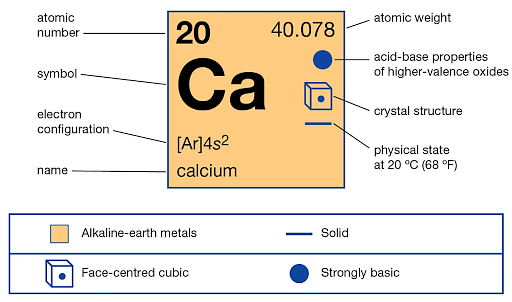
Calcium
Calcium Atomic Data
[Click Here for Sample Questions]
| Group | 2 |
| Period | 4 |
| Block | s |
| Atomic Number | 20 |
| Electron Configuration | ArAr4s2 |
| Atomic Radius | 2.31 |
| Covalent Radius (A) | 1.74 |
| Electron Bonding (kJ mol-1) | 2.369 |
| Electronegativity | 1.00 |
| Boiling Point | 1484ºC |
| Melting Point | 842ºC |
| Density (g cm-3) | 1.54 |
| Relative Atomic Mass | 40.078 |
Calcium and its Properties
[Click Here for Sample Questions]
The properties of calcium are divided into two groups - physical properties and chemical properties.
Physical Properties of Calcium
In this category, the properties of calcium can be identified through the senses, like color, odor, luster, density, firmness, boiling point, melting point and freezing point. Such properties can be identified without bringing any transformation to the substance. The physical properties are listed below:
| Color | silvery-white metallic color |
| State | Solid |
| Firmness | Fairly soft metal |
| Crystalline Structure | Cubic |
| Malleability | Can be shaped or bent |
| Ductility | Flattened into thin sheets, or pressed, rolled & cut |
| Boiling Point | 1484ºC |
| Melting Point | 842ºC |
Chemical Properties of Calcium
The chemical properties of calcium can be identified whenever there is a chemical reaction. They confirm the behavior of calcium during its transformation from one substance to another and also while reacting with different substances. The chemical properties are as follows:
| Chemical Formula | Ca |
| Oxidization | Used in the form of deoxidizer in steel |
| Isotopes | 6 (48Ca, 46Ca, 44Ca, 43Ca, 42Ca & 40Ca) |
| Compounds | Limestone, Gypsum, Marble, Anhydrite, etc. |
| Flammability | Gets ignited when heated in presence of air or oxygen |
| Reactivity with Water | Quickly reacts with cold water initially, but gradually the reaction slows down |
| Reactivity with Acid | Highly Reactive |
Ionization Energy of Calcium
[Click Here for Sample Questions]
The ionization energy of calcium is also termed Ionization Potential and it is the energy required for the removal of one electron from the Neutral atom. The chemical representation is:
X + energy → X+ + e-
In the above equation
- X is an atom/molecule that can be ionized.
- X+ is an atom/ molecule with a removed electron (+ve ion).
- e- removed electron
For removing the outermost electron the ionization energy required by a calcium atom is:
Ca + IE → Ca+ + e-
IE = 6.1132 eV (also known as the 1st ionization energy of calcium)
The ionization energy for removing the 1st electron is most frequently used. The energy needed for an electron removal from the species through a charge of (n-1) is referred to as the nth ionization of energy.
1st Ionization Energy - X → X++ e-
2nd Ionization Energy - X+ → X2+ + e-
3rd Ionization Energy - X2+ → X3+ + e-
Calcium Compounds
[Click Here for Sample Questions]
| Calcium Oxide | CaO |
| Calcium Chloride | CaCl2 |
| Calcium Hydroxide | Ca(OH)2 |
| Calcium Phosphate | Ca3(PO4)2 |
| Calcium Hypochlorite (Bleaching Powder) | Ca(ClO)2 |
| Calcium Carbonate | CaCO3 |
Calcium & its Uses
[Click Here for Sample Questions]
- It is essential for strong bones and teeth.
- The presence of calcium in the human body is required for muscular movements and the transmission of messages from the brain to other parts of the body.
- As multicellular life forms, calcium ions play the role of carriers within cells.
- It also helps in releasing hormones and enzymes.
- Calcium carbonate (CaCO3) is required for making cement and toothpaste.
- Due to its easily compound formation property with oxygen and sulfur, calcium is usually used for making steel.
- Several calcium compounds are used as food preservatives.
- Calcium gluconate [Ca(C6H11O7)2] is used in the form of food additives and also in vitamin pills.
- To control dust and to remove ice calcium chloride (CaCl2) is used.
Things to Remember
- It was founded by Humphry Davy in 1808.
- It is an essential component of the human body for strong bones and teeth.
- The nervous system uses calcium for the purpose of transmitting impulses through the body.
- To maintain good health calcium acts as an essential dietary supplement.
- The toxicity level of calcium ions is much lower than other metals.
- It is used for adding orange color to crackers.
- Food items like almonds, dairy products, soy, figs, broccoli, hazelnuts, etc.
- Several calcium compounds are used in various industries for making food preservatives, food additives, bleaching agents, steelmaking, etc.
Read More:
Sample Questions
Ques. State the importance of calcium in the human body. (3 marks)
Ans. Calcium is essential for muscle contraction and transmission of messages from the brain to other parts of the body. It also helps in releasing hormones and enzymes. With insufficient calcium in food, the body tends to take calcium from the bones for the normal functioning of cells. This might result in weak bones. Osteoporosis is one such calcium deficiency disease due to which bones break easily in men and women who are over fifty years of age.
Ques. What is the source of calcium? (3 marks)
Ans. Earlier calcium was produced by the electrolysis of anhydrous calcium chloride and pure calcium metal. Presently, it can be produced commercially by the process of heating aluminum and lime. Calcium is one of the most widely found elements on the Earth’s crust. It is present in limestone, dolomite, gypsum, fluorite, etc. Also, several food items are rich sources of calcium like broccoli, yogurt, milk, soybean, figs, salmon, etc.
Ques. What is the Ionization Energy of calcium? (3 marks)
Ans. There are 20 electrons present in the calcium atoms. The specific energy required for the removal of one electron out of the 20 electrons from the Neutral atom is known as ionization energy of calcium.
Ca + IE → Ca+ + e-
IE = 6.1132 eV (also known as the 1st ionization energy of calcium)
Ques. Describe the Atomic structure of calcium? (3 marks)
Ans. An atom belonging to calcium-40 (with atomic no. 20) has a nuclear composition wherein the element’s most common isotope has 20 protons and 20 neutrons. The electron shells present are taken up by 20 electrons.
- Energy Levels - 4
- 1st Energy Level - 2
- 2nd Energy Level - 8
- 3rd Energy Level - 8
- 4th Energy Level - 2
- Valency - 2
Ques. Who founded calcium and when? (2 marks)
Ans. Sir Humphry Davy founded calcium in 1808 and also named it. He was the one who separated pure calcium through the process of electrolysis of its oxides. Though few calcium compounds were identified by some chemists in ancient times, their chemistry was obscure. Calcium has an atomic number 20 and an atomic mass of 40.078 g/mol. Its chemical symbol is Ca.
Ques. What are the commercial uses of calcium? (3 marks)
Ans. Calcium compounds are mostly used in different industries like food and pharmaceuticals. A few of them are listed below:
- It is used for producing food preservatives and food additives.
- It is used for making calcium supplement pills.
- Due to its easily compound formation property with oxygen and sulfur, calcium is usually used for making steel.
- Used in the form of bleach in the paper industry.
- Calcium-lead alloy is used for making automotive batteries.
Ques. What effect does calcium deficiency have on the human body? (3 marks)
Ans. Calcium is one of the most abundant element present in the human body. The bones and teeth contain 99% of the entire calcium. It is essential for muscle contraction and for the purpose of transmission of messages from the brain to other parts of the body. It is important for the growth and development of the body and bone maintenance. Calcium deficiency will result in the absorption of calcium from the bones by the body to support cell functioning. This in turn will result in the weakening of bones and developing risks of osteoporosis. Also, joint pains, muscle cramps, fractures, spasms, etc. are caused due to calcium deficiency.
Ques. What is the role of calcium ions in an organism's physiological and biochemical processes? (3 marks)
Ans. Calcium ions in the form of electrolytes hold a significant part in an organism’s or cell’s physiological and biochemical processes:
- They form as the second messenger in the pathways through which messages are transmitted through a cell.
- They are the important elements during the process of neurotransmitter release from neurons.
- Calcium ions help all types of muscle cells during contraction.
- They are essential cofactors in several enzymes.
- Also vital for regulating egg physiology during fertilization.
Also Read:



Comments