



Content Writer
The cathode ray tube is a type of vacuum tube where an electron gun will emit electron beams, which will display images on a phosphorescent screen. It helps in converting an electrical signal into a visual display.
- Cathode ray experiments can easily produce electrons which move from one atom to another in the form of electric current.
- The electrons are accelerated from one end of the tube to another with the help of an electric field.
- When the electrons hit the farthest end of the tube, they discharge all the energy they carry due to their speed.
- A small quantity of energy is transformed into X-rays.
- It is most commonly used in our television set in the form of a picture tube.
Key Terms: Cathode Ray Experiment, Cathode Ray Tube, Electrical Signal, Electron, X-rays, Atoms, Heat, Energy, Electric current, Electric Field, Magnetic Field
What is Cathode Ray Tube?
[Click Here for Sample Questions]
Cathode Ray Tube is a vacuum tube where an electron beam, deflected by applied magnetic or electric fields, creates a trace on a fluorescent screen. It was invented in 1897 by the German physicist Karl Ferdinand Braun.
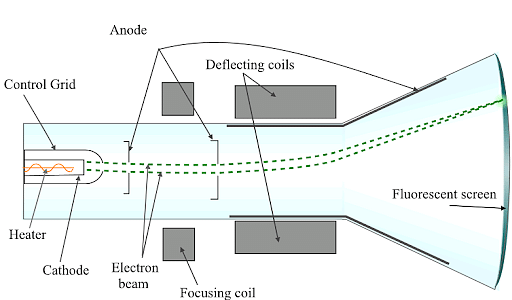
- It is a vacuum glass envelope containing an electron gun, a source of electrons and a fluorescent light.
- The tube will accelerate and redirect the electrons with the help of internal or external means.
- Light is created when electrons hit a fluorescent tube.
- The front area of the cathode ray tube is scanned repeatedly to generate a fixed pattern called a raster.
- These tubes are used in memory devices and computer monitors.
- Speed of cathode rays is comparatively slower than light.
Also Read:
| Related Articles | ||
|---|---|---|
| Hydrogen Spectrum | Positron | Enthalpy and Entropy |
J. J. Thomson Experiment – The Discovery of Electron
[Click Here for Sample Questions]
The cathode ray experiment was first conducted in 1878 by an English physicist, William Crookes. Later in the 19th century, J. J. Thomson studied the characteristics and the constituents of cathode rays.
- The cathode rays were deflected by electrical and magnetic fields.
- This behaviour was similar to that of a negatively charged particle, which suggested that the rays contained electrons.
- A discharge tube, also called a 'Crookes tube,' is made up of glass with two metallic plates.
- One end is connected to the positive terminal, and the other to the negative terminal of the high-voltage power supply.
- The plate connected to the negative terminal is the cathode, and the plate connected to the positive terminal is the anode.
- An electrical current was passed in the discharge tube experiment at a high voltage with low pressure.
- Due to this current, a stream of rays spreading from the cathode passed through the tube.
- These rays were named as the cathode rays.
Apparatus Setup
[Click Here for Sample Questions]
JJ Thomson started the work on the cathode ray experiment in the late 1800s. A cathode ray discharge tube is a cylindrical glass tube that consists of two metallic electrodes, namely an anode and a cathode.
- The electrodes are connected to a battery that will accelerate the electrons.
- The gas released in the tube is kept at a pressure of 0.0001 atm.
- The pressure inside the tube is maintained by a vacuum pump.
- Cathode rays will move from cathode to anode in a straight line in the absence of an electric and magnetic field.
- It will get deflected when placed in a magnetic and electric field.

Cathode Ray Discharge Tube
Procedure of the Experiment
[Click Here for Sample Questions]
The procedure of the experiment is as follows:
- The equipment is set up by passing a high source voltage of 10,000 volts.
- This, in return, will set up a low pressure inside the cathode ray discharge tubes.
- The tubes are converted into conductors of electricity by passing voltage through metallic electrodes.
- For the identification of rays, an additional dipole was set up inside the apparatus.
- This will result in the deflection of rays from the negative terminal to the positive terminal.
- The process was continued by placing the phosphorescent substance and producing the fluorescent display on the screen.
Conclusion
[Click Here for Sample Questions]
After completing the experiment, J.J. Thomson concluded that rays are negatively charged particles present or moving around in a set of positive charges.
- This theory helped physicists further to understand the atomic structure.
- The significant observation that he made was that the characteristics of cathode rays did not depend on the material of the electrodes.
- It is independent of the nature of the gas present in the cathode ray tube.
- In a nutshell, we came to know that electrons are the basic constituents of all atoms.
The number of electrons dispersed outside the nucleus is equal to the number of positively charged protons present in the nucleus. This also explains the electrically neutral nature of an atom.
Uses of Cathode Ray Tube
[Click Here for Sample Questions]
The uses of cathode ray tubes are as follows:
- Cathode ray tubes are used in computer monitors used to use CRT technology.
- X-rays are produced with the help of this tube.
- The technology is used in the screen of a cathode ray oscilloscope, which is coated with fluorescent substances.
- It is used in a video frame on an analogue television set.
Things to Remember
- A cathode ray tube is a vacuum tube which creates a trace on a fluorescent screen due to the presence of electric and magnetic fields.
- They are named after these rays are emitted by the negative electrode.
- Light is produced when electrons hit a fluorescent tube.
- Each cathode ray has similar properties irrespective of the elements.
- It is commercially used in CRT TV production.
Also Read:
Sample Questions
Ques. What are cathode ray tubes made of? (1 mark)
Ans. The cathode is made of a cesium alloy. Cesium is used as a cathode because it releases electrons readily when heated or hit by light.
Ques. Where can you find a cathode ray tube? (2 marks)
Ans. Cathode rays are electron streams observed in vacuum tubes (also known as an electron beam or an e-beam). If an evacuated tube of glass is fitted with two electrodes and a voltage is added, it is found that the glass opposite to the negative electrode glows from the electrons emitted by the cathode.
Ques. How did JJ Thomson find the electron? (2 marks)
Ans. In the year 1897 J.J. Thomson invented the electron by playing with a tube that was Crookes, or cathode ray. He proved that the cathode rays were charged negatively. Thomson understood that the accepted model of an atom did not account for the particles charged positively or negatively.
Ques. What are the properties of cathode rays? (3 marks)
Ans. The properties of cathode rays are as follows:
- Cathode rays move in a straight line and are able to cast sharp shadows.
- Magnetic field and electric field deflect these rays.
- They are produced at the cathode (negatively charged electrode) and travel towards the anode (positively charged electrode) in a vacuum tube.
- The properties of the cathode rays do not depend on the electrodes and the gas used in the vacuum tube.
- Speed of these rays is comparatively slower than light.
- They can penetrate through thin metal plates.
- Phosphors glow if cathode rays fall on it.
Ques. What do you mean by cathode? (2 marks)
Ans. A device’s anode is that terminal through which current flows in from outside. A device’s cathode is its terminal through which current flows out. Electrons are charged negatively, positive current flowing in is the same as out flowing electrons.
Ques. Who discovered the cathode rays? (2 marks)
Ans. In the year 1858, Plücker discovered cathode rays by sealing a couple of electrodes inside the tube, evacuating the air and forcing it between the electric current of the electrode. Cathode rays are negatively charged. They are 180o times lighter than hydrogen, the lightest element.
Ques. What is the Colour of cathode rays? (2 marks)
Ans. Cathode-ray tube (CRT), vacuum tube which produces images when electron beams strike its phosphorescent surface. CRTs can be coloured (using usually three electron guns to produce red, green, and blue images that render a multicoloured image when combined) or monochrome (using one electron gun).
Ques. How are cathode rays formed? (2 marks)
Ans. Cathode rays come from the cathode, as the cathode is negatively charged. The rays strike and ionize the gas sample inside the container. The electrons ejected from gas ionization travel to the anode. These rays are electrons that are actually created from the gas ionization inside the tube.
Ques. What are the components used in the cathode ray discharge tube? (4 marks)
Ans. The components used in the cathode ray discharge tube are as follows:
- A focused electron beam is produced by the electron gun or heater.
- Electrons are accelerated by anodes.
- The direction of the electron beam can be continually changed because to the extremely low-frequency electromagnetic field produced by deflecting coils.
- There are two varieties of deflecting coils: vertical and horizontal.
- It is possible to change the beam's intensity.
- A tiny, brilliant visible spot appears on the fluorescent screen as the electron beam strikes the phosphor-coated screen.
Ques. What are the observations of cathode ray experiment? (3 marks)
Ans. The observations of cathode ray experiment are as follows:
- Cathode rays moves from cathode terminal to anode terminal of the battery.
- It travel in a straight line in absence of electric and magnetic field but get deflected in presence of these fields.
- The rays are observed with the help of fluorescent screens.
- The direction of negative rays indicate that these rays are negatively charged.
Ques. What was the result of the cathode ray discharge tube experiment? (3 marks)
Ans. The result of the cathode ray discharge tube experiment are as follows:
The type of gas in the tube has no bearing on the mass and charge of cathode rays.
Electrons are negatively charged particles found in cathode rays.
It was determined that every atom had electrons since every gas emits cathode rays.
For Latest Updates on Upcoming Board Exams, Click Here: https://t.me/class_10_12_board_updates
Check-Out:



Comments