



Education Journalist | Study Abroad Lead
Transuranium elements or transuranic are those elements that lie beyond Uranium in the periodic table and have atomic numbers beyond 92. Nature is comprised of these chemical elements as its building blocks. All substances are made up of a mixture of these elements. There are a total of 118 chemical elements known, with uranium (atomic number = 92) being the heaviest naturally occurring element. In this article, we will discuss the definition, examples, and reactions of Transuranium elements.
| Table of Content |
Read More: Binomial Nomenclature
What are Transuranium elements?
Transuranium elements or transuranic elements are the chemical elements that lie beyond uranium on the periodic table.
- These elements have atomic numbers larger than 92.
- Transuranium elements are all radioactively decaying elements with half-lives ranging from 10 million years to a fraction of a second.
- In Rome in 1934, a group of Italian physicists led by Enrico Fermi and Emilio Segrè discovered transuranium elements.

Transuranium Element
Preparation of Transuranium elements
In the year 1934, a group of Italian physicists led by Fermi and Emilio Segrè blasted uranium nuclei with free neutrons in the city of Rome, attempting to create transuranium elements for the first time.
- Despite the possibility that transuranium species were formed, the experiment discovered nuclear fission rather than the synthesis of new elements.
- When two American scientists, Edwin Mattison McMillan and Philip Hauge Abelson, working at the University of California at Berkeley, exposed uranium oxide to neutrons from a cyclotron target in 1940, a transuranium element was first positively generated and characterized.
- One of the resultant elements was discovered to have the atomic number 93. It was given the name neptunium.
- Equations that balance all the particles of matter and the energy involved before and after the reaction can be used to model transformations in atomic nuclei.
Read Also:
Transuranium elements
Neptunium
Neptunium is a transuranium element that belongs to the actinide series on the Periodic Table, with an atomic number of 93 and an atomic mass of 237. It can be found between uranium (92), the last of the natural elements, and plutonium (100).
- Neptunium (237), like plutonium and uranium, is an alpha emitter, meaning it emits a particle made up of two protons and two neutrons following disintegration (similar to a helium nucleus). After then, it transforms into protactinium 233. (element 91).
- Neptunium is considered unstable in nuclear weapons because of its critical mass of 73 kg.
- This transuranium element is a member of the actinide series, and its chemical affinity is comparable to that of actinium (89).
- Neptunium, which has no commercial applications, is required for study and exploration.
- The neutron bombardment of a uranium nucleus produces neptunium.
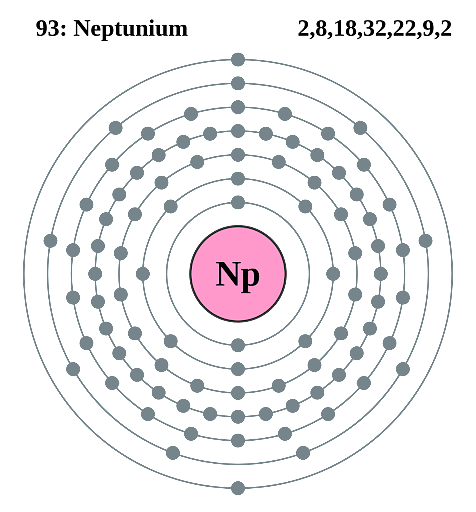
Atomic Structure of Neptunium
Plutonium
Plutonium is the second transuranium element and belongs to the actinide group of the periodic table. It has an atomic number of 94. In 1960, it was initially released.
- It was isolated and utilized to build the "Fat Man" nuclear bomb that was dropped on Nagasaki during WWII.
- Around 80,000 people died as a result of the atomic bomb's impact and radioactive after-effects combined.
- Plutonium shares the same name as its predecessor, neptunium, which was named after the planet Neptune.
- There are four oxidation states and six allotropes in this element. Hydrogen and nitrogen are easy to react with.
- Plutonium can combine with other elements to generate intermediate compounds.
- When large levels of the element are present, the metal becomes extremely heated during the alpha decay process, to the point that water can boil.
- The transuranium element, plutonium is obtained by irradiating uranium in nuclear reactors, which is the most common source. Plutonium is a rare element that does not occur naturally.
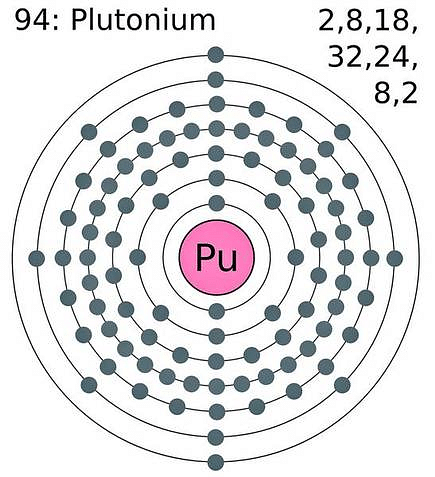
Atomic Structure of Plutonium
Americium
Americium is a human-made actinide transuranium element with an atomic number of 95 and no stable isotopes in the periodic table. It was named after the United States of America. Seaborg, Leon Morgan, Ralph James, and Albert Ghiorso discovered it in 1944, and B.B. Cunningham isolated it as the isotope.
- Actinides are a group of 15 elements that begin with actinium (atomic number 89) and finish with lawrencium (atomic number 103).
- Americium can be utilized as a suitable replacement for Plutonium in spaceship batteries in the coming years due to its rarity.
- In every minute concentration, americium-241 can be found in ionization smoke detectors in the home. In many aspects, americium is identical to plutonium (Pu).
- As a degradation product, this transuranium element plays a significant part in nuclear power production.

Atomic Structure of Americium
Curium
Curium is a transuranium radioactive metal with the symbol Cm and an atomic number of 96. This metal is created artificially in nuclear reactors.
- It is both an electropositive element and a chemically active compound that is not found in nature.
- As the temperature rises, the metal's resistance rises as well.
- Magnetic characteristics are present in this metal.
- For quantitative analysis, this metal can be employed in an X-ray spectrometer.
- It is employed as a power source in medical applications.
- This metal was discovered in 1944 by Glenn Seaborg, Albert Ghiorso, and James and named after Marie and Pierre Curie.
- Curium isotopes can be utilized in thermoelectric and thermionic converters in the power generation industry.
- Curium is employed in spacecraft applications because one gram may create roughly 3 watts of heat energy.
- Because it is a radioactive element, it has applications in the research industry.
- Curium is a dangerous metal that, when inhaled, can cause a variety of health problems. When swallowed, it can harm the liver and cause respiratory and gastrointestinal difficulties.
- When rats were injected with a curium isotope, they developed skeletal cancer.

Atomic Structure of Curium
Berkelium
It is the fifth identified transuranium element and is a radioactive element with atomic number 97.
- They can be found in various places of the world where nuclear testing has been conducted. It is also a member of the periodic table's actinide series.
- It has isotopes that can be exploited in basic research.
- The element has twenty isotopes with mass values ranging from 235 to 254.
- This transuranium element is not used biologically or technologically at this time.
- Between 1945 and 1980, it was utilized for atmospheric nuclear weapons tests.
- The element's isotopes are all radioactive.
Californium
It is a radio metallic element and a transuranium element with the atomic number 98 that belongs to the actinide group of the periodic table and was discovered in 1950 by G.T Seaborg. It is named after the university as well as the state of California.
- Californium is a good producer of neutrons, making it suitable as a neutron starting source in nuclear power plants.
- When exposed to air, it tarnishes gradually and is easily damaged by steam and acids.
- Neutron activation analysis may also be utilized to detect trace components in samples.
- Many types of brain and cervical malignancies can be treated with it.
- Californium – 252 emits a lot of neutrons.
- The element isn't found in nature on the surface of the Earth.
- This transuranium element is employed in medical diagnosis and mineral exploration and can be found in nuclear plants and research institutes.
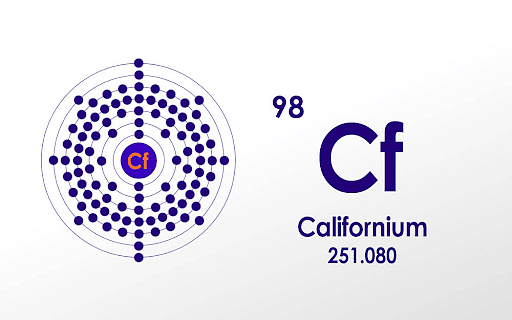
Atomic Structure of Californium
Einsteinium
In the actinide series, Einsteinium belongs to group 13 of the heavy transuranic elements. It was first discovered as a trace element in the aftermath of World War II, in approximately 1952, as a leftover from the huge hydrogen bomb explosion. It can't be found in nature or the Earth's crust.
- The actinide series' seventh transuranic element is Einsteinium.
- Einsteinium is a radioactive element that belongs to the periodic table's actinide group. It can react with oxygen atoms, steam, and acids, but not with alkalies. It prefers to be in the +3 oxidation state.
- This transuranium element is more easily created in small quantities by artificial natural transmutations of other radioactive elements than by another thermonuclear bomb detonation.
- It has the atomic number 99 and is a synthetic element that belongs to the periodic table.
- The transuranium element is generated through a chain of nuclear events that requires bombarding each isotope and then letting isotope beta decay. It was named after Albert Einstein.
- Einsteinium has 17 isotopes with mass numbers ranging from 241 to 257, as well as three recognized isomers.

Atomic Structure of Einsteinium
Fermium
In the periodic table of elements, fermium is also a transuranic element and a part of the actinide series.
- Although not enough fermium has been created to study its chemical properties, it is expected to be a metal vulnerable to acid, steam, and air attack.
- There is no practical use for the transuranium element, fermium because it is only found in extremely small quantities and all of its isotopes have very short lifetimes.
- Fermium is a rare element that may be synthesized in small quantities and has a short half-life.
- Scientists use this element in their studies to learn more about the other elements in the periodic table.
- Fermium-257 is the most stable isotope, with a half-life of roughly 100.5 days.

Atomic Structure of Fermium
Mendelevium
Mendelevium is a highly synthetic and radioactive metal and transuranium element with the atomic number 101 and the symbol Md in the periodic table. The metal is only generated at trace levels.
- The isotope is used in scientific research and to analyze the chemical characteristics of various elements and aqueous solutions.
- Einsteinium-253 was created by blasting it with helium ions. Mendelevium-258, the metal's most stable isotope, has a half-life of 51.5 days.
- Through the process of alpha decay or spontaneous fission, it decays into einsteinium-254.
- There are approximately 16 synthetic isotopes of this metal, with mass numbers ranging from 245 to 260.
- The metal has properties that are comparable to those of the actinide class elements, and it has an oxidation state of 3.

Atomic Structure of Mendelevium
Nobelium
Nobelium is a man-made transuranium element produced in small quantities. It belongs to the actinide family. There have been twelve isotopes identified among them thus far.
- Nobelium is highly radioactive. Nuclear bombardment, or irradiating a californium-249 target with carbon-12 ions, can create it directly.
- They're notoriously tough to spot. This metal is to the left of the actinide lawrencium and to the right of the actinide mendelevium on the periodic table.
- Nobelium is a transuranium element with two valences.
- Only in an aqueous solution can the behavior of this metal be better understood.
- It has no other use save for scientific studies.
- This transuranium element also has no adverse effects on the environment because of its short half-life.
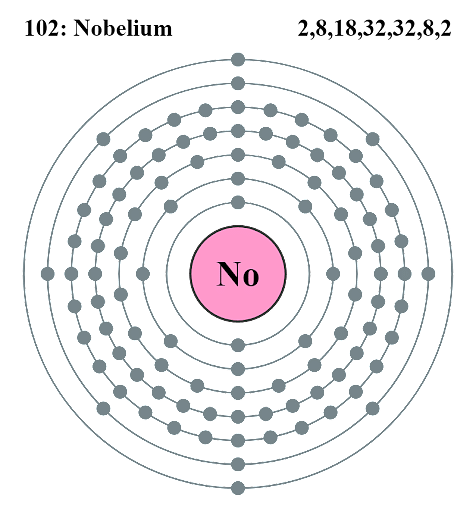
Atomic Structure of Nobelium
Lawrencium
The periodic table symbol for the transuranium element lawrencium is 'Lr.' It has an atomic number of 103. In 1961, it was discovered. It was formed by speeding subatomic particles that were encircled by a circle, and it never exists naturally as a free element. California mum can be used to make lawrencium, a radioactive transuranic element.
- It was formed by speeding subatomic particles that were encircled by a circle, and it never exists naturally as a free element.
- Californium can be used to make lawrencium, a radioactive transuranic element.
- Due to its radioactivity, lawrencium is not used.
- They are solely for scientific research.
- Lawrencium isotopes are radioactive. Its isotopes have an eleven-hour half-life, making it the longest-lived super-heavy to date.
- Only 12 isotopes of this transuranium element with mass numbers of 252, 262, and 266 are known among all the isotopes.
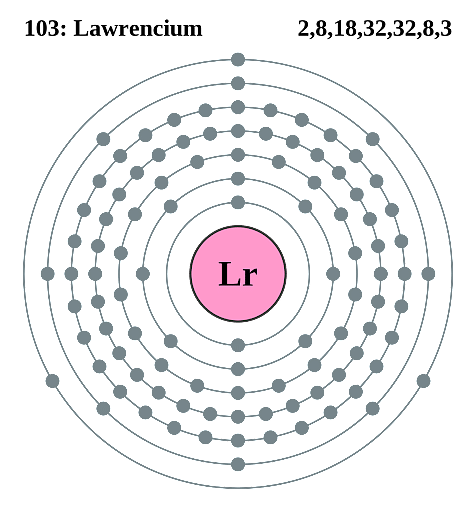
Atomic Structure of Lawrencium
Things to remember
- Transuranium elements or transuranic elements are chemical elements that are beyond uranium on the periodic table or have atomic numbers larger than 92.
- In 1934, a group of Italian physicists led by Enrico Fermi and Emilio Segrè blasted uranium nuclei with free neutrons in an attempt to create a transuranium element.
- The bombardment of heavy element targets with light-charged particles (such as the helium nuclei discussed above as alpha particles) from accelerators is an essential way of producing transuranium elements or isotopes.
- With the emission of some radiations, radioactive elements that decay in nature are readily involved in chemical reactions to generate new elements (radioactive or non-radioactive).
- Transuranium elements or isotopes are radioactive in the traditional sense: they decay by producing alpha particles, beta particles, and gamma rays, and they also fission spontaneously.
Read More: Mycorrhiza
Sample Questions
Ques. Define transuranium or transuranic elements. (1 mark)
Ans. Transuranium elements are all chemical elements in the periodic table that lie beyond uranium or have atomic numbers larger than 92.
Ques. What purpose does uranium serve? (2 marks)
Ans. Uranium, a transuranium element is easily split and yields a lot of energy under specific conditions, the isotope U-235 is essential. As a result, it is referred to as "fissile" and the term "nuclear fission" is used to describe it.
Ques. Make a list of uranium's properties. (5 marks)
Ans. The transuranium element uranium has the following properties:
- Except for noble gases, uranium reacts with practically all nonmetals and their compounds, and its reactivity increases as the temperature rises.
- It dissolves rapidly in hydrochloric and nitric acid but reacts slowly with non-oxidizing acids.
- This transuranium element can be chemically extracted from ores and transformed into uranium dioxide or other industrially useful forms.
- Coldwater can react with finely divided uranium.
- When hit with slow-moving neutrons, uranium-235 fissions into two smaller nuclei, releasing nuclear binding energy and neutrons.
Ques. Define Transmutation. (2 marks)
Ans. Transmutation is the process of changing the number of protons in an atom's nucleus to produce an atom with a new atomic number. Because transmutation is also a conversion of one element into another, it can be described as a chemical reaction. It can be done artificially and it also happens naturally.
Ques. Describe properties of Americium. (3 marks)
Ans. The transuranium element Americium has the following properties:
- Actinides are a group of 15 elements that begin with actinium (atomic number 89) and finish with lawrencium (atomic number 103).
- In every minute concentration, americium-241 can be found in ionization smoke detectors in the home. In many aspects, americium is identical to plutonium (Pu). As a degradation product, it plays a significant part in nuclear power production.
- Americium can be utilized as a suitable replacement for Plutonium in spaceship batteries in the coming years due to its rarity.
Ques. Describe some properties of the transuranium element Neptunium. (5 marks)
Ans. Transuranium element Neptunium is a member of the actinide series.
- Its chemical affinity is comparable to that of actinium (89).
- Neptunium (237), like plutonium and uranium, is an alpha emitter, meaning it emits a particle made up of two protons and two neutrons following disintegration (similar to a helium nucleus). After then, it transforms into protactinium 233. (element 91).
- The neutron bombardment of a uranium nucleus produces neptunium.
- Neptunium is considered unstable in nuclear weapons because of its critical mass of 73 kg.
Ques. Describe some properties of Californium. (5 marks)
Ans. The transuranium element Californianium is a good producer of neutrons, making it suitable as a neutron starting source in nuclear power plants.
- Using neutron activation analysis may also be utilized to detect trace components in samples.
- Many types of brain and cervical malignancies can be treated with it.
- When exposed to air, it tarnishes gradually and is easily damaged by steam and acids.
- There are a variety of compounds with various qualities. For example, Californianium – 252 is a powerful neutron emitter.
Read Also:



Comments