




A practical CAT 2026 preparation setup combines one reliable resource per section with PYQs, online practice, mock tests, and regular reading. It allows aspirants to build skills without repeatedly switching between books.
To effectively prepare for CAT, understand formulas before shortcuts. Maintain a formula and concept register with definitions and examples instead of relying only on memorisation.
- For VARC, resources such as Arun Sharma & Meenakshi Upadhyay and Nishit K. Sinha focus on RC and Verbal Ability practice,
- Word Power Made Easy supports vocabulary development to prepare for CAT VARC.
- For DILR, books by Arun Sharma and Nishit K. Sinha provide graded practice across LRDI sets
- Books from Arun Sharma, Nishit K. Sinha, and Sarvesh K. Verma offer structured Quant practice from foundational to advanced levels.
- In Quant, students with weak Maths basics can revise NCERT Classes 8–10 before moving to full CAT-level material.
- Prioritise Arithmetic and Algebra, as they form the majority of the CAT Quant questions.
- For VARC, read online articles for around 30 minutes daily and gradually include online sectionals, PYQs, and mocks.
- DILR is practice-driven. Focus on solving a wide variety of sets. Use tables, grids, seating diagrams, bracket trees and Venn diagrams according to the set structure.
Related Links:
- CAT 2026 Mock Test Series Links
- CAT 2026 Syllabus Weightage: Check Topic-wise Distribution, Sectional Analysis & Previous Year Trends
- CAT 2026 Exam Pattern: Sections, Marking Scheme, TITA & Normalisation
Key Summary
- The best books for CAT preparation are split by section: VARC, DILR, and Quantitative Aptitude, each requiring a different reading and solving strategy.
- Arun Sharma CAT books, especially Arun Sharma Quantitative Aptitude, remain among the most recommended CAT prep resources due to their Level of Difficulty (LOD) structure.
- Beginners should start with foundational CAT preparation books for beginners such as NCERT Class 8–10 Mathematics and Fast Track Objective Arithmetic before attempting advanced CAT books for MBA entrance prep.
- Books alone are not enough for CAT exam preparation: official mocks, previous year papers, and daily reading of quality long-form English content are equally essential parts of CAT preparation online.
CAT Preparation 2026: Best Books for VARC
CAT VARC preparation requires concept-based books, regular practice, and diverse reading to improve comprehension and familiarity with different topics.
- Choose books that cover CAT-specific question types: Focus on Para Jumbles, Para Summary, Odd One Out, and Reading Comprehension.
- Use books for concept clarity and practice: Select resources that explain question-solving approaches and provide sufficient RC passages and VARC questions.
- Build vocabulary through regular reading: Although direct vocabulary-based questions are limited, a strong vocabulary helps you understand complex words and dense RC passages.
| Recommended Book | Author | What It Helps With |
|---|---|---|
| How to Prepare for Verbal Ability and Reading Comprehension for CAT | Arun Sharma & Meenakshi Upadhyay |
|
| Verbal Ability and Reading Comprehension for the CAT | Nishit K. Sinha |
|
| Word Power Made Easy | Norman Lewis |
|
| High School English Grammar and Composition | Wren & Martin |
|
CAT RC passages cover diverse areas such as philosophy, sociology, economics and science. Reading across these domains alongside CAT preparation books can improve familiarity with dense and unfamiliar topics.
- Top mentors and IIM alumni recommend reading these accessible, domain-specific books alongside your standard CAT books to build comfort with dense prose:
| Genre | Recommended Book & Author | Why It Helps |
|---|---|---|
| Philosophy | Sophie's World by Jostein Gaarder | Builds abstract reasoning capabilities required for complex philosophical RCs |
| Economics & Society | Freakonomics by Steven Levitt & Stephen Dubner | Helps you comfortably track data-rich arguments and socio-economic logic |
| History & Evolution | Sapiens by Yuval Noah Harari | Standardizes comprehension of historical narratives and macro-evolutionary ideas |
| Science & Environment | A Short History of Nearly Everything by Bill Bryson | Explains dense scientific history in an engaging, narrative style |
How to Use VARC Books Effectively?
For the VARC books, follow the preparation strategy below:
- When starting with books like Arun Sharma or Nishit K. Sinha, ignore the timer completely for the first 4 to 6 weeks. Your sole focus is building accuracy and understanding text structure.
- For every Reading Comprehension (RC) passage, write a 1-line summary next to each paragraph before looking at the questions. This trains your brain to track the author's logical flow.
- Force yourself to articulate the primary purpose of the passage in your own words. Is the author arguing, critiquing, analyzing, or simply describing a phenomenon?
Standard CAT prep books group practice exercises into Levels of Difficulty (LOD). Move through them methodically:
| Difficulty Level | How to Use It |
|---|---|
| LOD 1 (Foundation) | Practise basic RCs and direct questions until you achieve around 85% accuracy. |
| LOD 2 (CAT Level) | Spend most of your practice time here and focus on inference-based questions. |
| LOD 3 (Advanced) | Use these questions to handle difficult and ambiguous passages without worrying about lower accuracy. |
Do not depend only on physical books. Since CAT is a computer-based exam, include regular online reading and practice to build screen-reading speed and stamina.
- Read online editorials and articles for around 30 minutes daily from sources such as Aeon, The Hindu, or The New York Times.
- Gradually shift to online sectional tests, PYQs, and mock tests to practise in an exam-like environment.
Ques. Which CAT books are best for VARC preparation?
Ans. Arun Sharma & Meenakshi Upadhyay's VARC book and Nishit K. Sinha's Verbal Ability and Reading Comprehension for the CAT are among the most widely used CAT preparation books for this section.
Check Out:
CAT Preparation 2026: Best Books for DILR
To crack the Data Interpretation & Logical Reasoning (DILR) section, your primary focus should be building structured logic and puzzle-solving intuition.
- Unlike other sections, DILR has zero theoretical formulas; instead, it tests your ability to organize messy information efficiently.
- When picking logical reasoning CAT books, buy them exclusively for the sheer variety of practice sets they offer.
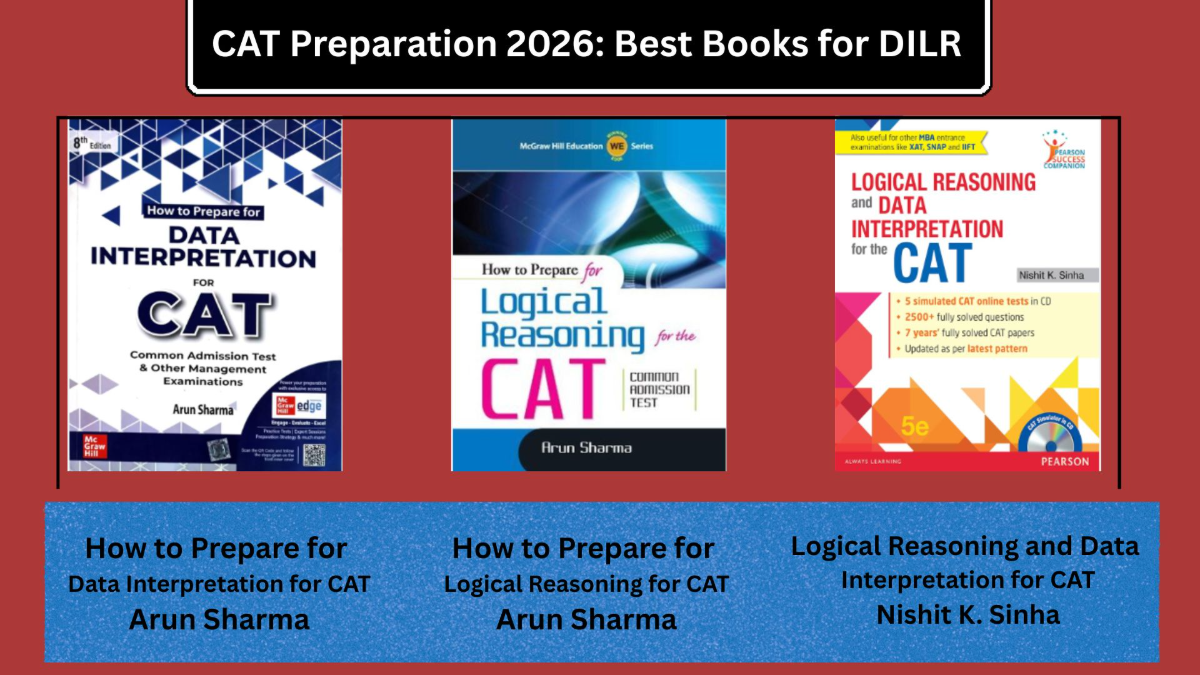
The most effective and highly recommended CAT logical reasoning book options are detailed below:
| Recommended Book | Author | What It Helps With |
|---|---|---|
| How to Prepare for Data Interpretation for CAT | Arun Sharma | Builds Data Interpretation skills through graded practice, from basic sets to higher-difficulty CAT-level questions |
| How to Prepare for Logical Reasoning for CAT | Arun Sharma | Develops Logical Reasoning and problem-solving skills with progressively difficult practice sets |
| Logical Reasoning and Data Interpretation for CAT | Nishit K. Sinha | Provides CAT-level LRDI practice, including arrangement-based problems, data interpretation sets, and logical reasoning questions |
How to Use DILR Books Effectively?
To master the Data Interpretation & Logical Reasoning (DILR) section, you cannot treat books like a reading assignment.
- Focus on the solving process, not just the answer: Spend 15–20 minutes attempting each DILR set, represent clues using tables, grids or diagrams, and avoid checking the solution too early.
- Build set-selection and analysis skills: Practise identifying easy, moderate and difficult sets, then compare your approach with the book's solution to find faster ways of representing data and applying constraints.
| Step | What to Do | Key Tip |
|---|---|---|
| 1. Follow the No-Solution Rule |
| Write clues in short mathematical or symbolic forms to identify connections between conditions |
| 2. Represent the Data Clearly |
| Use grids, tables, seating diagrams, bracket trees and Venn diagrams depending on the set |
| 3. Practise Set Selection |
| Green: familiar and structuredYellow: moderate/unclear Red: complex or calculation-heavy |
| 4. Analyse Your Scratch Work |
| Check whether you could use a cleaner representation, identify hidden constraints faster, or avoid trial and error |
Ques. Which logical reasoning books for CAT are recommended by mentors?
Ans. Arun Sharma's Logical Reasoning book and Nishit K. Sinha's combined LRDI book are the two most commonly recommended logical reasoning CAT books for building both DI and LR skills together.
Ques. Is CAT preparation online enough without books?
Ans. No. The most effective CAT prep strategy combines core CAT books for concept-building with CAT preparation online (mocks, PYQs, and daily reading) for speed, stamina, and percentile benchmarking.
CAT 2025 Question Paper Download
CAT 2025 DILR Question Paper PDF
| CAT DILR Slot | Question Paper | Solution PDF |
|---|---|---|
| CAT 2025 DILR Slot 1 Question Paper | Download Pdf | Download Pdf |
| CAT 2025 DILR Slot 2 Question Paper | Download Pdf | Download Pdf |
| CAT 2025 DILR Slot 3 Question Paper | Download Pdf | Download Pdf |
CAT 2025 VARC Question Paper PDF
| CAT VARC Question Paper | Question Paper | Solution PDF |
|---|---|---|
| CAT 2025 VARC Slot 1 Question Paper | Download Pdf | Download Pdf |
| CAT 2025 VARC Slot 2 Question Paper | Download Pdf | Download Pdf |
| CAT 2025 VARC Slot 3 Question Paper | Download Pdf | Download Pdf |
CAT 2025 QA Question Paper PDF
| CAT Quant Question Paper | Question Paper | Solution PDF |
|---|---|---|
| CAT 2025 Quant Slot 1 Question Paper | Download Pdf | Download Pdf |
| CAT 2025 Quant Slot 2 Question Paper | Download Pdf | Download Pdf |
| CAT 2025 Quant Slot 3 Question Paper | Download Pdf | Download Pdf |
CAT Preparation 2026: Best Books for Quantitative Aptitude
To achieve a high percentile in the Quantitative Aptitude (QA) section, your preparation material must focus heavily on conceptual depth and application rather than rote formula memorisation.
- The modern CAT QA section tests your mathematical logic, structural understanding, and data-manipulation speed across core modules like Algebra, Arithmetic, and Geometry.
- Students with weak Maths fundamentals can revise Class 9 and 10 textbooks before starting full CAT-level preparation material.
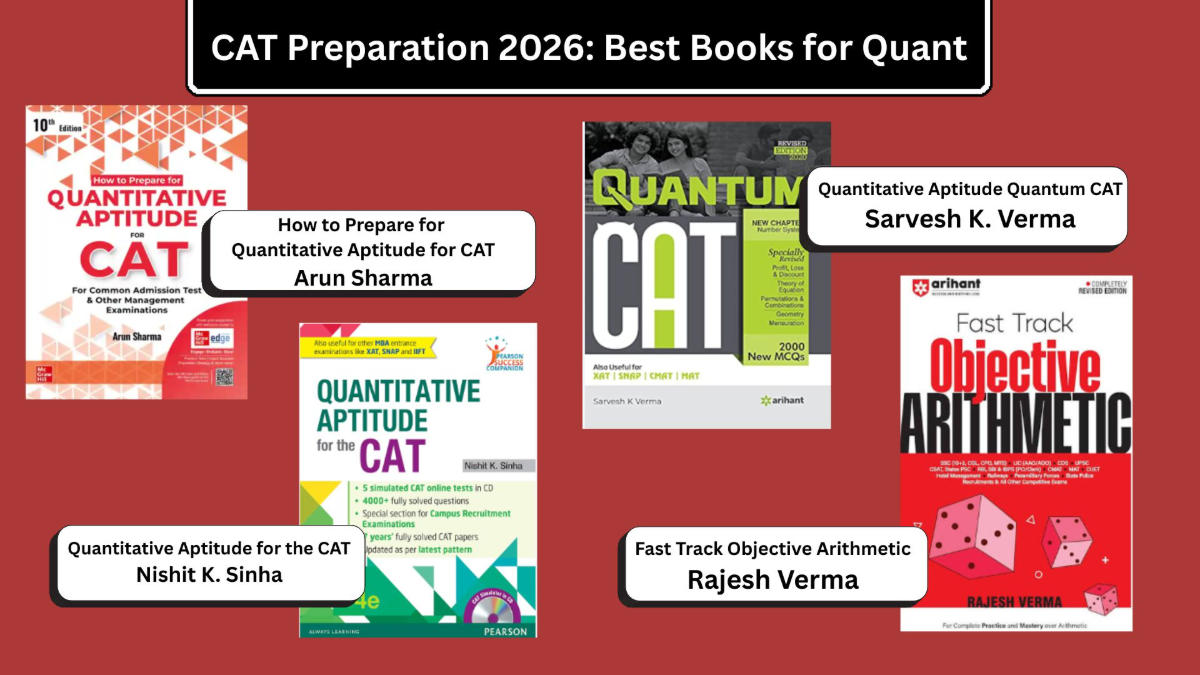
| Recommended Book/Resource | Author | What It Helps With |
|---|---|---|
| How to Prepare for Quantitative Aptitude for CAT | Arun Sharma |
|
| Quantitative Aptitude for the CAT | Nishit K. Sinha |
|
| Quantitative Aptitude Quantum CAT | Sarvesh K. Verma |
|
| NCERT Mathematics Textbooks (Classes 8–10) | NCERT |
|
| Fast Track Objective Arithmetic | Rajesh Verma |
|
As per student discussions on Quora, below are recommended books for Quant preparation:
- Sarvesh Kr. Verma (Arihant Publication): Recommended for starting your preparation, mastering basic concepts, and revising basic rules.
- Arun Sharma: Best suited for aspirants who already have a strong grasp and good understanding of Quants fundamentals.

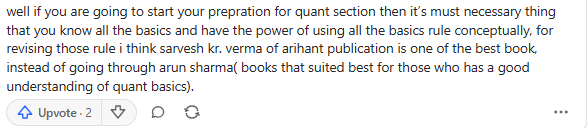
Source: Quora
How to Use Quant Books Effectively?
To score a 99+ percentile in the Quantitative Aptitude (QA) section, you cannot treat your math books like reading material.
- The Quants section tests how quickly you can spot shortcuts, eliminate choices, and apply 10th-grade concepts under pressure.
- Arithmetic and Algebra account for a major share of CAT QA, so prioritise these topics during preparation.
- Practise basic calculations mentally, including percentages, double-digit multiplication and simple squares, to improve calculation speed.
| Phase | How to Use the Book |
|---|---|
| 1. Build Concepts First |
|
| 2. Follow a 3-Step Solving Drill |
|
| 3. Maintain an Error Log |
|
| 4. Mix Questions Across Chapters |
|
| 5. Simulate Exam Conditions |
|
Ques. Is Arun Sharma's quantitative aptitude book enough for CAT preparation?
Ans. Arun Sharma quantitative aptitude is an excellent core resource and one of the best books for CAT preparation in this section, but pairing it with NCERT basics (if fundamentals are weak) and Sarvesh K. Verma's Quantum CAT for advanced geometry gives more complete coverage.
Also Check:
CAT Preparation Books for Beginners
For a beginner starting their CAT preparation journey from scratch, jumping straight into advanced online mocks or complex study material can lead to quick burnout.
The right beginner-friendly stack of CAT preparation books for beginners should focus on crystal-clear concept explanations, gradual difficulty scaling, and strong foundational math and reading drills.
- A Modern Approach to Logical Reasoning by R.S. Aggarwal: Builds basic reasoning and arrangement skills.
- NCERT Maths (Classes 8–10): Strengthens basic Maths fundamentals before CAT preparation.
- Fast Track Objective Arithmetic by Rajesh Verma: Improves calculation speed and Arithmetic basics.
- How to Prepare for Quantitative Aptitude for CAT by Arun Sharma: Start with theory and LOD 1 questions to build fundamentals.
- How to Prepare for VARC for CAT by Arun Sharma & Meenakshi Upadhyay: Helps improve RC skills and understand common question traps.
| Book/Resource | Author | Best For / How It Helps |
|---|---|---|
| A Modern Approach to Logical Reasoning | R.S. Aggarwal | Helps beginners build basic logical reasoning skills, including linear arrangements, scheduling and blood-relation problems |
| NCERT Mathematics Textbooks (Classes 8–10) | NCERT | Useful for students with weak basic Maths fundamentals, including fractions, linear equations and basic geometry |
| Fast Track Objective Arithmetic | Rajesh Verma | Builds Arithmetic fundamentals, calculation speed and mental-math skills before moving to advanced CAT-level questions |
| How to Prepare for Quantitative Aptitude for CAT | Arun Sharma | Suitable for beginners because its LOD-based structure allows students to start with theory and LOD 1 questions before moving to higher difficulty levels |
| How to Prepare for Verbal Ability and Reading Comprehension for CAT | Arun Sharma & Meenakshi Upadhyay | Helps beginners develop RC comprehension and Verbal Ability skills, including identifying the main idea and recognising common question traps |
Ques. Which CAT preparation books for beginners should I buy first?
Ans. Start with NCERT Mathematics (Classes 8–10) if your basics are weak, then move to Arun Sharma's Quantitative Aptitude and VARC books, both structured around Levels of Difficulty for a gradual ramp-up.
Also Check:
- CAT Verbal Ability and Reading Comprehension 2026 Preparation Tips, Best Books, and Important Topics
- CAT Preparation of Quantitative Aptitude 2026: Check Topic Wise Tips, Online Resources, Books, and Study Plan
- CAT Preparation of Data Interpretation & Logical Reasoning 2024: Check Topic Wise Preparation Plan, Books, & Online Materials
CAT Preparation Books Recommended by Toppers
When choosing the best CAT books recommended by toppers, the focus is often on consistent practice rather than collecting multiple resources. Shweta Arora, a CAT 99%+ scorer, recommends limiting your resources, with one reliable book for each preparation area being sufficient.
- Read the concepts, formulas, shortcuts, and methods for each chapter before attempting questions.
- Begin with Level 1/easy questions to check whether you have understood the concept correctly.
- Mock papers should be attempted under a time limit to practise exam pressure, question selection and time management.
- You can revise formulas after completing each chapter or during a second round of preparation after finishing the syllabus.
| Purpose | Recommended Books/Resources | How to Use |
|---|---|---|
| Previous Year Questions | Oswaal 25 Years CAT Previous Year Papers | Solve questions topic-wise and year-wise instead of attempting complete papers initially |
| Mock Tests | CAT mock-test books / online mock-test series | Start with topic and sectional tests, then move to full-length mocks as preparation progresses |
| Formula Book | A self-made formula notebook or a ready-made CAT formula book | Use it for quick revision of formulas and concepts during revision rounds |
Ques. What do toppers say about buying too many CAT preparation books?
Ans. Toppers like Shweta Arora advise against collecting multiple books per section; one reliable resource per CATegory, used thoroughly, outperforms a large, half-finished library of best CAT preparation books.
Also Check:
- CAT 2026 Preparation: 80 Days Strategy to Score 99 Percentile, Section-wise Targets and Mock Calendar
- CAT 2026: How Many Questions Should You Attempt for 95, 98 and 99 Percentile?
This video discusses the Best CAT 2026 study material and resources, shared by topper Shweta Arora, a 99 percentile scorer. She discusses the best books for CAT 2026 preparation, recommended YouTube channels & video lectures, study material for QA, VARC & DILR, mock tests to practice like the real CAT exam, and formula books & revision resources.
How to Choose the Best Books for CAT Preparation 2026?
Choose CAT study material based on your preparation needs instead of collecting multiple popular books. Using too many resources can lead to scattered practice, incomplete coverage, and burnout.
- Prefer books with clearly graded questions so you can move from basic concepts to CAT-level and advanced problems.
- Choose books that cover the topics and question types relevant to the latest CAT pattern rather than relying heavily on outdated content. Cross-check this against the current CAT exam syllabus for MBA admissions, available as a CAT syllabus PDF on the official B-school website.
- A good book should explain the solving process and, where useful, provide alternate approaches instead of giving only the correct answer.
| Factor | What to Check | Why It Matters |
|---|---|---|
| Difficulty Levels | Choose books that divide questions into Foundation, CAT-level, and Advanced difficulty | Helps you build concepts gradually and identify whether mistakes are due to weak basics or difficult questions |
| Syllabus Mapping | Check whether the book gives adequate coverage to the topics and question types relevant to the current CAT pattern | Prevents you from spending too much time on outdated or less relevant topics |
| Detailed Solutions | Prefer books with step-by-step explanations, alternate methods, and clear reasoning, rather than answer keys alone | Helps you understand mistakes and learn faster solving approaches |
| Previous-Year Questions | Look for topic-wise CAT PYQs integrated with the practice material | Lets you test your preparation against actual CAT questions after completing each topic. |
Based on students' discussions on Reddit, below are some recommended study materials students can refer to:
- Quantitative Aptitude: Use Quantum CAT by Sarvesh Verma to build a strong foundation and master basic concepts.
- DILR: Start with standard coaching material (TIME, IMS, CL) for fundamentals, then shift to YouTube practice videos, past year mock tests, and CAT Previous Year Questions (PYQs).
- VARC: Skip theory-heavy books and jump straight into practical application using CAT PYQs and previous year institute mock tests.

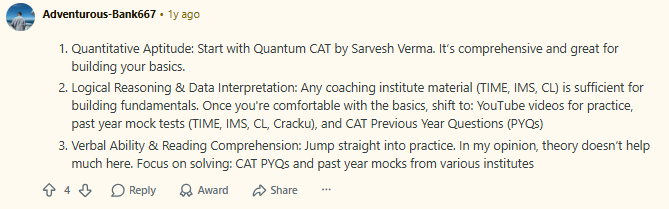
Source: Reddit
Ques. Where can I find the CAT exam syllabus PDF to match with my books?
Ans. The CAT exam syllabus PDF is typically published alongside the official CAT information bulletin; comparing it against your chosen CAT exam books ensures your practice material actually maps onto tested topics.
Also Check:
CAT Exam 2026 Study Material
Use a mix of official resources, mock tests, previous-year papers, and quality reading material to keep CAT preparation aligned with the actual exam.
- Prioritise exam-oriented resources: Use official CAT mocks and PYQs to understand the exam interface, question style, difficulty level, and changing patterns.
- Use mock-test series for performance analysis, newspapers and magazines for VARC practice, and topper/alumni videos for solving strategies and shortcuts.
| Resource | Purpose | Why It Is Crucial |
|---|---|---|
| Official CAT Mock Tests (iimCAT.ac.in) | Realistic full-length practice in the actual CAT exam interface and timer |
|
| Previous Year CAT Question Papers | Understand actual difficulty level and how the pattern has evolved |
|
| AIMCAT / SimCAT / CL Mock Tests | Percentile benchmarking against a large pool of serious CAT aspirants |
|
| The Economist / The Hindu / The New Yorker | Improve VARC reading speed and comprehension of dense English prose |
|
| YouTube Channels (IIM Alumni/Toppers) | Strategy sessions, section-specific shortcuts, and set walkthroughs |
|
Also Check:
CAT Preparation Strategy 2026
CAT preparation should focus on high-yield topics, consistent practice, question selection, and accuracy rather than trying to complete every topic or solve every question.
- Master the frequently practised Arithmetic, Algebra, DILR structures and RC skills before moving to difficult or less familiar topics.
- Combine books with PYQs, timed sectionals, full-length mocks and screen-based practice so that preparation reflects the actual computer-based CAT environment.
| Section | High-Yield Preparation Focus | Preparation Approach |
|---|---|---|
| Quantitative Aptitude (QA) | Arithmetic and Algebra: Percentages, Profit & Loss, Ratio & Proportion, SI/CI, Mixtures, Equations, Logarithms, AP/GP, Functions |
|
| Data Interpretation & Logical Reasoning (DILR) | Arrangements, Games & Tournaments, Venn Diagrams and caselet-based sets |
|
| Verbal Ability & Reading Comprehension (VARC) | Inference-based RCs, central idea, author's tone and argument evaluation |
|
| Screen-Based Practice | Online reading and computer-based question solving |
|
| Time Management | Question and set selection |
|
| Accuracy & Error Analysis | Reducing repeated mistakes |
|
CAT Preparation Books FAQs
Ques. What are the best books for CAT preparation overall?
Ans. Across sections, the most consistently recommended best CAT books are Arun Sharma's Quantitative Aptitude, Data Interpretation, and Logical Reasoning titles, Nishit K. Sinha's VARC and LRDI books, and NCERT Mathematics for candidates needing to rebuild basics.
Ques. Which Arun Sharma CAT book should I buy first?
Ans. Most mentors recommend starting with Arun Sharma's Quantitative Aptitude book due to its clear LOD 1/2/3 structure, followed by his VARC book (with Meenakshi Upadhyay) and his DILR titles.
Ques. Are there separate CAT books for MBA aspirants with a non-engineering background?
Ans. Yes. Non-engineering candidates are advised to start with NCERT Mathematics (Classes 8–10) and Fast Track Objective Arithmetic before moving to standard CAT exam books like Arun Sharma's Quantitative Aptitude.
Ques. Where can I check the CAT exam syllabus for MBA entrance before buying books?
Ans. The CAT exam syllabus for MBA admission is published in the official CAT information bulletin, usually available as a downloadable CAT syllabus pdf, and should guide which sections of your chosen books to prioritize.
Ques. Do I need separate logical reasoning CAT books, or do DILR books cover both DI and LR?
Ans. Most standard CAT logical reasoning book titles, such as Nishit K. Sinha's Logical Reasoning and Data Interpretation for CAT, cover both Data Interpretation and Logical Reasoning together, so a single combined book is usually sufficient alongside Arun Sharma's dediCATed LR and DI titles.



Comments