




CAT Number System formula sheet, free to download as a 6-page PDF. The topic is worth about 6 to 12 marks in Quant and this sheet fits on a revision desk.
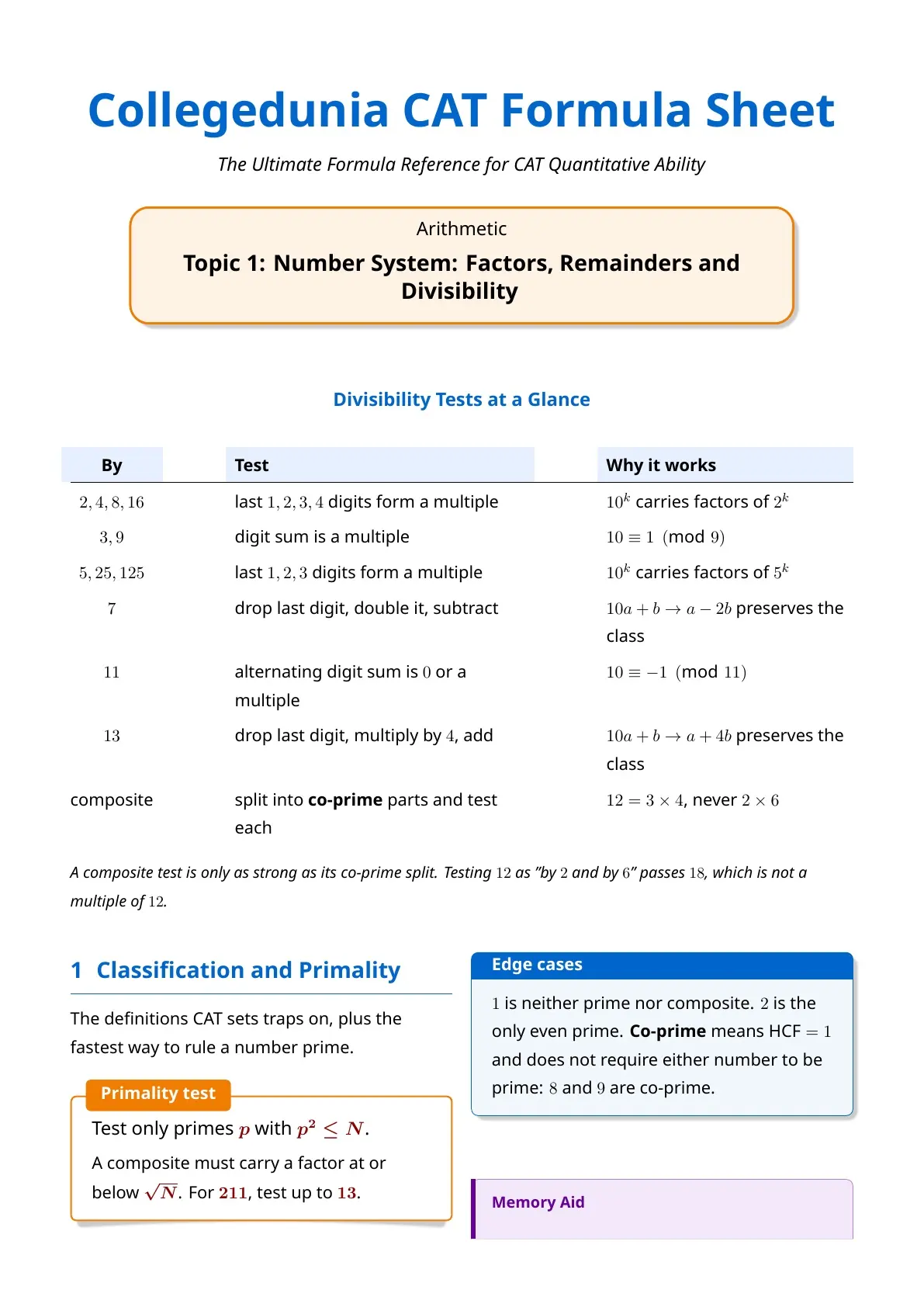
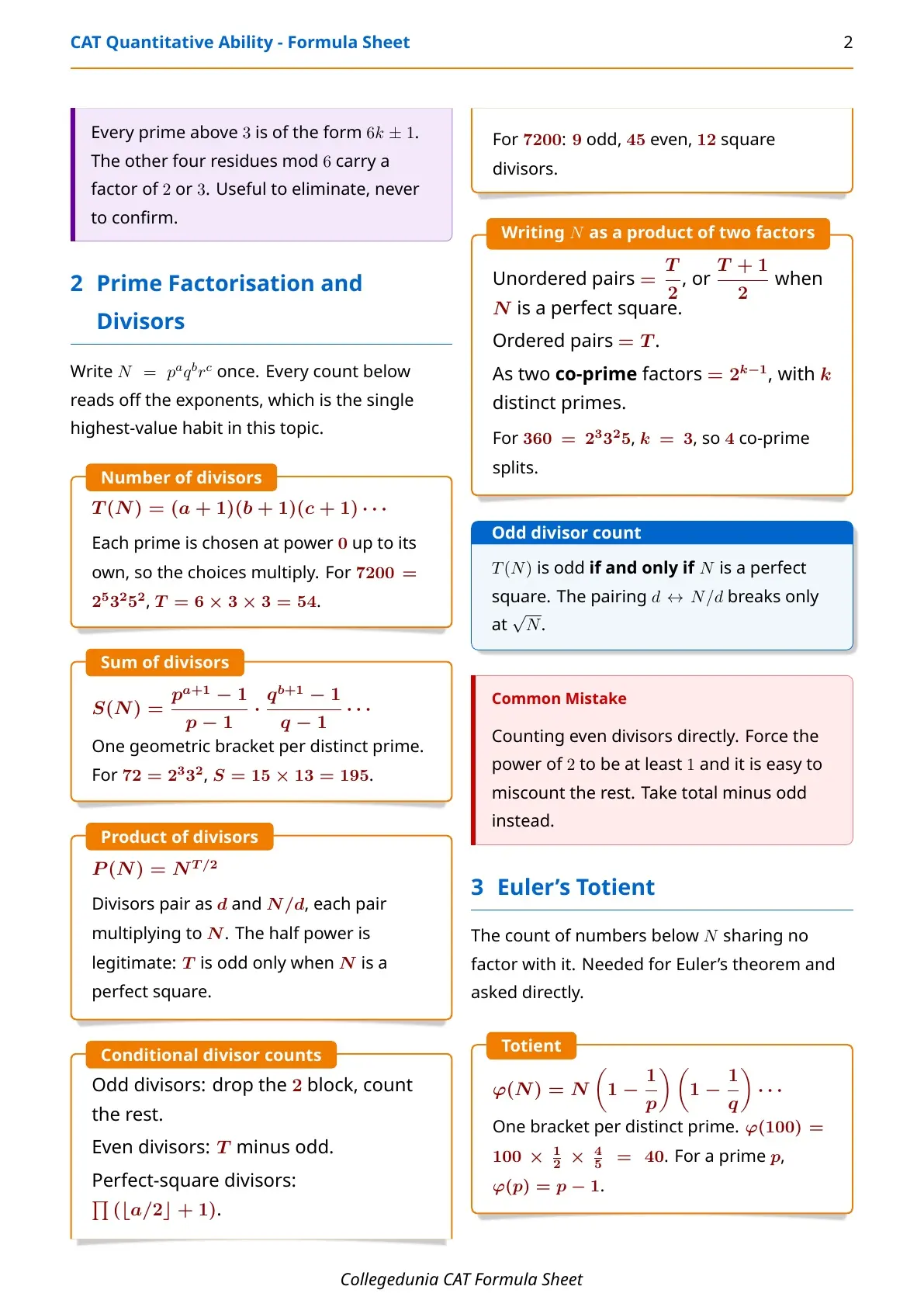
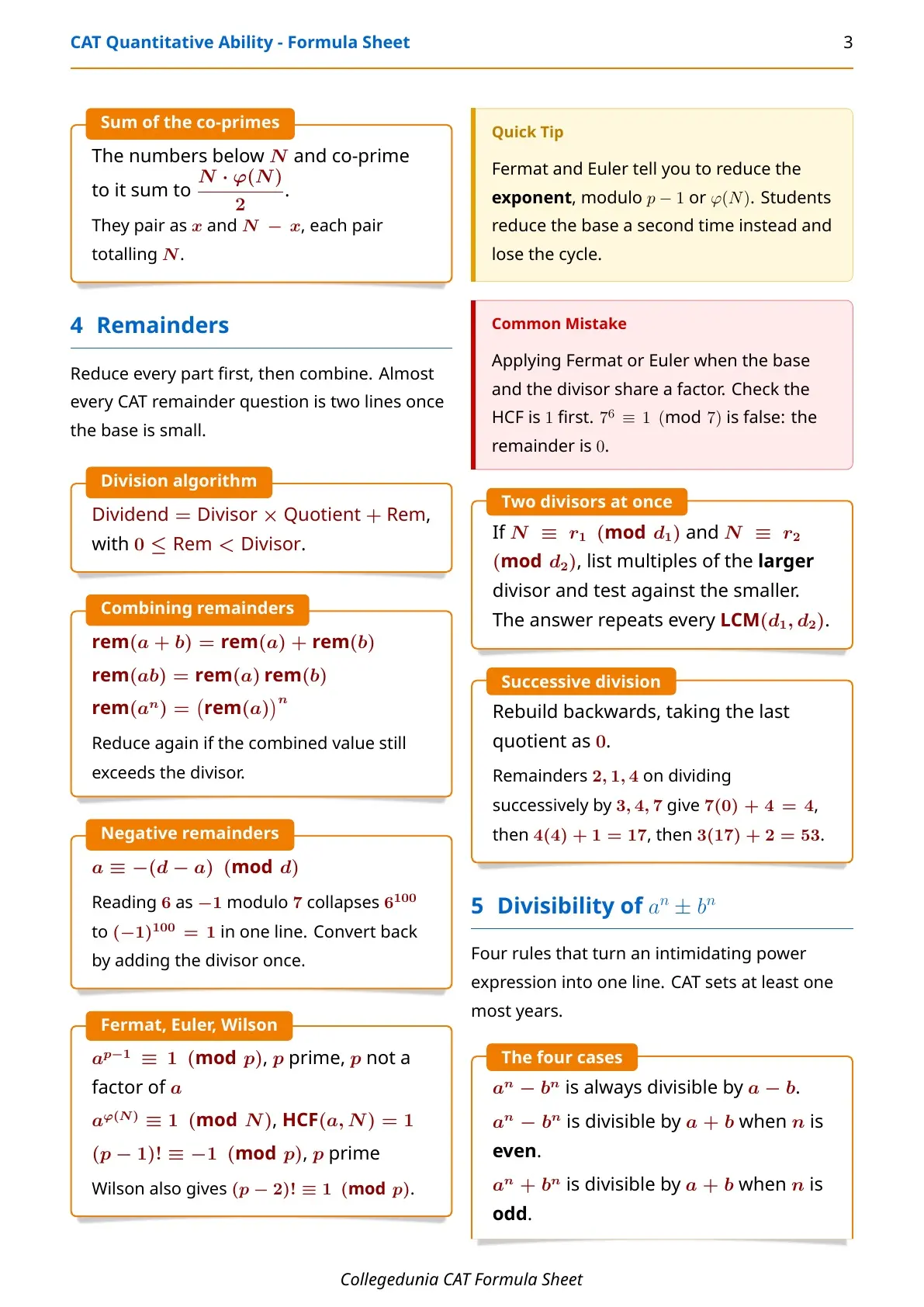
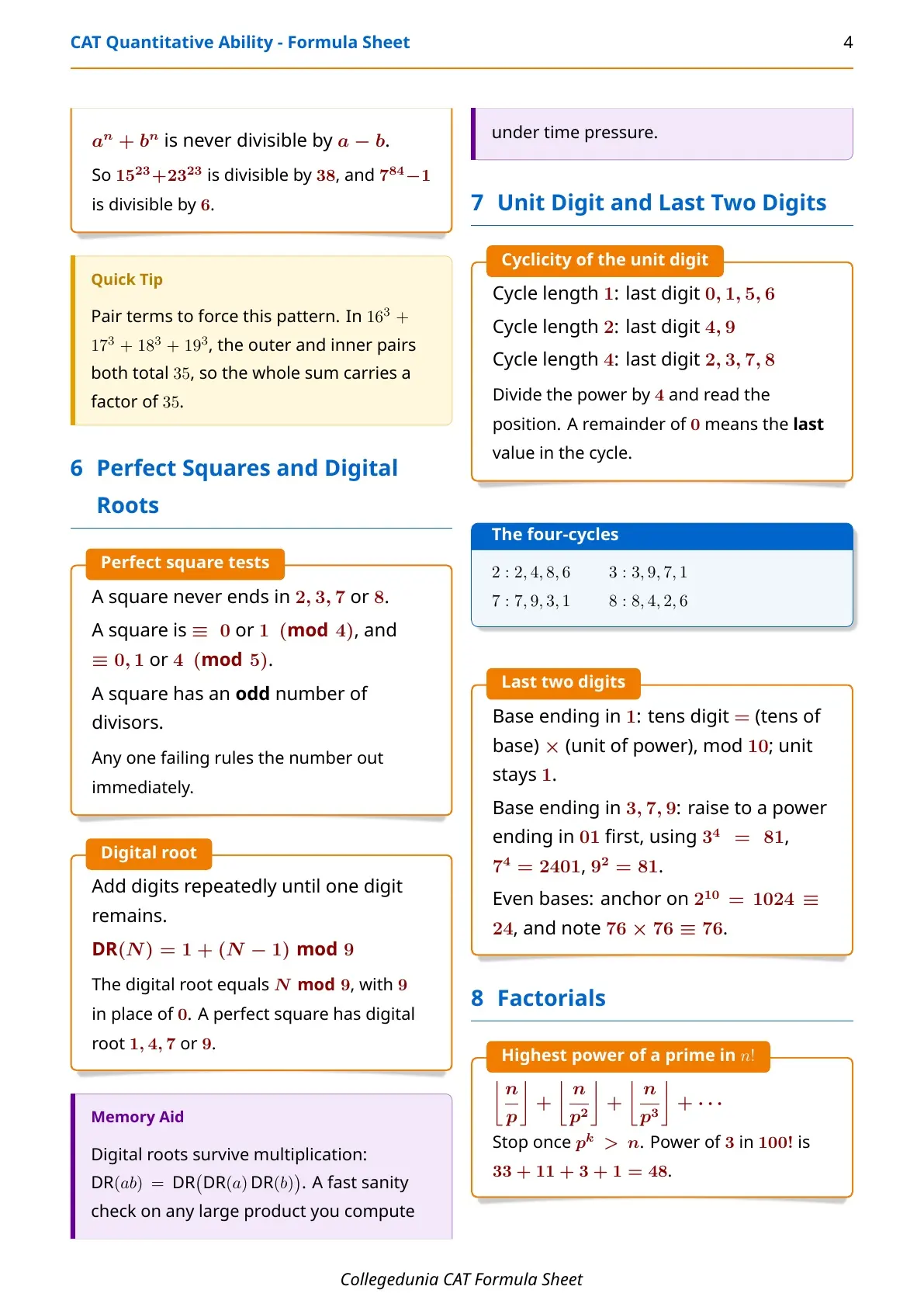
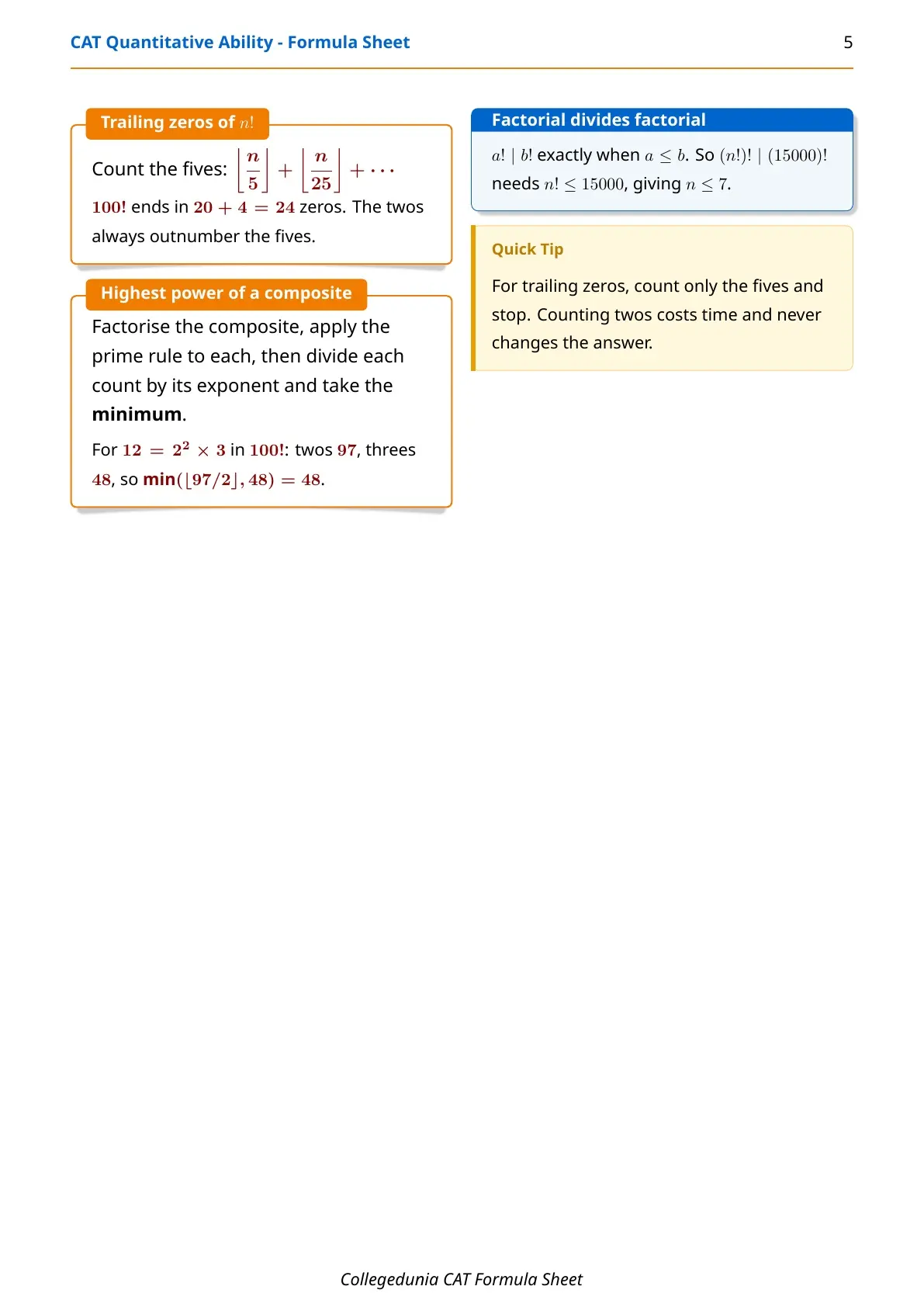
Everything is written for CAT rather than school level: divisor counting, remainder theorems, cyclicity and factorial powers, each with the one-line reason it works. For the full explanations, the CAT Number System notes cover the same ground in 22 pages.
What Sits on the Six Pages
The sheet opens with a full-width divisibility table, then runs two columns of formula boxes grouped by idea.
- Divisibility tests for 2 to 13, each with why it works
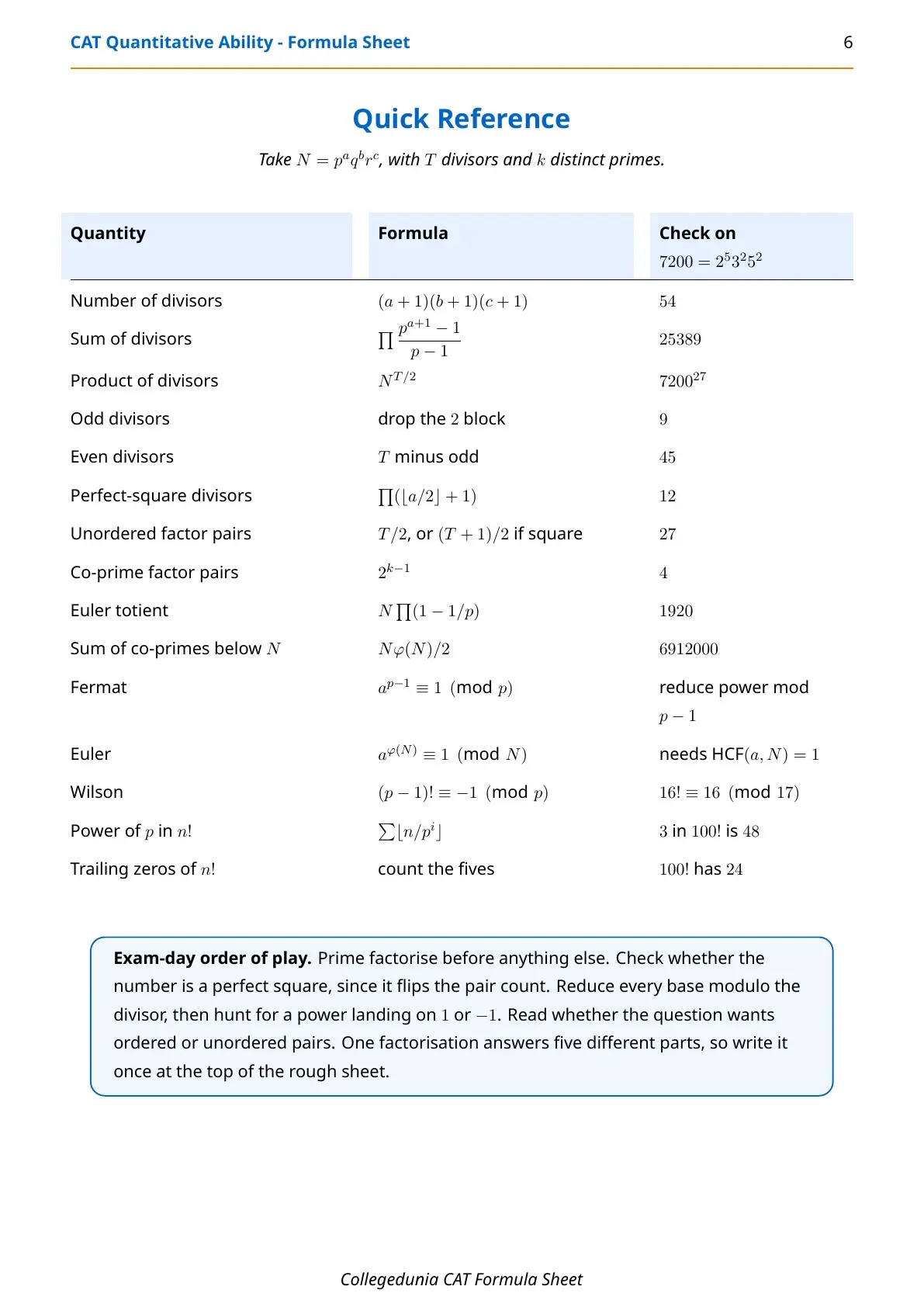
- Divisor formulas: count, sum, product, odd, even and perfect-square divisors
- Euler's totient, plus the sum of the numbers co-prime to N
- Remainder theorems: Fermat, Euler and Wilson, with their conditions
- Cyclicity tables and the last-two-digit methods
- Factorial powers and trailing zeros
The Formulas CAT Actually Rewards
A school formula sheet stops at divisibility rules. CAT questions live one layer above that, so these are the entries worth memorising first.
- Number of divisors from the prime powers, and the conditional counts built on it
- Two-factor pairs, including the self pair when the number is a perfect square
- Co-prime factor pairs, which is two raised to one less than the count of distinct primes
- Divisibility of powers, the four cases for a to the n plus or minus b to the n
- Highest power of a composite inside a factorial, which needs a minimum across primes
The sheet carries the powers rule in full because it turns an intimidating expression into one line. A sum like 15 to the 23 plus 23 to the 23 is divisible by 38 for a reason you can state in a sentence.
Five Entries Worth Memorising Verbatim
If you learn nothing else from the sheet, learn these. Between them they answer most of what CAT asks from this topic.
- Divisor count. Add one to each prime power and multiply. For 7,200 that is six times three times three, giving 54 divisors.
- Odd and even divisors. Drop the block of twos and count what remains to get the odd ones. Even divisors are the total minus the odd, never counted directly.
- Perfect-square divisors. Halve each prime power, round down, add one, multiply. For 7,200 that gives twelve.
- Trailing zeros of a factorial. Count only the fives, adding the whole-number parts of n over five, n over twenty-five and so on. The twos always outnumber them.
- Cyclicity. Unit digits repeat in cycles of at most four, so divide the power by four and read the position. A remainder of zero means the last value, not the first.
Each of these appears on the quick reference page with a worked value beside it, so you can check your recall against a number rather than against the formula alone.
Why Every Formula Carries a Reason
Each box states the formula, then one line on why it holds. That second line is what makes the sheet usable under time pressure.
Students who know that the digit-sum test works because ten leaves remainder one on division by nine can rebuild the rule for eleven and thirteen without memorising them separately. Students who memorised only the rule cannot.
The same holds for the composite tests. The sheet states plainly that a divisor must be split into co-prime parts, and shows the counter-example: eighteen passes both a test by two and a test by six, yet is not a multiple of twelve. Splitting twelve as three and four is the only valid form.
Perfect-square checks work the same way. A square never ends in two, three, seven or eight, and always leaves remainder zero or one on division by four. Either fact rules a candidate out in seconds, which matters when a question offers four large options and only one can be a square.
Watch the Shortcuts Applied
Source: Rodha
How to Revise From It
A formula sheet earns its place in the last fortnight, not the first. Use it to close gaps, not to learn the topic.
- Cover the right column of the quick reference and reproduce each formula
- Check every entry against the worked value for 7,200 printed beside it
- Say the reason out loud, not just the formula
- Attempt the previous year questions straight after, with the sheet closed
The final page repeats every formula in one table with a checked example, so a full revision pass takes about ten minutes once the topic is learnt.
What Is Deliberately Left Out
HCF, LCM and base systems are not here. They form the next topic in the CAT syllabus and get their own sheet, so this one stays on factors, remainders and divisibility without switching ideas midway.
CAT Number System Formula Sheet FAQs
Ques. Is this formula sheet enough to revise the topic?
Ans. It is a revision aid, not a first read. Every formula carries a one-line reason, so it works well once the topic is learnt. Students meeting the topic for the first time should start with the 22 page notes instead.
Ques. Does it include Fermat, Euler and Wilson theorems?
Ans. Yes, all three, each with the condition that makes it valid. Fermat and Euler both need the base and the divisor to share no common factor, and the sheet states that beside the formula because it is the most common slip.
Ques. Why are HCF and LCM missing?
Ans. They belong to the next topic of the CAT Quant syllabus, along with base systems, and have their own formula sheet. Splitting them keeps this sheet to one idea.
Ques. Can the formula sheet be downloaded free?
Ans. Yes. The 6 page PDF can be read on this page and downloaded at no cost, so students can print it or keep it on a phone during revision.



Comments