




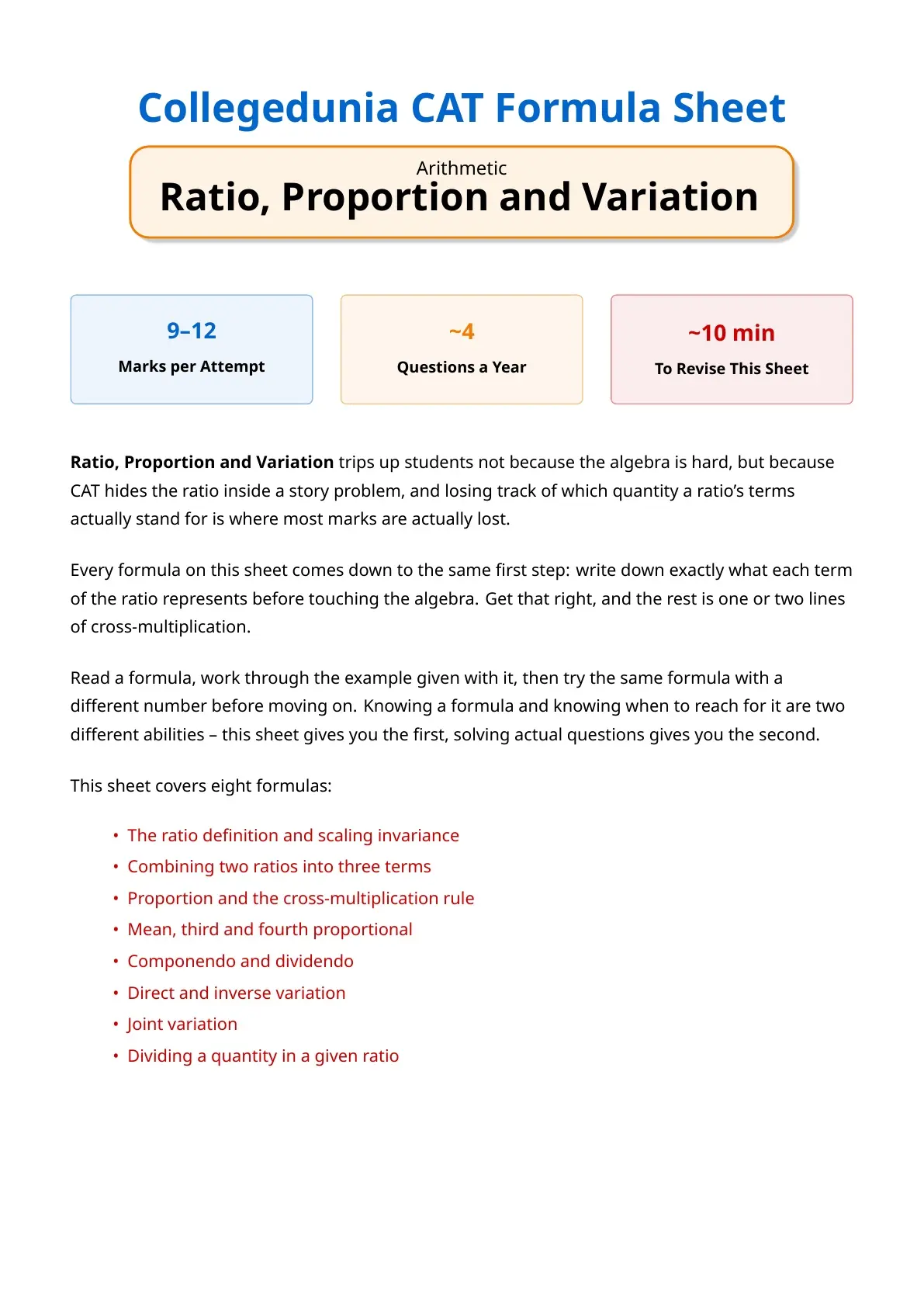
CAT Ratio, Proportion and Variation formula sheet, free to download as a 6-page PDF. The topic carries about 9 to 12 marks across roughly 4 questions a year, and takes roughly ten minutes to work through, so it belongs in your final revision.
The sheet covers all eight formulas in real notation, a 9-year weightage table, two real CAT questions with full solutions, and a concept video.
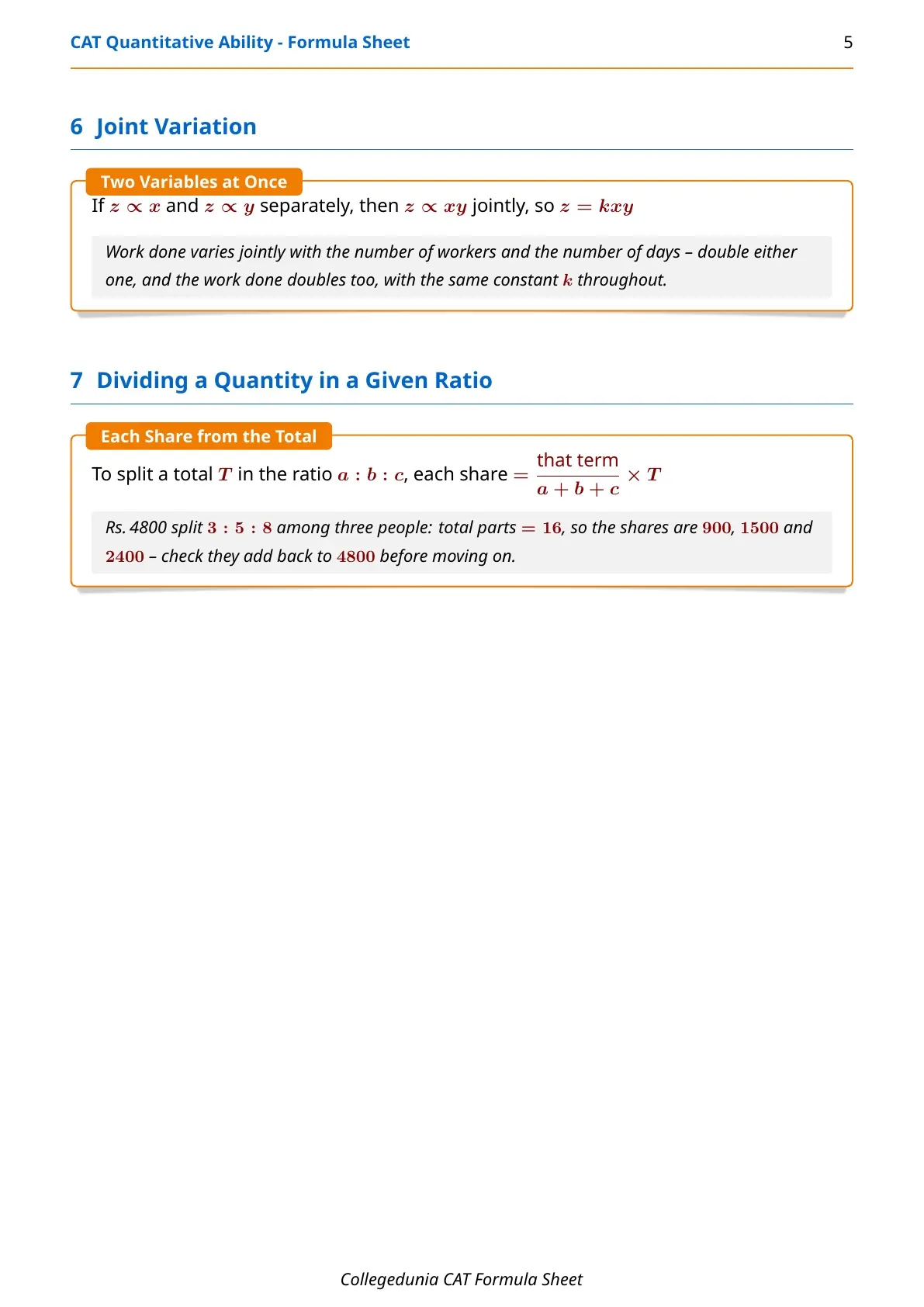
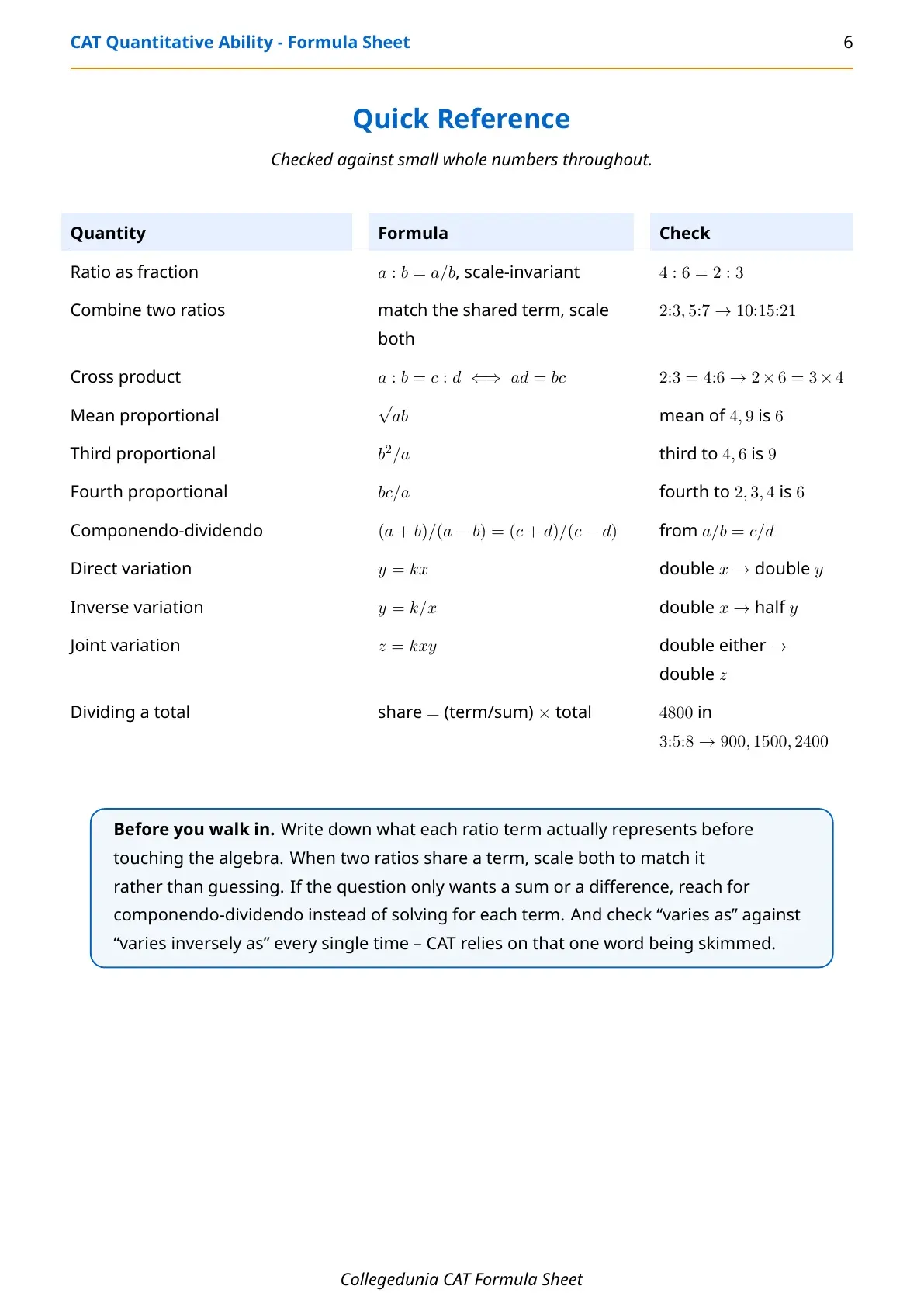
Built for revision, so every line trades explanation for speed. Read the working behind each formula in the full Ratio, Proportion and Variation notes before leaning on this sheet.
Ratio, Proportion and Variation Weightage in CAT: Previous Year Questions Analysis
As per CAT Ratio and Proportion weightage from past years, students can expect 4 to 5 questions from this topic every year, with 2024 as the highest-yielding year at 9 questions. CAT does not release an official chapter-wise weightage, so the numbers below are based on tagging every question from the released papers by topic and year.
| Year | Questions |
|---|---|
| 2025 | 6 |
| 2024 | 9 |
| 2023 | 5 |
| 2022 | 4 |
| 2021 | 2 |
| 2020 | 2 |
| 2019 | 3 |
| 2018 | 4 |
| 2017 | 2 |
| 9-Year Average | ~4.1 |
The 2024 spike to 9 questions is the outlier in an otherwise steady 2-to-6 range, so treat that year as the exception rather than the pattern. Ratio and proportion also feed directly into Mixtures, Time-Speed-Distance and Time and Work questions, so the topic's real exposure in the paper runs higher than its standalone count.
Ratio and Proportion Formula for CAT: The Basic Definition and Scaling Rule
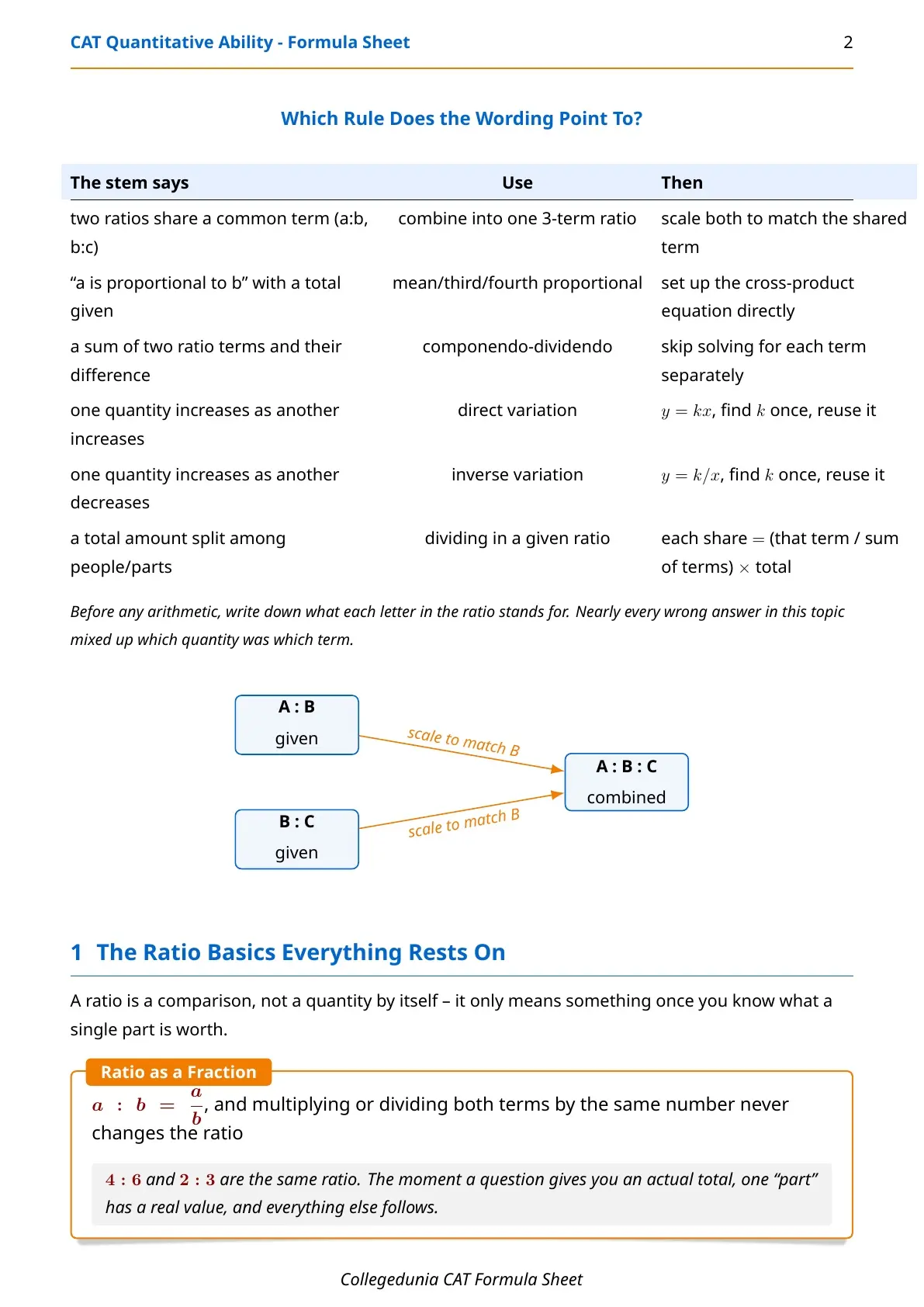
A ratio only means something once you know what a single part is worth, and it never changes when both terms are scaled together:
4:6 and 2:3 are the same ratio. A ratio of 2:3 does not mean the two quantities are literally 2 and 3 − they are 2k and 3k for some k, and k has to be found from whatever total or difference the question gives.
Combining Two Ratios Formula: How to Merge A:B and B:C into A:B:C
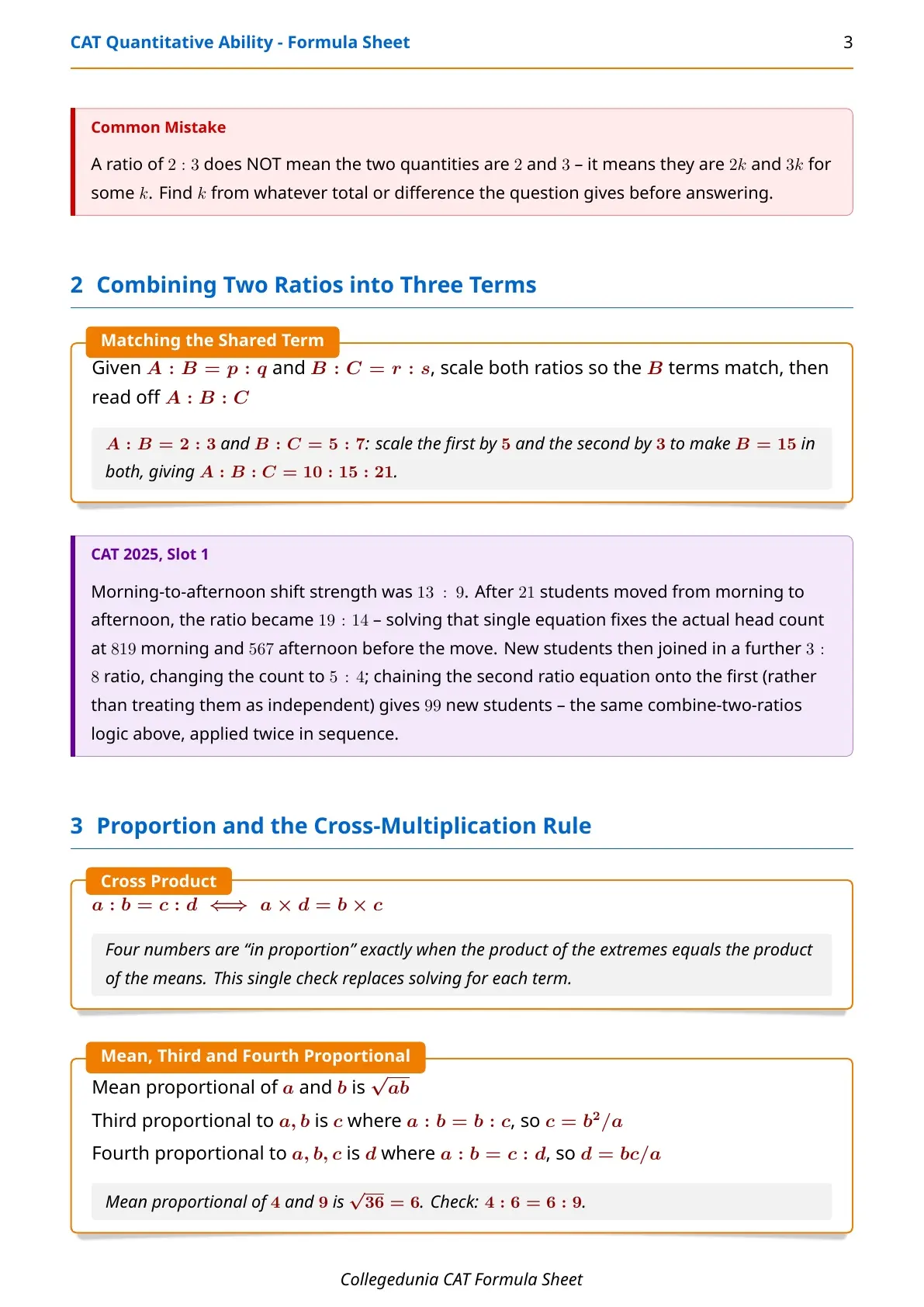
When two ratios share a common term, scale both so that shared term matches before reading off the combined ratio:
A:B = 2:3 and B:C = 5:7: scale the first by 5 and the second by 3 to make B = 15 in both, giving A:B:C = 10:15:21.
CAT 2025 (Slot 1). Morning-to-afternoon shift strength at a school was 13:9. After 21 students moved from morning to afternoon, the ratio became 19:14 − solving that equation fixes the actual head count at 819 morning and 567 afternoon before the move. New students then joined in a further 3:8 ratio, changing the count to 5:4; chaining the second ratio equation onto the first, rather than treating the two as independent, gives 99 new students − the same combine-two-ratios formula above, applied twice in sequence.
Proportion Formula for CAT: Cross-Multiplication and Mean Proportional
Four numbers are in proportion exactly when the product of the extremes equals the product of the means:
This single check replaces solving for each term separately whenever a question asks whether four given numbers are in proportion.
Mean proportional of 4 and 9 is the square root of 36, which is 6 − check: 4:6 = 6:9.
Componendo and Dividendo Formula: The Shortcut for Sum-and-Difference Questions
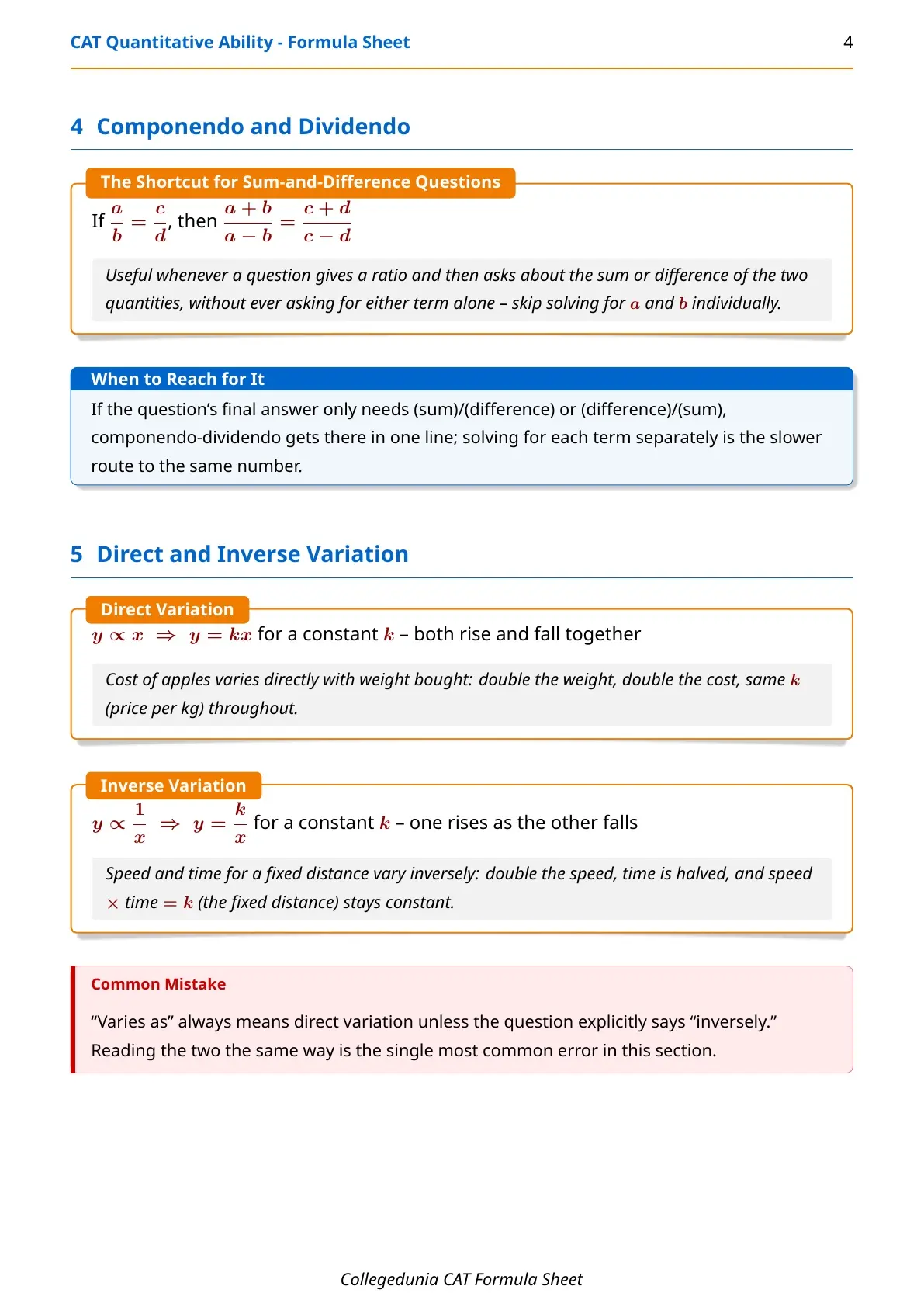
Componendo-dividendo skips solving for each term separately whenever a question only wants the sum or the difference of two quantities that are in a known ratio:
If a question's final answer only needs (sum)/(difference) or (difference)/(sum), this gets there in one line; solving for each term separately is the slower route to the same number.
Direct and Inverse Variation Formula for CAT Quantitative Aptitude
"Varies as" and "varies inversely as" are read completely differently, and CAT relies on that one word being skimmed:
Cost of apples varies directly with weight bought: double the weight, double the cost, same k throughout. Speed and time for a fixed distance vary inversely: double the speed, time is halved, and speed × time stays constant at k.
When two variables act on a third at once, the two combine into one joint formula:
Work done varies jointly with the number of workers and the number of days − double either one, and the work done doubles too, with the same constant k throughout.
Ratio, Proportion and Variation Questions for CAT with Solutions PDF
Ratio and proportion questions in CAT rarely test the base definition alone and usually chain it with a second condition. Below are two real CAT questions with solutions:
Q1 (CAT 2025, Slot 1). The ratio of the number of students in the morning shift and afternoon shift of a school was 13:9. After 21 students moved from the morning shift to the afternoon shift, this ratio became 19:14. Next, some new students joined the morning and afternoon shifts in the ratio 3:8, and then the ratio of the number of students in the morning shift and the afternoon shift became 5:4. The number of new students who joined is
(a) 110 (b) 88 (c) 121 (d) 99
Show Solution
- Step 1: Let morning = 13k, afternoon = 9k. After 21 students move: (13k−21):(9k+21) = 19:14.
- Step 2: Cross-multiplying: 14(13k−21) = 19(9k+21), giving 182k − 294 = 171k + 399, so 11k = 693 and k = 63.
- Step 3: Morning = 819, afternoon = 567 before the move. After the move: morning = 798, afternoon = 588 (check: 798:588 = 19:14).
- Step 4: Let 3m and 8m new students join morning and afternoon. New ratio: (798+3m):(588+8m) = 5:4.
- Step 5: Cross-multiplying: 4(798+3m) = 5(588+8m), giving 3192+12m = 2940+40m, so 28m = 252 and m = 9.
- Step 6: Total new students = 3m + 8m = 11m = 99.
Answer: (d) 99
Q2 (CAT 2024, Slot 2). When Rajesh's age was same as the present age of Garima, the ratio of their ages was 3:2. When Garima's age becomes the same as the present age of Rajesh, the ratio of the ages of Rajesh and Garima will become
(a) 3:2 (b) 4:3 (c) 5:4 (d) 2:1
Show Solution
- Step 1: Let Rajesh's present age = r, Garima's present age = g. The gap between their ages, r − g, stays fixed throughout.
- Step 2: (r−g) years ago, Rajesh's age was g (matching Garima's present age), and Garima's age then was g − (r−g) = 2g − r. The ratio at that time was g:(2g−r) = 3:2.
- Step 3: Cross-multiplying: 2g = 3(2g−r) = 6g − 3r, so 3r = 4g, giving r = 4g/3.
- Step 4: (r−g) years from now, Garima's age will be r (matching Rajesh's present age), and Rajesh's age then will be r + (r−g) = 2r − g.
- Step 5: Substituting r = 4g/3: 2r−g = 8g/3 − g = 5g/3, and Garima's age at that point is r = 4g/3.
- Step 6: New ratio = (5g/3):(4g/3) = 5:4.
Answer: (c) 5:4
Neither question is answered by a single formula on this sheet on its own − both need the ratio-as-multiplier setup chained with a second equation, which is the real skill this sheet is meant to build.
Ratio and Proportion Concept Video for CAT with Solved Examples
Source: MBA Wallah
How to Revise Ratio, Proportion and Variation Before CAT
The closing page repeats every formula in one table, each checked against small whole numbers.
- Cover the formula column and reproduce it from the quantity name
- Write down what each ratio term actually represents before touching the algebra
- Re-derive the componendo-dividendo shortcut rather than memorising the final expression alone
- Check "varies as" against "varies inversely as" every time a variation question appears
CAT Ratio Proportion Variation Formula Sheet FAQs
Ques. Does a ratio of 2:3 mean the two quantities are exactly 2 and 3?
Ans. No. A ratio of 2:3 means the quantities are 2k and 3k for some constant k, which has to be found from a total or a difference the question provides.
Ques. How do you combine two ratios that share a common term?
Ans. Scale both ratios so the shared term matches, then read off the combined three-term ratio. A:B = 2:3 and B:C = 5:7 combine to A:B:C = 10:15:21 once both are scaled to B = 15.
Ques. When should componendo-dividendo be used instead of solving directly?
Ans. Whenever the question's final answer only needs the sum or the difference of two quantities in a known ratio, not either quantity by itself. Solving for each term separately reaches the same answer but takes longer.
Ques. What is the difference between direct and inverse variation?
Ans. In direct variation, y = kx, so both quantities rise and fall together. In inverse variation, y = k/x, so one rises as the other falls. CAT questions rely on "varies as" and "varies inversely as" being read carefully.
Ques. Can the PDF be downloaded for free?
Ans. Yes. All 6 pages can be read on this page or downloaded at no cost, so it can be printed or kept on a phone for last-minute revision.



Comments