




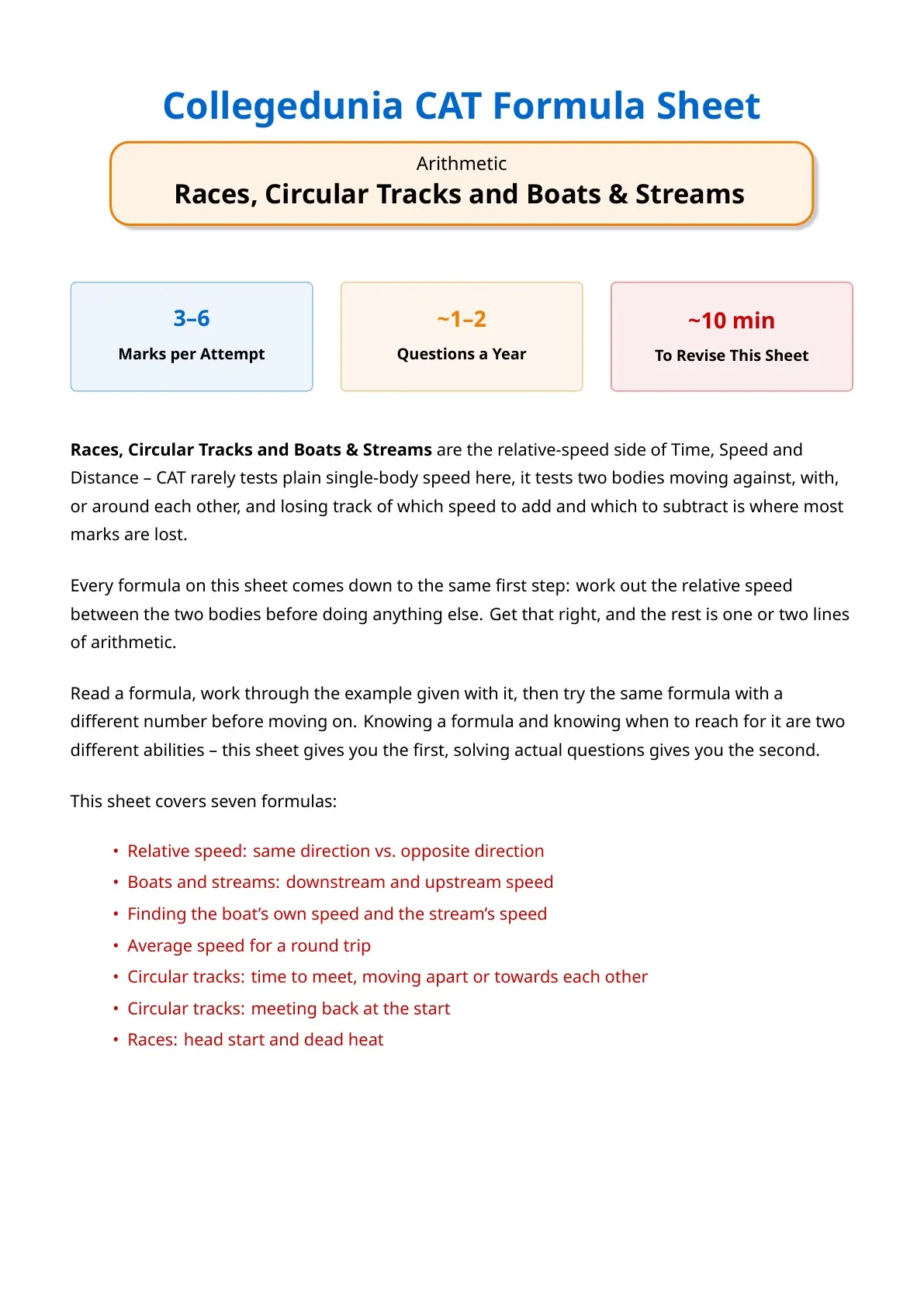
CAT Races, Circular Tracks and Boats and Streams formula sheet, free to download as a 6-page PDF. The topic carries about 3 to 6 marks across roughly 1 to 2 questions a year, and takes roughly ten minutes to work through, so it belongs in your final revision.
The sheet covers all seven formulas in real notation, a real weightage breakdown, two real CAT questions with full solutions, and a concept video.
Built for revision, so every line trades explanation for speed. Read the working behind each formula in the full Races, Circular Tracks and Boats and Streams notes before leaning on this sheet.
Races, Circular Tracks and Boats and Streams Weightage in CAT: Previous Year Questions Analysis
This topic is tested far less often as a standalone question than a chapter like Percentages or Profit and Loss − the tagged past-paper data shows Boats and Streams appearing just once in 2011, 2012, 2015 and 2016, and Races/Circular Track (tagged under Relative Speed) clustering in older papers rather than recent ones. CAT does not release an official chapter-wise weightage of its own.
| Year | Boats and Streams Questions |
|---|---|
| 2016 | 1 |
| 2015 | 1 |
| 2012 | 1 |
| 2011 | 1 |
That does not mean the topic is safe to skip − real CAT questions on boats, streams and circular tracks still show up in recent papers (2023 and 2020 examples are worked below), just not tagged consistently enough in the database to build a clean recent-year table. Relative speed itself, which every formula on this sheet depends on, is tested far more often as part of the broader Time, Speed and Distance section.
Boats and Streams Formula for CAT: Downstream and Upstream Speed
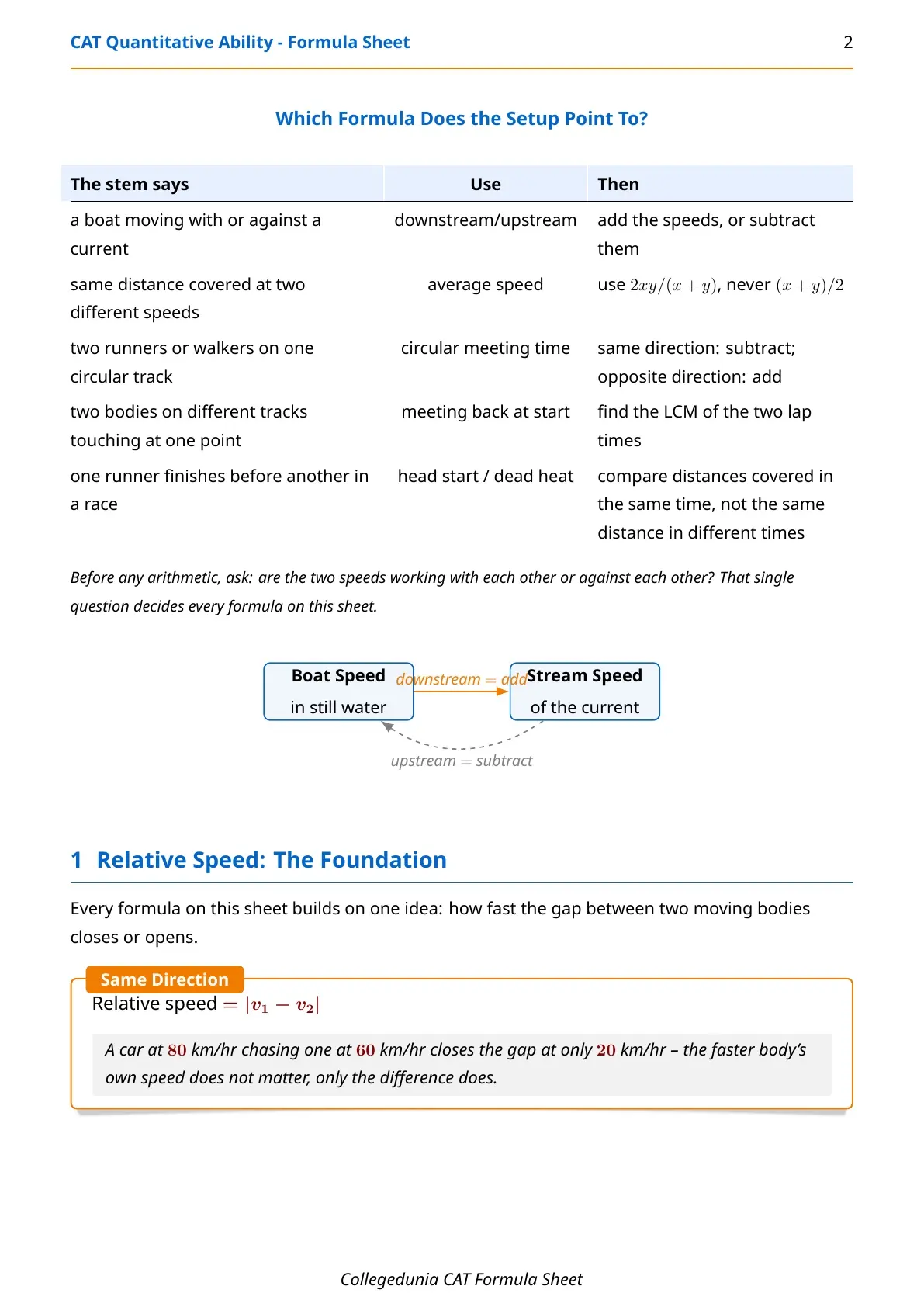
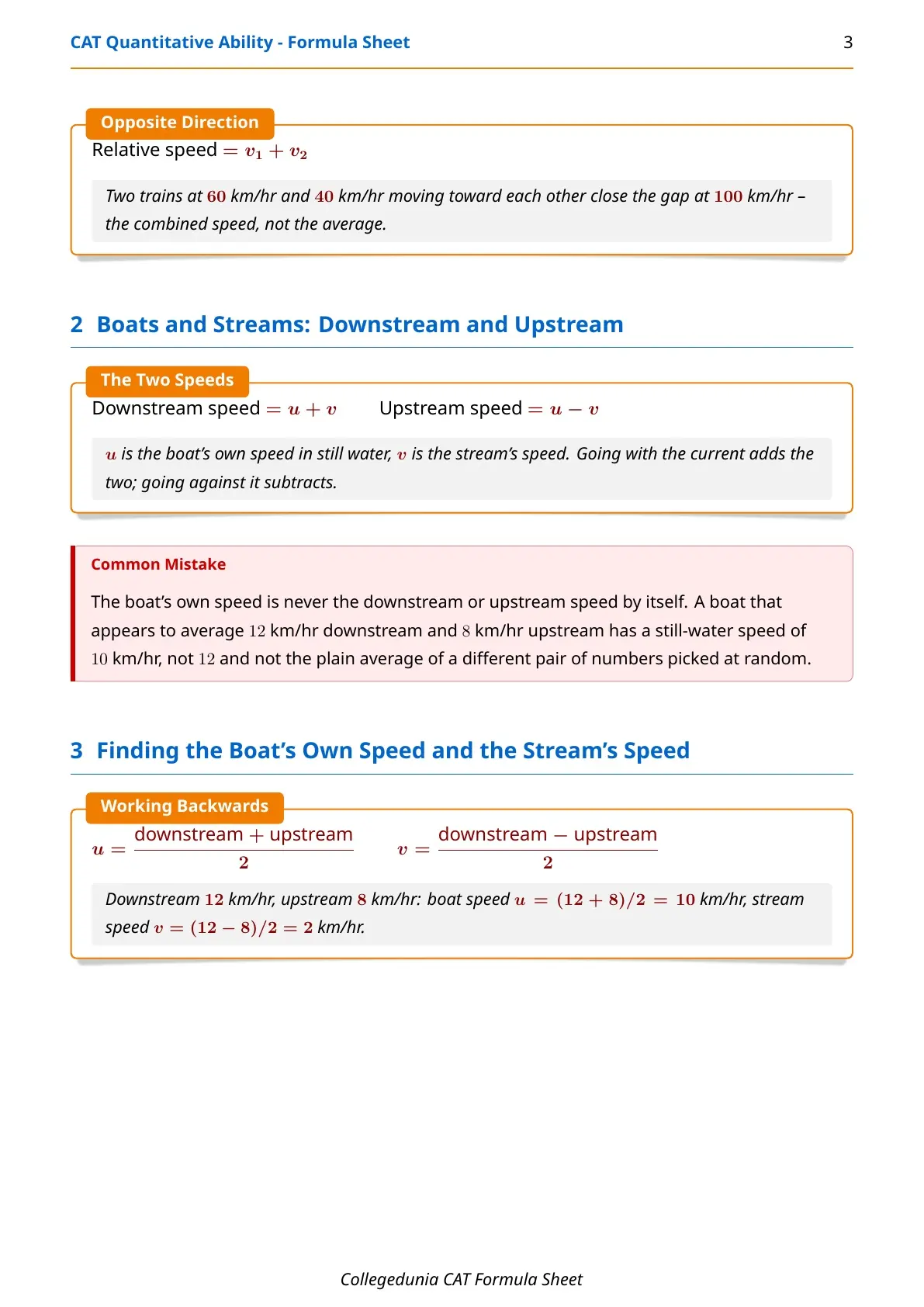
A boat moving with or against a current has two different effective speeds, and CAT expects both to be worked out from the boat's own speed and the stream's speed:
Going with the current adds the two speeds; going against it subtracts them. The boat's own speed is never the downstream or upstream figure by itself.
Running the same relation backwards recovers both individual speeds from a downstream/upstream pair:
Downstream 12 km/hr and upstream 8 km/hr gives boat speed u = (12+8)/2 = 10 km/hr and stream speed v = (12−8)/2 = 2 km/hr.
CAT 2023 (Slot 3). A boat takes 2 hours to travel downstream from port A to port B, and 3 hours to return upstream. Another boat takes a total of 6 hours to travel from B to A and back to B. With both boats' speeds and the river's speed constant, the slower boat's downstream travel time from A to B works out to 3(3−√5) hours − a question that needs the downstream/upstream relations chained with a quadratic, not read off a single formula.
Average Speed Formula for a Round Trip in CAT Quant
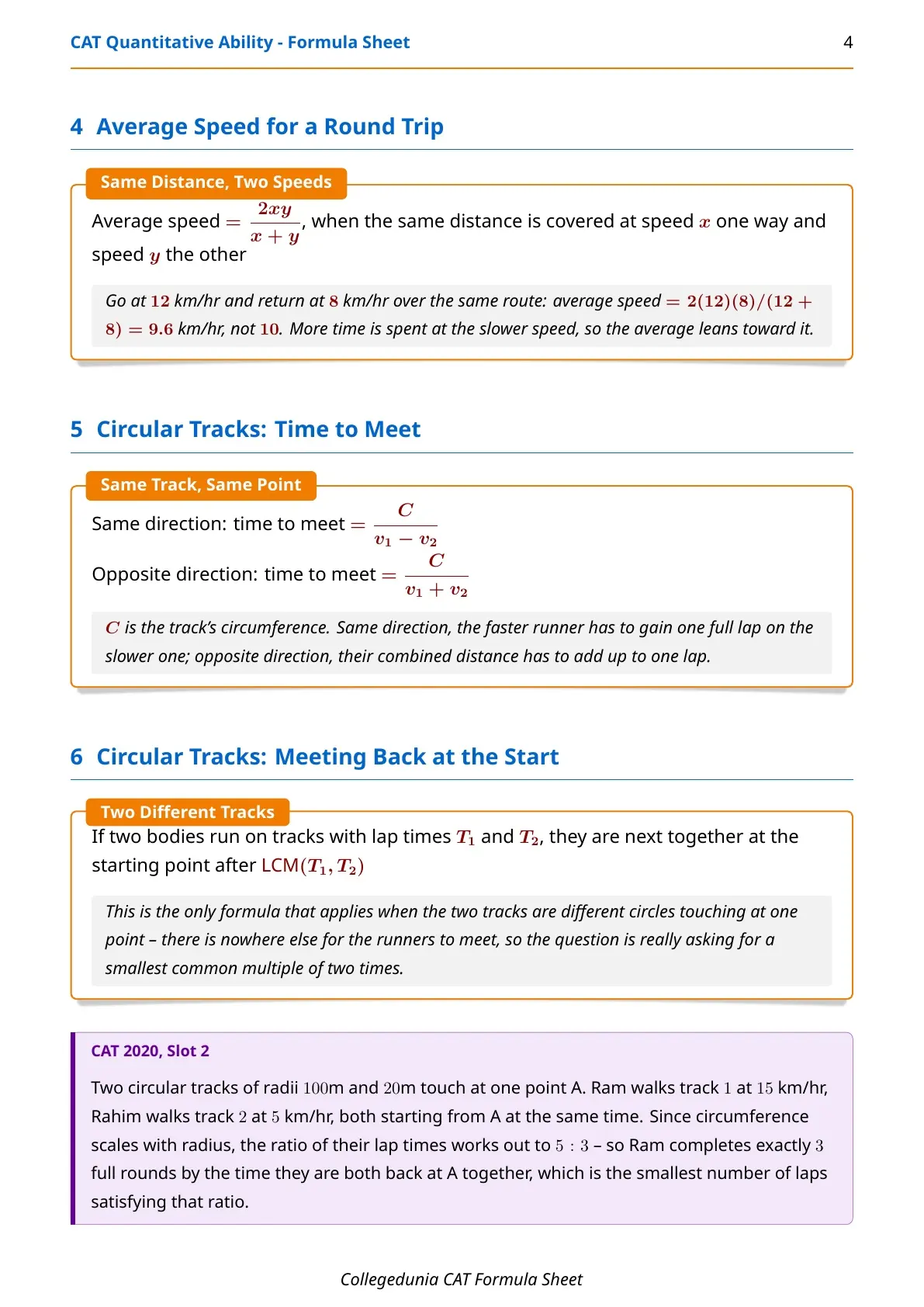
When the same distance is covered at two different speeds − going at one speed and returning at another − the average speed is never the plain average of the two:
Going at 12 km/hr and returning at 8 km/hr over the same route gives an average of 2(12)(8)/(12+8) = 9.6 km/hr, not 10 − more time is spent at the slower speed, so the average leans toward it.
Circular Track Formula for CAT: Time to Meet, Same Direction vs Opposite Direction
Two runners or walkers on the same circular track meet at different rates depending on which way they are moving:
Same direction, the faster runner has to gain one full lap on the slower one before they meet again. Opposite direction, their combined distance has to add up to exactly one lap.
A separate formula covers two runners on two different circular tracks that only touch at one point − there is nowhere else for them to meet, so the question becomes a smallest-common-multiple problem:
CAT 2020 (Slot 2). Two circular tracks of radii 100m and 20m touch at one point A. Ram walks track 1 at 15 km/hr, Rahim walks track 2 at 5 km/hr, both starting from A at the same time. What is the number of full rounds Ram makes before he meets Rahim again at A?
(a) 5 (b) 3 (c) 2 (d) 4
Show Solution
- Step 1: Circumference scales with radius, so track 1's lap length is 100/20 = 5 times track 2's lap length.
- Step 2: Ram's speed is 15 km/hr on the longer track, Rahim's is 5 km/hr on the shorter track − a speed ratio of 3:1.
- Step 3: Lap time = circumference ÷ speed, so the ratio of Ram's lap time to Rahim's lap time is (5/1) ÷ (3/1) = 5:3.
- Step 4: They are both back at A when Ram has completed a whole number of laps m and Rahim a whole number n with m × (Ram's lap time) = n × (Rahim's lap time), which holds first at the smallest m:n matching the inverse ratio 3:5.
- Step 5: So Ram completes exactly 3 full rounds by the time they are both back at A together.
Answer: (b) 3
Relative Speed Formula for CAT: Same Direction vs Opposite Direction
Every formula on this sheet builds on one relation: how fast the gap between two moving bodies closes or opens.
A car at 80 km/hr chasing one at 60 km/hr closes the gap at only 20 km/hr − the faster body's own speed does not matter, only the difference. Two trains at 60 km/hr and 40 km/hr moving toward each other close the gap at 100 km/hr, the combined speed, not the average.
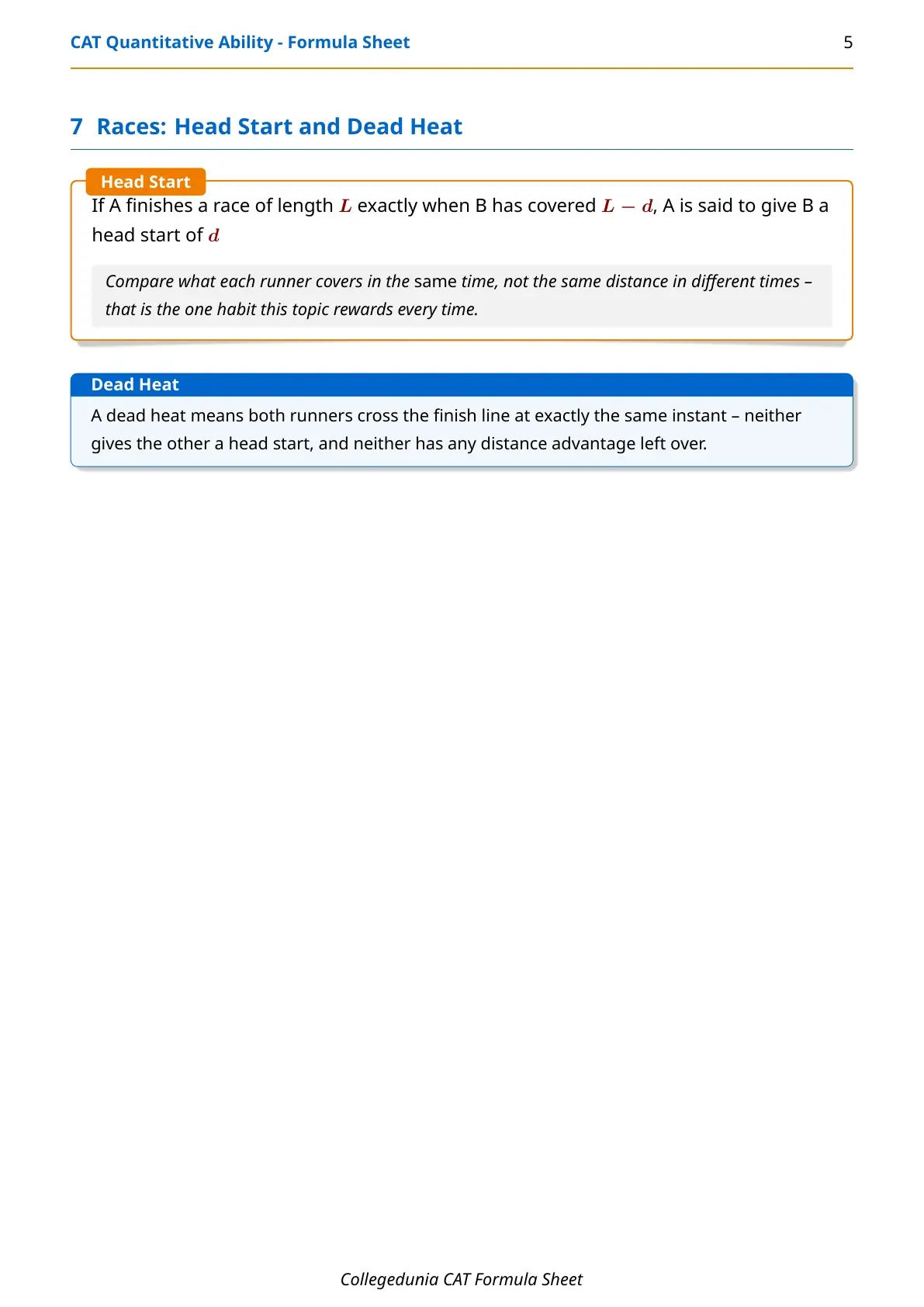
Head Start and Dead Heat Formula in CAT Races
In a race, comparing what each runner covers in the same time − not the same distance in different times − is the one habit this topic rewards every time:
A dead heat is the other extreme: both runners cross the finish line at exactly the same instant, with no head start and no distance advantage left over for either side.
Races and Boats Concept Video for CAT with Solved Examples
Source: MBA Wallah
How to Revise Races, Circular Tracks and Boats and Streams Before CAT
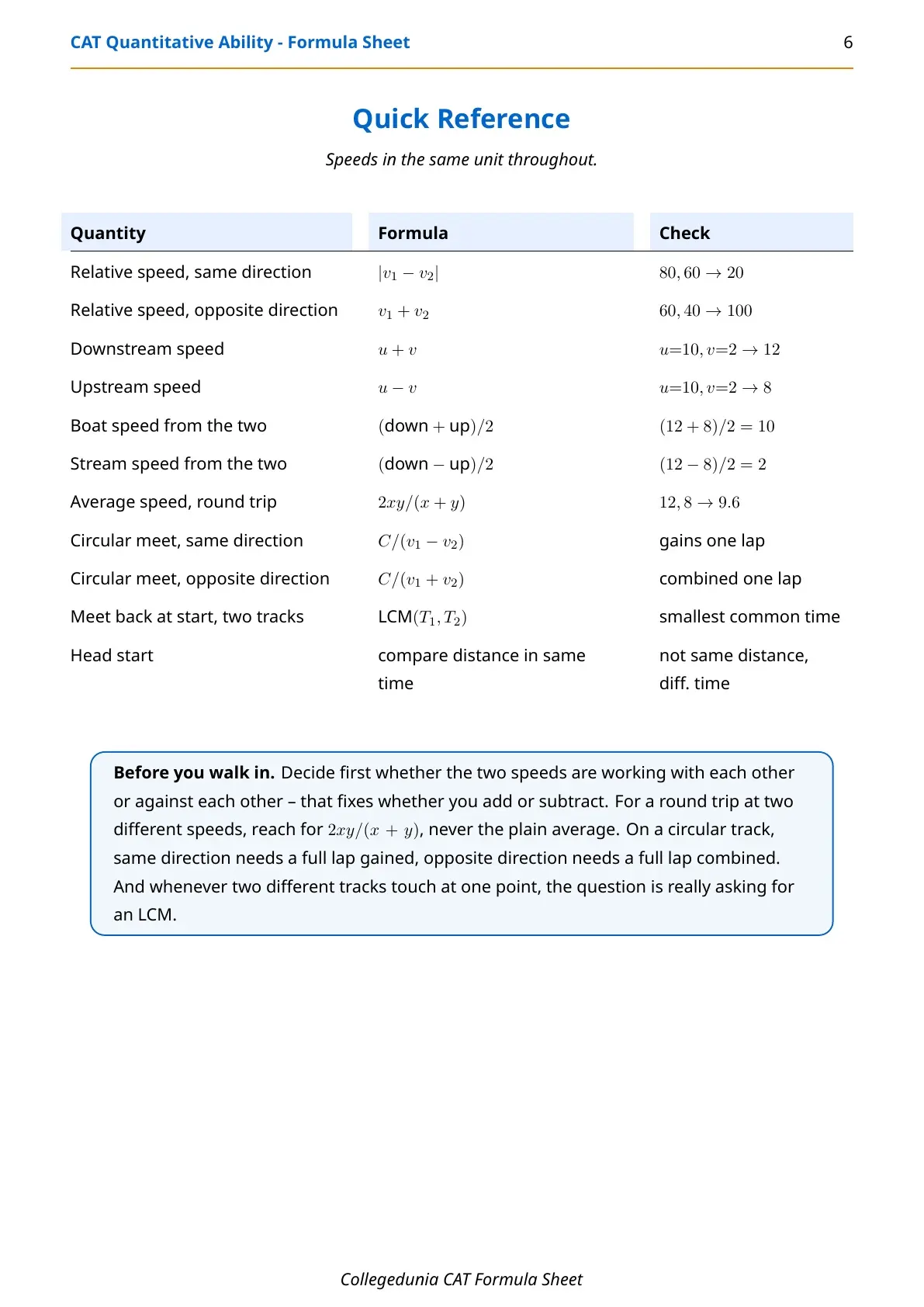
The closing page repeats every formula in one table, checked with real numbers throughout.
- Cover the formula column and reproduce it from the quantity name
- Ask first whether the two speeds are working with each other or against each other, before writing anything down
- Re-derive the average-speed formula for a round trip rather than defaulting to a plain average
- Check whether two tracks are the same circle or two different circles touching at one point − the second case always needs an LCM
CAT Races, Circular Tracks and Boats and Streams Formula Sheet FAQs
Ques. Is average speed for a round trip always the plain average of the two speeds?
Ans. No. When the same distance is covered at two different speeds, the average speed is 2xy/(x+y), not (x+y)/2. Going at 12 km/hr and returning at 8 km/hr averages 9.6 km/hr, not 10, because more time is spent at the slower speed.
Ques. How do you find a boat's own speed from its downstream and upstream speeds?
Ans. Boat speed = (downstream + upstream)/2, and stream speed = (downstream − upstream)/2. Downstream 12 km/hr and upstream 8 km/hr gives a boat speed of 10 km/hr and a stream speed of 2 km/hr.
Ques. What happens when two runners are on two different circular tracks that touch at one point?
Ans. They can only meet again at that single touching point, so the question becomes a smallest-common-multiple problem: find the LCM of the two runners' individual lap times.
Ques. Is this topic tested often in CAT?
Ans. Less often as a standalone question than Percentages or Profit and Loss, but real questions on boats, streams and circular tracks still appear in recent papers, and the underlying relative-speed relation is tested throughout the broader Time, Speed and Distance section.
Ques. Can the PDF be downloaded for free?
Ans. Yes. All 6 pages can be read on this page or downloaded at no cost, so it can be printed or kept on a phone for last-minute revision.



Comments