



Study Abroad Expert | Updated On - Jul 23, 2026
A backlog certificate is the official document from your Indian college stating how many backlogs you had during your degree. Universities abroad ask for it even when the count is zero. For Indian students, a missing or wrongly formatted certificate stalls otherwise complete applications. This guide covers who asks for it, counting rules, the format, the process and download-ready samples.
- Issued by the Registrar, Controller of Examinations, or Principal on official letterhead.
- Australia, Canada, Germany and New Zealand ask for it most often.
- The counting basis matters: subjects versus attempts can change your number.
- Students with none submit a zero backlog certificate instead

| Parameter | Detail |
|---|---|
| What it states | Total backlogs across the degree, with cleared status |
| Issued by | Registrar, Controller of Examinations or Principal |
| Who asks | Australia, Canada, Germany, New Zealand most often |
| Counting basis | Number of subjects or number of attempts, stated on the certificate |
| Zero backlogs | Zero backlog certificate confirming first-attempt passes |
| Typical fee and time | INR 100 to 500, about 3 to 15 working days |
| Downloads below | Format pack PDF, 2 filled sample PDFs, annotated example image |
Read More:
- Study abroad guide for Indian students
- Statement of Purpose (SOP): Format, Samples & Writing Tips
- Letter of Recommendation (LOR) Format with Samples
- What is a Bonafide Certificate? Importance and Samples
- Gap Certificate for Study Abroad: Format, Affidavit and PDF
What It Is and Who Asks for It
The certificate is your college's official statement of every subject you failed and later cleared, called backlogs, arrears, ATKT or supplementary exams depending on the university. Different names, one document. Admissions teams use it to read your marksheets correctly, since Indian grade sheets alone rarely show attempt history clearly. The wider journey sits in this guide on studying abroad after Class 12. Where it is asked:
- Australia: the most consistent asker, as part of academic and genuine student checks.
- Canada: common for university and college applications alike.
- Germany: requested by several universities and application portals during document review.
- New Zealand and Ireland: frequently requested alongside transcripts.
- USA and UK: less common as a separate document, since transcripts usually carry attempt history there.
Note: The zero backlog certificate is not optional paperwork for toppers. Universities that ask for a backlog count want the answer either way, and a written zero on letterhead settles the question faster than a transcript the officer must decode subject by subject.
Read More:
- Top Universities/College to Study Abroad
- Scholarships to Study Abroad: Types, Eligibility, Award Value
- Study Abroad Exams Entrance Exams In India
How Backlogs Are Counted
The same academic record can produce two different numbers, because some universities count failed subjects while others count total failed attempts. The certificate must state which basis it uses. The difference in one example: failing one subject twice before clearing it is one backlog by subjects but two by attempts. How the bases work:
| Basis | How it counts | Same record gives |
|---|---|---|
| By subjects | Each failed subject counts once, however many attempts | Lower number |
| By attempts | Every failed attempt counts, including repeats of one subject | Higher number |
| Cleared status | Certificates should confirm all backlogs stand cleared | Required either way |
Format and Contents with Example
The format is short and fixed: letterhead, reference number and date, the standard heading, student and program details, the total count with its basis, a subject-wise table and the signatory with seal. The annotated example maps each block.
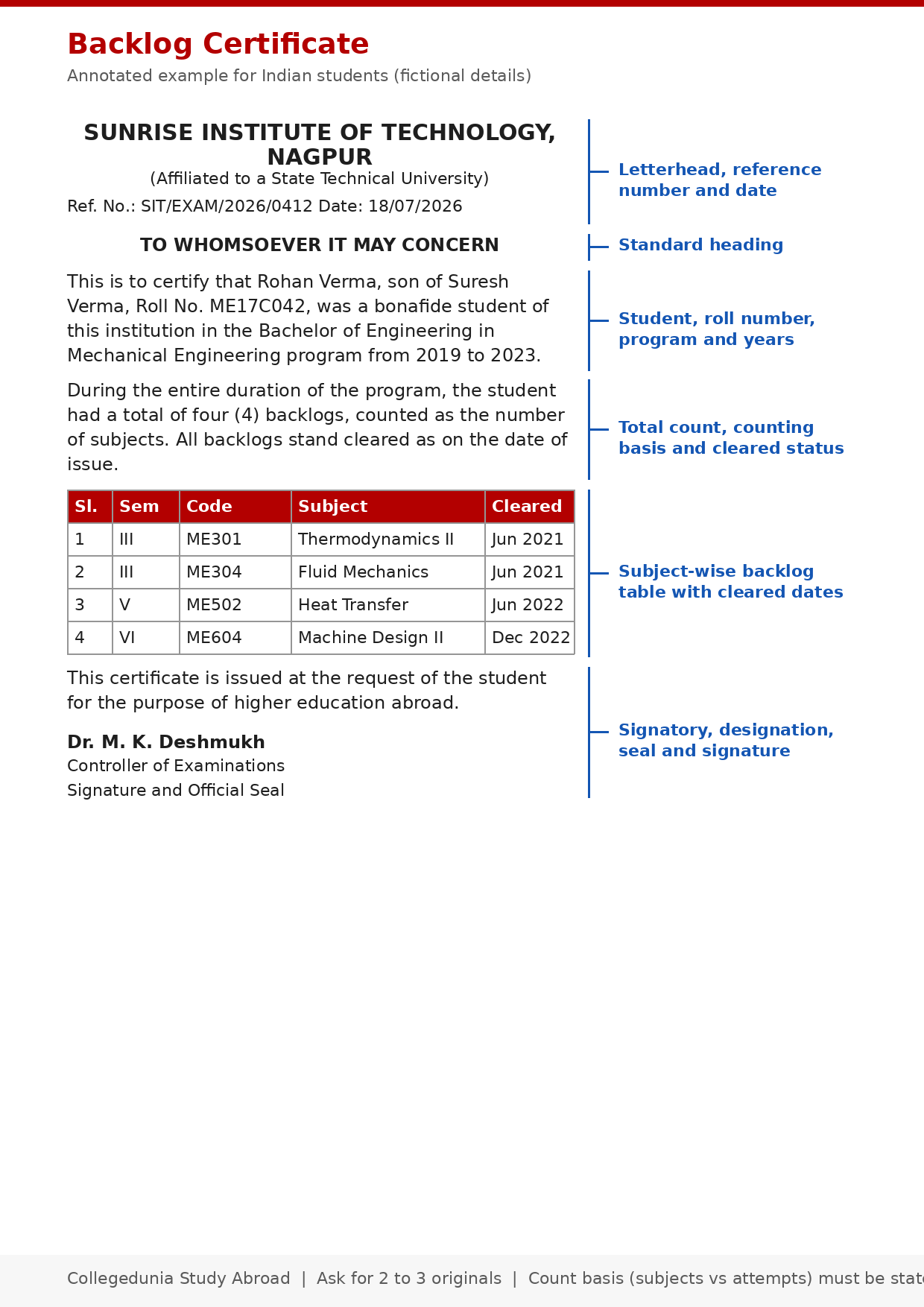
Downloads for this section:
| Backlog Certificate Format (PDF) |
| Sample Backlog Certificate (PDF) |
| Sample Zero Backlog Certificate (PDF) |
What the certificate covers and what it does not:
- Covers: the total count, its basis, subject-wise details and cleared status, under seal and signature.
- Does not: your marks or CGPA, which the transcripts carry, or any explanation of why backlogs happened.
The format pack includes the with-backlogs format, the zero backlog format and the request letter to the Registrar, since many Indian colleges have no standard template and will happily print one you bring.
How to Get the Certificate
Apply to the Registrar or exam cell with your marksheets, the fee of about INR 100 to 500 and, where helpful, the printed format, then collect 2 to 3 originals in 3 to 15 working days. Timing beats everything else. The application stage this feeds into is covered in this guide on the September intake in the USA, UK, Canada and Germany. The steps:
- Write the request to the Registrar or Controller of Examinations, using the request format in the pack.
- Attach marksheet copies for every semester, plus your ID and the prescribed fee.
- Specify the counting basis your target universities use, in writing.
- Ask for 2 to 3 originals, since portals, visa files and future applications each want one.
- Verify every line at pickup: name spelling, roll number, program, years and the count itself.
Backlog Limits and Application Impact
Tolerance varies widely: commonly quoted bands run up to around 7 or 8 backlogs for many Australian universities and lower for competitive programs, so verify every target individually. The number is context, not a verdict. Committees read backlogs alongside your overall record, and a cleared early-semester cluster with a strong final year reads very differently from failures spread across the degree. Shortlisting with this in mind helps, using this list of top universities abroad for Indian students. How to handle the impact:
- Treat published limits as bands, not law: policies differ by university, program and year.
- Show the trend: cleared backlogs plus rising final-year marks is a recoverable story.
- Address it once in writing: one factual sentence in the motivation letter or SOP with the fix, never a paragraph of apology.
- Balance the file: test scores, projects and work experience offset the count at most mid-band universities.
- Stay consistent: the certificate, transcripts, and anything you write must carry the same number.
Note: The certificate's job is to close the question, not open it. A clean, sealed document stating the count, the basis and cleared status leaves the committee nothing to query, which is exactly what a file with backlogs needs most: no loose ends.
Also Check:
A backlog certificate is thirty lines of paper that decide whether your marksheets are read correctly abroad. Get the basis right before printing, have it issued under seal with the subject-wise table and cleared status, collect two or three originals and keep the number identical everywhere it appears. Zero-backlog students should carry the zero version for the same reason. Use the format pack and samples above, give the exam cell its 3 to 15 working days, and this document becomes a formality finished in one visit rather than the query that stalls your application in peak season.
FAQs
Ques. What is a backlog certificate?
Ans. An official document from your Indian college stating the total backlogs during your degree, their counting basis, subject-wise details and cleared status, issued on letterhead by the Registrar, Controller of Examinations or Principal.
Ques. Which countries ask for a backlog certificate?
Ans. Australia most consistently, followed by Canada, Germany, New Zealand and Ireland. The USA and UK usually rely on transcripts, though individual universities anywhere can request the certificate separately.
Ques. Do I need one if I have no backlogs?
Ans. Yes, when asked. Submit a zero backlog certificate confirming first-attempt passes, since universities want the answer on letterhead either way and it settles the question faster than raw transcripts.
Ques. How are backlogs counted, by subjects or attempts?
Ans. Both bases exist. By subjects, each failed subject counts once; by attempts, every failed attempt counts, so one subject failed twice becomes two. Check your target's basis and have the certificate state it explicitly.
Ques. Who issues the backlog certificate?
Ans. The Registrar, Controller of Examinations or Principal of your college or university, on official letterhead with seal and signature. Affiliated-college students usually apply through their college exam cell first.
Ques. How long does it take and what does it cost?
Ans. Typically 3 to 15 working days and INR 100 to 500, varying by institution. Apply well before deadlines, and collect 2 to 3 originals in one visit so reissues never block a submission.



Comments