





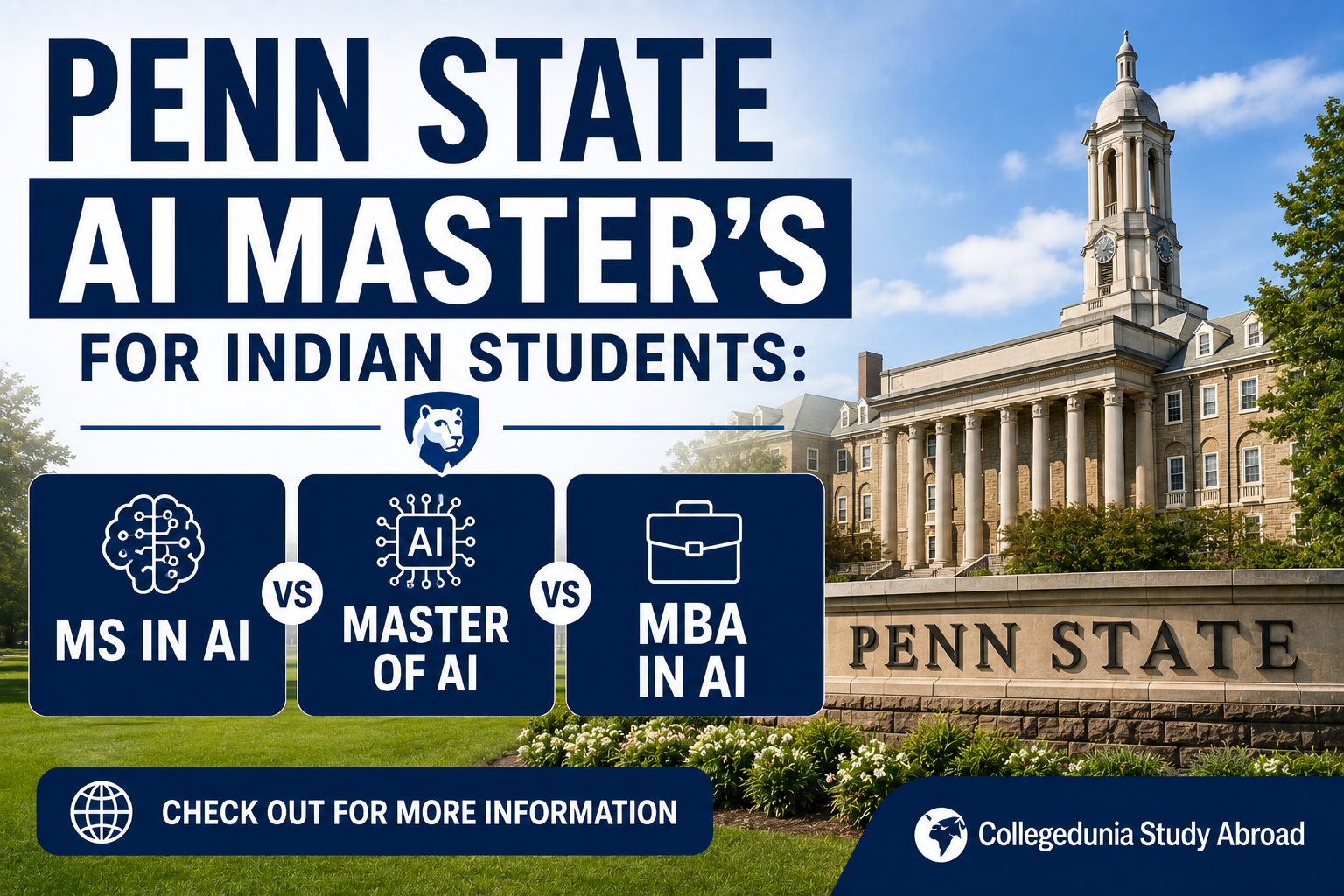
The Penn State AI Master’s for Indian Students comes in three flavours in 2026: a research-focused MS in Artificial Intelligence, a coding-heavy Master of Artificial Intelligence and a STEM-designated MBA in Artificial Intelligence. All three sit at Penn State Great Valley near Philadelphia. The Master of AI also runs fully online through Penn State World Campus.
- Pick the MS in AI if you want a research thesis and a PhD-ready profile.
- Pick the Master of AI if you want to build and ship AI systems as an engineer.
- Pick the MBA in AI if you want to lead AI teams, not code them.
- All three are STEM-designated, which unlocks up to 3 years of work rights in the US after graduation.
Penn State Great Valley is the only US university offering three separate AI master’s tracks under one roof from Fall 2026. That matters because most Indian applicants confuse the MS in AI with the Master of AI, and end up in the wrong classroom. This guide breaks down fees, admissions, career paths and STEM OPT reality so you pick the correct AI degree the first time.
| Parameter | Detail |
|---|---|
| Campus | Penn State Great Valley, Malvern (Philadelphia suburbs) |
| Programs on offer | MS AI (30 credits), Master of AI (33 credits), MBA in AI (33 credits) |
| Intake for international students | Fall only |
| Application deadline for F-1 applicants | April 30 |
| Out-of-state tuition (Fall 2026 / Spring 2027) | USD 2,032 per credit (around INR 1.94 lakh per credit) |
| Total tuition, MS in AI (30 credits) | Around USD 60,960 (INR 58 lakh) |
| Total tuition, Master of AI or MBA in AI (33 credits) | Around USD 67,056 (INR 64 lakh) |
| Master of AI online, World Campus rate | USD 1,078 per credit, roughly USD 35,574 total (INR 34 lakh) |
| STEM designation | Yes for all three, up to 3 years OPT |
| GRE or GMAT | Not required, considered if submitted |
| English test | TOEFL or IELTS required for Indian applicants |
Conversions based on a USD-INR rate of INR 95.68 as of August 18, 2026. Rates fluctuate; check the current rate before financial planning.
Also check,
- Pennsylvania State University Fees & Deadlines
- Penn State University Admissions 2027 for Indian Students
- MS in Artificial Intelligence in USA: Top Universities and Fees
- Top Artificial Intelligence Universities & Colleges in USA
Three Penn State AI Master’s Compared
The three Penn State AI Master’s programs solve three different career problems. The MS in AI is built for researchers. The Master of AI is built for engineers. The MBA in AI is built for future managers.
All three sit inside Penn State Great Valley, a graduate-only campus in Malvern that is 30 minutes from downtown Philadelphia. Great Valley launched the MS in AI in Fall 2026 to sit alongside its existing Master of AI and its newer MBA in AI. Here is how the three degrees stack up on the choices that actually matter to an Indian applicant.
| Feature | MS in AI | Master of AI | MBA in AI |
|---|---|---|---|
| Best for | Research roles, PhD | ML engineer, AI developer | AI product manager, consulting |
| Credits | 30 | 33 | 33 |
| Format | Hybrid on-campus | Hybrid or fully online | Hybrid on-campus |
| Thesis | Yes, two semesters | No, capstone project | No, capstone project |
| Coding depth | Deep, plus research methods | Deepest, production code | Moderate, tools not build |
| Business content | Minimal | Optional electives | Core business core |
| STEM OPT | Yes | Yes | Yes, unusual for an MBA |
| Total tuition | Around USD 60,960 | Around USD 67,056 hybrid, USD 35,574 online | Around USD 67,056 |
Note: If you get admitted to more than one of these, the choice is not about ranking. It is about the job title you want three years from now.
Read More: Undergraduate Courses in USA for Indian Students 2026
MS AI at Penn State Great Valley
The MS in Artificial Intelligence is Penn State Great Valley’s newest AI degree and it is aimed squarely at students who want to do research. It launches in Fall 2026 as a 30-credit hybrid programme.
Full-time students finish in two years. Part-time students finish in two and a half. The programme is STEM-designated, so Indian graduates on an F-1 visa can stay up to three years on OPT plus STEM OPT.
What the coursework covers
Core courses run through machine learning, deep learning, natural language processing, computer vision and reinforcement learning. Students also complete a two-semester thesis with a faculty advisor.
- Two specialisation options: AI Engineering for programmers who build these systems.
- Applied and Generative AI (offered online only) for business-focused use of low-code AI tools.
- Faculty-mentored original research in fields like healthcare, manufacturing and cybersecurity.
- Hybrid seven-week classes that alternate between in-person and online.
Who the MS AI is built for
Program leadership says the degree prepares students for research-intensive industry roles and doctoral study. That framing is important. This is not the fastest path to a coding job. Applicants need a bachelor’s degree in computer science, engineering or mathematics. Students from other backgrounds can apply if they have covered calculus, linear algebra, probability and two programming courses.
Master of AI Engineering Track
The Master of Artificial Intelligence is Penn State’s professional AI degree, and it is the most popular of the three with international students. It runs 33 credits and covers the same core AI stack, but skips the thesis in favour of a capstone project. You can take it two ways. The hybrid version runs at Great Valley in Malvern with a mix of in-person and online sessions. The fully online version runs through Penn State World Campus.
Two specialisation tracks
- AI Engineering: a coding-intensive path for people who want to design and ship production AI systems.
- Applied and Generative AI: a lighter-code path that focuses on using AI tools inside business teams.
Both tracks cover natural language processing, machine vision, deep learning, AI foundations and AI ethics. Both are STEM-designated.
Online vs on-campus for Indian students
Only the on-campus hybrid version works for F-1 visa students. The fully online World Campus version cannot support a student visa.
The online option becomes useful only if you are already in the US on another status, or you want to study while working in India. Online tuition is USD 1,078 per credit, roughly half the on-campus rate.
| Delivery mode | Total tuition | Visa-friendly? |
|---|---|---|
| Hybrid at Great Valley | Around USD 67,056 | Yes, meets F-1 rules |
| Fully online, World Campus | Around USD 35,574 | No, cannot back an F-1 visa |
What students actually say about Penn State World Campus: "The instructors are helpful and easy to contact and the assignments are challenging and engaging. The cohort model works well when you have work and family to juggle." (Paraphrased from Penn State World Campus student reviews on Niche.)
MBA in AI at Penn State Great Valley
The MBA in Artificial Intelligence is Penn State Great Valley’s newest business degree and one of the very few STEM-designated MBAs in the US that names AI in the title. It runs 33 credits, hybrid, and part-time students can finish in as little as 18 months.
Unlike the MS AI and Master of AI, this is a management degree first. You still take AI courses, but you also take core MBA subjects like finance, strategy, marketing and operations.
What makes this MBA different
Two things set it apart from a normal MBA. First, it is STEM-designated, so international students get the three-year OPT window instead of the standard one year. Second, its electives lean hard into machine learning, generative AI and AI product management.
- Business core: finance, accounting, marketing, operations and organisational behaviour.
- AI core: AI strategy, machine learning for managers and generative AI in business.
- Delivery: hybrid seven-week classes, meets F-1 visa requirements for international students.
Who should choose the MBA in AI
This is the right degree if you want to run AI teams, not write the code. Typical fits are:
- Engineers with three to five years of experience who want to move into product or consulting.
- Non-tech professionals moving into an AI-heavy industry like healthcare, finance or supply chain.
- Founders who want to build an AI-first company.
Penn State AI Master’s Total Cost
Total two-year cost of a Penn State AI Master’s for an Indian student on an F-1 visa lands between USD 96,000 and USD 115,000 (roughly INR 92 lakh to INR 110 lakh). That includes tuition, living costs, health insurance and fees.
The out-of-state tuition rate for the 2026-2027 academic year is USD 2,032 per credit. International students pay the out-of-state rate. Pennsylvania residents pay USD 1,207 per credit, but that rate does not apply to F-1 holders.
Tuition alone, by programme
| Programme | Credits | Total tuition (USD) | In INR |
|---|---|---|---|
| MS in AI | 30 | USD 60,960 | INR 58.3 lakh |
| Master of AI, hybrid | 33 | USD 67,056 | INR 64.2 lakh |
| MBA in AI | 33 | USD 67,056 | INR 64.2 lakh |
| Master of AI, online | 33 | USD 35,574 | INR 34.0 lakh |
Living costs in Malvern
Great Valley sits in the Philadelphia Main Line suburbs. Rents are lower than downtown Philadelphia but higher than State College. A shared apartment costs USD 600 to USD 800 per month.
- Rent: USD 600 to USD 800 per month for a shared apartment.
- Food and groceries: USD 300 to USD 400 per month.
- Transport: USD 100 to USD 150 per month with the SEPTA regional rail.
- Health insurance: around USD 2,500 to USD 3,000 per year, mandatory for F-1 students.
Total living costs work out to USD 18,000 to USD 24,000 per year (INR 17 lakh to INR 23 lakh). Over two years that is another INR 34 to 46 lakh on top of tuition.
Funding your Penn State AI Master’s
Full merit scholarships for MS students in the US are rare. Most Indian students fund the degree with a mix of an education loan and part-time on-campus work.
- Loans: HDFC Credila, SBI Global Ed-Vantage, Avanse and Prodigy Finance all fund Penn State degrees.
- Assistantships: Research assistant and teaching assistant roles waive part of tuition and add a stipend, but slots are limited.
- Fulbright-Nehru Master’s Fellowship: a fully-funded option for high-achieving Indian applicants.
- On-campus work: up to 20 hours per week during term, allowed on an F-1 visa.
Build a 5 to 8% currency buffer into your budget. The rupee has weakened against the dollar for most of the last decade.
Note: If total cost is your biggest constraint, the MS in AI saves you about USD 6,000 in tuition compared with the Master of AI or MBA in AI. That is a whole term of rent.
Applying to Penn State AI Master’s
Indian applicants for a Penn State AI Master’s must apply for Fall intake only, and the deadline is April 30 each year. Spring intake is not open to F-1 visa students at Great Valley. The admissions bar is realistic. There is no rigid cutoff, but the programme expects a junior and senior GPA of 3.0 out of 4.0 or higher, which maps to roughly 65 to 70% in an Indian degree.
Documents you need
- Bachelor’s degree in a related field (CS, engineering, math or a science background with prerequisites).
- Transcripts from every degree-granting institution.
- One-page statement of intent covering academic background, work experience and goals.
- Two letters of recommendation, usually one academic and one professional.
- TOEFL or IELTS score for English proficiency, mandatory for Indian applicants.
- Resume or CV listing internships, projects and any published work.
Tests and cutoffs
GRE and GMAT are not required for the MS in AI or Master of AI, and they are optional for the MBA in AI. Strong scores can help borderline files, so submit if you have a 320+ GRE or 700+ GMAT. For English, Penn State typically expects a TOEFL iBT score of 80 or higher and an IELTS score of 6.5 or higher, with no band under 6.0. Duolingo scores are accepted at many US universities, but confirm with the Great Valley admissions office before you rely on it.
| Requirement | Minimum expected |
|---|---|
| Undergraduate GPA | 3.0 out of 4.0 (approx. 65 to 70%) |
| TOEFL iBT | 80 or higher |
| IELTS | 6.5 or higher |
| GRE or GMAT | Not required, considered if submitted |
| Work experience | Preferred for MBA in AI, not required for MS or Master of AI |
Timeline for a Fall 2027 start
Applications open in September the year before. If you plan a Fall 2027 start, work backwards from April 30, 2027.
- September to December 2026: take TOEFL or IELTS, draft your statement of intent, request LORs.
- January to March 2027: submit online application, pay the fee, upload transcripts.
- April 30, 2027: final deadline for international applicants.
- May to June 2027: admission decisions and I-20 issued.
- June to July 2027: book an F-1 visa slot, pay the SEVIS fee.
- August 2027: orientation and classes start.
AI Master’s Jobs, OPT and H-1B
All three Penn State AI Master’s programmes are STEM-designated, which means an Indian graduate on an F-1 visa can work in the US for up to 3 years without an H-1B. That is 12 months of standard OPT plus a 24-month STEM OPT extension.
This three-year window is the single biggest reason Indian students pick a US AI master’s over similar programmes in the UK, Australia or Germany.
Roles Penn State AI graduates target
- Machine learning engineer: USD 130,000 to USD 190,000 median across the US, higher in San Francisco, New York and Seattle.
- Data scientist: USD 105,000 to USD 140,000 median, strong pipeline in healthcare and finance.
- AI product manager: USD 120,000 to USD 160,000 median, a common landing spot for MBA in AI graduates.
- Research scientist: USD 130,000 plus, typically at labs like Google, Meta or Amazon Science, best-fit for MS AI graduates.
Entry-level machine learning engineer salaries begin around USD 70,000 for fresh graduates without prior industry experience. Numbers scale sharply after the first year on the job.
OPT to H-1B, the honest picture
OPT and STEM OPT together give you a three-year runway to convert to a work visa. The main long-term option is H-1B, and the rules changed in early 2026.
From the FY 2027 cycle, the US uses a wage-weighted selection system instead of a random lottery. Higher-paid roles get more lottery entries. For entry-level roles the win rate has dropped from roughly 30% to roughly 15% per year.
- Higher-paid roles (Level III and Level IV) get more lottery entries.
- Three-year win rate for a typical Indian STEM master’s graduate is now around 66%.
- The new USD 100,000 annual fee per H-1B application may push smaller employers to skip sponsorship.
Note: Do not treat H-1B as automatic. Target E-Verify employers early, take internships that convert to full-time offers and look at Canada or the UK as a backup pathway if the lottery does not clear.
Also Check:
The right Penn State AI Master’s depends on the job you want, not the ranking. A research-bound student picks the MS in AI. An engineer picks the Master of AI. A future manager picks the MBA in AI. Total cost sits in a tight band across the three, and all three unlock the same three-year post-study work window. Apply by April 30, book your visa slot early, and plan a currency buffer of 5 to 8% into your two-year budget.
FAQs
Ques. Which Penn State AI Master’s is best for Indian students?
Ans. It depends on your target role. Pick the MS in AI for research and PhD paths. Pick the Master of AI for machine learning engineer roles. Pick the MBA in AI if you want to lead AI teams. All three are STEM-designated and unlock the same three-year OPT window.
Ques. What is the fee for a Penn State AI Master’s for Indian students?
Ans. Around USD 60,960 (INR 58 lakh) for the MS in AI and USD 67,056 (INR 64 lakh) for the Master of AI or MBA in AI. Add USD 36,000 to USD 48,000 for two years of living costs in Malvern.
Ques. Is Penn State’s MBA in AI STEM-designated?
Ans. Yes. The MBA in Artificial Intelligence at Penn State Great Valley is STEM-designated. That gives international graduates up to 3 years of OPT, not the standard 12 months. Very few MBA programmes in the US carry this benefit.
Ques. Is GRE required for a Penn State AI Master’s?
Ans. No. GRE and GMAT are not required for the MS in AI or Master of AI. They are optional for the MBA in AI. Submit only if your score is strong (GRE 320 plus, GMAT 700 plus) and your undergraduate GPA is below 3.0.
Ques. What is the deadline for Fall intake at Penn State Great Valley?
Ans. April 30 for international applicants on F-1 or J-1 visas. International students are admitted for Fall only. Spring and summer intakes are not open for new F-1 applicants.
Ques. Can Indian students do the Penn State Master of AI fully online?
Ans. Yes, through Penn State World Campus. Tuition drops to about USD 35,574 total. But the online version does not support an F-1 visa. It works only if you plan to study from India or you already hold another US immigration status.
Ques. What jobs do Penn State AI Master’s graduates get?
Ans. Common roles are machine learning engineer, data scientist, AI product manager and research scientist. Median salaries range from USD 105,000 for data scientists to USD 190,000 for senior ML engineers. Fresh graduates start at around USD 70,000 to USD 100,000.
Ques. Does Penn State Great Valley offer scholarships to Indian students?
Ans. Direct merit scholarships are limited. Most Indian students fund the degree with a mix of an education loan, assistantships and part-time on-campus work. The Fulbright-Nehru Master’s Fellowship is the strongest external option, but the selection bar is high.
Ques. How long is the STEM OPT for Penn State AI graduates?
Ans. Three years total. Twelve months of standard OPT plus a 24-month STEM OPT extension. Employers must be enrolled in E-Verify for the STEM extension. All three Penn State AI Master’s programmes are STEM-designated.
Ques. What are the English test cutoffs for Penn State AI Master’s?
Ans. Typical minimums are TOEFL iBT 80 and IELTS 6.5 with no band under 6.0. Some competitive programmes prefer TOEFL 100 or IELTS 7.0. Confirm the current cutoff on the Penn State Graduate School GCAC-305 page before you take the test.
Ques. Is the MS in AI at Penn State different from the Master of AI?
Ans. Yes, they are two separate degrees. The MS in AI is research-heavy with a two-semester thesis and prepares students for PhDs. The Master of AI is coding-heavy with a capstone project and prepares students for engineering jobs. Same faculty, different outcomes.
Ques. Which Indian city offers the best F-1 visa slots for August intake?
Ans. All five US consulates (Delhi, Mumbai, Chennai, Kolkata, Hyderabad) issue student visas. Slots open in June and fill within days. Book on the same day your I-20 arrives to avoid a Fall-intake delay.

interested in this College ?
Follow & Share this college to get information about admission.



Comments