




Master of Science [MS] (Plant Breeding)
Field of Study:
$20,800 /Yr

Cornell University Master of Science in Plant Breeding is a typically two to three-year, in-person research degree in Ithaca for bachelor’s-equivalent applicants with faculty encouragement. Fall 2027 tuition is unpublished; 2026-27 tuition was US$20,800 (INR 19.75 Lakhs), as a prior-cycle reference. The next regular intake is Fall 2027, while spring admission has no open call.
The thesis-based program develops crop improvement skills through field evaluation, genetics, genomics, data analysis and communication. It best fits applicants who can match a defined research question with a Cornell faculty adviser.
- Plant Breeding and Plant Genetics concentrations support applied crop improvement or molecular and computational research.
- Students can connect Ithaca laboratories and field facilities with Cornell AgriTech research in Geneva.
- The Graduate Record Examination is not required, so research evidence carries more value than an optional test score.
Current Admission Status
Applications for the Fall 2027 intake are Open. International student deadline: 1 December 2026.
Cornell publishes no cutoff time on its correction page, so Indian applicants should use 30 November 2026 as their personal submission date. M.S. consideration also requires prior faculty approval and encouragement.
Also Check: Cornell University graduate admission
Cornell MS Plant Breeding Fees and Living Costs 2027
Fall 2027 tuition remains unpublished after checks of Cornell’s program, Bursar, financial aid and funding pages. Verify the target fee on the official fee page.
Prior-cycle planning context: The figures below use Cornell’s 2026-27 statutory research master’s rate, while the application fee is the current published amount.
| Cost item | Official amount | INR equivalent | Applicant meaning |
|---|---|---|---|
| Statutory research M.S. tuition | US$20,800 per academic year | INR 19.75 Lakhs | Gross tuition before any assistantship or fellowship credit |
| Graduate application fee | US$105 | INR 9,969 | Paid when submitting unless Cornell approves a fee waiver |
| Funded M.S. package | Full tuition, individual health insurance and stipend | Value depends on the award | Competitive support must appear in the admission offer |
Source: Cornell Office of the Bursar 2026-27 rates and current School of Integrative Plant Science funding terms.
All INR conversions in the article use a conversion rate of US$1 = INR 94.94 as of 26 October 2026. Rates fluctuate daily, verify before applying.
The published gross rate matters mainly as a funding-risk ceiling because Cornell says funded Plant Breeding M.S. students do not pay tuition or individual health insurance. However, M.S. assistance is competitive, so applicants should not treat admission as proof of funding until the offer states the covered period.
Cost of Living in Ithaca for Plant Breeding Students
Cornell’s cached 2026-27 international graduate estimate combines living expenses at US$3,118 (INR 2.96 Lakhs) monthly. It is a student budget rather than the separate F-1 visa fee requirement.
| Expense period | US$ estimate | INR estimate |
|---|---|---|
| Combined living costs per month | US$3,118 | INR 2.96 Lakhs |
| Monthly total | US$3,118 | INR 2.96 Lakhs |
| Annual total | US$37,418 | INR 35.52 Lakhs |
The prior-cycle planning illustration is US$20,800 (INR 19.75 Lakhs) tuition plus US$37,418 (INR 35.52 Lakhs) living costs, equalling US$58,218 (INR 55.27 Lakhs). This calculated gross budget excludes unverified ancillary charges and should not be presented as Cornell’s Fall 2027 cost.
A funded offer can remove the gross tuition charge and add a stipend, which changes the cash requirement substantially. Compare the offer’s funding duration with the thesis timeline because the research M.S. usually lasts two to three years.
Read More: cost of studying in the USA
ROI reality: Funding status is the decisive cost variable because the field covers tuition and insurance for funded students, while an unfunded applicant faces the full gross budget.
Cornell MS Plant Breeding Admission 2027
Fall 2027 admission requires a bachelor’s degree equivalent to a U.S. bachelor’s, three academic recommendations and prior encouragement from a Plant Breeding faculty member. Cornell publishes no minimum GPA for this M.S.
Academic Eligibility and Research Fit
Cornell evaluates international credentials centrally and makes the final equivalency decision. Since the field sets no numeric grade threshold, converting eligibility into an Indian percentage or ten-point CGPA would create an unsupported requirement.
| Admission factor | Published requirement | Meaning for Indian applicants |
|---|---|---|
| Prior degree | U.S. bachelor’s degree or international equivalent | A recognized Indian bachelor’s can qualify, subject to Cornell’s credential review |
| Grade threshold | No minimum GPA published | Use transcripts to show strength in genetics, plant science, statistics and research methods |
| M.S. faculty support | Prior approval and encouragement from a field faculty member | Secure research alignment before paying the application fee |
| Recommendations | Three academic recommendations | Choose faculty who can evaluate independent research potential |
| Graduate Record Examination | Not required | Do not submit a score as a substitute for research evidence |
The field reviews applications holistically for the applicant’s proposed contribution, preparation and program fit. A strong file should therefore connect previous crop, genetics or quantitative work to one adviser, one crop system and a feasible thesis question.
English Language Proficiency
Fall 2027 score requirements are unpublished after a successful check of Cornell’s current English page. Applicants should verify the target policy on the official English requirement page.
Prior-cycle reference: Cornell states that these 2026-27 research-degree scores may change for future terms. IELTS means International English Language Testing System, while TOEFL iBT means Test of English as a Foreign Language Internet-Based Test.
| Route | Tier A | Tier B |
|---|---|---|
| IELTS Academic | Overall 7.0 with speaking 8.0 | Overall 7.0 |
| TOEFL iBT before 21 January 2026 | Speaking 27, reading 20, listening 15, writing 20 | Speaking 22, reading 20, listening 15, writing 20 |
| TOEFL iBT from 21 January 2026 | Speaking 5.5, reading 4, listening 3.5, writing 4 | Speaking 4, reading 4, listening 3.5, writing 4 |
| Standing exemption | English-medium bachelor’s equivalent completed mainly in India can qualify | |
- Applicants using the India exemption should ensure their transcript or university website clearly confirms English as the medium of instruction.
- Tier B permits admission but requires an English assessment and support plan before a teaching assistant appointment.
- Pearson Test of English is not listed, so applicants needing a test should prepare IELTS Academic or TOEFL iBT.
The revised TOEFL scale is reproduced exactly from Cornell’s current page without self-conversion. Because its published scores remain labelled 2026-27, confirm the Fall 2027 policy before booking or sending results.
Check Out: Cornell University graduate programs
Tip for Indian students: Faculty alignment is the admission gate for this M.S., so a targeted research conversation should precede the formal application.
Cornell MS Plant Breeding Application 2027
The Fall 2027 application deadline is 1 December 2026, and the ApplyWeb system is open. Cornell’s cycle-specific correction supersedes older November dates still visible on program and catalog pages.
Target-cycle schedule: Cornell publishes one regular Fall intake for this field. Spring has no open call, although exceptional fully funded candidates with an adviser may receive permission.
| Stage | Published Fall 2027 position | Indian applicant action |
|---|---|---|
| Faculty alignment | M.S. applicants need prior faculty approval and encouragement | Discuss a feasible thesis question before submitting |
| Application and funding consideration | 1 December 2026 | Use 30 November 2026 IST as a personal completion date |
| Field review | Holistic assessment of preparation, purpose and program fit | Make research methods and adviser fit explicit across the file |
| Decision communication | Sent directly by the Plant Breeding field | Monitor ApplyWeb and the email used in the application |
The field publishes no Fall 2027 interview schedule or decision date, so neither should be assumed. Applicants can verify the controlling date on Cornell’s current deadline correction page.
Application File Strategy
A complete file includes unofficial transcripts, an academic statement of purpose, a personal statement, three academic recommendations and English proof or exemption. The US$105 application fee (INR 9,969) is paid at submission unless Cornell grants a waiver.
- Name a faculty member whose crop system, breeding method or genomics work directly supports the proposed thesis question.
- Use the academic statement to connect prior field, laboratory or quantitative methods with the intended concentration and adviser.
- Ask recommenders to evaluate research independence, data handling and persistence rather than repeating transcript grades.
- Request a fee waiver at least three business days before Cornell’s deadline because payment or waiver submission locks the application.
The personal statement should complement rather than duplicate the research-focused academic statement. Since M.S. admission is faculty-dependent, a generic crop-improvement narrative leaves the committee without evidence that the proposed project is workable at Cornell.
Deadline interpretation
Cornell publishes no portal cutoff time or timezone for this corrected date, so an exact IST conversion is not possible. Completing the file on 30 November 2026 avoids relying on an unstated portal hour.
Application tip: Submit only after faculty encouragement, then make every document support the same adviser, crop system and thesis direction.
Cornell MS Plant Breeding Scholarships 2027
Funding is competitive for M.S. students, but a funded Plant Breeding offer includes tuition, individual health insurance and a stipend. Applicants must submit by 1 December 2026 for field funding consideration.
The table separates program funding from named fellowships because each route has different selection mechanics. A live award without a named 2027-28 cycle is labelled current published rather than target-cycle confirmed.
| Funding route | Published value | Eligibility and route | Published timing |
|---|---|---|---|
| SIPS funded M.S. support | Tuition, stipend and individual health insurance | Competitive Plant Breeding admission funding, recorded in the offer | Apply by 1 December 2026 |
| Denison Graduate Fellowship | One year of full twelve-month funding plus at least one further M.S. funding year | One incoming SIPS M.S., M.S./Ph.D. or Ph.D. student is nominated by field leadership | Current schedule: nomination by 28 February and decision by 15 March |
| Cornell Fellowship | One semester or one academic year of tuition, stipend and individual health insurance | International applicants can be considered through the admission application without a separate fellowship form | Current published award; target cycle not named |
| Graduate research or teaching assistantship | Full research-degree tuition credit, stipend and individual health insurance | Assigned by the field, department or principal investigator without a separate application | Terms appear in the appointment or admission offer |
| Quad Fellowship | US$40,000 (INR 37.98 Lakhs) one-time award | Indian citizens entering or enrolled in an eligible U.S. STEM master’s can apply directly | 1 March 2027 |
The Quad Fellowship’s US$40,000 award equals INR 37.98 Lakhs at the article’s exchange rate, but applicants must confirm that their degree meets Quad’s current field list. It can supplement other grants, so it should not replace the request for Cornell funding.
- Ask whether the offer guarantees academic-year and summer support across the expected two to three-year thesis period.
- Confirm whether the appointment is a graduate research assistantship, teaching assistantship or fellowship because service duties and summer payments differ.
- Treat the scholarship package as confirmed only when the written offer states tuition credit, health coverage, stipend amount and duration.
Denison needs no student application because each School of Integrative Plant Science field nominates one candidate. By contrast, the Quad Fellowship requires a separate application and should be prepared independently from Cornell’s admission file.
Read More: Cornell University scholarship options
Funding limit
Cornell has not published Fall 2027 stipend rates, so prior-year stipends are not used to estimate target-cycle cash support. Require the offer letter to state the actual amount.
Scholarship reality: A funded offer can remove tuition risk, but M.S. support is competitive and only the written duration protects the full thesis timeline.
Cornell MS Plant Breeding Salary 2027
Cornell publishes no Plant Breeding M.S. salary or offer rate on the checked program and outcomes surfaces. The figures below are external U.S. labor-market benchmarks, not Cornell graduate outcomes.
May 2025 benchmark context: The U.S. Bureau of Labor Statistics reports national occupation and industry medians for agricultural scientists. These medians cover workers at different experience levels.
| Evidence scope | Measure | Annual US$ | INR equivalent |
|---|---|---|---|
| External U.S. occupation benchmark | Soil and plant scientists median | US$78,850 | INR 74.86 Lakhs |
| External U.S. occupation benchmark | Agricultural and food scientists median | US$81,970 | INR 77.82 Lakhs |
| External U.S. industry benchmark | Research and development median | US$93,950 | INR 89.20 Lakhs |
| External U.S. industry benchmark | State colleges and universities median | US$66,100 | INR 62.76 Lakhs |
Source: U.S. Bureau of Labor Statistics Occupational Outlook Handbook, May 2025 wage data.
The field names careers in industry, research, agricultural extension, international programs and the public sector. However, the BLS medians do not establish a starting salary, employer demand or placement probability for Cornell graduates.
Research Value and Financial Tradeoff
The M.S. earns value through a thesis, adviser-led research and methods spanning field trials, genetics, genomics and data analysis. That structure suits applicants pursuing research roles or later doctoral study, but it is less suitable for someone seeking a fixed coursework timetable.
- A funded offer reduces the largest academic cost, so verify the support period before assessing the degree’s research value.
- For United States employment, match the thesis methods to soil, plant or agricultural scientist roles rather than treating a national median as an offer forecast.
- For an India return, compare the research portfolio with local seed, public research and agricultural biotechnology roles without converting United States wages into expected Indian pay.
- For doctoral study, prioritise publication potential, methods training and adviser fit because the master’s requires a fresh doctoral application at Cornell.
Actual take-home pay varies with location, filing status and deductions, so use the IRS tax withholding estimator after receiving a U.S. offer. No payback period is calculated because Cornell course-specific salaries and Fall 2027 funding amounts are unpublished.
Honest take: The degree’s financial case rests on funded research training, not a published placement rate or salary promise.
USA Visa for Cornell MS Plant Breeding Students 2027
Admitted Indian students normally use the F-1 student visa, with a US$185 (INR 17,564) visa fee and US$350 (INR 33,229) SEVIS I-901 fee. SEVIS means Student and Exchange Visitor Information System, and the combined fee outlay is US$535 (INR 50,793).
- Optional Practical Training permits up to 12 months of related work, while CIP 01.1104 supports a conditional 24-month Science, Technology, Engineering and Mathematics extension.
- The STEM extension requires the degree code on the Form I-20, an E-Verify employer and an approved training plan.
- H-1B sponsorship has no single course-specific salary threshold because the employer must meet the applicable actual or prevailing wage.
- An F-2 spouse or unmarried minor child may accompany the student but cannot work, and the degree creates no automatic permanent-residence timeline.
Read More: U.S. student visa requirements
Visa reality: The STEM code can extend related work authorization to 36 months, but employer eligibility and the I-20 classification still control the extension.
Cornell MS Plant Breeding Ranking 2027
Cornell ranks fourth globally for Agriculture and Forestry in the QS World University Rankings by Subject 2026. The position improved from fifth in the same 2025 table.
Subject-ranking context: QS evaluates the wider Agriculture and Forestry discipline rather than Cornell’s Plant Breeding M.S. alone.
| QS edition | Ranking scope | Cornell position | Overall score |
|---|---|---|---|
| 2026 | Agriculture and Forestry | 4 | 86.2 |
| 2025 | Agriculture and Forestry | 5 | 83.8 |
The subject rank supports Cornell’s research environment across agriculture, but it does not measure M.S. admission odds, adviser availability or graduate salary. Use it after confirming a faculty match rather than as a substitute for project fit.
Check Out: Cornell University rankings
Key insight: The fourth-place subject position signals broad agricultural research strength, while the applicant’s adviser and thesis match determine this program’s practical value.
Cornell’s Plant Breeding M.S. fits applicants with a defined crop-improvement question and preparation for adviser-led thesis research. Its field, laboratory and computational scope supports applied breeding or plant genetics pathways. The material tradeoff is faculty-dependent admission combined with competitive funding rather than an assured package. Before 1 December 2026, secure faculty encouragement and obtain written clarity on support duration.
Cornell MS Plant Breeding FAQs
Ques. Is the Cornell Plant Breeding M.S. fully funded for Indian students?
Ans. Funding is competitive rather than automatic. A funded offer includes tuition, individual health insurance and a stipend, so verify the amount and duration in writing.
Ques. How competitive is admission to Cornell’s Plant Breeding M.S.?
Ans. Cornell publishes no M.S. admit rate for this field. Prior faculty encouragement, three academic recommendations and a coherent thesis fit matter more than the unrequired Graduate Record Examination.
Ques. What is a realistic Fall 2027 cost for Cornell Plant Breeding?
Ans. Fall 2027 tuition is unpublished. The 2026-27 gross prior-cycle planning illustration was US$58,218 (INR 55.27 Lakhs) for tuition and living costs before funding.
Ques. When should an Indian applicant contact Cornell Plant Breeding faculty?
Ans. Contact faculty before submitting because M.S. consideration requires prior encouragement. Use 30 November 2026 IST as a personal completion date ahead of Cornell’s 1 December deadline.
Ques. Does Cornell Plant Breeding qualify for STEM OPT and guarantee a U.S. job?
Ans. CIP 01.1104 appears on the STEM list, supporting 12 months of OPT plus a conditional 24-month extension. It does not guarantee employment or a salary.
Important Alert
- Application Deadline For Fall 2027 Intake - Nov 15, 2026
Tuition Fees
| Year | 1st Year Fees |
|---|---|
| Tuition Fees | $20800 |
Other Expenses
| Head | Avg Cost Per Year |
|---|---|
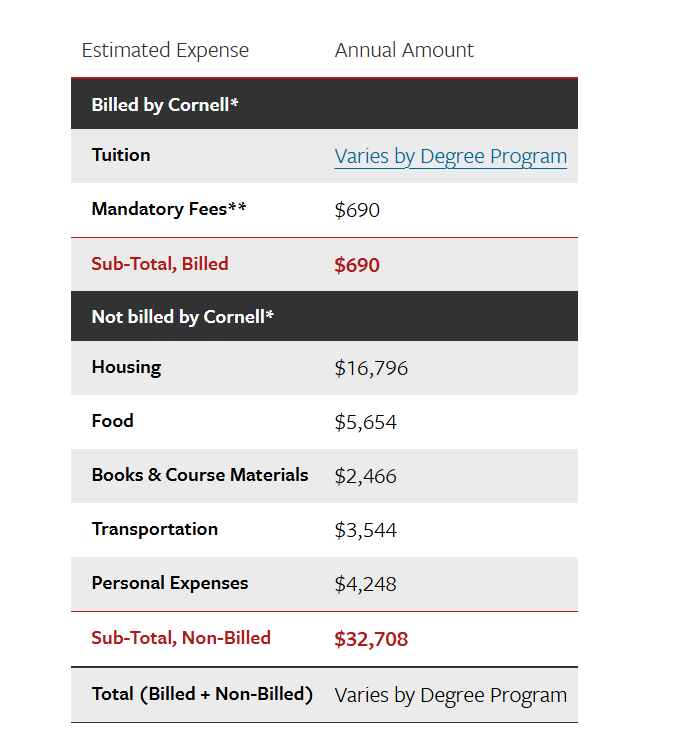
| Housing | $16796 |
| Food | $5654 |
Previous Year Tuition Fees
| Year | 1st Year Fees |
|---|---|
| 2024 | $68380 |
Important Dates
Applicants may be considered for the M.S. degree or for spring admission, but only with prior approval and encouragement from a faculty member in the field.
| Event | Application Date |
|---|---|
| Application Deadline For Fall 2027 Intake | Nov 15, 2026 |
Required Document List
Complete Application
Application Fee
Official Transcripts
English Language Requirements
Documentation of Financial Support
Three Recommendation Letter

Do you think the Rankings are wrong ? Report Here
Key Resources for Your Study Abroad Journey


Course Guides
Best MS Courses in USA for International Students in 2025
Masters (MS) in USA: Colleges, Courses, Deadlines, Eligibility & Fees
MS in USA With Low GPA: Universities, Requirements, and Admissions
Options Available
| Program | Delivery Type | Duration | Program Type | Tuition Fees |
| M.S Plant Pathology | full time | 2 years | on-campus | $23956 |
Scholarship Grants & Financial Aids
| Name | Scholarship Per Student | Level of Study | Type | |
|---|---|---|---|---|
| Comindware Scholarship | Scholarship per student$ 4,000/Yr$4,000 | Level Of StudyApprenticeship | TypeMerit-Based | |
| Forktip Women’s- Innovation Scholarship | Scholarship per studentVariable Amount | Level Of StudyBachelor | TypeCollege-Specific | |
| FINCAD Women in Finance Scholarship | Scholarship per student$ 20,000/Yr$20,000 | Level Of StudyMaster | TypeMerit-Based | |
| Ritchie-Jennings Memorial Scholarship Program | Scholarship per student$ 10,000/Yr$10,000 | Level Of StudyBachelor | TypeMerit-Based | |
| Axol Science Scholarship | Scholarship per student$ 2,000/Yr$2,000 | Level Of StudyBachelor | TypeCompany-Sponsored | |
| VueVille Future Technology Scholarship | Scholarship per student$ 1,000/Yr$1,000 | Level Of StudyBachelor | TypeMerit-Based |
Similar Programs
| Program | Important Date | Total Fees | Median Exams Score | Action |
|---|---|---|---|---|
-- | USD 64,665 /Yr | |||
Application Deadline For Fall 2027 Intake (15th Nov 2026) | USD 20,800 /Yr |
| ||
-- | USD 106,550 /Yr |


Do you think the Dates are wrong ? Report Here

interested in this College ?
Follow & Share this college to get information about admission.



Comments