



Education Journalist | Study Abroad Lead
Pollination is the natural process where pollen grains are transferred from another (male reproductive part) to the stigma (female reproductive part) of the flower with the help of wind, birds, insects, etc. It is a method of sexual reproduction between plants. There are several types of pollination - self-pollination, cross-pollination, insect pollination, and wind pollination. The process initiates fertilization by transferring the genetic information of spermatophytes (seed plants) to the succeeding generation.
Read also: Pollination by Water
| Table of Content |
Key Terms: Pollination, insect-pollinated flowers, wind-pollinated flowers, self-pollination, cross-pollination, Pollen grains, sexual reproduction, spermatophytes, catkins, dandelion flowers
Wind Pollinated Flowers
[Click Here for Sample Questions]
The flowers which reproduce through the transfer of pollen grains from the anther to the stigma with the help of wind as an agent are known as wind-pollinated flowers. The pollen grains get dusted only when the flowers become mature. Flowers such as common catkins, dandelion flowers, dioecious pussy willow go through pollination when the pollen grains fall in the stigma of other flowers.

Wind Pollinated Flowers
Read also: Artificial Pollination
Insect Pollinated Flowers
[Click Here for Sample Questions]
The flowers reproduce through the transfer of pollen grains from the anther of one flower to the stigma of another flower with the help of insects, birds, and animals as agents. Some of the common insect-pollinated flowers are sunflower, buddleja, and orchid.
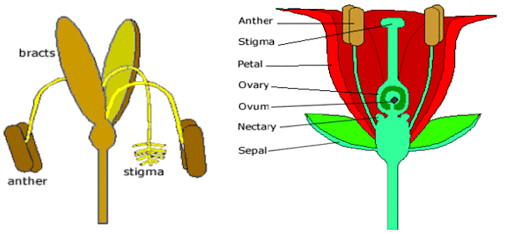
Insect Pollinated Flowers
Figure: Artificial Pollination
Read More:
| Related Topics to Pollination | ||
|---|---|---|
| Pollination by Insects | Double Fertilization in Angiosperms | Gemmule |
| Apomixis | Binary fission | Reproduction in animals |
Difference Between Insect-pollinated and Wind-pollinated Flowers
[Click Here for Sample Questions]
Differences between Insect-pollinated and Wind-pollinated flowers are tabulated below:
| Wind Pollinated Flowers | Insect Pollinated Flowers |
|---|---|
| The process of pollination with the help of wind | the process of pollination with the help of an insect |
| Consists of light-colored petals without any pleasurable strong smell | Attractive appearance with bright colored petals and strong, pleasant smell |
| The lightweight of the pollen grains are easily carried by the wind | Large and sticky pollen grains stick to the insects and get easily carried away. |
| Bears unisexual flowers | Bears bisexual flowers |
| Wastage of pollen grains because of its huge production and lightweight | Less wastage of pollen grains because of its limited production |
| Nectar is not produced | Nectar is produced |
| Filaments are long and slender | Filaments are short and strong |
| These flowers have anthers that give support to the flower from outside | The anthers in these flowers are situated deep inside the flowers |
| The long stamen of these flowers are visible out of petals | The small stamens are not visible out of the petals |
| The stigma of these flowers are feathery and it hangs out | The stigma of the flowers are small and found inside the petals |
Things to Remember
- Pollination which occurs when the pollen grains are directly transferred from the anther to the stigma of the same flower is known as self-pollination.
- Cross-pollination is the pollination that occurs due to the transfer of pollen grains from the anther to the stigma of another flower.
- Self-pollination is considered the primary type of pollination and cross-pollination is a complex type of pollination.
- Pollinating agents are classified as- biotic (animals) and abiotic agents (wind and water).
- Polyembryony is the process in which angiosperms produce more than one embryo in their seeds.
- The male reproductive organ in a flower is the androecium which consists of the stamens whereas the female reproductive organ is the gynoecium which consists of the pistils.
- Insect pollinated flowers are generally attractive in their appearance with their size, color, fragrance, and richness in nectar.
Read More:
| Related Articles | ||
|---|---|---|
| Pistil | Monocot dicot plants anatomy | Controlled Pollination |
| Sporulation | Budding | Oestrus Cycle |
Sample Questions
Ques. What are pollen grains? (2 Marks)
Ans. Pollen grains are essential sexual parts of reproduction in flowers. A mature pollen grain contains two kinds of cells- the vegetative cell and the generative cells. Pollen grains cause severe allergies and chronic respiratory disorders such as bronchitis, asthma, etc. because of their rich nutritive value, pollen tablets are used as supplements. They are generally spherical in shape with a diameter of 25-50 micrometers. It has two layers as exine and intine.
Ques. What does the gynoecium consist of? (3 Marks)
Ans. Gynoecium is the female reproductive part of a plant which consists of:
- Single pistil which is known as monocarpellary or more than one pistil which is known as multicarpellary.
- Fused pistil which is known as syncarpous or free pistle which is known as apocarpous
- Each pistil have stigma, style, and ovary
- The ovary consists of the ovarian cavity or locule.
- The ovarian cavity consists of the placenta
- The placenta gives rise to megasporangia or ovules.
Ques. What is double fertilization? (3 Marks)
Ans. Two male gametes are released by a pollen tube inside the embryo sac in an angiospermic plant. The process of syngamy takes place where a zygote is formed by the fusion of one male gamete and the egg.
Triple fusion is the process where a male gamete fuses with the secondary nucleus to form the primary endosperm nucleus. The whole process is known as double fusion as there are two fusions (syngamy and triple fusion) that occur inside an ovule during fertilization.
Ques. Name the two devices by which autogamy can be avoided in flowering plants. (2 Marks)
Ans. The devices which prevent autogamy in plants are:
(i) to restrict the falling of the pollen grain of the same flower on the stigma, the anther and stigma are arranged in such an order.
(ii) through the genetic process of self-incompatibility, germination is avoided
Ques. What is xenogamy or allogamy? (1 Mark)
Ans. It is the type of pollination that happens in which the pollen grains of different species fall on the stigma. Examples are spinach, broccoli, onions, and squash. It is fertilized through cross-pollination.
Ques. What are the different devices that encourage cross-pollination? (2 Marks)
Ans. Methods that encourage cross-pollination are:
- Unisexual flowers are produced as it will prevent geitonogamy and autogamy. They have male and female parts on different parts or different flowers in the same plant.
- The process of self-incompatibility is a genetic mechanism to restrict pollen from fertilizing ovules of the same flower by restraining their germination on stigma or pistil.
- The response of stigma and the release of pollen grains do not happen at the same time to avoid self-pollination.
Ques. What is pollen-pistil interaction? (2 Marks)
Ans. The step-by-step process of a group of events from falling of pollen over stigma to the formation of the pollen tube and its entry into the ovule. The chemical components of the pollen grains interact with the pistil in order to accept or reject the pollen grains.
For Latest Updates on Upcoming Board Exams, Click Here:https://t.me/class_10_12_board_updates
Do Check Out:



Comments