



Content Curator
Controlled pollination is a process of plant hybridization generally used in horticulture and genetic experiments. Traditional plant breeding programmes require the involvement of the human hand to promote the reproductive process in plants. This can be achieved by controlled pollination. In this process, the pistillate flowers are wrapped in a transparent bag to safeguard them from undesired pollen grains. When these flowers are ready, they are brushed or dusted with the selected pollen to achieve the desired characteristics.
| Table of Content |
Key Takeaways: Pollination, Plant Breeding, Artificial Hybridization, Emasculation, Bagging and Tagging
What is Pollination?
[Click Here for Sample Questions]
Pollination is the process through which pollen from the anther gets transferred to the stigma of a plant. It performs an important part in the sexual reproduction of plants. Pollination is beneficial not only to plants but to the human race as well by bestowing on us a variety of fruits to eat and flowers to use for various purposes.
Pollination happens in two ways:
- Cross-pollination: Cross-pollination is when the pollen of one plant is made to fertilize with another variety. The two plants are usually within the same species. This integration yields a new variety that has the characteristics of both varieties. Insects and wind help cross-pollination to happen. It can also be done manually to achieve the desired traits in plants.
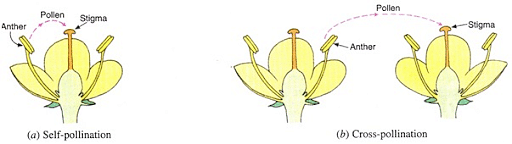
- Self-pollination: Self-pollination happens when the transfer of pollen takes place within the same flower, from the anther to the stigma. This form of pollination mostly happens in plants that are hermaphrodite meaning that they consist of male and female sexual parts in their flower.
Successful fertilization and production of seeds take place when the pollen of a particular flower is compatible with the stigma of another. If they don’t match, the stigma rejects the pollen and fertilization is unable to take place which can hamper crop production. As a result, Artificial Hybridization was introduced to overcome this problem.
Artificial Hybridization
[Click Here for Previous Years Questions]
Artificial hybridization is a method to enhance crop production. In this method, great care is taken to ensure that the desired pollen grains are used for pollination and that the stigma is secured from unwanted pollen.
Artificial hybridization is one of the most important techniques to improve crop yield. It results in the accomplishment of the best product from the two combined species. The crop that is produced as a result of artificial hybridization possesses many qualities like stress and disease resistance.
Read More: Reproduction in Plants
Artificial hybridization can be achieved by using the following two techniques:
Emasculation
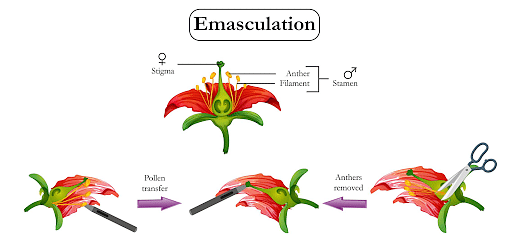
Hybridization in plants is done by selecting two genetically unrelated parents and cross-breeding them which gives birth to a hybrid. The first step in this procedure is Emasculation which involves the extraction of anthers from the female parent plant in bisexual flowers. This step is carried out much before the anther gets matured. Emasculation prevents the flower from getting self-pollinated. Anthers are not removed if the flower is unisexual.
Bagging
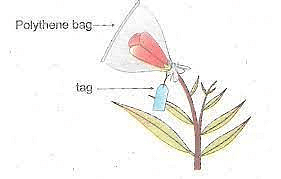
Bagging is the technique that is followed after the emasculation of a flower is completed. Till the period the emasculated flower opens (anthesis), the stigma needs to be protected from any unwanted pollination before the desired pollen is dusted onto it to achieve the desired result. This is done by covering the flower with a transparent bag immediately after emasculation is done. The bag protects the flower from coming in contact with any undesirable pollen. It covers the shoot’s tip and is held in place by securing it tightly with a rubber band or string.
The next step is to dust the desired pollen grains on the stigma of the emasculated flower. Once this is done, the flower is repacked with the bag along with relevant details. This is known as tagging.
Artificial hybridization guarantees that the most suitable pollen is fused with the flower’s stigma. Through this method, we can successfully achieve a great variety and better quality of crops with desirable characteristics.
Read Also:
Experiment for Controlled Pollination
[Click Here for Sample Questions]
Aim of the experiment: To perform artificial hybridization through controlled pollination by using the techniques of emasculation, bagging and tagging.
Materials Required:
- Plants with large bisexual flowers
- Tweezers
- Scissors
- Brush
- Alcohol
- Rubber bands
- Paper bags
- Paper clips
- Tags
- Magnifying Glass
Theory:
Emasculation is a process of artificial hybridization in which the anthers (the part of the stamen that makes and holds pollen) are removed from bisexual flowers in such a manner that the pistil (female reproductive part) remains unaffected. Emasculation is performed much before the anthers grow fully. This is done to prevent the flower from self-pollination and to make certain that it gets fertilized by the desired pollen grains collected from ideal varieties. The emasculated flower is then covered up with an appropriately sized paper bag to prevent any fertilization with unwanted pollen grains.
Read More: Cross Pollination
Bagging protects the flower from pollinating agents like insects and wind and helps to achieve the production of plants and flowers with the best characteristics.
The emasculated flower is then dusted with the selected and desired pollen grain and bagged again. A tag is put up on the flower with important details like the date of emasculation, date of fertilization, and names of the father and mother plant’s variety. This is known as tagging.
Read More: gametes
Procedure to perform the experiment:
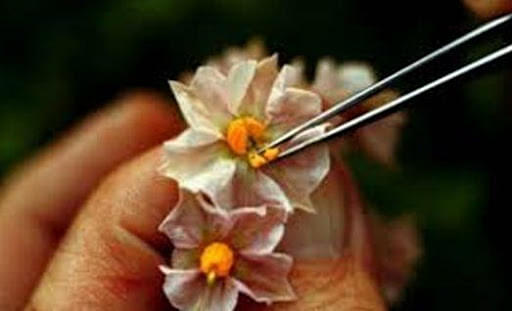
- Take a flower bud, open it carefully and pluck the stamens with the help of a tweezer. Select a bud whose anthers have not yet matured. This is known as the process of emasculation. Label it as the female parent plant and remove the stamens with care.
- Take a paper/plastic bag and wrap it on the emasculated flower. This is done to safeguard the plant from coming in contact with undesired pollen grains. This is called bagging. Certain things should be kept in mind during bagging- the bag should be transparent with tiny holes in it and its size should be according to the size of the selected flower. The holes in the bag help the flower breathe and aid in photosynthesis. The bag should be firmly held in place by tying a string or rubber band tightly around it which will not let it loose
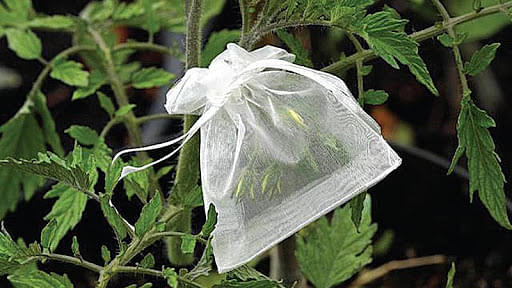
- Now take the plucked anthers of the desired male parent plant which consists of matured pollen. Bring them in contact with the stigma of the emasculated flower by dusting the pollen on the stigmatic surface with the help of a brush or tweezer.
- Wrap up the pollinated flower once again with the bag immediately thereafter. Mark the female parent plant so that it is easy to recognize and remember it. Each pollinated flower must be tagged with details such as the name of the seed parent, the name of the pollen parent and the date of when crossing took place.
Read More: Insect Pollinated and Wind Pollinated Flowers
Things to Remember
[Click Here for Previous Years Questions]
- Artificial Hybridization is a method through which successful pollination and fertilization take place by using selected pollen grains.
- The pollen should match with the stigma for cross-pollination to take place.
- Emasculation is the process of removing the anthers of a female flower. The anthers should be picked up before they mature.
- Emasculation is required only in bisexual flowers. There is no need to emasculate unisexual flowers.
- Pollination is divided into two categories- Cross-pollination and self-pollination.
Read More: Reproduction in organisms mcq
Previous Years Questions
- Meiosis takes place in...[NEET 2013]
- The sexual reproduction is absent in….[NEET 1995]
- For union between stock and scion in grafting which one is the first to occur….[NEET 1990]
- Which one of the following plants reproduces vegetatively by epiphyllous buds?
- Vegetative propagation in mint occurs by…
- Hydra reproduces by budding. This is an example of...
- A clone is ......… [KCET 2011]
- Animals which possess cleidoic eggs exhibit….[KCET 2011]
- Which among these is not a post fertilization event ?...[KCET 2016]
- Type of asexual reproduction found in Hydra is..[KEAM]
- Which of the following is having longitudinal binary fission ?….[KEAM]
- In grafting, the stock and scion should be joined….
- Banana is vegetatively propagated by… [AMUEEE 2012]
- Vegetative propagation by leaves is seen in… [JKCET 2010]
- Vegetative propagation in water hyacinth takes place by...[AMUEEE 2013]
- A slender, prostrate subaerial branch of the stem which creeps along….
Sample Questions
Ques. State the advantages of cross-pollination. (3 Marks)
Ans. The advantages of cross-pollination are:
- The offspring that are produced are healthier as the flaws of the original species are eliminated and restored with better characteristics.
- Many new varieties can be created by cross-pollinating two different species or two different varieties of the same species.
- The seeds produced through cross-pollination are plentiful and of good quality.
Ques. Enumerate the disadvantages of cross-pollination. (3 Marks)
Ans. Following are the disadvantages of cross-pollination:
- Cross-pollination may not always be possible since there is always a need for a pollinating agent, whose availability cannot be made certain at the right time
- Abundant pollen grains have to be produced to make certain that pollination takes place, because of which a lot of pollen is wasted.
- The resultant flower may possess some undesirable characteristics.
Ques. What is Emasculation? (2 Marks)
Ans. The process in which the anthers from bisexual flowers are removed in such a manner that the pistil remains unaffected is called emasculation. It is employed in many plant hybridization techniques.
Ques. What is the purpose of using the technique of emasculation while plant breeding? (3 Marks)
Ans. Plant breeders use this technique in bisexual flowers to procure the desired variety of a plant by crossing a selected plant with the desired pollen of another flower. The anthers are removed and then the flower is covered with a bag before it blooms to make certain that it is protected from all external pollination. This is done to ensure that pollination is done with the pollen procured from desirable varieties. Afterwards, the matured and usable pollen grains are brushed on the bagged stigma. This is performed by the breeders to permit artificial pollination to occur and to procure the desired variety of plants.
Ques. Describe pollen-pistil interaction. How is it brought into effect? (3 Marks)
Ans. Pollen-pistil interaction is the series of events starting from the first stage of pollination to the development of the pollen tube till the last stage when it enters the ovule. At the time of this interaction, the stigma either accepts or rejects the dusted pollen grains, which happens by the interaction of the chemical components present in the pollen grains with that of the pistil.
Ques. What do you understand by double fertilization? (5 Marks)
Ans. Double fertilization is a mechanism of fertilization in flowering plants (angiosperms). It takes place in the following sequence:
(i) Two male gametes are released by the pollen tube into the embryo sac.
(ii) A zygote is formed by the fusion of one of the male gametes with the egg. This process is termed syngamy.
(iii) The other one combines with the two polar nuclei that make the endosperm. This is called triple fusion.
(iv) When these two fusions (syngamy and triple fusion) occur inside an ovule during fertilization, it is called double fertilization.
Ques. Would you perform emasculation in a cucurbit plant? Give reasons. (3 Marks)
Ans. As a cucurbit plant has unisexual flowers, emasculation will not be required in the same. Emasculation is needed only in bisexual flowers to protect them from self-pollination. In a cucurbit plant, only unisexual flowers are produced by the female plant, in which only one gamete is produced. Therefore, emasculation is not needed to prevent self-pollination.
Do Check Out:



Comments