



Education Journalist | Study Abroad Lead
SI Units in Physics (International System Of Units) is a metric system used as a measurement standard. SI Units include 7 Base Units used for defining 22 Derived Units. SI units can be expressed as standard multiple or as fractional quantities. These quantities are defined with prefix multipliers with powers of 10 that range between 10-24 to 1024. Physical quantities are measured using units, which are standardized values. SI unit gets its name from the French term Systeme International. This International System of Units is important to ensure that our everyday measurements stay consistent worldwide.
| Table of Contents |
Key Terms: SI unit of Momentum, SI unit density, SI unit of surface tension, SI Unit of Displacement, SI unit of gravitational constant
What are SI Units?
[Click Here for Sample Questions]
The SI unit is an international system of measurement used in technical and scientific research to minimize confusion with measuring units. It is important to have a standard unit system because it allows people all around the globe to understand measurements in a single, common system.
SI base units
The table below shows the 7 base SI units:
| Quantity | SI Unit | SI Unit Symbol |
|---|---|---|
| SI Unit of Length | Meter | m |
| SI Unit of Mass (M) | Kilogram | kg |
| SI Unit of Time (T) | Second | s |
| SI Unit of Electric current (I) | Ampere | A |
| SI Unit of Thermodynamic temperature (Θ) | Kelvin | K |
| SI Unit of Amount of Substance (N) | Mole | mol |
| SI Unit of Luminous intensity (J) | Candela | cd |
Types of SI Units
[Click Here for Sample Questions]
Multiple SI units are used to denote various quantities in physics. Base units and derived units are two types of units that may be used to classify quantities.
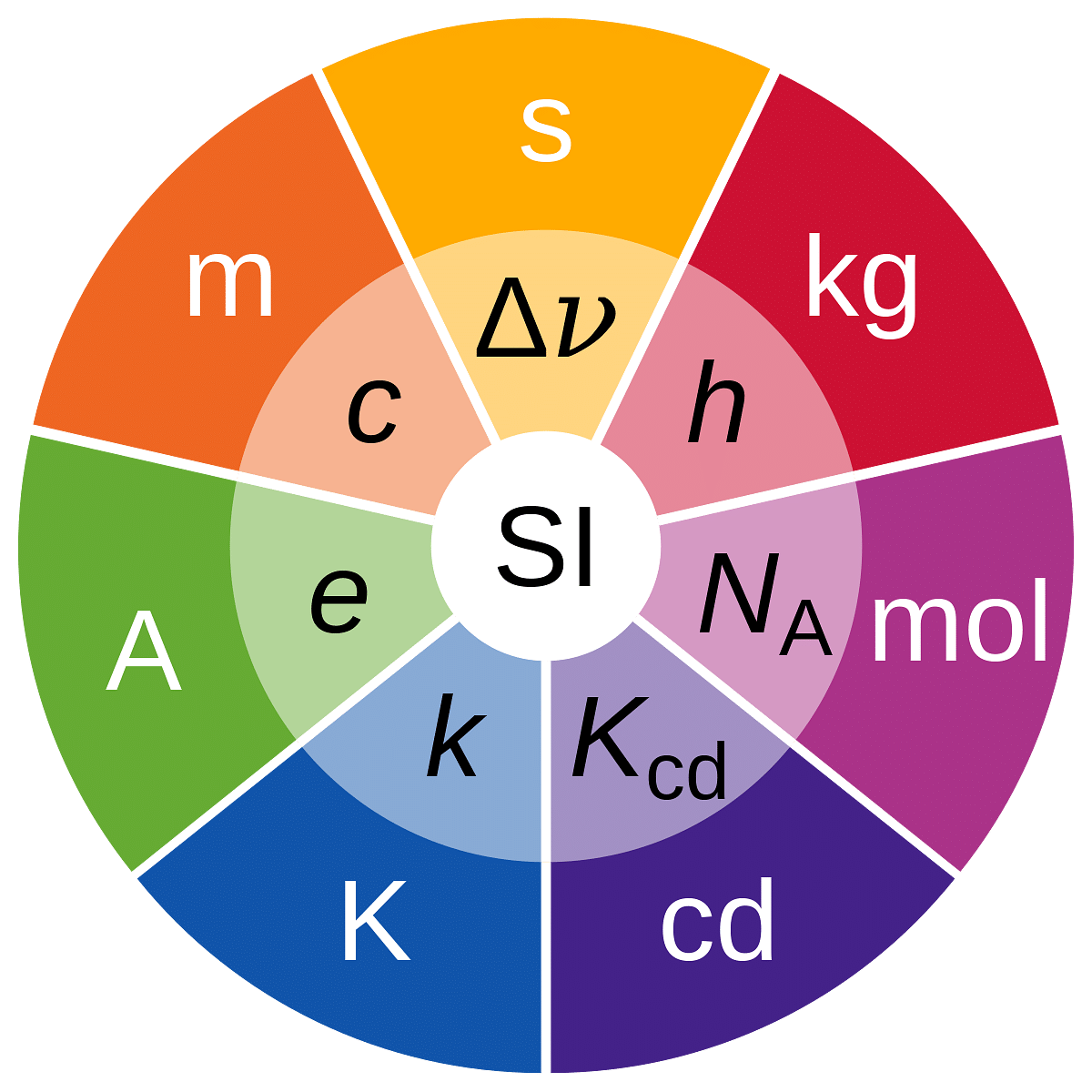
Types of SI Units
- Base units are the fundamental units that are the building blocks of the system. All the other units are derived from these SI Base units.
- Derived Units are unlimited as they are formed by various operations on the base SI units.
SI Base Units
[Click Here for Sample Questions]
SI Base Units in Physics are the fundamental units and are considered building blocks of the system.
- One of the examples is that the SI unit of mass is the kilogram (this is also confused with grams).
- The base units are assumed to be mutually independent.
- These are the fundamental units that serve as the system's base units.
- The SI Base units are the basis for deriving all other units.
- One example is a meter which is an SI unit of length.
Also Read:
SI Base Units List
There are a total of seven SI basic units. The following are the seven units, along with their SI unit and symbol:
| SI Units | Symbol |
|---|---|
| Meter (m) | Meter is the SI unit of length. It is defined as the constant value of the speed of light in a vacuum. It is represented as ms-1 |
| Kilogram (kg) | Kilogram is the SI unit of mass. It is determined by taking the Planck constant fixed value. Kg.m2.s-1 is the unit of measurement. |
| Second (s) | The SI unit of time is defined as the fixed value of Cesium frequency. It is written as s1. |
| Ampere (A) | The SI unit of electric current is the ampere (A), which is defined by taking the fixed value of the basic charge. |
| Kelvin (K) | Kelvin is the SI unit of thermodynamic temperature. It is determined by taking the fixed value of the Boltzmann constant, which is k = 1.380649*10-23. |
| Mole (mol) | Mol is the SI unit of quantity of material and is defined by the fixed value of the Avogadro constant NA. A mole is defined as a unit of measurement that comprises 6.02214076×10²³ elementary entities and is expressed as mol-1. |
| Candela (cd) | Candela is the SI unit of luminous intensity, and the fixed value of luminous efficacy determines it. |
Also Read: Value of ‘C’
SI Derived Units
[Click Here for Sample Questions]
Multiple operations on the basic units generate the derived units. They are countless.
- The dimensions of derived units are represented in terms of the dimensions of base units.
- A combination of base and derived units are used to express derived units.
SI Derived Units List
In physics, there are various derived units. The following are some of the most often used SI-derived units in physics.
| Quantity Name | SI Units | SI Unit Symbol | Expressed in SI Base Unit | Expressed in other SI units |
|---|---|---|---|---|
| Force, Weight | Newton | N | kg⋅g⋅s-2 | – |
| Frequency | Hertz | Hz | s-1 | – |
| Electric charge | Coulomb | C | s⋅A | – |
| Electric potential (Voltage) | Volt | V | kg.m2.s-3.A-1 | W/A |
| Capacitance | Farad | F | kg.m2.s-2.A-2 | Wb/A |
| Inductance | Henry | H | kg−1.m−2.s4.A2 | C/V |
| Electrical conductance | Siemens | S | kg−1.m−2.s3.A2 | Ω−1 |
| Magnetic flux | Weber | Wb | kg.m2.s−2.A−1 | V⋅s |
| Magnetic flux density | Tesla | T | kg.s−2.A−1 | Wb/m2 |
| Energy, Work, Heat | Joule | J | kg.m2.s−2 | N⋅m |
| Power, Radiant flux | Watt | W | kg.m2.s−3 | J/s |
| Angle | Radian | Rad | m.m−1 | – |
| Radioactivity | Becquerel | Bq | s-1 | – |
| Luminous flux | Lumen | Lm | cd | cd⋅sr |
Aside from these derived SI units, a few more units are often used in physics are –
- The kilogram meter per second (kg- m/s) is the SI unit of momentum (P).
- Tesla is the SI unit for magnetic field (B).
- The joule is the SI unit of heat.
- The SI unit of velocity is the meter per second (m/s).
These key physics SI units list is helpful to write the units and dimensions corresponding to the quantity accurately. Any unit answer is regarded as incomplete without its unit.
SI conventions
Conventions for writing SI units' names and symbols are –
- Only SI base and derived units should be used to express the values of quantities.
- All names of units are written in small letters (newton or kilogram) except for Celsius.
- The unit symbol is in lower case unless it is derived from a proper name, in which case the first letter of the symbol is in upper case.
- The symbols for units are unaltered in the plural.
- For unit values, more than 1 or less than -1, a plural of the unit is used and a singular unit is used for values between 1 and -1.
- A space is left between the numerical value and the SI unit symbol (25 kg, but not 25-kg or 25kg).
SI Units Prefixes
[Click Here for Sample Questions]
SI prefixes are used for forming decimal multiples and submultiples of SI units. The grouping of a prefix symbol attached to a unit symbol form a new inseparable unit symbol.
| Multiplying Factor | Name (symbol) | Scientific Notation |
|---|---|---|
| 1 000 000 000 000 000 000 000 000 | yotta (Y) | 1024 |
| 1 000 000 000 000 000 000 000 | zetta (Z) | 1021 |
| 1 000 000 000 000 000 000 | exa (E) | 1018 |
| 1 000 000 000 000 000 | peta (P) | 1015 |
| 1 000 000 000 000 | tera (T) | 1012 |
| 1 000 000 000 | giga (G) | 109 |
| 1 000 000 | mega (M) | 106 |
| 1 000 | kilo (k) | 103 |
| 100 | hecto (h) | 102 |
| 10 | deca (da) | 101 |
| 1 | - | 100 |
| 0.1 | deci (d) | 10-1 |
| 0.01 | centi (c) | 10-2 |
| 0.001 | milli (m) | 10-3 |
| 0.000 001 | micro (µ) | 10-6 |
| 0.000 000 001 | nano (n) | 10-9 |
| 0.000 000 000 001 | pico (p) | 10-12 |
| 0.000 000 000 000 001 | femto (f) | 10-15 |
| 0.000 000 000 000 000 001 | atto (a) | 10-18 |
| 0.000 000 000 000 000 000 001 | zepto (z) | 10-21 |
| 0.000 000 000 000 000 000 000 001 | yocto (y) | 10-24 |
Advantages of SI Units
[Click Here for Sample Questions]
Using appropriate SI units has many advantages such as-
- It helps with the explanations of the various Physics relate studies and experiments.
- It helps with the conversions between two categories of equations.
- The quantity-related ideas and equations can be explained clearly and more accurately through the use of SI Units.
Standardizing the measurements helps to keep them accurate and consistent and also helps society have confidence in data.
Unit-Based Articles in Physics
[Click Here for Sample Questions]
Some of the other important units in physics include –
Things to Remember
- The Full Form of the SI Unit is Système International. SI unit is a global measuring system used to measure units.
- The seven fundamental physical quantities are lengths, mass, time, electric current, temperature, amount of substance, and light intensity.
- The SI unit was introduced in 1960.
- Fundamental units are elementary units and cannot be reduced any further.
- All derived units are created by multiplying and/or dividing one or more basic units. Examples of derived units include Velocity (m/s), Acceleration (m2/s), Momentum (kg-m/s) and Force (N).
Important Previous Year Questions
- Water falls from a height of 60 m at the rate of 15 kg/s… (NEET 2008)
- A particle of mass M, starting from rest, undergoes… (NEET 2010)
- A ball moving with velocity 2m/s… (NEET 2010)
- Two masses of 1 g and 9 g are moving with equal kinetic energies… (NEET 1993)
- A batsman hits back a ball straight in the direction of the bowler without… (NEET 1989)
- A bullet of mass 10 g leaves a rifle at an initial velocity of… (NEET 1989)
- On a frictionless surface, a block of mass MM moving at… (NEET 2015)
- Two particles of masses m1, m2 move with initial velocities...(NEET 2015)
- A particle moves from a point… (NEET 2016)
- A body, constrained to move in y-direction… (NEET 1994)
- When a body moves with a constant speed along a circle...(NEET 1994)
- One coolie takes 1 minute to raise a suitcase through… (NEET 2013)
- The potential energy of a system increases if work is done… (NEET 2011)
- A mass mm moving horizontally… (NEET 2011)
- A moving body of mass m and velocity… (NEET 1996)
Sample Questions
Ques 1. When did the International System of Units (SI) come into being? (1 mark)
Ans. The SI unit was introduced in 1960.
Ques 2. What is meant by the unit of measurement? (1 mark)
Ans. The reference standard used for measurements is specified as a unit.
Ques 3. What are the most often used measuring systems? (2 marks)
Ans. The following are the most regularly used measuring systems:
- The CGS system
- The MKS system
- The SI system
Ques 4. Give the names of the fundamental physical quantities. (2 marks)
Ans. The seven fundamental physical quantities are lengths, mass, time, electric current, temperature, amount of substance, and light intensity.
Ques 5. Define the unit of length. (2 marks)
Ans. The SI unit of length is the meter (symbol m). It is calculated by taking the fixed numerical value of the speed of light in vacuum, c, and converting it to m s-1, where the second is specified in terms of ΔvCs.
Ques 6. Define Derived units. (2 marks)
Ans. A derived unit is created by combining SI basic units mathematically.
The same rules apply to derived unit conversion calculations like other units.
Ques 7. What does it mean when SI units are referred to as a cohesive system of units? (3 marks)
Ans. We choose several base units for a set of fundamental values in the coherent unit system and derive other units by dividing or multiplying any constant into it. This produces the same numerical and physical units. The whole collection of base units & derived units with decimal multiples and submultiples are referred to as SI units. For example, kilometers, meters, and millimeters are SI units, as is meter per second and millimeter per second. Coherent SI units are "meter" and "meter per second" from this category.
Ques 8. What is the significance of the SI system? (3 marks)
Ans. The following are some of the reasons why the SI system is important:
- The SI system is based on exact and definite standards.
- The base used in the SI system is 10, which makes conversion easy;
- The SI system uses Latin and Greek prefixes to refer to numerals.
- The SI units may be deduced from one another without the need for conversion factors.
Ques 9. State the differences between the fundamental units and derived units. (5 marks)
Ans.
| Fundamental Units | Derived Units |
|---|---|
| The term "fundamental units" refers to all units that are independent and unrelated to one another (including themselves). | All derived units are created by multiplying and/or dividing one or more basic units with or without the addition of any additional numerical factor. |
| Fundamental units cannot be reduced any further. These are elementary units. | Derived units may be reduced to their most basic form, which is made up of fundamental units. |
| Fundamental units cannot be stated in terms of derived units. | Fundamental units can be used to express derived units. |
| In the SI system, there are just seven fundamental units. | The Metric System has a significant number of derived units. |
| Examples of fundamental units include Length (Meter, m), Mass (Kilogram, kg), and Time (Second, s). | Examples of derived units include Velocity (m/s), Acceleration (m2/s), Momentum (kg-m/s) and Force (N). |
Ques 10. Describe a Newton. (3 marks)
Ans. A Newton is a unit of force. Remember Newton's second law: F=ma.
If you solve this equation purely in terms of units, you can find the equivalent unit for force.
F=ma
Replace force with Newtons, mass with kilograms, and acceleration with meters per square-second.
N=kg∗m/s2
N=kg∗m/s2
Using dimensional analysis, we can find the equivalent units of virtually any measurement.
Ques 11. Is Vector an SI unit? Justify your answer. (3 marks)
Ans. A vector is not a unit of measurement. A vector is a quantity with both magnitude and direction. This is different from a scalar, which has only magnitude but no direction. All units of measurement can be classified as either vectors or scalars. For example, velocity is a vector and speed is a scalar.
Kilograms are the SI units for mass. Farads is the SI unit for capacitance. Newton-meters are compound SI units that measures torque and are equivalent to Joules. Seconds are the SI unit for time.
Ques 12. Explain how Watt is an SI Unit of Power. (2 marks)
Ans. The correct SI unit for power is the Watt, which is equivalent to Joules per second. Joules are used to measure energy or work. Coulombs are the SI unit for electrical charge and lumens are the SI units for brightness. A horsepower is a non-SI unit for power.
Ques 13. Miles per hour is a measure of speed. The SI unit for this measurement is m/s. Explain. (3 marks)
Ans. All physics calculations require the use of proper standard units, known as SI units. "Miles per hour" is a measure of length (miles) per unit time (hour). A change in position per unit of time can correspond to either speed or velocity. Velocity is the vector conversion of speed, giving a magnitude of speed in an applied direction.
\(s = \frac{\Delta d}{\Delta t} and \overrightarrow{v} = \frac{\Delta \overrightarrow{d}}{\Delta t}\)
The standard unit for distance or displacement is a meter and the standard unit for time is a second. In these equations, we can see that an answer will have the units "meters per second" once the distance is divided by the time.
\(s = \frac{m}{s} = and \overrightarrow{v} =\frac{m}{s}\)
Kilometers per hour and feet per second can also be used to measure a speed of velocity, but do not correspond to standard SI units.
Ques 14. What are the SI units for temperature? (4 marks)
Ans. All physics calculations require the use of proper standard units, known as SI units. When working with temperature, physics calculations require the use of the absolute temperature, given in the units of Kelvin. Kelvin uses absolute zero as their initial reference, whereas degrees Celsius use the freezing point of water. Since absolute zero is equal to approximately −273oC, the conversion from Celsius to Kelvin is simply to add 273.
0oC+273=273K
Degrees Fahrenheit are a relatively non-standard unit for measuring temperature, and require a more complicated conversion.
Keq refers to the equilibrium constant for chemical reactions. Though this value is dependent on temperature, it is not a unit of measurement and is not used in physics calculations.
\(K_{eq} = \frac{[C]^e [D]^d}{[A]^a [B]^b}\)
k can refer to a few different things in physics but is never used as a unit of measurement. This variable generally refers to Coulomb's constant in calculations with electric fields, but can also be used for the dielectric constant of material or Boltzmann's constant.
\(k = \frac{1}{4 \pi \in _0} = 9.00 \times 10^9 \frac{m^2 N}{C^2}\)
Ques 15. What are the SI units for length? (3 marks)
Ans. All physics calculations require the use of proper standard units, known as SI units. It is important to convert all terms to SI units before proceeding to use any formulae.
Distance and displacement are quantifications of length. The SI unit for length is meters; thus any calculation requiring a distance or displacement term must use meters for this variable.
One kilometer is equivalent to one thousand meters. One hundred centimeters are equivalent to one meter.
1km=1000m
1cm=0.01m
Check out:



Comments