



Content Curator
Biology is the study of life and life processes. Biology is the basis for the scientific study of living organisms and their respective characteristics. Life science, medicine, conservation, genetics, microbiology, Cell biology and various other fields are distributaries of the subject of Biology. Modern technology has led its way to Interdisciplinary research by integrating various disciplines such as Chemistry, physics and medicine to gear up the development in biology and its allied fields. In Class 12 syllabus, Biology subject is divided into Botany (study of plants) and Zoology (Study of animals).
Also Read: Comparison Articles in Biology
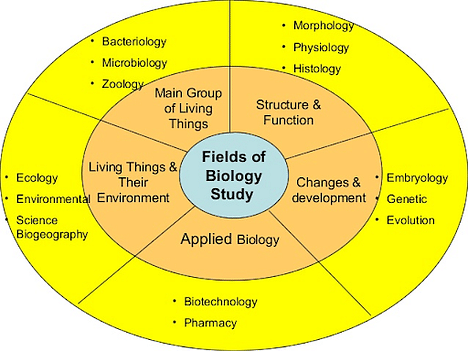
Branches of Biology
| Table of Content |
Aspects of Biology
The different aspects of biology and their subtopics are discussed below.
Taxonomic Hierarchy of Organisms
There are millions of living organisms in the world and without any classification, it is impossible to identify each of them separately. Thus, all the organisms are classified in a taxonomic hierarchy in the order of Kingdom → Phylum → Class → Class → Order → Family → Genus → Species.
Below are some concepts that explains in detail about the Plant kingdom, morphology of plants and their functions.
Below are some concepts that explains in detail about the Animal kingdom, lifecycle of animals & insects, their functions and anatomy.
Ecology and Environment
All the living organisms in this world constantly interact with one another for the basic need of survival. The inter-relationship between these organisms determines the balance between environment and organisms. The food chain, biomass, energy pyramid, etc maintain the proportion and balance to lead a sustainable life.
Cell- Basic Unit of Life
Cell is the basic unit of life. Cells are broadly classified into Plant cells and animal cells. The only difference between the two is that animal cells don’t have a cell wall. Cells contains cell organelles which have different functions to promote the growth of the cell. Some of the cell organelles are the nucleus, mitochondria, vacuoles, cytoplasm, endoplasmic reticulum, cell wall, cell membrane, etc. The DNA or the genetic information is present inside the nucleus.
| Fundamental Unit of Life | Golgi Apparatus | Lysosomes |
| Endomembrane | Mitochondria | Plastids |
| Cytoskeleton | Proteins | Neuron |
| Discovery of Cells | Tissues | Plasma Membrane |
| Protoplasm | Rhizobium | TCA Cycle |
Unicellular and Multicellular Organisms
All organisms can be classified into unicellular or multicellular. Unicellular organisms are single celled microscopic organisms. Some of the examples of unicellular organisms are amoeba, paramoecium, euglena, etc. Apart from these, all other organisms are multicellular where a group of cell with common function makes up a tissue, tissues together form organ and organs together form organ system.
Microbiology
It is the study of microorganisms such as bacteria, virus, fungi, algae, etc. It is also necessary to study the characteristics and function of each of these organisms. Depending of the study of the subject, microbiology is classified into different fields such as bacteriology (study of bacteria), virology (study of viruses), mycology (study of fungus), etc.
| Bacteria | Archaebacteria | Eubacteria |
| Dinoflagellates | Protozoa | Algae |
| Amoeba | Cryptosporidium | Fungus |
| Bacteriophage | Meiosis and Mitosis | Nutrition in Amoeba |
Physiology, Health and Hygiene
It is very important to take good care of health and hygiene. The study of various organs of the human body and its functions forms a large portion of the subject. It also deals with the diseases that occurs in the body which may be either communicable or non-communicable diseases. The sources, preventive measures and treatment for these dieases also come under the purview of the subject.
Below are some articles that explains in detail about different physiological functions of human body and their respective organs.
Below are some articles that explains in detail about different hormones secreted in the human body and their respective functions.
| Luteinizing Hormone | Growth Hormone | Hormonal Imbalance |
| Female Hormones | Estrogen Hormone | Cortisol Hormone |
| Parathyroid Hormone | Melatonin Hormone | ADH Hormone |
| FSH | Androgen Hormone | Hormones in Animals |
Below are some articles that explains in detail about different types of vitamins and their deficiency diseases in the human body.
| Vitamin B12 Deficiency | Vitamin D | Water soluble and fat soluble vitamins |
| Vitamin D and D3 | Scientific names of Vitamins | Scurvy |
| MCQ on Vitamins | Vitamin B | Vitamin Classification |
Genetics and Evolution
The passing on of characteristics from one generation to another is called heredity. Any minute changes in this gene transfer might cause a unique characteristic which forms the basis for evolution. Evolution has been the case since life appeared on earth. Evolution helps in adapting to the changing environment.



Comments