




GPAT 2027, Graduate Pharmacy Aptitude Test, is a national-level entrance exam in India conducted for admission into Master of Pharmacy (M.Pharm) programs. The GPAT exam is administered by the National Board of Examinations in Medical Sciences (NBEMS).
Candidates generally need a 4-year B.Pharm degree from a PCI-recognised institution. Final-year B.Pharm students can also apply subject to the prescribed completion requirements.
| Check Out: GPAT 2027 Official Information Bulletin (Expected in late December 2026) |
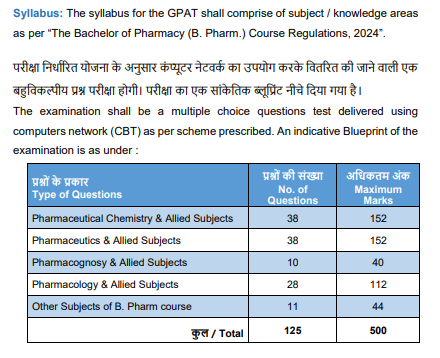
- GPAT is conducted as a Computer-Based Test (CBT) in English, and it is 3 hours (180 minutes) long in duration.
- GPAT consists of 125 MCQs, with each question having four options. Each correct answer carries +4 marks, and an incorrect answer attracts −1 mark, making the maximum score 500 marks.
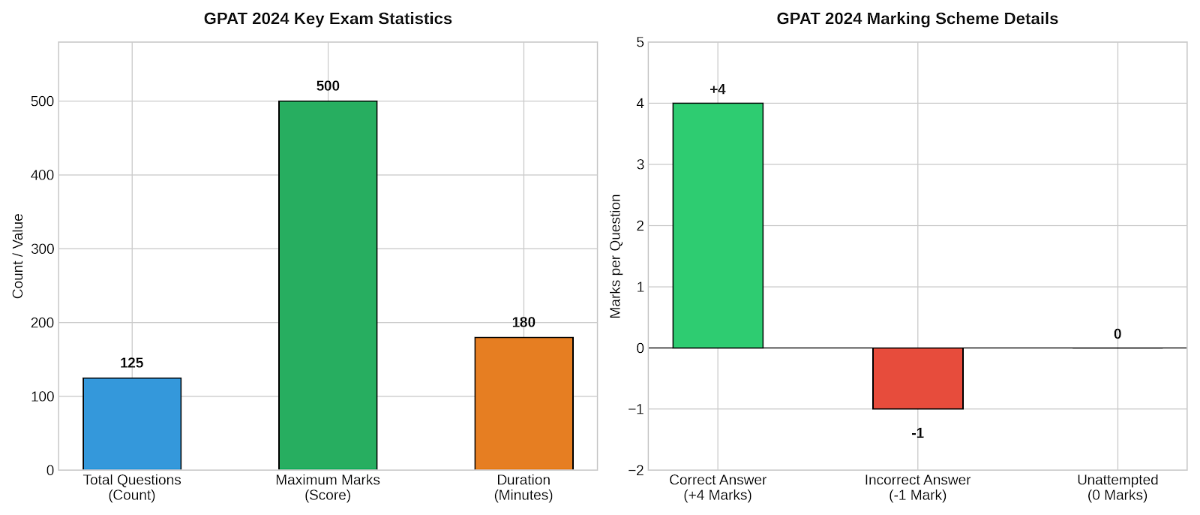
- The syllabus is divided into five major areas: Pharmaceutical Chemistry, Pharmaceutics, Pharmacology, Pharmacognosy, and Other Allied Subjects of B.Pharm.
- Pharmaceutical Chemistry and Pharmaceutics carry the highest weightage, with 38 questions and 152 marks each.
- The application generally involves online registration, form filling, document/photo uploads, test-city selection, fee payment, and final submission.
- A qualified GPAT scorecard remains valid for three years, which gives candidates flexibility in when they use their score for admission and government stipend eligibility.
Check Out:
- GPAT 2027 Application Form, Check Dates, Direct Link, Steps to Edit
- GPAT Syllabus 2027: Download PDF, Check Changes, Exam Pattern & Topic-Wise Weightage
- GPAT Eligibility Criteria 2027: Check Age Limit and Educational Qualification
Key Summary
- GPAT 2027 is a computer-based test of 125 MCQs worth 500 marks, with +4 for correct answers and -1 for incorrect ones.
- Eligibility requires a 4-year B.Pharm degree (or final-year status); there is no upper age limit and no cap on the number of attempts.
- GPAT exam fees are ₹3,500 for General/OBC/EWS candidates and ₹2,500 for SC/ST/PwD candidates, paid entirely online.
- There is no centralized GPAT counselling; admission happens through NIPER JEE, state-level counselling, or independent university portals.
What is GPAT Exam?
GPAT full form is Graduate Pharmacy Aptitude Test. It is a national-level entrance examination in India conducted for admissions into M.Pharm programs across nearly all AICTE-approved pharmacy colleges in India.
- NTA was the conducting authority from 2019 through 2023 for GPAT.
- The management of the exam was officially handed over to the National Board of Examinations in Medical Sciences (NBEMS) starting from the 2024 cycle.
| Particular | Details |
|---|---|
| Conducting Body | National Board of Examinations in Medical Sciences (NBEMS), on behalf of PCI |
| Exam Name | Graduate Pharmacy Aptitude Test (GPAT) |
| Courses Covered | M.Pharm and equivalent postgraduate pharmacy courses |
| Exam Level | National Level (All India) |
| Exam Mode | Computer-Based Test (CBT) |
| Total Questions | 125 MCQs |
| Total Marks | 500 |
| Marking Scheme | +4 correct, −1 incorrect, 0 unattempted |
| Basic Eligibility | B.Pharm (4-year) degree, or final-year student |
| Age Limit | No upper age limit |
| Application Mode | Online only |
| GPAT Official Website | natboard.edu.in |
The video explains why GPAT matters, highlighting how a strong score can enhance career prospects. It also covers GPAT eligibility criteria and exam management, including the application requirements and the role of NBEMS in conducting the examination smoothly.
Also Check:
GPAT 2027: Important Dates (Tentative)
The GPAT 2027 admission timeline is expected to span from registration in December 2026 to counselling between May and July 2027.
- The application process is expected to begin in late December 2026, followed by form correction, test-city allocation, admit card release, and the GPAT exam in the first week of March 2027.
- The provisional answer key is expected in mid-March, the result in the first week of April 2027, and admission counselling is likely to continue from May to July 2027.
| Event | Timeline (Expected) |
|---|---|
| Official Notification & Information Bulletin | Late December 2026 |
| GPAT Registration Window Opens | Late December 2026 |
| Last Date to Submit GPAT Application Form & Fees | Mid-January 2027 |
| Selective Form Correction Window | Mid-to-Late January 2027 |
| Final Edit Window (Images) | Mid-February 2027 |
| Intimation of Allocated Test City | Late February 2027 |
| GPAT 2027 Admit Card Release | Early March 2027 |
| GPAT 2027 Exam Date | First week of March 2027 |
| Provisional Answer Key & Response Sheet | Mid-March 2027 |
| Answer Key Challenge Window | Mid-March 2027 |
| GPAT 2027 Result Declaration | First week of April 2027 |
| Admission Counselling Begins | May – July 2027 |
Also Check:
GPAT Exam Eligibility Criteria 2027
To apply for the Graduate Pharmacy Aptitude Test, candidates must satisfy eligibility rules laid down by the Pharmacy Council of India and enforced by NBEMS.
Educational Qualification
- Candidates must hold a Bachelor's Degree in Pharmacy (4 years after 10+2) from a PCI-recognized institute.
- Final-year/final-semester B.Pharm students are eligible to apply, provided their results are declared before the admission cycle concludes.
- A B.Tech in Pharmaceutical Technology, Fine Chemical Technology, or similar engineering degrees does not qualify for GPAT.
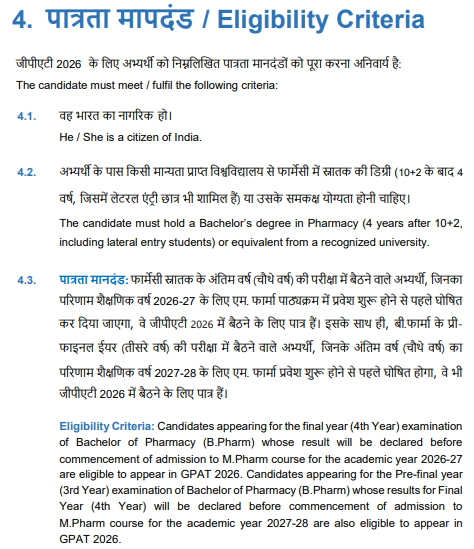
Source: GPAT Information Bulletin 2026
| Eligibility Criteria | Requirement |
|---|---|
| Educational Qualification | B.Pharm (4 years, PCI-recognized) |
| Final-Year Candidates | Eligible, subject to timely degree completion |
| Ineligible Degrees | B.Tech Pharmaceutical/Fine Chemical Technology |
| Nationality | Primarily Indian citizens |
| Age Limit | No upper age limit |
| Attempt Limit | Unlimited attempts |
| Minimum B.Pharm Marks | Not mandated by GPAT; may apply at institute level |
| Lateral Entry Candidates | Eligible, subject to B.Pharm qualification |
GPAT Question Paper with Solution PDF
| GPAT Paper | Question Paper PDF | Solution PDF |
|---|---|---|
| GPAT 2026 Question Paper | Download PDF | Check Solutions |
| GATE 2025 25 May Question Paper PDF (Shift 1) | Download PDF | Download PDF |
| GATE 2025 25 May Question Paper PDF (Shift 2) | Download PDF | Download PDF |
GPAT 2027 Application Fee
The GPAT exam fee structure is fixed by category and must be paid entirely online through the NBEMS application portal.
- Non-Refundable: Once paid, the GPAT exam fees cannot be withdrawn, adjusted, or carried forward.
- Accepted Modes: Credit Card, Debit Card, Net Banking, or UPI — no cash or offline payments.
- Forfeiture: If a candidate is absent or later found ineligible, the GPAT exam fee already paid is forfeited.
| Category | GPAT Exam Fee |
|---|---|
| General, OBC, EWS | ₹3,500 |
| SC, ST, PwD | ₹2,500 |
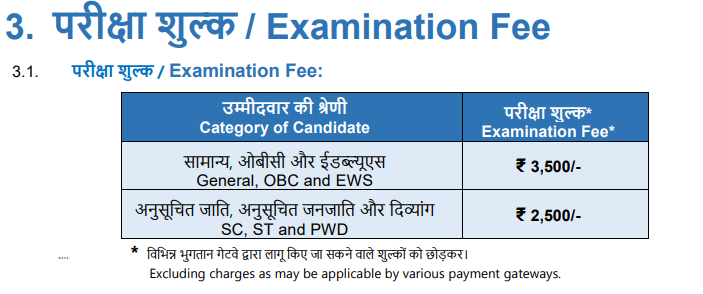
Source: GPAT Information Bulletin 2026
GPAT Registration and Application Process 2027
GPAT registration must be completed on the official GPAT website, natboard.edu.in.
- Five-Step Process: GPAT registration involves user registration, application form filling, document uploads, test city selection, and fee payment with final submission.
- Careful Submission Required: Candidates should enter their details accurately, upload documents in the prescribed format, and verify that the application status shows “S” (Successful) after submission.
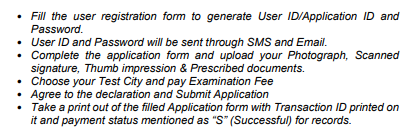
Source: GPAT Information Bulletin 2026
| Step | Application Stage | Key Actions |
|---|---|---|
| Step 1 | Online User Registration |
|
| Step 2 | Application Form |
|
| Step 3 | Document & Biometric Uploads |
|
| Step 4 | Test City Selection |
|
| Step 5 | Fee Payment & Final Submission |
|
Fields that cannot be edited after final submission:
- Full Name
- Primary Email ID
- Primary Mobile Number
- Nationality Status
- Chosen Examination Test City
- Aadhaar Card Number
Documents Required for GPAT Registration 2027
The GPAT 2027 application requires applicants to keep their identity, academic, and prescribed digital upload documents ready.
- Digital uploads: Photograph, signature, and left thumb impression must meet the specified size, format, ink, and file-size requirements.
- Identity & academic documents: Keep Aadhaar or an alternative photo ID, Class 10 and 12 documents, and B.Pharm marksheets ready for verification.
| Document / Upload | Key Requirements |
|---|---|
| Recent Photograph | Under 3 months old, white background, face 70–80% of frame; .jpg/.jpeg, under 80 KB |
| Digital Signature | Black/dark blue ink, 1.5 cm × 3.5 cm box; under 80 KB |
| Left Thumb Impression | Blue/black ink, 1.5 cm × 3.5 cm box; under 80 KB |
| Aadhaar Card | Recommended for identity verification |
| Alternative Photo ID | PAN, Driving Licence, Voter ID, or Passport |
| Class 10 Certificate | Date of birth and name verification |
| Class 12 Marksheet | Educational qualification details |
| B.Pharm Marksheets | Marks, enrolment, and qualification status |
Category Certificates
- Candidates must submit the applicable OBC-NCL, SC/ST, EWS, or PwBD certificate issued by the prescribed authority.
- Ensure the certificate is valid and meets the required category and authority specifications at the time of application.
| Category | Certificate Required |
|---|---|
| OBC-NCL | OBC-NCL Certificate (Central List, non-creamy layer) |
| SC / ST | Certificate from competent government authority |
| EWS | Income & Asset Certificate |
| PwBD | Disability Certificate from competent medical authority |
Also Check: GPAT 2027 Photograph & Signature Upload Guidelines: Check Size, Format and Other Details
GPAT Exam Pattern 2027
The GPAT exam pattern is a computer-based test divided into 5 time-bound sections, each with 25 questions and a strict 36-minute limit.
- Once a section's timer expires, answers are auto-saved and the section locks.
- There is no backward navigation and no early exit into the next section.
Marking scheme: Each correct answer awards 4 marks, while 1 mark is deducted for every incorrect response; unattempted questions receive no marks.
Source: GPAT Information Bulletin 2026
| Parameter | Specification |
|---|---|
| Mode | Computer-Based Test (CBT) |
| Language | English only |
| Total Duration | 3 hours (180 minutes) |
| Question Type | MCQs, 4 options each |
| Total Questions | 125 |
| Maximum Score | 500 marks |
| Marking Scheme | +4 correct, −1 incorrect, 0 unattempted |
Graduate Pharmacy Aptitude Test Syllabus 2027: Subject-Wise Weightage
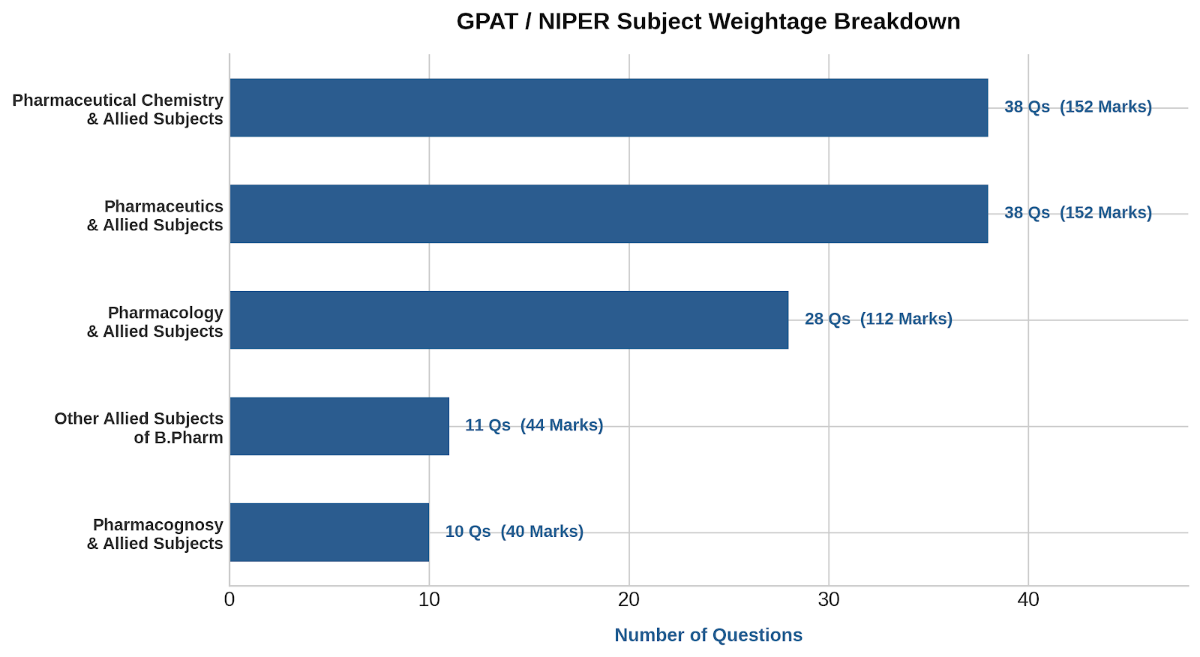
The GPAT 2027 syllabus is divided into five major subject areas, with Pharmaceutical Chemistry and Pharmaceutics carrying the highest weightage.
- Highest weightage: Pharmaceutical Chemistry and Pharmaceutics each comprise 38 questions and 152 marks, together accounting for 304 marks.
- Other sections: Pharmacology carries 112 marks, while Pharmacognosy and Other Allied Subjects contribute 40 and 44 marks, respectively.
| Subject / Section | Questions | Marks |
|---|---|---|
| Pharmaceutical Chemistry & Allied Subjects | 38 | 152 |
| Pharmaceutics & Allied Subjects | 38 | 152 |
| Pharmacology & Allied Subjects | 28 | 112 |
| Pharmacognosy & Allied Subjects | 10 | 40 |
| Other Allied Subjects of B.Pharm | 11 | 44 |
| Total | 125 | 500 |
Also Check: GPAT Preparation 2027: Check Best Books for Preparation and Subject-Wise Preparation Tips
GPAT Pharmaceutical Chemistry Sample Papers 2026 - Download PDF
| Sample Paper | PDF Download |
|---|---|
| GPAT Pharmaceutical Chemistry Sample Paper 1 | Download PDF |
| GPAT Pharmaceutical Chemistry Sample Paper 2 | Download PDF |
| GPAT Pharmaceutical Chemistry Sample Paper 3 | Download PDF |
| GPAT Pharmaceutical Chemistry Sample Paper 4 | Download PDF |
| GPAT Pharmaceutical Chemistry Sample Paper 5 | Download PDF |
GPAT Pharmaceutics Sample Papers 2026 - Download PDF
| Sample Paper | PDF Download |
|---|---|
| GPAT Pharmaceutics Sample Paper 1 | Download PDF |
| GPAT Pharmaceutics Sample Paper 2 | Download PDF |
| GPAT Pharmaceutics Sample Paper 3 | Download PDF |
| GPAT Pharmaceutics Sample Paper 4 | Download PDF |
| GPAT Pharmaceutics Sample Paper 5 | Download PDF |
| GPAT Pharmaceutics Sample Paper 6 | Download PDF |
| GPAT Pharmaceutics Sample Paper 7 | Download PDF |
| GPAT Pharmaceutics Sample Paper 8 | Download PDF |
| GPAT Pharmaceutics Sample Paper 9 | Download PDF |
| GPAT Pharmaceutics Sample Paper 10 | Download PDF |
GPAT Pharmacognosy Sample Papers 2026 - Download PDF
| Sample Paper | PDF Download |
|---|---|
| GPAT Pharmacognosy Sample Paper 1 | Download PDF |
| GPAT Pharmacognosy Sample Paper 2 | Download PDF |
| GPAT Pharmacognosy Sample Paper 3 | Download PDF |
| GPAT Pharmacognosy Sample Paper 4 | Download PDF |
| GPAT Pharmacognosy Sample Paper 5 | Download PDF |
GPAT Syllabus 2027
The GPAT 2027 syllabus covers core B.Pharm subjects, with topics ranging from drug chemistry and formulation to pharmacology, pharmacognosy, and pharmaceutical management.
- Core subjects: Pharmaceutical Chemistry, Pharmaceutics, and Pharmacology cover major areas such as drug synthesis, analysis, dosage forms, pharmacokinetics, drug mechanisms, and systemic pharmacology.
- Allied areas: Pharmacognosy and other B.Pharm subjects include crude drugs, phytochemistry, pharmaceutical laws, biochemistry, clinical pharmacy, and management concepts.
| Subject / Section | Key Topics |
|---|---|
| Pharmaceutical Chemistry & Allied Subjects |
|
| Pharmaceutics & Allied Subjects |
|
| Pharmacology & Allied Subjects |
|
| Pharmacognosy & Allied Subjects |
|
| Other Allied Subjects of B.Pharm |
|
Also Check:
GPAT Exam Preparation Tips 2027
The GPAT 2027 preparation strategy should focus on high-yield concepts, regular revision, and targeted practice across major B.Pharm subjects.
- Allocate more study time to Pharmaceutical Chemistry and Pharmaceutics, which together account for 76 questions. Build strong concepts first, then revise frequently tested facts and formulas.
- Solve previous-year questions topic-wise and attempt full-length mock tests regularly. Analyse incorrect and unattempted questions to identify weak areas and improve speed and accuracy.
| Subject | Preparation Tips |
|---|---|
| Pharmaceutical Chemistry |
|
| Pharmaceutics & Allied Subjects |
|
| Pharmacology |
|
| Pharmacognosy & Jurisprudence |
|
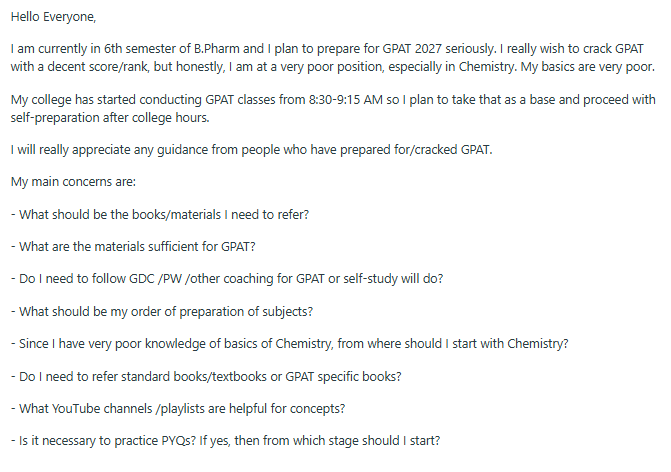
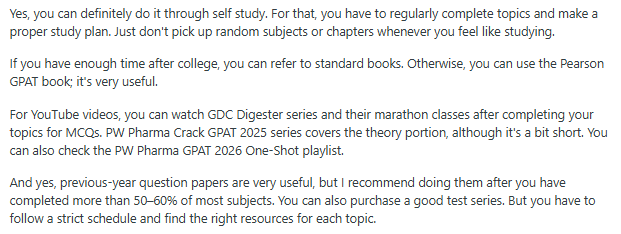
Recommended study approach by students on Reddit
Building Chemistry Basics (Weak Point Solution)
- Organic Chemistry: Start with NCERT Class 11 & 12 Organic Chemistry to fix core concepts (reaction mechanisms, IUPAC, isomerism, aromaticity). Once clear, move to Morrison & Boyd or Finar.
- Medicinal Chemistry: Do not memorize reactions blindly. Learn SAR (Structure-Activity Relationship), drug classification, chemical names, and active pharmacophores using Foye's or Wilson and Gisvold.
Medicinal Chemistry: Learn SAR and drug classification conceptually rather than memorizing reactions.
Core Textbooks: Pharmacology (KD Tripathi, Rang & Dale), Pharmaceutics (Lachman & Lieberman, Ansel's), Pharmacognosy (CK Kokate), Pharmaceutical Analysis (Kasture, Skoog).
Source: Reddit
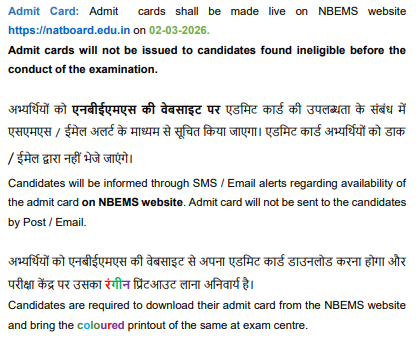
GPAT Admit Card 2027
The GPAT admit card is released online only, typically 4 to 5 days before the exam. GPAT admit card must be downloaded and printed; it is not sent by post, courier, or email attachment.
Before arriving at the test center, candidates must:
- Affix a recent passport-size color photograph in the designated box (matching the uploaded digital photo, white background, no staples or signature across it).
- Print the admit card on a clean, white A4 sheet using a laser printer, ensuring the barcode, photograph, and test-center address are fully legible.
Source: GPAT Information Bulletin 2026
GPAT Result 2027 and Scorecard
The GPAT result and scorecard are declared by NBEMS approximately one month after the exam, typically in the first week of April 2027, and are available for GPAT scorecard download from the official GPAT website.
Information on the GPAT Scorecard:
- Candidate's Name, Roll Number, Application ID
- Category
- Total Marks (out of 500)
- All India Rank (AIR)
- Qualifying Status
- Category-wise Cutoff Scores
Validity: The GPAT scorecard remains valid for 3 years from the date of result declaration. Candidates who secure admission to a PCI-approved college within this window remain eligible for the government-funded monthly stipend (historically around ₹12,400 per month).
Also Check:
GPAT Exam Cutoff
The category-wise GPAT cutoff trends show how qualifying marks have changed across different reservation categories over the last three years.
- The General cutoff increased sharply from 163 in 2024 to 216 in 2025, before slightly declining to 213 in 2026, indicating consistently high competition for the unreserved category.
- OBC-NCL, EWS, SC, and ST cutoffs were all higher in 2026 than in 2024, with ST showing the largest relative increase, from 76 to 116.
The Pharmacy Council of India follows a 10% qualification rule, meaning only the top 10% of candidates qualify. Therefore, the cutoff can change each year depending on the exam difficulty and number of candidates.
| Category | 2026 Cutoff | 2025 Cutoff | 2024 Cutoff |
|---|---|---|---|
| General (UR) | 213 | 216 | 163 |
| OBC-NCL | 177 | 168 | 131 |
| EWS | 180 | 172 | 104 |
| SC | 142 | 119 | 103 |
| ST | 116 | 85 | 76 |
Also Check:
GPAT Mock Test 2027, Attempt Free Topicwise, Subjectwise and Full Mock Test, Download PDF
GPAT 2027: Rank vs Marks
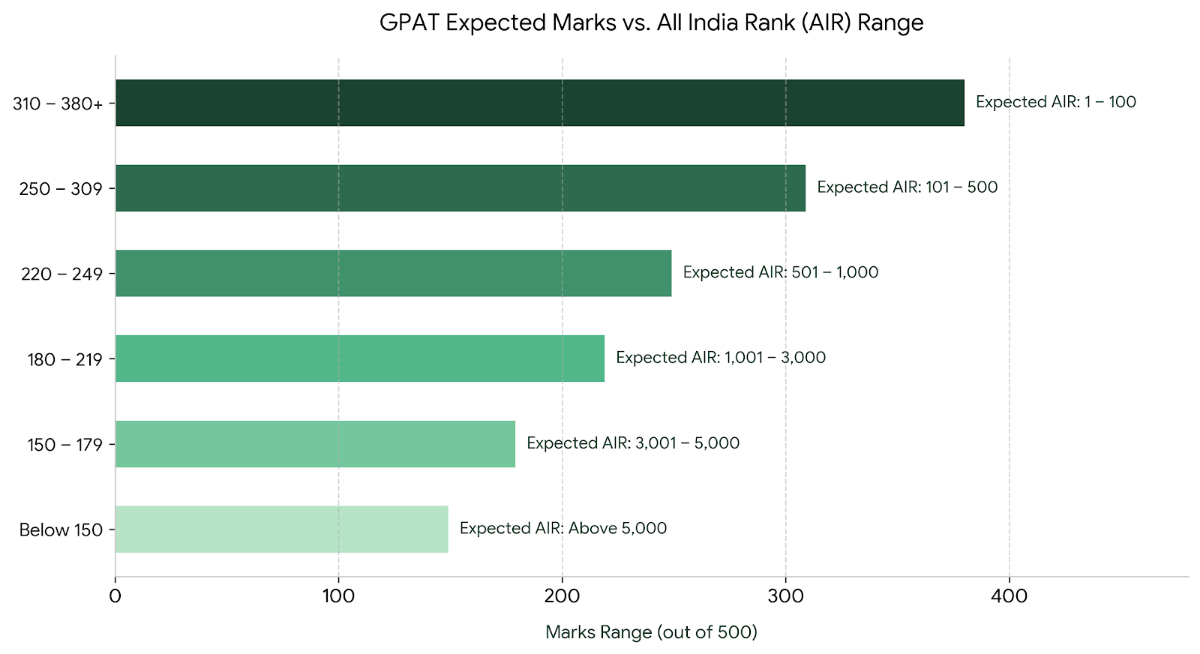
The expected GPAT rank range generally improves as the score increases, with higher marks opening access to more competitive institutions.
- Candidates scoring 310+ marks can target the top 100 ranks and highly competitive institutions, while 250–309 marks may place candidates in the 101–500 rank range.
- Scores of 220–249 may lead to ranks around 501–1,000, while scores below 180 generally correspond to ranks beyond 3,000.
Tie-Breaking Protocol: If two candidates score identical marks, NBEMS resolves rank using:
- Higher Pharmaceutics marks,
- Higher Pharmacy Practice marks,
- Fewer negative responses, and
- Older date of birth, in that order.
| Marks (Out of 500) | Expected AIR Range | Target Institutional Level |
|---|---|---|
| 310 – 380+ | 1 – 100 | IIT BHU, NIPER core branches, top central universities |
| 250 – 309 | 101 – 500 | Premier state-government pharmacy colleges |
| 220 – 249 | 501 – 1,000 | Top-tier university departments |
| 180 – 219 | 1,001 – 3,000 | Average government and top private institutions |
| 150 – 179 | 3,001 – 5,000 | Semi-government or local private institutions |
| Below 150 | Above 5,000 | State counselling pool for basic private colleges |
Also Check: List of Top Colleges in India Accepting GPAT Based on 2026 Ranking
GPAT 2027: Counselling and Admission
Unlike JEE Advanced or GATE, there is no centralized counselling for GPAT. Once results are declared, admission runs through three separate tracks:
- Centralised admission routes: NIPERs use NIPER JEE, while state-level counselling authorities use GPAT scores for admission and seat allotment as per their respective rules.
- Direct institute admissions: Universities and institutes conducting their own admissions may accept the GPAT 2027 score through separate application and counselling processes.
| Admission Route | Process | Role of GPAT |
|---|---|---|
| NIPERs | NIPER JEE, a separate entrance test | GPAT qualification is the mandatory eligibility gate but NIPER JEE rank decides admission |
| State-Level Counselling | State bodies (DTE Maharashtra, ACPC Gujarat, OJEE Odisha, etc.) run centralized counselling | GPAT-qualified candidates get priority in seat allotment |
| Independent Universities | ICT Mumbai, Jamia Hamdard, BITS Pilani release their own admission notifications | Candidates apply directly using their GPAT 2027 score |
Step-by-Step Counselling Flow:
- Verify that your scorecard shows "Qualified" status.
- Submit separate application forms for each target state board or university.
- Colleges publish a merit list based on GPAT All India Rank.
- Attend document verification for B.Pharm transcripts and category certificates.
- Freeze your allotted branch and pay the initial tuition fee to lock the seat.
Top Universities Accepting GPAT Score
Over 780 AICTE-approved colleges and university departments across India accept the GPAT entrance exam score for M.Pharm admissions. The expected GPAT cutoff ranges vary by institute, with the most competitive national institutes generally requiring the highest ranks.
- Top ranks for premier institutes: NIPER Mohali/Hyderabad, IIT BHU, Jamia Hamdard, and ICT Mumbai generally fall within the top 100–600 AIR range.
- Other NIPER campuses and leading public/private institutes may consider candidates with ranks extending to around 1,000, depending on the programme and admission year.
National Institutes
| Institution | Expected AIR Cutoff | Key Focus |
|---|---|---|
| NIPER Mohali / Hyderabad | Top 100–300 | Formulation, Regulatory Affairs, Pharmaceutical Synthesis |
| IIT BHU, Varanasi | Top 200–600 | Pharmaceutical Technology |
| Other NIPER Campuses | Top 300–800 | Industrial linkages, advanced research |
Public & Central Universities
| Institution | Expected AIR Cutoff | Key Focus |
|---|---|---|
| Jamia Hamdard, New Delhi | Top 100–400 | Pharmacognosy, Clinical Pharmacy |
| ICT Mumbai | Top 100–500 | Chemical Engineering, Pharmaceutical Scale-up |
| Panjab University (UIPS) | Top 200–600 | Pharmaceutical education legacy |
| DIPSAR Delhi | Top 300–700 | Hospital Pharmacy |
| Jadavpur University | Top 400–800 | Biotechnology research |
Top-Tier Private Institutes
| Institution | Expected AIR Cutoff | Key Focus |
|---|---|---|
| BITS Pilani | Top 100–500 | Industry-oriented M.Pharm |
| MCOPS, Manipal | Top 400–900 | Research infrastructure |
| JSS College of Pharmacy | Top 500–1,000 | Clinical Pharmacy Management |
GPAT 2027 FAQs
Ques. What is the GPAT exam?
Ans. GPAT full form is Graduate Pharmacy Aptitude Test — a national-level entrance exam for M.Pharm admissions, conducted by NBEMS on behalf of the Pharmacy Council of India.
Ques. Is GPAT conducted by NTA?
Ans. No. Graduate Pharmacy Aptitude Test is actually conducted by the National Board of Examinations in Medical Sciences (NBEMS), not the National Testing Agency.
Ques. What is the GPAT exam syllabus?
Ans. The GPAT syllabus covers the full 4-year B.Pharm curriculum across five domains — Pharmaceutical Chemistry, Pharmaceutics, Pharmacology, Pharmacognosy, and Other Allied Subjects, as detailed in the official graduate pharmacy aptitude test syllabus.
Ques. Where can I find the GPAT syllabus PDF?
Ans. The official GPAT syllabus PDF is released along with the information bulletin on the GPAT official website, natboard.edu.in, at the start of each registration cycle.
Ques. What is the GPAT exam fee for GPAT 2027?
Ans. The GPAT exam fees are ₹3,500 for General, OBC, and EWS candidates, and ₹2,500 for SC, ST, and PwD candidates, payable online through the GPAT application form portal.
Ques. How do I complete GPAT registration and fill the GPAT application form?
Ans. GPAT registration is done entirely online on natboard.edu.in in five steps: account creation, application form filling, document/biometric upload, test city selection, and fee payment.
Ques. When will GPAT results be declared, and how do I get the GPAT scorecard?
Ans. GPAT results are typically declared in the first week of April, about a month after the exam date, and the scorecard can be downloaded directly from the GPAT official website using your application details.
Ques. What is the GPAT exam date for 2027?
Ans. The GPAT 2027 exam date is expected in the first week of March 2027, though the exact date is confirmed only in the official information bulletin.
Ques. Who is eligible for the GPAT entrance exam?
Ans. Candidates with a completed or final-year 4-year B.Pharm degree from a PCI-recognized institute are eligible; there is no upper age limit and no cap on the number of attempts.
Ques. Is the GPAT form editable after submission?
Ans. No. Once the GPAT form is submitted, key fields such as name, email, mobile number, nationality, test city, and Aadhaar number cannot be changed, even during later edit windows.


%20-%202026-04-07T124527.778.png?h=112&w=263&mode=stretch)


%20-%202026-03-08T142957.638.png?h=112&w=263&mode=stretch)



Comments