NCERT Solutions for Class 11 Legal Studies Chapter 6 Jurisprudence, Nature and Meaning of Law cover all textbook questions for the 2026-27 CBSE syllabus. The PDF explains natural law, analytical law, historical law, sociological law, natural justice and the purpose of law in short school-answer form.
Includes 13 solved question cards with detailed solution and expert solution tabs.
Covers Natural Law School, Analytical School, social engineering and natural justice.
Uses comparison tables, source cues and final-answer boxes for quick revision.
Jurisprudence, Nature and Meaning of Law Class 11 Legal Studies NCERT Solutions PDF
Student Feedback: In a Collegedunia poll of 10,940 Class 11 Legal Studies students, 74 percent said this chapter became easier when the schools of law were revised as one comparison table.
These Class 11 Legal Studies Chapter 6 solutions are checked against the official NCERT chapter and written for the 2026-27 CBSE syllabus.
Jurisprudence, Nature and Meaning of Law Exercise Pattern
Jurisprudence, Nature and Meaning of Law asks students to compare legal theories and explain short legal maxims. The answers are conceptual, so each response needs a direct point, then a textbook reason.
Question group
What it checks
Best answer format
Q1 differences
Schools of jurisprudence
Two-column contrast
Q2 brief answers
Social engineering, natural law and justice
Definition plus two points
Q3 detailed answers
Purpose of law and jurist views
Author-wise table or list
Q4 application
Identify the school from a legal scenario
School name, clues and explanation
Schools of Law in Jurisprudence, Nature and Meaning of Law
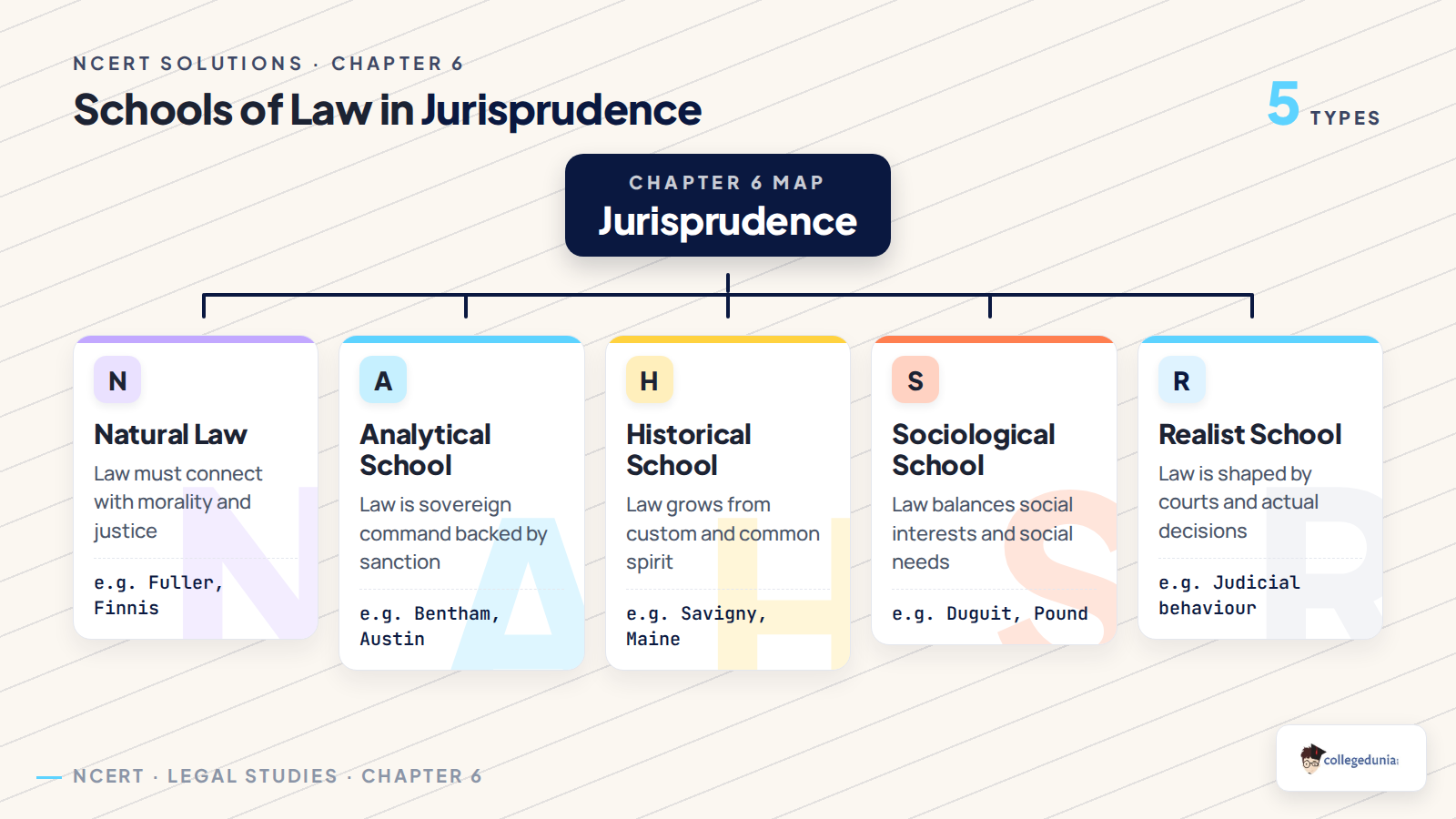
The chapter compares five schools of law. The safest revision method is to learn one source, one key jurist and one main idea for each school.
Natural Law School: law must connect with morality and justice.
Analytical School: law is a sovereign command backed by sanction.
Historical School: law grows from custom and common spirit.
Sociological School: law balances social interests and social needs.
Realist School: law is shaped by courts and actual decisions.
Natural Law School and Natural Justice in Class 11 Legal Studies
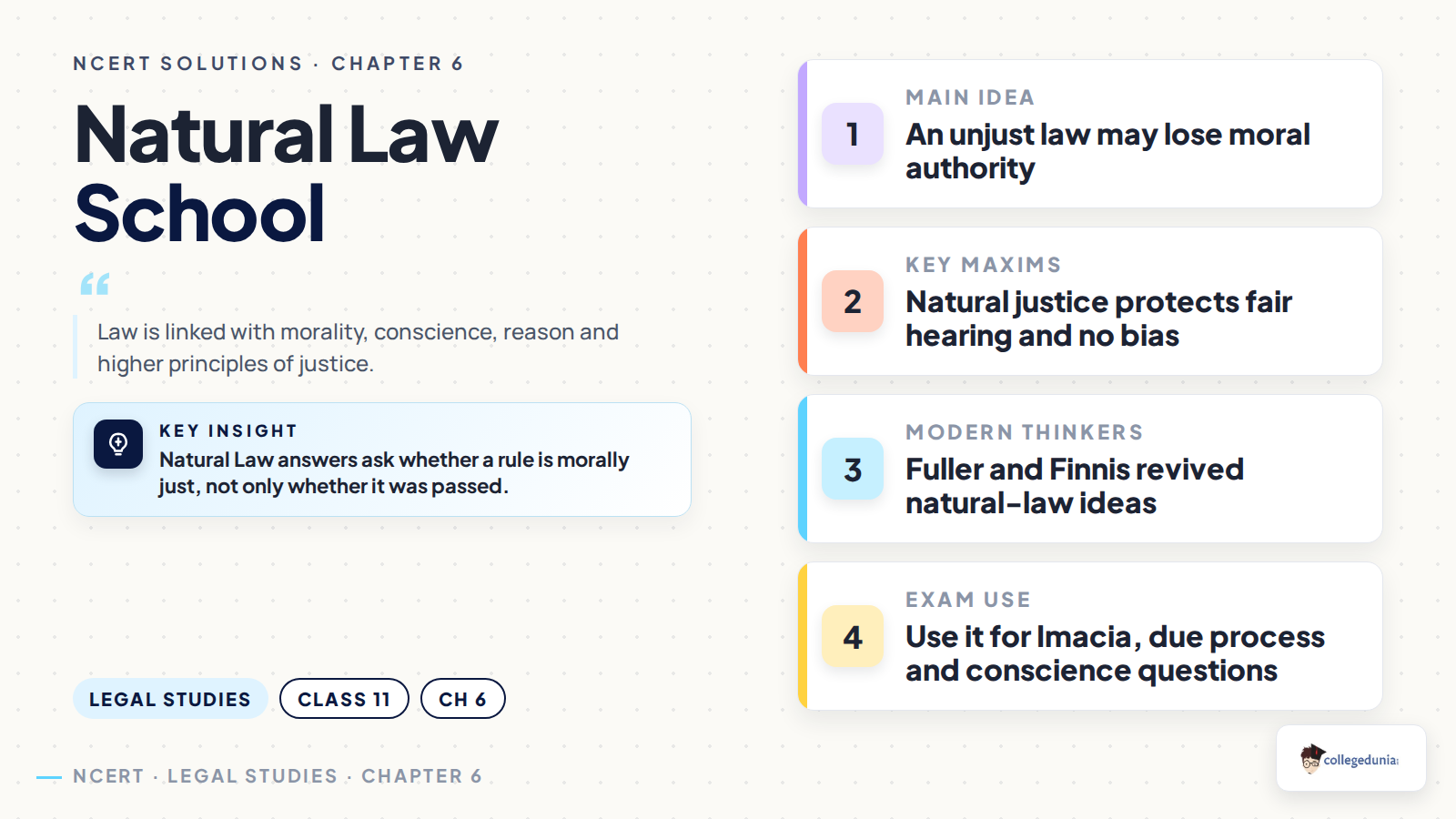
Natural Law School says law is not only a command written by the State. It must also answer to conscience, reason and justice. This idea helps in Q2(c), Q2(d), Q2(e) and the Imacia scenario.
Lex iniusta non est lex means an unjust law is not a true law.
Nemo judex in causa sua means no one should judge their own cause.
Audi alteram partem means hear the other side before deciding.
Articles 14 and 21 ground natural justice in equality and fair procedure.
Roscoe Pound and Social Engineering in Jurisprudence
Roscoe Pound introduced the idea of social engineering. It belongs to sociological jurisprudence and treats law as a tool for balancing competing interests in society.
Jurist
Main view
Exam cue
Duguit
Law serves social solidarity.
Interdependence
Jhering
Law protects social interests.
Means to an end
Ehrlich
Living law comes from social practices.
Society first
Roscoe Pound
Law balances competing interests.
Social engineering
Common Mistakes in Jurisprudence, Nature and Meaning of Law Answers
Do not use the same line for every school of law. Each school has a different starting point.
Do not confuse Natural Law School with natural justice maxims.
Do not write only jurist names without their main views.
Do not explain social engineering without naming Roscoe Pound.
Do not skip uniformity and impartiality in the purpose-of-law answer.
Jurisprudence, Nature and Meaning of Law Cross-Resource Study Links
Use these Class 11 Legal Studies resources after reading the solved PDF. They help students move from full answers to short revision.
All NCERT Solutions for Class 11 Legal Studies Chapter 6 Jurisprudence, Nature and Meaning of Law with Step-by-Step Solutions
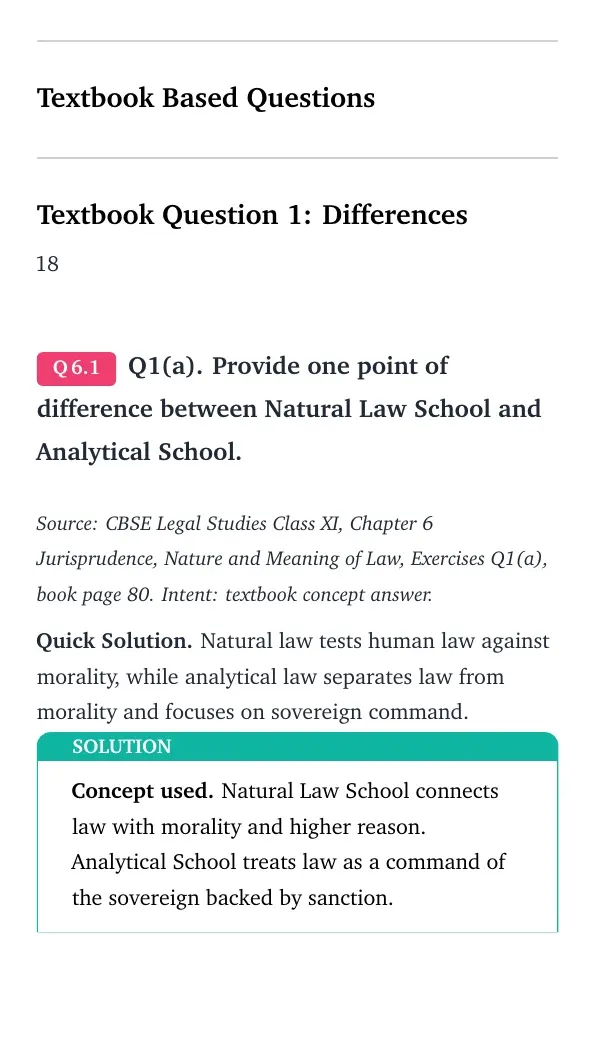
Textbook Question 1: Differences
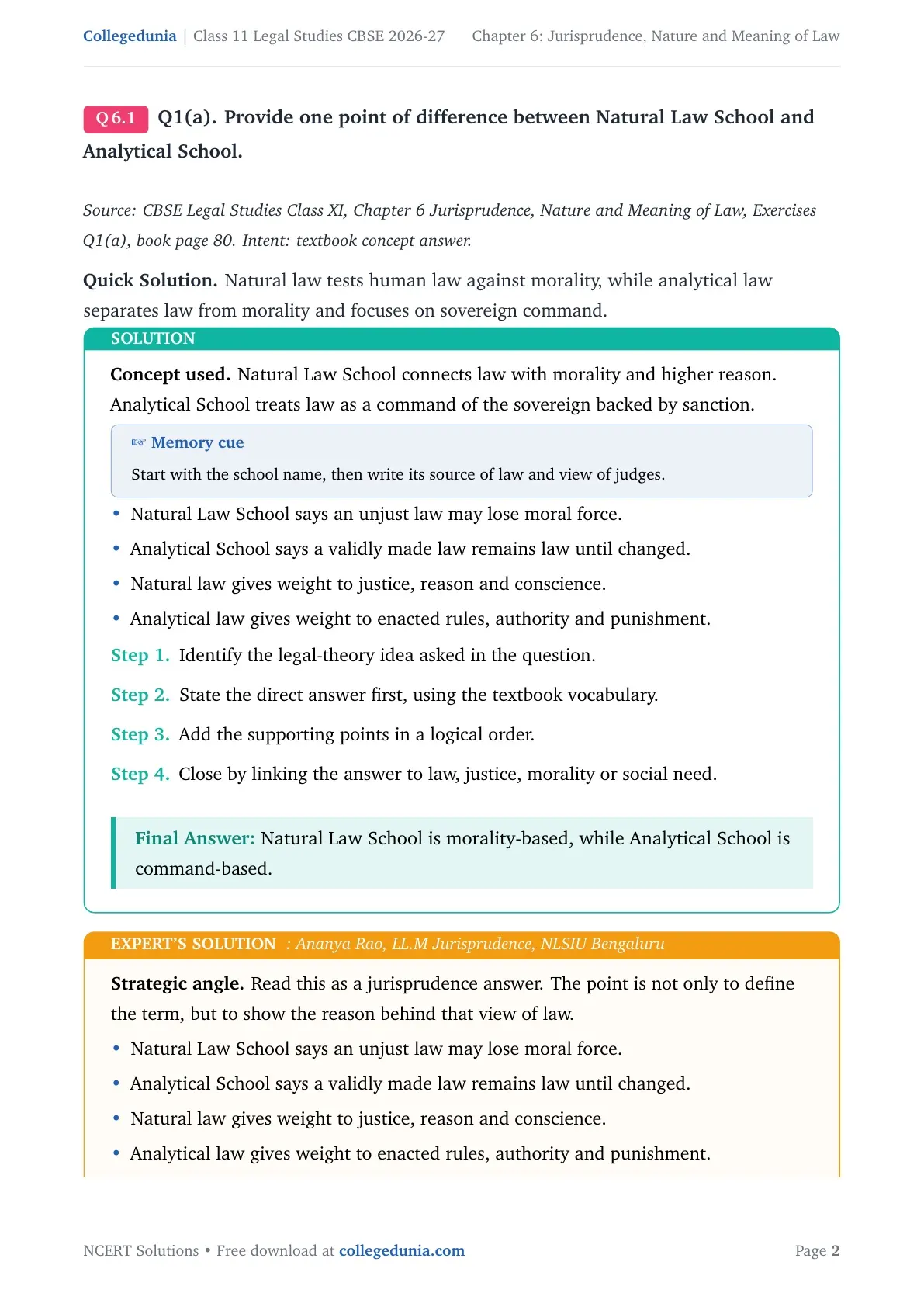
Q 6.1
Q1(a). Provide one point of difference between Natural Law School and Analytical School.
Concept used. Natural Law School connects law with morality and higher reason. Analytical School treats law as a command of the sovereign backed by sanction.
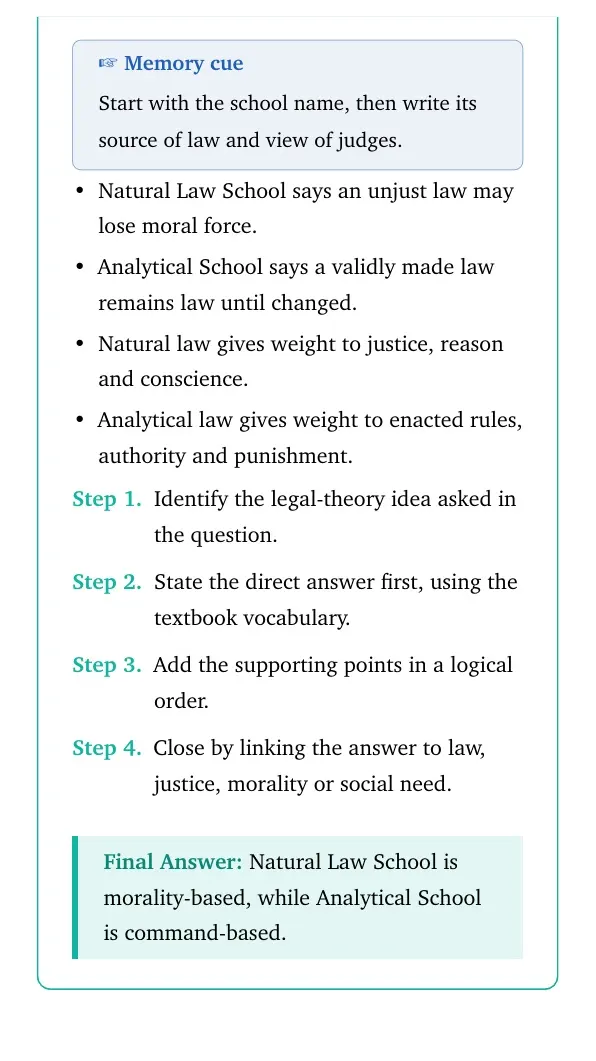
Memory cue
Start with the school name, then write its source of law and view of judges.
Natural Law School says an unjust law may lose moral force.
Analytical School says a validly made law remains law until changed.
Natural law gives weight to justice, reason and conscience.
Analytical law gives weight to enacted rules, authority and punishment.
Identify the legal-theory idea asked in the question.
State the direct answer first, using the textbook vocabulary.
Add the supporting points in a logical order.
Close by linking the answer to law, justice, morality or social need.
Natural Law School is morality-based, while Analytical School is command-based.
AR
Ananya Rao
LL.M Jurisprudence, NLSIU Bengaluru
Verified Expert
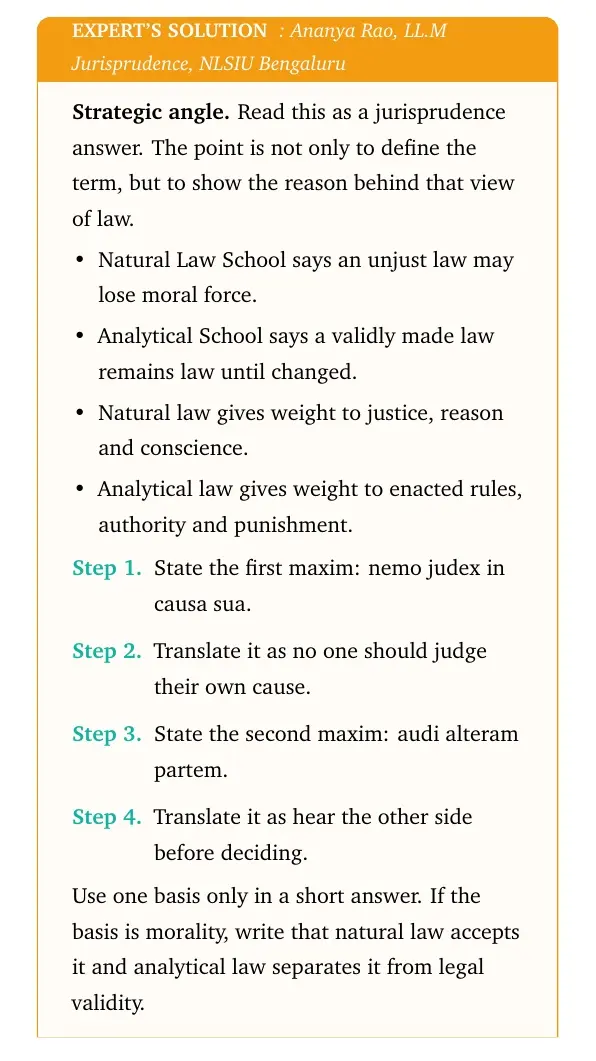
Strategic angle. Read this as a jurisprudence answer. The point is not only to define the term, but to show the reason behind that view of law.
Natural Law School says an unjust law may lose moral force.
Analytical School says a validly made law remains law until changed.
Natural law gives weight to justice, reason and conscience.
Analytical law gives weight to enacted rules, authority and punishment.
State the first maxim: nemo judex in causa sua.
Translate it as no one should judge their own cause.
State the second maxim: audi alteram partem.
Translate it as hear the other side before deciding.
Use one basis only in a short answer. If the basis is morality, write that natural law accepts it and analytical law separates it from legal validity.
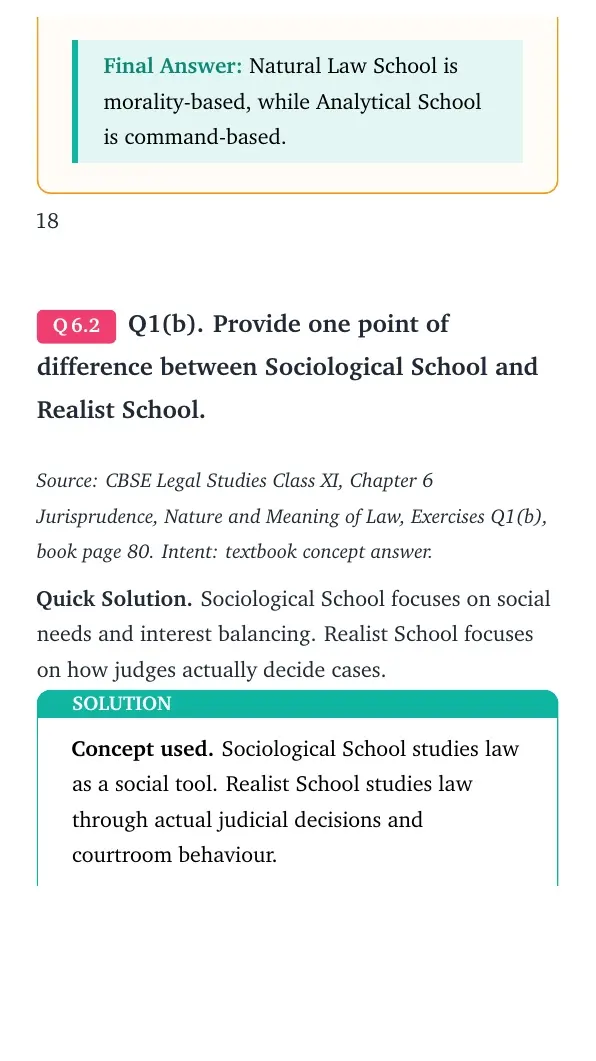
Natural Law School is morality-based, while Analytical School is command-based.
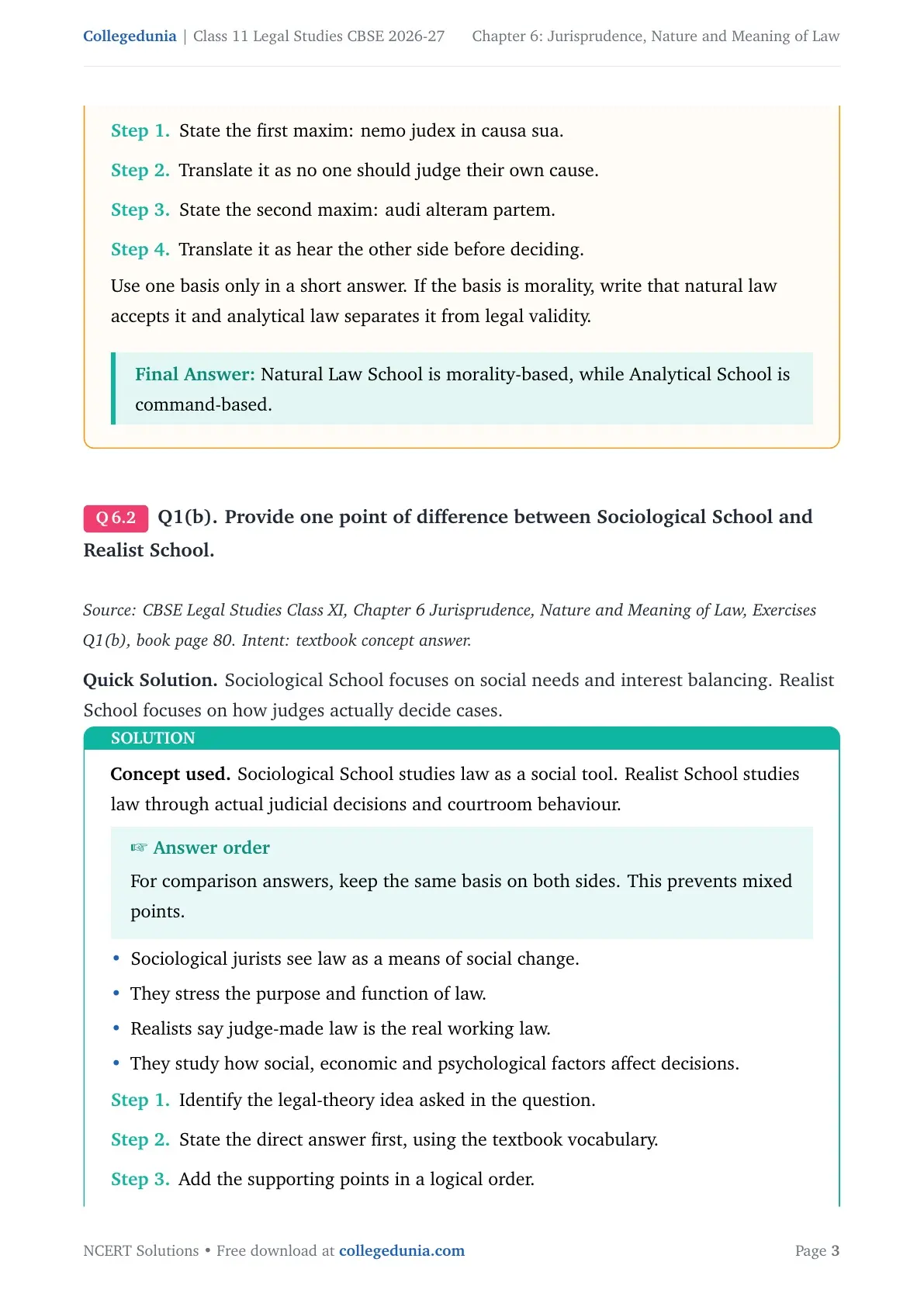
Q 6.2
Q1(b). Provide one point of difference between Sociological School and Realist School.
Concept used. Sociological School studies law as a social tool. Realist School studies law through actual judicial decisions and courtroom behaviour.
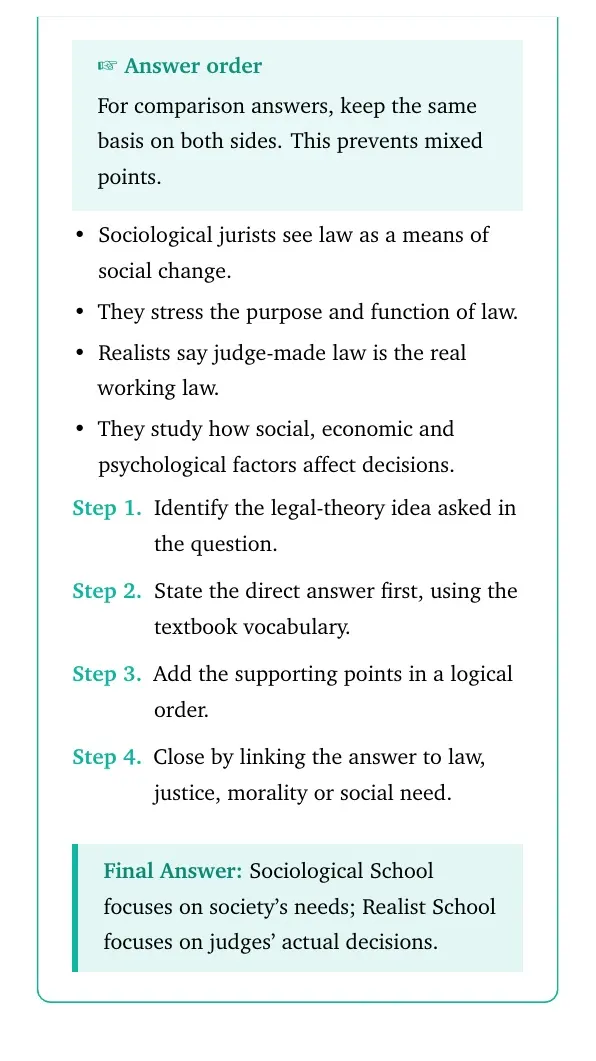
Answer order
For comparison answers, keep the same basis on both sides. This prevents mixed points.
Sociological jurists see law as a means of social change.
They stress the purpose and function of law.
Realists say judge-made law is the real working law.
They study how social, economic and psychological factors affect decisions.
Identify the legal-theory idea asked in the question.
State the direct answer first, using the textbook vocabulary.
Add the supporting points in a logical order.
Close by linking the answer to law, justice, morality or social need.
Sociological School focuses on society's needs; Realist School focuses on judges' actual decisions.
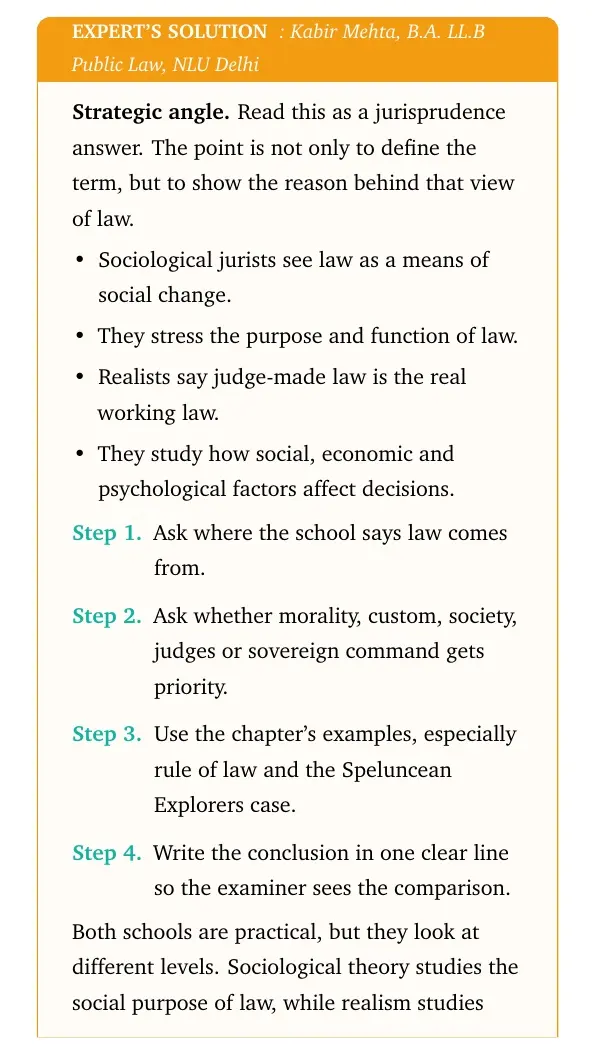
KM
Kabir Mehta
B.A. LL.B Public Law, NLU Delhi
Verified Expert
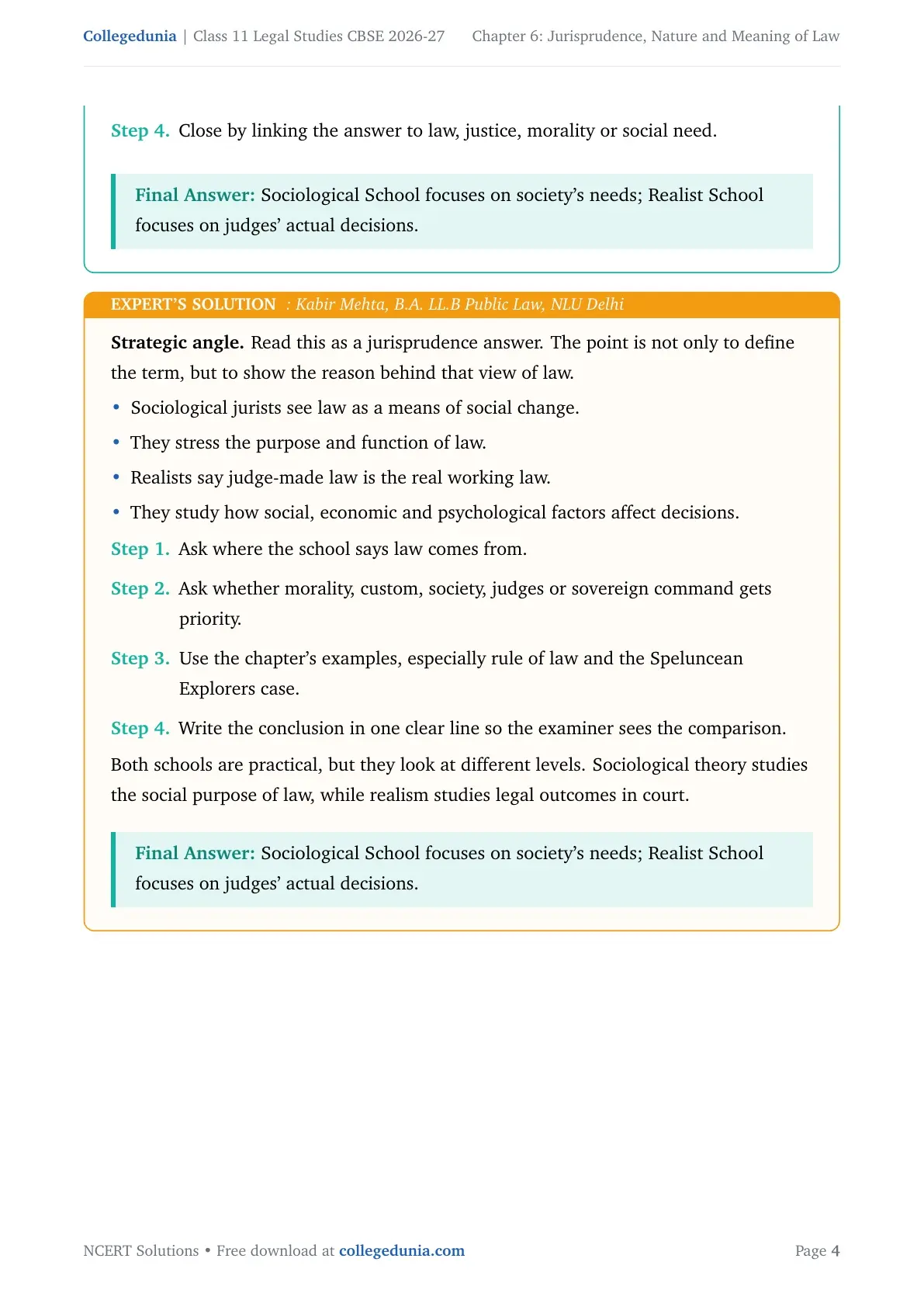
Strategic angle. Read this as a jurisprudence answer. The point is not only to define the term, but to show the reason behind that view of law.
Sociological jurists see law as a means of social change.
They stress the purpose and function of law.
Realists say judge-made law is the real working law.
They study how social, economic and psychological factors affect decisions.
Ask where the school says law comes from.
Ask whether morality, custom, society, judges or sovereign command gets priority.
Use the chapter's examples, especially rule of law and the Speluncean Explorers case.
Write the conclusion in one clear line so the examiner sees the comparison.
Both schools are practical, but they look at different levels. Sociological theory studies the social purpose of law, while realism studies legal outcomes in court.
Sociological School focuses on society's needs; Realist School focuses on judges' actual decisions.
Q 6.3
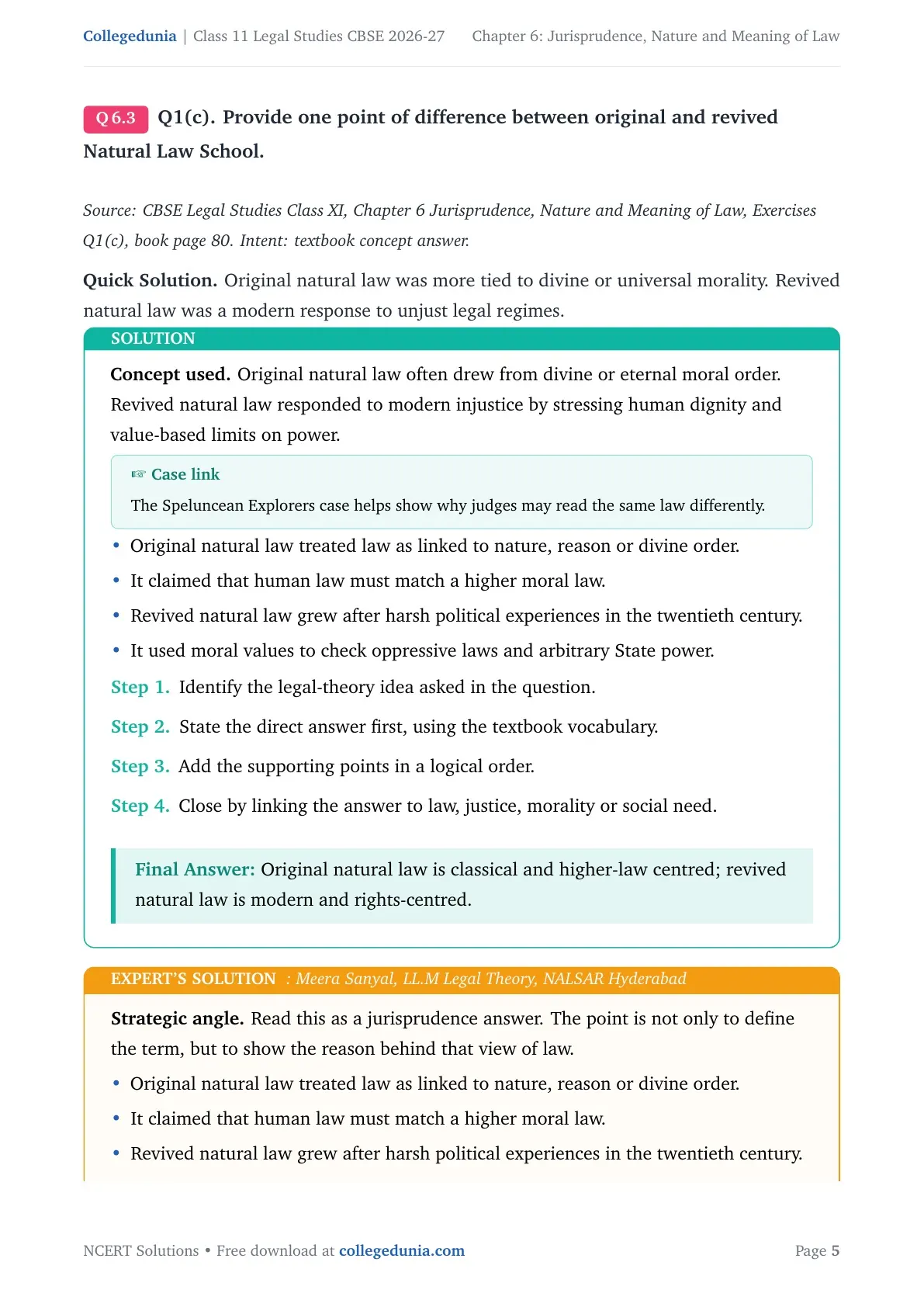
Q1(c). Provide one point of difference between original and revived Natural Law School.
Concept used. Original natural law often drew from divine or eternal moral order. Revived natural law responded to modern injustice by stressing human dignity and value-based limits on power.
Case link
The Speluncean Explorers case helps show why judges may read the same law differently.
Original natural law treated law as linked to nature, reason or divine order.
It claimed that human law must match a higher moral law.
Revived natural law grew after harsh political experiences in the twentieth century.
It used moral values to check oppressive laws and arbitrary State power.
Identify the legal-theory idea asked in the question.
State the direct answer first, using the textbook vocabulary.
Add the supporting points in a logical order.
Close by linking the answer to law, justice, morality or social need.
Original natural law is classical and higher-law centred; revived natural law is modern and rights-centred.
MS
Meera Sanyal
LL.M Legal Theory, NALSAR Hyderabad
Verified Expert
Strategic angle. Read this as a jurisprudence answer. The point is not only to define the term, but to show the reason behind that view of law.
Original natural law treated law as linked to nature, reason or divine order.
It claimed that human law must match a higher moral law.
Revived natural law grew after harsh political experiences in the twentieth century.
It used moral values to check oppressive laws and arbitrary State power.
Ask where the school says law comes from.
Ask whether morality, custom, society, judges or sovereign command gets priority.
Use the chapter's examples, especially rule of law and the Speluncean Explorers case.
Write the conclusion in one clear line so the examiner sees the comparison.
The chapter notes that extreme legal positivism could make law look like a bare command. The revival answered that problem by bringing justice and value back into legal thought.
Original natural law is classical and higher-law centred; revived natural law is modern and rights-centred.
Q 6.4
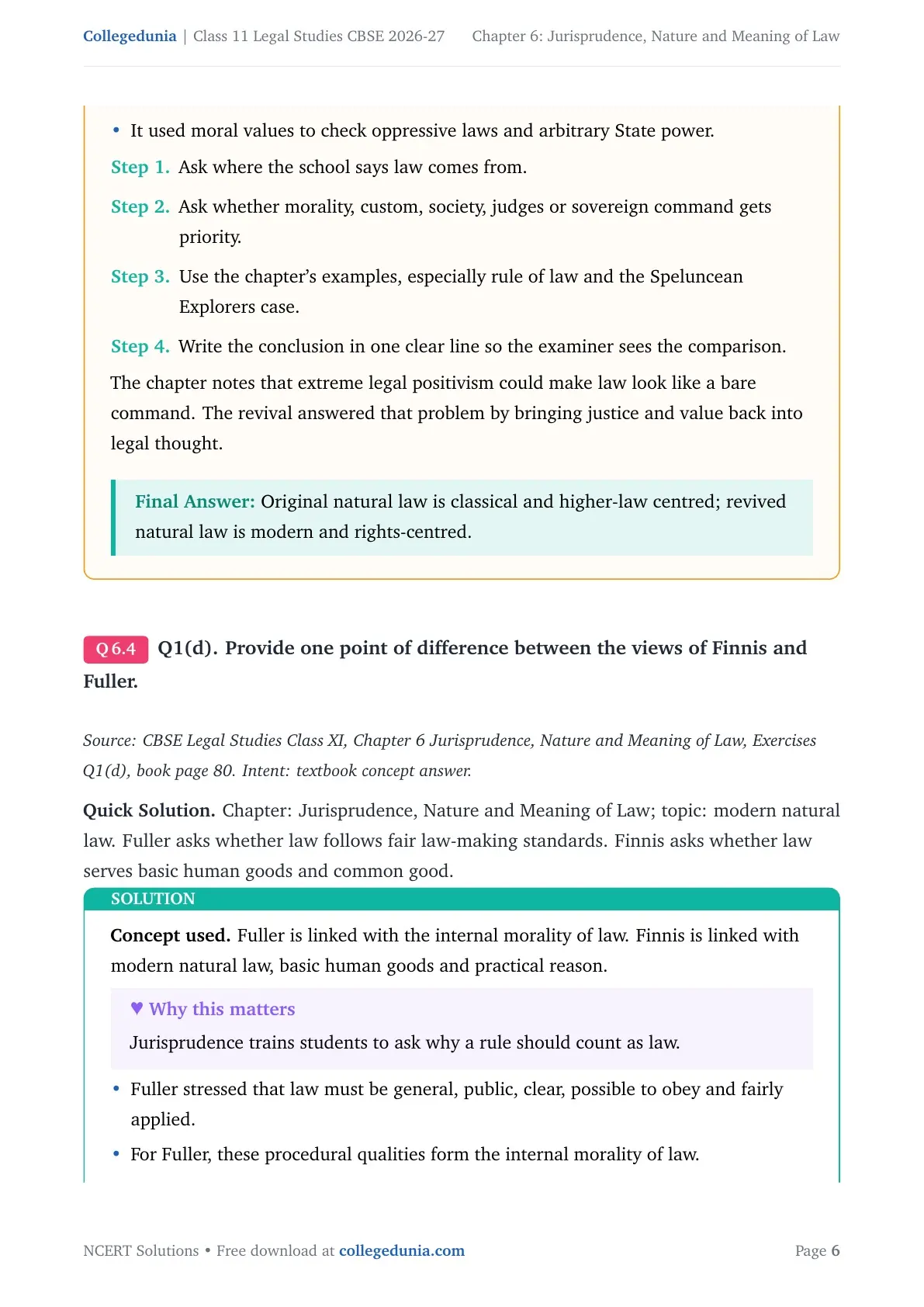
Q1(d). Provide one point of difference between the views of Finnis and Fuller.
Concept used. Fuller is linked with the internal morality of law. Finnis is linked with modern natural law, basic human goods and practical reason.
Why this matters
Jurisprudence trains students to ask why a rule should count as law.
Fuller stressed that law must be general, public, clear, possible to obey and fairly applied.
For Fuller, these procedural qualities form the internal morality of law.
Finnis stressed basic human goods such as life, knowledge, friendship and practical reasonableness.
For Finnis, law should coordinate society toward common good.
Identify the legal-theory idea asked in the question.
State the direct answer first, using the textbook vocabulary.
Add the supporting points in a logical order.
Close by linking the answer to law, justice, morality or social need.
Fuller focuses on procedural morality of law; Finnis focuses on basic goods and common good.
RB
Rohan Batra
LL.M Constitutional Law, GNLU Gandhinagar
Verified Expert
Strategic angle. Read this as a jurisprudence answer. The point is not only to define the term, but to show the reason behind that view of law.
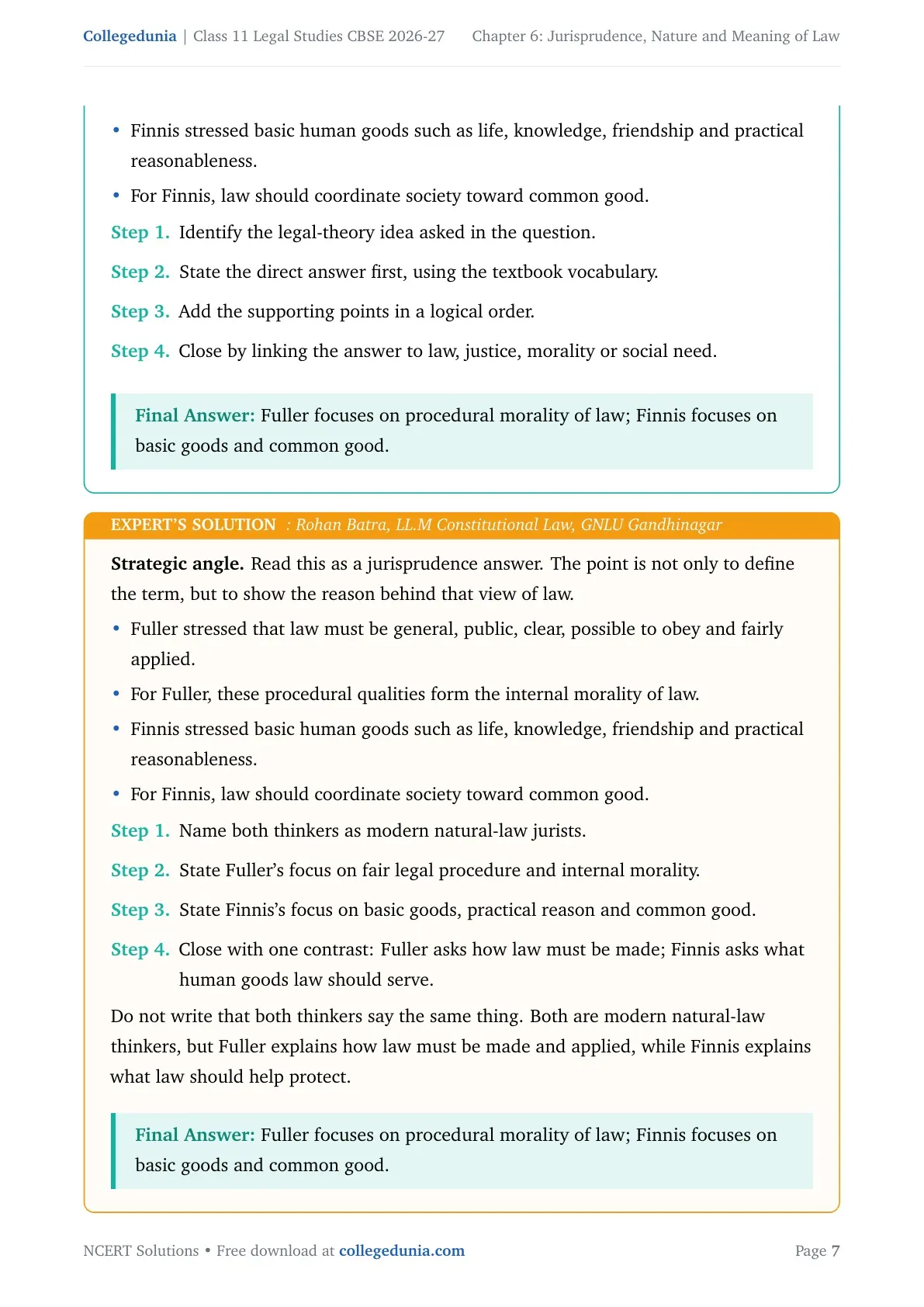
Fuller stressed that law must be general, public, clear, possible to obey and fairly applied.
For Fuller, these procedural qualities form the internal morality of law.
Finnis stressed basic human goods such as life, knowledge, friendship and practical reasonableness.
For Finnis, law should coordinate society toward common good.
Name both thinkers as modern natural-law jurists.
State Fuller's focus on fair legal procedure and internal morality.
State Finnis's focus on basic goods, practical reason and common good.
Close with one contrast: Fuller asks how law must be made; Finnis asks what human goods law should serve.
Do not write that both thinkers say the same thing. Both are modern natural-law thinkers, but Fuller explains how law must be made and applied, while Finnis explains what law should help protect.
Fuller focuses on procedural morality of law; Finnis focuses on basic goods and common good.
Textbook Question 2: Brief Answers
Q 6.5
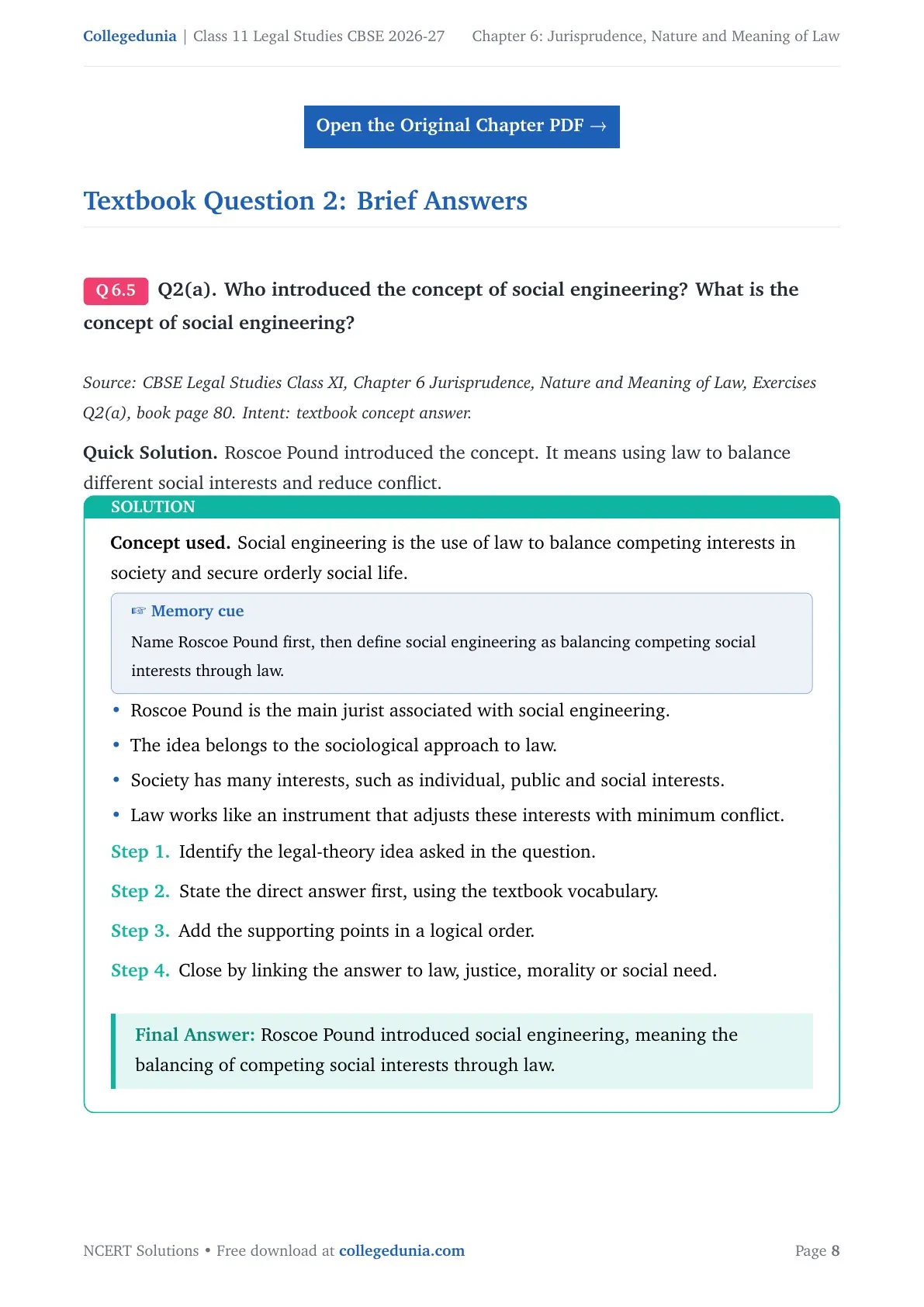
Q2(a). Who introduced the concept of social engineering? What is the concept of social engineering?
Concept used. Social engineering is the use of law to balance competing interests in society and secure orderly social life.
Memory cue
Name Roscoe Pound first, then define social engineering as balancing competing social interests through law.
Roscoe Pound is the main jurist associated with social engineering.
The idea belongs to the sociological approach to law.
Society has many interests, such as individual, public and social interests.
Law works like an instrument that adjusts these interests with minimum conflict.
Identify the legal-theory idea asked in the question.
State the direct answer first, using the textbook vocabulary.
Add the supporting points in a logical order.
Close by linking the answer to law, justice, morality or social need.
Roscoe Pound introduced social engineering, meaning the balancing of competing social interests through law.
IM
Ishita Menon
B.A. LL.B Legal Studies, Symbiosis Pune
Verified Expert
Strategic angle. Read this as a jurisprudence answer. The point is not only to define the term, but to show the reason behind that view of law.
Roscoe Pound is the main jurist associated with social engineering.
The idea belongs to the sociological approach to law.
Society has many interests, such as individual, public and social interests.
Law works like an instrument that adjusts these interests with minimum conflict.
Name Roscoe Pound as the jurist.
Place the idea in sociological jurisprudence.
Explain that society has competing individual, public and social interests.
Conclude that law balances those interests with minimum conflict.
A strong answer should use the word balance. Pound did not treat law as a rule on paper only. He treated it as a working tool for social adjustment.
Roscoe Pound introduced social engineering, meaning the balancing of competing social interests through law.
Q 6.6
Q2(b). On what grounds was the historical approach to law criticised?
Concept used. The historical approach explains law through custom, social development and the common spirit of the people.
Answer order
Map the criticism words directly: vague means unclear proof, parochial means too local, and unscientific means not tested by a clear method.
It could not always explain modern legislation and planned reform.
Its idea of common spirit was difficult to prove clearly.
It could become narrow because it tied law too closely to local customs.
It did not fully account for rapid social change and deliberate law-making.
Identify the legal-theory idea asked in the question.
State the direct answer first, using the textbook vocabulary.
Add the supporting points in a logical order.
Close by linking the answer to law, justice, morality or social need.
The historical approach was criticised for being vague, narrow and unscientific in explaining law.
AS
Arjun Sen
LL.M Public Law, NUJS Kolkata
Verified Expert
Strategic angle. Read this as a jurisprudence answer. The point is not only to define the term, but to show the reason behind that view of law.
It could not always explain modern legislation and planned reform.
Its idea of common spirit was difficult to prove clearly.
It could become narrow because it tied law too closely to local customs.
It did not fully account for rapid social change and deliberate law-making.
Begin with the historical school's focus on custom and gradual growth.
Explain why common spirit can be vague.
Explain why a custom-based theory can become parochial.
Explain why it is called unscientific when it cannot handle modern planned legislation.
The safest textbook answer uses the chapter's words: vague, parochial and unscientific. Add one reason only if the question asks for explanation.
The historical approach was criticised for being vague, narrow and unscientific in explaining law.
Q 6.7
Q2(c). What do you understand by the maxim Lex iniusta non est lex?
Concept used. The maxim belongs to natural law thought and links legal validity with moral justice.
Case link
The Speluncean Explorers case helps show why judges may read the same law differently.
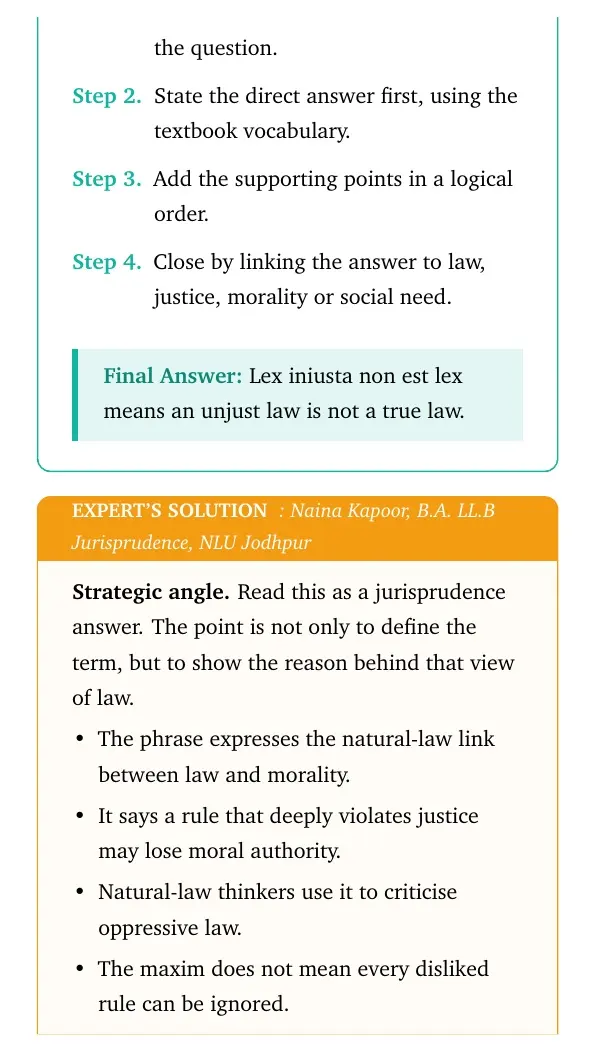
The phrase expresses the natural-law link between law and morality.
It says a rule that deeply violates justice may lose moral authority.
Natural-law thinkers use it to criticise oppressive law.
The maxim does not mean every disliked rule can be ignored.
Identify the legal-theory idea asked in the question.
State the direct answer first, using the textbook vocabulary.
Add the supporting points in a logical order.
Close by linking the answer to law, justice, morality or social need.
Lex iniusta non est lex means an unjust law is not a true law.
NK
Naina Kapoor
B.A. LL.B Jurisprudence, NLU Jodhpur
Verified Expert
Strategic angle. Read this as a jurisprudence answer. The point is not only to define the term, but to show the reason behind that view of law.
The phrase expresses the natural-law link between law and morality.
It says a rule that deeply violates justice may lose moral authority.
Natural-law thinkers use it to criticise oppressive law.
The maxim does not mean every disliked rule can be ignored.
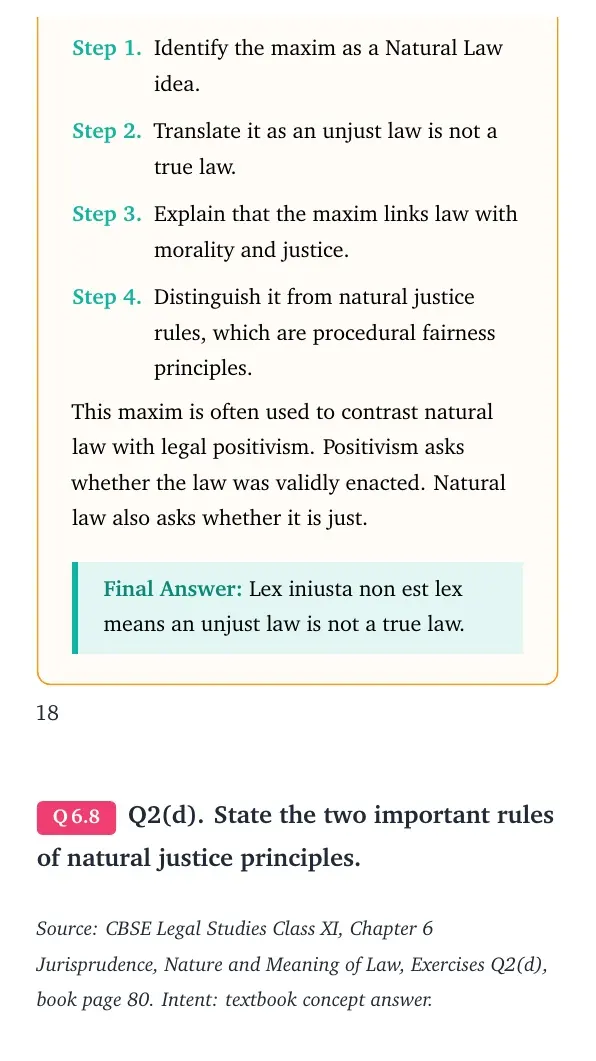
Identify the maxim as a Natural Law idea.
Translate it as an unjust law is not a true law.
Explain that the maxim links law with morality and justice.
Distinguish it from natural justice rules, which are procedural fairness principles.
This maxim is often used to contrast natural law with legal positivism. Positivism asks whether the law was validly enacted. Natural law also asks whether it is just.
Lex iniusta non est lex means an unjust law is not a true law.
Q 6.8
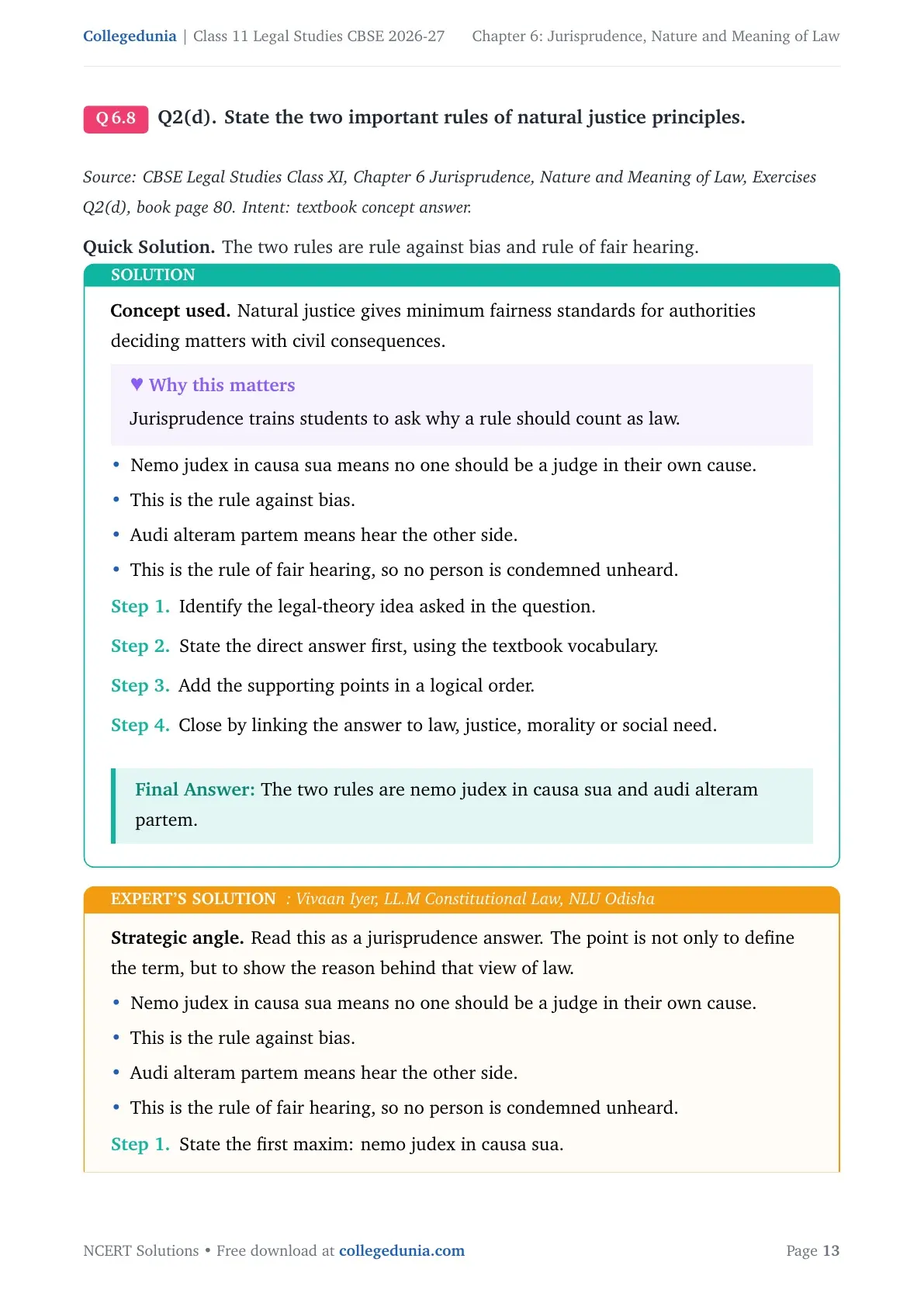
Q2(d). State the two important rules of natural justice principles.
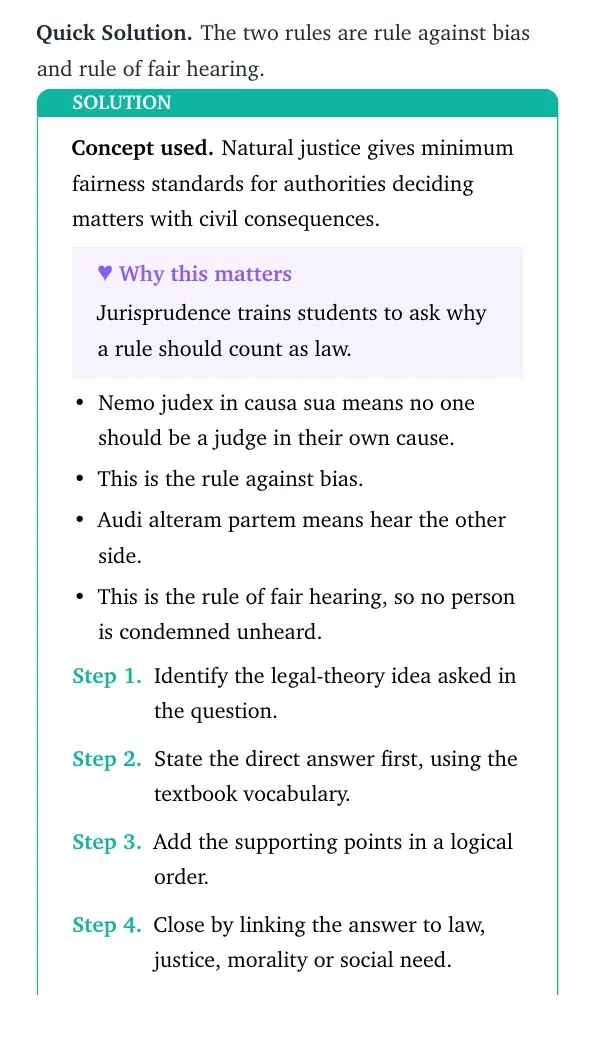
Concept used. Natural justice gives minimum fairness standards for authorities deciding matters with civil consequences.
Why this matters
Jurisprudence trains students to ask why a rule should count as law.
Nemo judex in causa sua means no one should be a judge in their own cause.
This is the rule against bias.
Audi alteram partem means hear the other side.
This is the rule of fair hearing, so no person is condemned unheard.
Identify the legal-theory idea asked in the question.
State the direct answer first, using the textbook vocabulary.
Add the supporting points in a logical order.
Close by linking the answer to law, justice, morality or social need.
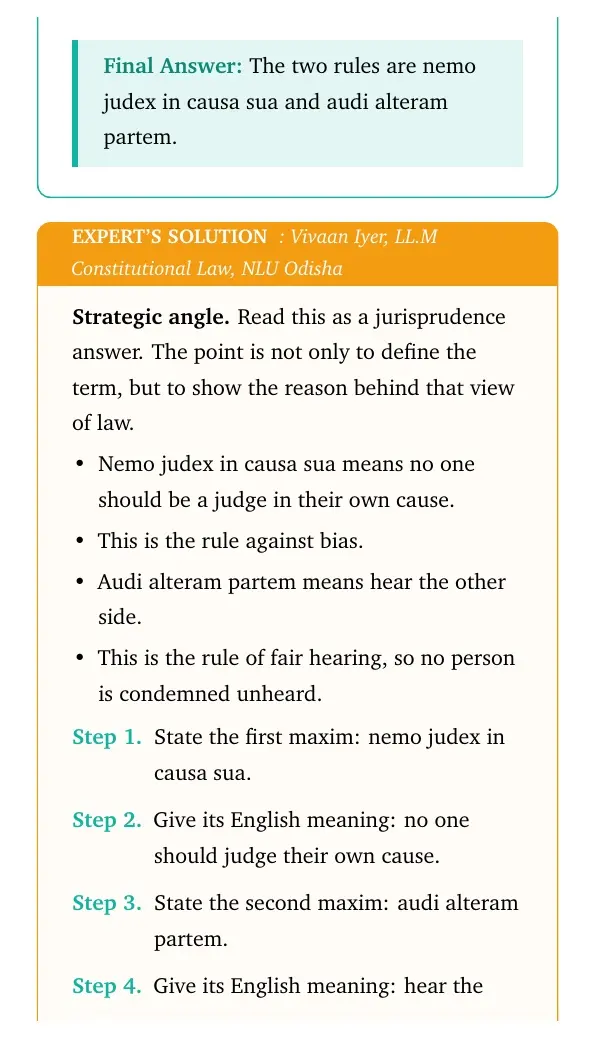
The two rules are nemo judex in causa sua and audi alteram partem.
VI
Vivaan Iyer
LL.M Constitutional Law, NLU Odisha
Verified Expert
Strategic angle. Read this as a jurisprudence answer. The point is not only to define the term, but to show the reason behind that view of law.
Nemo judex in causa sua means no one should be a judge in their own cause.
This is the rule against bias.
Audi alteram partem means hear the other side.
This is the rule of fair hearing, so no person is condemned unheard.
State the first maxim: nemo judex in causa sua.
Give its English meaning: no one should judge their own cause.
State the second maxim: audi alteram partem.
Give its English meaning: hear the other side before deciding.
Use the Latin phrase and the English meaning together. The Latin earns precision, and the English meaning shows that the rule has been understood.
The two rules are nemo judex in causa sua and audi alteram partem.
Q 6.9
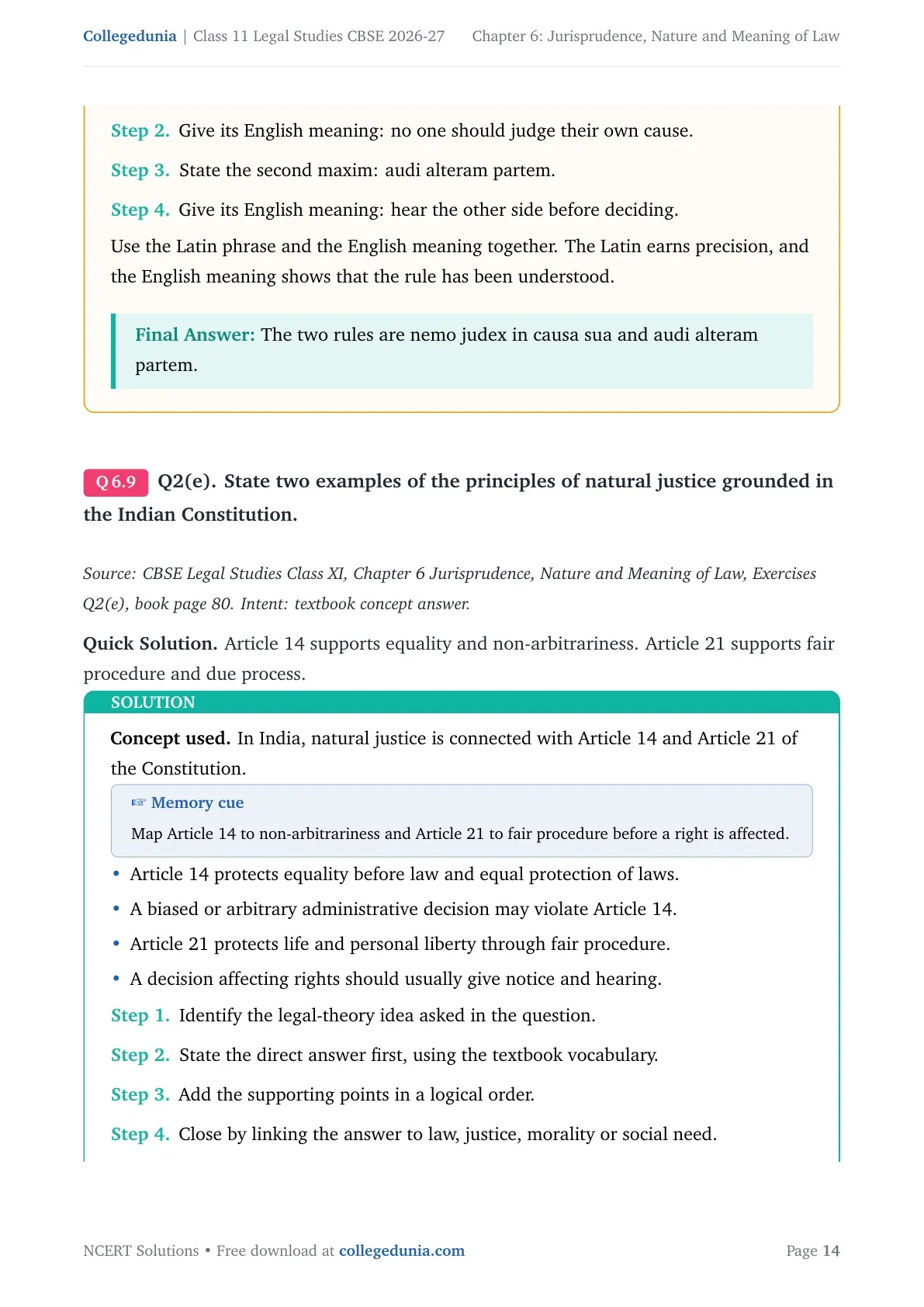
Q2(e). State two examples of the principles of natural justice grounded in the Indian Constitution.
Concept used. In India, natural justice is connected with Article 14 and Article 21 of the Constitution.
Memory cue
Map Article 14 to non-arbitrariness and Article 21 to fair procedure before a right is affected.
Article 14 protects equality before law and equal protection of laws.
A biased or arbitrary administrative decision may violate Article 14.
Article 21 protects life and personal liberty through fair procedure.
A decision affecting rights should usually give notice and hearing.
Identify the legal-theory idea asked in the question.
State the direct answer first, using the textbook vocabulary.
Add the supporting points in a logical order.
Close by linking the answer to law, justice, morality or social need.
Article 14 and Article 21 are two constitutional bases for natural justice in India.
SM
Sanya Malhotra
B.A. LL.B Legal Theory, ILS Pune
Verified Expert
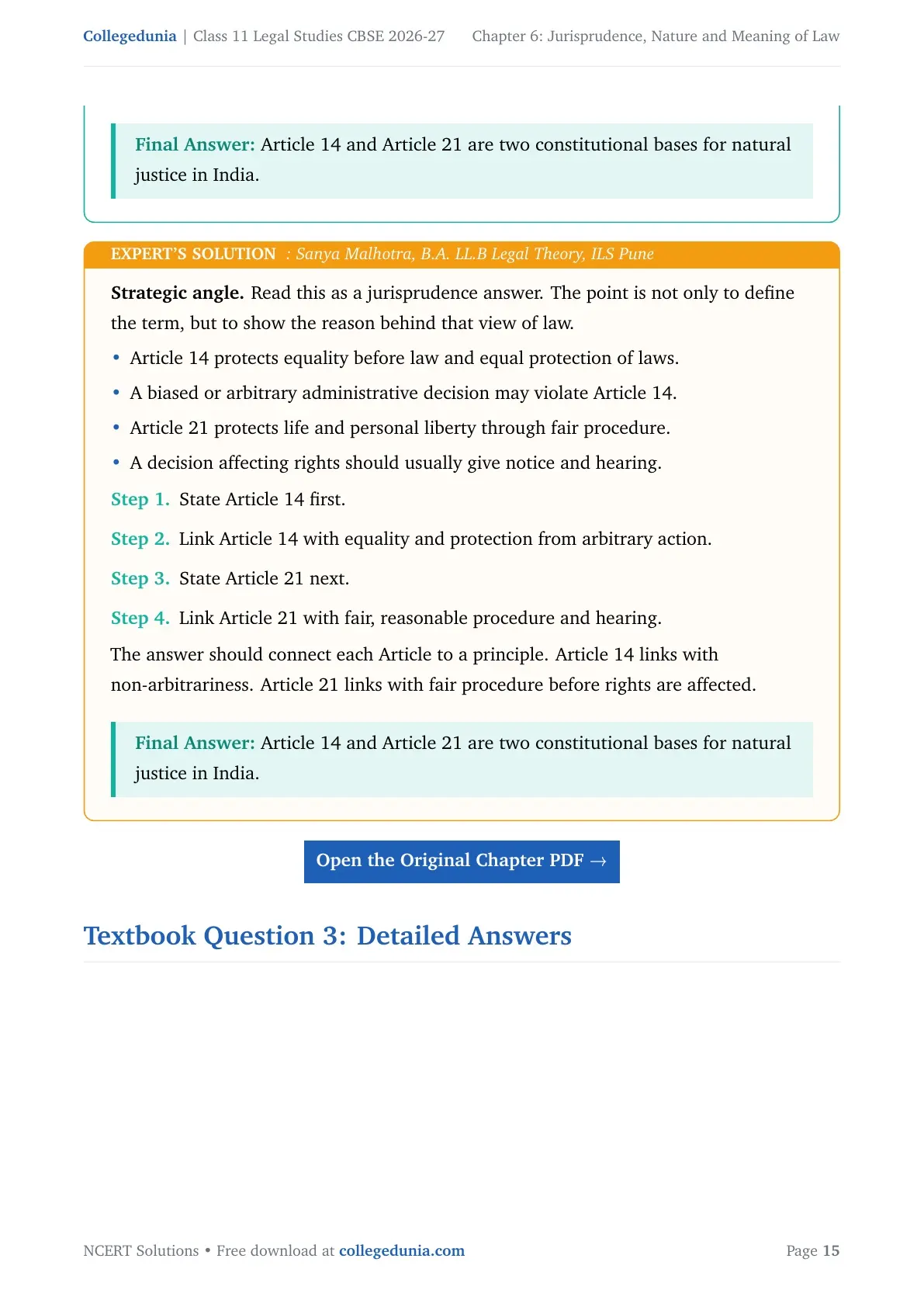
Strategic angle. Read this as a jurisprudence answer. The point is not only to define the term, but to show the reason behind that view of law.
Article 14 protects equality before law and equal protection of laws.
A biased or arbitrary administrative decision may violate Article 14.
Article 21 protects life and personal liberty through fair procedure.
A decision affecting rights should usually give notice and hearing.
State Article 14 first.
Link Article 14 with equality and protection from arbitrary action.
State Article 21 next.
Link Article 21 with fair, reasonable procedure and hearing.
The answer should connect each Article to a principle. Article 14 links with non-arbitrariness. Article 21 links with fair procedure before rights are affected.
Article 14 and Article 21 are two constitutional bases for natural justice in India.
Textbook Question 3: Detailed Answers
Q 6.10
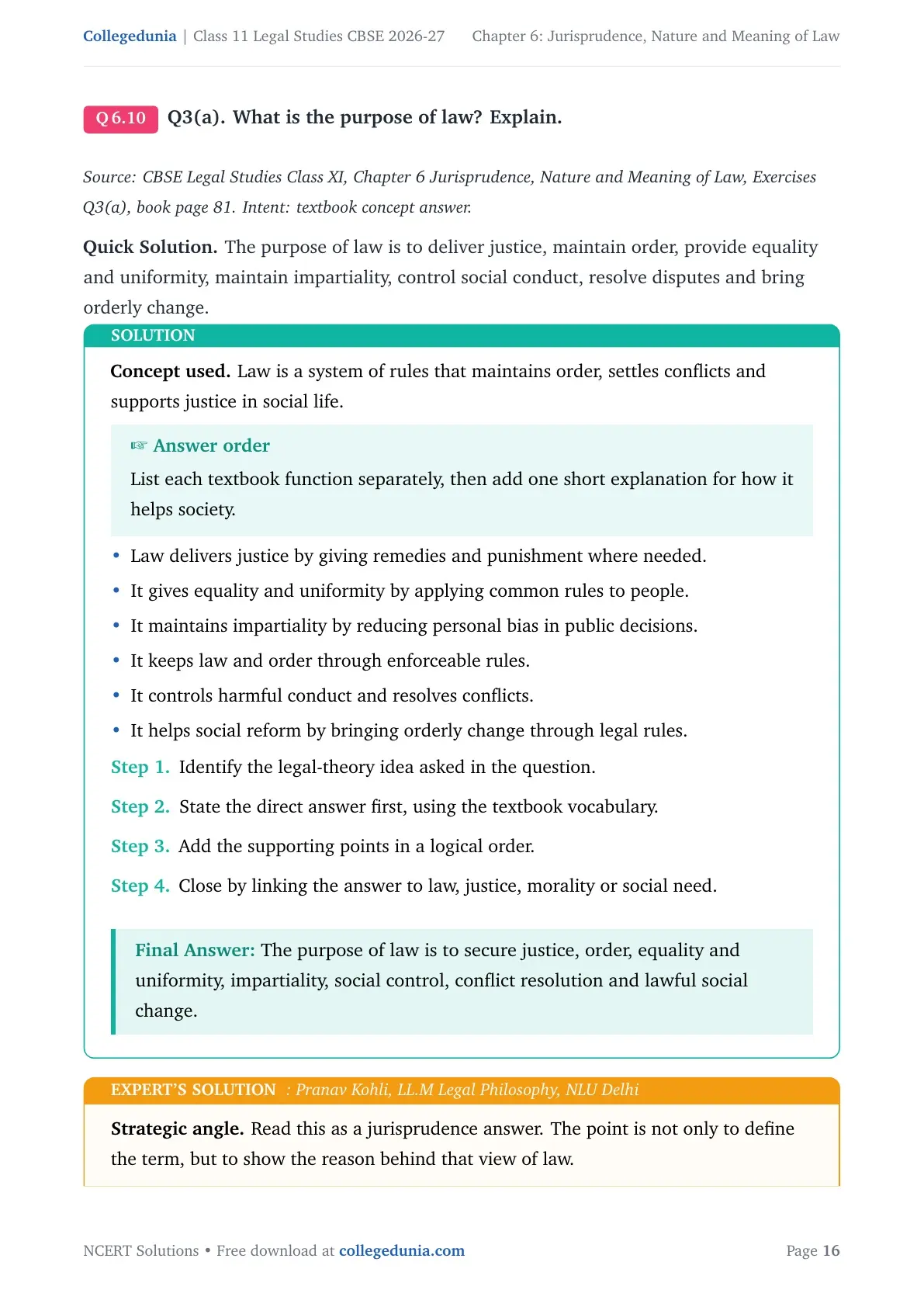
Q3(a). What is the purpose of law? Explain.
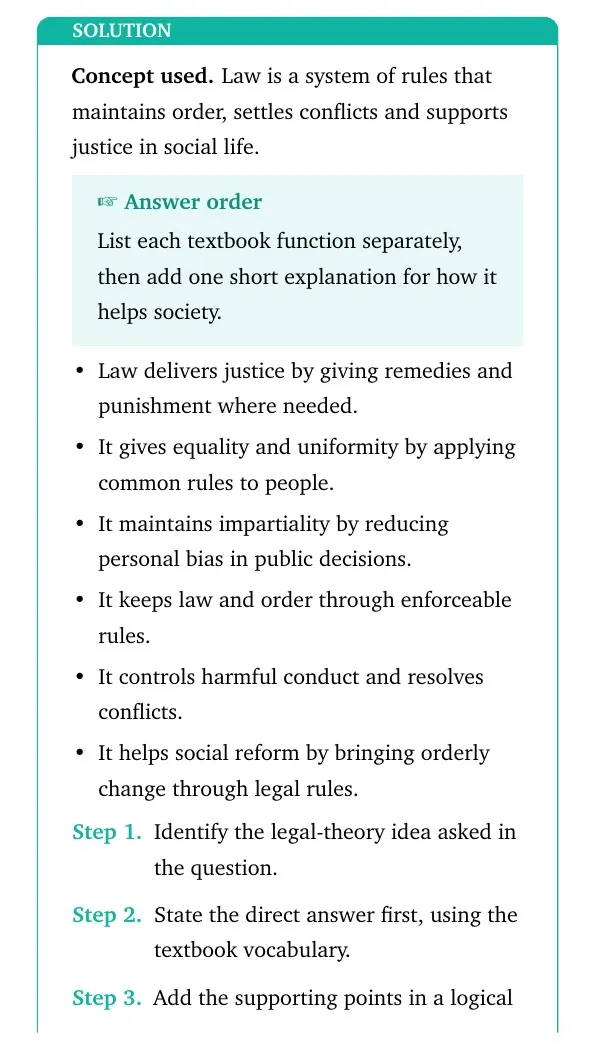
Concept used. Law is a system of rules that maintains order, settles conflicts and supports justice in social life.
Answer order
List each textbook function separately, then add one short explanation for how it helps society.
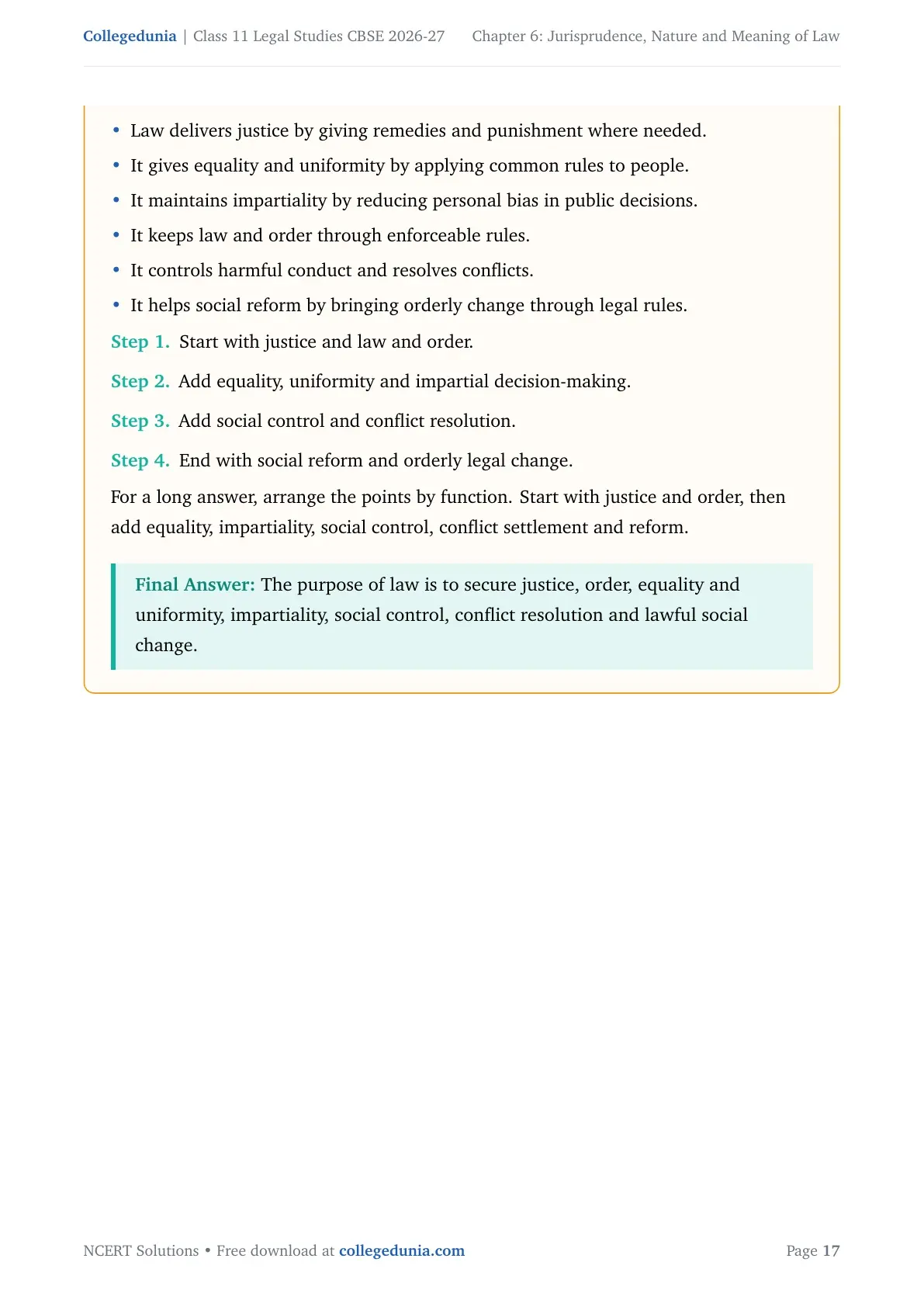
Law delivers justice by giving remedies and punishment where needed.
It gives equality and uniformity by applying common rules to people.
It maintains impartiality by reducing personal bias in public decisions.
It keeps law and order through enforceable rules.
It controls harmful conduct and resolves conflicts.
It helps social reform by bringing orderly change through legal rules.
Identify the legal-theory idea asked in the question.
State the direct answer first, using the textbook vocabulary.
Add the supporting points in a logical order.
Close by linking the answer to law, justice, morality or social need.
The purpose of law is to secure justice, order, equality and uniformity, impartiality, social control, conflict resolution and lawful social change.
PK
Pranav Kohli
LL.M Legal Philosophy, NLU Delhi
Verified Expert
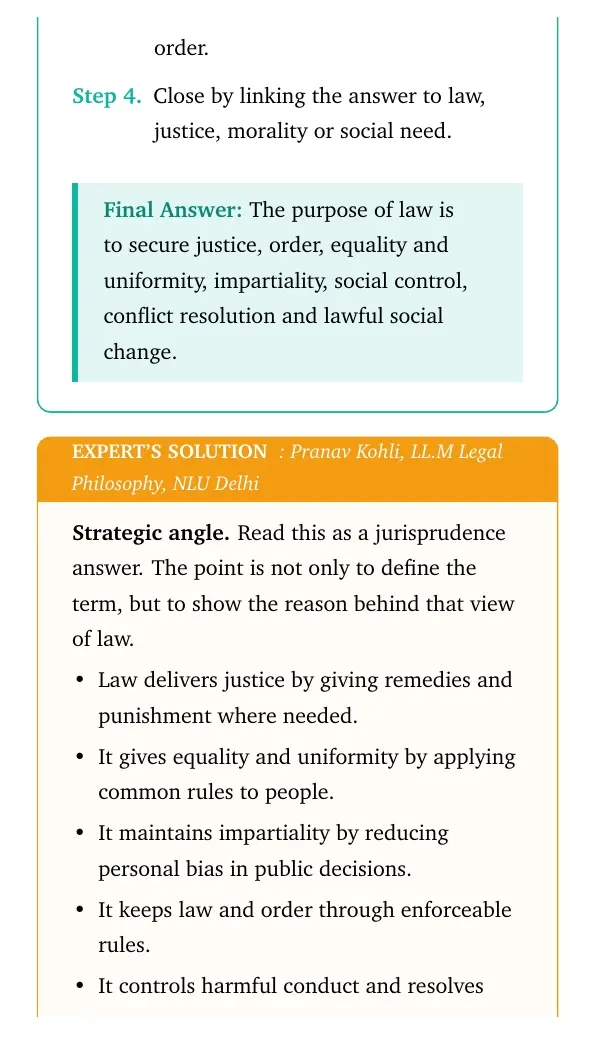
Strategic angle. Read this as a jurisprudence answer. The point is not only to define the term, but to show the reason behind that view of law.
Law delivers justice by giving remedies and punishment where needed.
It gives equality and uniformity by applying common rules to people.
It maintains impartiality by reducing personal bias in public decisions.
It keeps law and order through enforceable rules.
It controls harmful conduct and resolves conflicts.
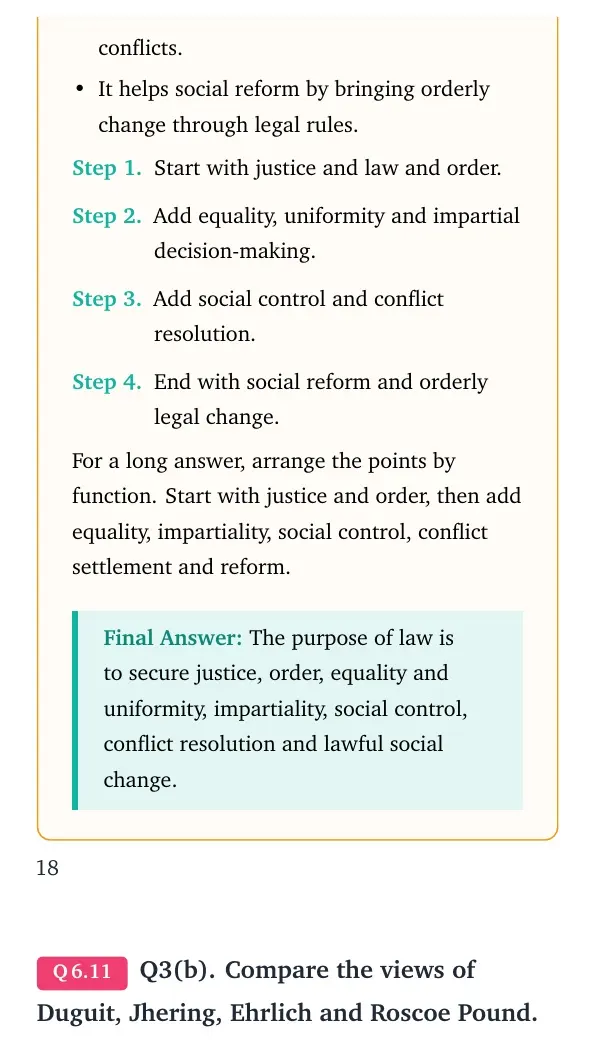
It helps social reform by bringing orderly change through legal rules.
Start with justice and law and order.
Add equality, uniformity and impartial decision-making.
Add social control and conflict resolution.
End with social reform and orderly legal change.
For a long answer, arrange the points by function. Start with justice and order, then add equality, impartiality, social control, conflict settlement and reform.
The purpose of law is to secure justice, order, equality and uniformity, impartiality, social control, conflict resolution and lawful social change.
Q 6.11
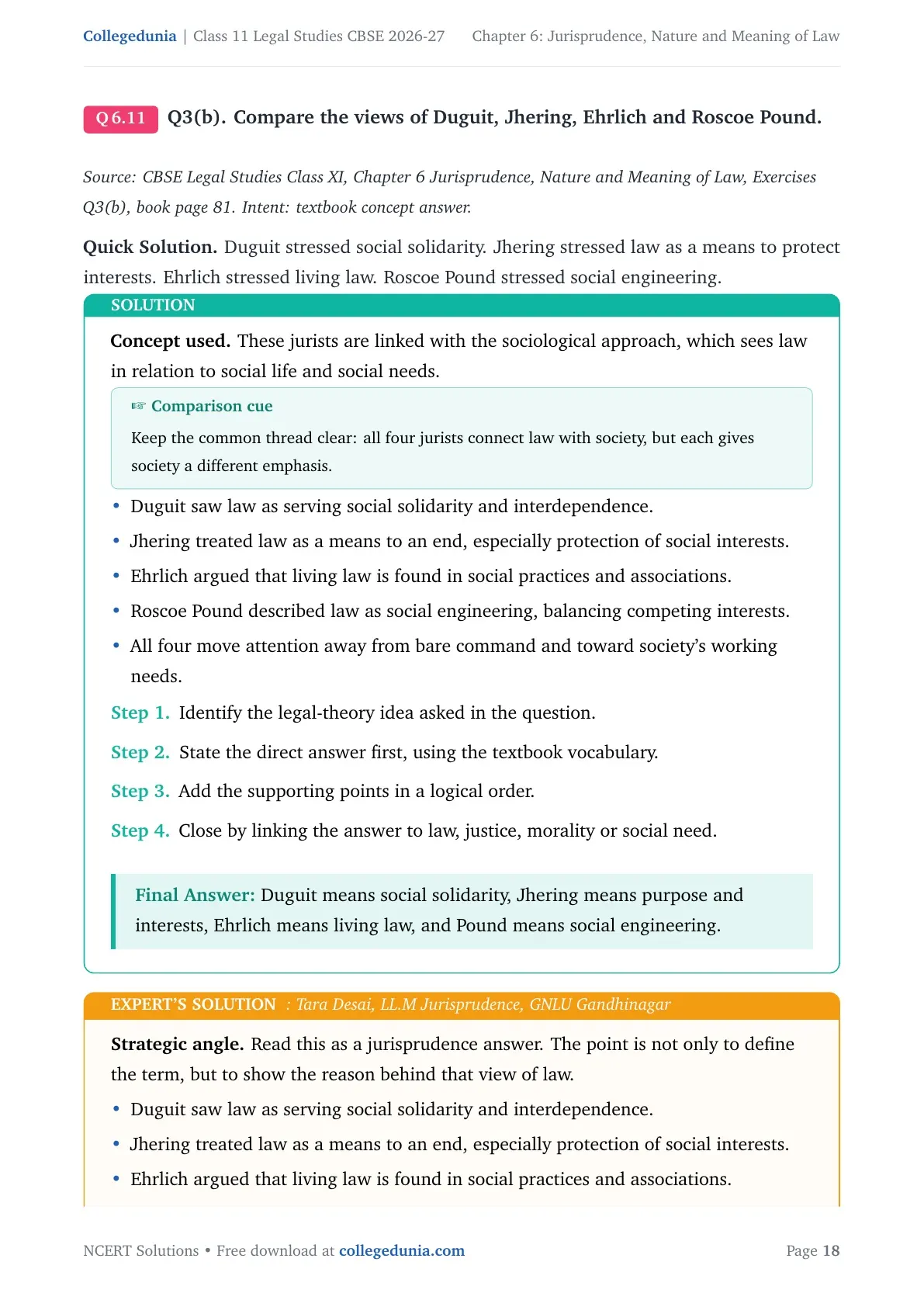
Q3(b). Compare the views of Duguit, Jhering, Ehrlich and Roscoe Pound.
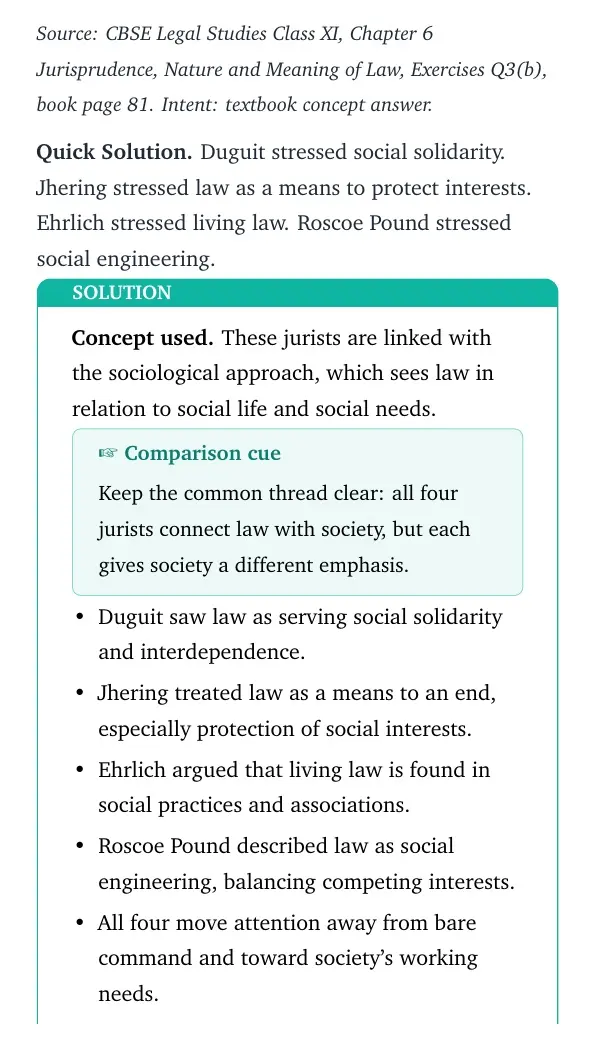
Concept used. These jurists are linked with the sociological approach, which sees law in relation to social life and social needs.
Comparison cue
Keep the common thread clear: all four jurists connect law with society, but each gives society a different emphasis.
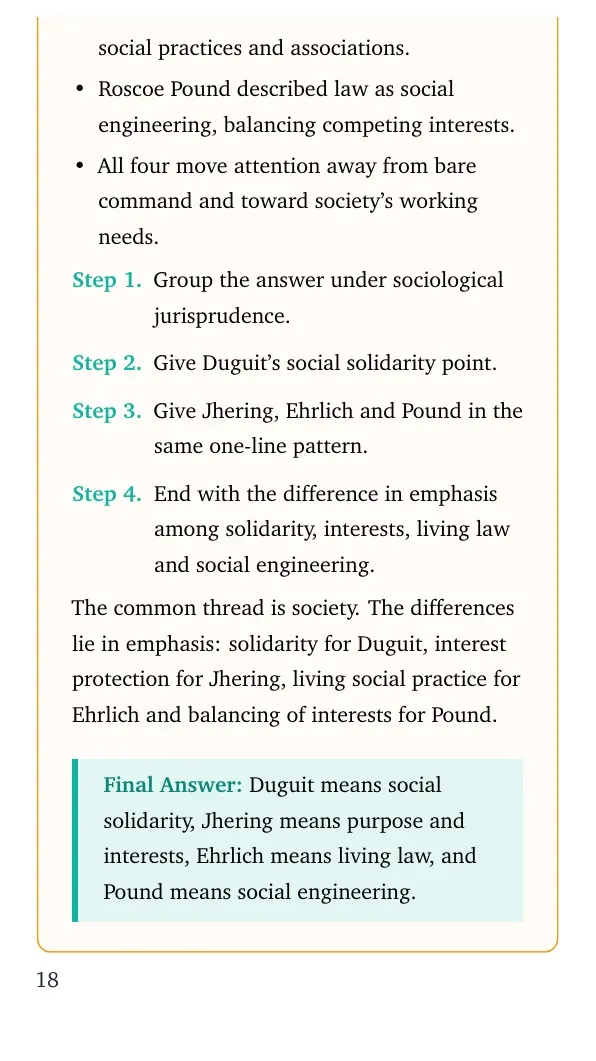
Duguit saw law as serving social solidarity and interdependence.
Jhering treated law as a means to an end, especially protection of social interests.
Ehrlich argued that living law is found in social practices and associations.
Roscoe Pound described law as social engineering, balancing competing interests.
All four move attention away from bare command and toward society's working needs.
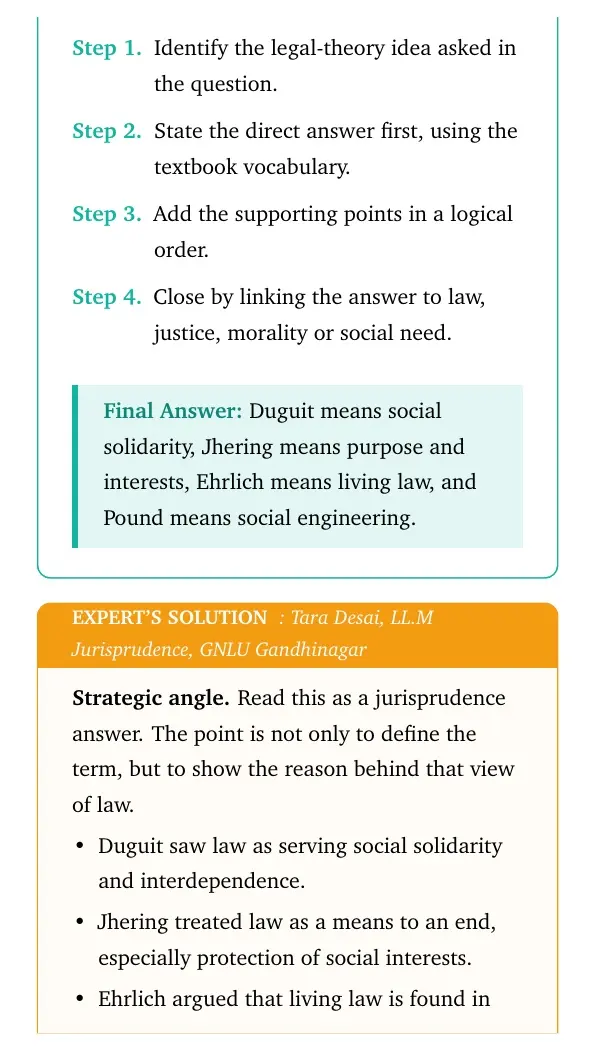
Identify the legal-theory idea asked in the question.
State the direct answer first, using the textbook vocabulary.
Add the supporting points in a logical order.
Close by linking the answer to law, justice, morality or social need.
Duguit means social solidarity, Jhering means purpose and interests, Ehrlich means living law, and Pound means social engineering.
TD
Tara Desai
LL.M Jurisprudence, GNLU Gandhinagar
Verified Expert
Strategic angle. Read this as a jurisprudence answer. The point is not only to define the term, but to show the reason behind that view of law.
Duguit saw law as serving social solidarity and interdependence.
Jhering treated law as a means to an end, especially protection of social interests.
Ehrlich argued that living law is found in social practices and associations.
Roscoe Pound described law as social engineering, balancing competing interests.
All four move attention away from bare command and toward society's working needs.
Group the answer under sociological jurisprudence.
Give Duguit's social solidarity point.
Give Jhering, Ehrlich and Pound in the same one-line pattern.
End with the difference in emphasis among solidarity, interests, living law and social engineering.
The common thread is society. The differences lie in emphasis: solidarity for Duguit, interest protection for Jhering, living social practice for Ehrlich and balancing of interests for Pound.
Duguit means social solidarity, Jhering means purpose and interests, Ehrlich means living law, and Pound means social engineering.
Q 6.12
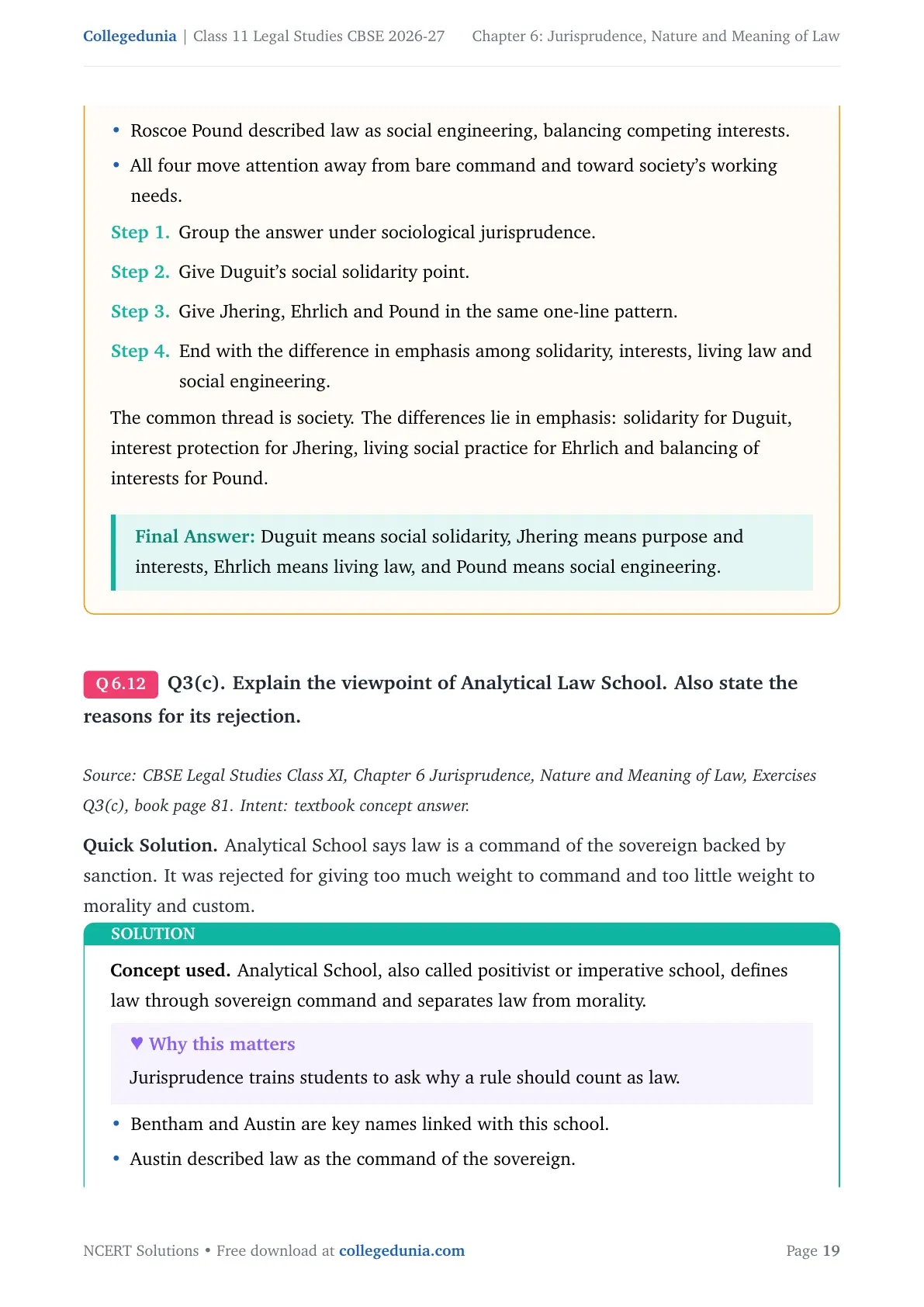
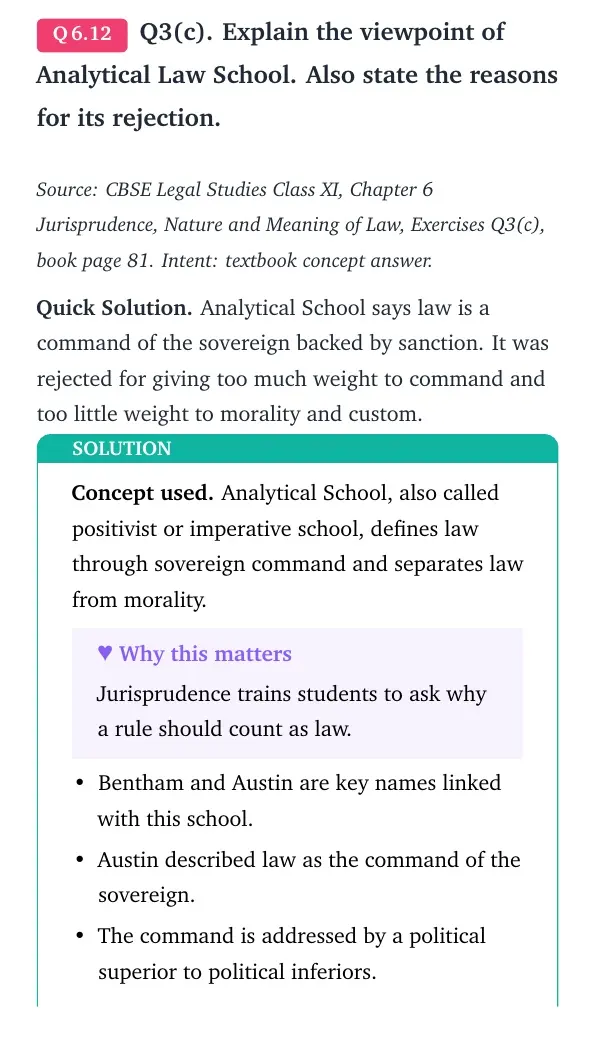
Q3(c). Explain the viewpoint of Analytical Law School. Also state the reasons for its rejection.
Concept used. Analytical School, also called positivist or imperative school, defines law through sovereign command and separates law from morality.
Why this matters
Jurisprudence trains students to ask why a rule should count as law.
Bentham and Austin are key names linked with this school.
Austin described law as the command of the sovereign.
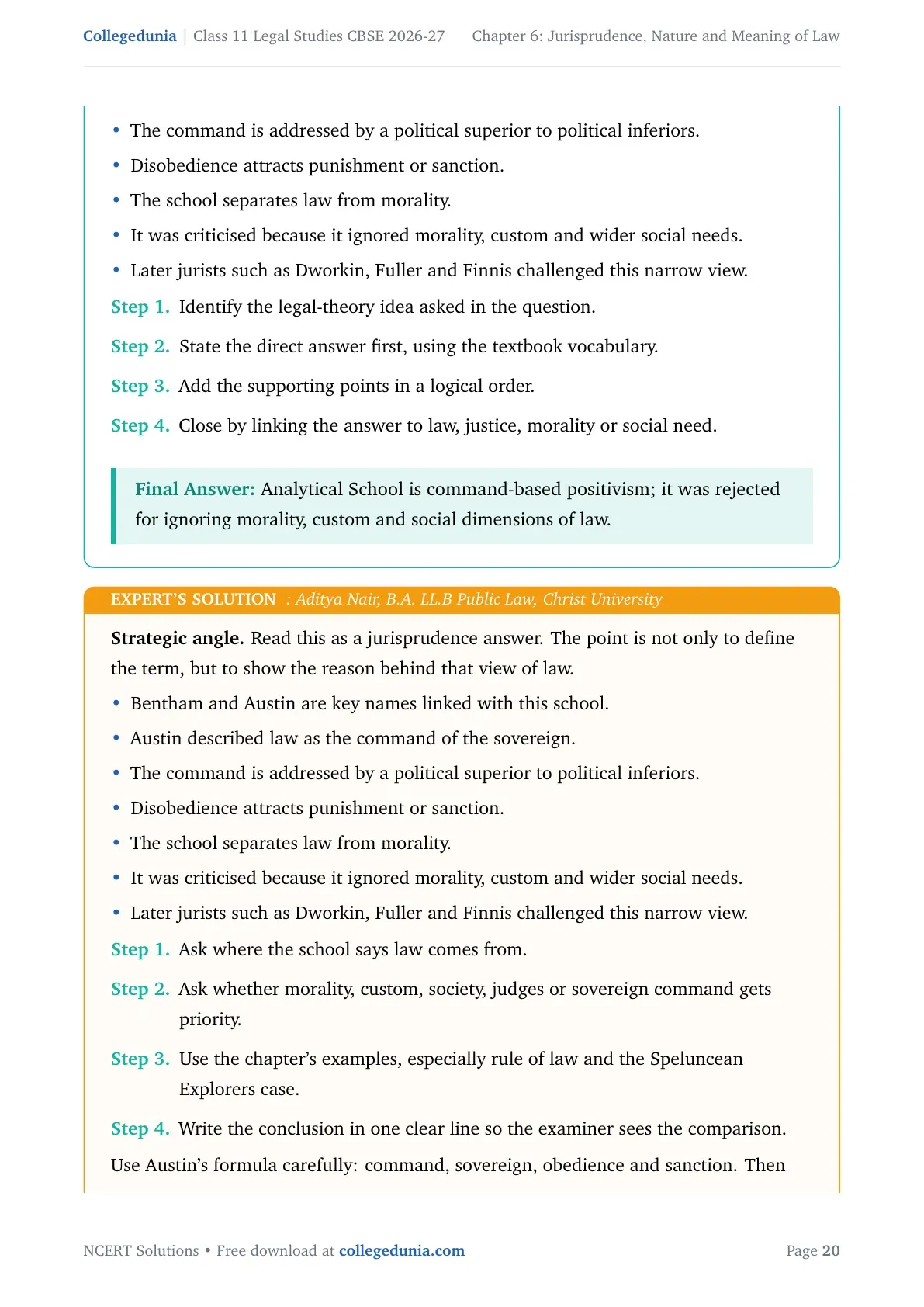
The command is addressed by a political superior to political inferiors.
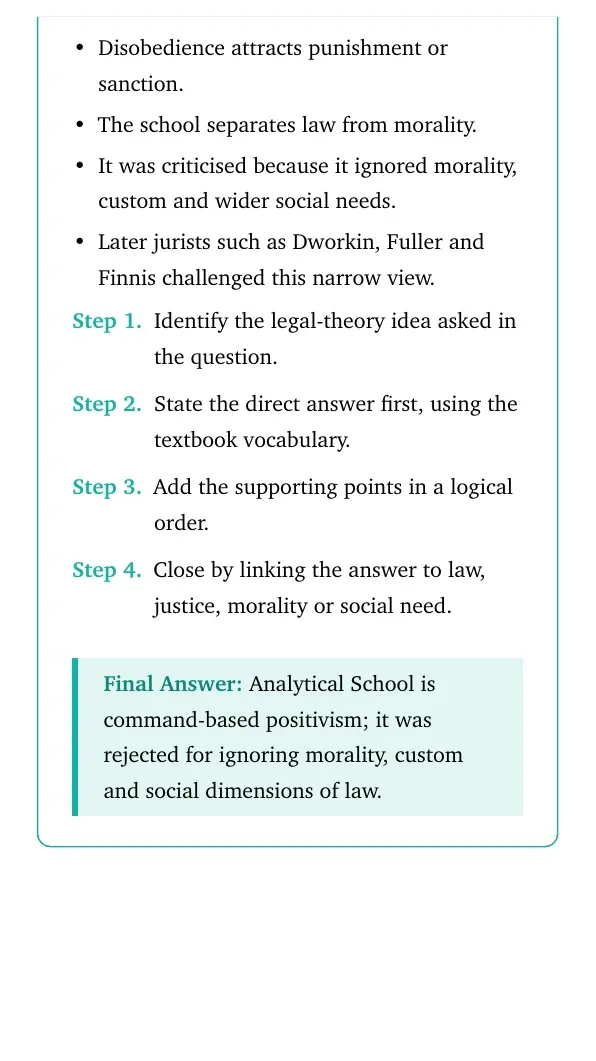
Disobedience attracts punishment or sanction.
The school separates law from morality.
It was criticised because it ignored morality, custom and wider social needs.
Later jurists such as Dworkin, Fuller and Finnis challenged this narrow view.
Identify the legal-theory idea asked in the question.
State the direct answer first, using the textbook vocabulary.
Add the supporting points in a logical order.
Close by linking the answer to law, justice, morality or social need.
Analytical School is command-based positivism; it was rejected for ignoring morality, custom and social dimensions of law.
AN
Aditya Nair
B.A. LL.B Public Law, Christ University
Verified Expert
Strategic angle. Read this as a jurisprudence answer. The point is not only to define the term, but to show the reason behind that view of law.
Bentham and Austin are key names linked with this school.
Austin described law as the command of the sovereign.
The command is addressed by a political superior to political inferiors.
Disobedience attracts punishment or sanction.
The school separates law from morality.
It was criticised because it ignored morality, custom and wider social needs.
Later jurists such as Dworkin, Fuller and Finnis challenged this narrow view.
Ask where the school says law comes from.
Ask whether morality, custom, society, judges or sovereign command gets priority.
Use the chapter's examples, especially rule of law and the Speluncean Explorers case.
Write the conclusion in one clear line so the examiner sees the comparison.
Use Austin's formula carefully: command, sovereign, obedience and sanction. Then explain rejection by showing what the formula leaves out.
Analytical School is command-based positivism; it was rejected for ignoring morality, custom and social dimensions of law.
Textbook Question 4: Application
Q 6.13
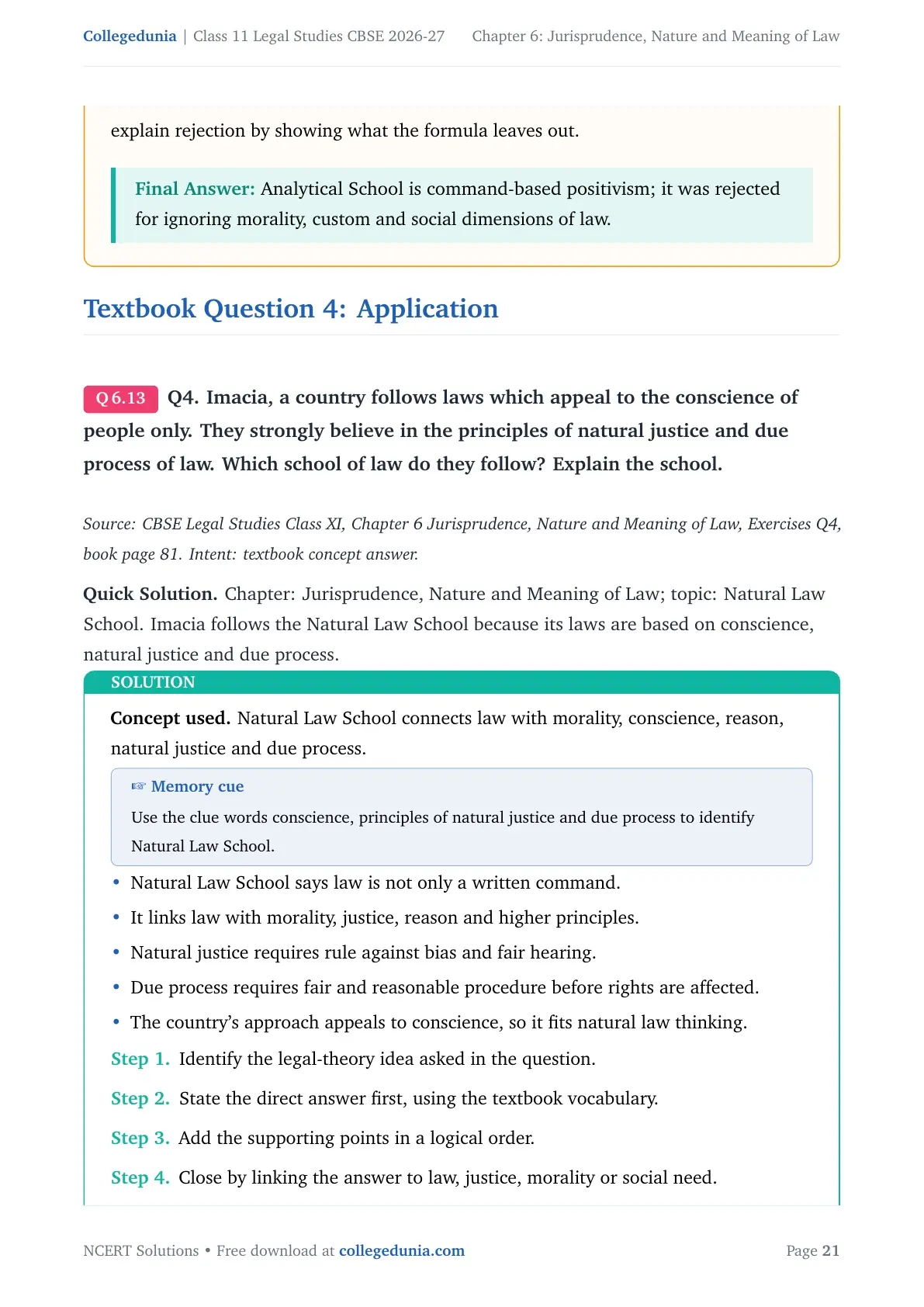
Q4. Imacia, a country follows laws which appeal to the conscience of people only. They strongly believe in the principles of natural justice and due process of law. Which school of law do they follow? Explain the school.
Concept used. Natural Law School connects law with morality, conscience, reason, natural justice and due process.
Memory cue
Use the clue words conscience, principles of natural justice and due process to identify Natural Law School.
Natural Law School says law is not only a written command.
It links law with morality, justice, reason and higher principles.
Natural justice requires rule against bias and fair hearing.
Due process requires fair and reasonable procedure before rights are affected.
The country's approach appeals to conscience, so it fits natural law thinking.
Identify the legal-theory idea asked in the question.
State the direct answer first, using the textbook vocabulary.
Add the supporting points in a logical order.
Close by linking the answer to law, justice, morality or social need.
Imacia follows the Natural Law School of jurisprudence.
KS
Kavya Shah
LL.M Constitutional Law, NALSAR Hyderabad
Verified Expert
Strategic angle. Read this as a jurisprudence answer. The point is not only to define the term, but to show the reason behind that view of law.
Natural Law School says law is not only a written command.
It links law with morality, justice, reason and higher principles.
Natural justice requires rule against bias and fair hearing.
Due process requires fair and reasonable procedure before rights are affected.
The country's approach appeals to conscience, so it fits natural law thinking.
Identify the school from the conscience clue.
Connect principles of natural justice with fairness.
Connect due process with fair legal procedure.
Explain that natural law judges legal rules against morality and reason.
The clue words are conscience, natural justice and due process. These words point away from strict command theory and toward law based on reason and moral fairness.
Imacia follows the Natural Law School of jurisprudence.
Jurisprudence, Nature and Meaning of Law Class 11 Legal Studies NCERT Solutions FAQs
Ques. What does Jurisprudence, Nature and Meaning of Law cover in Class 11 Legal Studies?
Ans. It covers the meaning of law, schools of law, social engineering, natural justice, constitutional fairness and the purpose of law.
Ques. How many questions are solved in the Class 11 Legal Studies Chapter 6 PDF?
Ans. The PDF solves 13 textbook subpart questions with detailed solutions, expert solutions and final answer boxes.
Ques. Which school of law is linked with conscience and natural justice?
Ans. Natural Law School is linked with conscience, morality, natural justice, due process and higher principles of fairness.
Ques. Who introduced social engineering in jurisprudence?
Ans. Roscoe Pound introduced social engineering. It means law balances competing interests in society with minimum conflict.
Ques. What are the two main rules of natural justice?
Ans. The two rules are nemo judex in causa sua, or no bias, and audi alteram partem, or fair hearing.








Comments