NCERT Solutions for Class 11 Legal Studies Chapter 8 Sources of Laws cover all textbook questions for the 2026-27 CBSE syllabus. The PDF explains custom, judicial precedent, legislation, delegated legislation and court-hierarchy examples in clear school-answer format.
Includes 10 solved question cards with detailed solution and expert solution tabs.
Covers custom, ratio decidendi, obiter dicta, legislation and delegated legislation.
Uses source tables, hierarchy cues and final-answer boxes for quick revision.
Sources of Laws Class 11 Legal Studies NCERT Solutions PDF
Student Feedback: In a Collegedunia check of 10,940 Class 11 Legal Studies students, 74 percent said Sources of Laws became easier when custom, precedent and legislation were revised in one chart.
These Class 11 Legal Studies Chapter 8 solutions are checked against the official NCERT chapter and written for the 2026-27 CBSE syllabus.
Sources of Laws asks students to compare sources, identify types of legislation and apply the doctrine of precedent. The safest answer style is term first, reason second.
Question group
What it checks
Best answer format
Q1 differences
Custom, precedent, legislation and court authority
One basis of comparison in each point
Q2 to Q5
Short notes, valid custom tests and kinds of legislation
Definition, features and classification
Q6 to Q10
Delegated legislation, precedent applications and valid custom
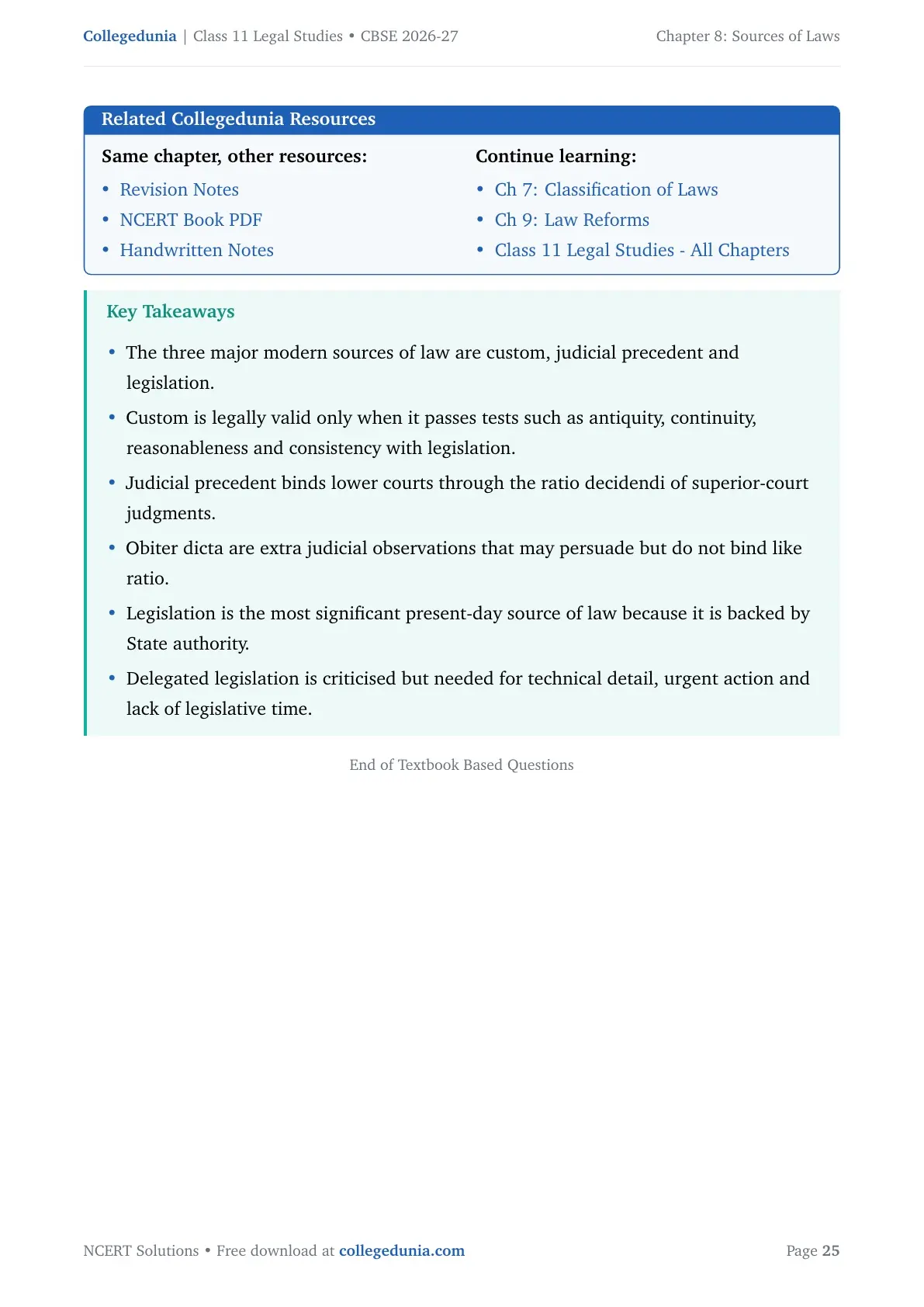
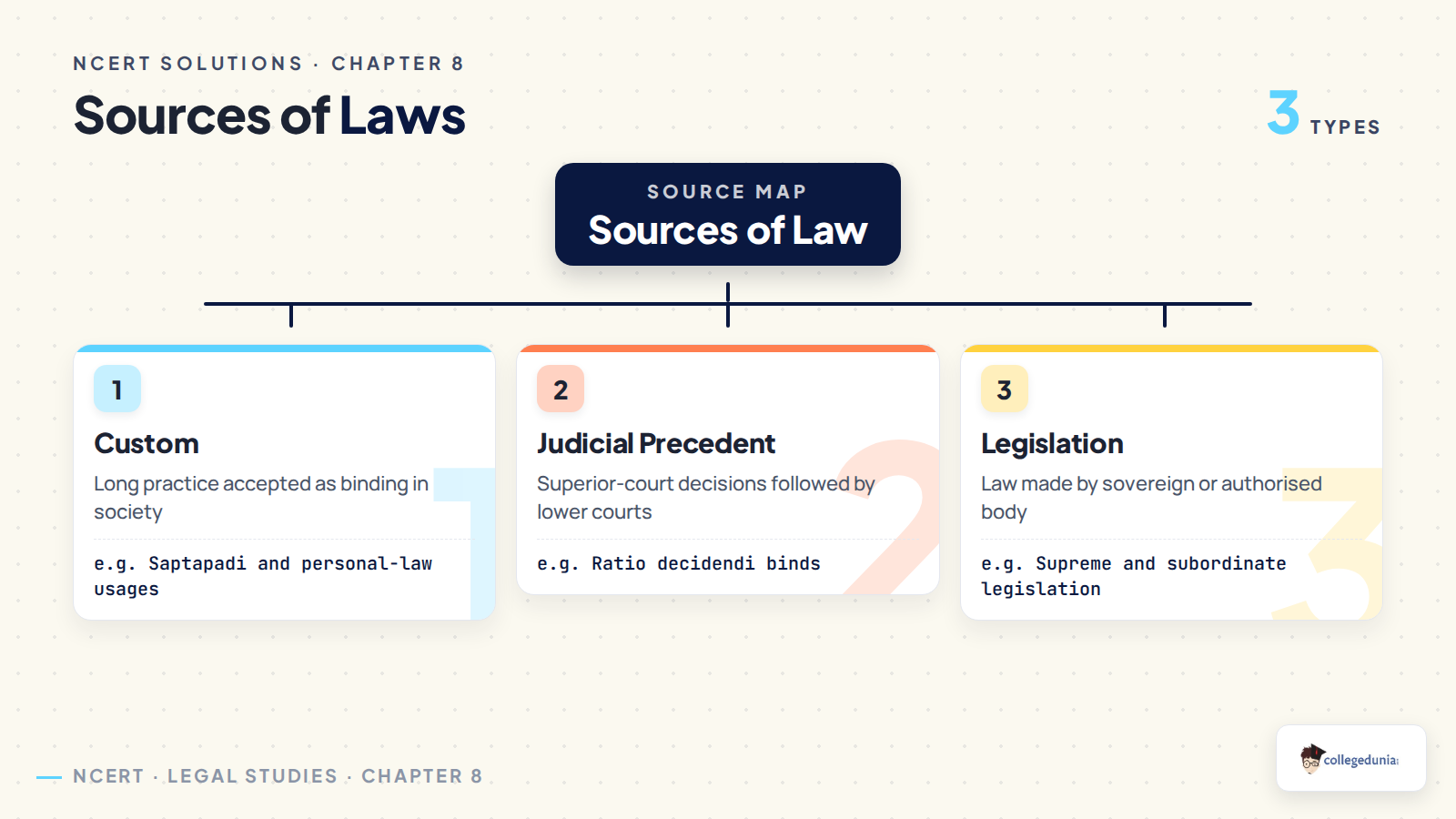
The chapter identifies custom, judicial precedent and legislation as the major sources of law in modern society. Custom grows from long social practice, precedent grows from superior-court decisions and legislation grows from organised law-making authority.
Custom: long-established practice that becomes binding when recognised by law.
Judicial precedent: earlier superior-court judgment followed in later similar cases.
Legislation: law made by the sovereign or an authorised body.
Ratio Decidendi and Obiter Dicta Difference
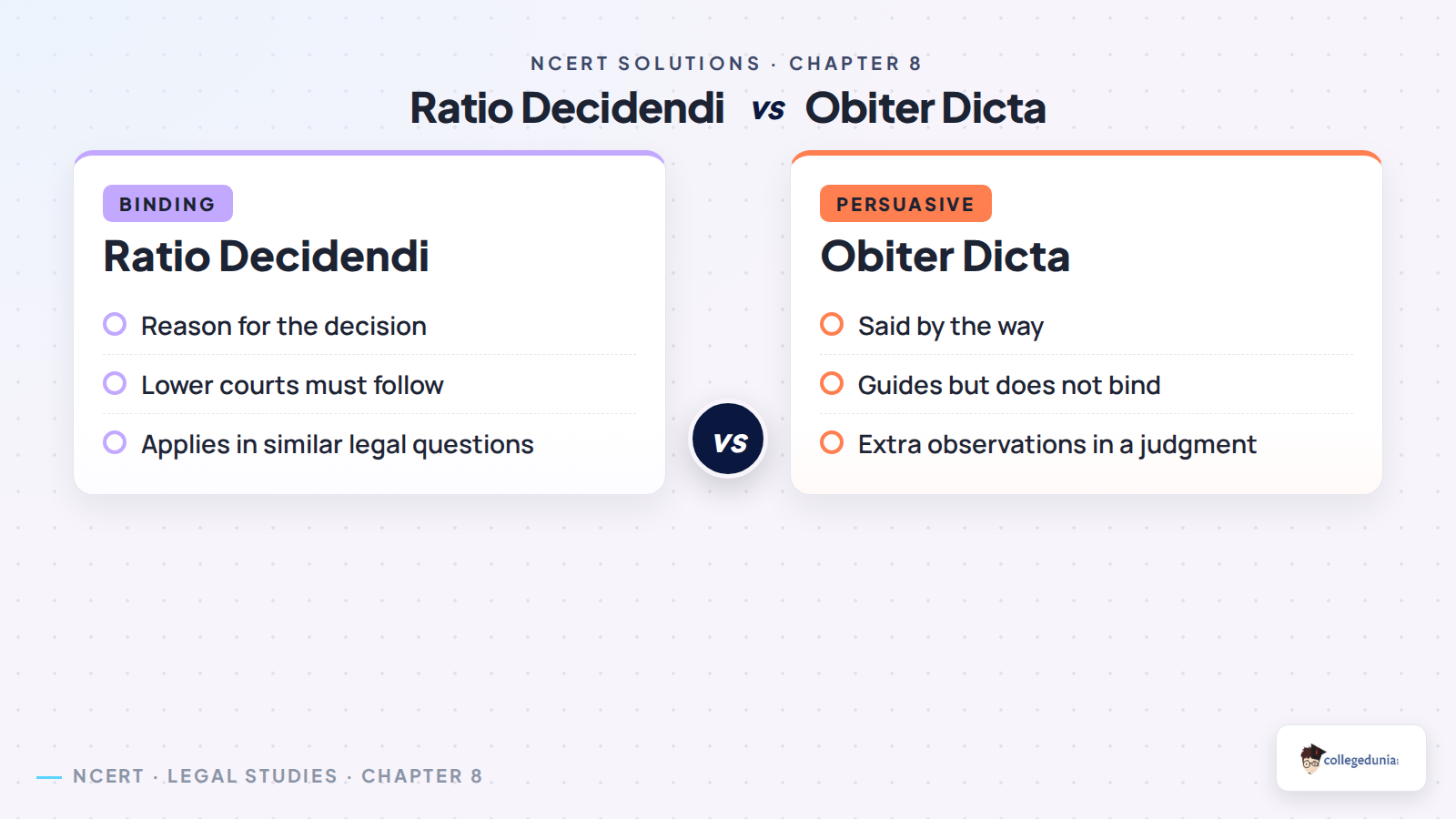
Ratio decidendi is the binding reason for a judicial decision. Obiter dicta are remarks said by the way. Lower courts must follow ratio as binding law, while obiter usually guides through persuasive value.
Basis
Ratio decidendi
Obiter dicta
Meaning
Reason for the decision
Observation not required for the final decision
Authority
Binding on lower courts in similar cases
Persuasive value
Exam clue
Operative legal rule plus reason
Extra comment or background remark
Valid Custom Tests in Class 11 Legal Studies
All customs do not automatically become law. Courts recognise a custom only when it satisfies legal tests drawn from the chapter.
Antiquity: the practice should be very old and accepted over time.
Continuity: it should have been followed without serious interruption.
Reasonableness and morality: it should agree with justice, public utility and public policy.
Consistency with legislation: it should not contradict an enacted law.
Sources of Laws Cross-Resource Study Links
Use these Class 11 Legal Studies resources after reading the solved PDF. They help students move from full solutions to short revision and official source checking.
All NCERT Solutions for Class 11 Legal Studies Chapter 8 Sources of Laws with Step-by-Step Solutions
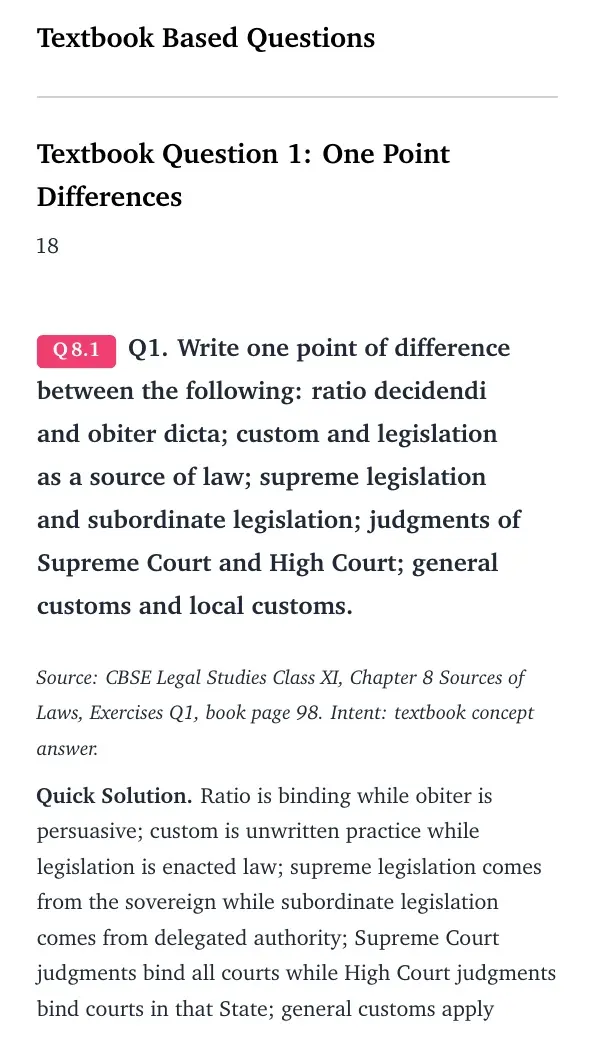
Textbook Question 1: One Point Differences
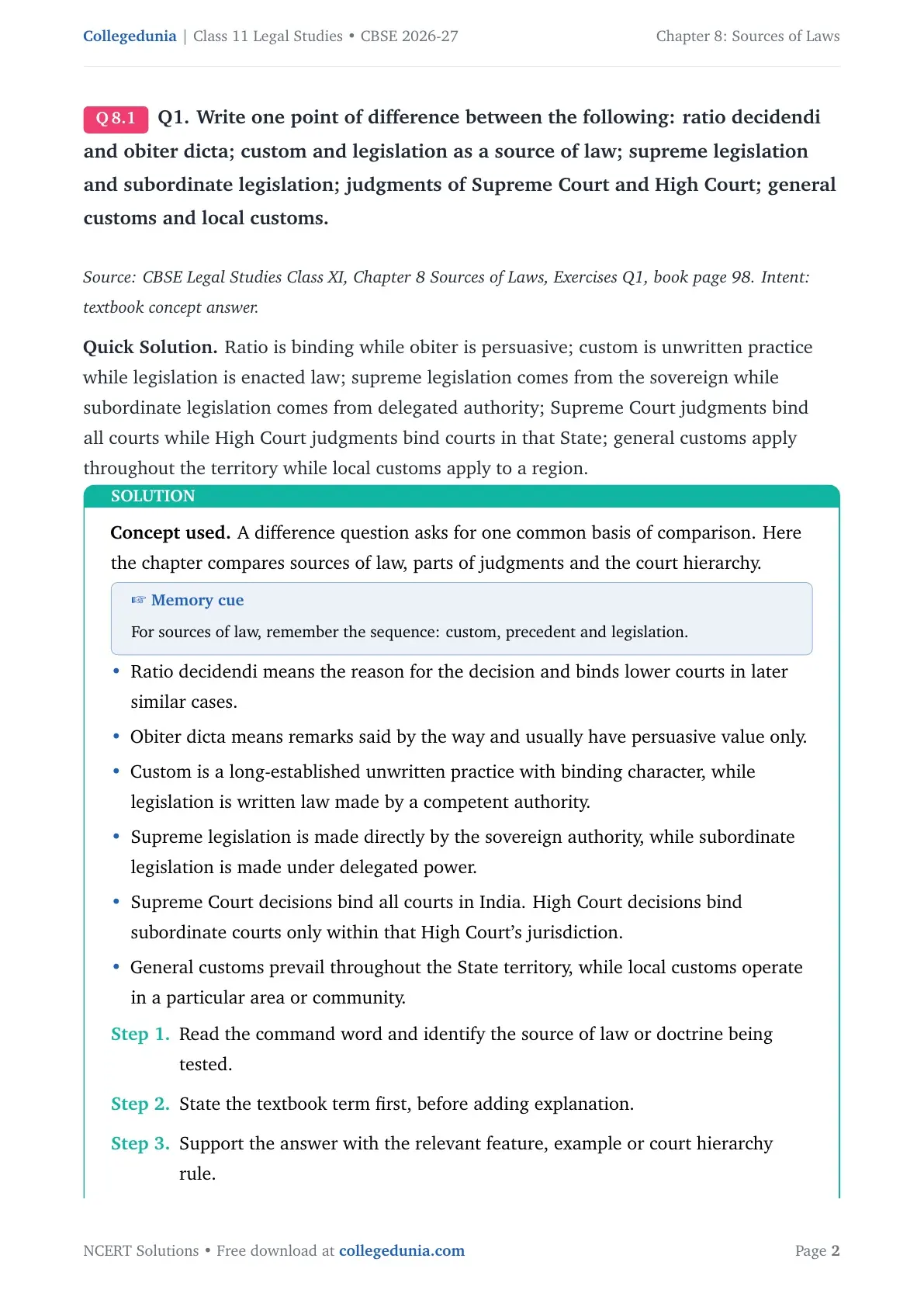
Q 8.1
Q1. Write one point of difference between the following: ratio decidendi and obiter dicta; custom and legislation as a source of law; supreme legislation and subordinate legislation; judgments of Supreme Court and High Court; general customs and local customs.
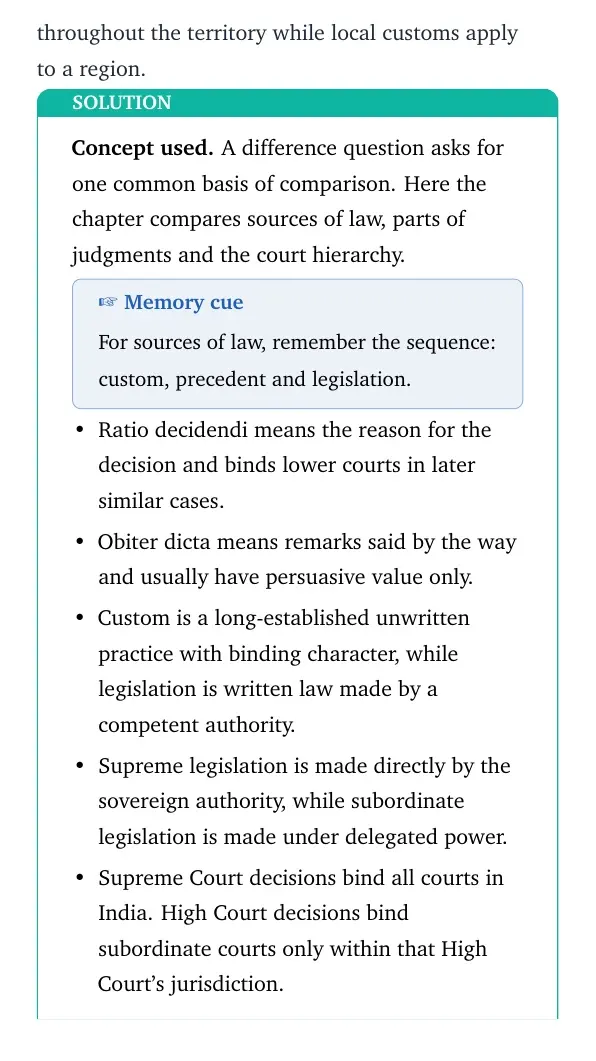
Concept used. A difference question asks for one common basis of comparison. Here the chapter compares sources of law, parts of judgments and the court hierarchy.
Memory cue
For sources of law, remember the sequence: custom, precedent and legislation.
Ratio decidendi means the reason for the decision and binds lower courts in later similar cases.
Obiter dicta means remarks said by the way and usually have persuasive value only.
Custom is a long-established unwritten practice with binding character, while legislation is written law made by a competent authority.
Supreme legislation is made directly by the sovereign authority, while subordinate legislation is made under delegated power.
Supreme Court decisions bind all courts in India. High Court decisions bind subordinate courts only within that High Court's jurisdiction.
General customs prevail throughout the State territory, while local customs operate in a particular area or community.
Read the command word and identify the source of law or doctrine being tested.
State the textbook term first, before adding explanation.
Support the answer with the relevant feature, example or court hierarchy rule.
End with a direct conclusion that answers every part of the question.
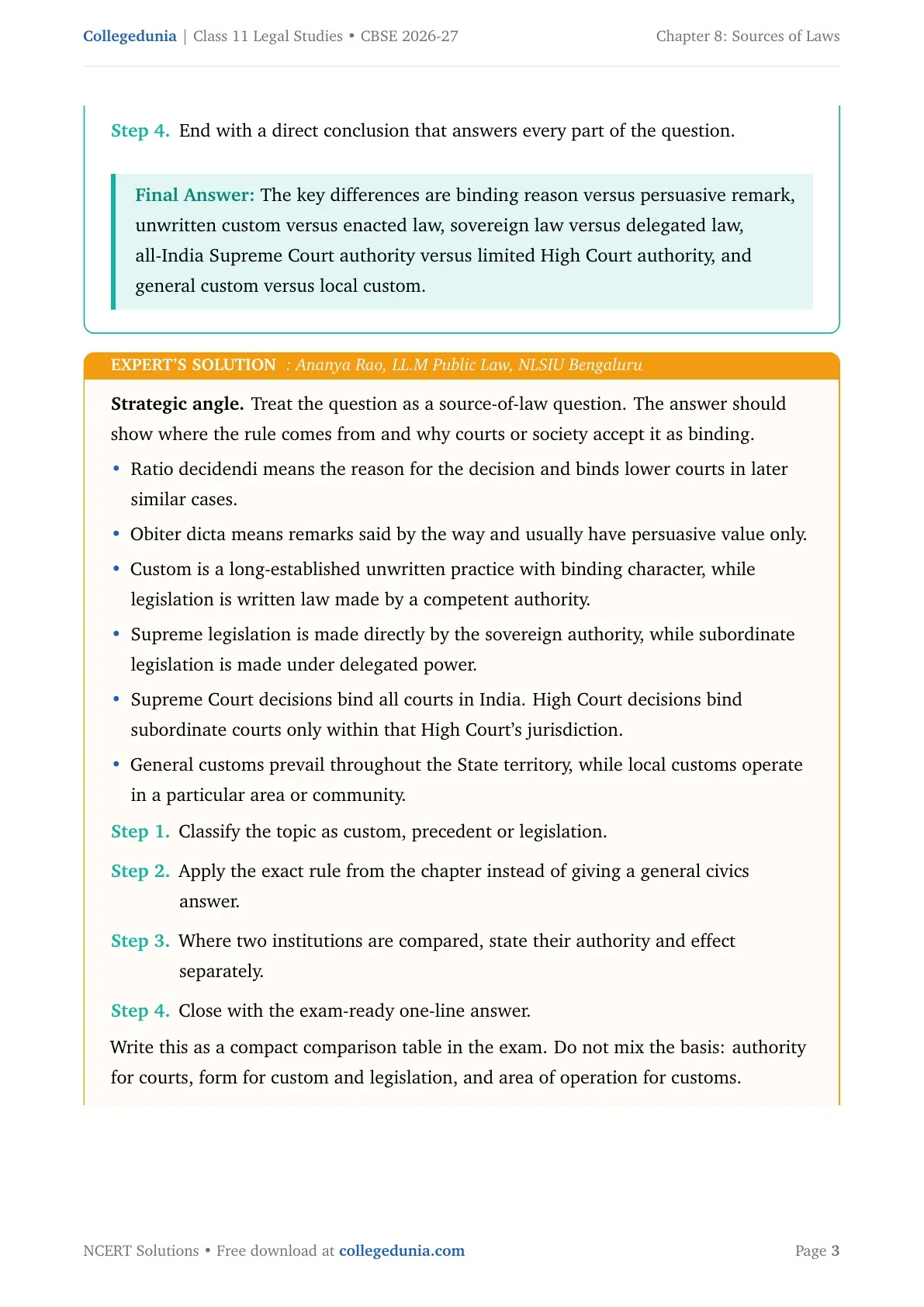
The key differences are binding reason versus persuasive remark, unwritten custom versus enacted law, sovereign law versus delegated law, all-India Supreme Court authority versus limited High Court authority, and general custom versus local custom.
AR
Ananya Rao
LL.M Public Law, NLSIU Bengaluru
Verified Expert
Strategic angle. Treat the question as a source-of-law question. The answer should show where the rule comes from and why courts or society accept it as binding.
Ratio decidendi means the reason for the decision and binds lower courts in later similar cases.
Obiter dicta means remarks said by the way and usually have persuasive value only.
Custom is a long-established unwritten practice with binding character, while legislation is written law made by a competent authority.
Supreme legislation is made directly by the sovereign authority, while subordinate legislation is made under delegated power.
Supreme Court decisions bind all courts in India. High Court decisions bind subordinate courts only within that High Court's jurisdiction.
General customs prevail throughout the State territory, while local customs operate in a particular area or community.
Classify the topic as custom, precedent or legislation.
Apply the exact rule from the chapter instead of giving a general civics answer.
Where two institutions are compared, state their authority and effect separately.
Close with the exam-ready one-line answer.
Write this as a compact comparison table in the exam. Do not mix the basis: authority for courts, form for custom and legislation, and area of operation for customs.
The key differences are binding reason versus persuasive remark, unwritten custom versus enacted law, sovereign law versus delegated law, all-India Supreme Court authority versus limited High Court authority, and general custom versus local custom.
Textbook Question 2: Short Notes
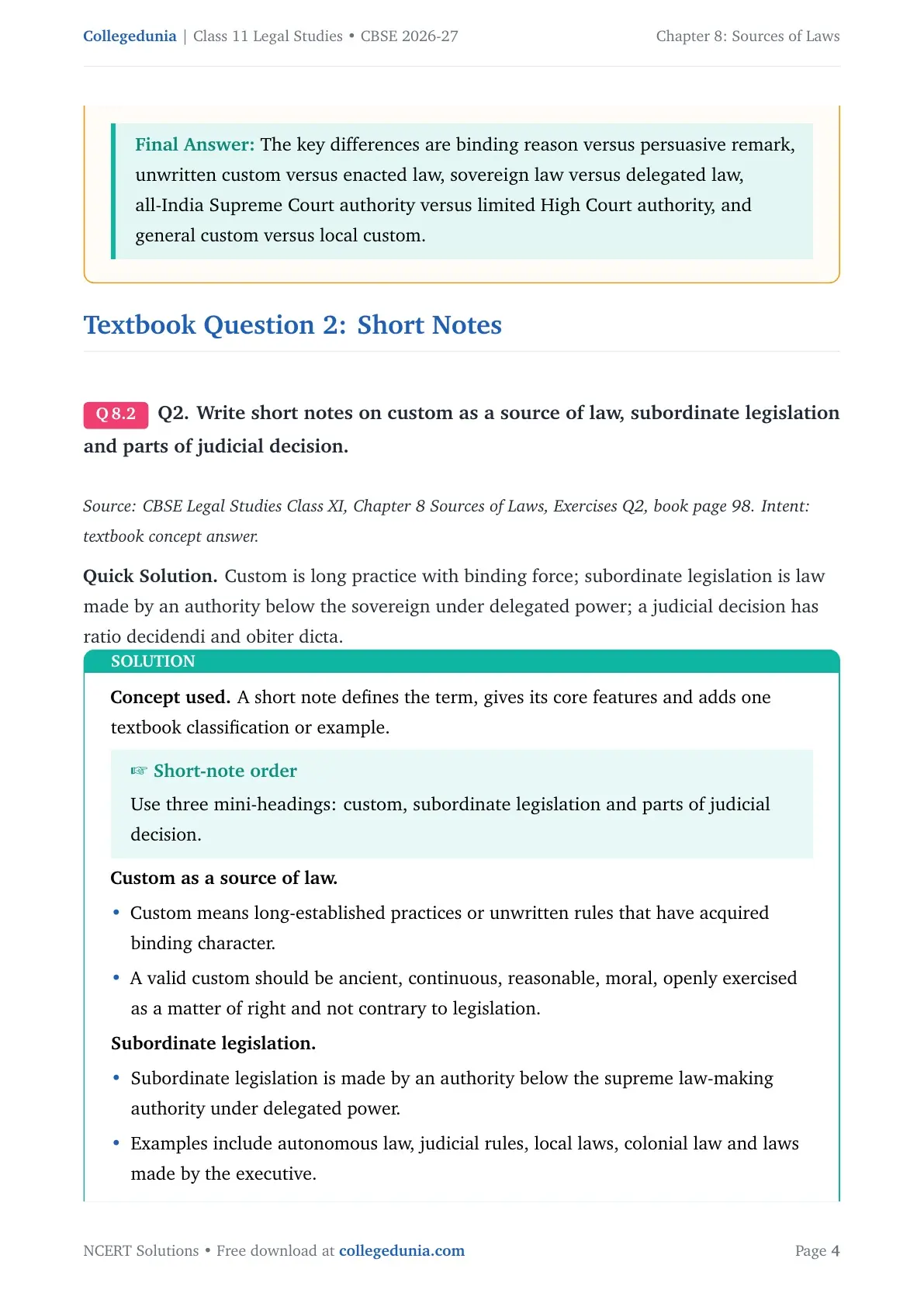
Q 8.2
Q2. Write short notes on custom as a source of law, subordinate legislation and parts of judicial decision.
Concept used. A short note defines the term, gives its core features and adds one textbook classification or example.
Short-note order
Use three mini-headings: custom, subordinate legislation and parts of judicial decision.
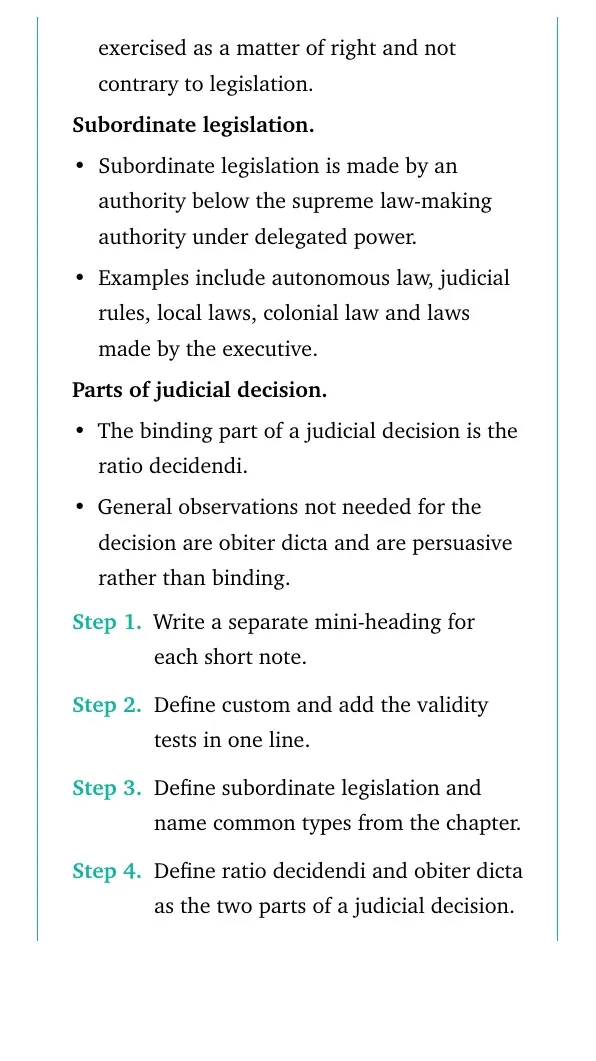
Custom as a source of law.
Custom means long-established practices or unwritten rules that have acquired binding character.
A valid custom should be ancient, continuous, reasonable, moral, openly exercised as a matter of right and not contrary to legislation.
Subordinate legislation.
Subordinate legislation is made by an authority below the supreme law-making authority under delegated power.
Examples include autonomous law, judicial rules, local laws, colonial law and laws made by the executive.
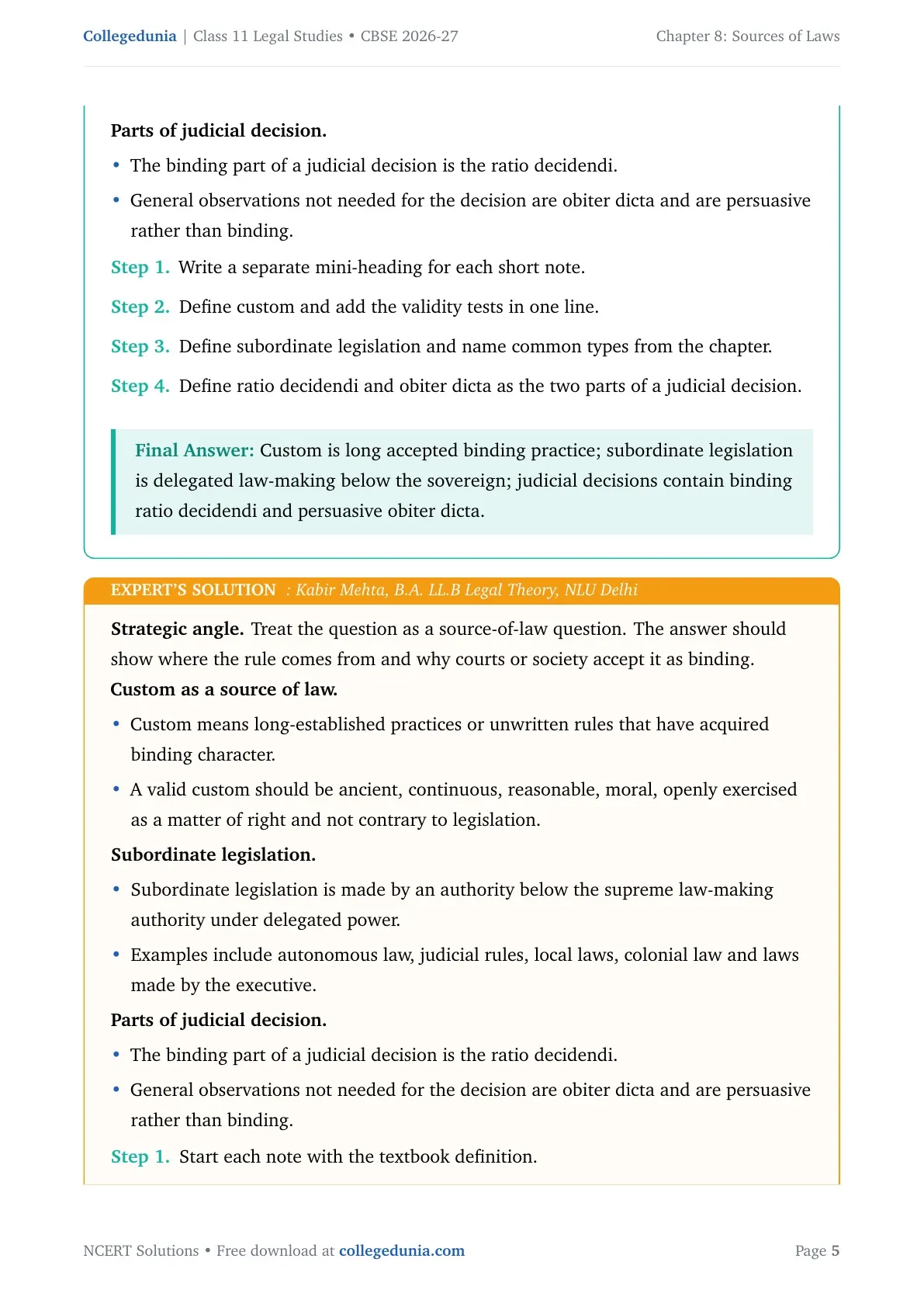
Parts of judicial decision.
The binding part of a judicial decision is the ratio decidendi.
General observations not needed for the decision are obiter dicta and are persuasive rather than binding.
Write a separate mini-heading for each short note.
Define custom and add the validity tests in one line.
Define subordinate legislation and name common types from the chapter.
Define ratio decidendi and obiter dicta as the two parts of a judicial decision.
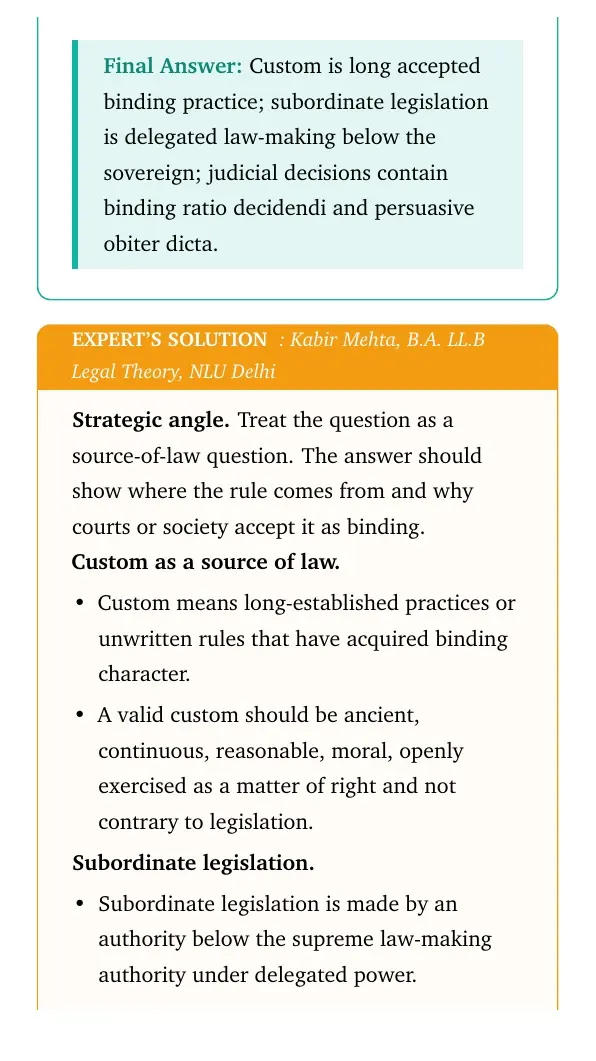
Custom is long accepted binding practice; subordinate legislation is delegated law-making below the sovereign; judicial decisions contain binding ratio decidendi and persuasive obiter dicta.
KM
Kabir Mehta
B.A. LL.B Legal Theory, NLU Delhi
Verified Expert
Strategic angle. Treat the question as a source-of-law question. The answer should show where the rule comes from and why courts or society accept it as binding.
Custom as a source of law.
Custom means long-established practices or unwritten rules that have acquired binding character.
A valid custom should be ancient, continuous, reasonable, moral, openly exercised as a matter of right and not contrary to legislation.
Subordinate legislation.
Subordinate legislation is made by an authority below the supreme law-making authority under delegated power.
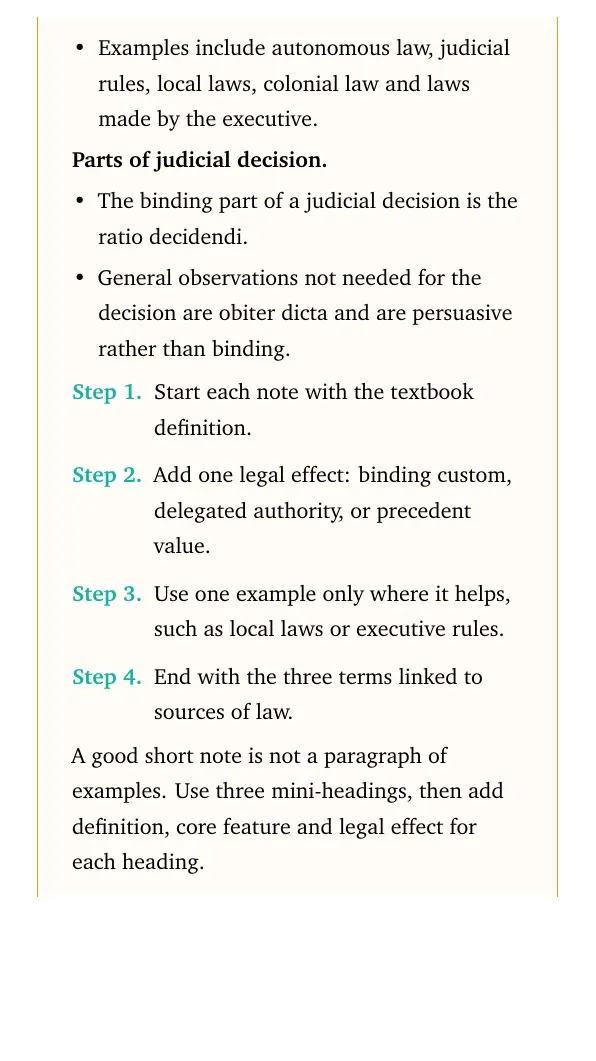
Examples include autonomous law, judicial rules, local laws, colonial law and laws made by the executive.
Parts of judicial decision.
The binding part of a judicial decision is the ratio decidendi.
General observations not needed for the decision are obiter dicta and are persuasive rather than binding.
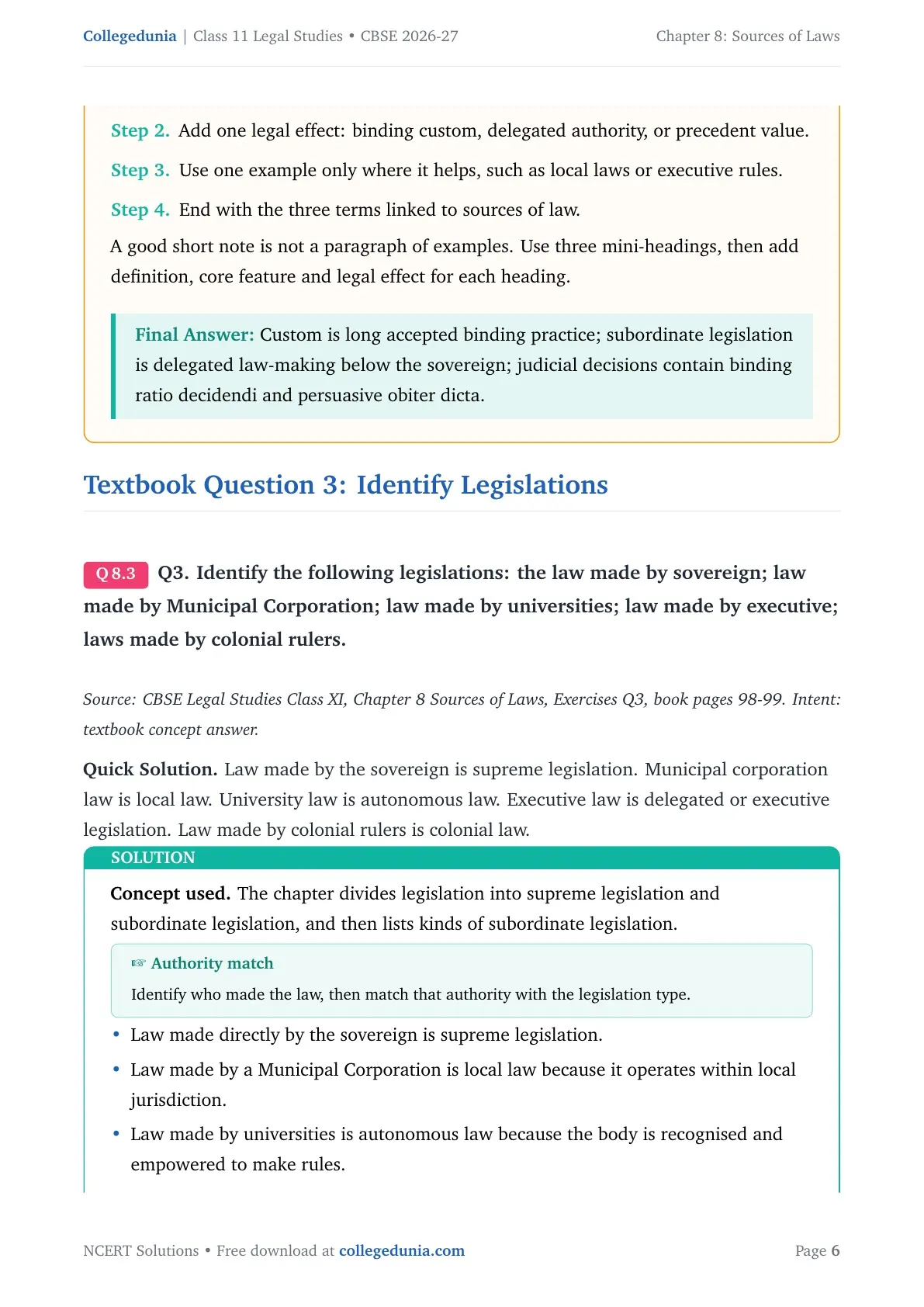
Start each note with the textbook definition.
Add one legal effect: binding custom, delegated authority, or precedent value.
Use one example only where it helps, such as local laws or executive rules.
End with the three terms linked to sources of law.
A good short note is not a paragraph of examples. Use three mini-headings, then add definition, core feature and legal effect for each heading.
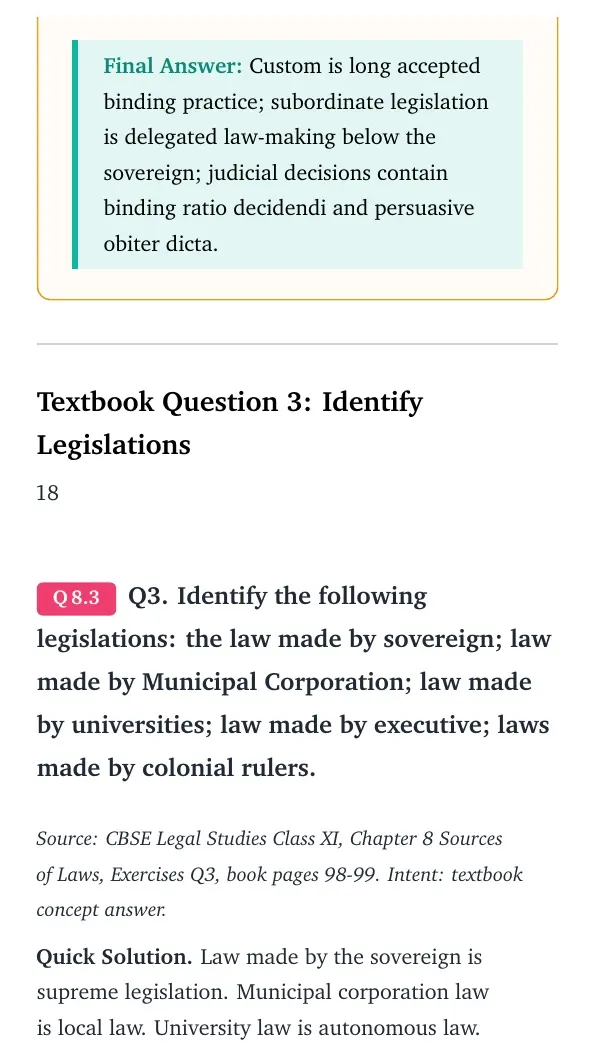
Custom is long accepted binding practice; subordinate legislation is delegated law-making below the sovereign; judicial decisions contain binding ratio decidendi and persuasive obiter dicta.
Textbook Question 3: Identify Legislations
Q 8.3
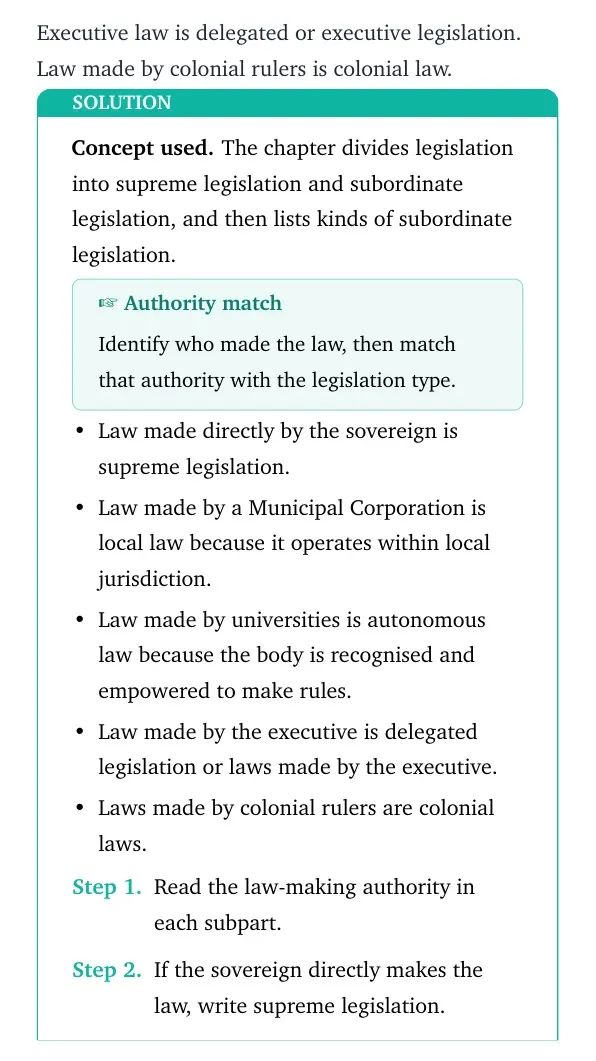
Q3. Identify the following legislations: the law made by sovereign; law made by Municipal Corporation; law made by universities; law made by executive; laws made by colonial rulers.
Concept used. The chapter divides legislation into supreme legislation and subordinate legislation, and then lists kinds of subordinate legislation.
Authority match
Identify who made the law, then match that authority with the legislation type.
Law made directly by the sovereign is supreme legislation.
Law made by a Municipal Corporation is local law because it operates within local jurisdiction.
Law made by universities is autonomous law because the body is recognised and empowered to make rules.
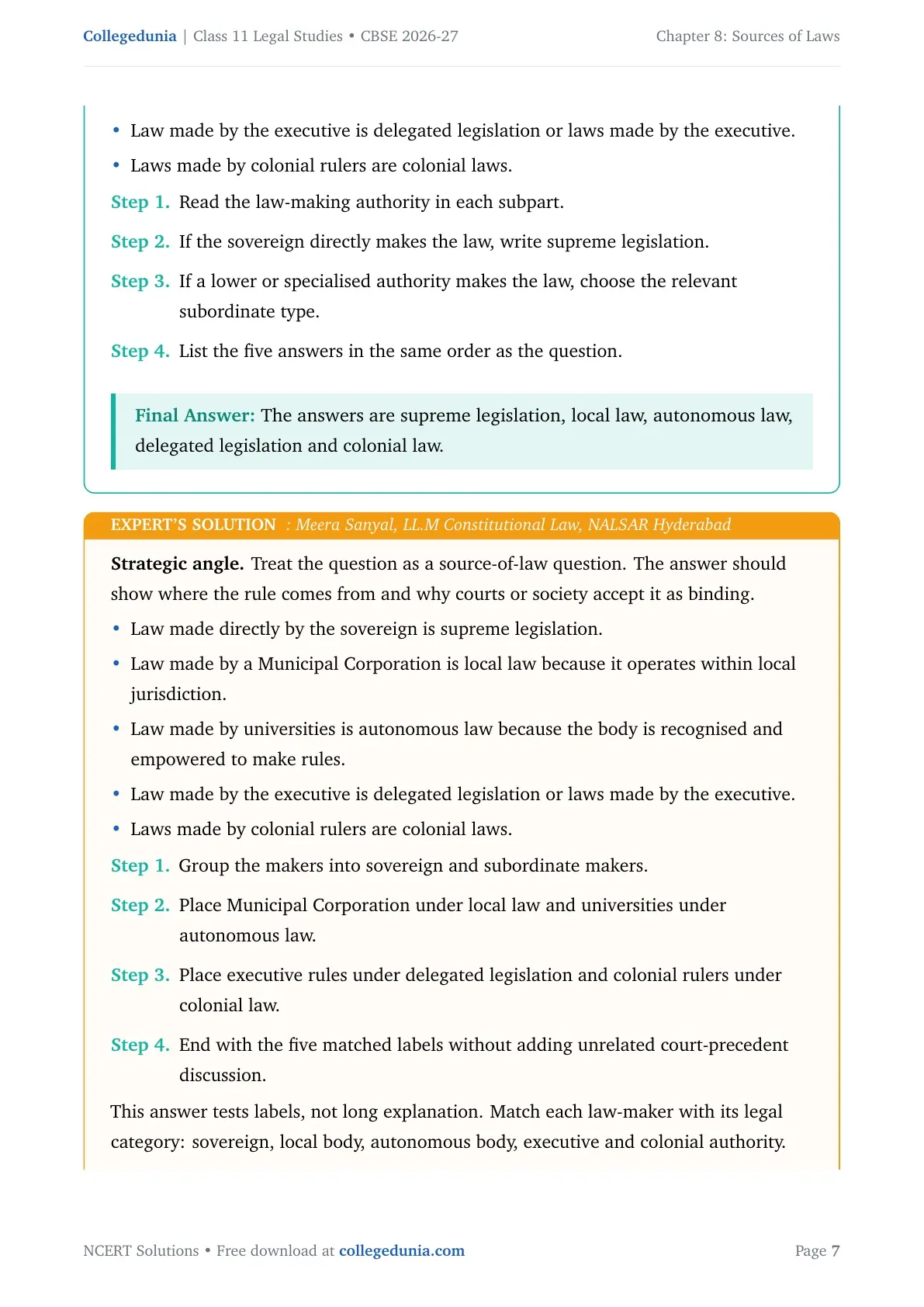
Law made by the executive is delegated legislation or laws made by the executive.
Laws made by colonial rulers are colonial laws.
Read the law-making authority in each subpart.
If the sovereign directly makes the law, write supreme legislation.
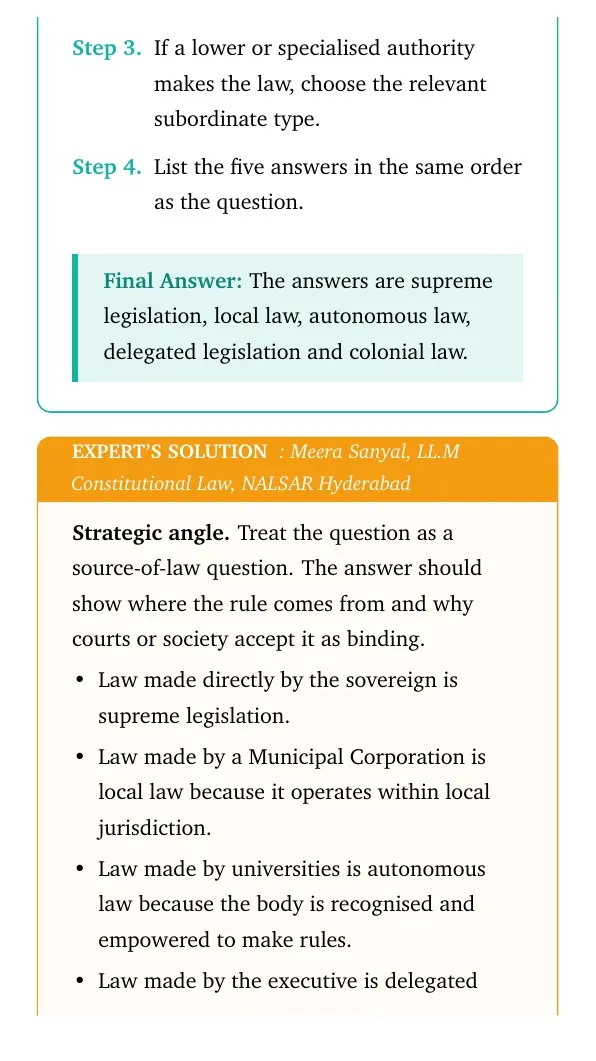
If a lower or specialised authority makes the law, choose the relevant subordinate type.
List the five answers in the same order as the question.
The answers are supreme legislation, local law, autonomous law, delegated legislation and colonial law.
MS
Meera Sanyal
LL.M Constitutional Law, NALSAR Hyderabad
Verified Expert
Strategic angle. Treat the question as a source-of-law question. The answer should show where the rule comes from and why courts or society accept it as binding.
Law made directly by the sovereign is supreme legislation.
Law made by a Municipal Corporation is local law because it operates within local jurisdiction.
Law made by universities is autonomous law because the body is recognised and empowered to make rules.
Law made by the executive is delegated legislation or laws made by the executive.
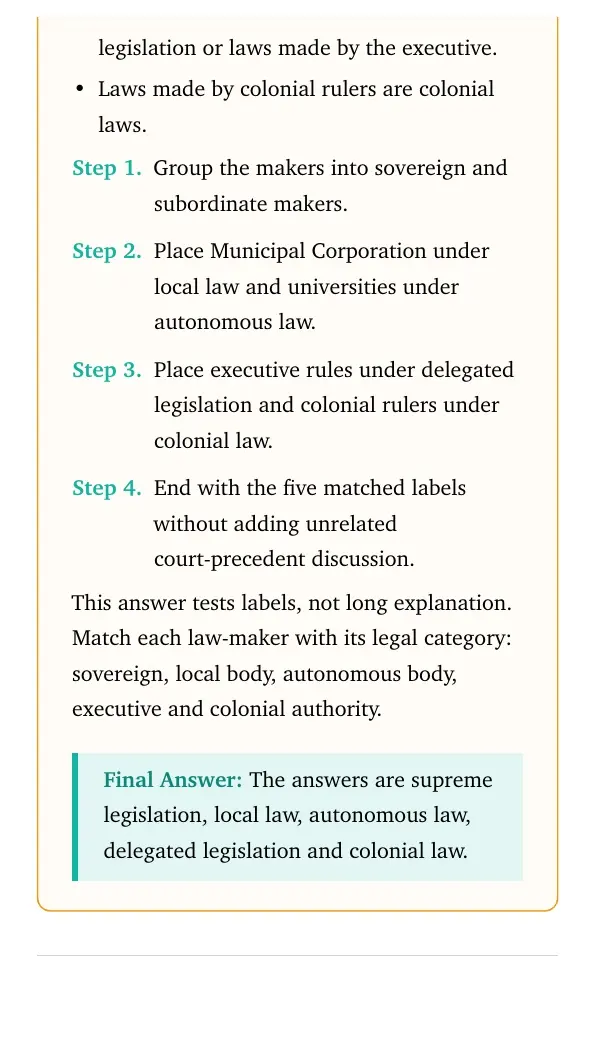
Laws made by colonial rulers are colonial laws.
Group the makers into sovereign and subordinate makers.
Place Municipal Corporation under local law and universities under autonomous law.
Place executive rules under delegated legislation and colonial rulers under colonial law.
End with the five matched labels without adding unrelated court-precedent discussion.
This answer tests labels, not long explanation. Match each law-maker with its legal category: sovereign, local body, autonomous body, executive and colonial authority.
The answers are supreme legislation, local law, autonomous law, delegated legislation and colonial law.
Textbook Question 4: Brief Answers
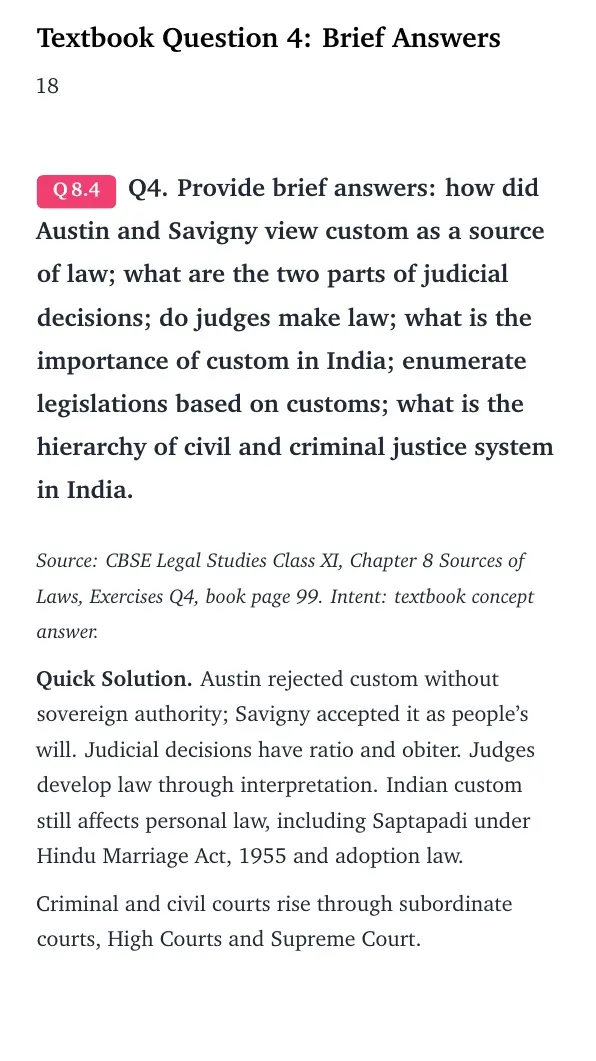
Q 8.4
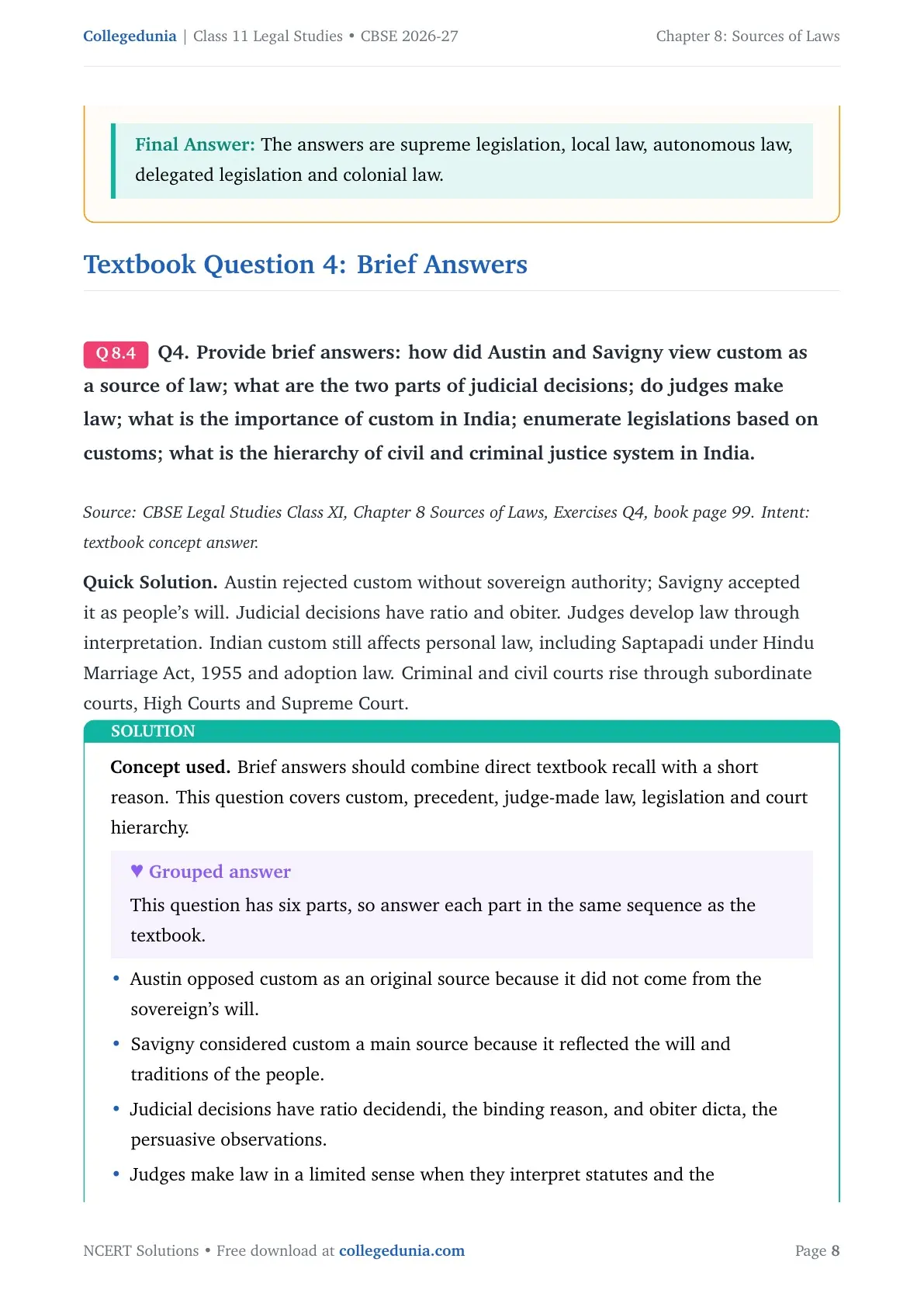
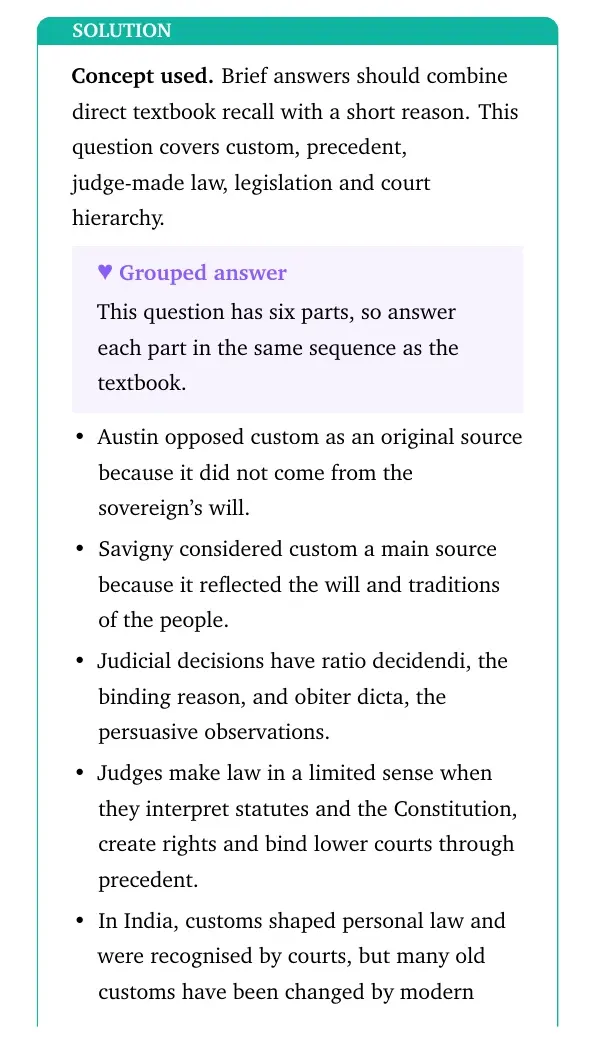
Q4. Provide brief answers: how did Austin and Savigny view custom as a source of law; what are the two parts of judicial decisions; do judges make law; what is the importance of custom in India; enumerate legislations based on customs; what is the hierarchy of civil and criminal justice system in India.
Concept used. Brief answers should combine direct textbook recall with a short reason. This question covers custom, precedent, judge-made law, legislation and court hierarchy.
Grouped answer
This question has six parts, so answer each part in the same sequence as the textbook.
Austin opposed custom as an original source because it did not come from the sovereign's will.
Savigny considered custom a main source because it reflected the will and traditions of the people.
Judicial decisions have ratio decidendi, the binding reason, and obiter dicta, the persuasive observations.
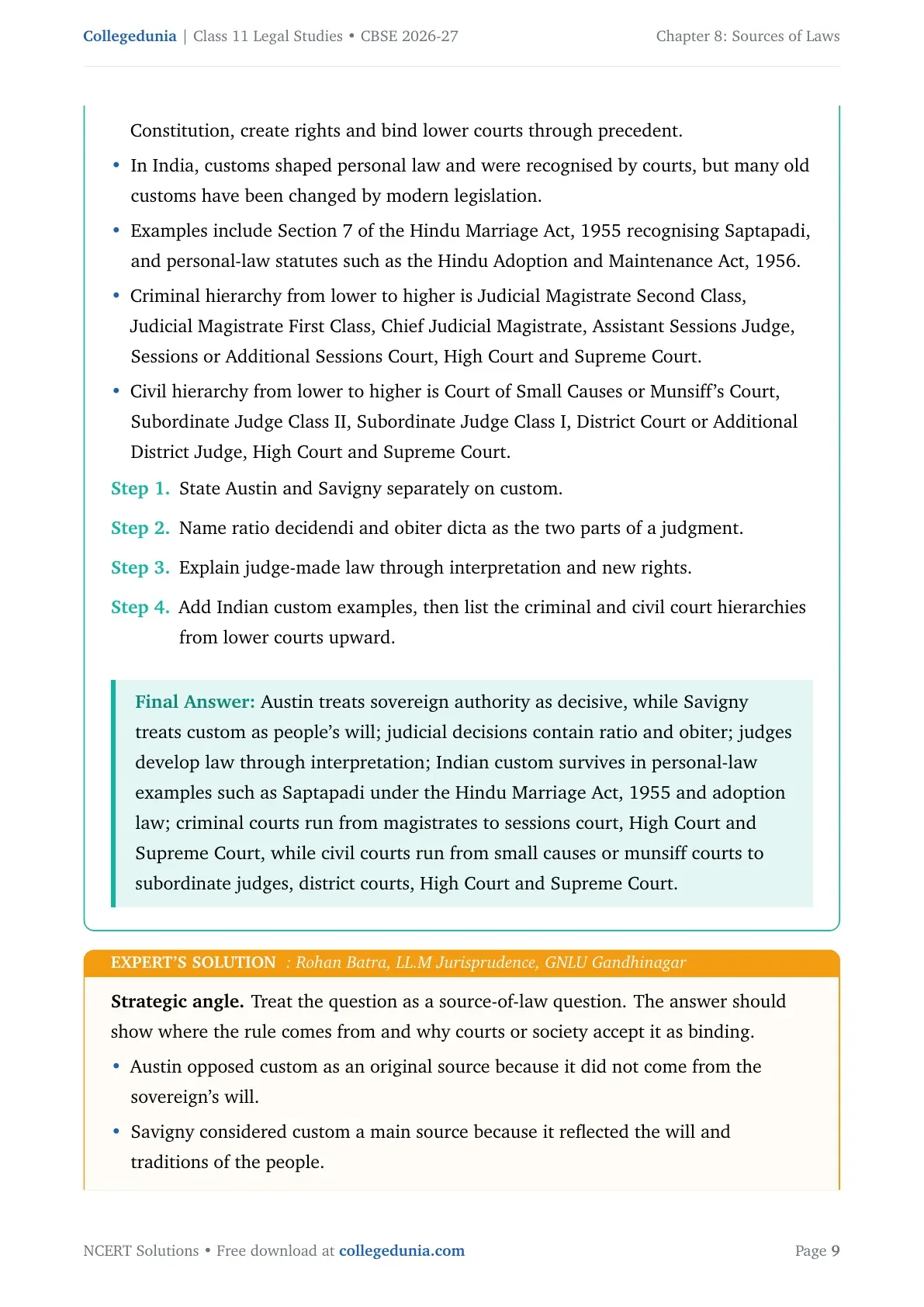
Judges make law in a limited sense when they interpret statutes and the Constitution, create rights and bind lower courts through precedent.
In India, customs shaped personal law and were recognised by courts, but many old customs have been changed by modern legislation.
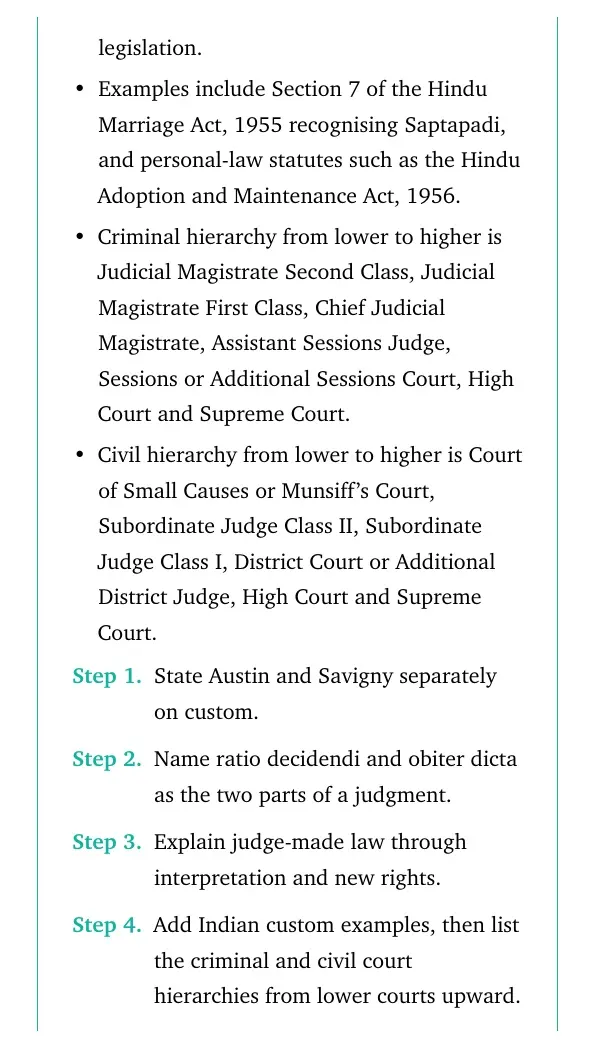
Examples include Section 7 of the Hindu Marriage Act, 1955 recognising Saptapadi, and personal-law statutes such as the Hindu Adoption and Maintenance Act, 1956.
Criminal hierarchy from lower to higher is Judicial Magistrate Second Class, Judicial Magistrate First Class, Chief Judicial Magistrate, Assistant Sessions Judge, Sessions or Additional Sessions Court, High Court and Supreme Court.
Civil hierarchy from lower to higher is Court of Small Causes or Munsiff's Court, Subordinate Judge Class II, Subordinate Judge Class I, District Court or Additional District Judge, High Court and Supreme Court.
State Austin and Savigny separately on custom.
Name ratio decidendi and obiter dicta as the two parts of a judgment.
Explain judge-made law through interpretation and new rights.
Add Indian custom examples, then list the criminal and civil court hierarchies from lower courts upward.
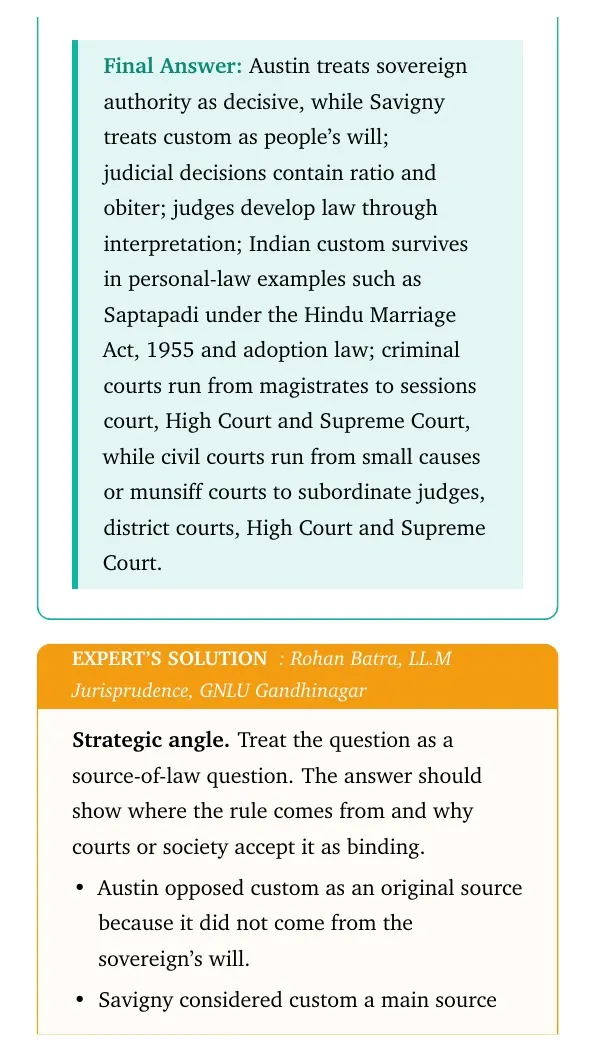
Austin treats sovereign authority as decisive, while Savigny treats custom as people's will; judicial decisions contain ratio and obiter; judges develop law through interpretation; Indian custom survives in personal-law examples such as Saptapadi under the Hindu Marriage Act, 1955 and adoption law; criminal courts run from magistrates to sessions court, High Court and Supreme Court, while civil courts run from small causes or munsiff courts to subordinate judges, district courts, High Court and Supreme Court.
RB
Rohan Batra
LL.M Jurisprudence, GNLU Gandhinagar
Verified Expert
Strategic angle. Treat the question as a source-of-law question. The answer should show where the rule comes from and why courts or society accept it as binding.
Austin opposed custom as an original source because it did not come from the sovereign's will.
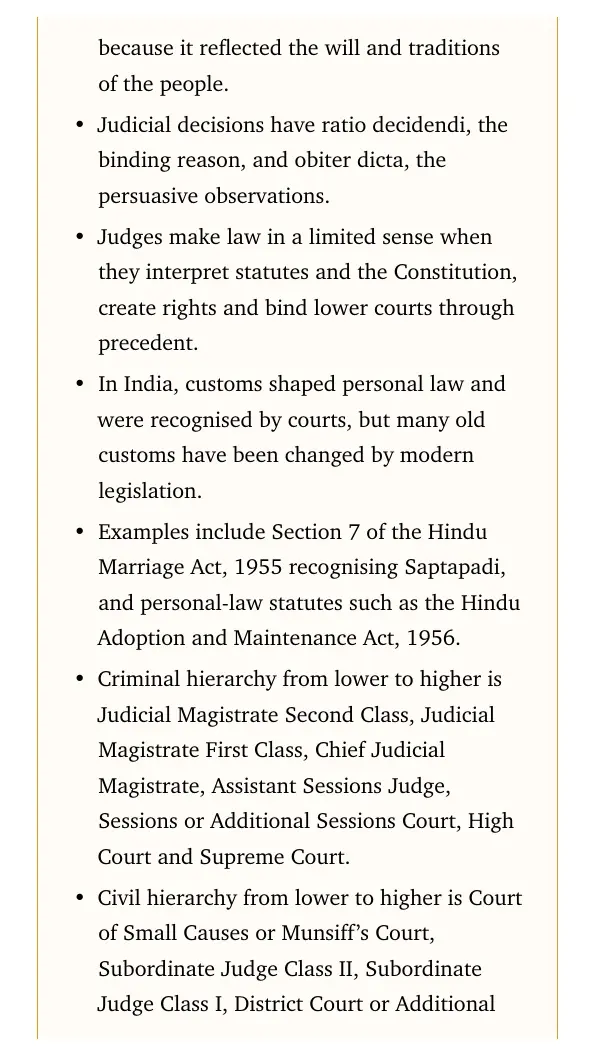
Savigny considered custom a main source because it reflected the will and traditions of the people.
Judicial decisions have ratio decidendi, the binding reason, and obiter dicta, the persuasive observations.
Judges make law in a limited sense when they interpret statutes and the Constitution, create rights and bind lower courts through precedent.
In India, customs shaped personal law and were recognised by courts, but many old customs have been changed by modern legislation.
Examples include Section 7 of the Hindu Marriage Act, 1955 recognising Saptapadi, and personal-law statutes such as the Hindu Adoption and Maintenance Act, 1956.
Criminal hierarchy from lower to higher is Judicial Magistrate Second Class, Judicial Magistrate First Class, Chief Judicial Magistrate, Assistant Sessions Judge, Sessions or Additional Sessions Court, High Court and Supreme Court.
Civil hierarchy from lower to higher is Court of Small Causes or Munsiff's Court, Subordinate Judge Class II, Subordinate Judge Class I, District Court or Additional District Judge, High Court and Supreme Court.
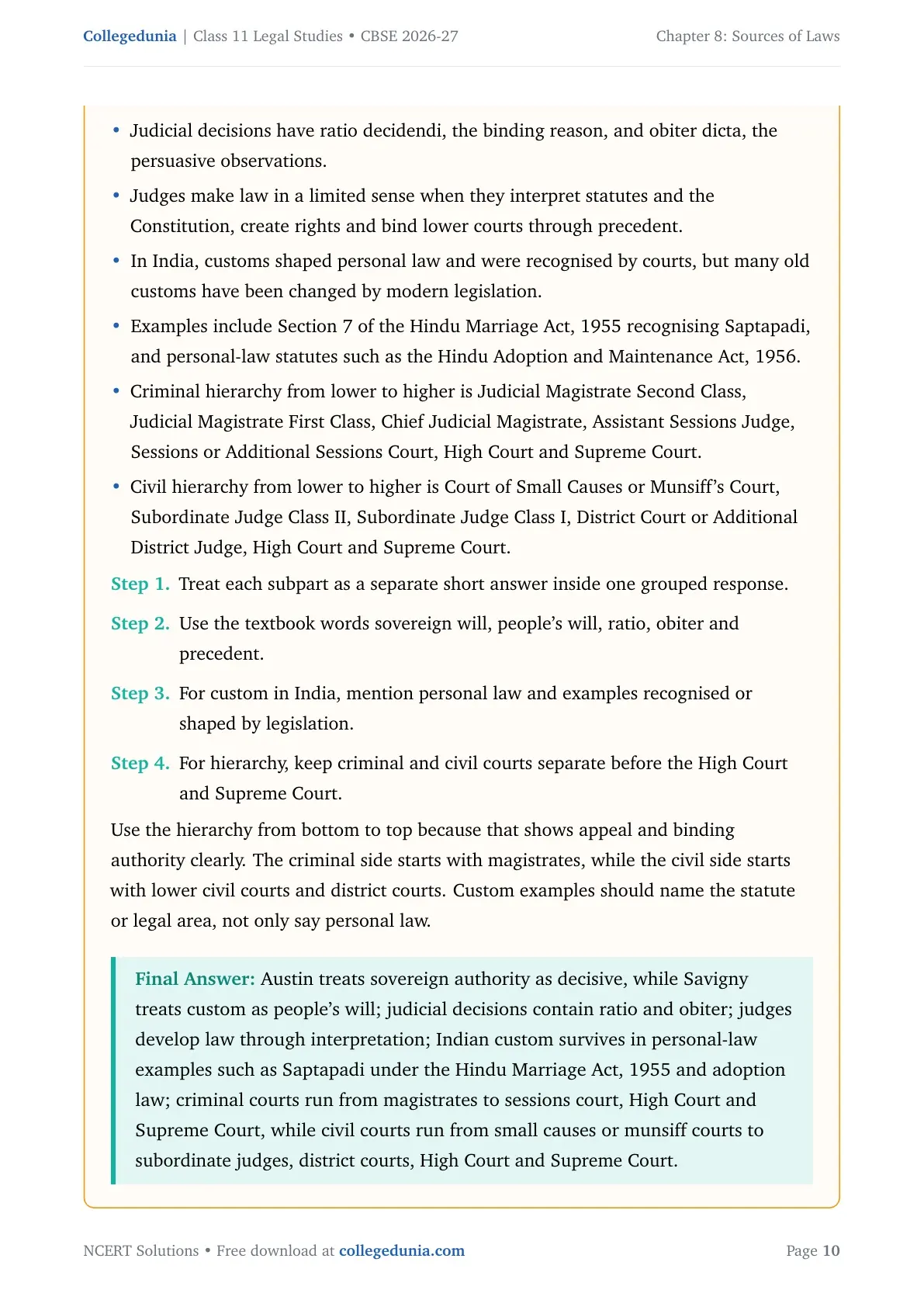
Treat each subpart as a separate short answer inside one grouped response.
Use the textbook words sovereign will, people's will, ratio, obiter and precedent.
For custom in India, mention personal law and examples recognised or shaped by legislation.
For hierarchy, keep criminal and civil courts separate before the High Court and Supreme Court.
Use the hierarchy from bottom to top because that shows appeal and binding authority clearly. The criminal side starts with magistrates, while the civil side starts with lower civil courts and district courts. Custom examples should name the statute or legal area, not only say personal law.
Austin treats sovereign authority as decisive, while Savigny treats custom as people's will; judicial decisions contain ratio and obiter; judges develop law through interpretation; Indian custom survives in personal-law examples such as Saptapadi under the Hindu Marriage Act, 1955 and adoption law; criminal courts run from magistrates to sessions court, High Court and Supreme Court, while civil courts run from small causes or munsiff courts to subordinate judges, district courts, High Court and Supreme Court.
Textbook Question 5: Detailed Answers
Q 8.5
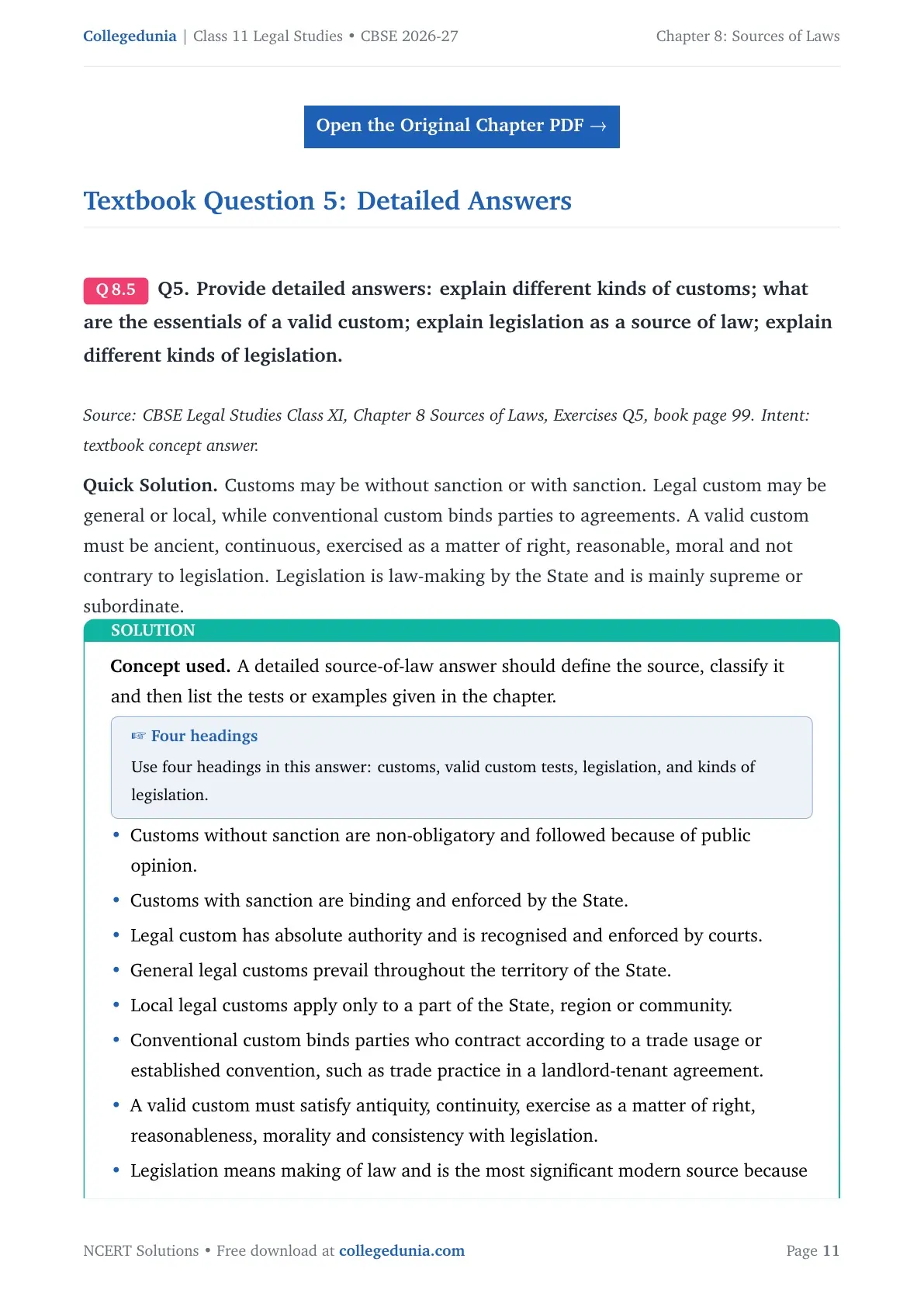
Q5. Provide detailed answers: explain different kinds of customs; what are the essentials of a valid custom; explain legislation as a source of law; explain different kinds of legislation.
Concept used. A detailed source-of-law answer should define the source, classify it and then list the tests or examples given in the chapter.
Four headings
Use four headings in this answer: customs, valid custom tests, legislation, and kinds of legislation.
Customs without sanction are non-obligatory and followed because of public opinion.
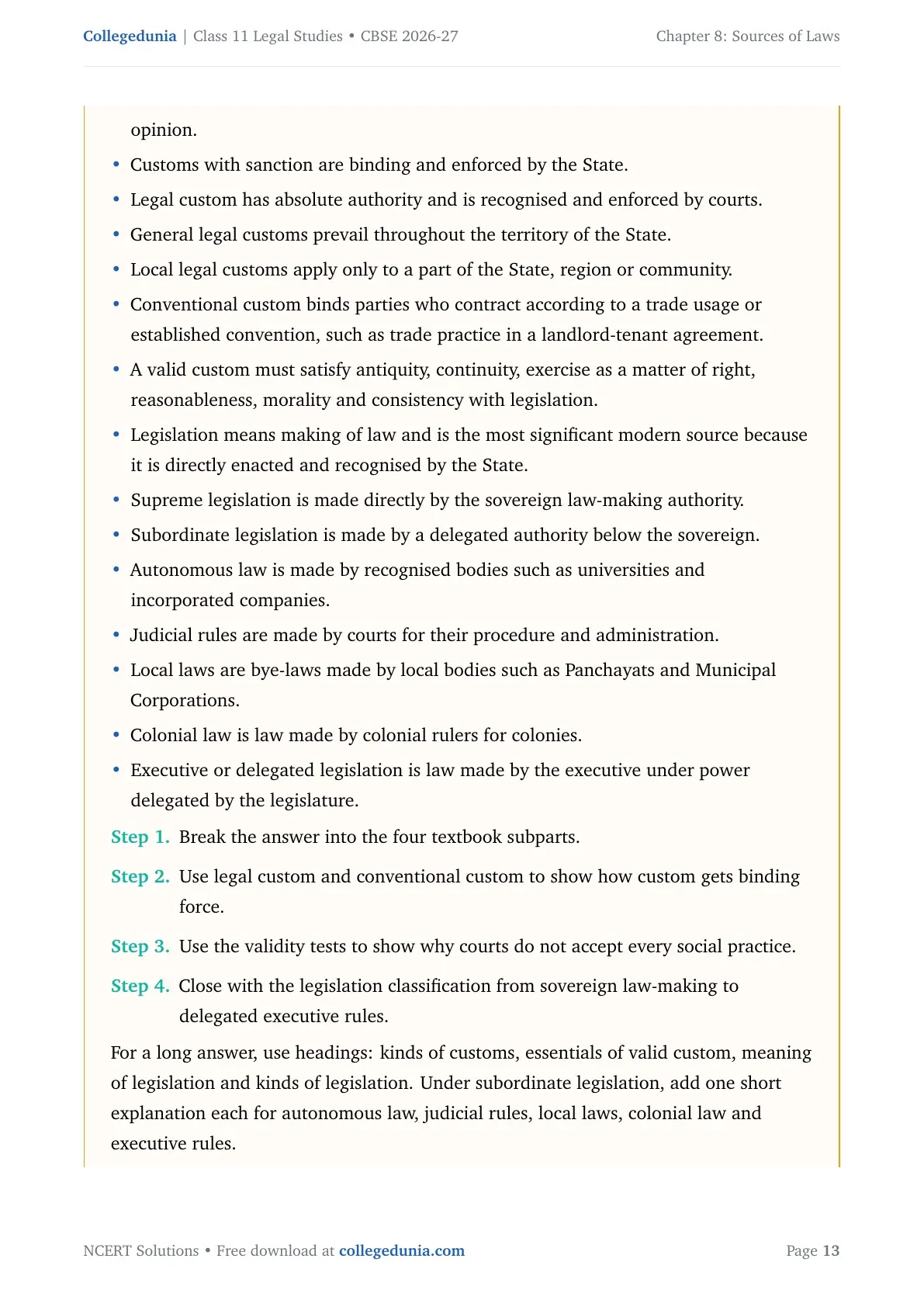
Customs with sanction are binding and enforced by the State.
Legal custom has absolute authority and is recognised and enforced by courts.
General legal customs prevail throughout the territory of the State.
Local legal customs apply only to a part of the State, region or community.
Conventional custom binds parties who contract according to a trade usage or established convention, such as trade practice in a landlord-tenant agreement.
A valid custom must satisfy antiquity, continuity, exercise as a matter of right, reasonableness, morality and consistency with legislation.
Legislation means making of law and is the most significant modern source because it is directly enacted and recognised by the State.
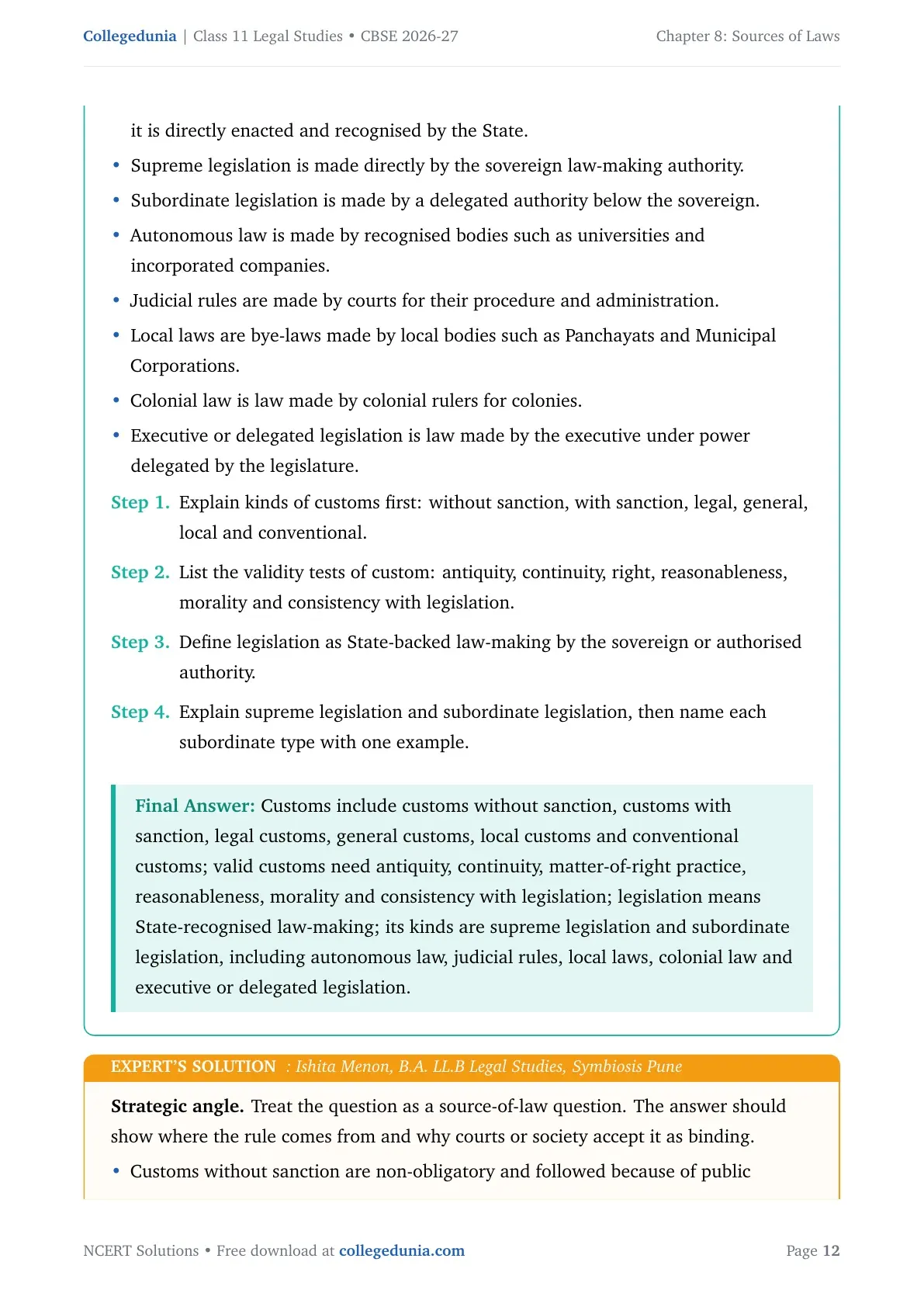
Supreme legislation is made directly by the sovereign law-making authority.
Subordinate legislation is made by a delegated authority below the sovereign.
Autonomous law is made by recognised bodies such as universities and incorporated companies.
Judicial rules are made by courts for their procedure and administration.
Local laws are bye-laws made by local bodies such as Panchayats and Municipal Corporations.
Colonial law is law made by colonial rulers for colonies.
Executive or delegated legislation is law made by the executive under power delegated by the legislature.
Explain kinds of customs first: without sanction, with sanction, legal, general, local and conventional.
List the validity tests of custom: antiquity, continuity, right, reasonableness, morality and consistency with legislation.
Define legislation as State-backed law-making by the sovereign or authorised authority.
Explain supreme legislation and subordinate legislation, then name each subordinate type with one example.
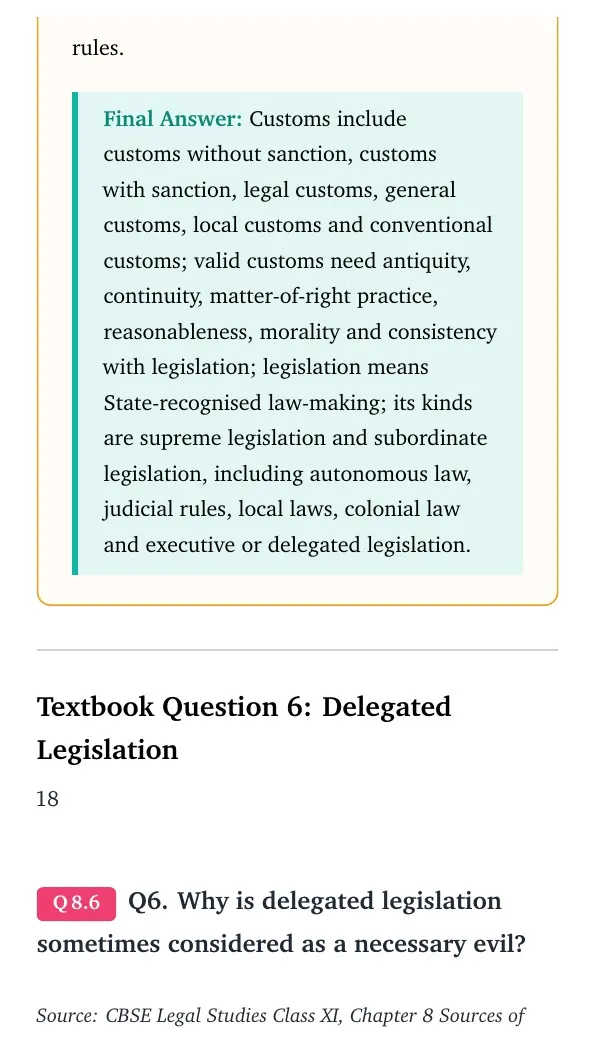
Customs include customs without sanction, customs with sanction, legal customs, general customs, local customs and conventional customs; valid customs need antiquity, continuity, matter-of-right practice, reasonableness, morality and consistency with legislation; legislation means State-recognised law-making; its kinds are supreme legislation and subordinate legislation, including autonomous law, judicial rules, local laws, colonial law and executive or delegated legislation.
IM
Ishita Menon
B.A. LL.B Legal Studies, Symbiosis Pune
Verified Expert
Strategic angle. Treat the question as a source-of-law question. The answer should show where the rule comes from and why courts or society accept it as binding.
Customs without sanction are non-obligatory and followed because of public opinion.
Customs with sanction are binding and enforced by the State.
Legal custom has absolute authority and is recognised and enforced by courts.
General legal customs prevail throughout the territory of the State.
Local legal customs apply only to a part of the State, region or community.
Conventional custom binds parties who contract according to a trade usage or established convention, such as trade practice in a landlord-tenant agreement.
A valid custom must satisfy antiquity, continuity, exercise as a matter of right, reasonableness, morality and consistency with legislation.
Legislation means making of law and is the most significant modern source because it is directly enacted and recognised by the State.
Supreme legislation is made directly by the sovereign law-making authority.
Subordinate legislation is made by a delegated authority below the sovereign.
Autonomous law is made by recognised bodies such as universities and incorporated companies.
Judicial rules are made by courts for their procedure and administration.
Local laws are bye-laws made by local bodies such as Panchayats and Municipal Corporations.
Colonial law is law made by colonial rulers for colonies.
Executive or delegated legislation is law made by the executive under power delegated by the legislature.
Break the answer into the four textbook subparts.
Use legal custom and conventional custom to show how custom gets binding force.
Use the validity tests to show why courts do not accept every social practice.
Close with the legislation classification from sovereign law-making to delegated executive rules.
For a long answer, use headings: kinds of customs, essentials of valid custom, meaning of legislation and kinds of legislation. Under subordinate legislation, add one short explanation each for autonomous law, judicial rules, local laws, colonial law and executive rules.
Customs include customs without sanction, customs with sanction, legal customs, general customs, local customs and conventional customs; valid customs need antiquity, continuity, matter-of-right practice, reasonableness, morality and consistency with legislation; legislation means State-recognised law-making; its kinds are supreme legislation and subordinate legislation, including autonomous law, judicial rules, local laws, colonial law and executive or delegated legislation.
Textbook Question 6: Delegated Legislation
Q 8.6
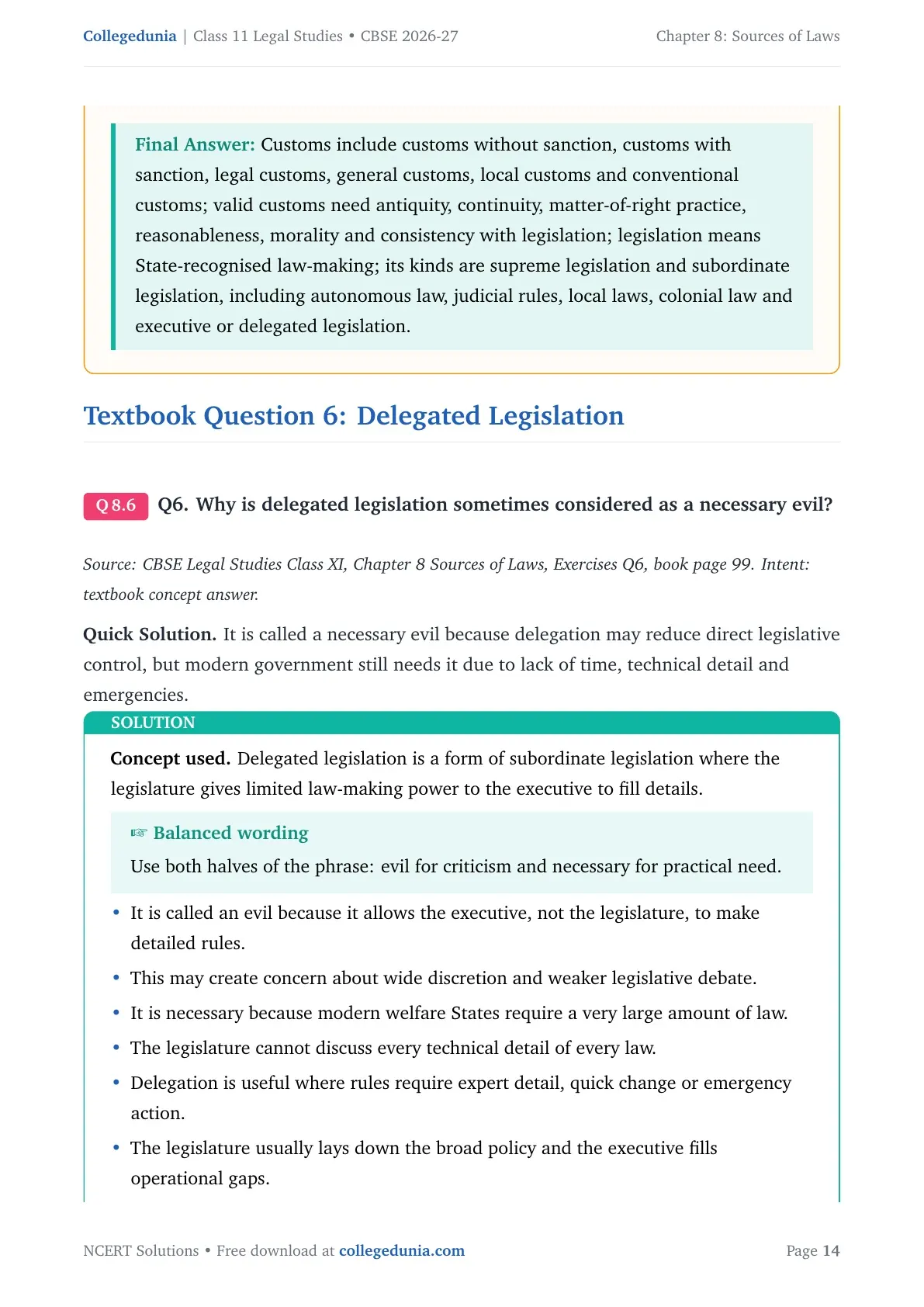
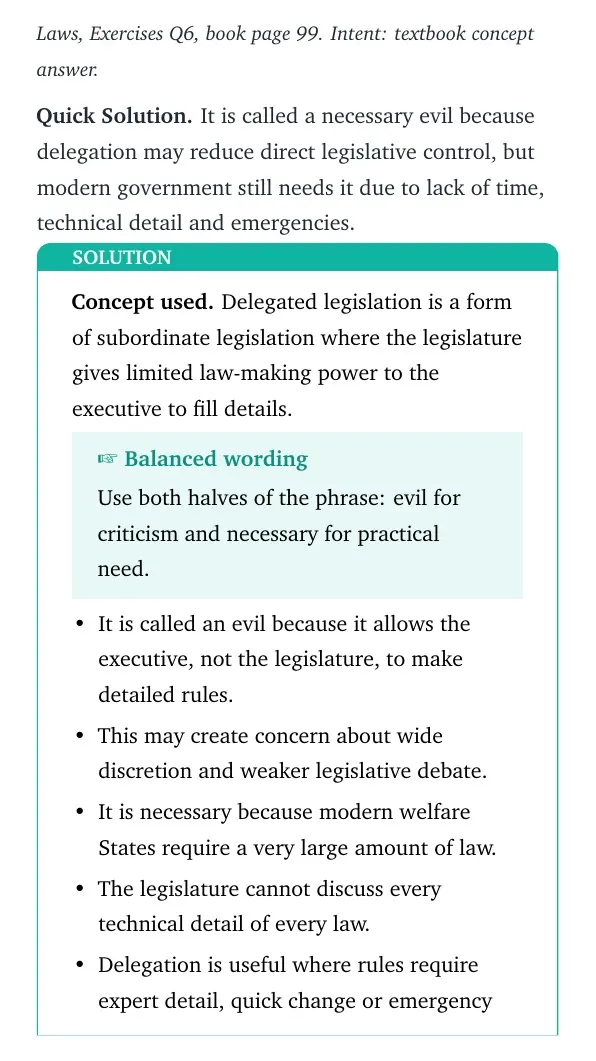
Q6. Why is delegated legislation sometimes considered as a necessary evil?
Concept used. Delegated legislation is a form of subordinate legislation where the legislature gives limited law-making power to the executive to fill details.
Balanced wording
Use both halves of the phrase: evil for criticism and necessary for practical need.
It is called an evil because it allows the executive, not the legislature, to make detailed rules.
This may create concern about wide discretion and weaker legislative debate.
It is necessary because modern welfare States require a very large amount of law.
The legislature cannot discuss every technical detail of every law.
Delegation is useful where rules require expert detail, quick change or emergency action.
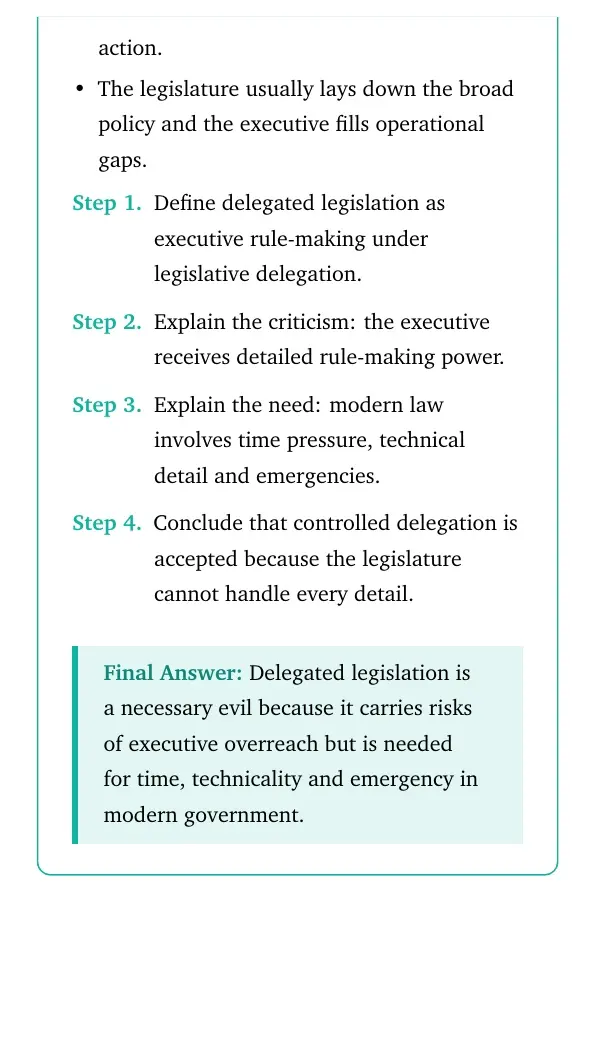
The legislature usually lays down the broad policy and the executive fills operational gaps.
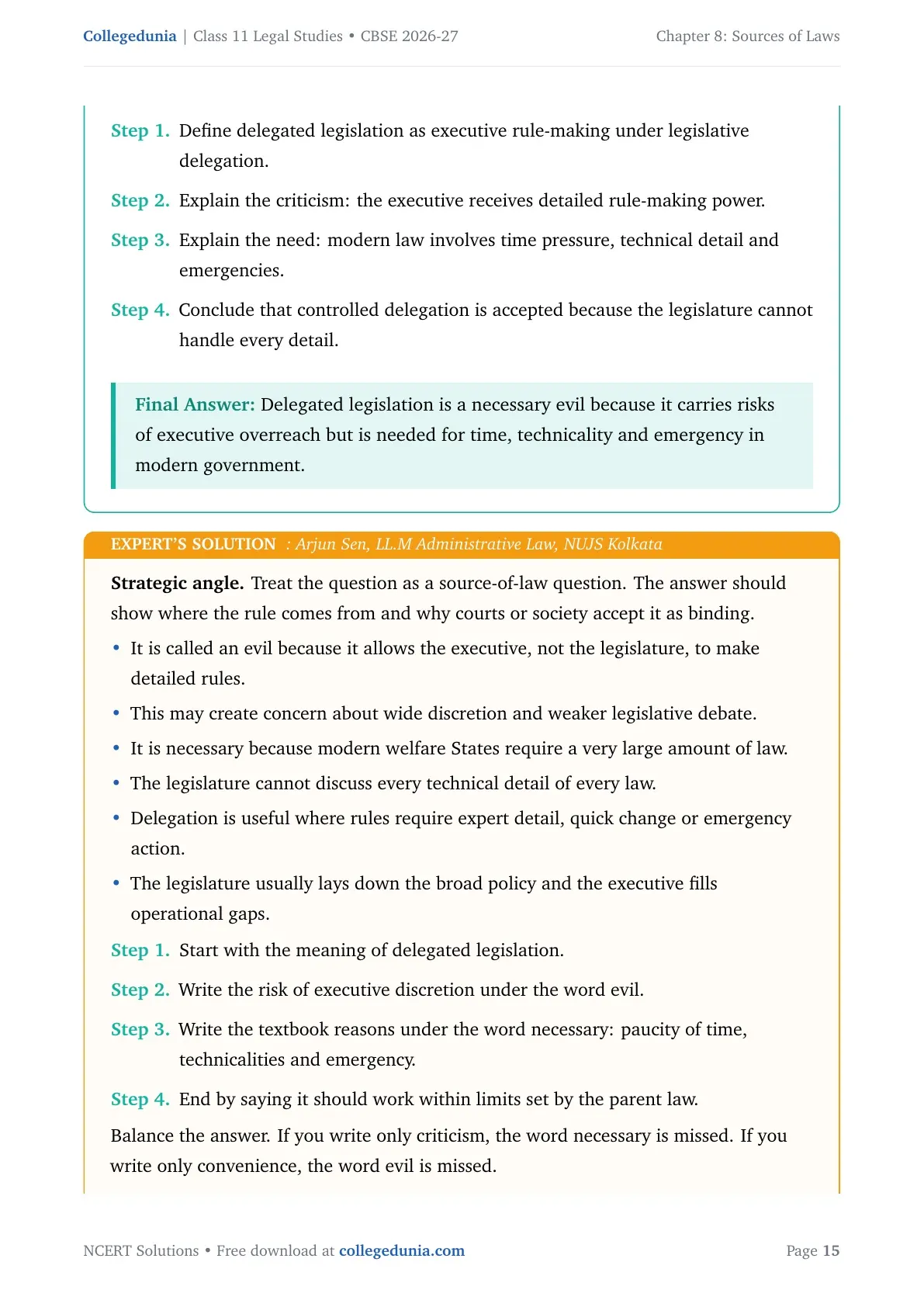
Define delegated legislation as executive rule-making under legislative delegation.
Explain the criticism: the executive receives detailed rule-making power.
Explain the need: modern law involves time pressure, technical detail and emergencies.
Conclude that controlled delegation is accepted because the legislature cannot handle every detail.
Delegated legislation is a necessary evil because it carries risks of executive overreach but is needed for time, technicality and emergency in modern government.
AS
Arjun Sen
LL.M Administrative Law, NUJS Kolkata
Verified Expert
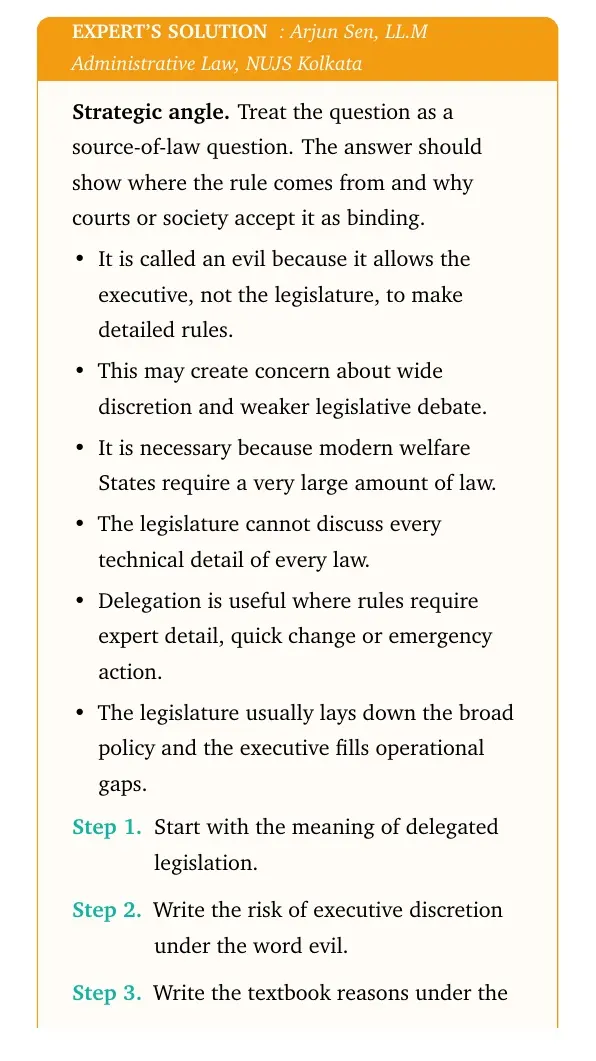
Strategic angle. Treat the question as a source-of-law question. The answer should show where the rule comes from and why courts or society accept it as binding.
It is called an evil because it allows the executive, not the legislature, to make detailed rules.
This may create concern about wide discretion and weaker legislative debate.
It is necessary because modern welfare States require a very large amount of law.
The legislature cannot discuss every technical detail of every law.
Delegation is useful where rules require expert detail, quick change or emergency action.
The legislature usually lays down the broad policy and the executive fills operational gaps.
Start with the meaning of delegated legislation.
Write the risk of executive discretion under the word evil.
Write the textbook reasons under the word necessary: paucity of time, technicalities and emergency.
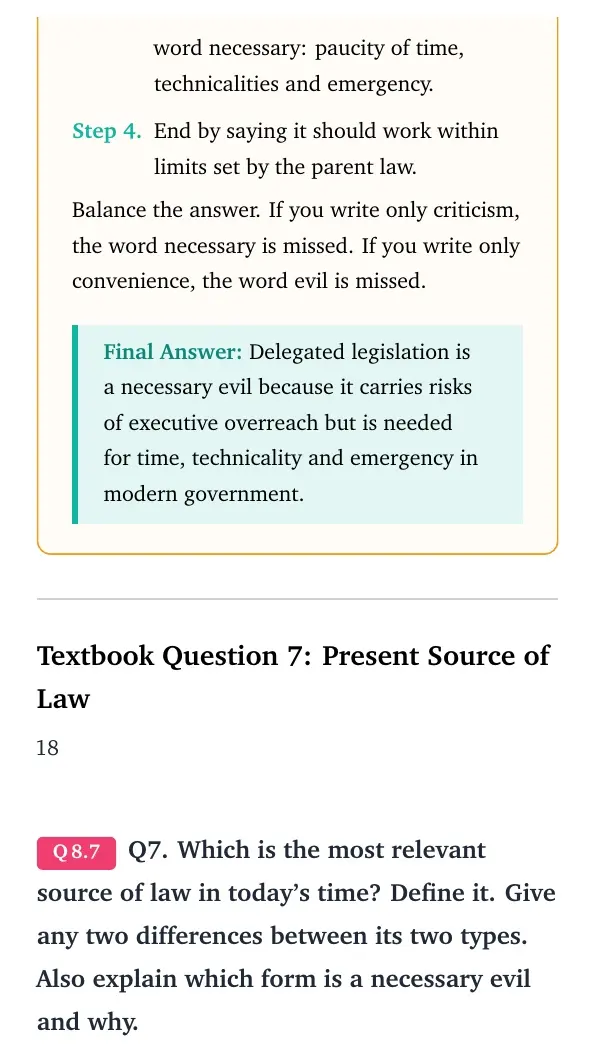
End by saying it should work within limits set by the parent law.
Balance the answer. If you write only criticism, the word necessary is missed. If you write only convenience, the word evil is missed.
Delegated legislation is a necessary evil because it carries risks of executive overreach but is needed for time, technicality and emergency in modern government.
Textbook Question 7: Present Source of Law
Q 8.7
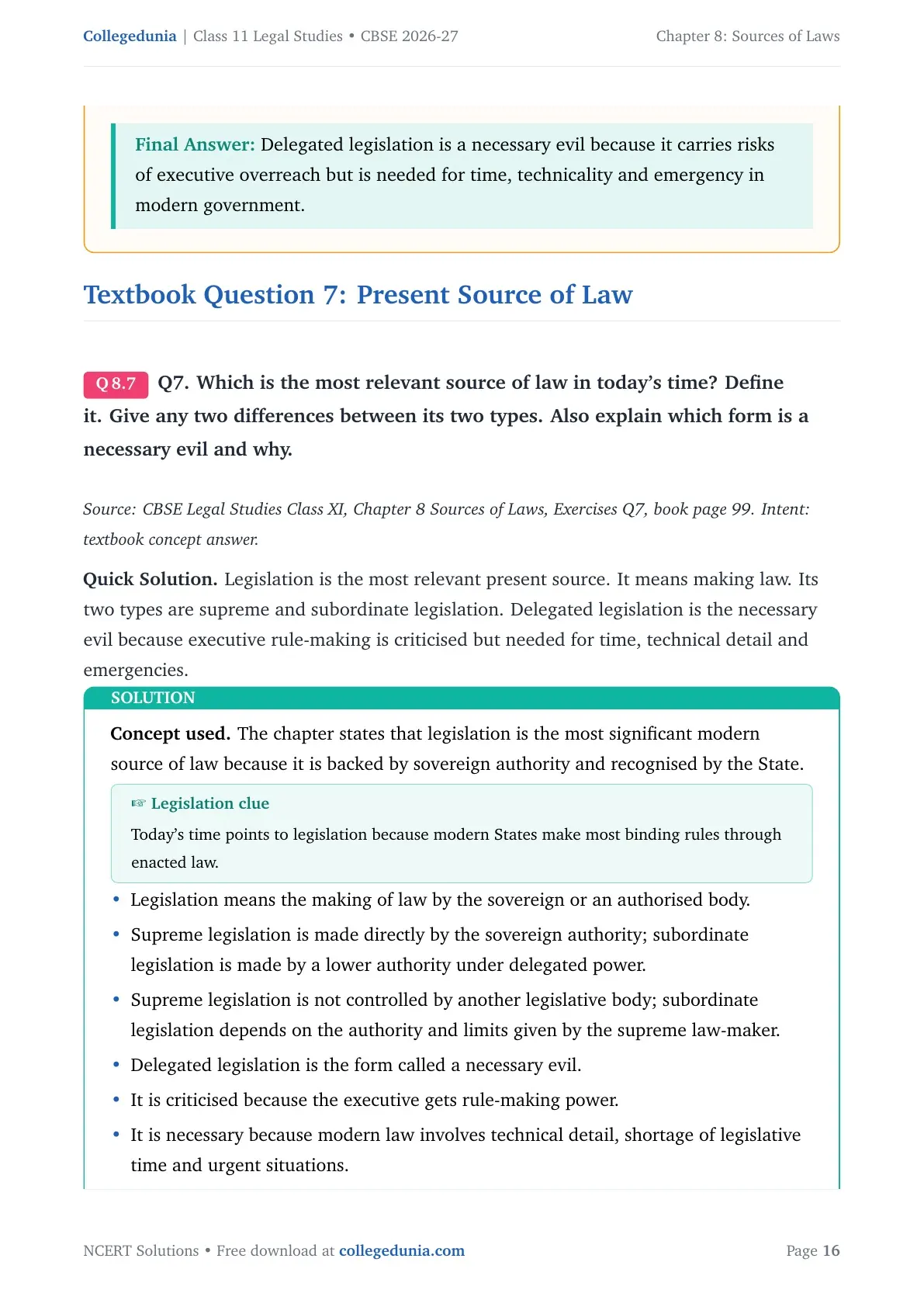
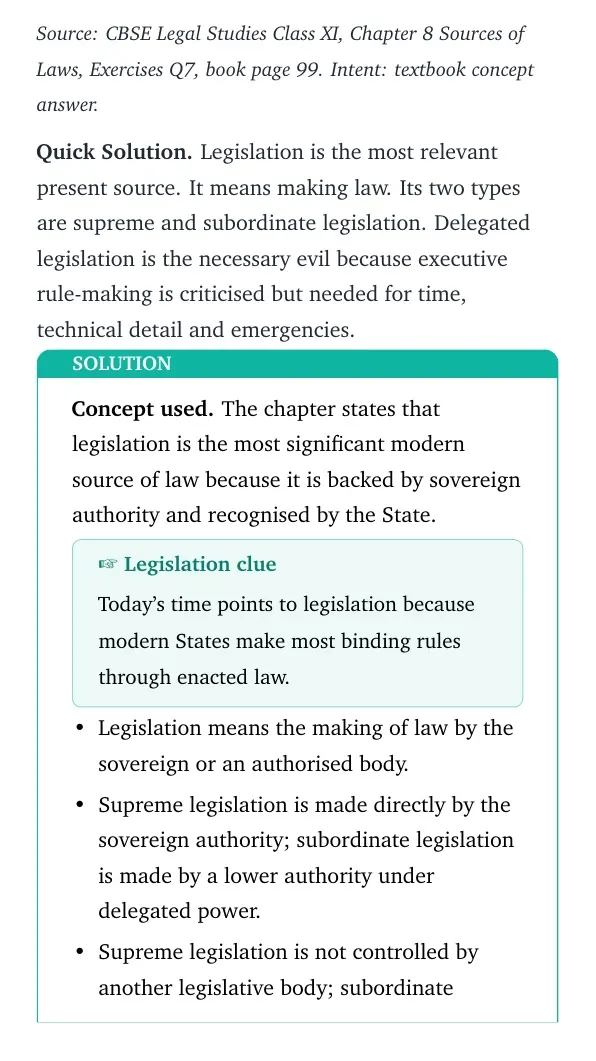
Q7. Which is the most relevant source of law in today's time? Define it. Give any two differences between its two types. Also explain which form is a necessary evil and why.
Concept used. The chapter states that legislation is the most significant modern source of law because it is backed by sovereign authority and recognised by the State.
Legislation clue
Today's time points to legislation because modern States make most binding rules through enacted law.
Legislation means the making of law by the sovereign or an authorised body.
Supreme legislation is made directly by the sovereign authority; subordinate legislation is made by a lower authority under delegated power.
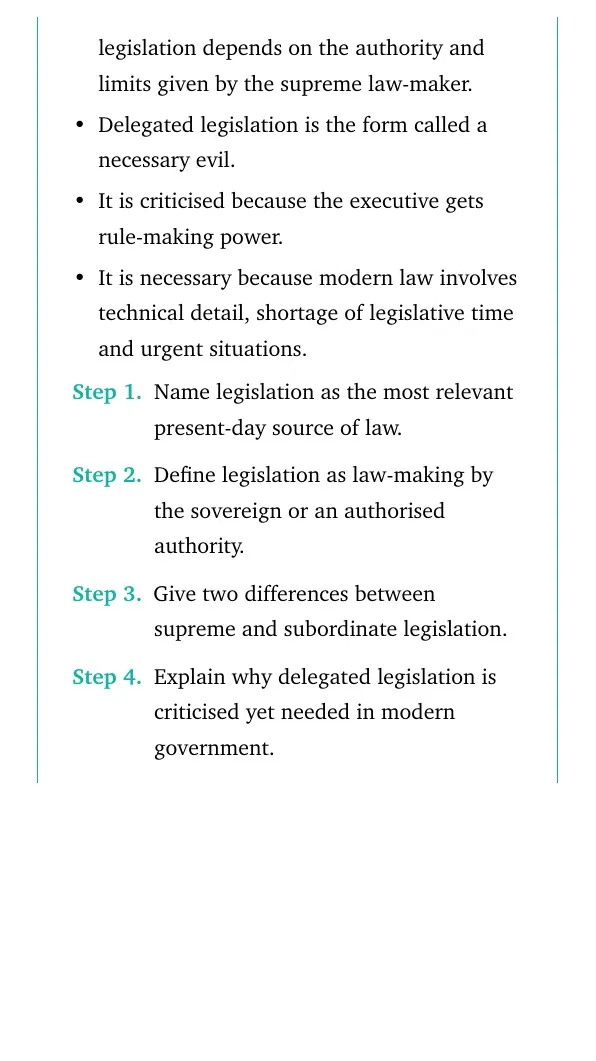
Supreme legislation is not controlled by another legislative body; subordinate legislation depends on the authority and limits given by the supreme law-maker.
Delegated legislation is the form called a necessary evil.
It is criticised because the executive gets rule-making power.
It is necessary because modern law involves technical detail, shortage of legislative time and urgent situations.
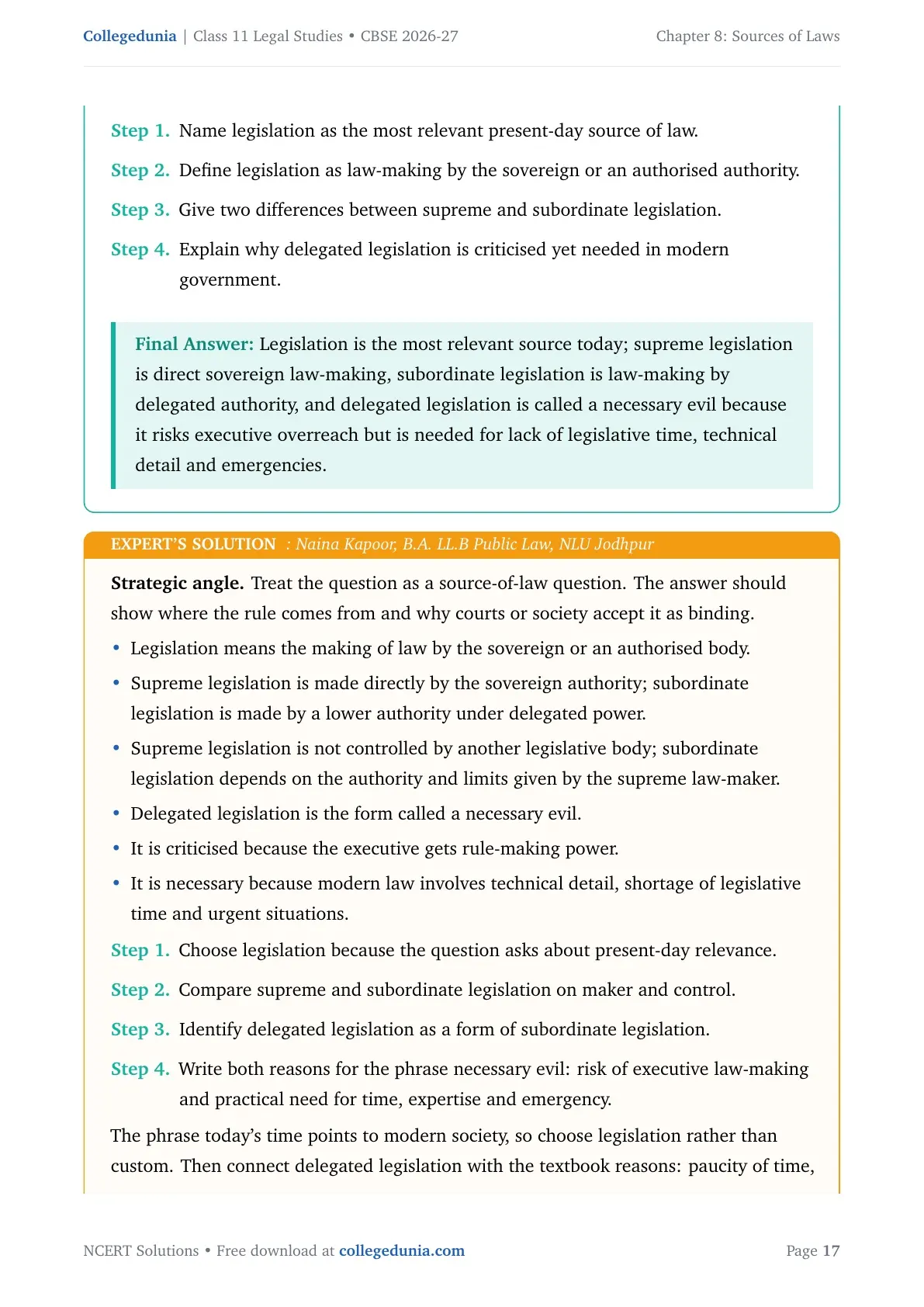
Name legislation as the most relevant present-day source of law.
Define legislation as law-making by the sovereign or an authorised authority.
Give two differences between supreme and subordinate legislation.
Explain why delegated legislation is criticised yet needed in modern government.
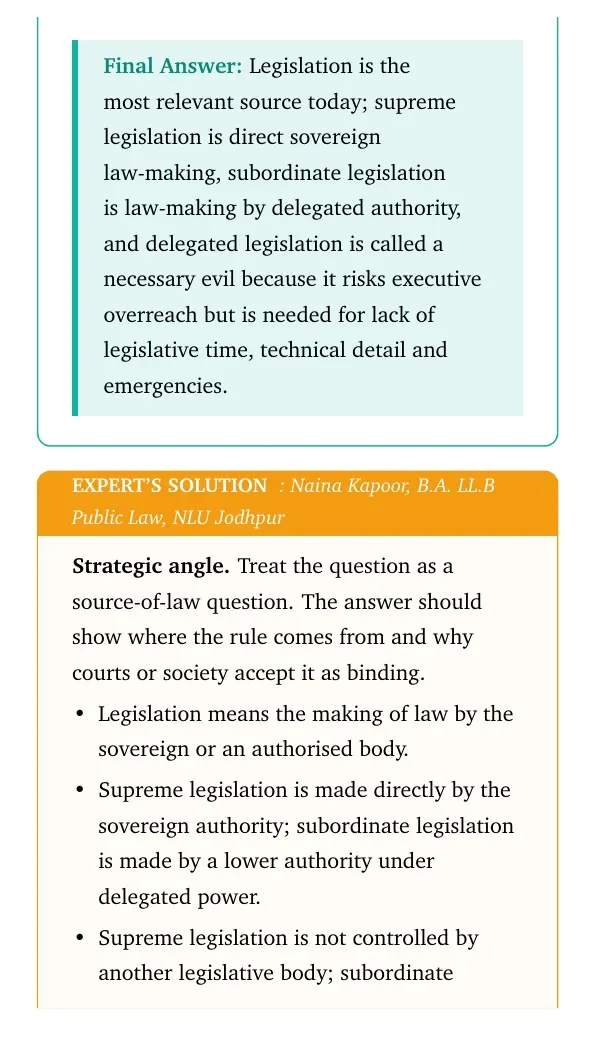
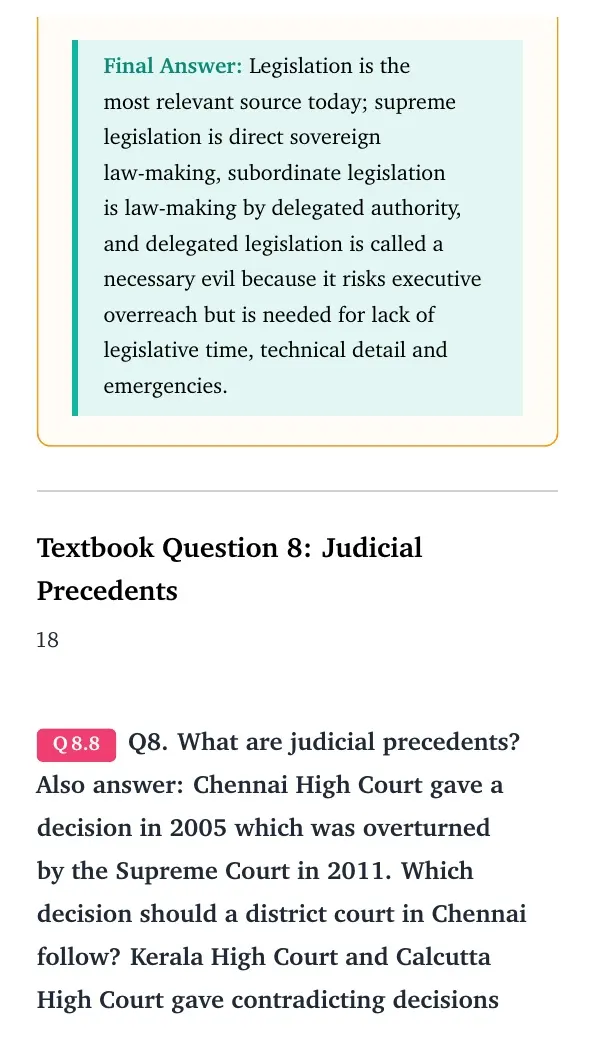
Legislation is the most relevant source today; supreme legislation is direct sovereign law-making, subordinate legislation is law-making by delegated authority, and delegated legislation is called a necessary evil because it risks executive overreach but is needed for lack of legislative time, technical detail and emergencies.
NK
Naina Kapoor
B.A. LL.B Public Law, NLU Jodhpur
Verified Expert
Strategic angle. Treat the question as a source-of-law question. The answer should show where the rule comes from and why courts or society accept it as binding.
Legislation means the making of law by the sovereign or an authorised body.
Supreme legislation is made directly by the sovereign authority; subordinate legislation is made by a lower authority under delegated power.
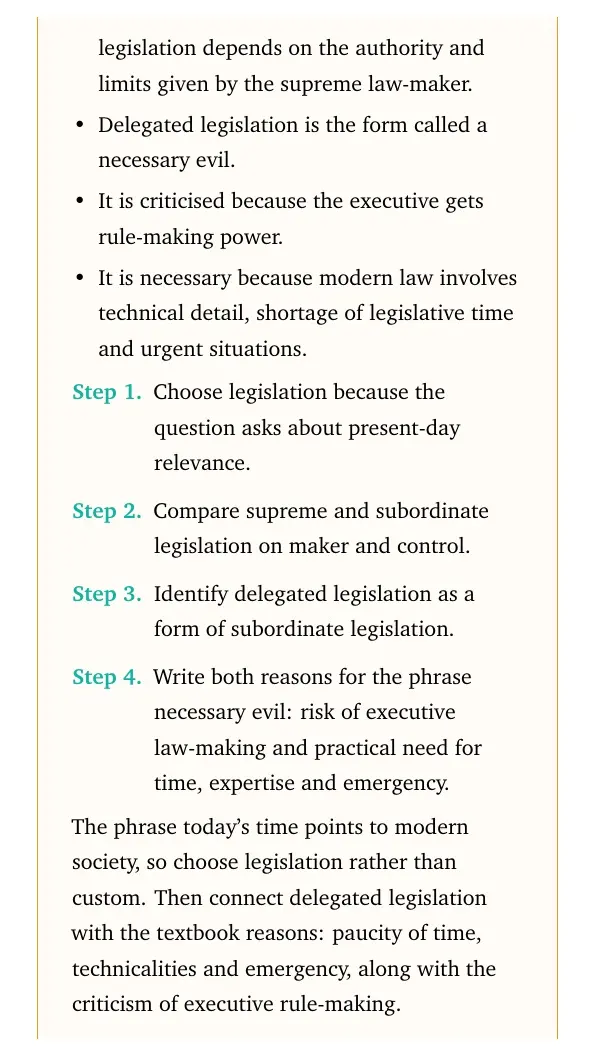
Supreme legislation is not controlled by another legislative body; subordinate legislation depends on the authority and limits given by the supreme law-maker.
Delegated legislation is the form called a necessary evil.
It is criticised because the executive gets rule-making power.
It is necessary because modern law involves technical detail, shortage of legislative time and urgent situations.
Choose legislation because the question asks about present-day relevance.
Compare supreme and subordinate legislation on maker and control.
Identify delegated legislation as a form of subordinate legislation.
Write both reasons for the phrase necessary evil: risk of executive law-making and practical need for time, expertise and emergency.
The phrase today's time points to modern society, so choose legislation rather than custom. Then connect delegated legislation with the textbook reasons: paucity of time, technicalities and emergency, along with the criticism of executive rule-making.
Legislation is the most relevant source today; supreme legislation is direct sovereign law-making, subordinate legislation is law-making by delegated authority, and delegated legislation is called a necessary evil because it risks executive overreach but is needed for lack of legislative time, technical detail and emergencies.
Textbook Question 8: Judicial Precedents
Q 8.8
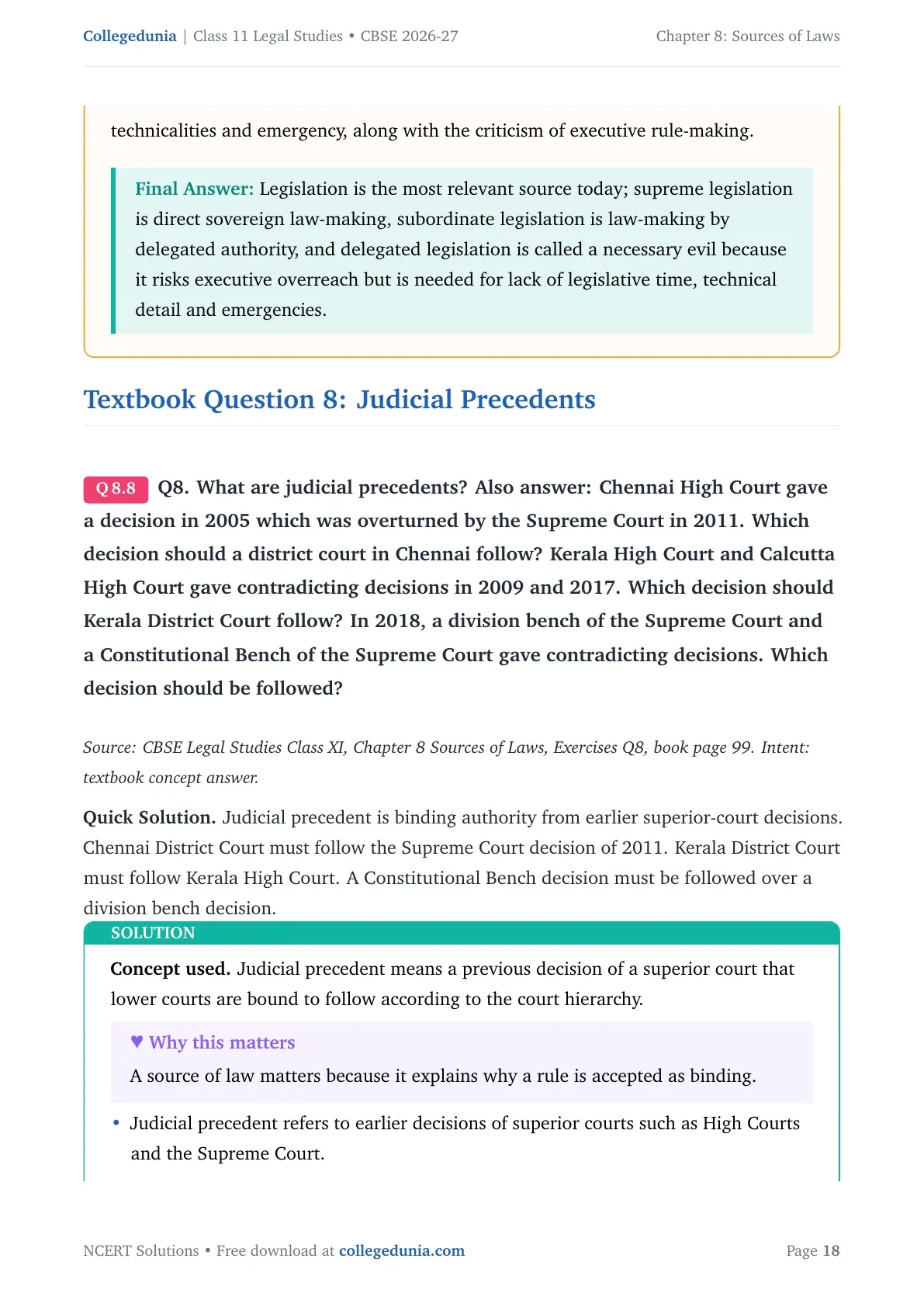
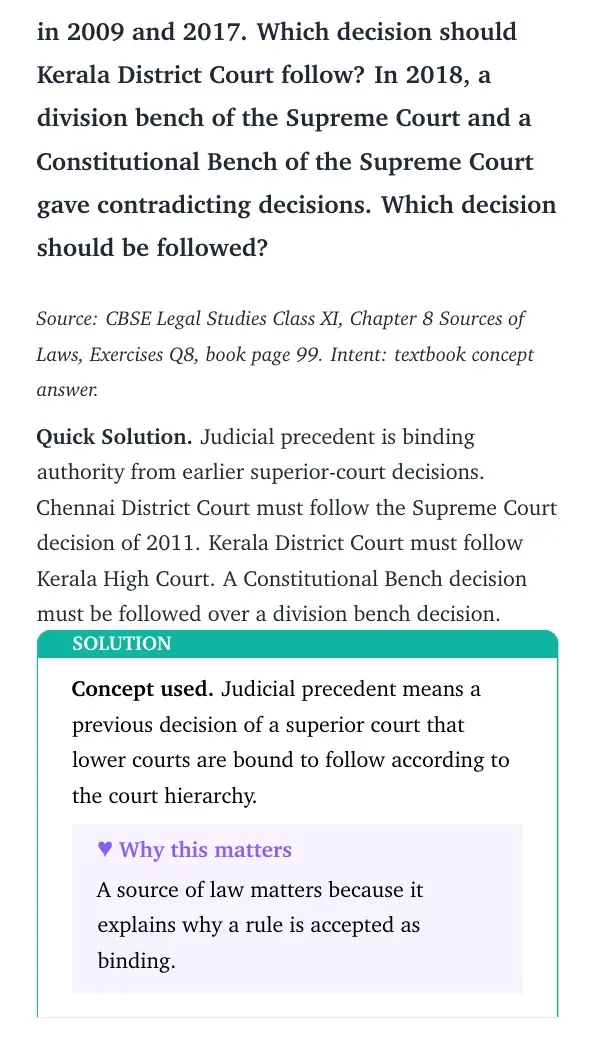
Q8. What are judicial precedents? Also answer: Chennai High Court gave a decision in 2005 which was overturned by the Supreme Court in 2011. Which decision should a district court in Chennai follow? Kerala High Court and Calcutta High Court gave contradicting decisions in 2009 and 2017. Which decision should Kerala District Court follow? In 2018, a division bench of the Supreme Court and a Constitutional Bench of the Supreme Court gave contradicting decisions. Which decision should be followed?
Concept used. Judicial precedent means a previous decision of a superior court that lower courts are bound to follow according to the court hierarchy.
Why this matters
A source of law matters because it explains why a rule is accepted as binding.
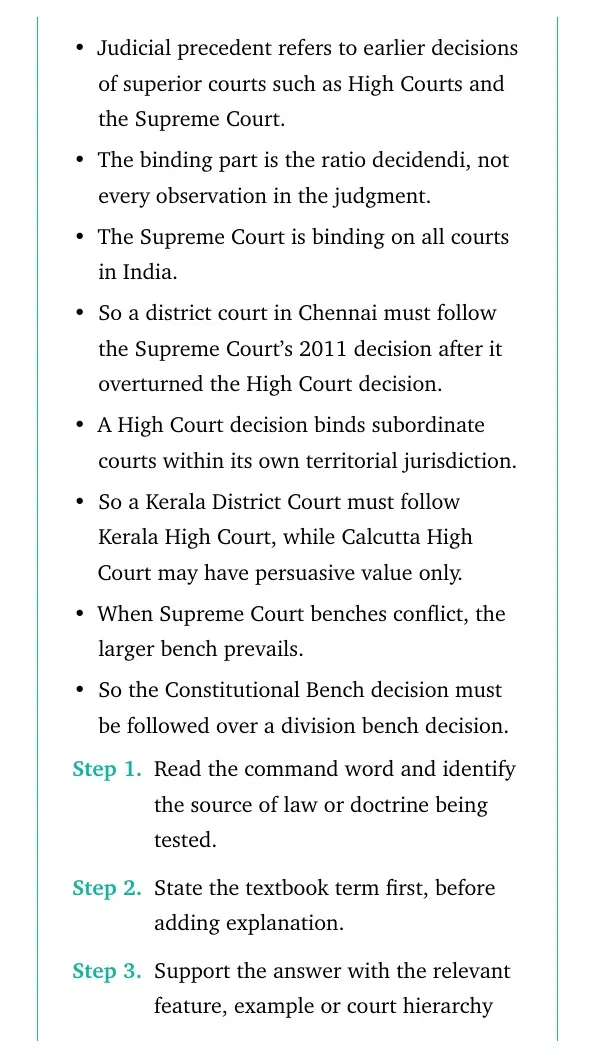
Judicial precedent refers to earlier decisions of superior courts such as High Courts and the Supreme Court.
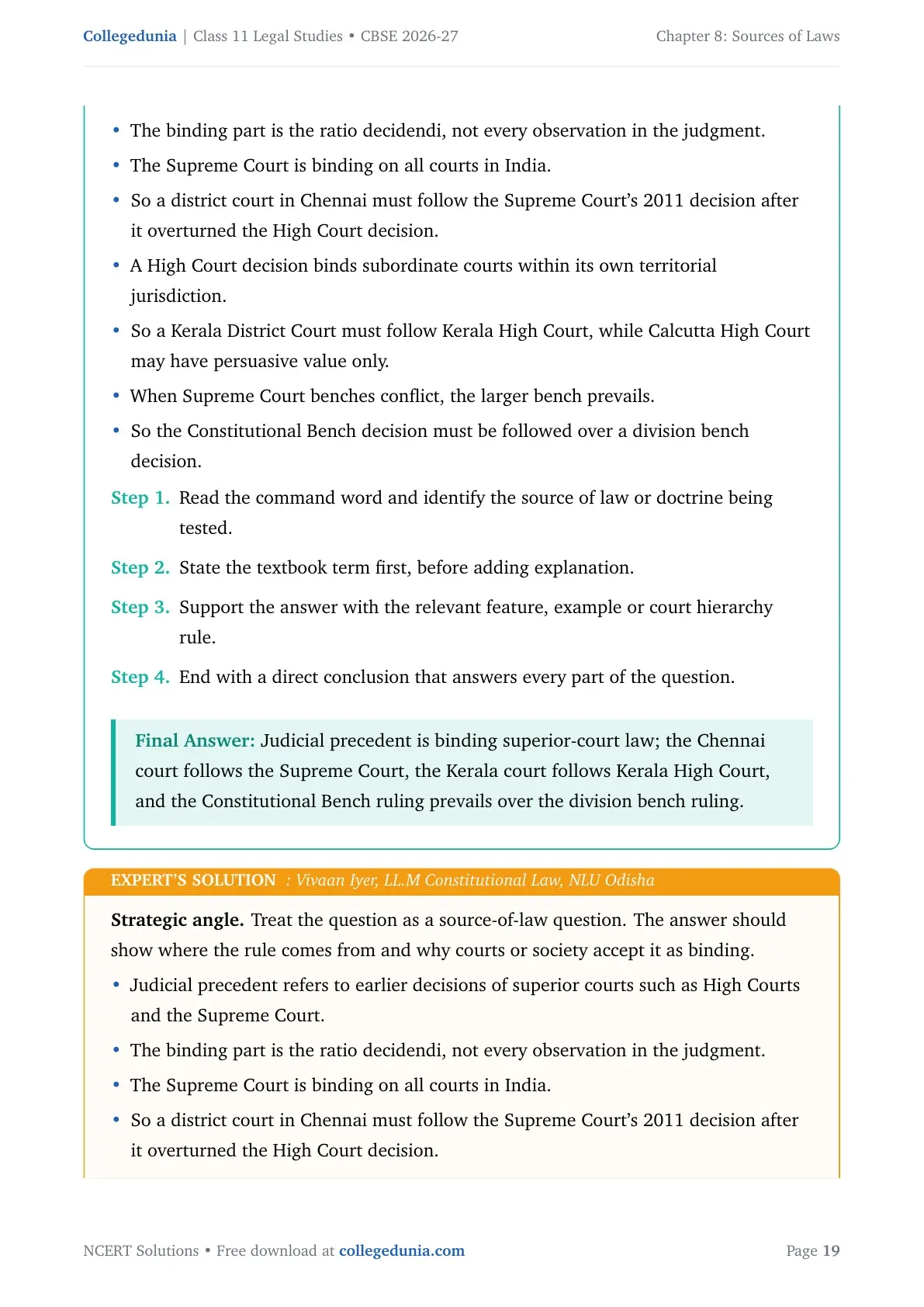
The binding part is the ratio decidendi, not every observation in the judgment.
The Supreme Court is binding on all courts in India.
So a district court in Chennai must follow the Supreme Court's 2011 decision after it overturned the High Court decision.
A High Court decision binds subordinate courts within its own territorial jurisdiction.
So a Kerala District Court must follow Kerala High Court, while Calcutta High Court may have persuasive value only.
When Supreme Court benches conflict, the larger bench prevails.
So the Constitutional Bench decision must be followed over a division bench decision.
Read the command word and identify the source of law or doctrine being tested.
State the textbook term first, before adding explanation.
Support the answer with the relevant feature, example or court hierarchy rule.
End with a direct conclusion that answers every part of the question.
Judicial precedent is binding superior-court law; the Chennai court follows the Supreme Court, the Kerala court follows Kerala High Court, and the Constitutional Bench ruling prevails over the division bench ruling.
VI
Vivaan Iyer
LL.M Constitutional Law, NLU Odisha
Verified Expert
Strategic angle. Treat the question as a source-of-law question. The answer should show where the rule comes from and why courts or society accept it as binding.
Judicial precedent refers to earlier decisions of superior courts such as High Courts and the Supreme Court.
The binding part is the ratio decidendi, not every observation in the judgment.
The Supreme Court is binding on all courts in India.
So a district court in Chennai must follow the Supreme Court's 2011 decision after it overturned the High Court decision.
A High Court decision binds subordinate courts within its own territorial jurisdiction.
So a Kerala District Court must follow Kerala High Court, while Calcutta High Court may have persuasive value only.
When Supreme Court benches conflict, the larger bench prevails.
So the Constitutional Bench decision must be followed over a division bench decision.
Classify the topic as custom, precedent or legislation.
Apply the exact rule from the chapter instead of giving a general civics answer.
Where two institutions are compared, state their authority and effect separately.
Close with the exam-ready one-line answer.
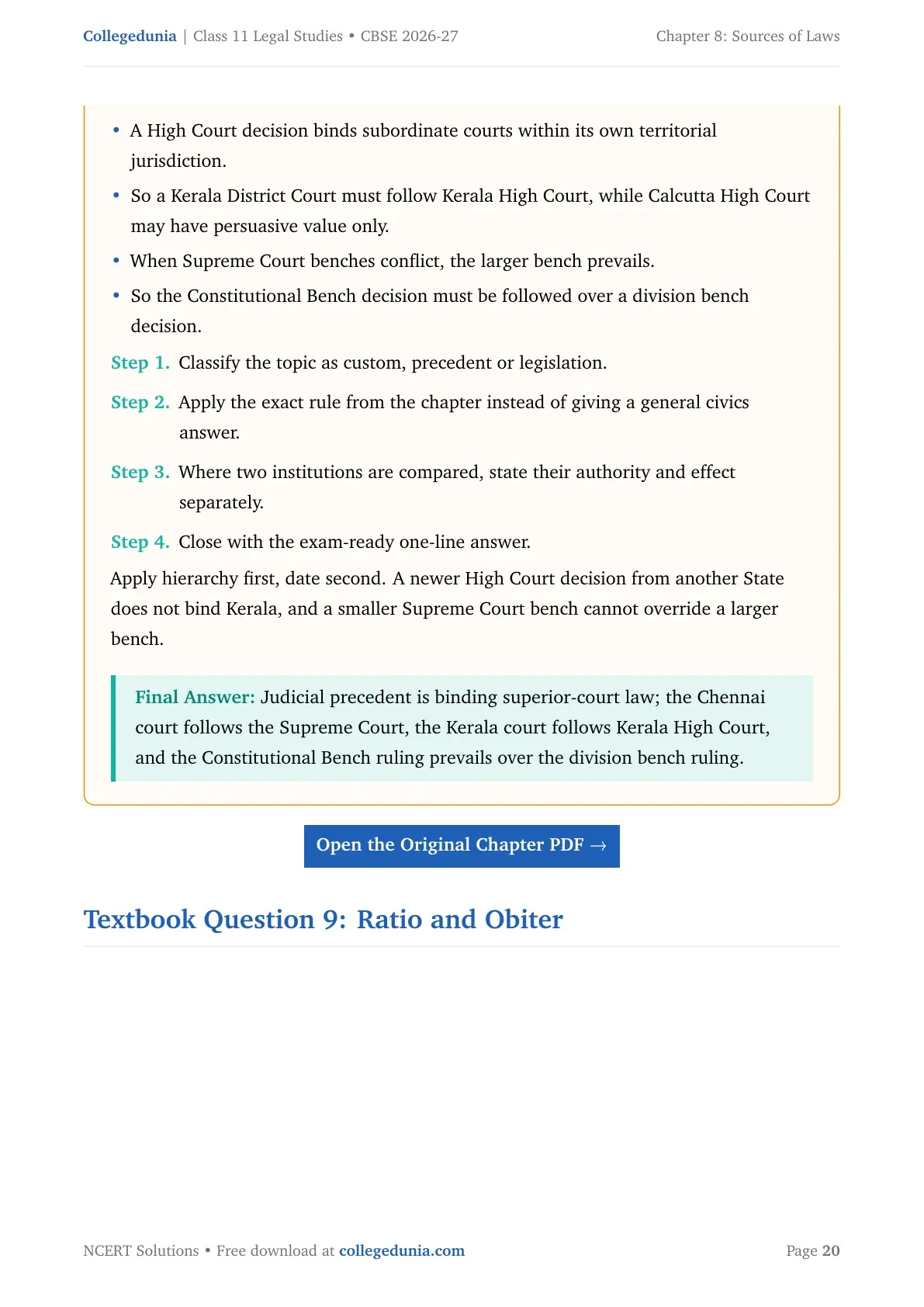
Apply hierarchy first, date second. A newer High Court decision from another State does not bind Kerala, and a smaller Supreme Court bench cannot override a larger bench.
Judicial precedent is binding superior-court law; the Chennai court follows the Supreme Court, the Kerala court follows Kerala High Court, and the Constitutional Bench ruling prevails over the division bench ruling.
Textbook Question 9: Ratio and Obiter
Q 8.9
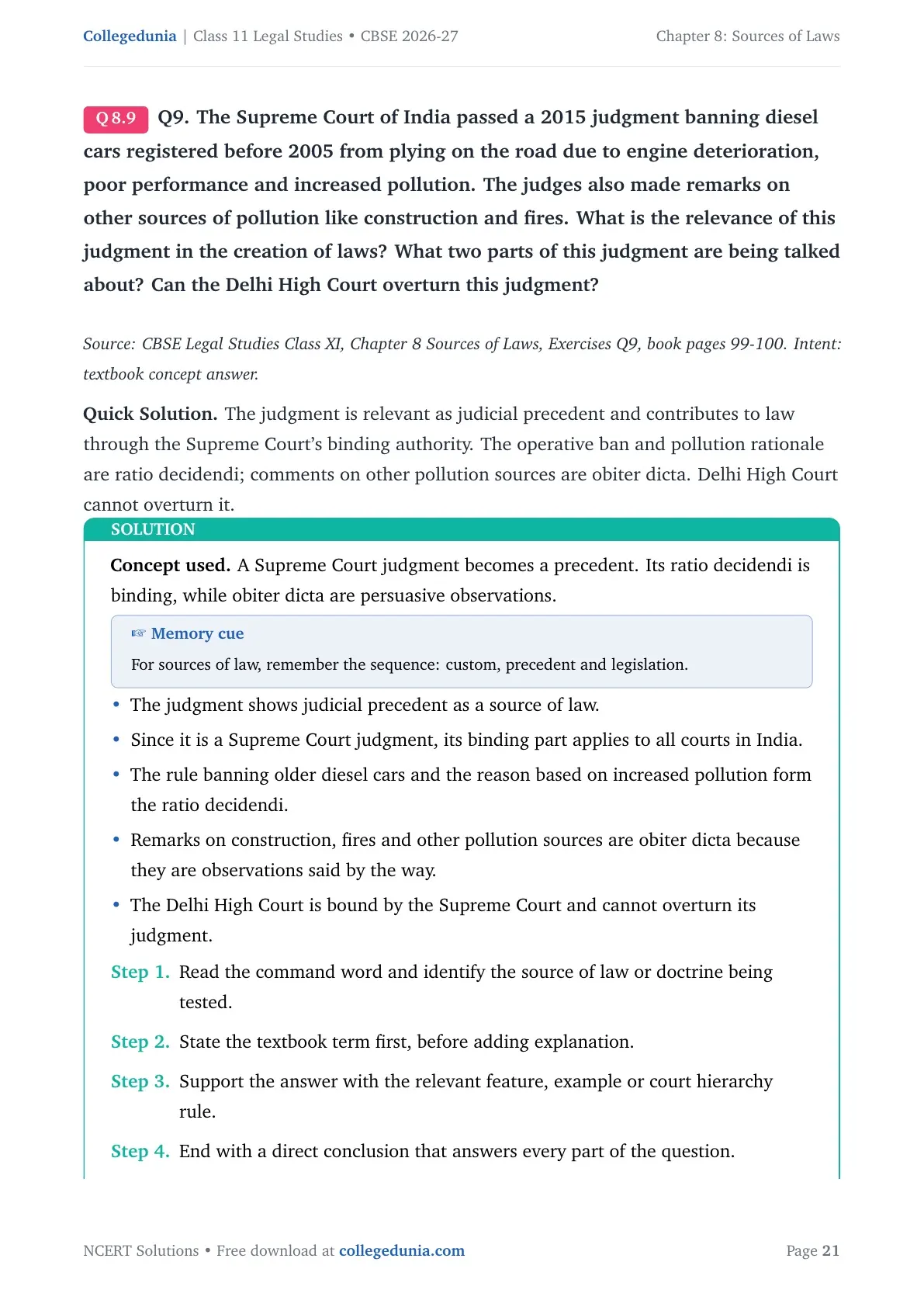
Q9. The Supreme Court of India passed a 2015 judgment banning diesel cars registered before 2005 from plying on the road due to engine deterioration, poor performance and increased pollution. The judges also made remarks on other sources of pollution like construction and fires. What is the relevance of this judgment in the creation of laws? What two parts of this judgment are being talked about? Can the Delhi High Court overturn this judgment?
Concept used. A Supreme Court judgment becomes a precedent. Its ratio decidendi is binding, while obiter dicta are persuasive observations.
Memory cue
For sources of law, remember the sequence: custom, precedent and legislation.
The judgment shows judicial precedent as a source of law.
Since it is a Supreme Court judgment, its binding part applies to all courts in India.
The rule banning older diesel cars and the reason based on increased pollution form the ratio decidendi.
Remarks on construction, fires and other pollution sources are obiter dicta because they are observations said by the way.
The Delhi High Court is bound by the Supreme Court and cannot overturn its judgment.
Read the command word and identify the source of law or doctrine being tested.
State the textbook term first, before adding explanation.
Support the answer with the relevant feature, example or court hierarchy rule.
End with a direct conclusion that answers every part of the question.
The judgment creates binding precedent; the binding ban and reason are ratio decidendi, extra pollution remarks are obiter dicta, and Delhi High Court cannot overturn the Supreme Court.
SM
Sanya Malhotra
B.A. LL.B Legal Theory, ILS Pune
Verified Expert
Strategic angle. Treat the question as a source-of-law question. The answer should show where the rule comes from and why courts or society accept it as binding.
The judgment shows judicial precedent as a source of law.
Since it is a Supreme Court judgment, its binding part applies to all courts in India.
The rule banning older diesel cars and the reason based on increased pollution form the ratio decidendi.
Remarks on construction, fires and other pollution sources are obiter dicta because they are observations said by the way.
The Delhi High Court is bound by the Supreme Court and cannot overturn its judgment.
Classify the topic as custom, precedent or legislation.
Apply the exact rule from the chapter instead of giving a general civics answer.
Where two institutions are compared, state their authority and effect separately.
Close with the exam-ready one-line answer.
Separate the legal rule from background remarks. The rule needed to decide the case binds. Comments not needed for the decision can guide later courts but do not overrule the Supreme Court's command.
The judgment creates binding precedent; the binding ban and reason are ratio decidendi, extra pollution remarks are obiter dicta, and Delhi High Court cannot overturn the Supreme Court.
Textbook Question 10: Valid Custom
Q 8.10
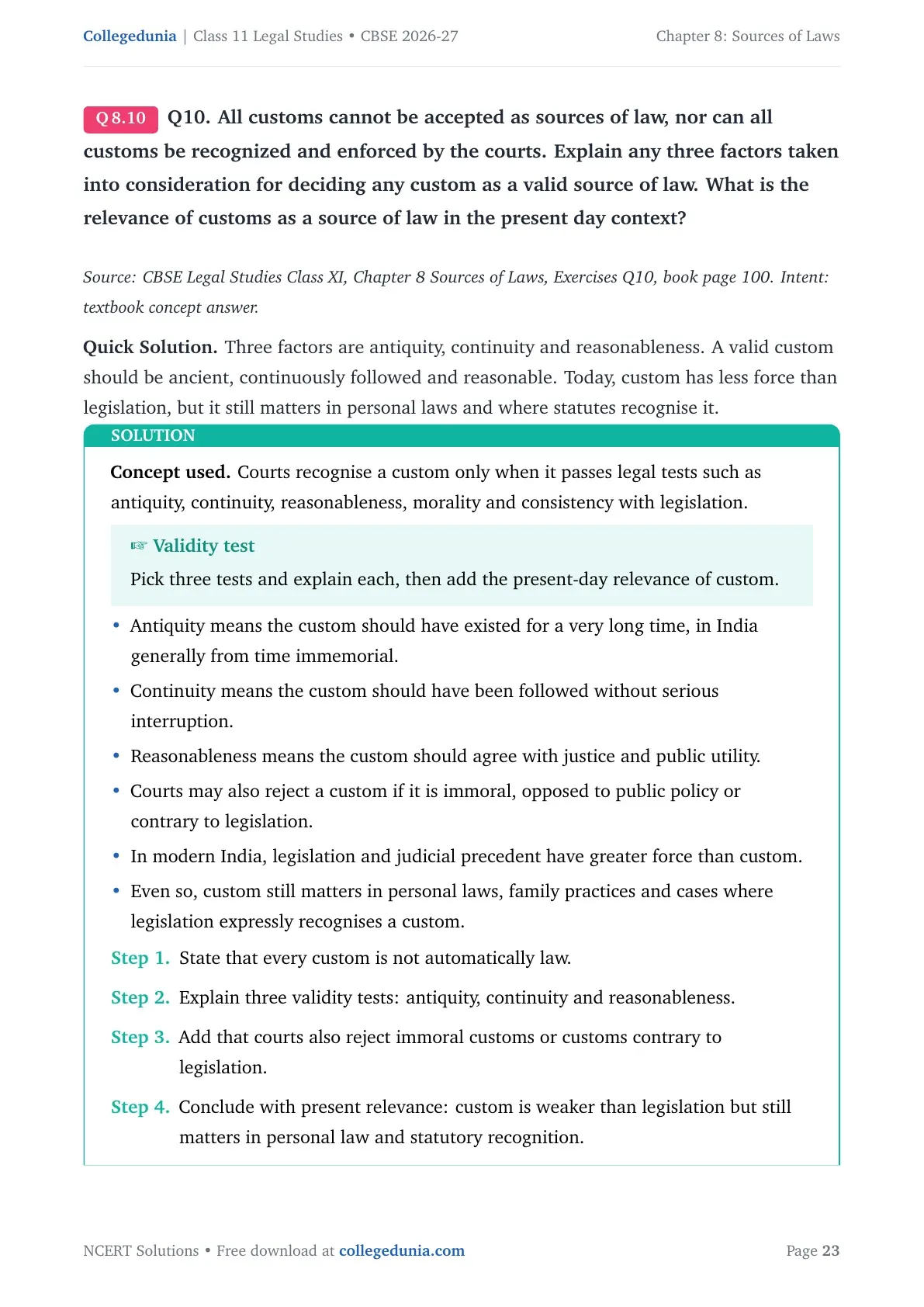
Q10. All customs cannot be accepted as sources of law, nor can all customs be recognized and enforced by the courts. Explain any three factors taken into consideration for deciding any custom as a valid source of law. What is the relevance of customs as a source of law in the present day context?
Concept used. Courts recognise a custom only when it passes legal tests such as antiquity, continuity, reasonableness, morality and consistency with legislation.
Validity test
Pick three tests and explain each, then add the present-day relevance of custom.
Antiquity means the custom should have existed for a very long time, in India generally from time immemorial.
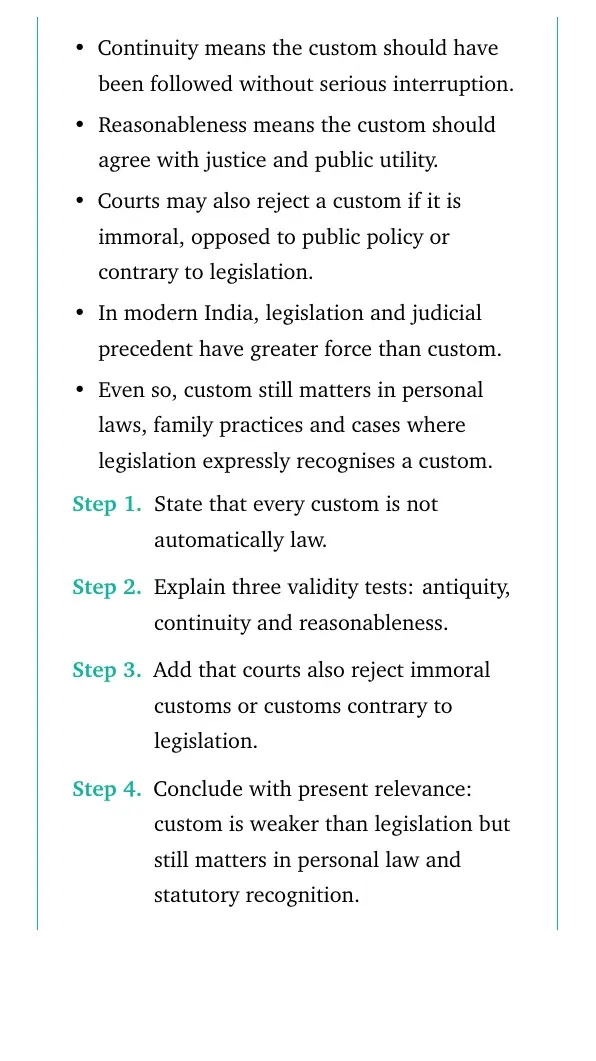
Continuity means the custom should have been followed without serious interruption.
Reasonableness means the custom should agree with justice and public utility.
Courts may also reject a custom if it is immoral, opposed to public policy or contrary to legislation.
In modern India, legislation and judicial precedent have greater force than custom.
Even so, custom still matters in personal laws, family practices and cases where legislation expressly recognises a custom.
State that every custom is not automatically law.
Explain three validity tests: antiquity, continuity and reasonableness.
Add that courts also reject immoral customs or customs contrary to legislation.
Conclude with present relevance: custom is weaker than legislation but still matters in personal law and statutory recognition.
A custom becomes valid only when it is ancient, continuous and reasonable, and present-day custom remains relevant mainly where personal law or legislation recognises it.
PK
Pranav Kohli
LL.M Legal Method, NLU Delhi
Verified Expert
Strategic angle. Treat the question as a source-of-law question. The answer should show where the rule comes from and why courts or society accept it as binding.
Antiquity means the custom should have existed for a very long time, in India generally from time immemorial.
Continuity means the custom should have been followed without serious interruption.
Reasonableness means the custom should agree with justice and public utility.
Courts may also reject a custom if it is immoral, opposed to public policy or contrary to legislation.
In modern India, legislation and judicial precedent have greater force than custom.
Even so, custom still matters in personal laws, family practices and cases where legislation expressly recognises a custom.
Begin with the court-recognition rule for custom.
Explain each selected test in one sentence with the legal effect.
Connect present-day relevance to personal law and customs expressly saved by statutes.
End by saying legislation now has greater force, but valid custom has not disappeared.
Do not say every old practice is law. The court tests the practice before enforcing it. A custom loses effect if it clashes with morality, public policy or modern legislation.
A custom becomes valid only when it is ancient, continuous and reasonable, and present-day custom remains relevant mainly where personal law or legislation recognises it.
Sources of Laws Class 11 Legal Studies NCERT Solutions FAQs
Ques. What does Sources of Laws cover in Class 11 Legal Studies?
Ans. It covers custom, judicial precedent, legislation, valid custom tests, ratio decidendi, obiter dicta and delegated legislation.
Ques. How many questions are solved in the Class 11 Legal Studies Chapter 8 PDF?
Ans. The PDF solves 10 textbook question groups with detailed solutions, expert solutions and final answer boxes.
Ques. What are the three main sources of law in this chapter?
Ans. The three main sources are custom, judicial precedent and legislation.
Ques. What is the difference between ratio decidendi and obiter dicta?
Ans. Ratio decidendi is the binding reason for a decision. Obiter dicta are extra observations with persuasive value.
Ques. Why is delegated legislation called a necessary evil?
Ans. It is criticised because the executive makes detailed rules, but it is needed for time, technical detail and emergencies.








Comments