



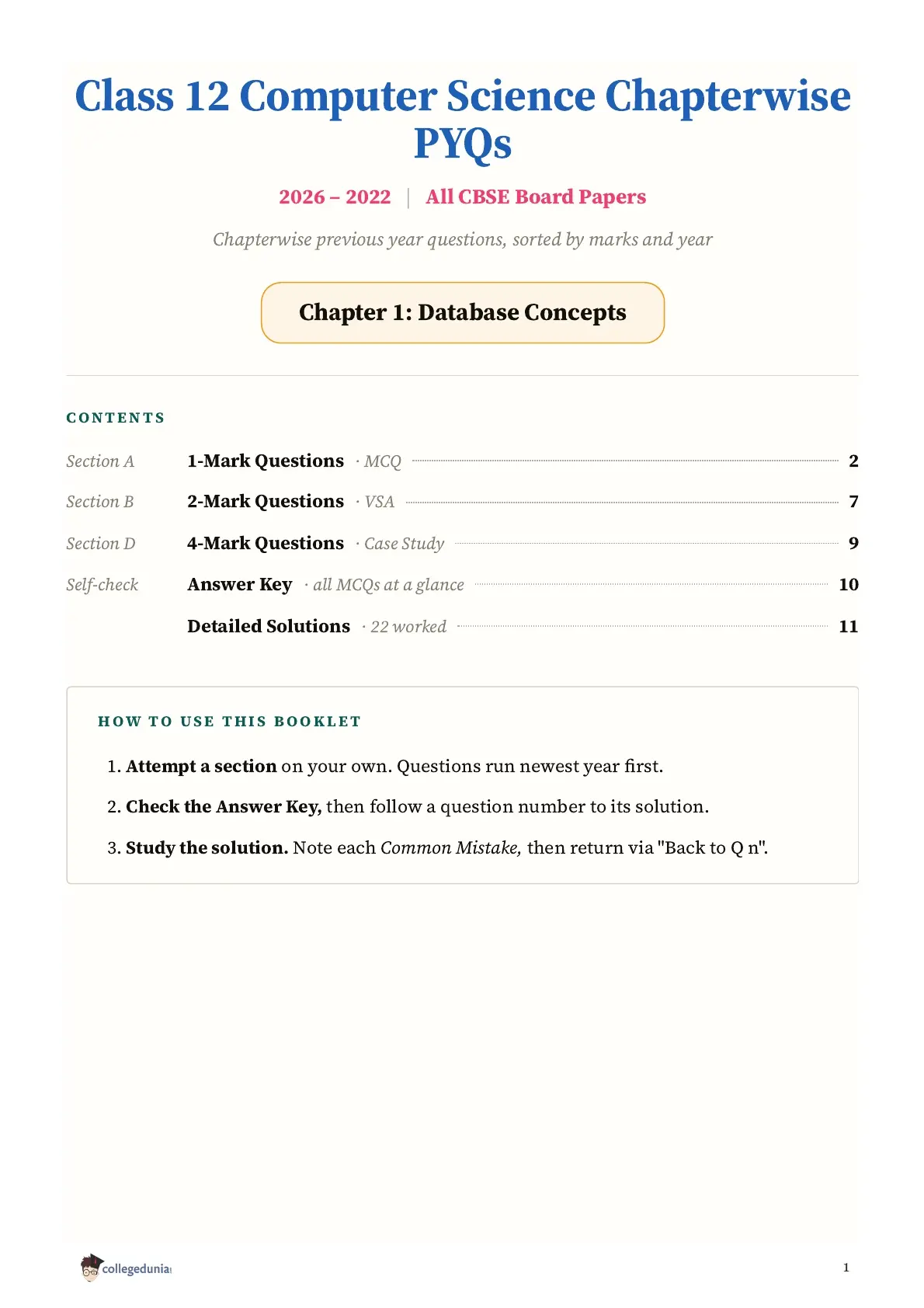
Class 12 Computer Science Database Concepts PYQ, free to download as a 23-page PDF with 22 solved questions: 10 from the 2022 to 2026 board papers and 12 from CBSE's official sample papers. Database Concepts sits in Unit 3, Database Management, of the Class 12 Computer Science (083) syllabus, which carries 20 theory marks along with SQL.
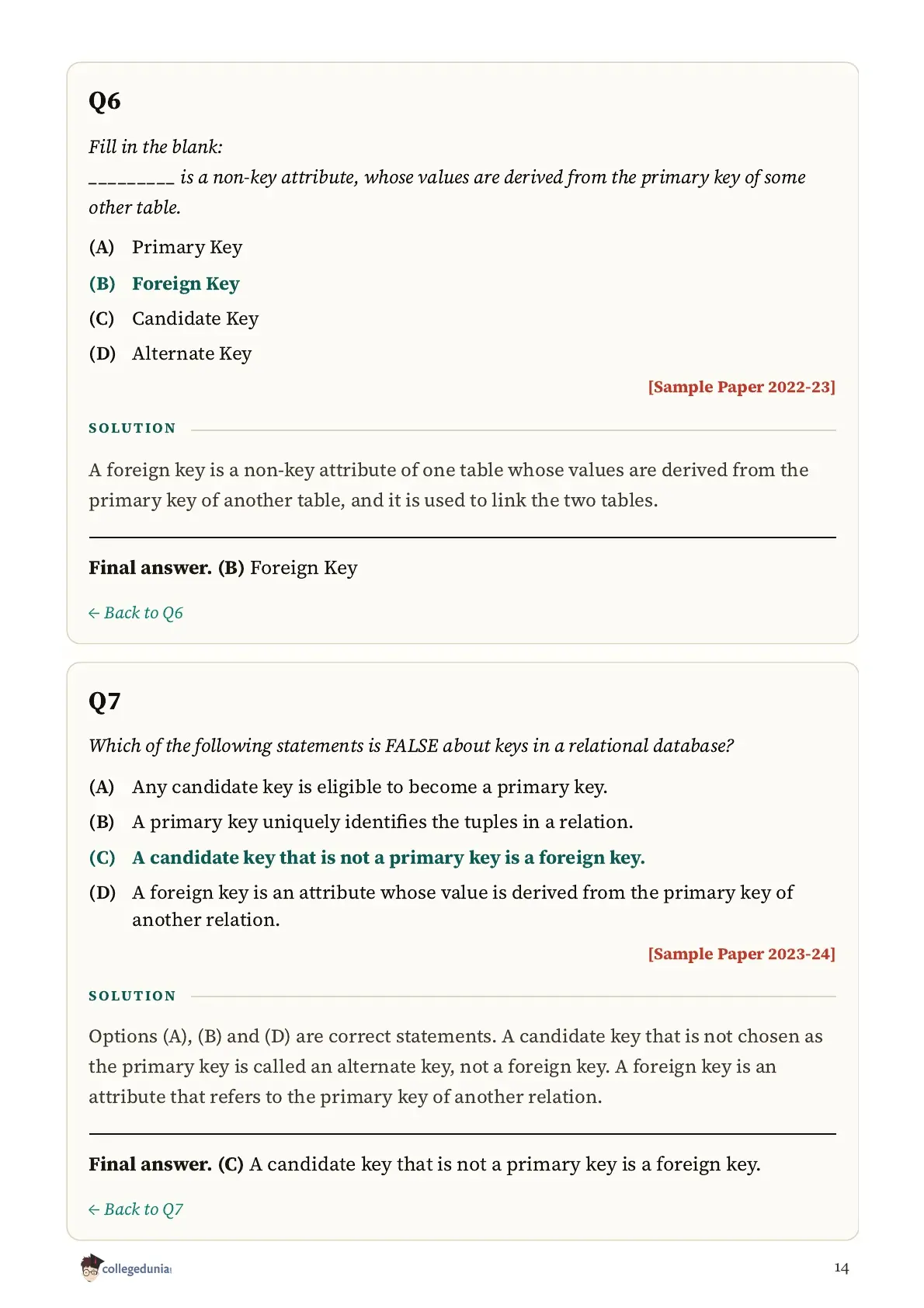
The questions keep returning to primary key (11 questions), candidate key (9), cardinality (7), degree (7), foreign key (6) and alternate key (4).
On this page you get:
- 22 questions with a worked solution each: 15 MCQs and fill-in items, 6 short answers and 1 case study
- An Answer Key that lists all 15 MCQs at a glance
- Question counts by topic, so you know whether to start with keys, degree and cardinality, or the relational terms
- A marks-wise table of questions (1, 2 and 4 mark)
- The common mistakes students make, such as giving the Cartesian product of a degree 5 and a degree 3 table as degree 15, and a short FAQ

Database Concepts Weightage in the Class 12 Computer Science Paper
CBSE does not print a mark figure for Database Concepts alone. The Class 12 Computer Science (083) theory paper carries 70 marks, and the syllabus gives Unit 3, Database Management, 20 of them. That is the unit-level figure, shared with the SQL chapter, so treat any chapter-level number you see elsewhere as an estimate. The unit marks are as reported by prep sites and the published syllabus summaries, and we could not confirm them on a CBSE document, so treat them as unofficial.
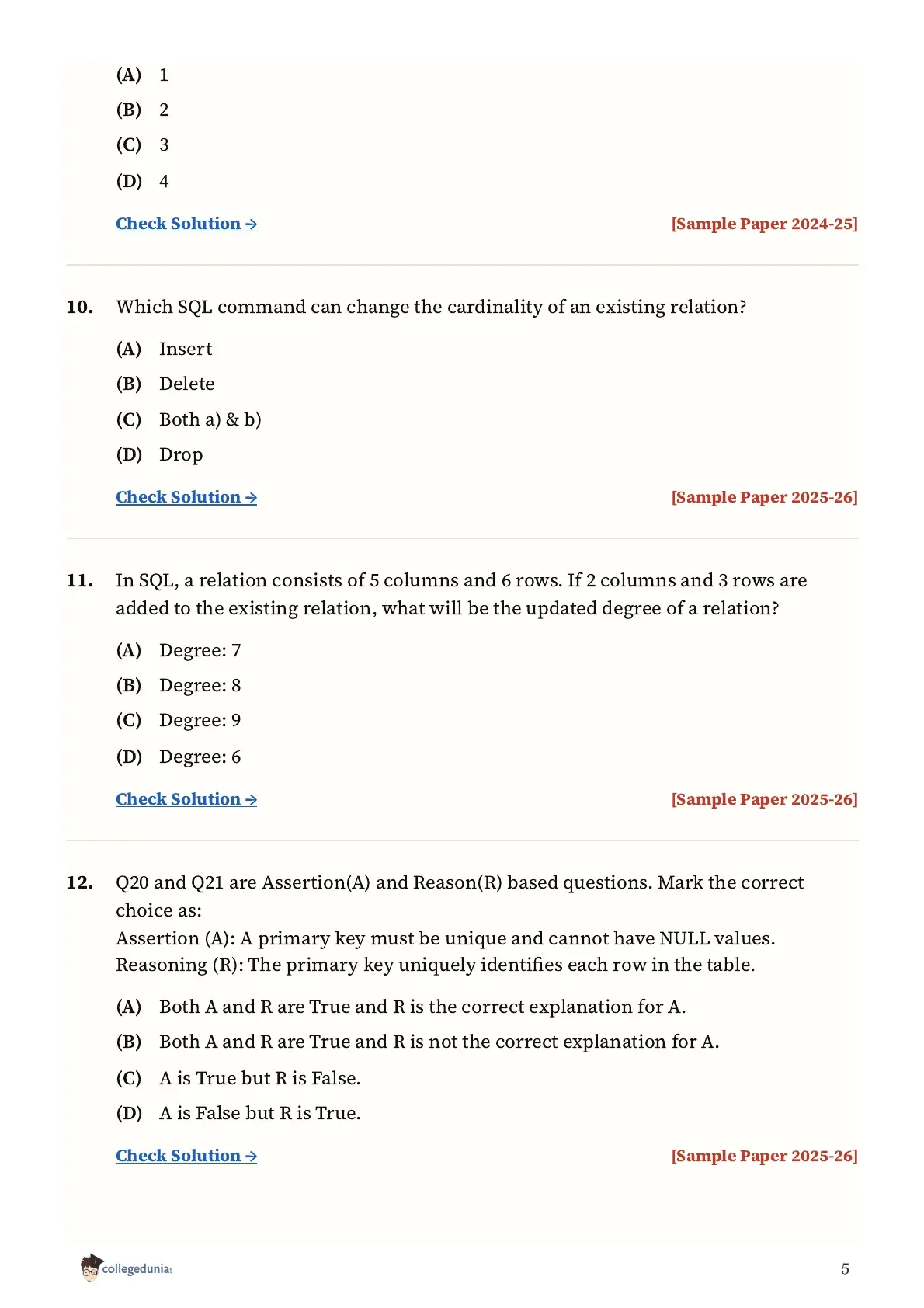
In this set the chapter appears mostly as 1-mark questions, with a few 2-mark answers and one 4-mark case study. The table shows the count at each mark value.
| Marks per Question | Questions in the Set |
|---|---|
| 1 mark | 15 |
| 2 marks | 6 |
| 4 marks (case study) | 1 |
Database Concepts Questions by Topic
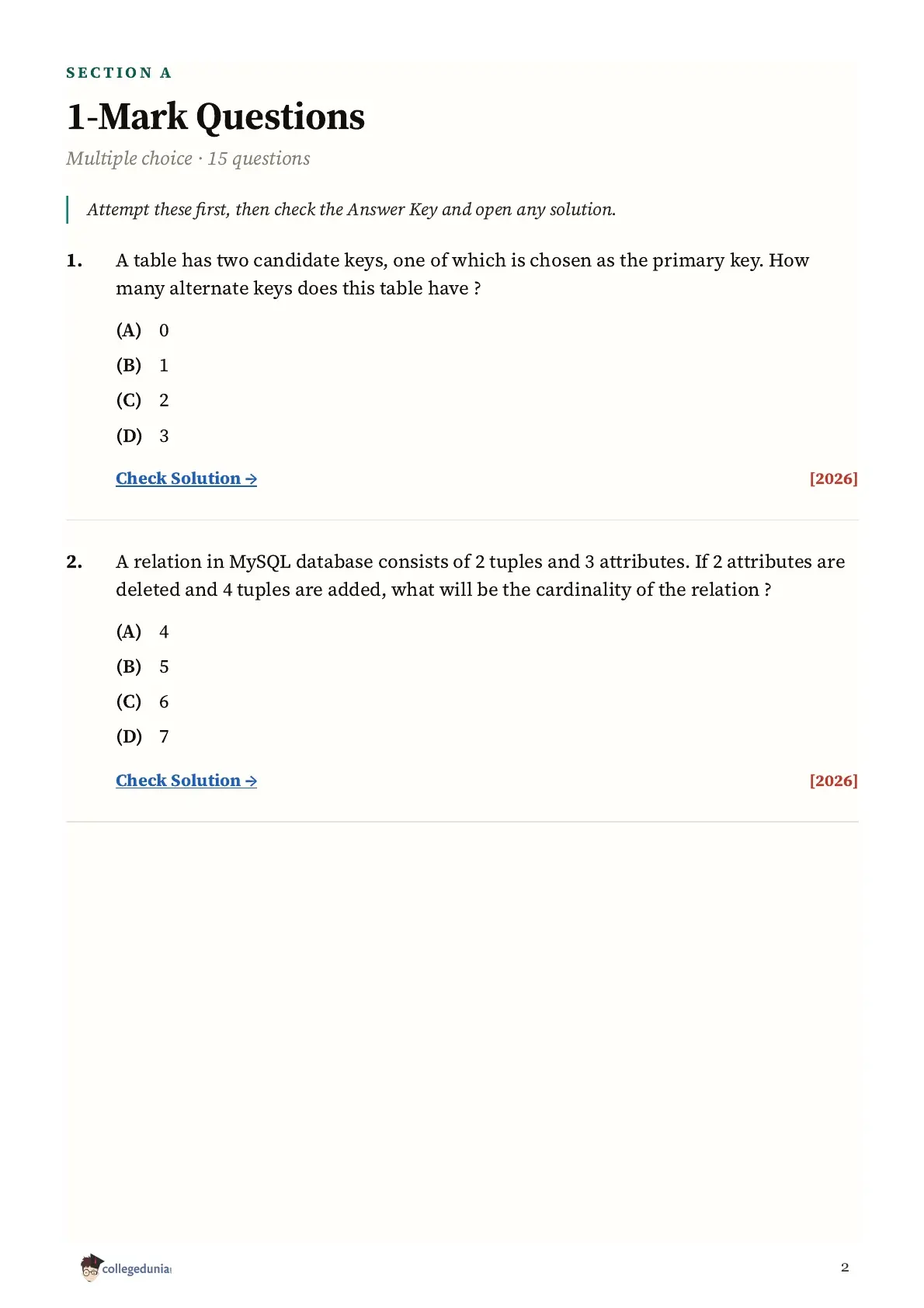
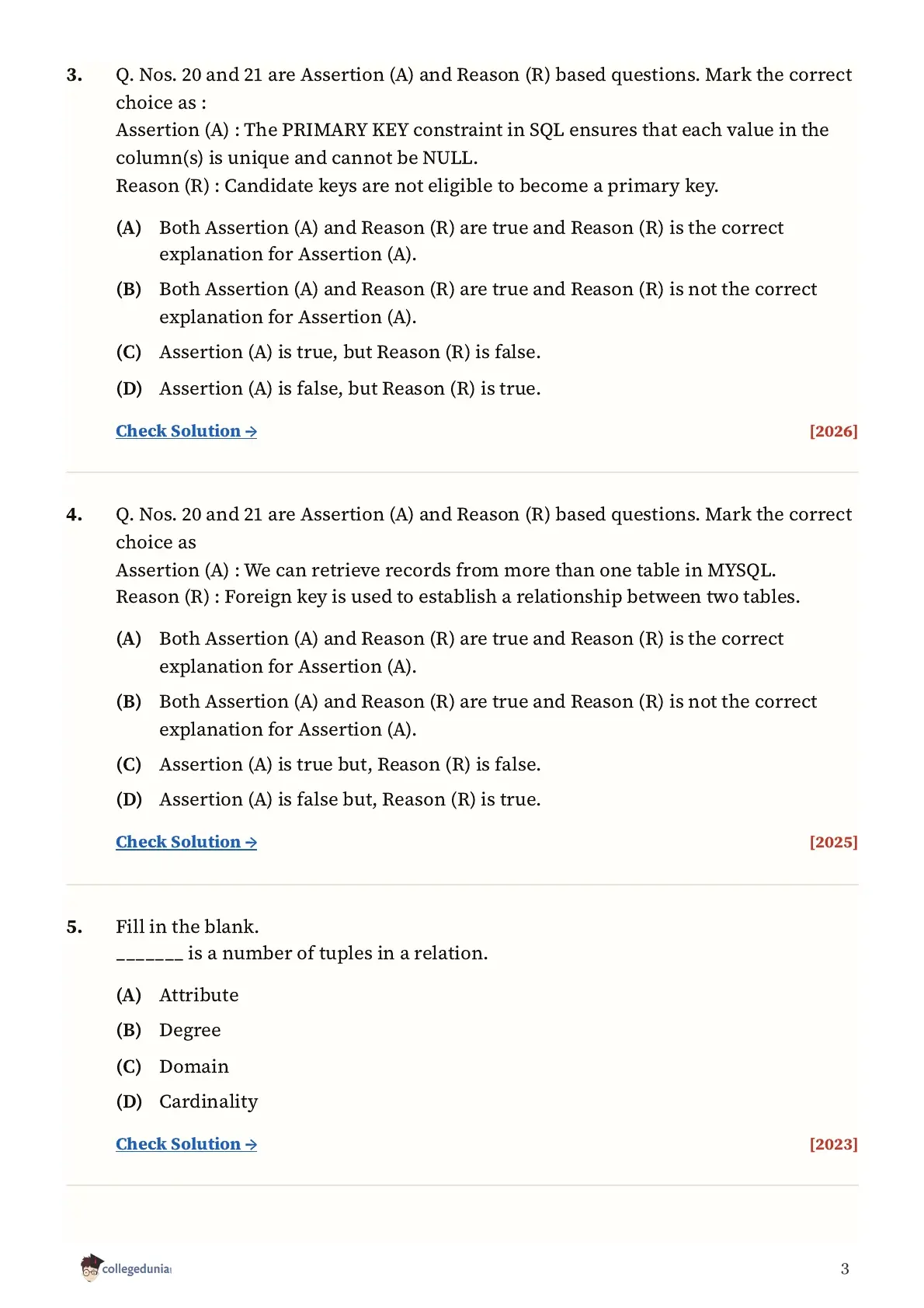
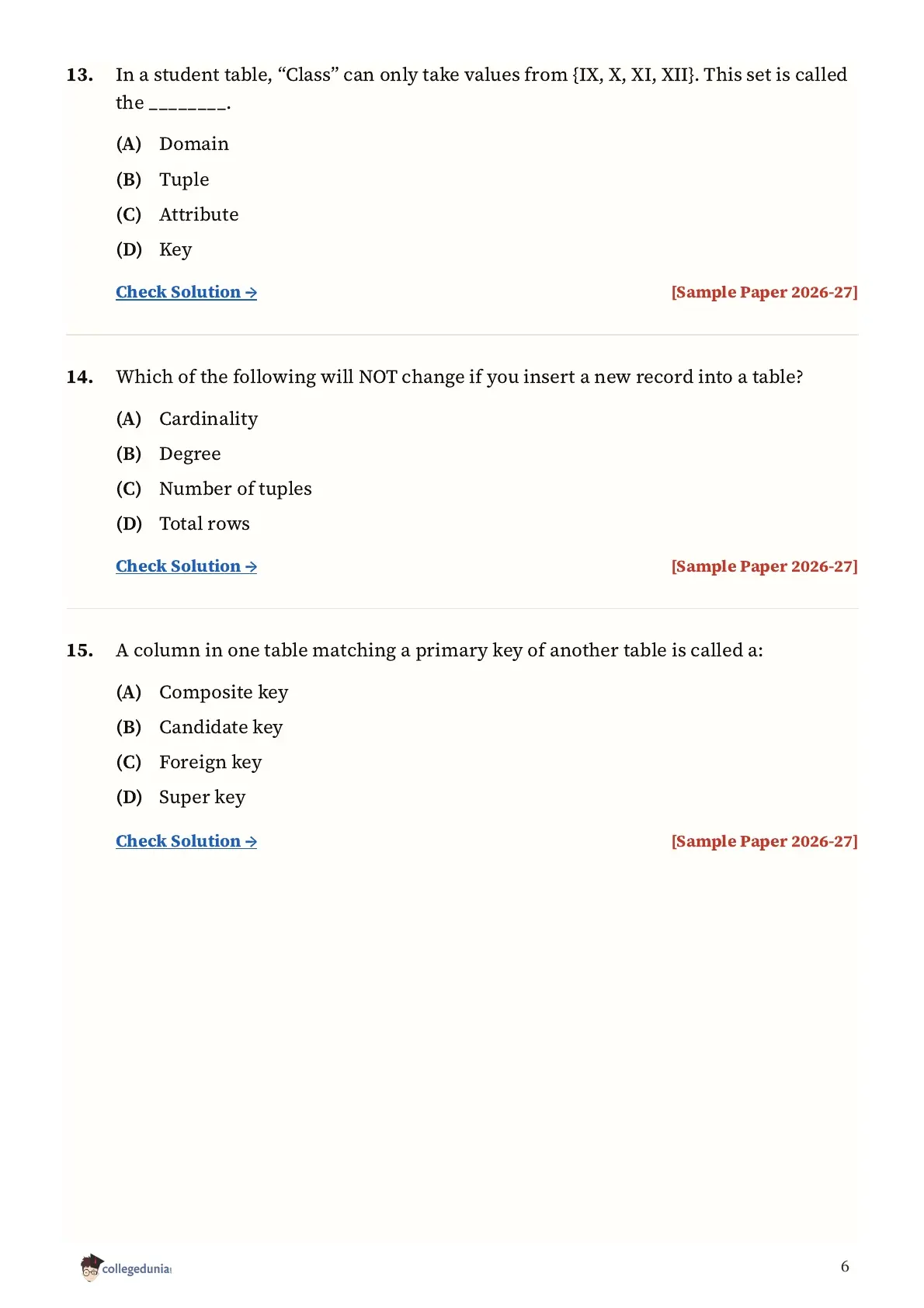
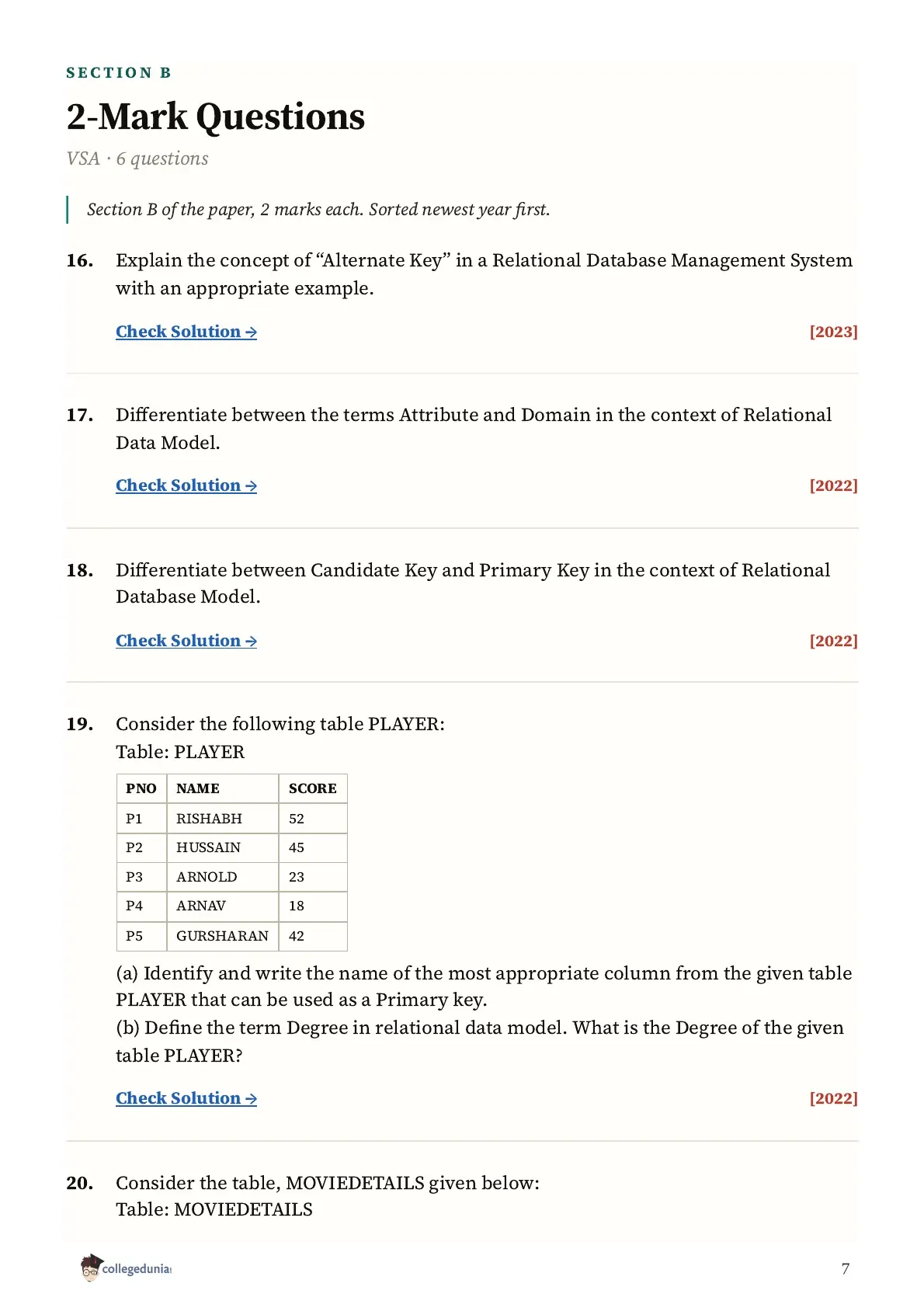
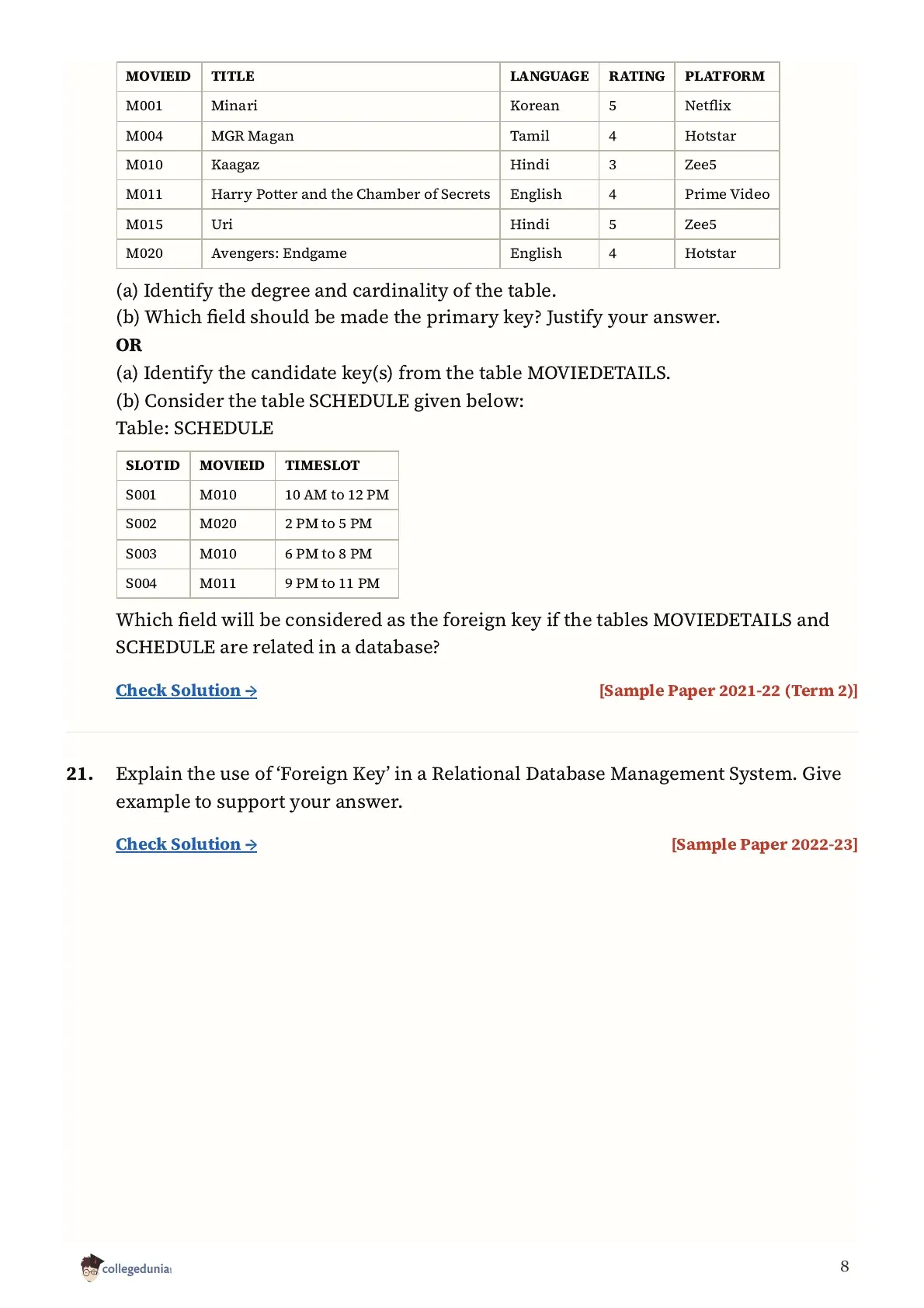
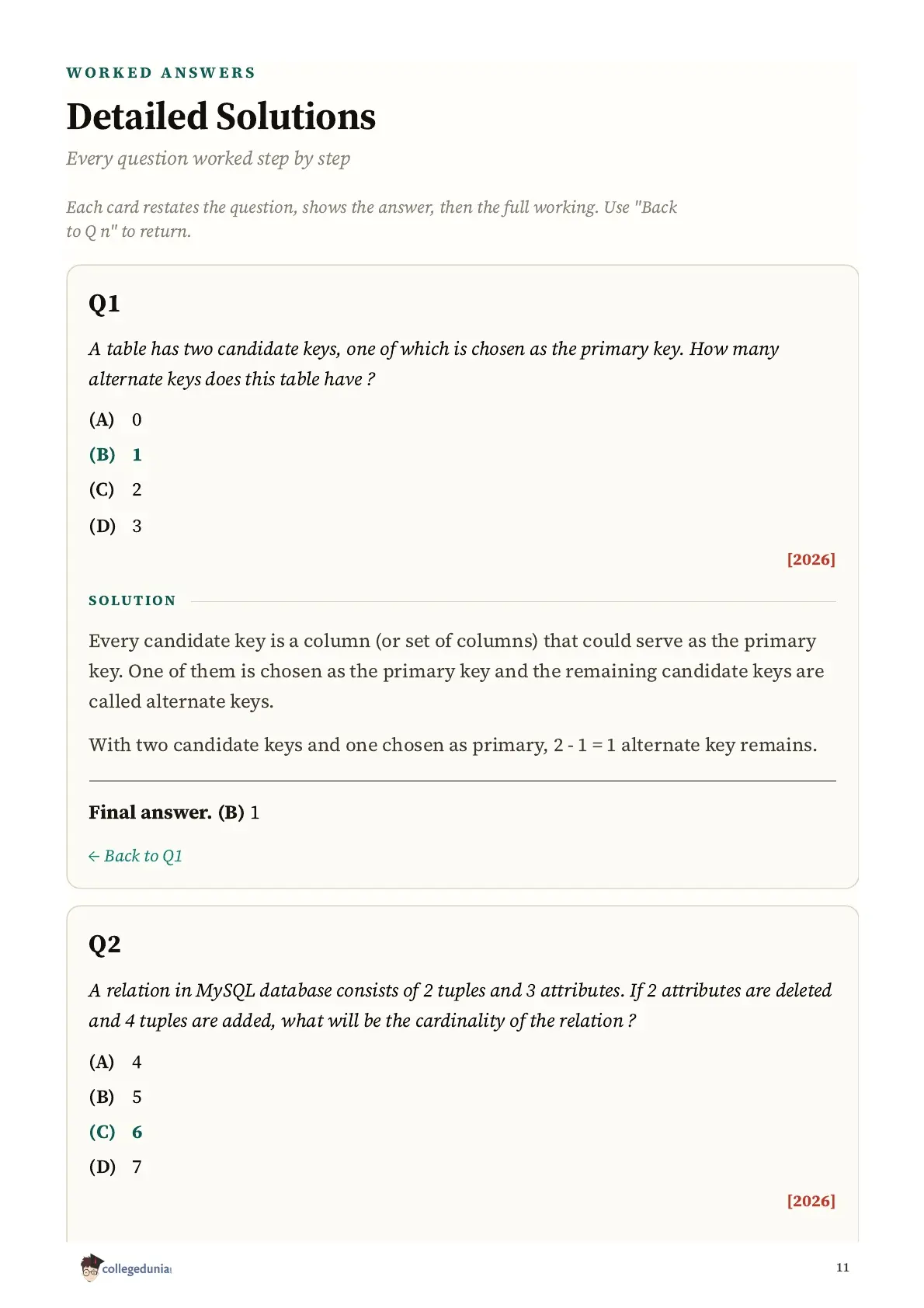
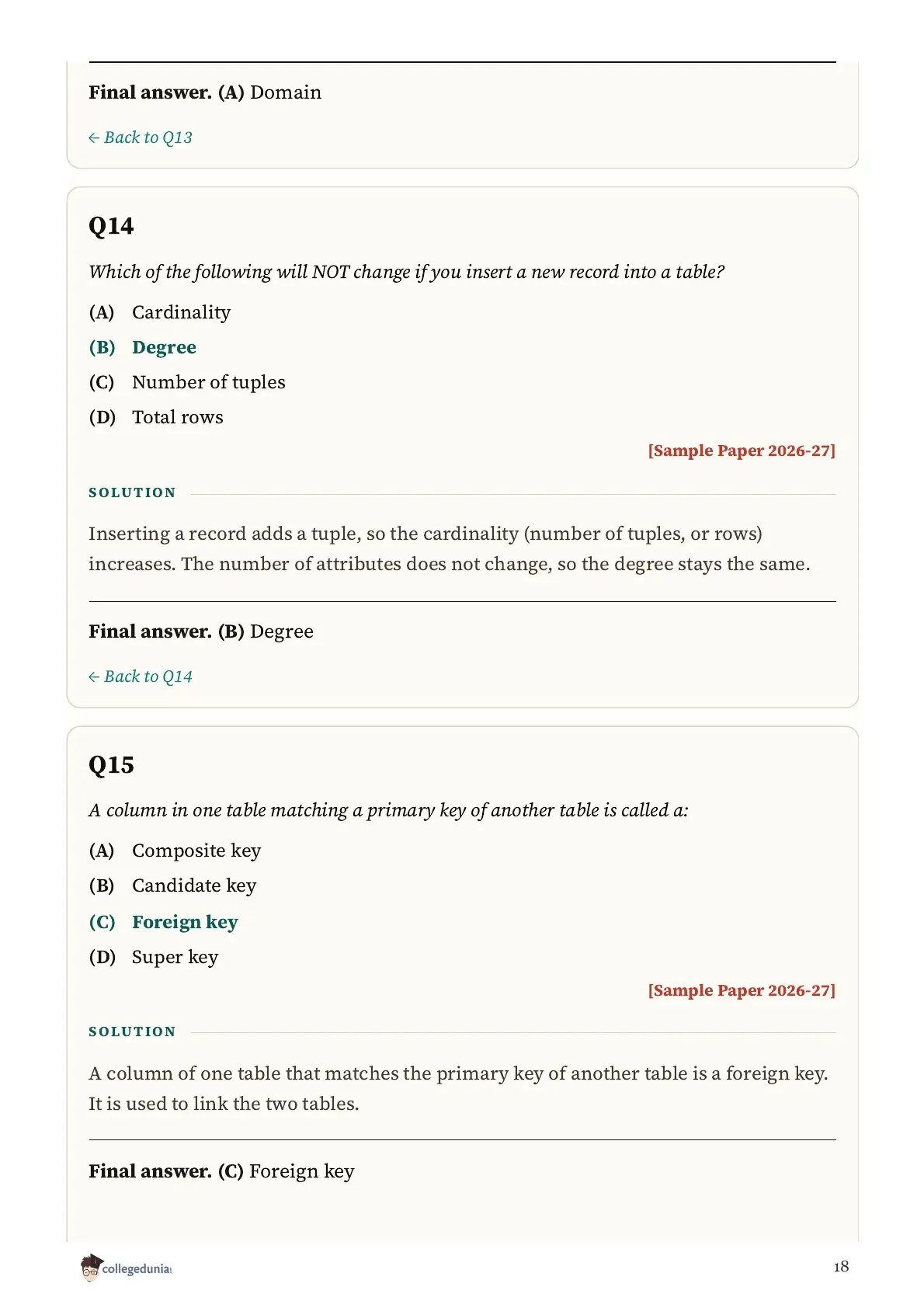
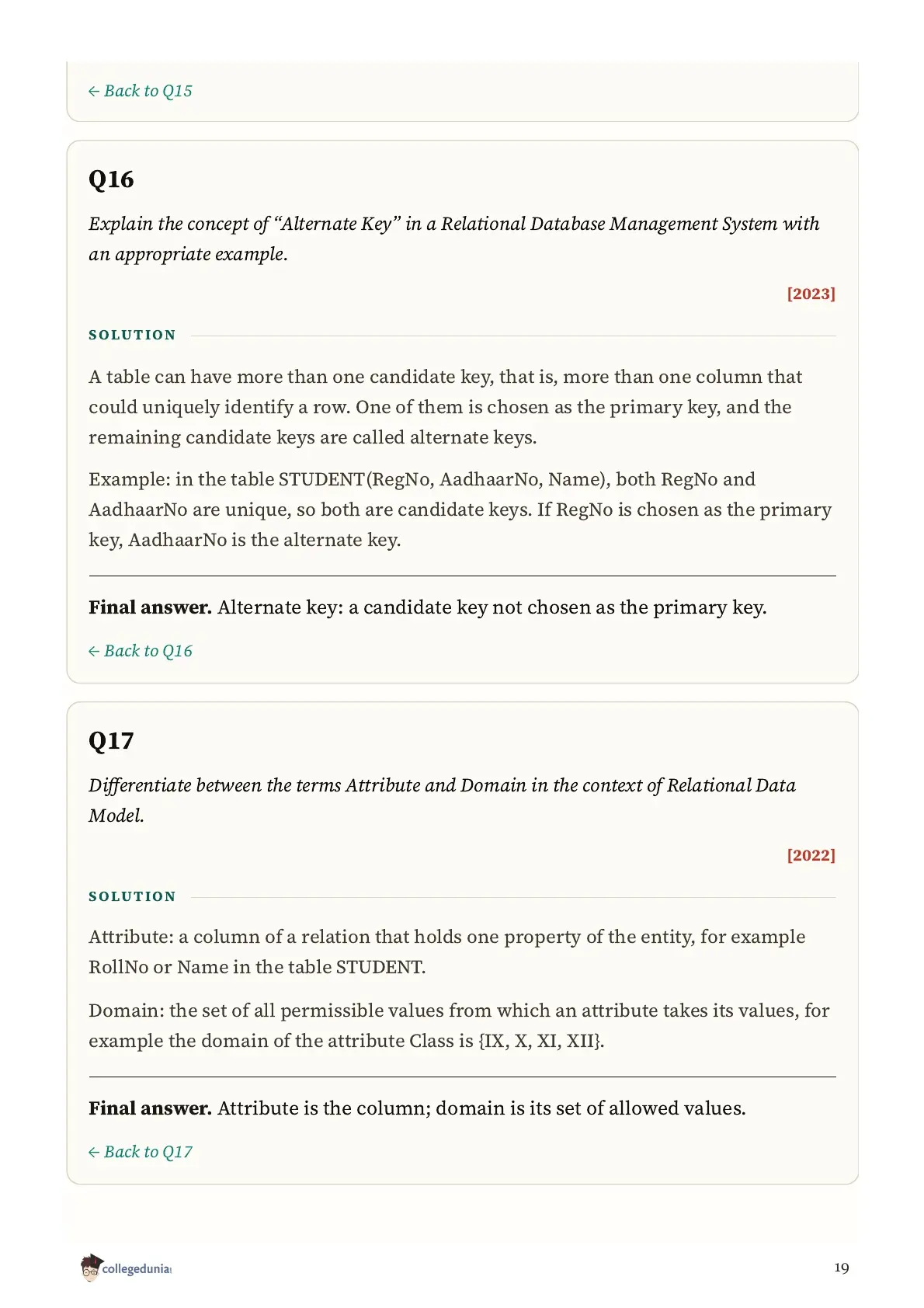
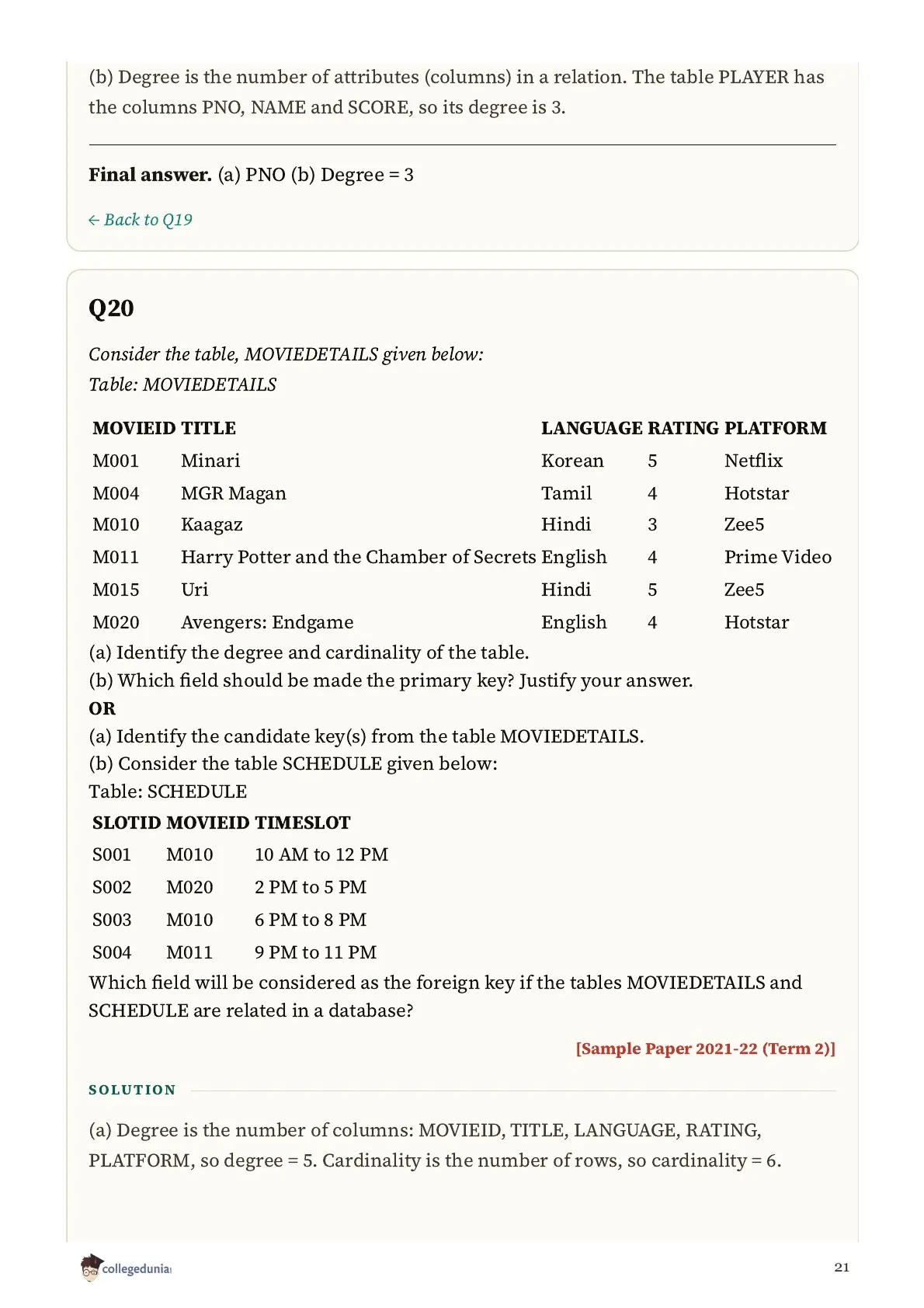
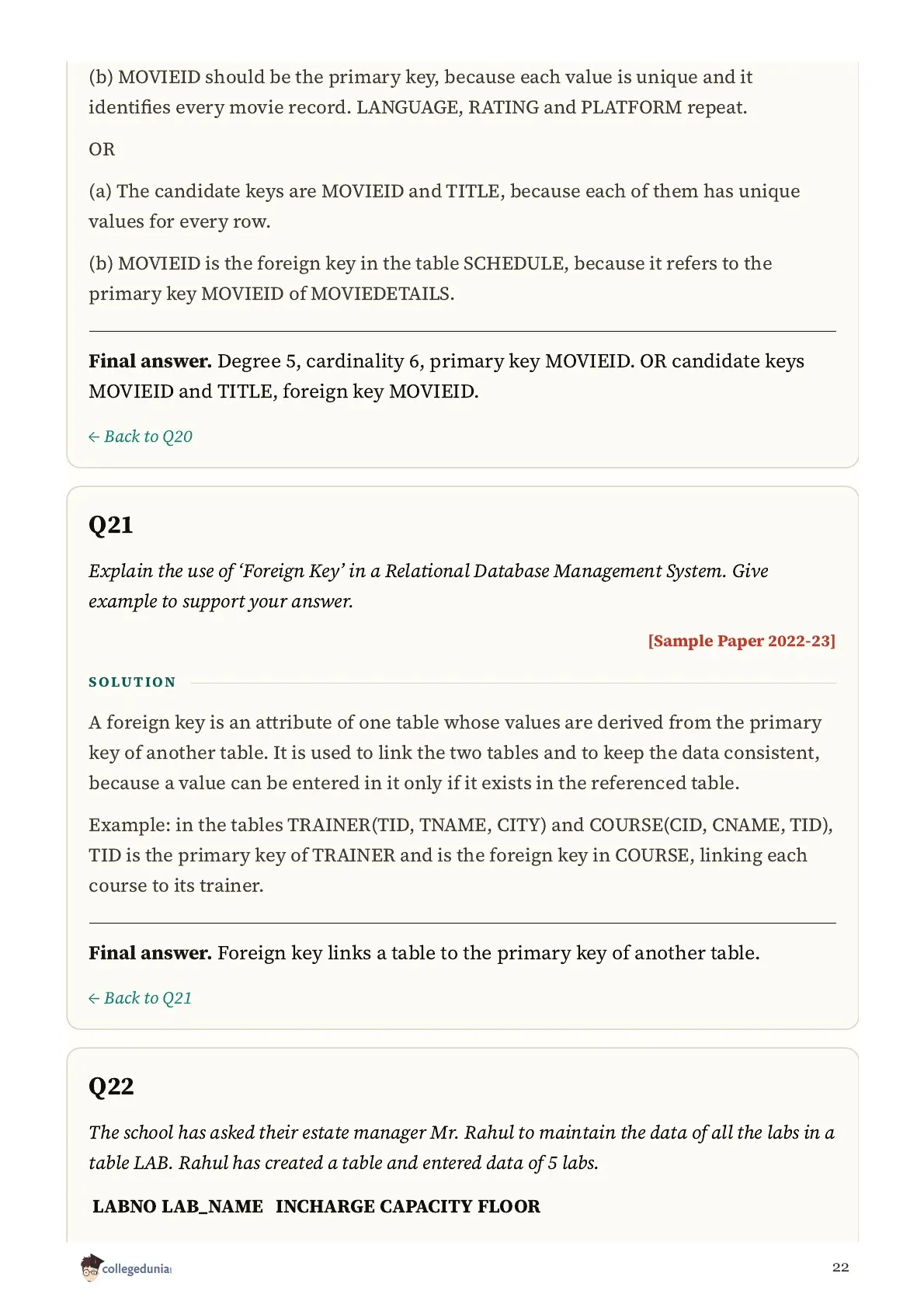
Keys dominate. Primary key is named in 11 of the 22 questions and candidate key in 9, so almost every paper checks whether you can tell the two apart. Alternate key shows up in 4 questions, usually as a counting item: a table with one primary key and two alternate keys has 3 candidate keys, and a table with two candidate keys has 1 alternate key. Foreign key appears in 6, from the one-line definition to the MOVIEDETAILS and SCHEDULE pair, where MOVIEID links the two tables.
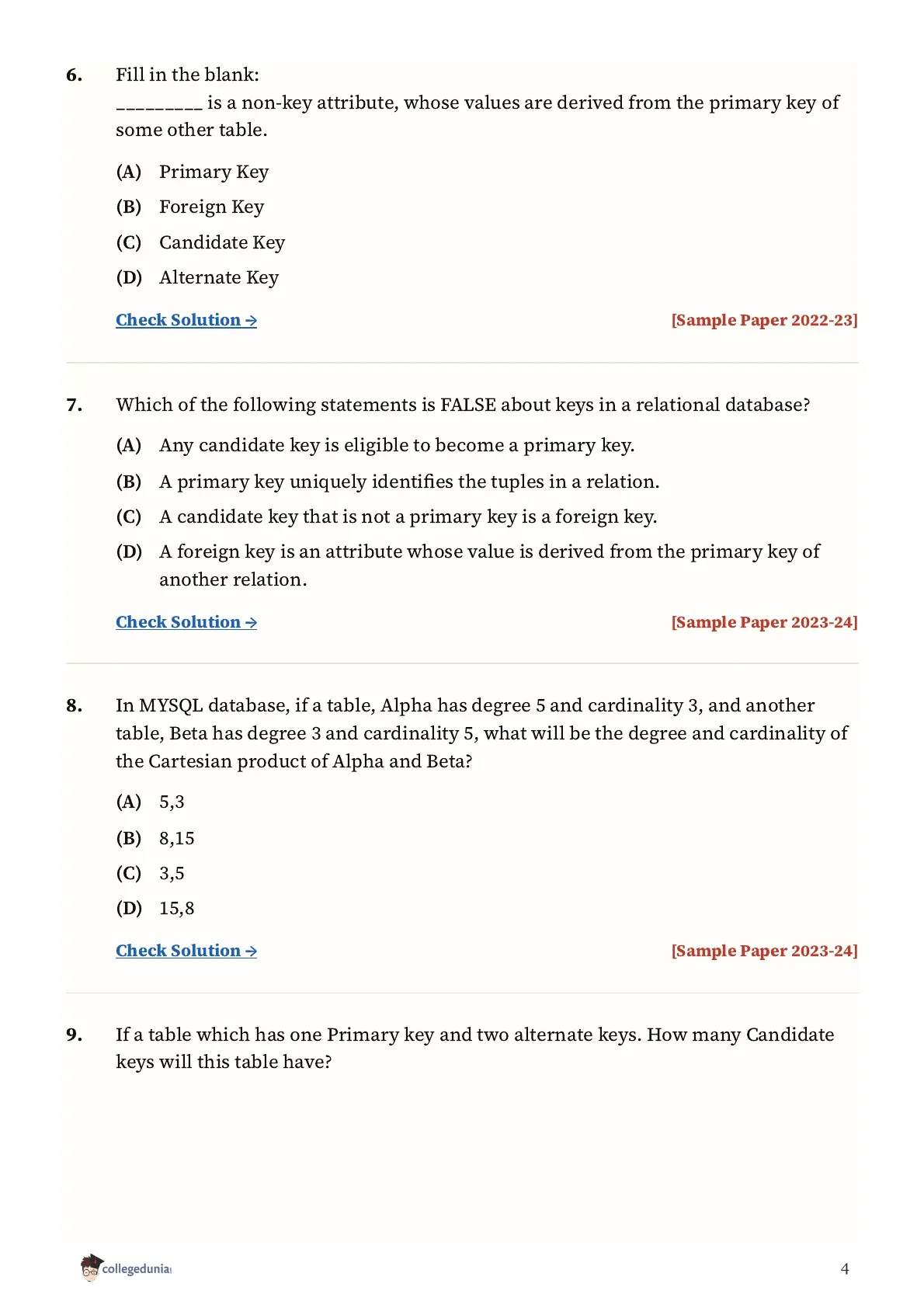
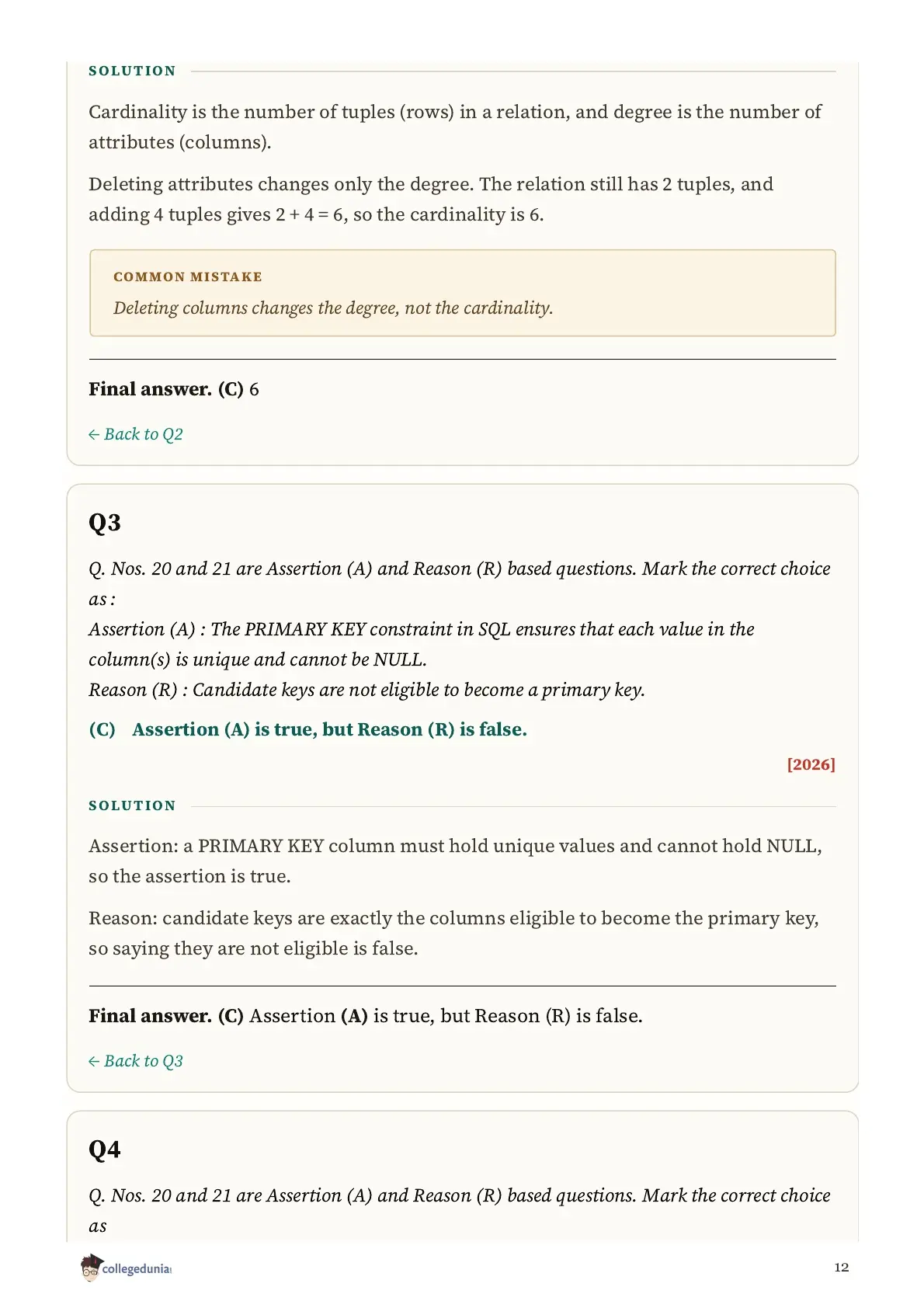
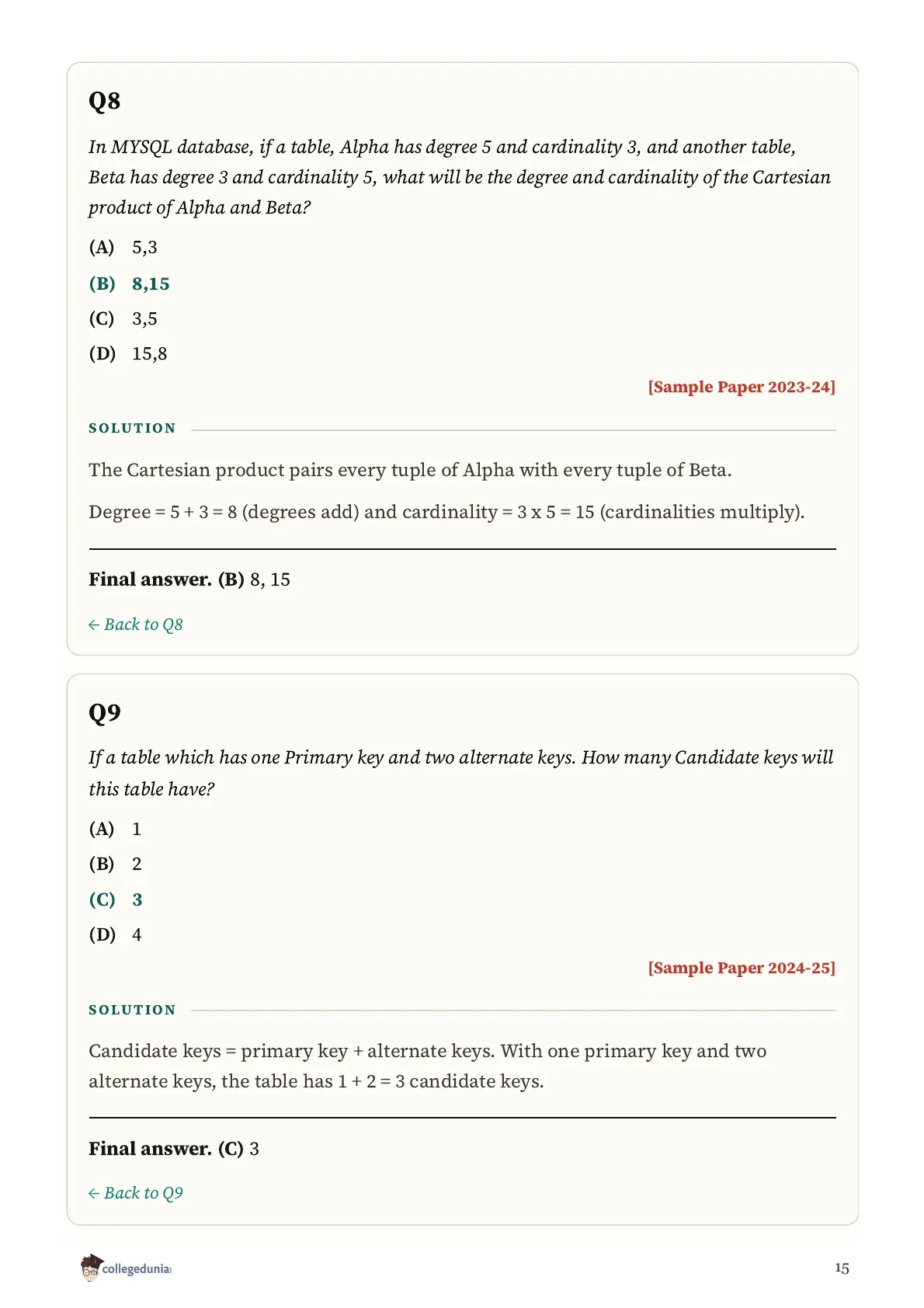
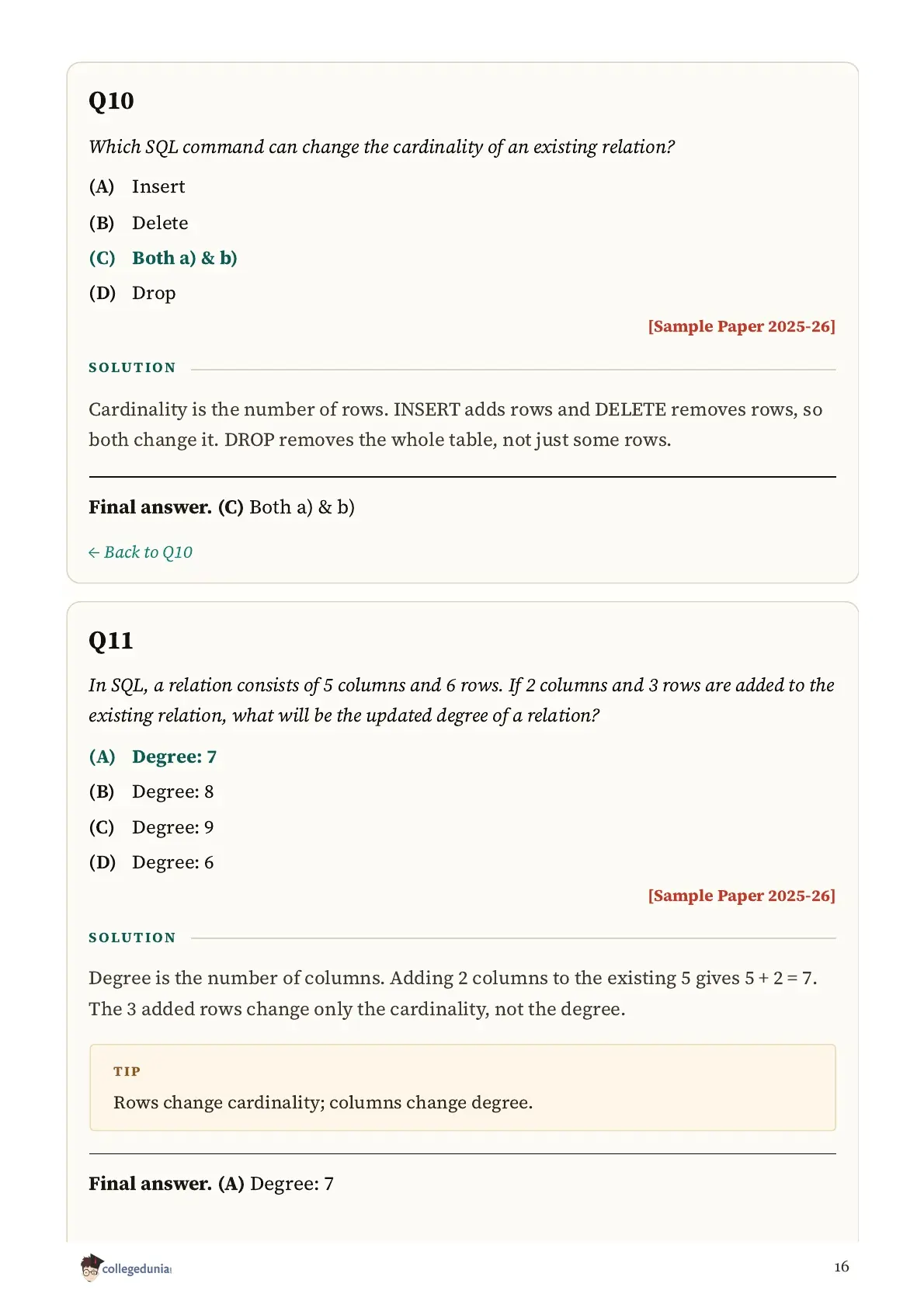
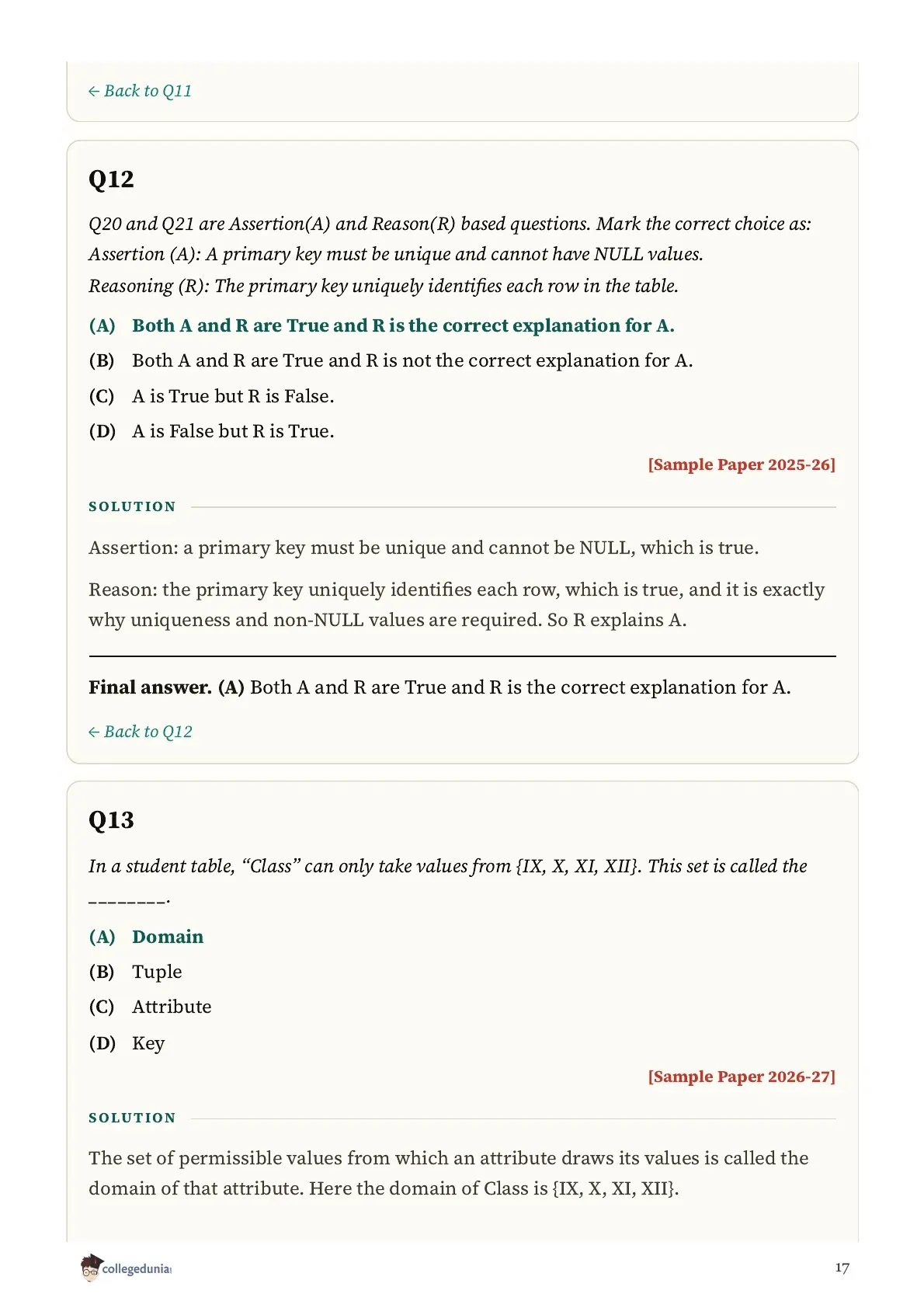
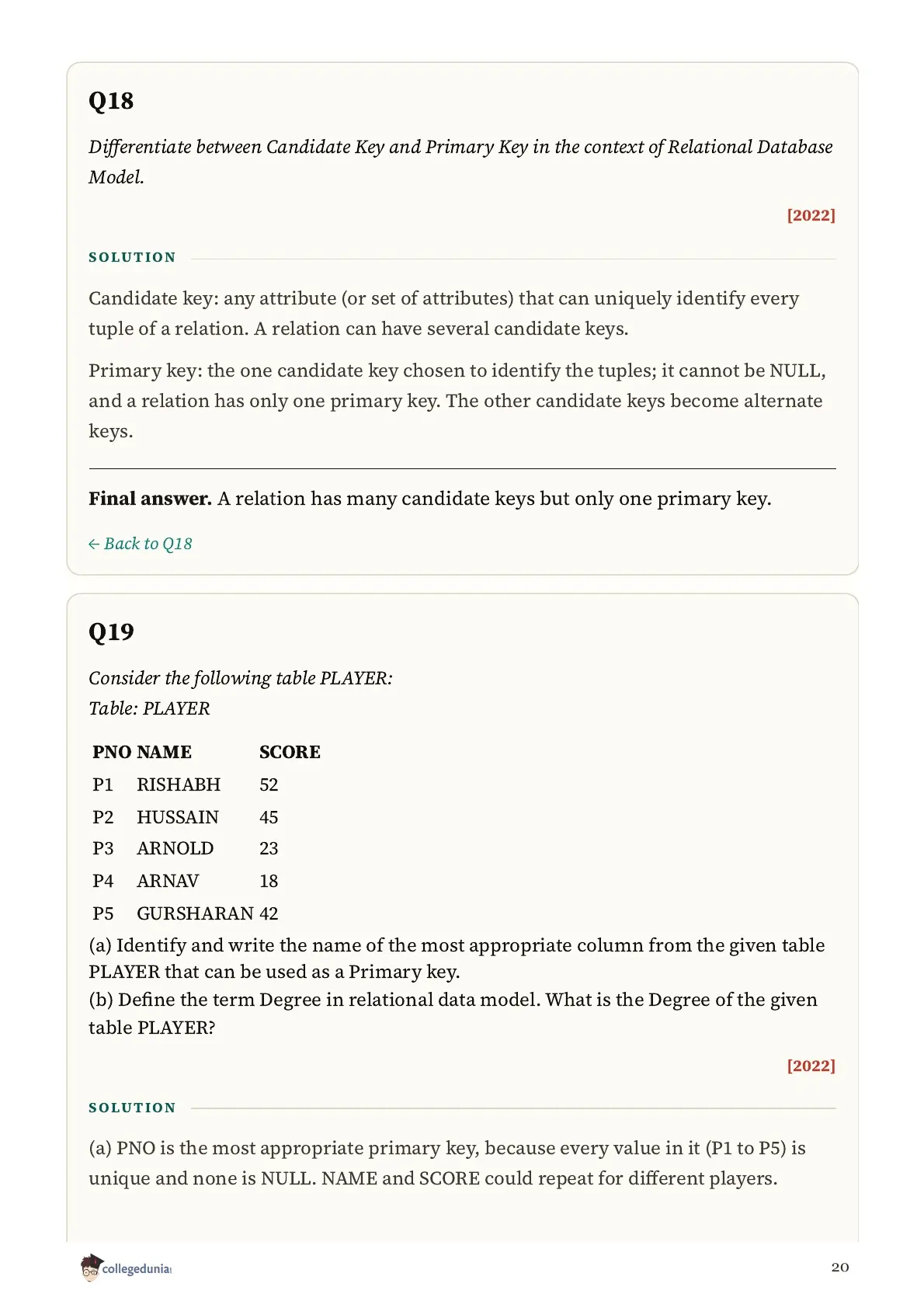
Degree and cardinality are asked in 7 questions each. They come as small calculations: add 2 columns and 3 rows to a 5 by 6 relation, delete 2 attributes and add 4 tuples to a relation with 2 tuples, or find the Cartesian product of Alpha (degree 5, cardinality 3) and Beta (degree 3, cardinality 5). The 2-mark questions ask for differences, such as Attribute and Domain or Candidate Key and Primary Key, plus an Alternate Key example and a Foreign Key example. The PLAYER table question picks the primary key and defines degree.
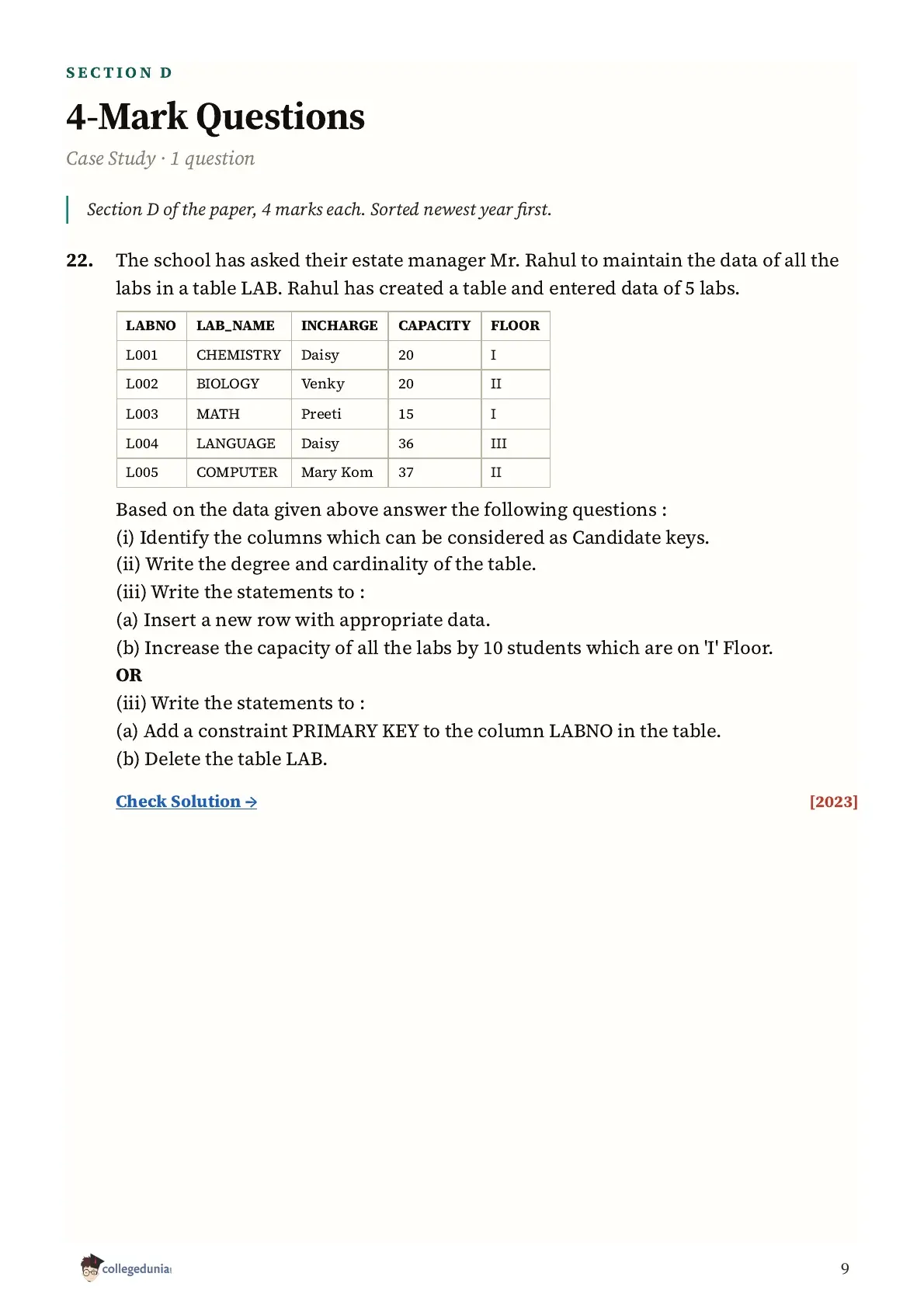
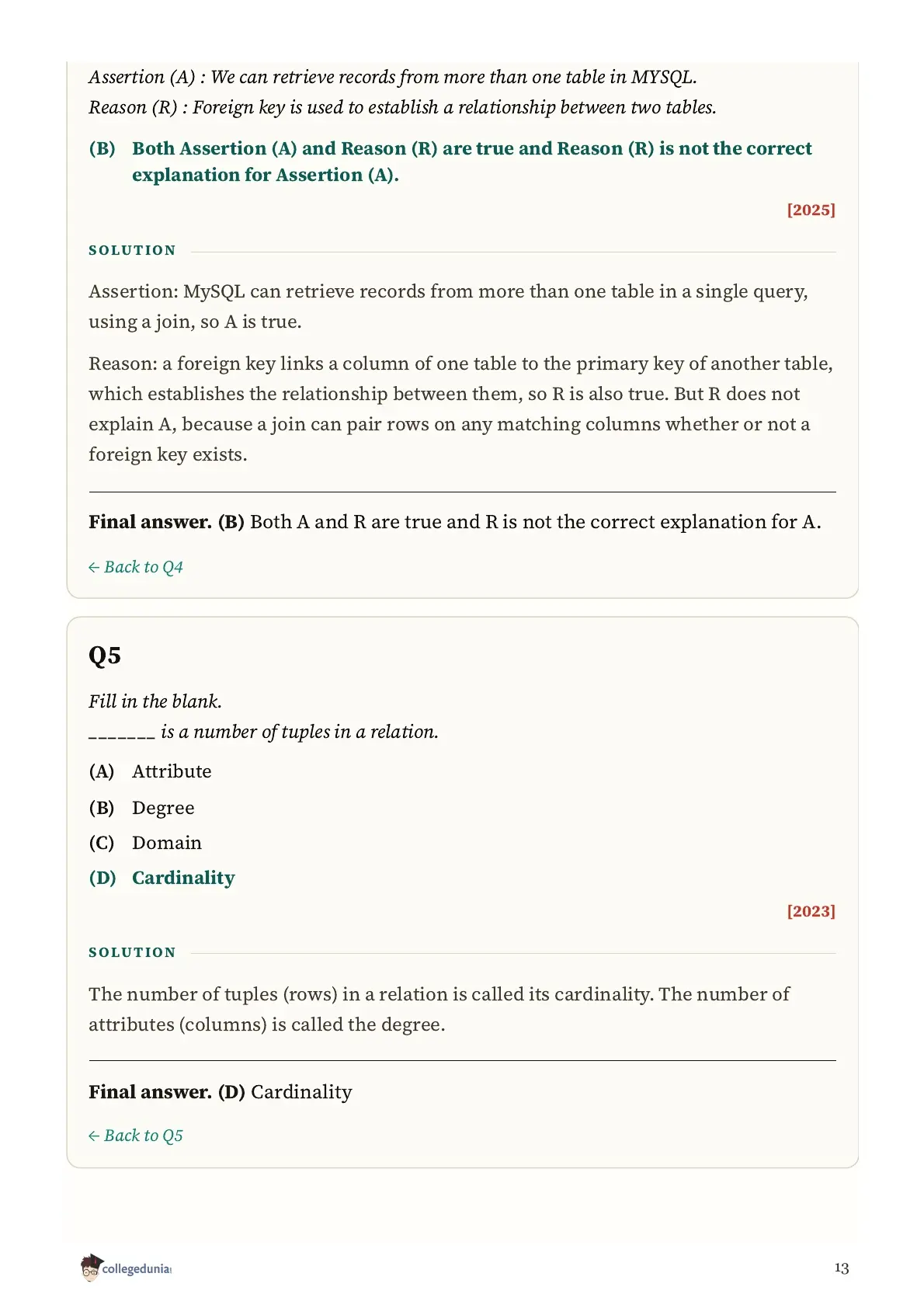
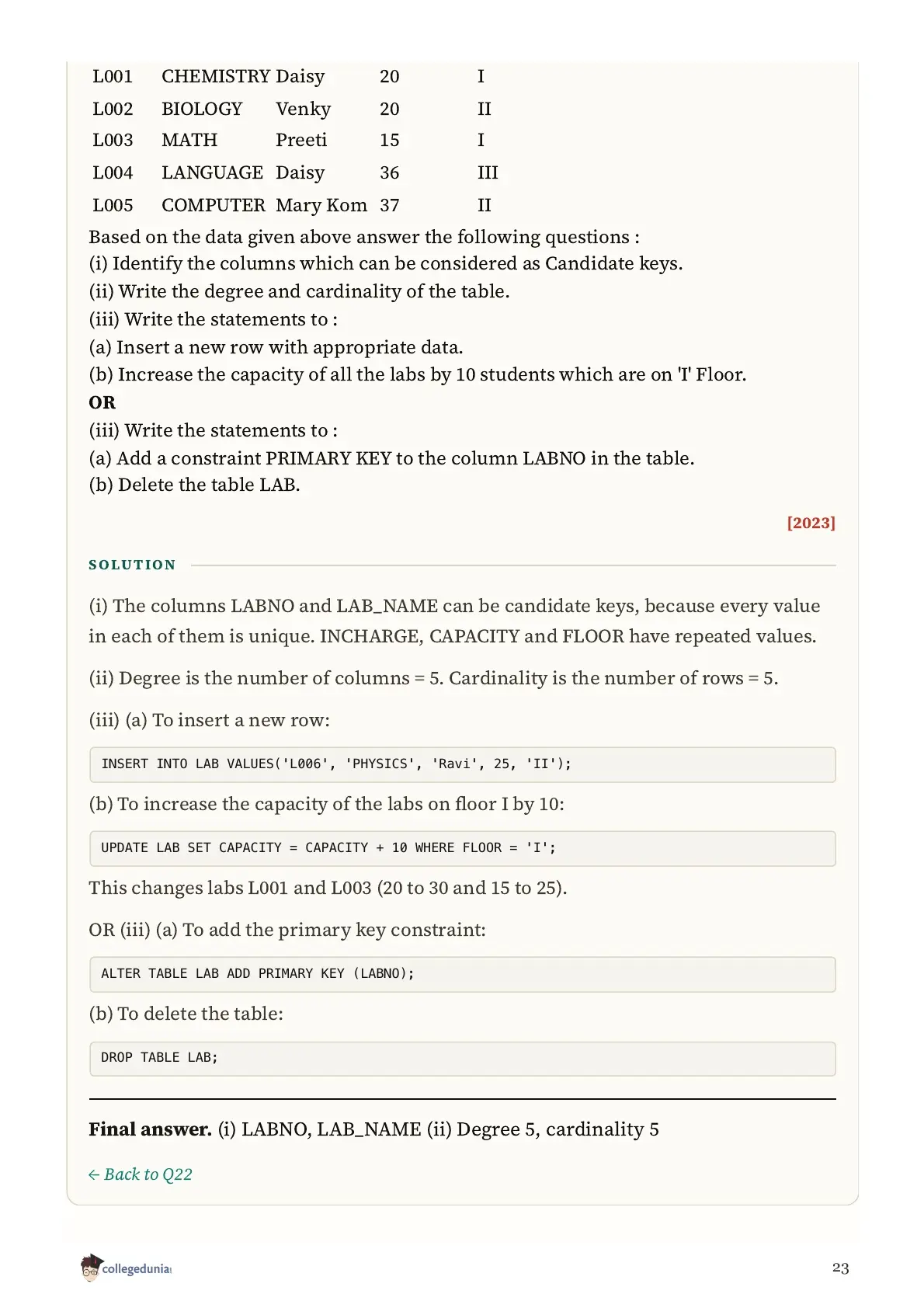
3 questions are Assertion and Reason items, all on primary key and foreign key. The single case study uses a LAB table with five rows and asks for candidate keys, degree, cardinality and two SQL statements (INSERT and UPDATE, or ALTER and DROP in the OR part). The counts come from keyword matches over the question text, so a question that names two terms is counted under both. All 15 MCQs are in the Answer Key.
Source: Magnet Brains
How to Approach the Set
Begin with the 15 one-mark questions. Learn the six terms (attribute, tuple, domain, degree, cardinality, key) as one-line definitions, then practise the counting items until the arithmetic is automatic: degrees add and cardinalities multiply in a Cartesian product, while inserting rows changes only cardinality. Move to the 2-mark answers and write each difference as two short points with a tiny example table. Finish with the LAB case study, where the candidate keys come from reading which columns hold no repeated values.
Common Mistakes in Database Concepts Questions
- Writing 15, 8 for the Cartesian product of Alpha and Beta. Degree is 5 + 3 = 8 and cardinality is 3 x 5 = 15.
- Saying that deleting columns lowers the cardinality. It changes the degree only.
- Calling a candidate key that was not chosen as primary a foreign key. It is an alternate key.
- Marking Assertion and Reason as both true with a correct explanation when the reason is about candidate keys not being eligible for primary key. Candidate keys are exactly the eligible ones.
- Naming LANGUAGE or INCHARGE as a candidate key in the LAB table, where values repeat (Daisy appears twice).
- Forgetting that INSERT and DELETE both change cardinality, so the answer is "Both".
Using the Answer Key and Solutions
The PDF is 23 pages and free to download. Each section is sorted newest year first, the Answer Key lists every MCQ at a glance, and each question links to its worked solution and back. Attempt a section first, check the key, then read the solution. The solutions are written by Collegedunia's Computer Science experts and are not official CBSE marking schemes. Board and sample-paper questions are tagged separately, so you can practise the real papers first.
Class 12 Computer Science PYQs by Chapter
Database Concepts Class 12 Computer Science PYQ FAQs
Ques. How many questions are in the Database Concepts Class 12 PYQ PDF?
Ans. The PDF has 22 questions: 10 from the 2022, 2023, 2025 and 2026 board papers and 12 from CBSE's official sample papers. 15 are MCQs and fill-in items, 6 are short answers and 1 is a case study.
Ques. Does this PYQ PDF include solutions, or only the questions?
Ans. All 22 questions have a worked solution, and the 15 MCQs also appear in an Answer Key before the solutions.
Ques. Are the solutions official?
Ans. No. They are written by Collegedunia's Computer Science experts, run and checked against CBSE's marking schemes where CBSE has published them (the 2023, 2024 and 2025 board papers and the sample papers). The 2022 and 2026 board papers have no published scheme, so those answers were worked out and run by hand. They are not an official CBSE marking scheme.
Ques. How many marks does Database Concepts carry in the Class 12 Computer Science paper?
Ans. CBSE gives marks per unit, not per chapter. Unit 3, Database Management, carries 20 of the 70 theory marks and also covers SQL. Check cbseacademic.nic.in for the current syllabus.
Ques. Which topics are asked most from Database Concepts?
Ans. Primary key appears in 11 questions, candidate key in 9, cardinality and degree in 7 each, foreign key in 6 and alternate key in 4.
Ques. Do sample-paper questions count as board questions?
Ans. No. 12 of the 22 questions come from CBSE's sample papers and carry a Sample Paper tag. They follow the board pattern but were not asked in a board exam.
Ques. What is the difference between degree and cardinality?
Ans. Degree is the number of attributes (columns) and cardinality is the number of tuples (rows). 7 questions in the set test one or both, often by adding or deleting rows and columns.



Comments