



The Class 12 Engineering Graphics Machine Drawing Rod Joints PYQ PDF is available for free download. This chapter-wise file helps students revise Chapter 3 rod-joint drawing questions for the 2026-27 board exam.
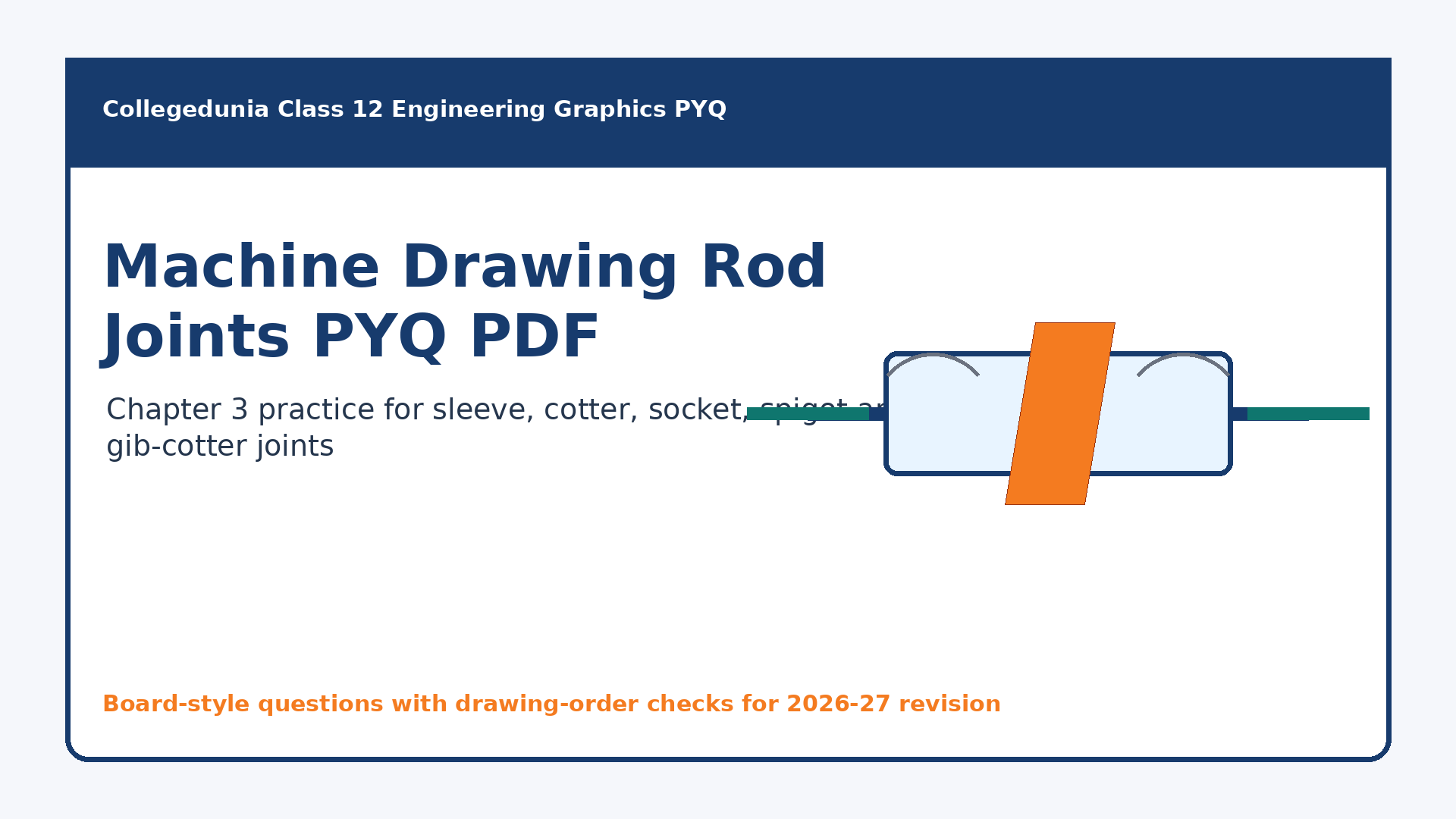
- Covers sleeve and cotter joint, socket and spigot joint, gib and cotter joint, centre lines, hatching and top-view projection.
- Includes 24 NCERT-based board-style questions because the local PYQ source set has no extractable chapter rows for this topic.
- Useful for practising drawing order, sectional front view, top view and final darkening checks before full board-paper practice.
Student Feedback: Students can use this PYQ PDF to revise rod-joint drawing sequence without mixing cotter, socket, spigot and gib details.
In This Article
Class 12 Engineering Graphics Rod Joints PYQ PDF
The PDF focuses on Class 12 Engineering Graphics Chapter 3, Machine Drawing - Rod Joints. The questions are arranged by marks so students can practise definitions, construction order and full machine-drawing prompts in a board-style sequence.
- Chapter: Chapter 3 Machine Drawing - Rod Joints
- Main theme: joining rods with sleeve, socket, spigot, cotter and gib arrangements
- Practice type: objective, short construction, drawing-sequence, board-style and long-answer drawing questions
- Best use: revise centre line, sectional front view, top view, hatching and title-block discipline before timed drawing practice
Questions Covered in Rod Joints PYQ PDF
The repeated examination pattern checks whether students can read the machine part, choose the correct sectional view and keep all rod-joint elements aligned from the front view to the top view.
| PYQ Cluster | Question Focus | Answer Skill |
|---|---|---|
| Part identification | Cotter, sleeve, socket, spigot, gib, collar and slot | Name the part and state its drawing role |
| Sectional front view | Cutting plane, hatching and assembled outline | Draw visible edges and avoid unnecessary hidden lines |
| Top view projection | Projecting widths, heads and slot position | Transfer details from the sectional front view accurately |
| Board drawing practice | Complete rod-joint assembly questions | Finish views, labels and drawing conventions neatly |
Rod Joints Video Revision
Source: Engineering Graphics learning channel on YouTube
Rod Joint Drawing Flow
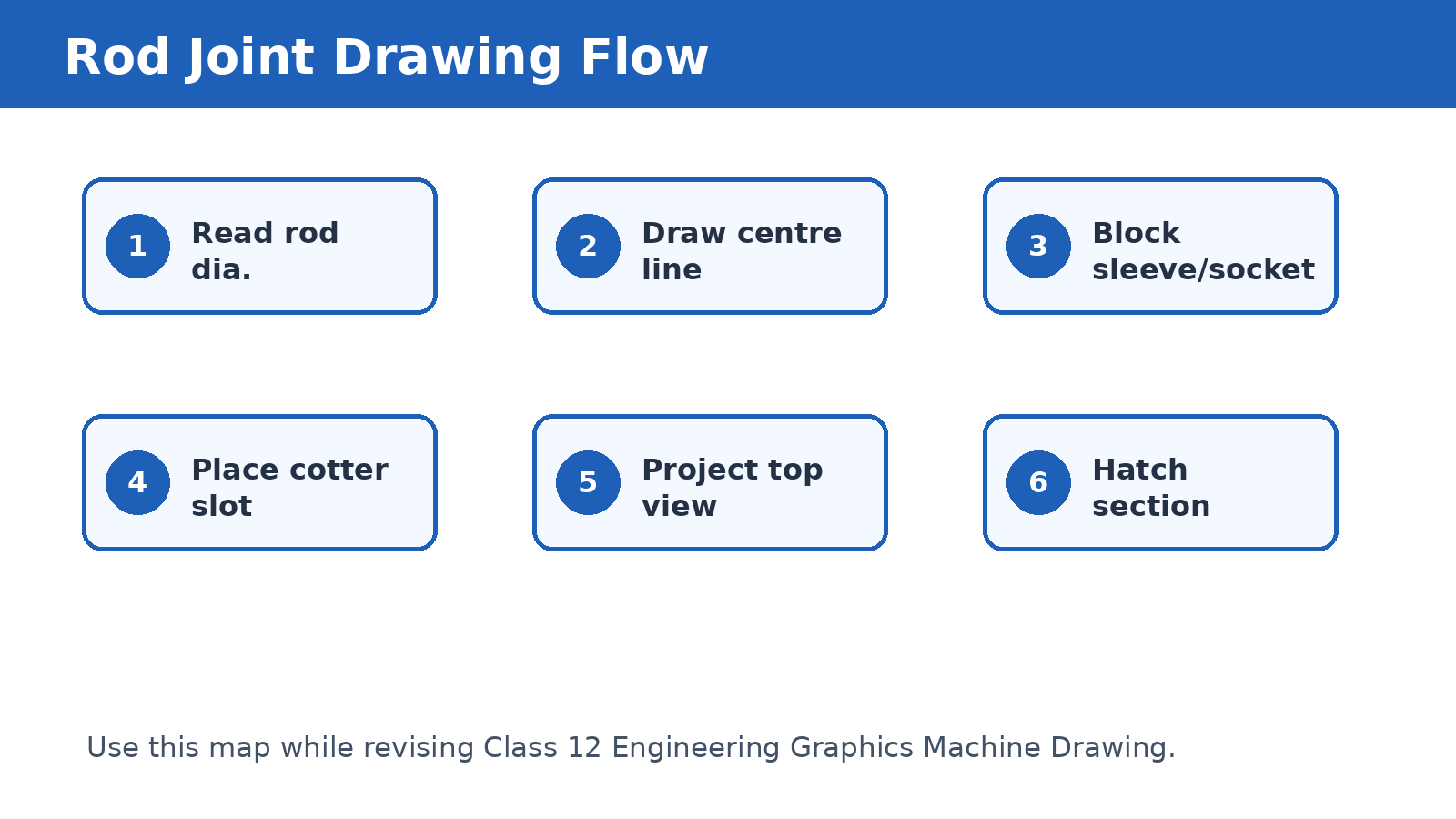
Start every rod-joint answer with the common centre line, then block the main joined parts before adding slots, cotter taper, collars and hatching. This keeps the final top view aligned with the sectional front view.
- Alignment: keep rods, sleeve or socket, cotter slot and centre line in one construction sequence
- Sectioning: hatch adjacent parts in opposite directions or with different spacing
- Projection: complete the top view only after the sectional front view has the correct widths
- Final check: darken visible outlines, label major parts and remove construction confusion
Rod Joint Comparison Map
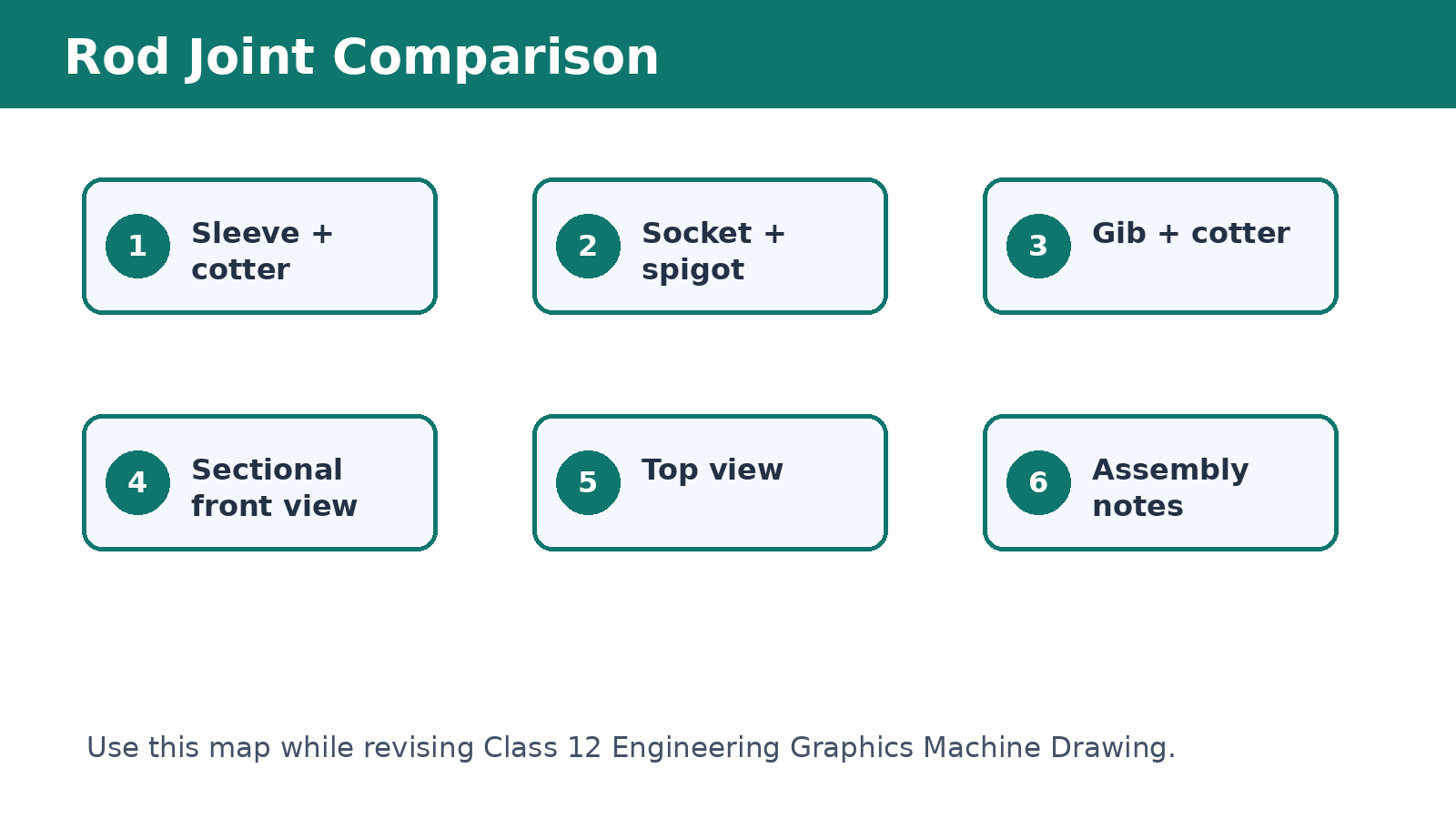
Use the comparison map to avoid mixing the parts of different rod joints. Sleeve and cotter questions emphasise the central sleeve, socket and spigot questions emphasise male-female fitting, while gib and cotter questions emphasise side support.
Class 12 Engineering Graphics Rod Joints Related Resources
| Resource | Link |
|---|---|
| Rod Joints Handwritten Notes | Chapter 3 Handwritten Notes |
| Engineering Graphics NCERT Book PDF | Class 12 Engineering Graphics Book PDF |
| Engineering Graphics Board Papers | Class 12 Engineering Graphics Question Papers |
All Class 12 Engineering Graphics PYQ Chapters
| Resource | Link |
|---|---|
| Isometric Projection of Solids PYQ | Chapter 1 PYQ PDF |
| Machine Drawing Bearings PYQ | Chapter 2 PYQ PDF |
| Machine Drawing Rod Joints PYQ | Chapter 3 PYQ PDF |
| Machine Drawing Tie-rod and Pipe Joints PYQ | Chapter 4 PYQ PDF |
| Machine Drawing Shaft Couplings PYQ | Chapter 5 PYQ PDF |
| Machine Drawing Pulleys PYQ | Chapter 6 PYQ PDF |
Class 12 Engineering Graphics Rod Joints PYQ FAQs
Ques. Where can I download Class 12 Engineering Graphics Machine Drawing Rod Joints PYQ PDF?
Ans. You can download the chapter-wise PYQ PDF from the PDF viewer and download link above.
Ques. Which rod-joint topics are important for PYQ practice?
Ans. Focus on sleeve and cotter joint, socket and spigot joint, gib and cotter joint, sectional front view, top view, hatching and centre-line alignment.
Ques. Does this PDF include extracted previous-year rows?
Ans. No. The local source set has no extractable chapter rows for this topic, so the PDF uses NCERT-based board-style practice questions for rod joints.
Ques. How should students attempt rod-joint drawing questions?
Ans. Start with the centre line, block the assembled parts, add the cotter or gib details, project the top view and then finish hatching, labels and dark outlines.



Comments