




If you are preparing the Kaleidoscope poetry section for the Class 12 English Elective paper, start by seeing how little CBSE has actually asked on this poem. Only 9 real previous year questions exist for John Donne's A Lecture upon the Shadow, and all nine are collected here as a free 3-page PDF, sorted by marks. The file carries the questions only, with no answer key.
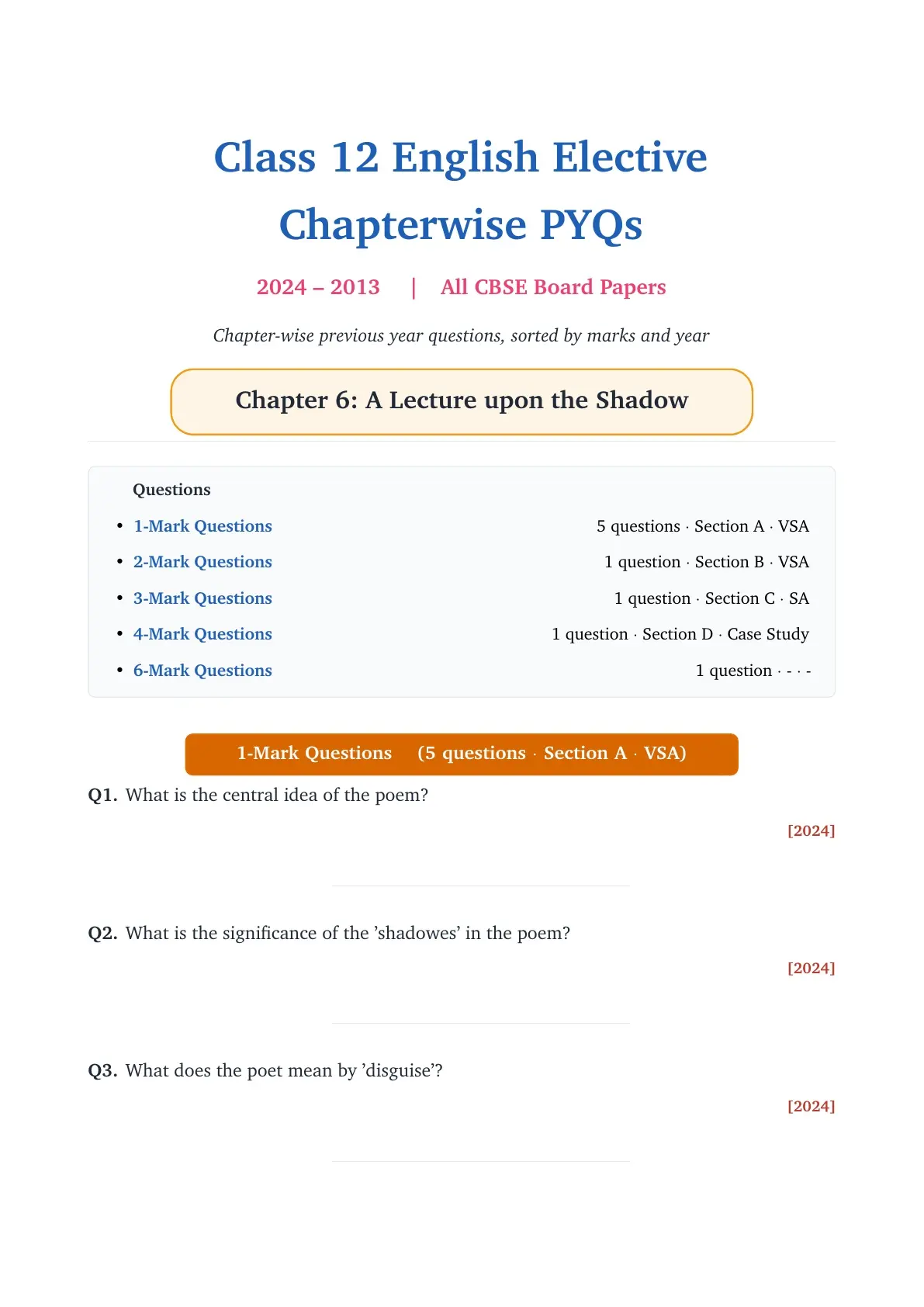
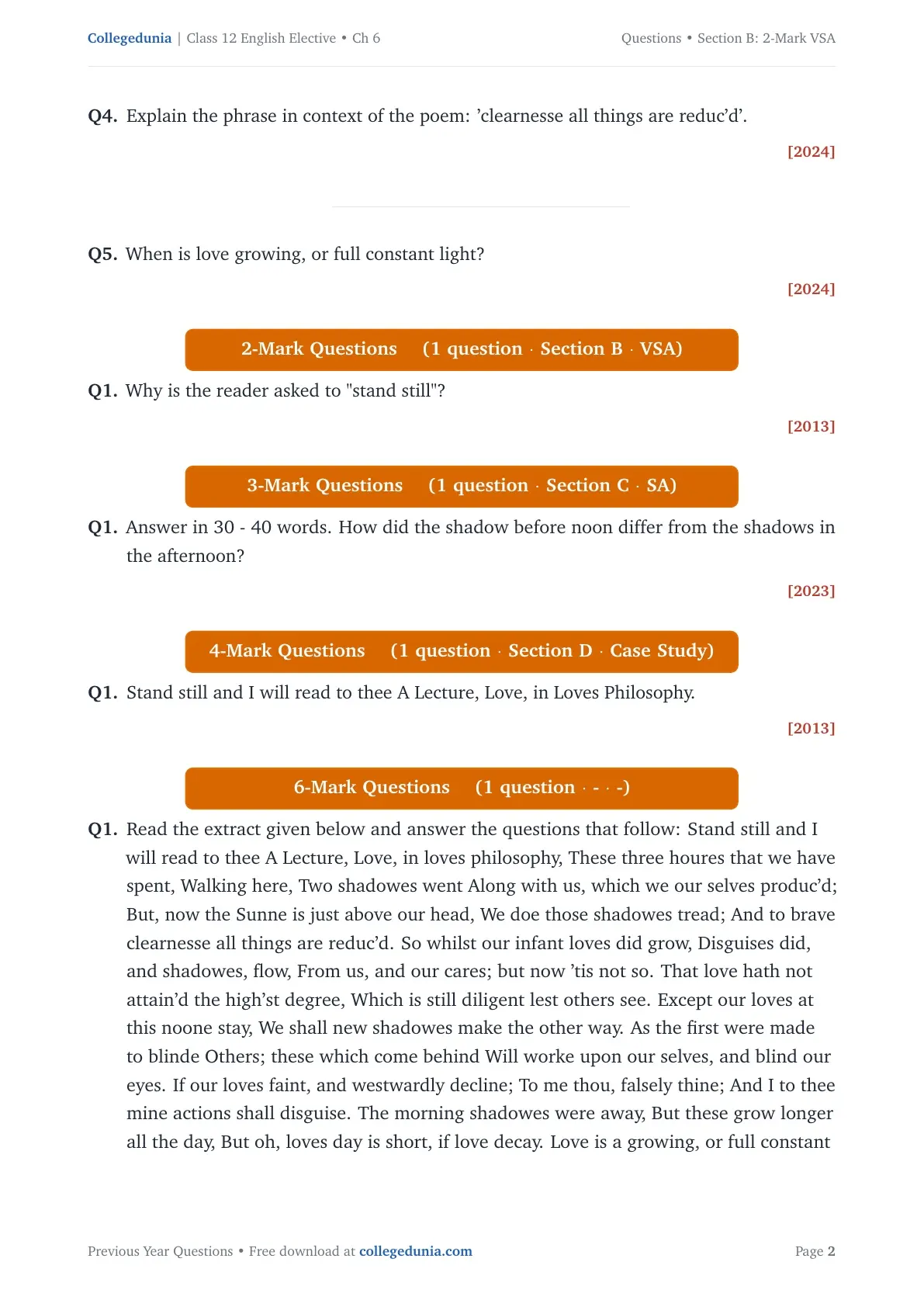
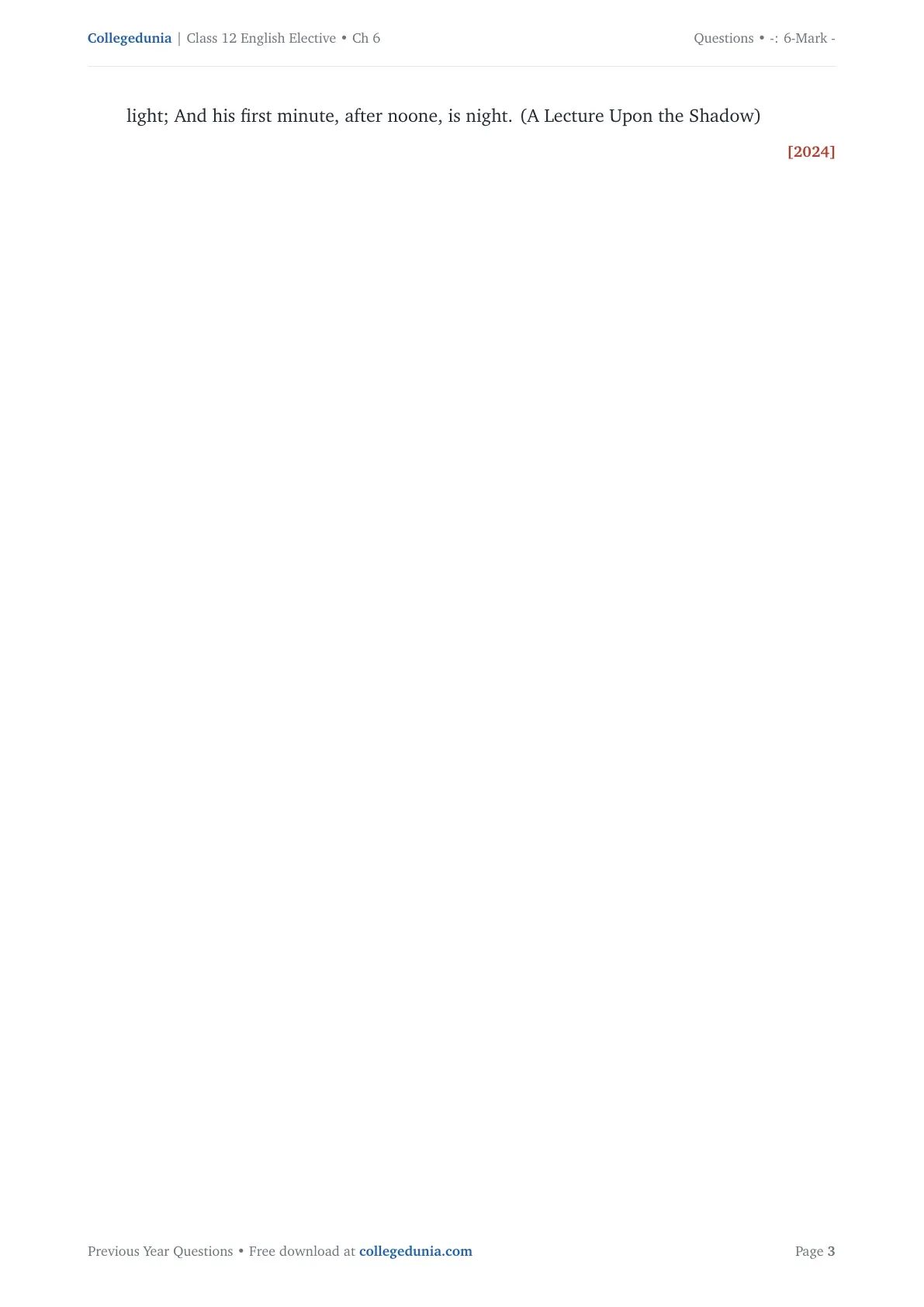
- Nine questions worth 20 marks: 5 one-mark, 1 two-mark, 1 three-mark, 1 four-mark and 1 six-mark.
- Three board years only: 2024, 2023 and 2013, and every question is printed with its year.
- This is a small set, not a full question bank. Treat it as a pattern check, not full coverage.
Every question in this Collegedunia set is lifted from an actual CBSE Class 12 English Elective board paper and tagged with the year it appeared, according to the 2026-27 syllabus for Kaleidoscope.
All Nine A Lecture upon the Shadow Board Questions at a Glance
The whole set fits on one screen, so there is no reason to hide it. Below is every question CBSE has set on this Donne poem, printed the way the board printed it, with the year beside each one.
| Marks | Year | Question as Printed |
|---|---|---|
| 1 | 2024 | What is the central idea of the poem? |
| 1 | 2024 | What is the significance of the 'shadowes' in the poem? |
| 1 | 2024 | What does the poet mean by 'disguise'? |
| 1 | 2024 | Explain the phrase in context of the poem: 'clearnesse all things are reduc'd'. |
| 1 | 2024 | When is love growing, or full constant light? |
| 2 | 2013 | Why is the reader asked to "stand still"? |
| 3 | 2023 | Answer in 30 to 40 words. How did the shadow before noon differ from the shadows in the afternoon? |
| 4 | 2013 | Case study on the opening lines: "Stand still and I will read to thee A Lecture, Love, in Loves Philosophy." |
| 6 | 2024 | Read the extract given below and answer the questions that follow. The full text of the poem is printed as the extract. |
The PDF stops at exactly this point. It carries these nine questions and their years, nothing else. No model answers, no marking scheme, no hints.
Marks-wise and Year-wise Split of the Nine Donne Questions
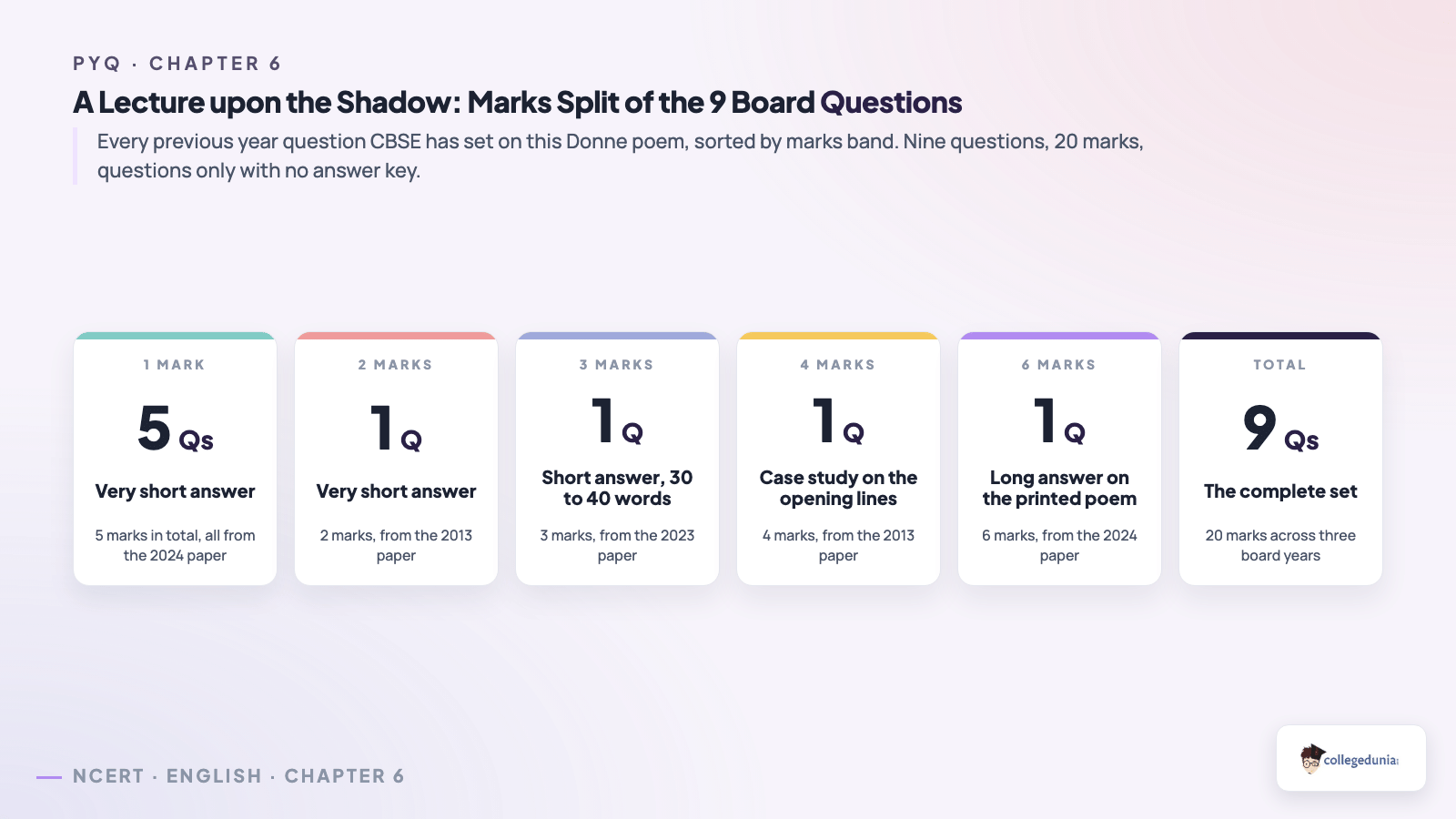
Nine questions is a thin history, and the split explains why. Five of the nine sit in the 1-mark band and all five come from a single paper. The table shows where the 20 marks actually sit.
| Marks | Questions | Total Marks | Paper Section | Question Type |
|---|---|---|---|---|
| 1 mark | 5 | 5 | Section A | Very short answer on theme, diction and imagery |
| 2 mark | 1 | 2 | Section B | Very short answer |
| 3 mark | 1 | 3 | Section C | Short answer, 30 to 40 words |
| 4 mark | 1 | 4 | Section D | Case study built on the opening two lines |
| 6 mark | 1 | 6 | Not fixed | Long answer on the printed poem |
| Total | 9 | 20 | – | – |
By year the picture is even simpler. Six of the nine questions come from the 2024 paper alone, worth 11 marks. The 2013 paper gave two questions worth 6 marks, and 2023 gave the single 3-mark question. Everything in this set was set on the printed text of the poem.
The Shadow Conceit CBSE Keeps Coming Back To
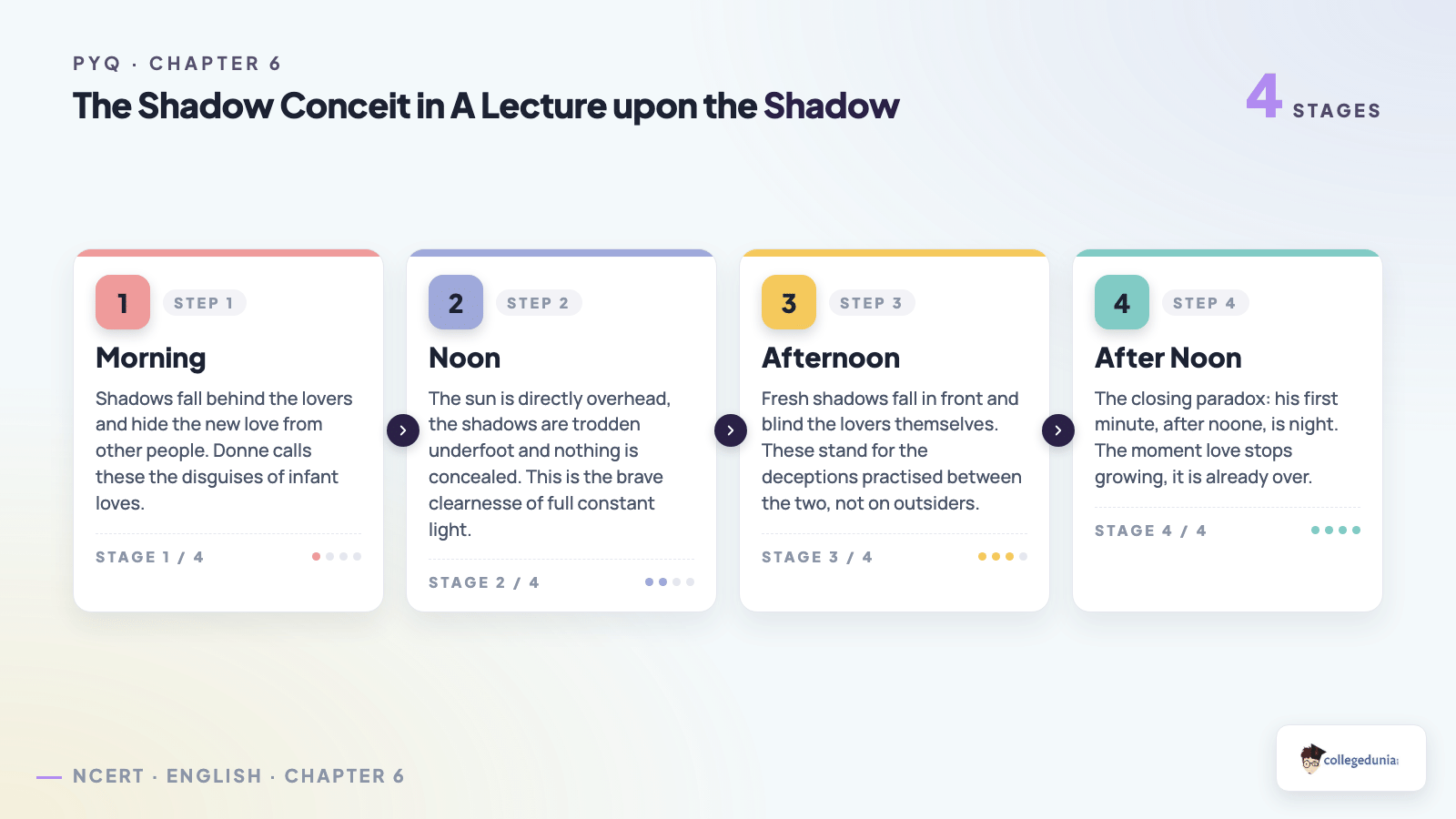
Donne builds the poem on one extended comparison. Lovers walking for three hours cast shadows behind them in the morning, stand shadowless at noon, then cast fresh shadows the other way as the day declines. Every question in this set hangs off that one image.
- The morning shadows. They fall behind the lovers and hide the love from other people. Donne calls these the disguises of "infant loves".
- Noon, the "brave clearnesse". The sun is overhead, the shadows are trodden underfoot, and nothing is concealed. This is love at its full and constant light.
- The afternoon shadows. These fall in front and blind the lovers themselves, which is Donne's picture of lies between two people rather than lies told to outsiders.
- The closing paradox. "And his first minute, after noone, is night." Love has no gentle decline in this poem. The moment it stops growing, it is already over.
Three of the five 1-mark questions ask for one of these four points in a single line. The 3-mark question asks you to set the morning shadows against the afternoon shadows directly, which is the conceit stated as a compare-and-contrast task.
How to Attempt Each Marks Band on a Kaleidoscope Poem
Poetry answers in the English Elective paper are marked on content points, not on length. A poem question also expects you to quote. One short phrase from the text, correctly placed, is usually worth a mark on its own.
- 1-mark questions: one line, no explanation. "The shadows stand for the disguises lovers use" is a complete answer.
- 2-mark questions: two points in about 30 words. The "stand still" question wants the dramatic opening and the lecture that follows it.
- 3-mark questions: three points inside the stated 30 to 40 word limit. Name both sets of shadows, then say what each one hides.
- 4-mark case study: the answer must come from the printed lines. Do not bring in the last stanza if it is not on the paper.
- 6-mark long answer: five or six points in about 120 to 150 words, with two short quotations from the poem. Give it 12 minutes.
Common Mistakes Students Make in A Lecture upon the Shadow Answers
- Treating the shadows as one thing. The morning shadows and the afternoon shadows do opposite work. The first blind other people, the second blind the lovers. Mixing them loses the 3-mark question outright.
- Paraphrasing the poem instead of explaining it. A 1-mark question on 'disguise' wants the meaning, not a retelling of the walk.
- Modernising Donne's spelling in a quotation. Write "shadowes" and "clearnesse" as printed. The archaic spelling is part of the text.
- Writing about a plot. This is a poem with an argument, not a narrative. Answers that describe events instead of the idea score badly.
- Skipping the closing line. The last two lines carry the whole conclusion, and examiners look for them in the 6-mark answer.
Student Feedback on the A Lecture upon the Shadow Poem
- 64% of students rated the metaphysical conceit the hardest part of the Kaleidoscope poetry section.
- Out of 10,140 students surveyed, about 3 in 5 said the archaic spelling slowed their first reading of the poem.
- Students reported that drawing the three stages of the day on paper made the 3-mark comparison easy to write.
- The most-skipped question type was the 1-mark phrase explanation, skipped by roughly 26% of the students in the survey.
How to Use This Short PYQ Set in Your Revision
Nine questions will not fill an evening, and they are not meant to. Use the set to test whether you can hold the conceit in your head, then go back to the poem for the rest.
- Read the poem twice, then close the book. Answer the five 1-mark questions from memory. Any miss shows a line you have not understood yet.
- Write the 3-mark comparison to the word limit. Count the words the first two times so 30 to 40 words starts to feel automatic.
- Attempt the 4-mark and 6-mark questions in one timed sitting. Both are extract-based, so the same quotations serve both answers.
Because the set is this small, pair it with the other Kaleidoscope chapters rather than working through it alone. The tables further down link the companion material for this poem and the PYQ sets for the rest of the textbook.
A Lecture upon the Shadow Class 12 Related Study Resources
The previous year questions work best beside the poem itself and a set of notes on the conceit. These are the companion resources for the same chapter.
| Resource | Link |
|---|---|
| NCERT Solutions | A Lecture upon the Shadow Class 12 NCERT Solutions (coming soon) |
| Revision Notes | A Lecture upon the Shadow Class 12 Revision Notes (coming soon) |
| Handwritten Notes | A Lecture upon the Shadow Class 12 Handwritten Notes (coming soon) |
| NCERT Book PDF | Kaleidoscope Poetry Section NCERT Book PDF (coming soon) |
Kaleidoscope PYQ PDFs for Class 12 English Elective
The same marks-sorted compilation is being built for the other chapters of the Kaleidoscope textbook, from the official CBSE papers.
| Chapter | Title | Previous Year Questions |
|---|---|---|
| Chapter 1 | I Sell My Dreams | I Sell My Dreams Class 12 PYQ PDF (coming soon) |
| Chapter 2 | Eveline | Eveline Class 12 PYQ PDF (coming soon) |
| Chapter 3 | A Wedding in Brownsville | A Wedding in Brownsville Class 12 PYQ PDF (coming soon) |
| Chapter 4 | Tomorrow | Tomorrow Class 12 PYQ PDF (coming soon) |
| Chapter 5 | One Centimetre | One Centimetre Class 12 PYQ PDF (coming soon) |
| Chapter 6 | A Lecture upon the Shadow | A Lecture upon the Shadow Class 12 PYQ PDF (coming soon) |
FAQs on A Lecture upon the Shadow Class 12 Previous Year Questions
Questions Students Ask About the A Lecture upon the Shadow Question Compilation
Ques. How many previous year questions are in the A Lecture upon the Shadow PDF?
Ans. Nine questions worth 20 marks in total. That is every question CBSE has set on this poem in the papers we have, so the set is deliberately short.
Ques. Does the A Lecture upon the Shadow PYQ PDF include the answers?
Ans. No. The 3-page file is questions only, printed as CBSE set them, with the board year under each one. There is no answer key and no marking scheme.
Ques. Which years do these A Lecture upon the Shadow questions come from?
Ans. Three papers. Six questions from 2024, one from 2023 and two from 2013. The 2024 paper alone supplies all five of the 1-mark questions.
Ques. Is nine questions enough practice for this poem?
Ans. On its own, no. Use it to check the pattern and the marks bands, then answer the textbook questions in Kaleidoscope for wider practice.
Ques. Are these questions valid for the 2026-27 syllabus?
Ans. Yes. The poem stays in the poetry section of the 2026-27 CBSE Class 12 English Elective syllabus, and the marks bands are unchanged.
Ques. What is the central idea of A Lecture upon the Shadow?
Ans. Love must keep growing or it ends. Donne argues that once love stops rising towards its noon, its very first minute afterwards is night.
Ques. What do the shadows stand for in the poem?
Ans. Disguises. The morning shadows hide a new love from other people. The afternoon shadows are the deceptions the lovers practise on each other.
Ques. What does 'brave clearnesse' mean in the poem?
Ans. The noon state where the sun is directly overhead and nothing casts a shadow. Donne uses it for love that is open, mature and hides nothing.



Comments