



The Class 12 Psychology Chapter 7 Social Influence and Group Processes PYQ PDF brings together 15 board-paper questions from CBSE papers between 2022 and 2026. Every question carries a full step-by-step solution, so students can check an answer and see exactly how examiners expect group-formation, cohesiveness, and social-loafing questions to be answered, according to the latest 2026-27 CBSE syllabus.
- 15 questions across the usual CBSE sections: one-mark MCQs, very short and short answer questions, and longer case-study prompts.
- Full solutions included for all 15 questions, not just a bare answer key.
- Five exam years covered: 2022, 2023, 2024, 2025, and 2026.
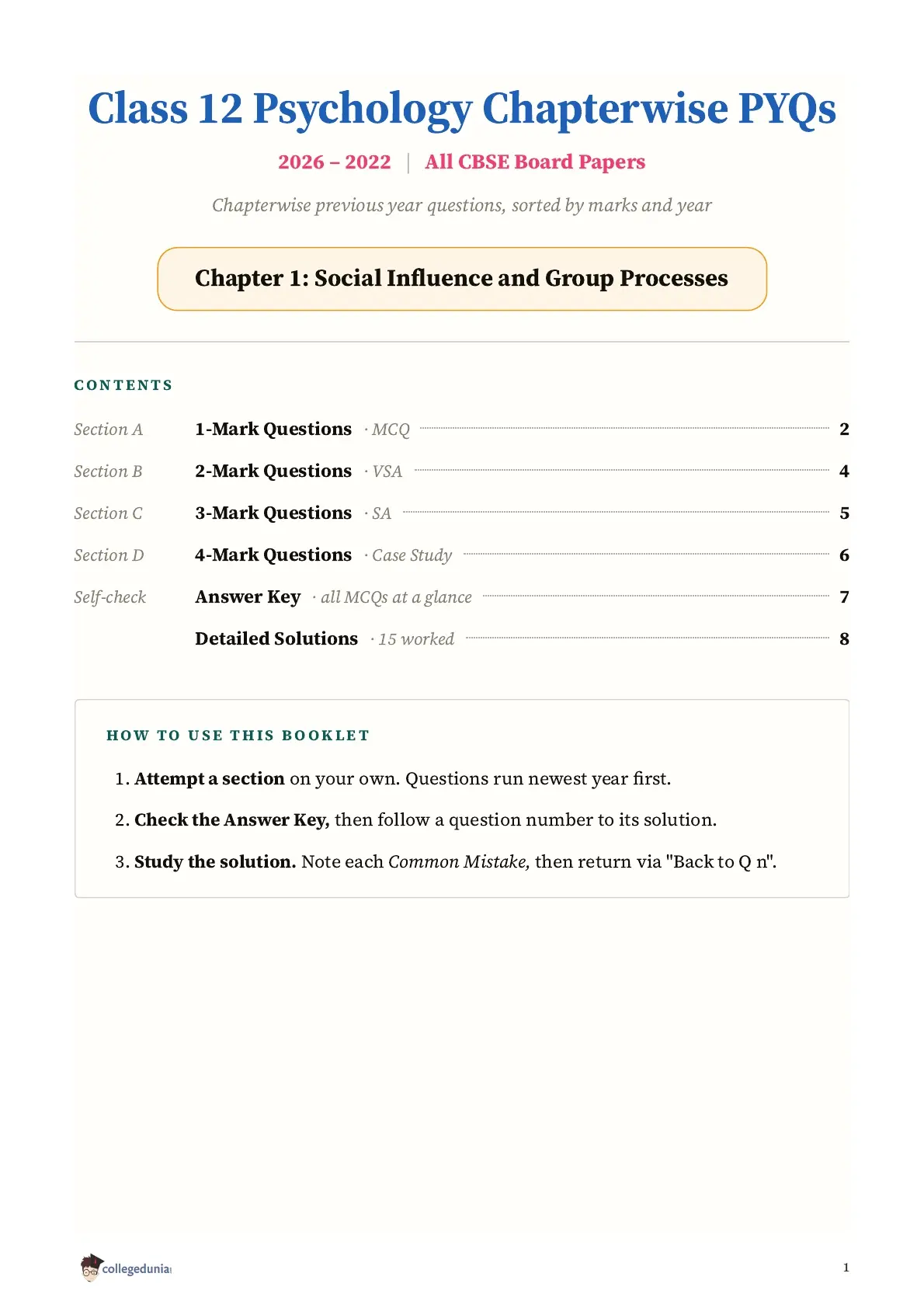
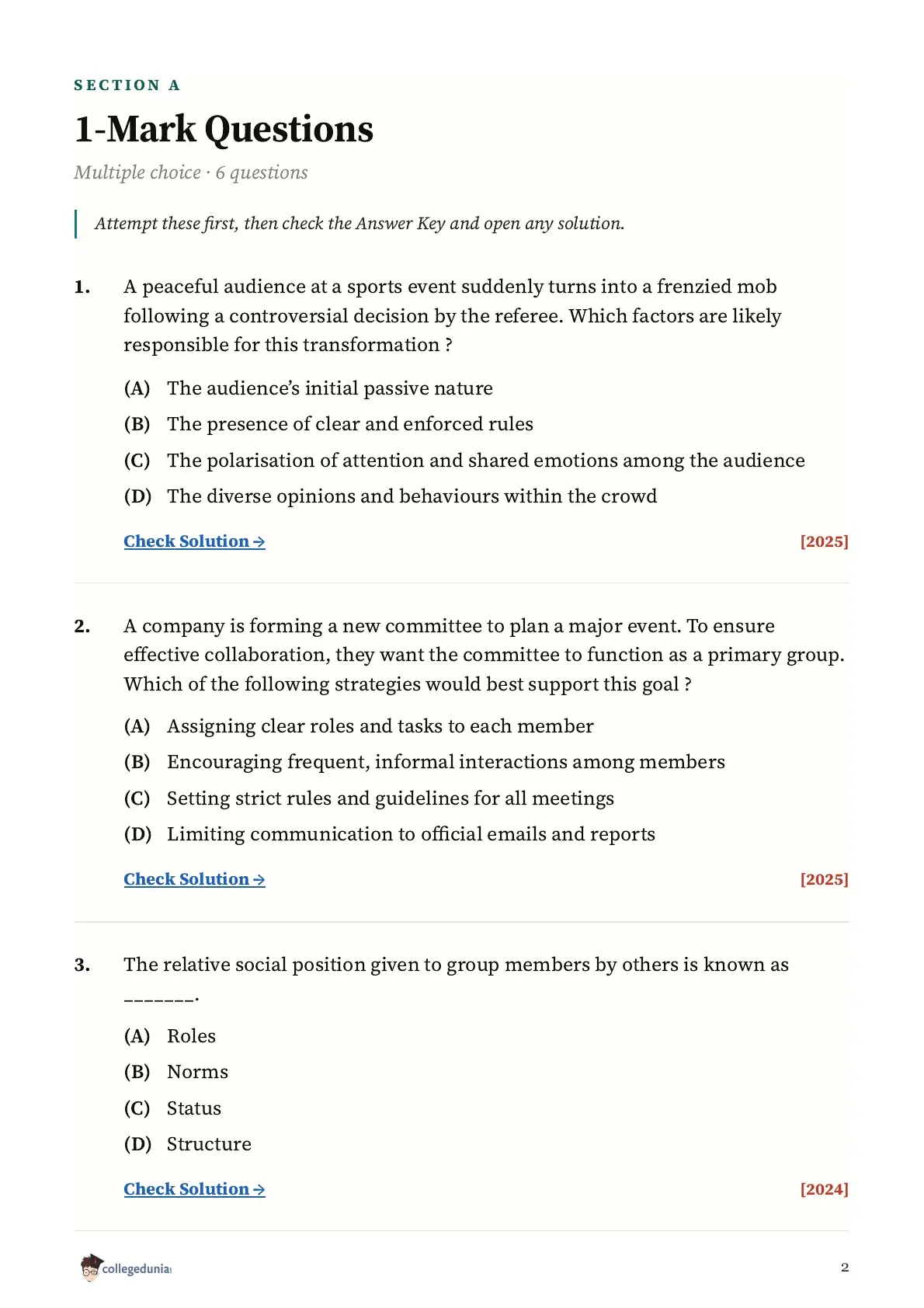
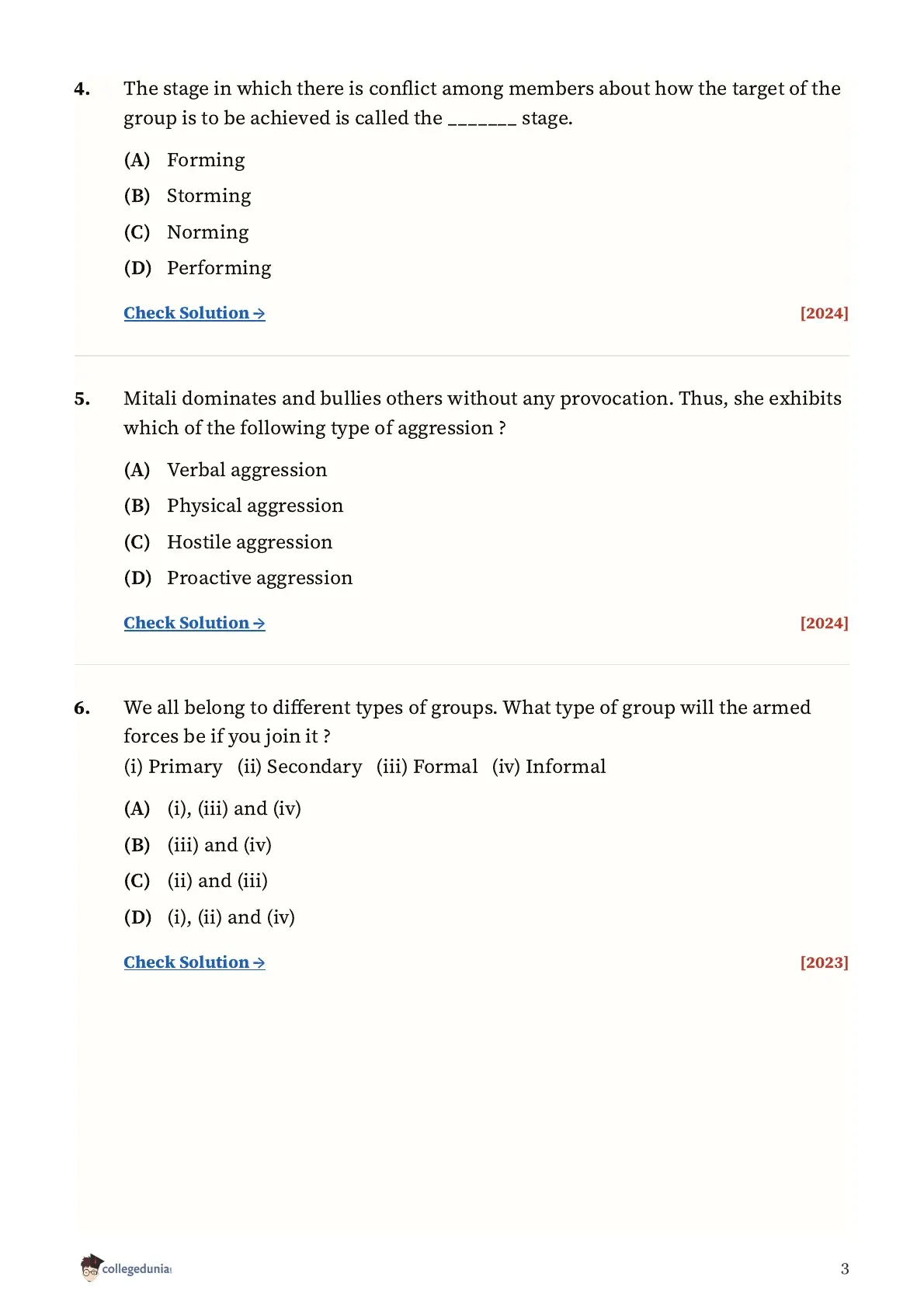
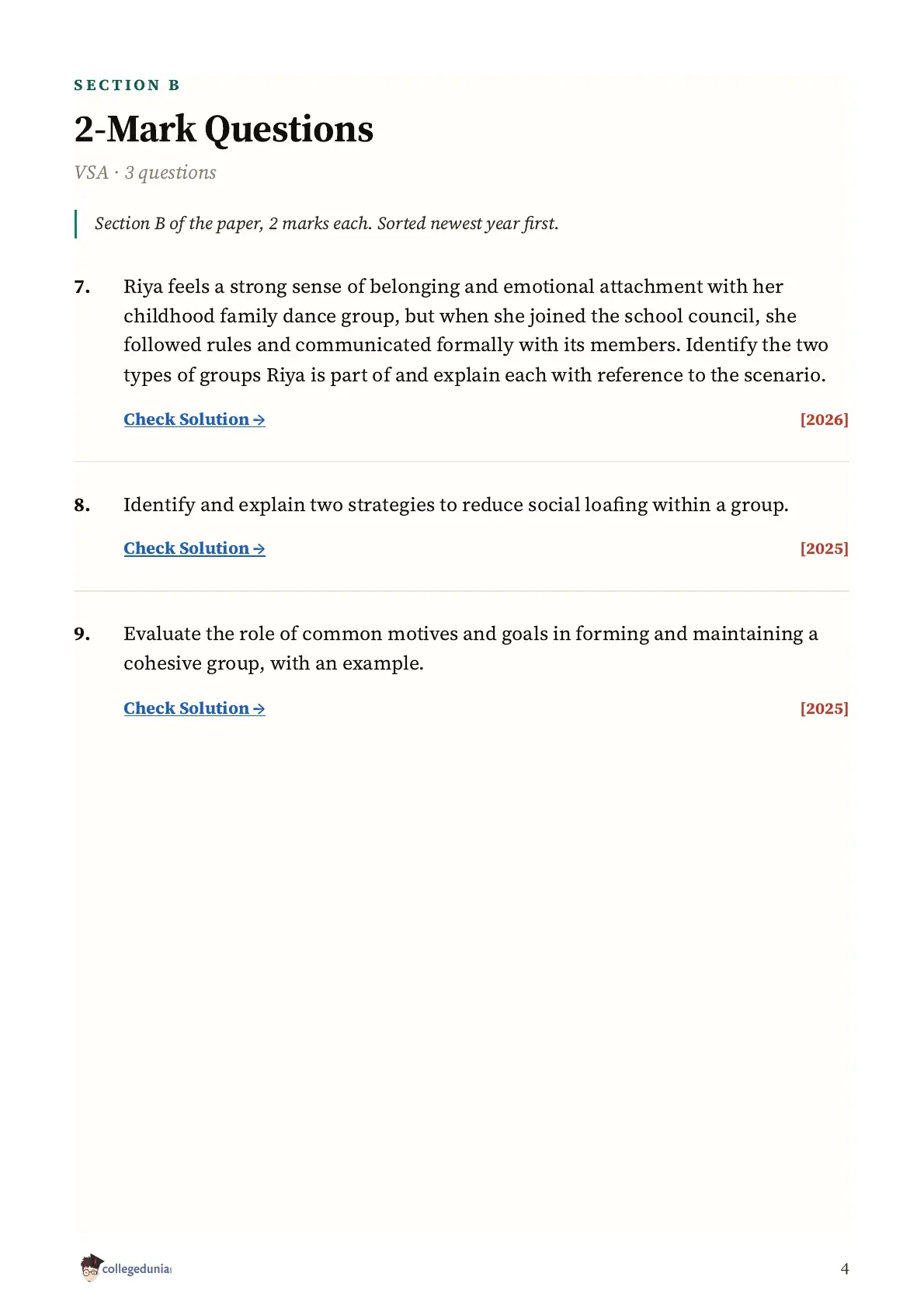
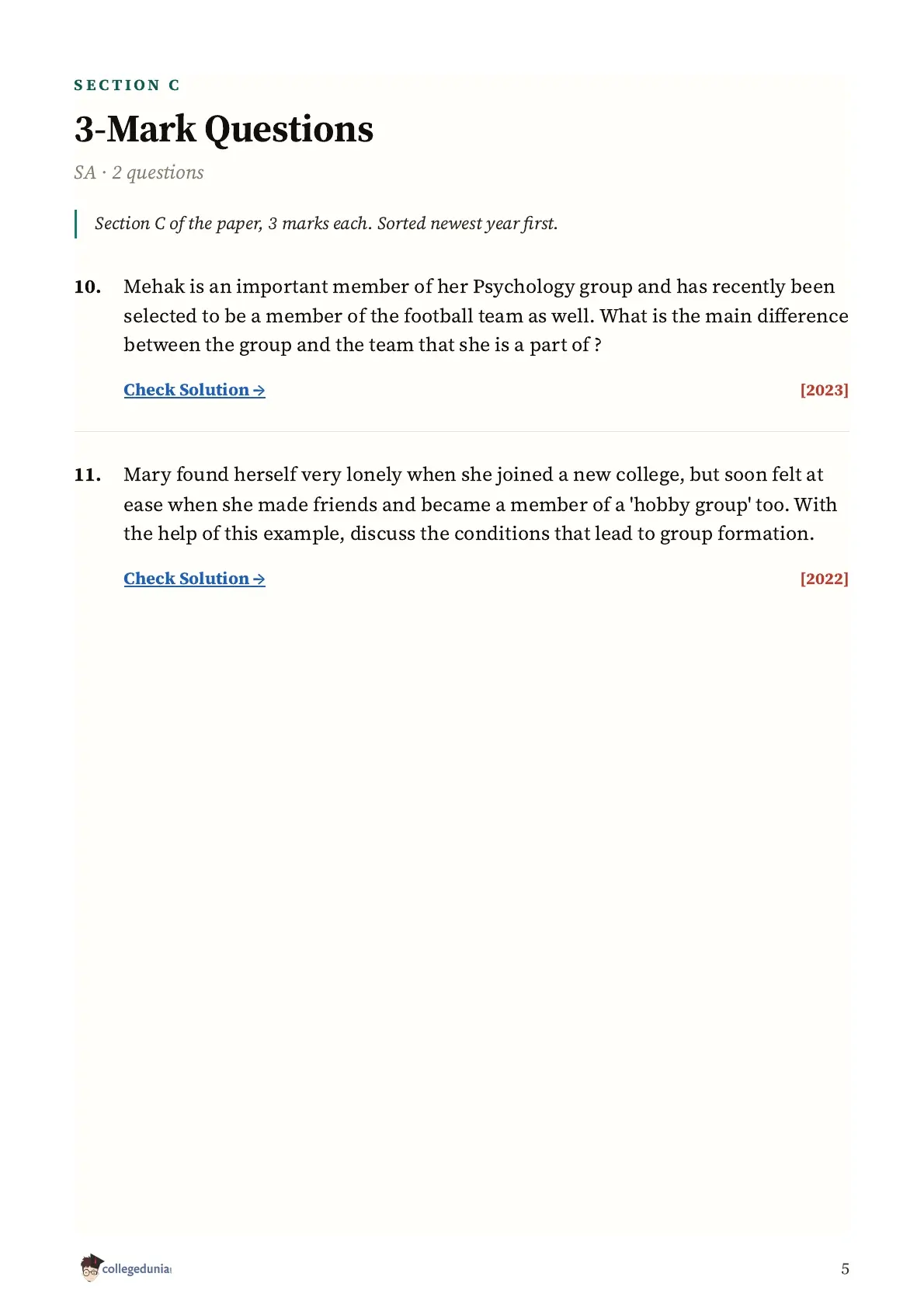
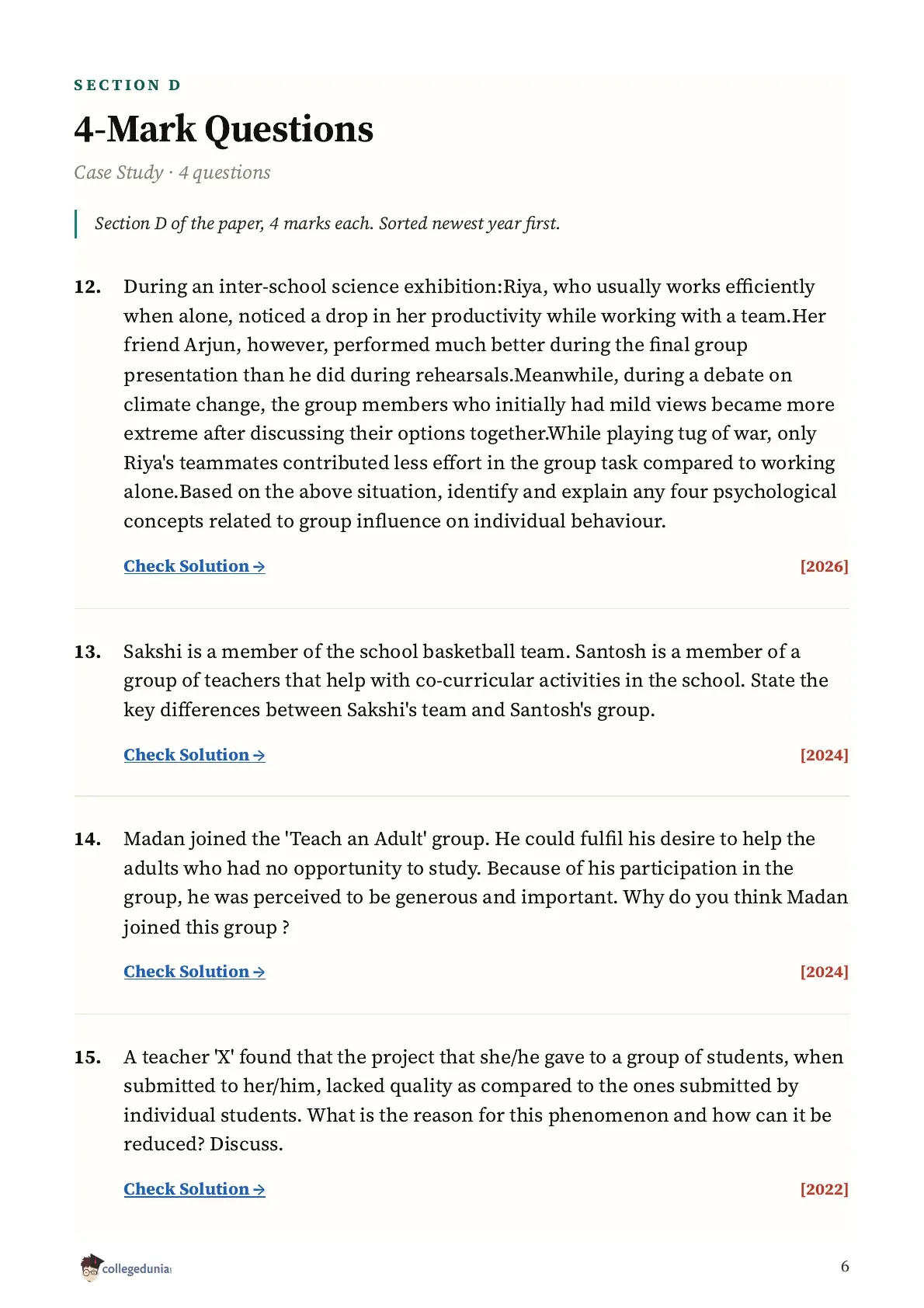
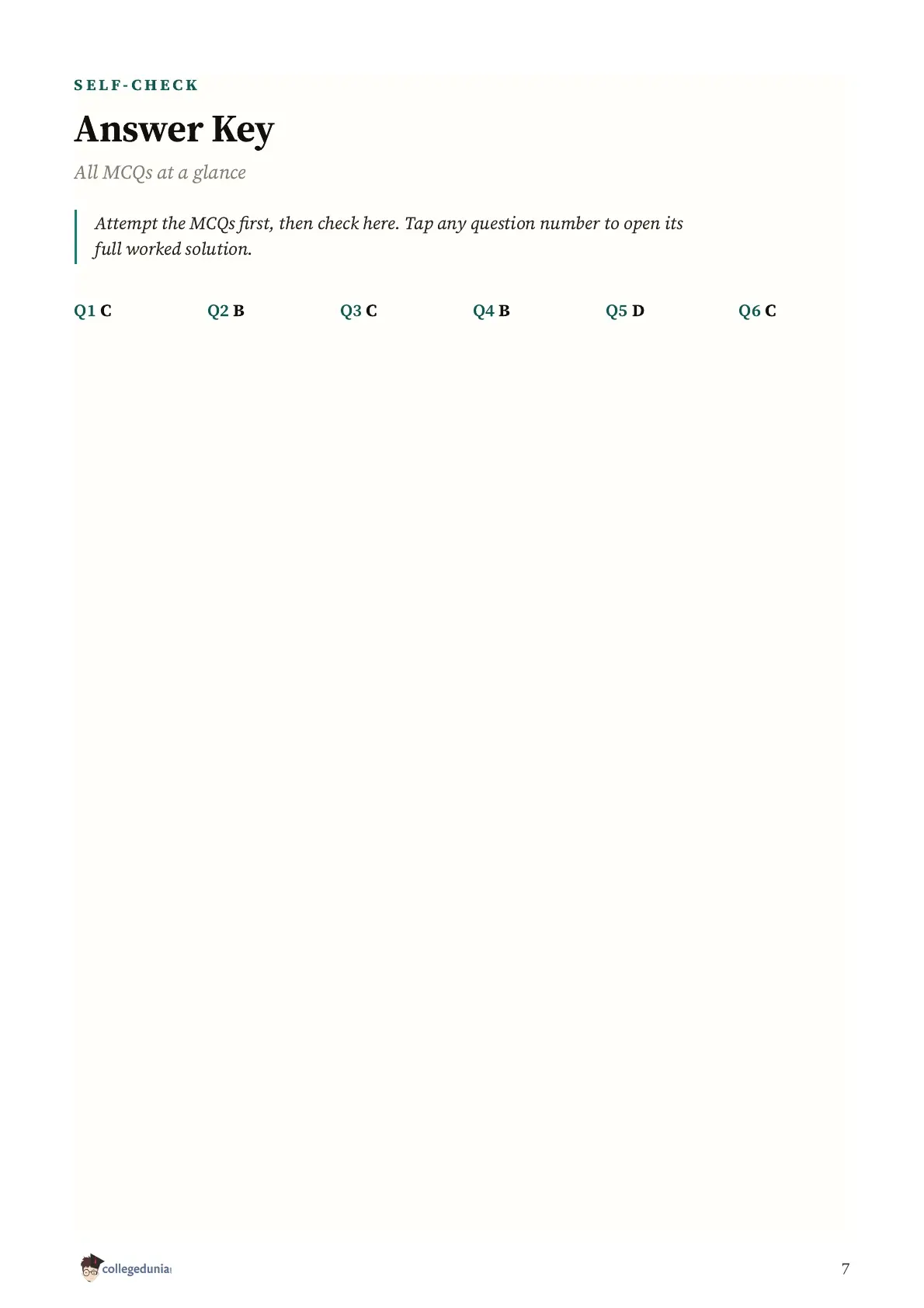
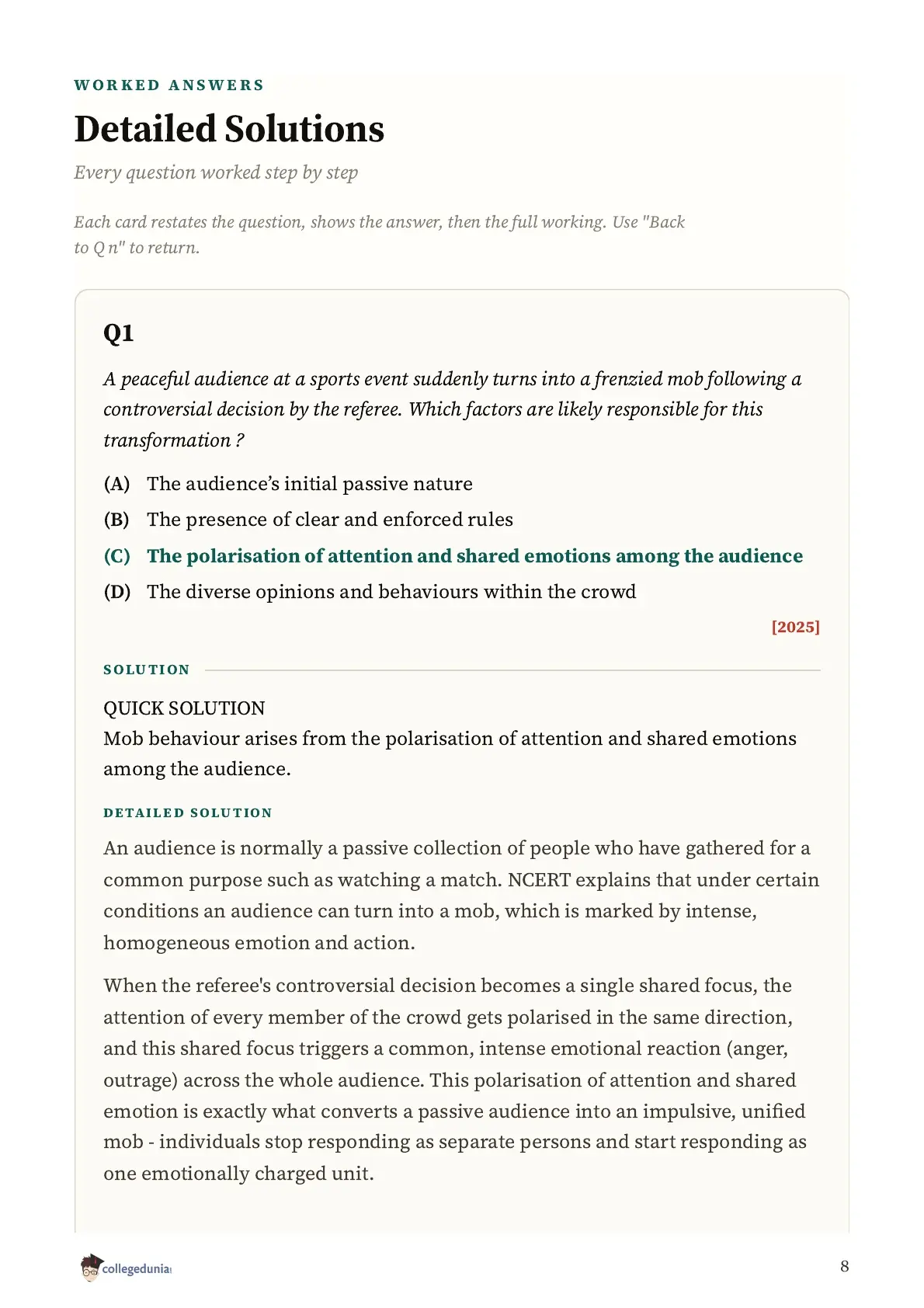
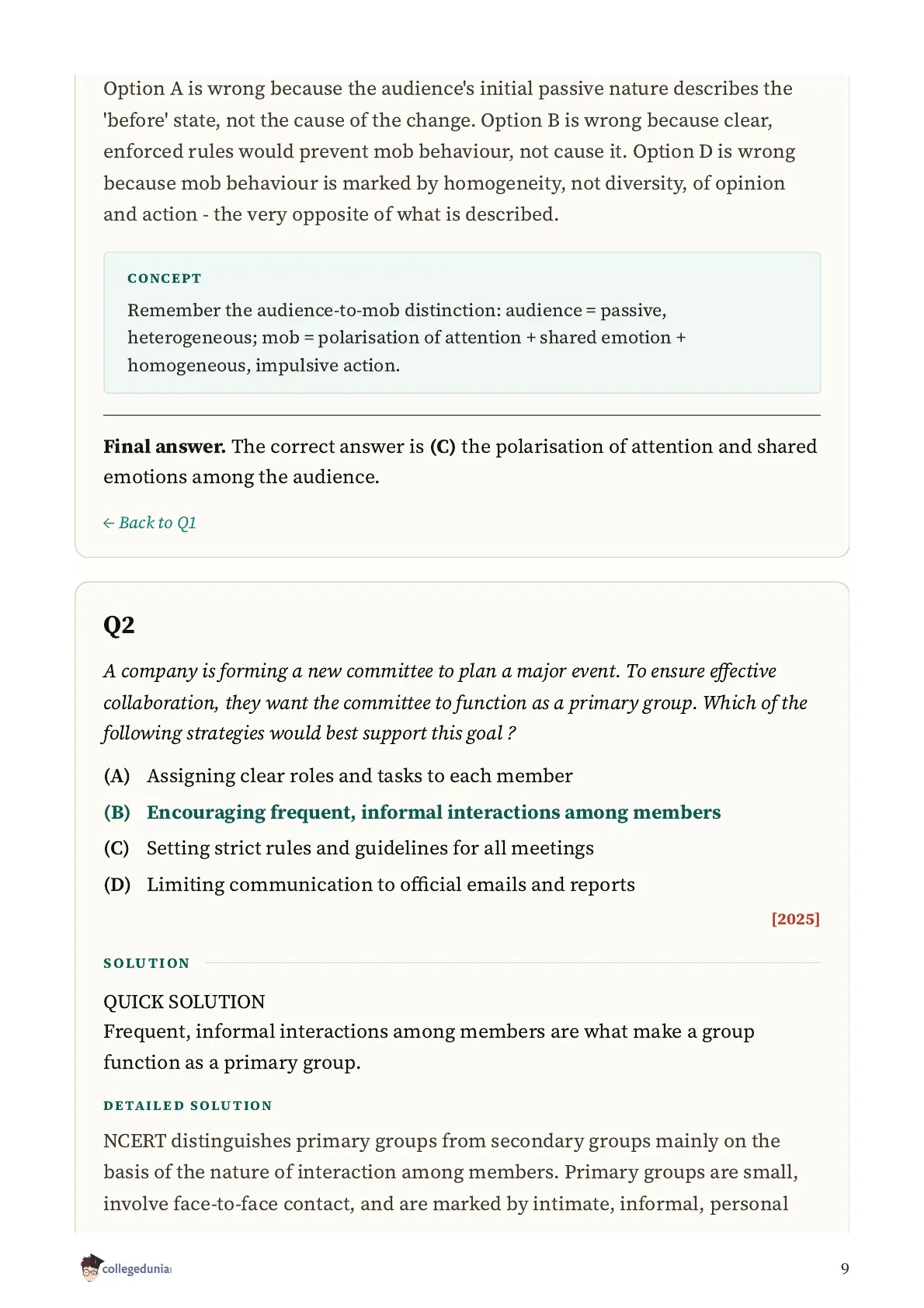
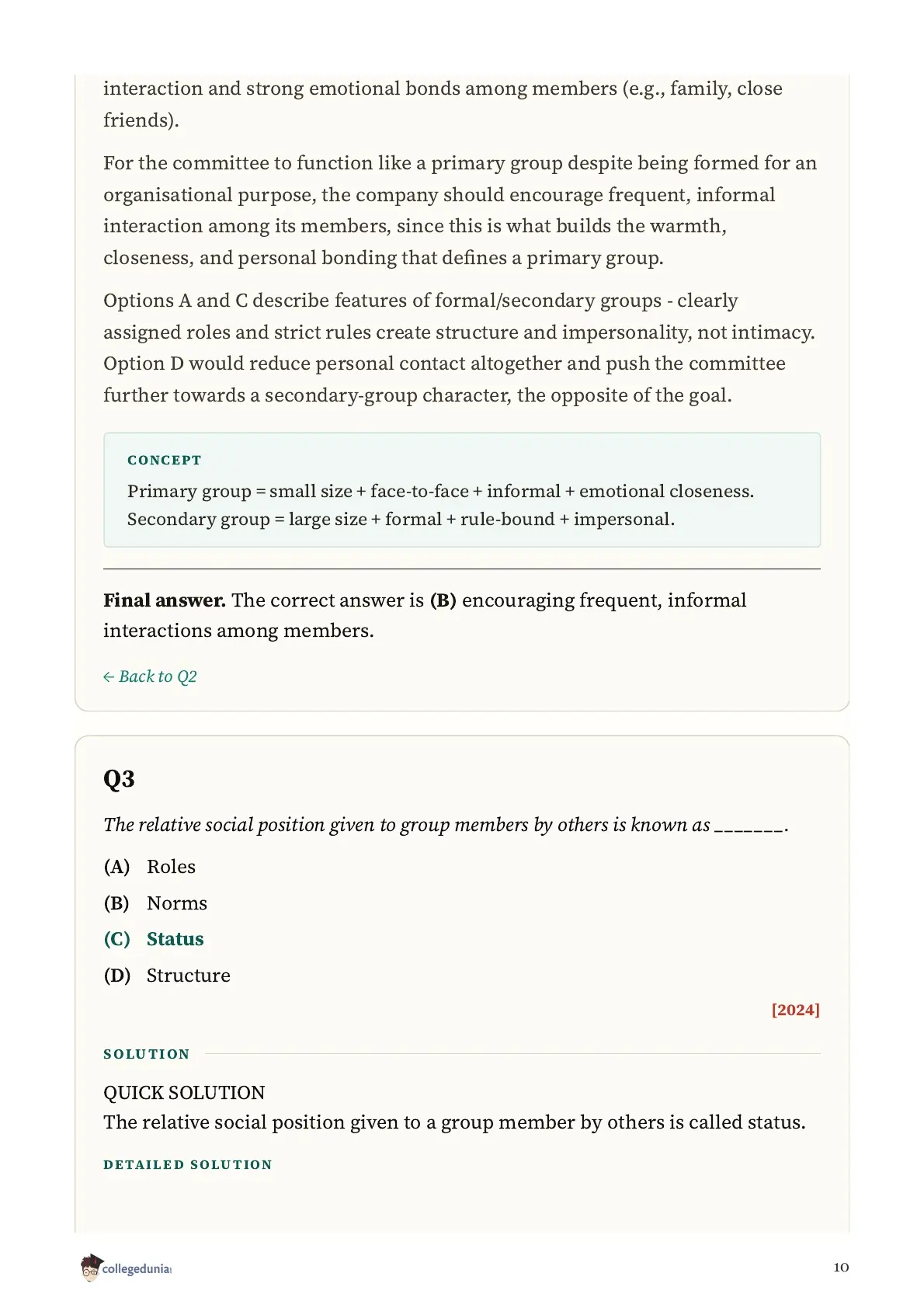
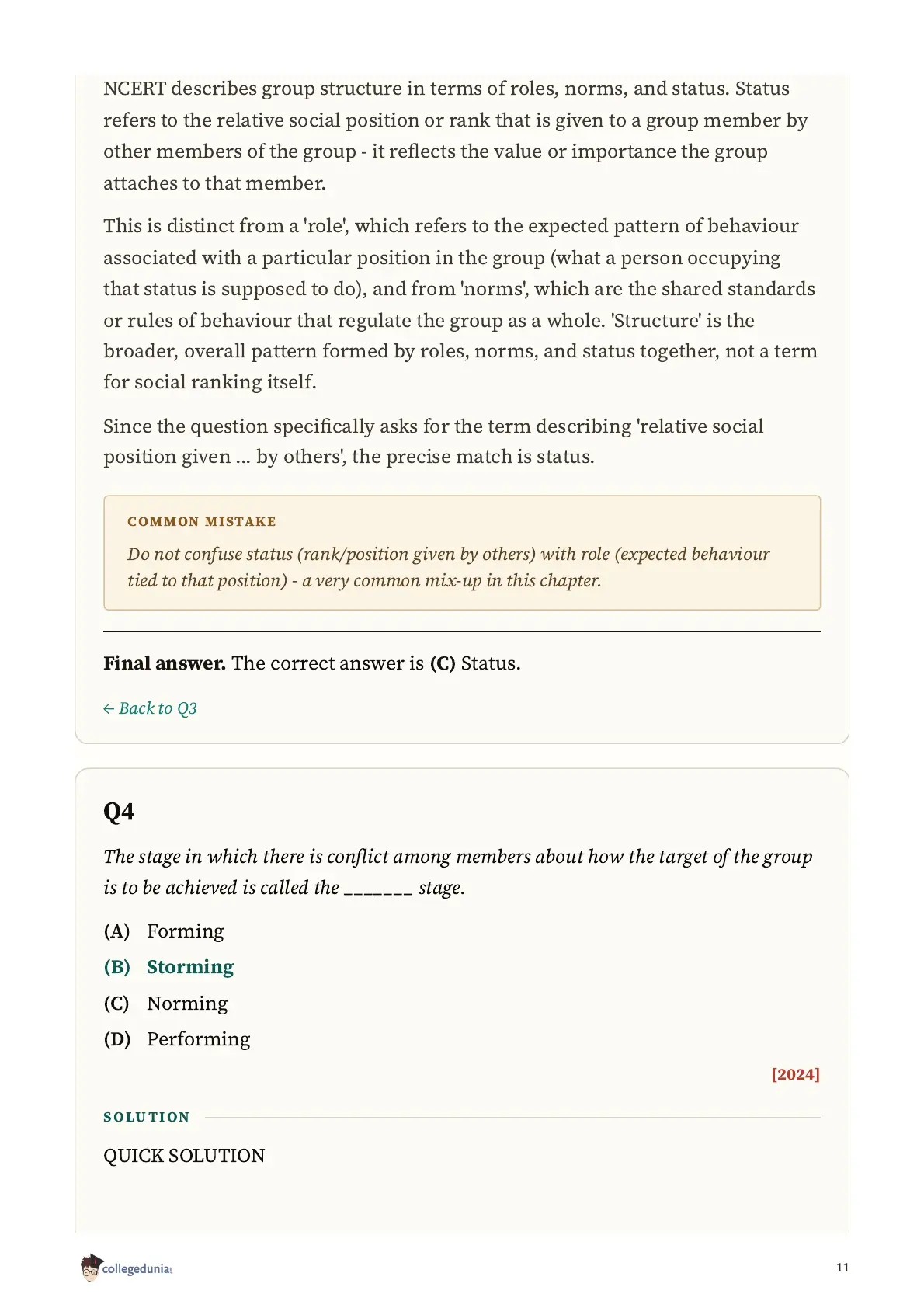
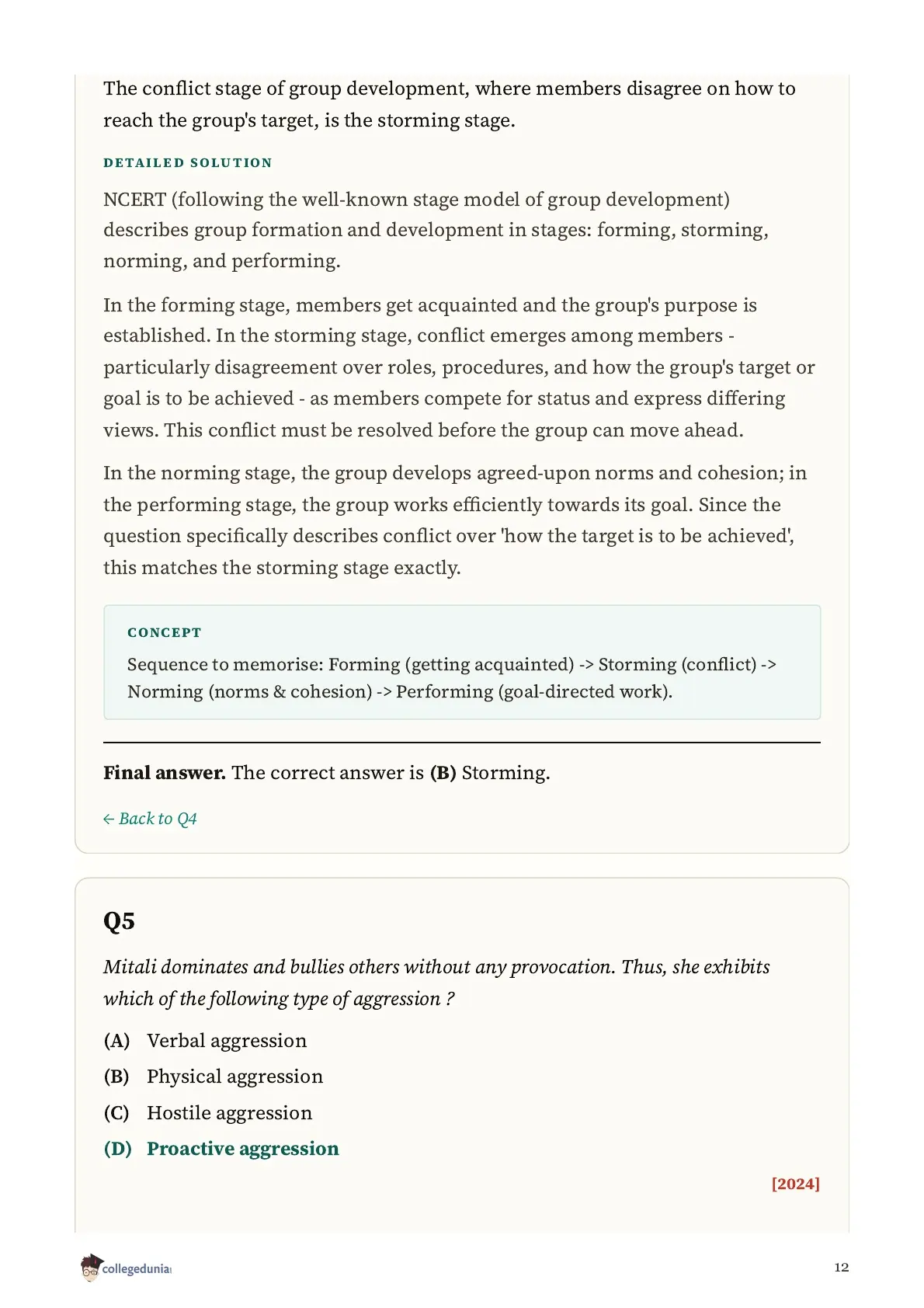
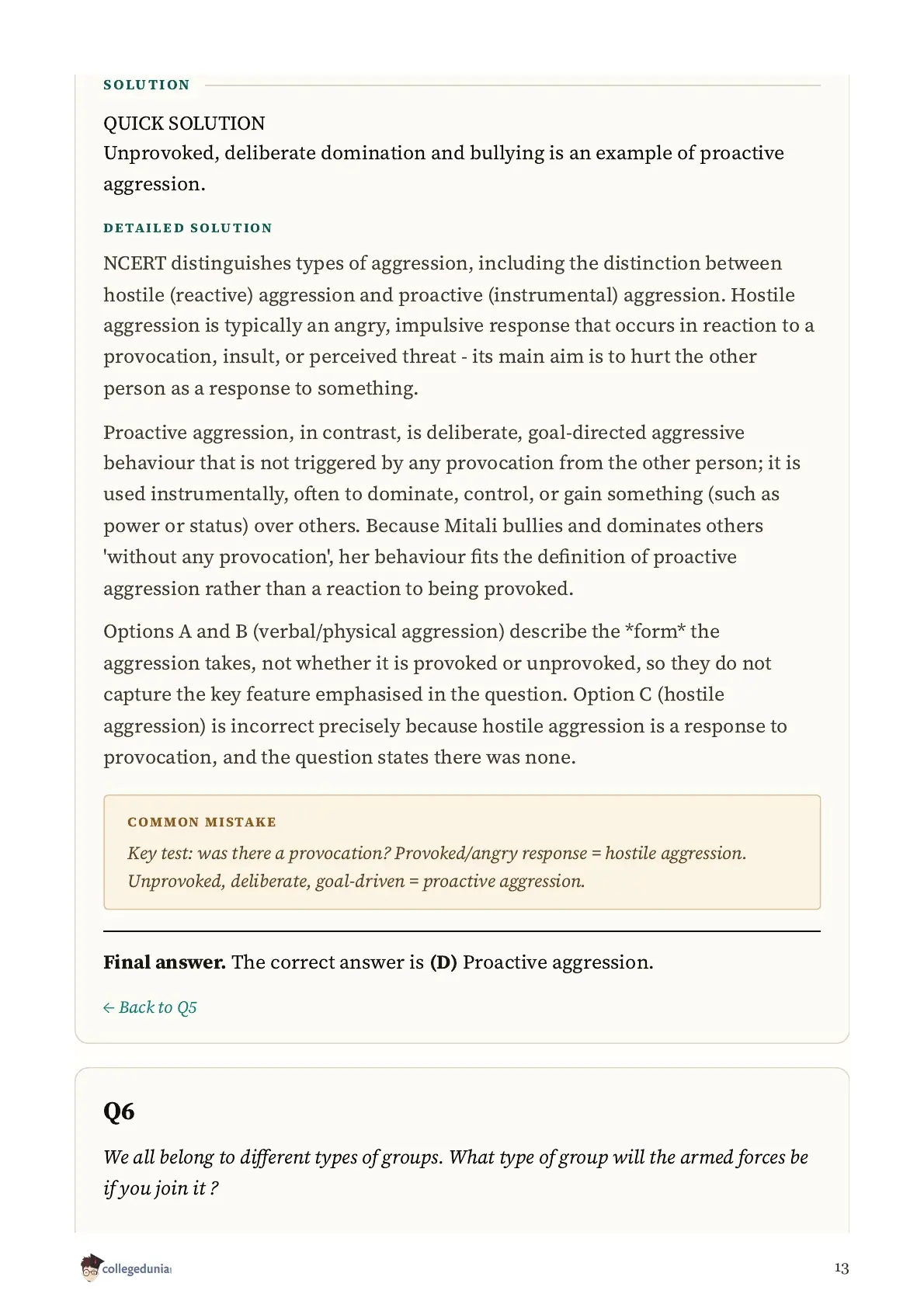
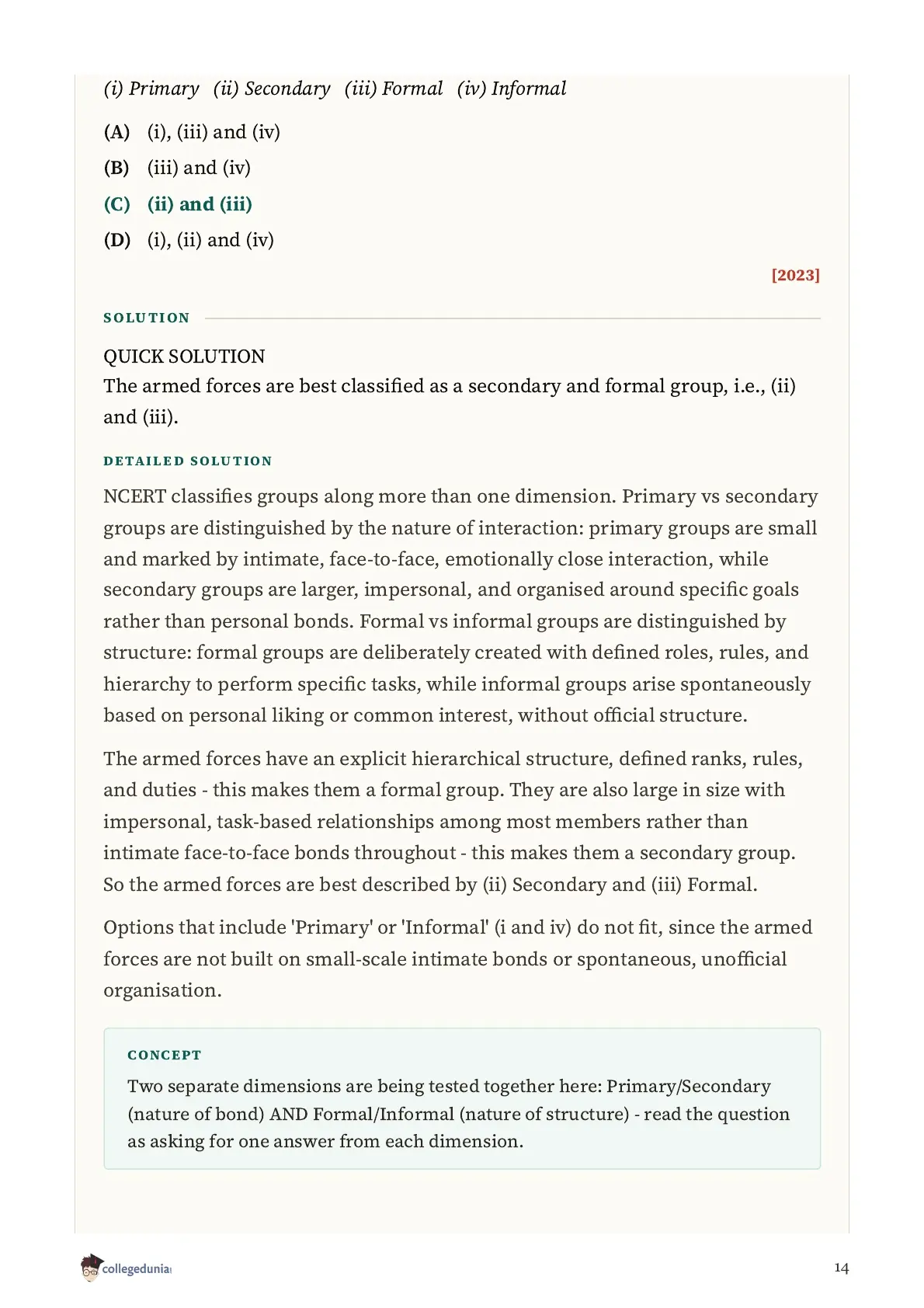
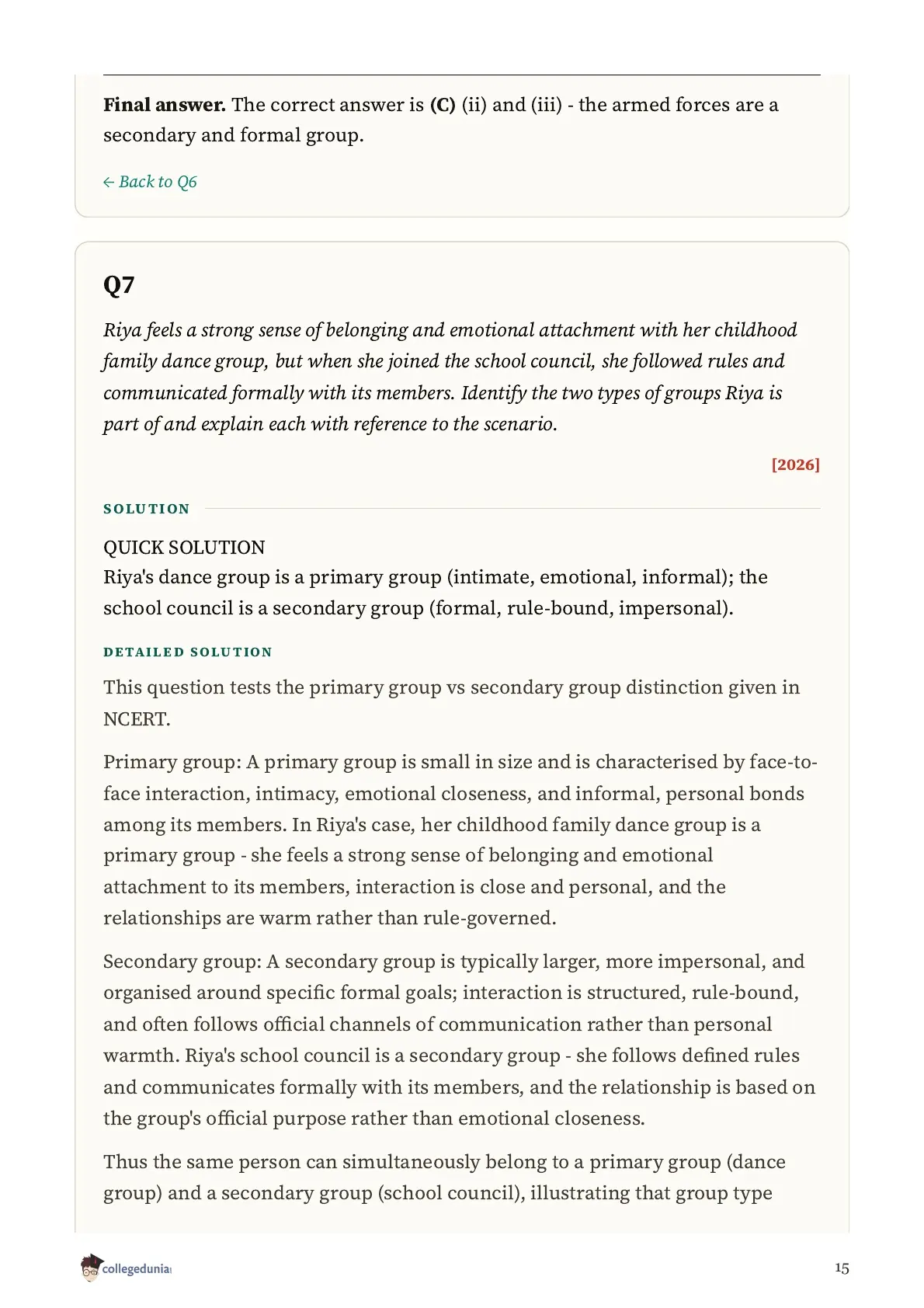
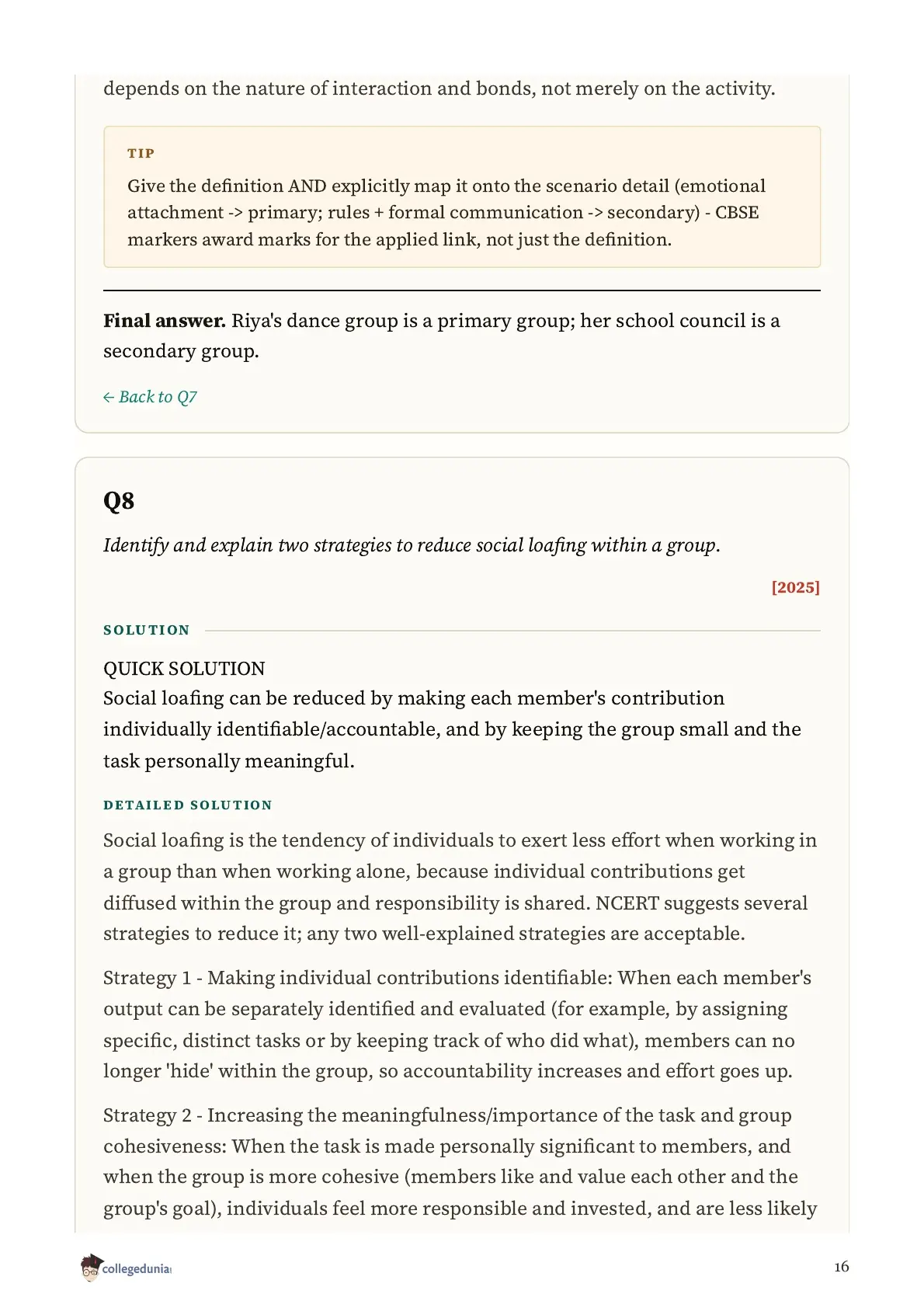
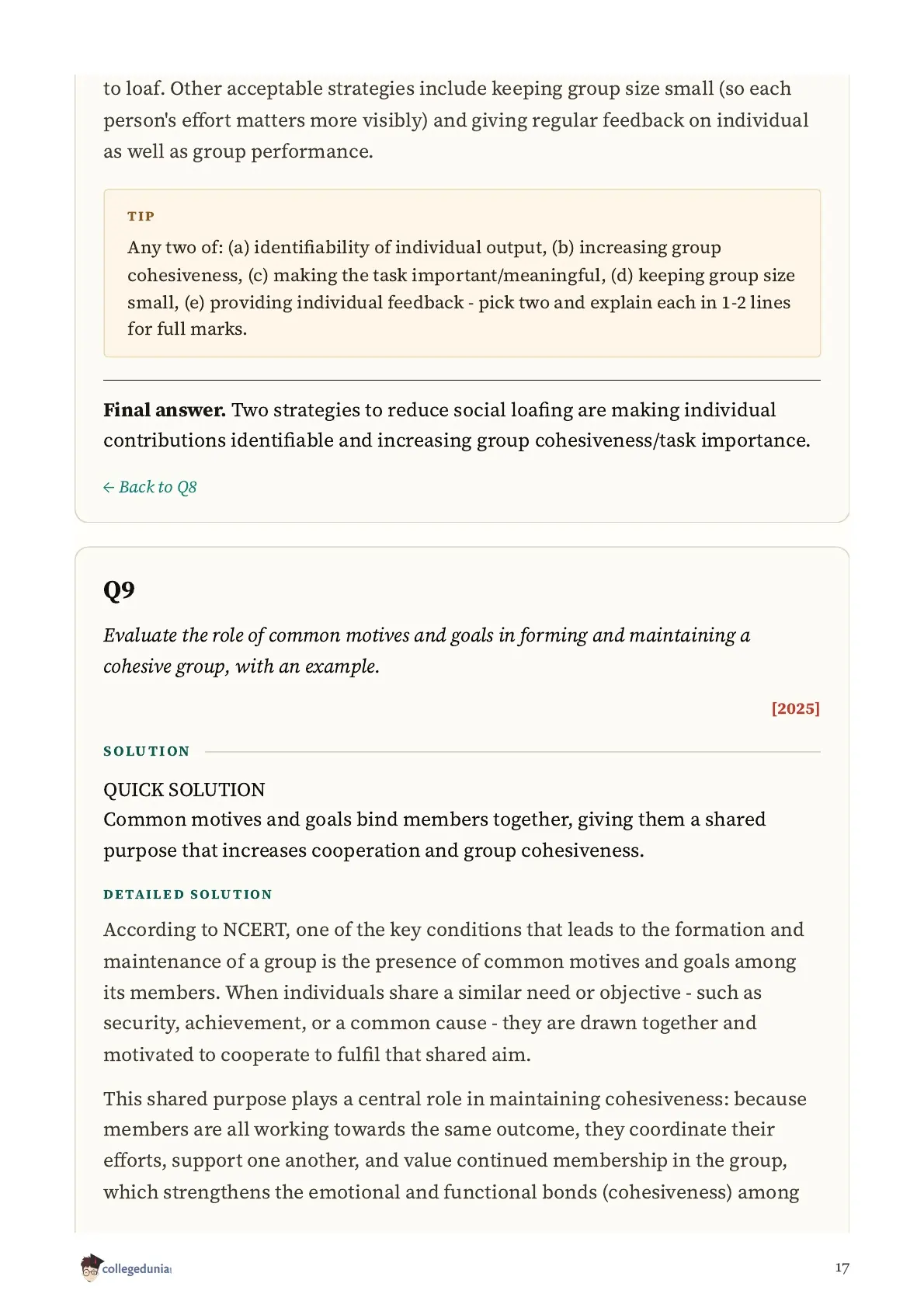
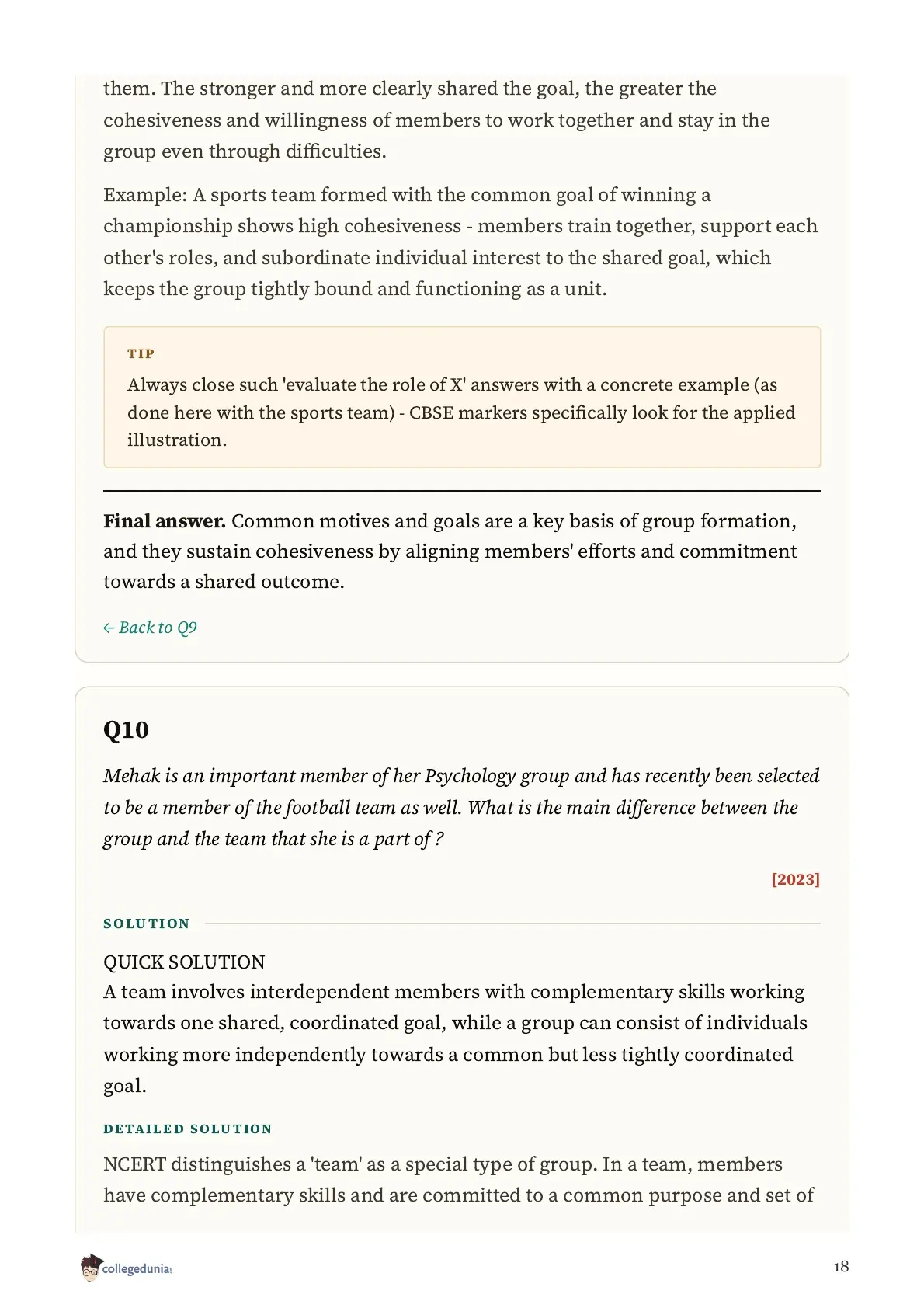
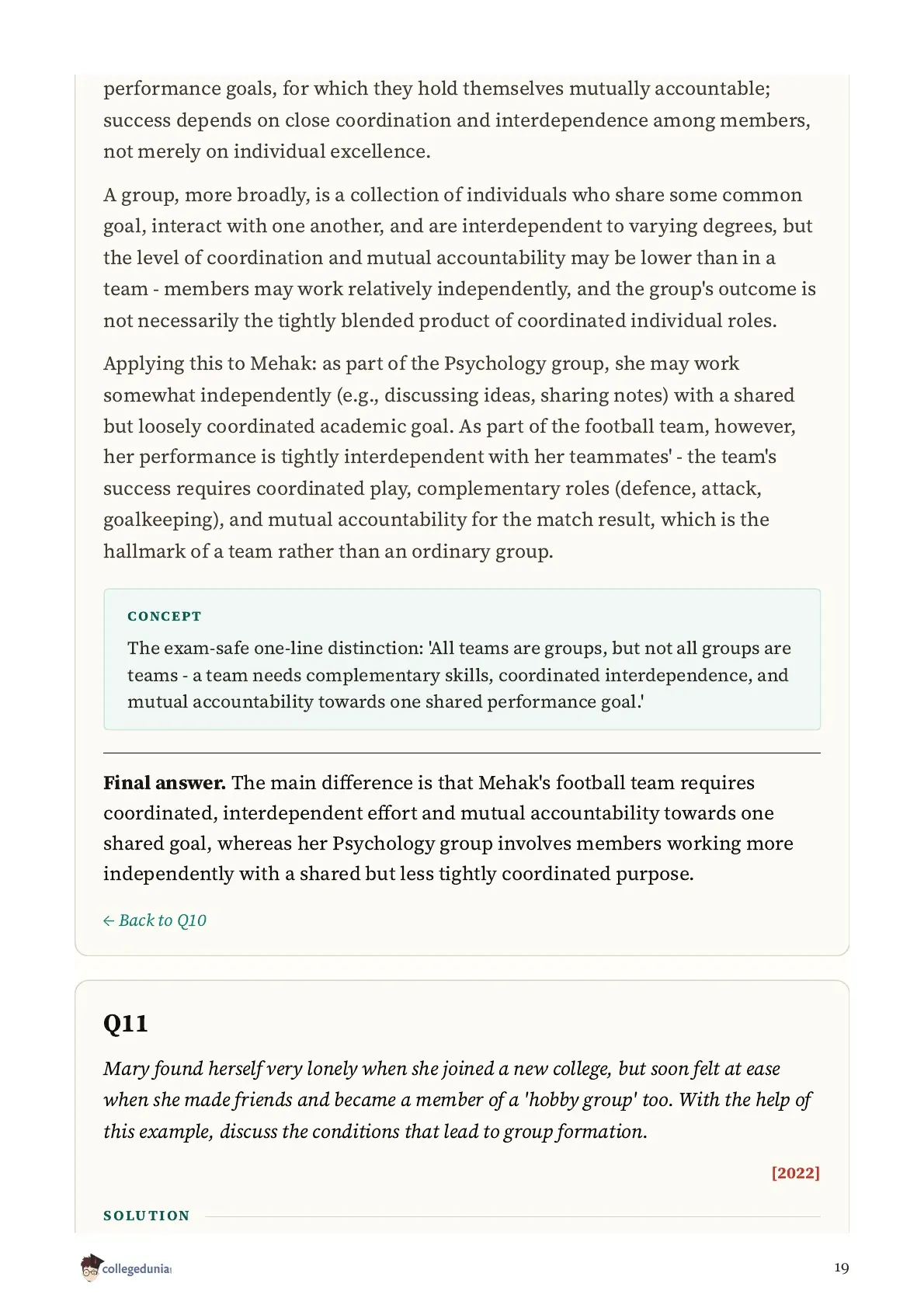
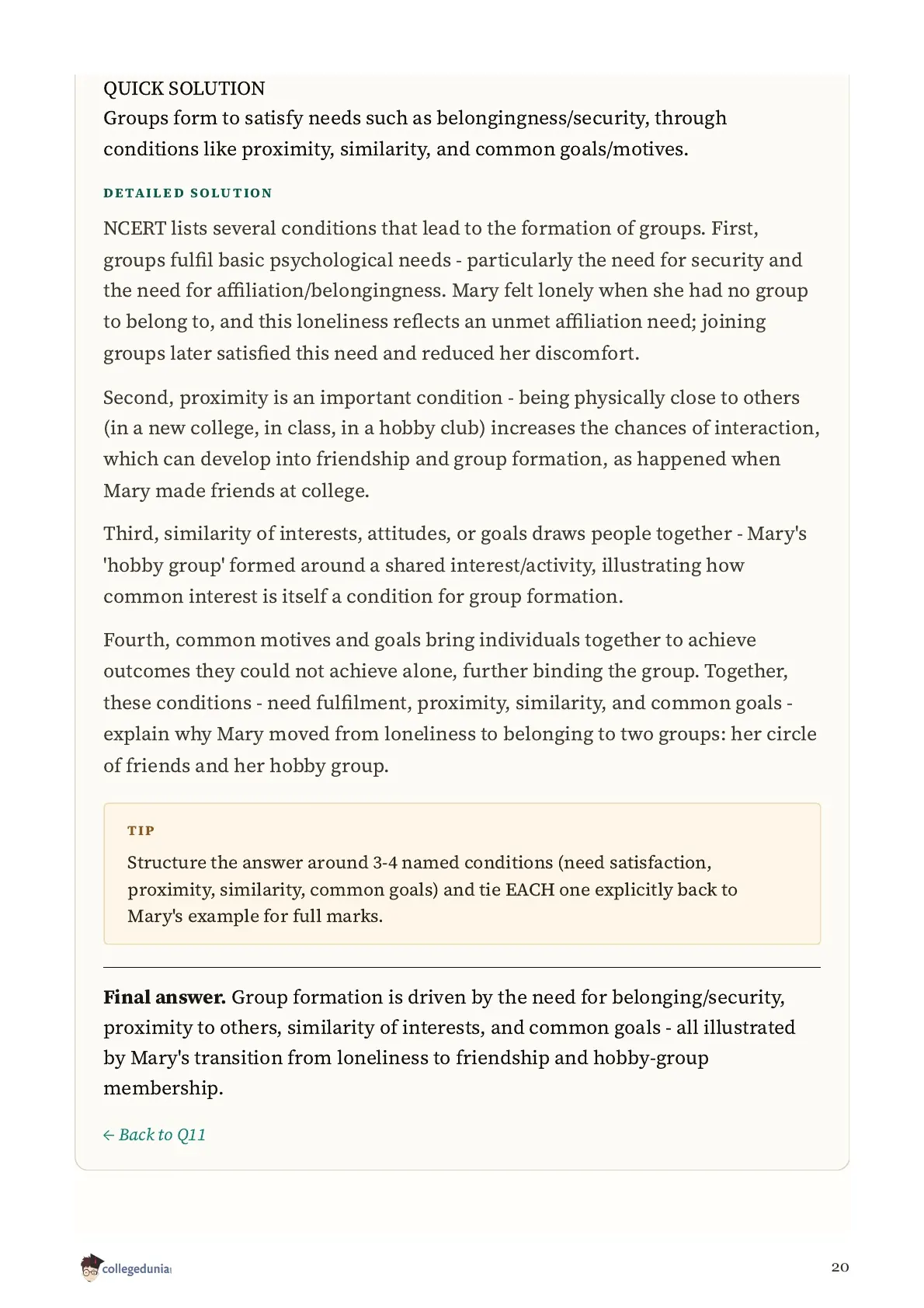
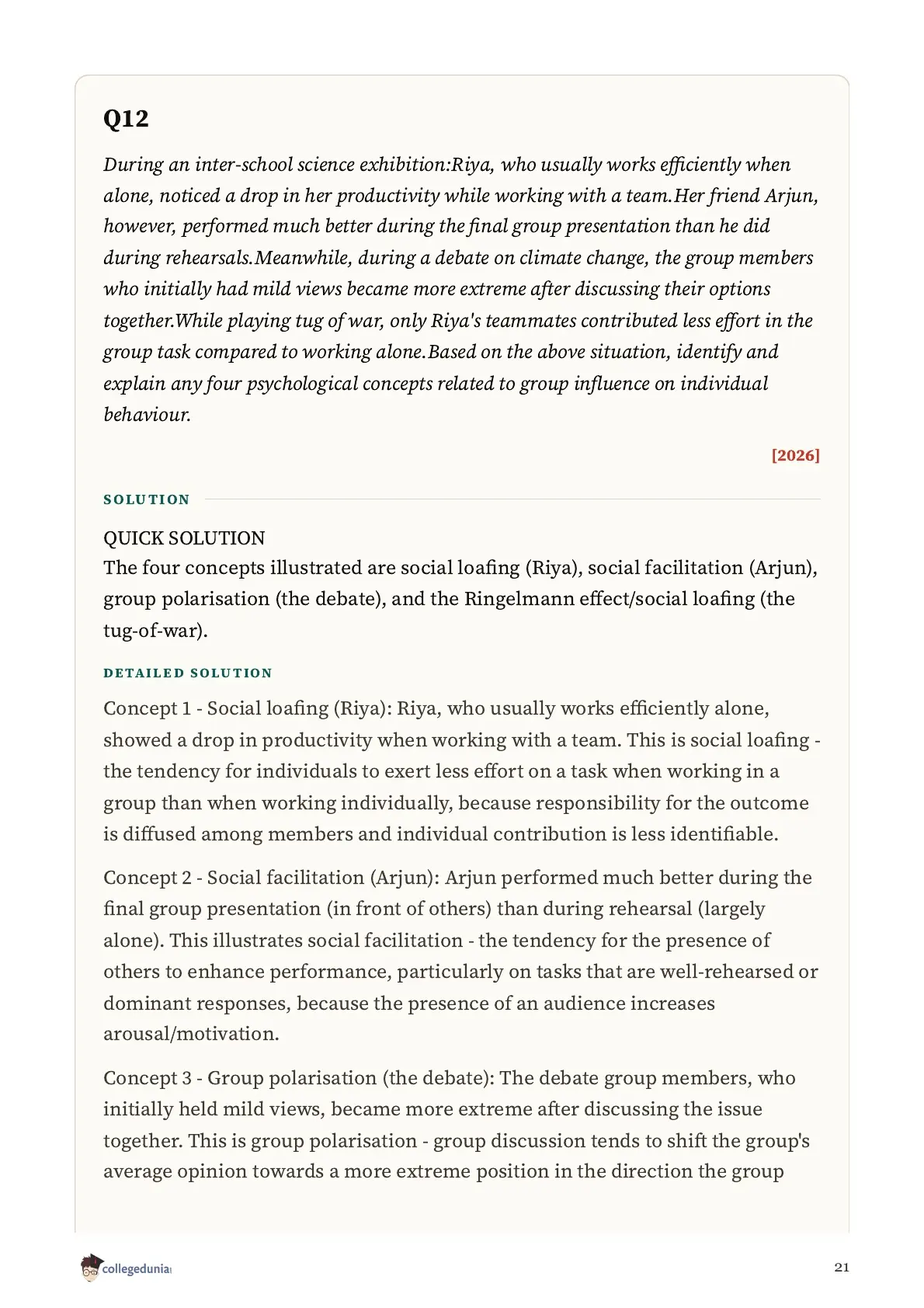
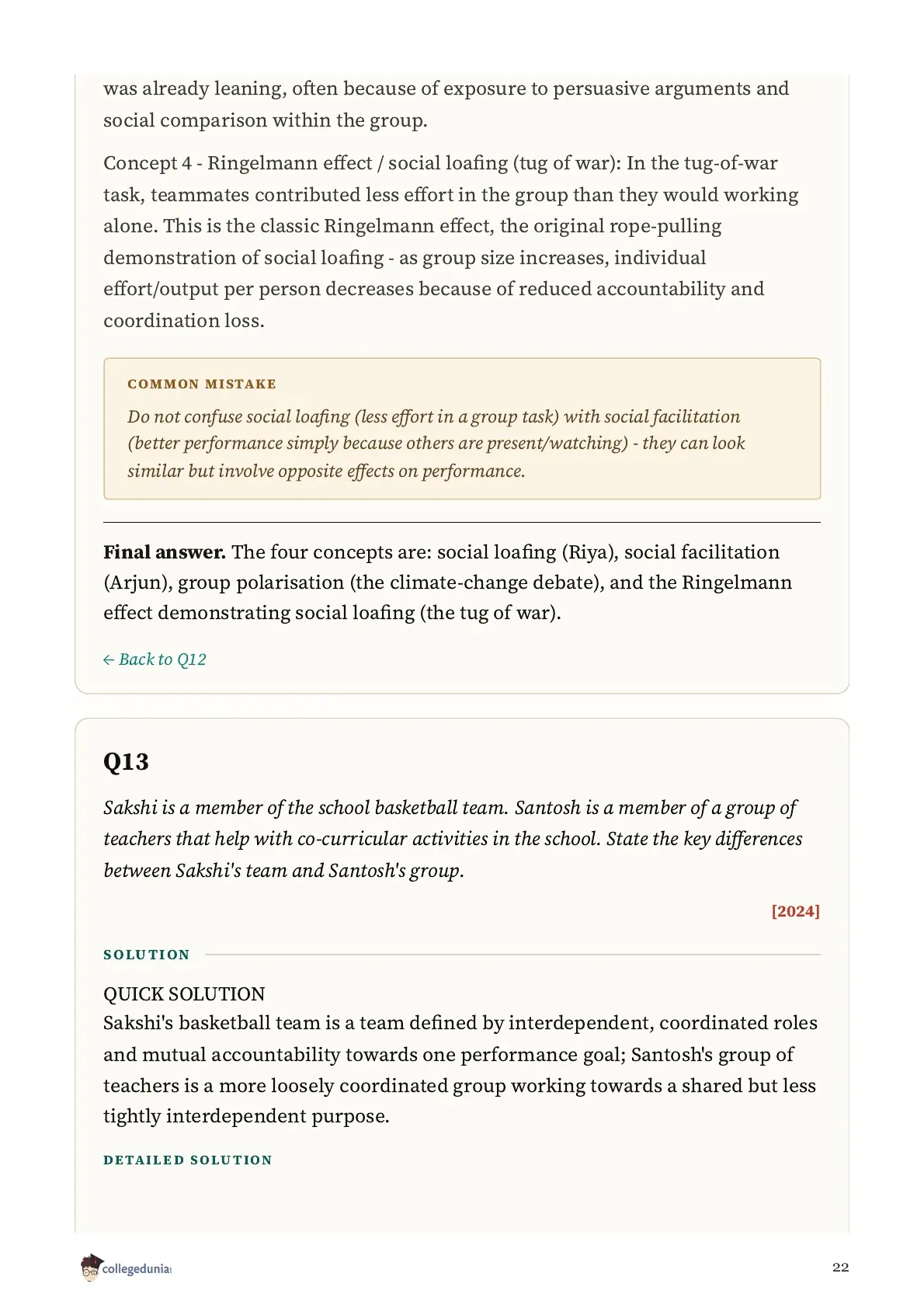
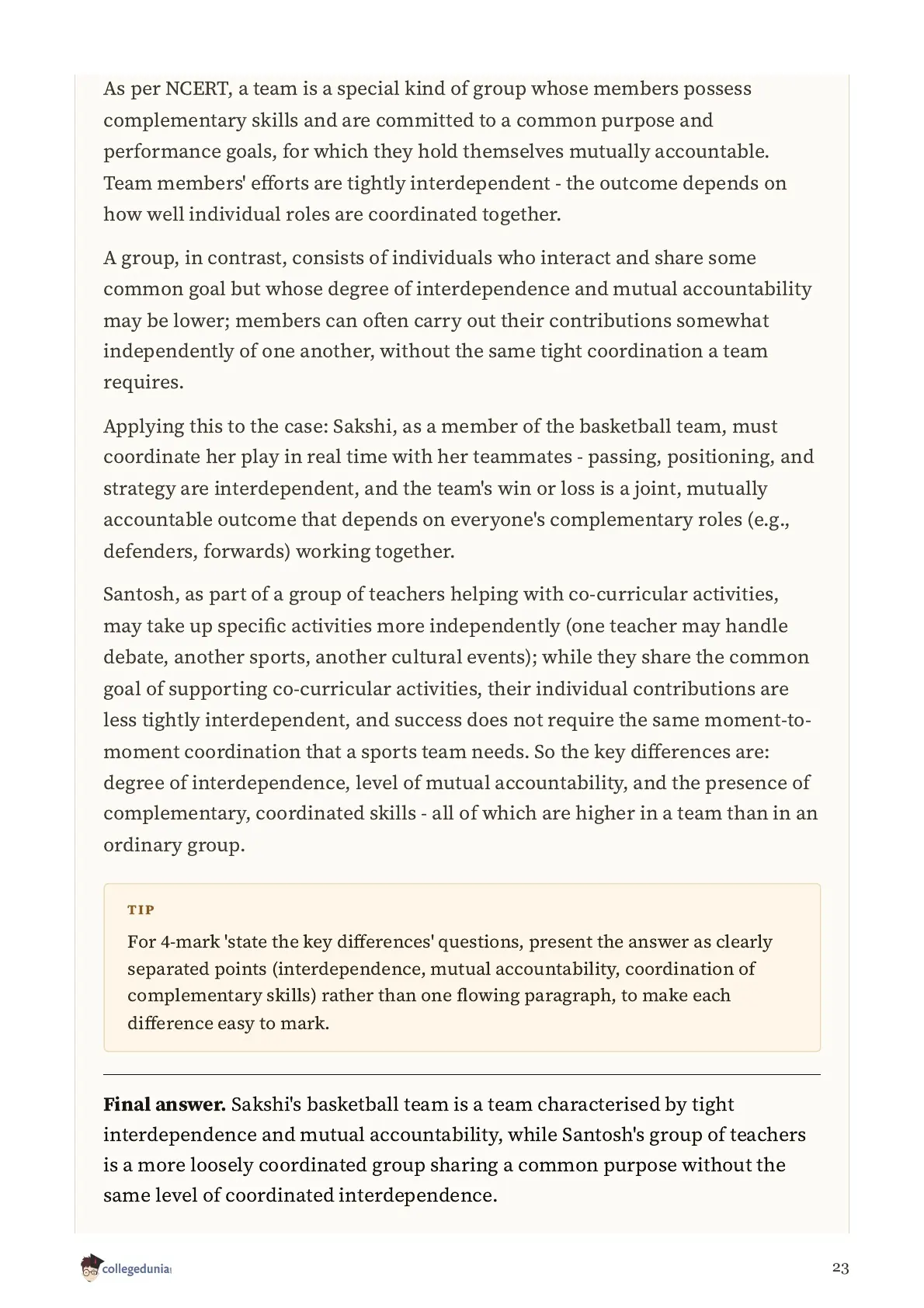
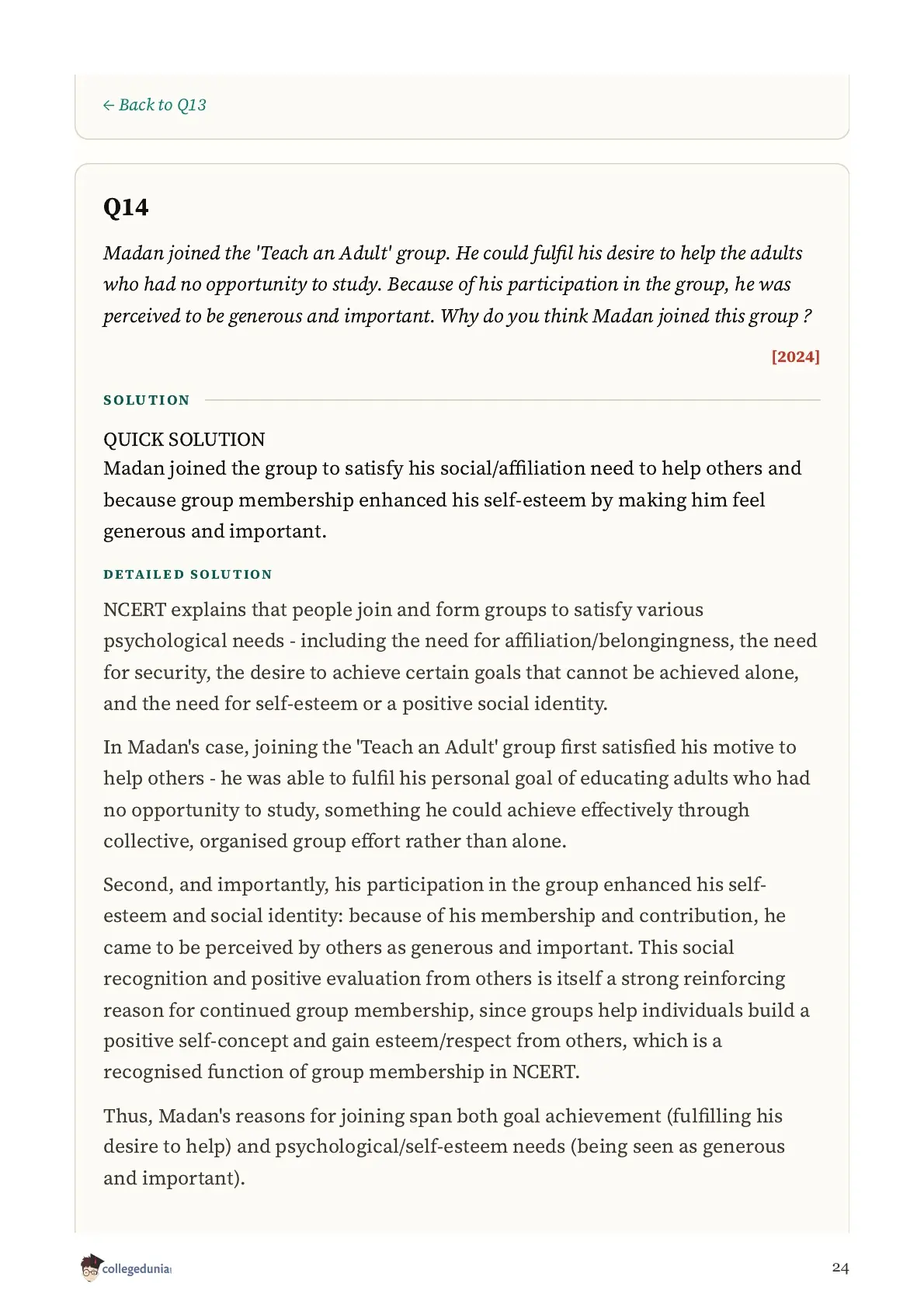
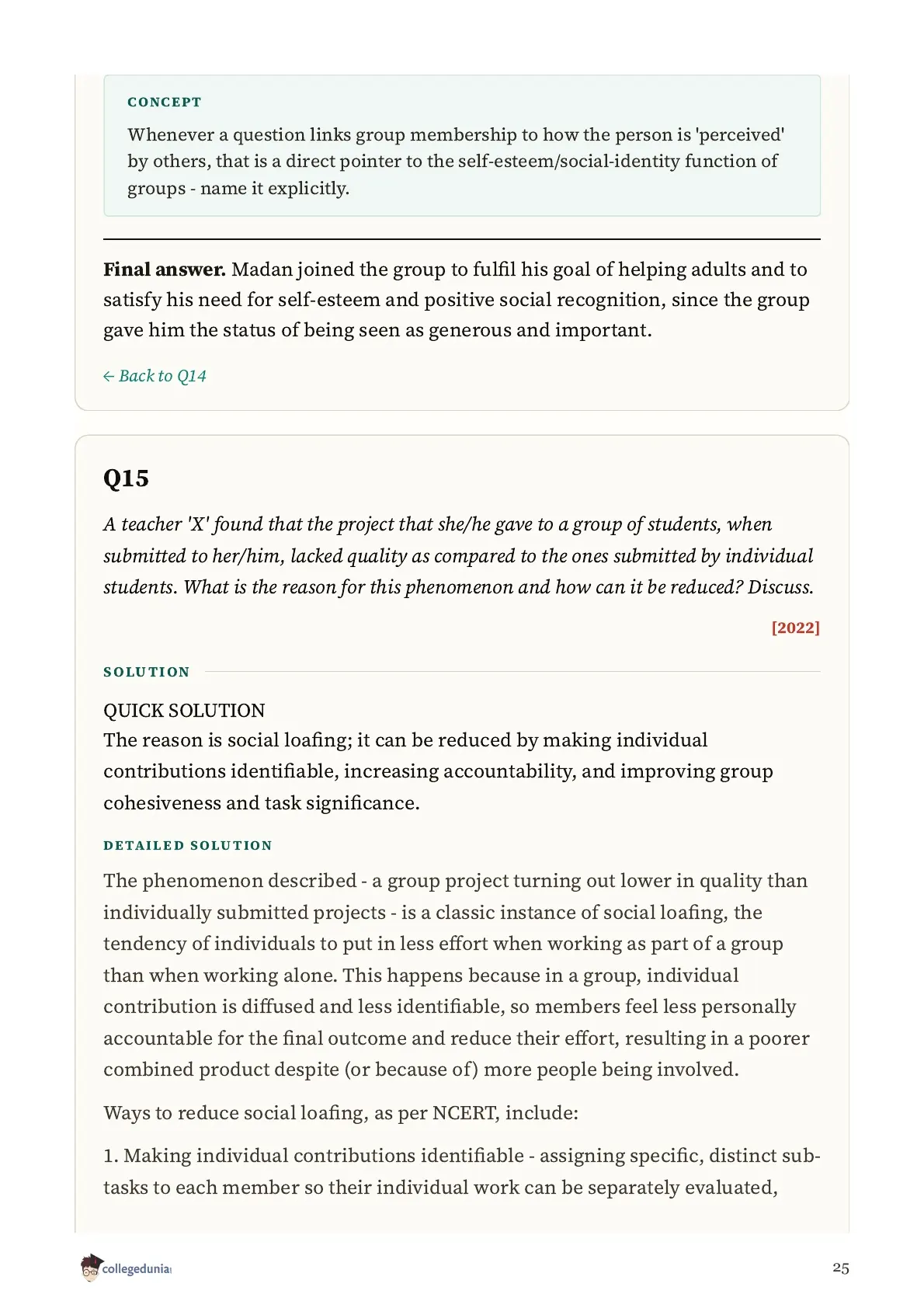
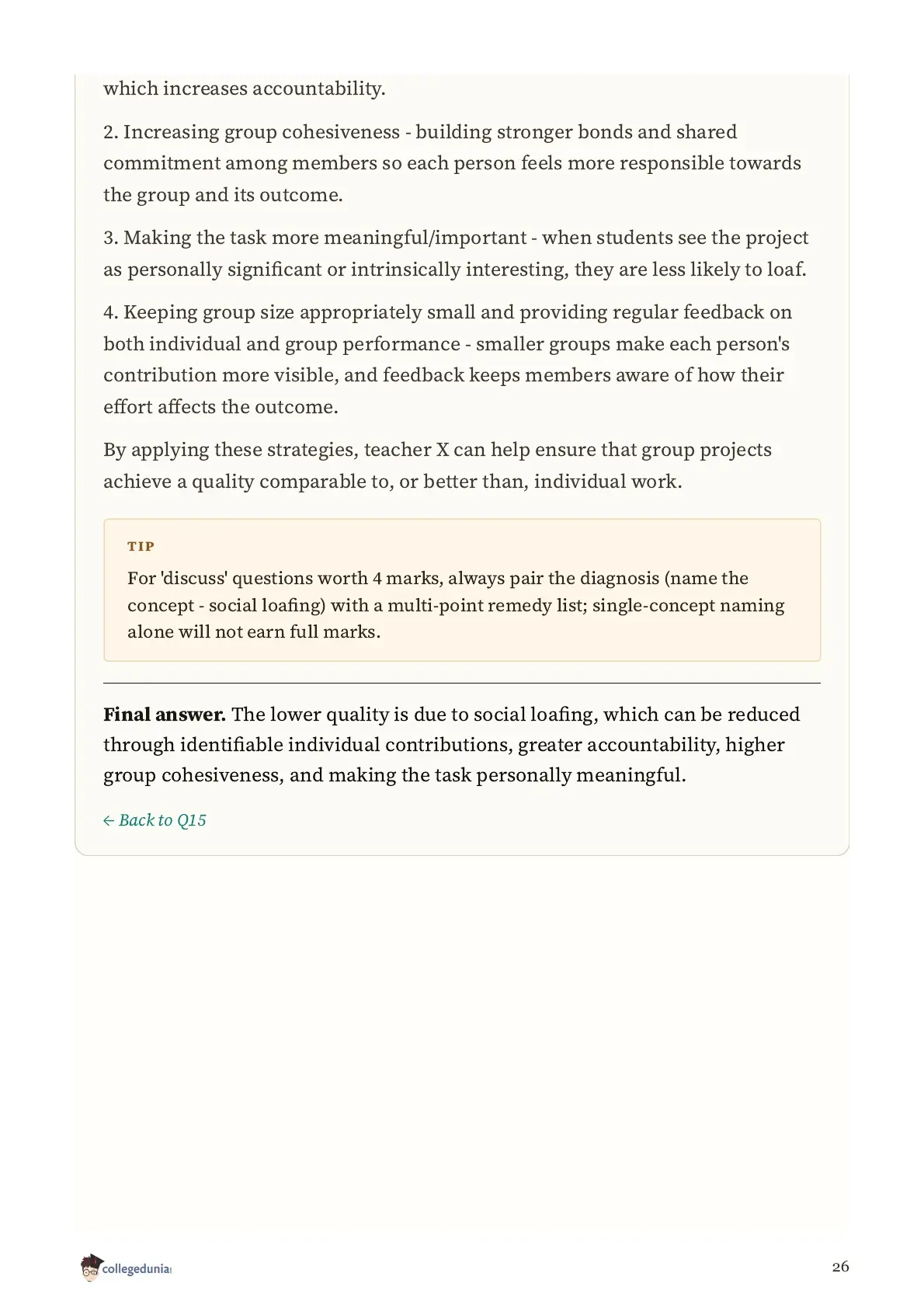
Every solution in this Social Influence and Group Processes PYQ PDF is checked question by question against the 2022 to 2026 CBSE Class 12 Psychology board papers, and according to the 2026-27 NCERT chapter.
Source: 2026-27 Class 12 Psychology student poll. Sample of 11,540 students from CBSE schools across 15 states.
What the Social Influence and Group Processes Chapter 7 PYQs Cover
The Social Influence and Group Processes PYQs test how well students can apply group concepts to a short scenario, not just recall a definition. Case-study prompts usually describe a person or a team and ask which concept explains their behaviour.
- Types and nature of groups: primary vs secondary, formal vs informal, in-group vs out-group.
- Stages of group formation: forming, storming, norming, and performing.
- Group structure: status, roles, and norms within a group.
- Group cohesiveness and the role of common motives and goals.
- Social loafing and strategies teachers and group leaders use to reduce it.
- Social facilitation, group polarisation, and the difference between a group and a team.
Social Influence and Group Processes Full Chapter Explained
Source: Magnet Brains on YouTube
Marks-wise Distribution of the Social Influence and Group Processes PYQs
Like every Class 12 Psychology chapter, the CBSE paper spreads Social Influence and Group Processes questions across four sections. This PDF's 15 questions follow that same pattern.
| Section | Marks Each | Questions in This PDF | Typical Format |
|---|---|---|---|
| Section A | 1 mark | 6 | MCQ |
| Section B | 2 marks | 3 | Very Short Answer (VSA) |
| Section C | 3 marks | 2 | Short Answer (SA) |
| Section D | 4 marks | 4 | Case-Study based |
Section A carries the most questions but the fewest total marks, so most students clear it fastest. Section D carries fewer questions but adds up to 16 of the 34 total marks in this set, since a case study usually asks students to name several group-influence concepts inside one story.
Year-wise Spread of the Social Influence and Group Processes Board Questions (2022-2026)
This PDF pulls from five back-to-back CBSE cycles, so students can see how many questions each year contributed and which sections they came from.
| Year | Questions in This PDF | Sections Represented |
|---|---|---|
| 2022 | 2 | Section C, Section D |
| 2023 | 2 | Section A, Section C |
| 2024 | 5 | Section A, Section D |
| 2025 | 4 | Section A, Section B |
| 2026 | 2 | Section B, Section D |
Every one of the five most recent CBSE cycles is represented in this compilation, with 2024 contributing the most questions. Students can see how the same idea, say social loafing or group formation, has been asked in slightly different ways over the years.
Topic Frequency in the Social Influence and Group Processes Board Questions
Not every topic in the chapter gets asked with equal weight. Based on the 15 questions in this PDF, social loafing and the basic types of groups come up most often, usually inside a short scenario about a student, a team, or a committee.
| Topic Cluster | How Often It Appears | Typical Section |
|---|---|---|
| Social loafing and ways to reduce it | Most frequent | B, D |
| Types and nature of groups (primary/secondary, formal/informal) | Most frequent | A, B |
| Group polarisation and crowd/mob behaviour | Frequent | A, D |
| Group vs team, and stages or conditions of group formation | Frequent | A, C, D |
| Cohesiveness, social facilitation, and reasons for joining a group | Occasional | B, D |
Marks-Band Attempt Strategy for the Social Influence and Group Processes Chapter
A clear order of attempt saves time in the actual CBSE Class 12 Psychology paper. Most students should not start with Section D.
- Start with Section A: clear the six one-mark MCQs first; they need recall, not writing.
- Move to Section B: the 2-mark VSA rewards a crisp two-line answer, not a paragraph.
- Then Section C: for 3-mark SA, name the concept first, then explain it with one example.
- Finish with Section D: read the case study twice, underline every separate behaviour described, and match each one to a named concept before writing.
Common Mistakes Students Make on the Social Influence and Group Processes Questions
- Confusing social loafing with social facilitation, when a case study names two people showing opposite effects.
- Using "group" and "team" interchangeably, when Section C and D specifically ask for the difference between them.
- Describing a scenario without naming the exact type of group (primary/secondary, formal/informal) the question is asking for.
- Not naming the group-formation stage (forming, storming, norming, performing) explicitly, and only describing what is happening.
- In four-mark case studies, explaining only two or three concepts instead of the four the question asks for.
Conformity, Compliance, and Obedience: Asch and Milgram in the Syllabus
The full NCERT chapter also covers how individuals change their behaviour because of others, even outside the group-formation topics tested in this PDF's 15 questions. These three terms sound similar but describe different kinds of social influence.
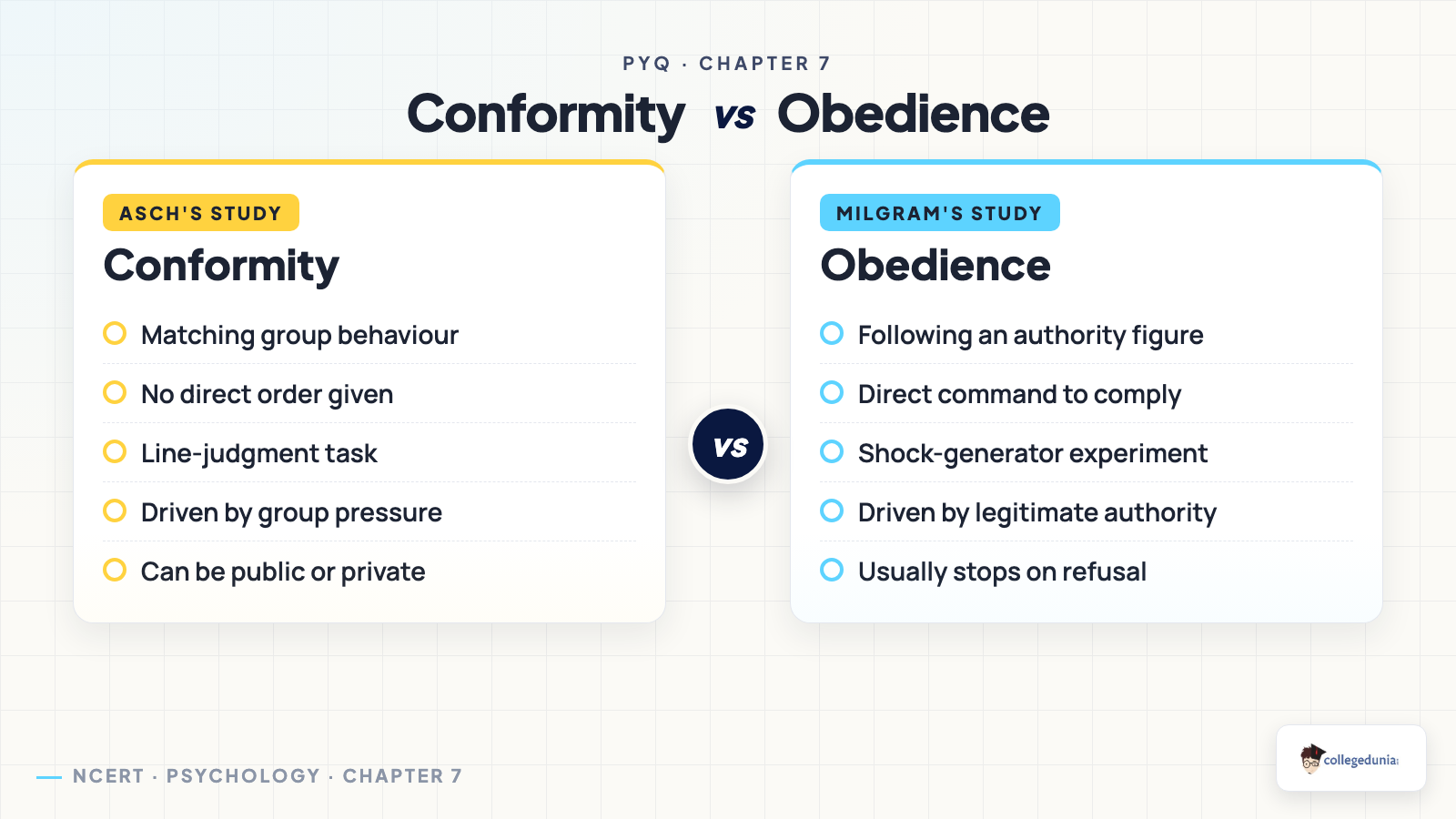
Conformity is changing behaviour to match a group, shown in Solomon Asch's line-judgment experiment where participants agreed with an obviously wrong group answer. Obedience is following a direct order from an authority figure, shown in Stanley Milgram's experiment where participants kept giving what they believed were electric shocks because an experimenter told them to continue.
- Conformity: changing behaviour to match group norms, even without a direct request.
- Compliance: agreeing to a direct request from another person or group.
- Obedience: following an order from someone seen as an authority figure.
Group Phenomena Class 12 Students Must Tell Apart: Loafing, Polarisation, and Groupthink
Three group phenomena get confused most often because they all describe how being in a group changes individual behaviour. Social loafing, group polarisation, and groupthink are separate ideas, and this chapter's questions often test whether students can tell them apart.
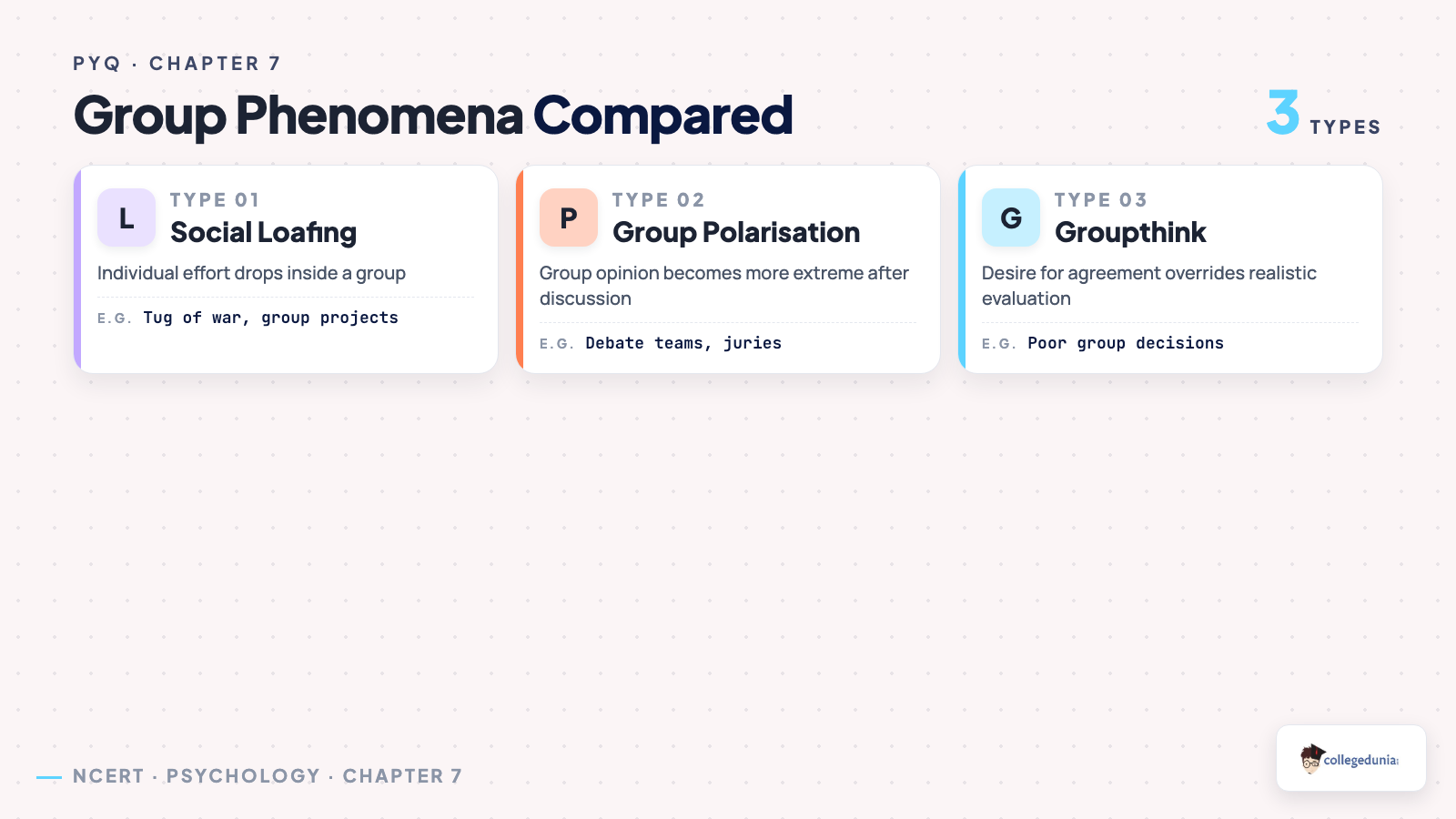
- Social loafing: a person puts in less individual effort when working in a group than when working alone.
- Group polarisation: a group's initial opinion becomes more extreme after group discussion.
- Groupthink: a group's desire for agreement leads it to make a poor decision without weighing alternatives properly.
How These PYQs Pair with Other Chapter 7 Resources
This PDF works best alongside the other Class 12 Psychology Chapter 7 resources on Collegedunia. Use the PYQ PDF to practise recall and timing after the concepts are already clear from the notes.
| Resource | Best Used For | Link |
|---|---|---|
| NCERT Notes | First read of every concept, definition, and example | Social Influence and Group Processes Class 12 Notes |
| NCERT Solutions | Textbook exercise questions, answered in full | Social Influence and Group Processes Class 12 NCERT Solutions |
| Handwritten Notes | Quick one-shot revision the night before the exam | Social Influence and Group Processes Handwritten Notes |
| NCERT Book PDF | Official textbook chapter, page by page | Social Influence and Group Processes Class 12 NCERT Book PDF |
| PYQ (this page) | Timed practice on real board questions with solutions | Social Influence and Group Processes PYQ |
How to Use the Social Influence and Group Processes PYQ PDF Most Effectively
The PDF works best as a timed drill, not a read-through. A simple three-round routine covers all 15 questions without wasting a full mock-test slot.
- Round 1: attempt Section A and B cold, without looking at the solutions, and time yourself.
- Round 2: attempt Section C and D, then check every answer against the step-by-step solution in the PDF.
- Round 3: redo only the questions marked wrong, a day or two later, to confirm the concept has stuck.
NCERT PYQ for Class 12 Psychology: All Chapters
The table below lists the PYQ PDF for every chapter of Class 12 Psychology, so students can move straight to another chapter's board questions.
| Chapter | Resource |
|---|---|
| Chapter 1 | Variations in Psychological Attributes PYQ (coming soon) |
| Chapter 2 | Self and Personality PYQ (coming soon) |
| Chapter 3 | Meeting Life Challenges PYQ (coming soon) |
| Chapter 4 | Psychological Disorders PYQ (coming soon) |
| Chapter 5 | Therapeutic Approaches PYQ (coming soon) |
| Chapter 6 | Attitude and Social Cognition PYQ (coming soon) |
| Chapter 7 | Social Influence and Group Processes PYQ |
Social Influence and Group Processes Class 12 Psychology PYQ FAQs
Ques. Does the Social Influence and Group Processes PYQ PDF include solutions?
Ans. Yes. All 15 questions in this PDF come with a full step-by-step solution, not just a final answer key. Each solution shows the exact points an examiner would look for.
Ques. How many questions are in the Class 12 Psychology Social Influence and Group Processes PYQ PDF?
Ans. The PDF has 15 board-paper questions spread across the usual CBSE mark bands: one-mark MCQ, very short answer, short answer, and case-study questions.
Ques. Which years are covered in this PYQ compilation?
Ans. The questions are drawn from the 2022, 2023, 2024, 2025, and 2026 CBSE Class 12 Psychology board papers.
Ques. Is this PYQ PDF free to download?
Ans. Yes, the Social Influence and Group Processes PYQ PDF is free to download from this page, with no login required.
Ques. Is this PDF according to the 2026-27 CBSE syllabus?
Ans. Yes. Every question is checked against the current 2026-27 NCERT chapter, and none of the questions test content that has been dropped from the rationalised syllabus.
Ques. How many marks does Social Influence and Group Processes carry in the CBSE board paper?
Ans. The chapter is tested across all four sections of the paper, from one-mark MCQs to four-mark case studies, based on the pattern seen in the last five years of board papers.
Ques. How should I use this PDF to prepare for boards?
Ans. Attempt the questions section by section under a timer, check each answer against the solution, then redo only the ones marked wrong a few days later.
Ques. What is social loafing?
Ans. Social loafing is the tendency to put in less individual effort on a task when working as part of a group than when working alone.
Ques. What is the difference between conformity, compliance, and obedience?
Ans. Conformity is changing behaviour to match a group without being asked directly. Compliance is agreeing to a direct request. Obedience is following an order from someone seen as an authority figure.
Ques. What is group polarisation?
Ans. Group polarisation is the tendency for a group's initial opinion to become more extreme after the members discuss it together.
Ques. What is the difference between a group and a team?
Ans. A group is a collection of people who see themselves as belonging together, while a team is a group organised around a specific, coordinated task where each member has a defined role.
Ques. What are the stages of group formation?
Ans. NCERT describes four stages of group formation: forming, storming, norming, and performing, each marking a different point in how the group organises itself.



Comments